Morphological and Syntactic Analysis TwoLevel Morphology Daniel Zeman



- Slides: 90
Morphological and Syntactic Analysis Two-Level Morphology Daniel Zeman http: //ufal. mff. cuni. cz/course/npfl 094
Two-Level (Mor)Phonology • Kimmo Koskenniemi: Ph. D thesis (1983). • Testable using pc-kimmo (freely available at http: //www. sil. org/pckimmo/). • Lauri Karttunen (Xerox Grenoble): twolevel compiler, finite state technology, xfst, see http: //www. xrce. xerox. com/. • Morphological “classics” 6. 11. 2009 http: //ufal. mff. cuni. cz/course/npfl 094 2
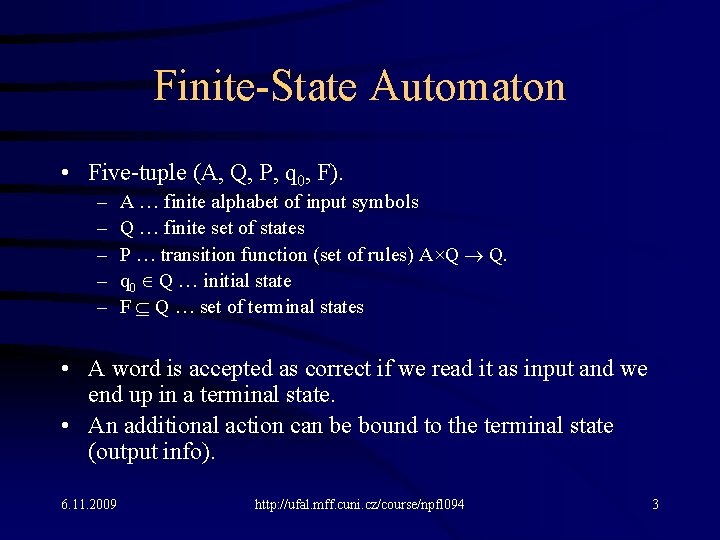
Finite-State Automaton • Five-tuple (A, Q, P, q 0, F). – – – A … finite alphabet of input symbols Q … finite set of states P … transition function (set of rules) A×Q Q. q 0 Q … initial state F Q … set of terminal states • A word is accepted as correct if we read it as input and we end up in a terminal state. • An additional action can be bound to the terminal state (output info). 6. 11. 2009 http: //ufal. mff. cuni. cz/course/npfl 094 3
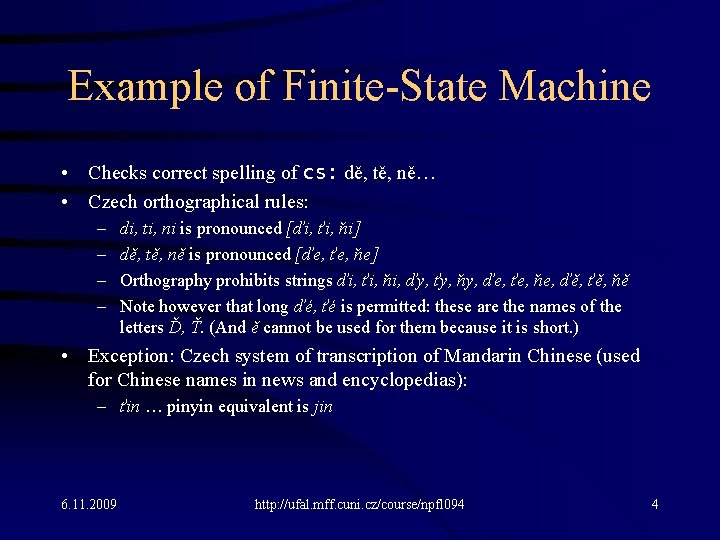
Example of Finite-State Machine • Checks correct spelling of cs: dě, tě, ně… • Czech orthographical rules: – – di, ti, ni is pronounced [ďi, ťi, ňi] dě, tě, ně is pronounced [ďe, ťe, ňe] Orthography prohibits strings ďi, ťi, ňi, ďy, ťy, ňy, ďe, ťe, ňe, ďě, ťě, ňě Note however that long ďé, ťé is permitted: these are the names of the letters Ď, Ť. (And ě cannot be used for them because it is short. ) • Exception: Czech system of transcription of Mandarin Chinese (used for Chinese names in news and encyclopedias): – ťin … pinyin equivalent is jin 6. 11. 2009 http: //ufal. mff. cuni. cz/course/npfl 094 4
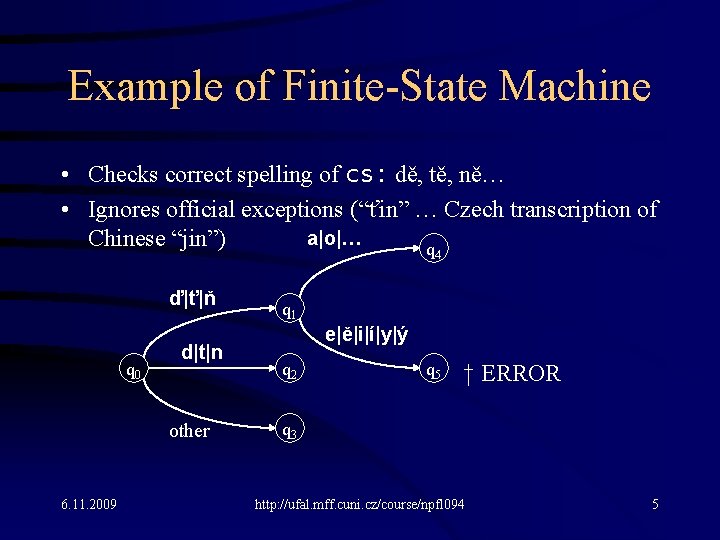
Example of Finite-State Machine • Checks correct spelling of cs: dě, tě, ně… • Ignores official exceptions (“ťin” … Czech transcription of a|o|… Chinese “jin”) q 4 ď|ť|ň q 0 d|t|n other 6. 11. 2009 q 1 e|ě|i|í|y|ý q 2 q 5 † ERROR q 3 http: //ufal. mff. cuni. cz/course/npfl 094 5
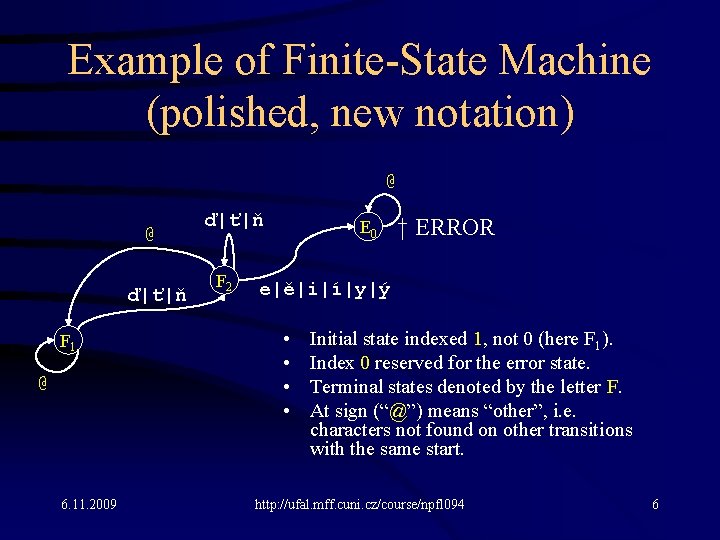
Example of Finite-State Machine (polished, new notation) @ @ ď|ť|ň F 1 @ 6. 11. 2009 ď|ť|ň F 2 E 0 † ERROR e|ě|i|í|y|ý • • Initial state indexed 1, not 0 (here F 1). Index 0 reserved for the error state. Terminal states denoted by the letter F. At sign (“@”) means “other”, i. e. characters not found on other transitions with the same start. http: //ufal. mff. cuni. cz/course/npfl 094 6
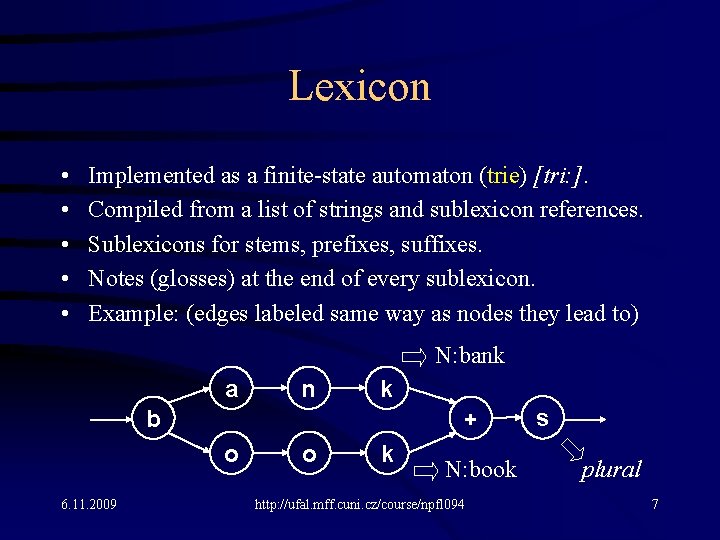
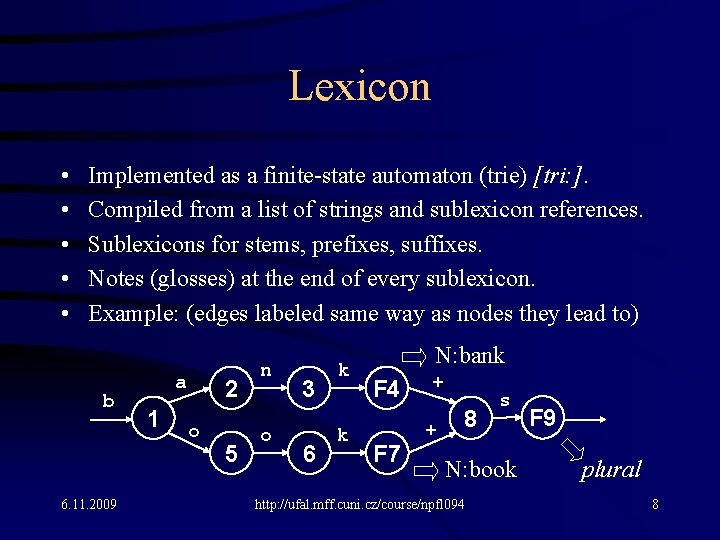
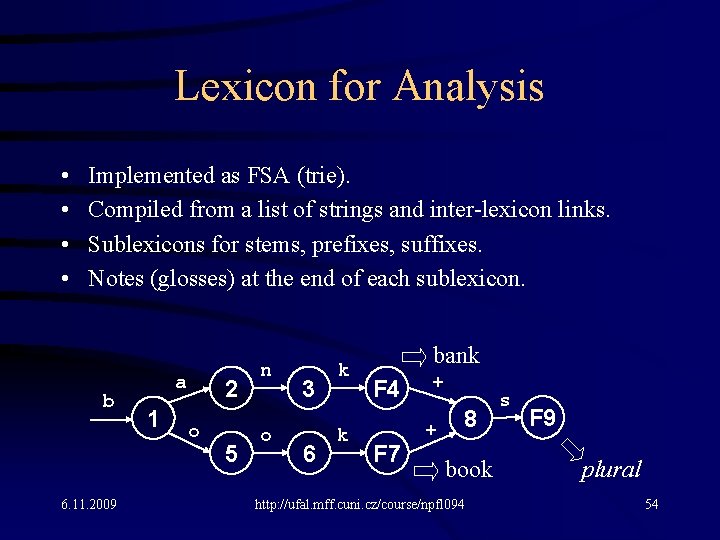
Lexicon • • • Implemented as a finite-state automaton (trie) [tri: ]. Compiled from a list of strings and sublexicon references. Sublexicons for stems, prefixes, suffixes. Notes (glosses) at the end of every sublexicon. Example: (edges labeled same way as nodes they lead to) N: bank a n k b + o 6. 11. 2009 o k N: book http: //ufal. mff. cuni. cz/course/npfl 094 s plural 7
Lexicon • • • Implemented as a finite-state automaton (trie) [tri: ]. Compiled from a list of strings and sublexicon references. Sublexicons for stems, prefixes, suffixes. Notes (glosses) at the end of every sublexicon. Example: (edges labeled same way as nodes they lead to) b 6. 11. 2009 a 1 2 o 5 n o 3 6 k k N: bank F 4 F 7 + + 8 s N: book http: //ufal. mff. cuni. cz/course/npfl 094 F 9 plural 8
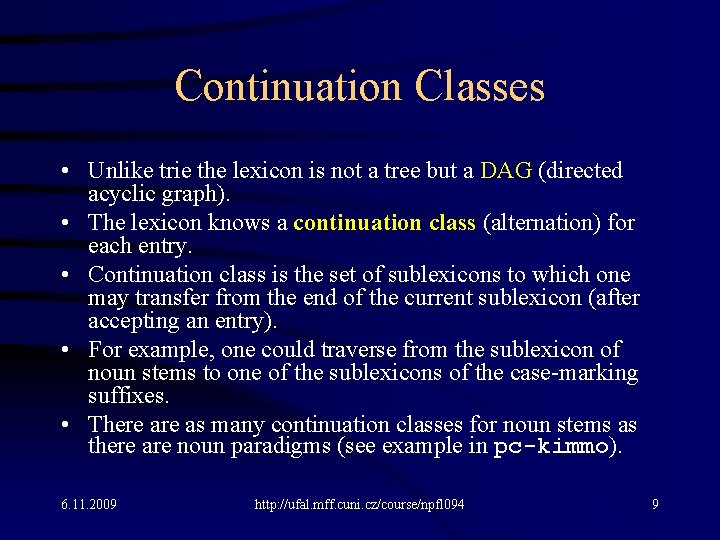
Continuation Classes • Unlike trie the lexicon is not a tree but a DAG (directed acyclic graph). • The lexicon knows a continuation class (alternation) for each entry. • Continuation class is the set of sublexicons to which one may transfer from the end of the current sublexicon (after accepting an entry). • For example, one could traverse from the sublexicon of noun stems to one of the sublexicons of the case-marking suffixes. • There as many continuation classes for noun stems as there are noun paradigms (see example in pc-kimmo). 6. 11. 2009 http: //ufal. mff. cuni. cz/course/npfl 094 9
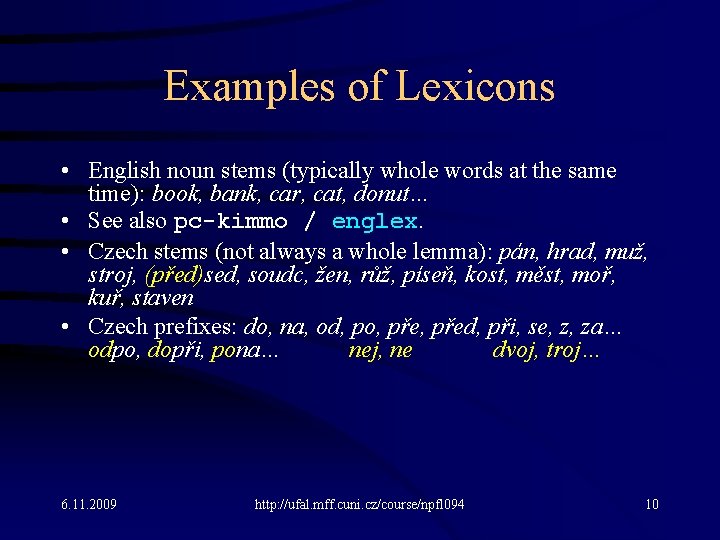
Examples of Lexicons • English noun stems (typically whole words at the same time): book, bank, car, cat, donut… • See also pc-kimmo / englex. • Czech stems (not always a whole lemma): pán, hrad, muž, stroj, (před)sed, soudc, žen, růž, píseň, kost, měst, moř, kuř, staven • Czech prefixes: do, na, od, po, před, při, se, z, za… odpo, dopři, pona… nej, ne dvoj, troj… 6. 11. 2009 http: //ufal. mff. cuni. cz/course/npfl 094 10
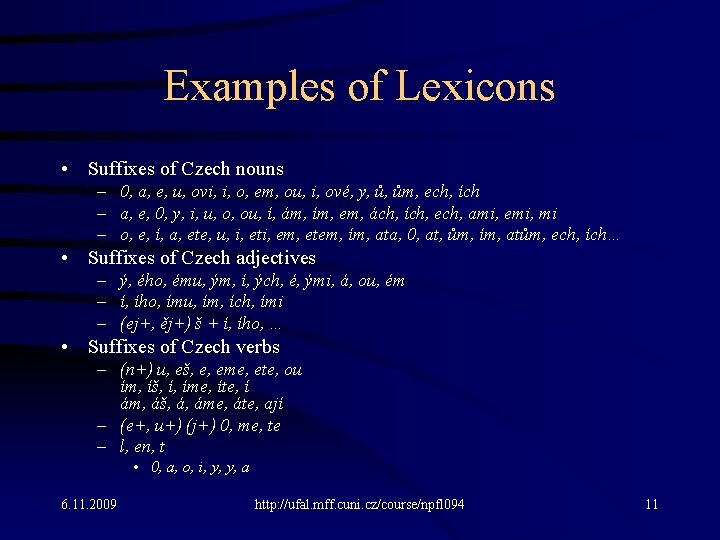
Examples of Lexicons • Suffixes of Czech nouns – 0, a, e, u, ovi, i, o, em, ou, i, ové, y, ů, ům, ech, ích – a, e, 0, y, i, u, o, ou, í, ám, ím, em, ách, ích, ech, ami, emi, mi – o, e, í, a, ete, u, i, eti, em, etem, ím, ata, 0, at, ům, ím, atům, ech, ích… • Suffixes of Czech adjectives – ý, ého, ému, ým, í, ých, é, ými, á, ou, ém – í, ího, ímu, ím, ích, ími – (ej+, ěj+) š + í, ího, … • Suffixes of Czech verbs – (n+) u, eš, e, eme, ete, ou ím, íš, í, íme, íte, í ám, áš, á, áme, áte, ají – (e+, u+) (j+) 0, me, te – l, en, t • 0, a, o, i, y, y, a 6. 11. 2009 http: //ufal. mff. cuni. cz/course/npfl 094 11
PC Kimmo Demonstration • http: //ufal. mff. cuni. cz/~zeman/vyuka/podklady/pc kimmo-cs. zip • List of Czech nouns • List of suffixes of inflection class žena • t cs • r žena • r ženy • Separate entry for each interpretation of +y so we can have different glosses 6. 11. 2009 http: //ufal. mff. cuni. cz/course/npfl 094 12
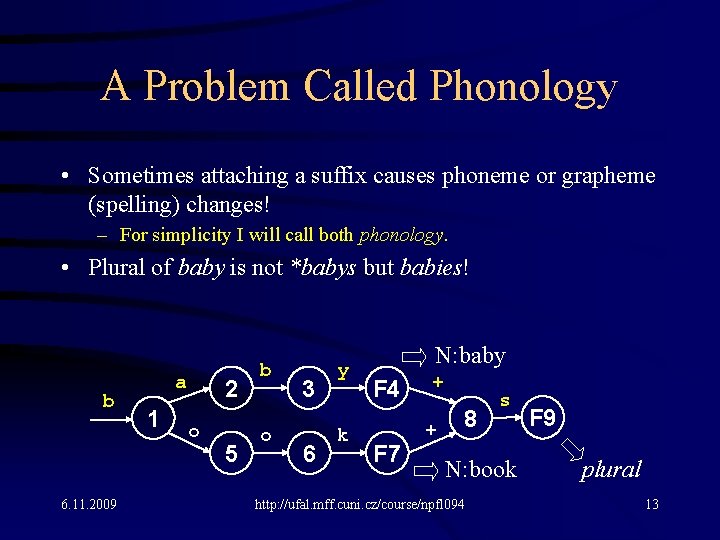
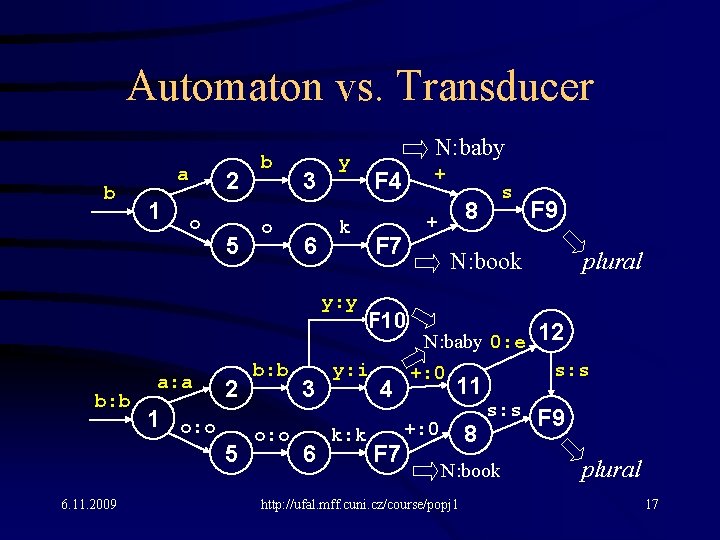
A Problem Called Phonology • Sometimes attaching a suffix causes phoneme or grapheme (spelling) changes! – For simplicity I will call both phonology. • Plural of baby is not *babys but babies! b 6. 11. 2009 a 1 2 o 5 b o 3 6 y k N: baby F 4 F 7 + + 8 s N: book http: //ufal. mff. cuni. cz/course/npfl 094 F 9 plural 13
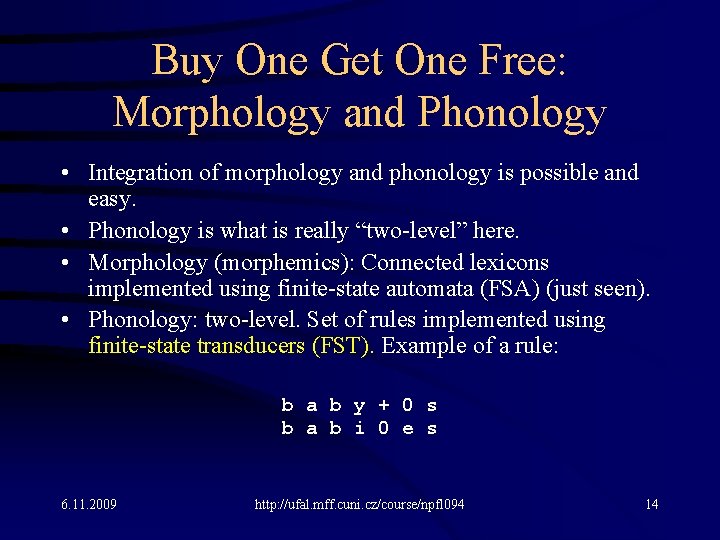
Buy One Get One Free: Morphology and Phonology • Integration of morphology and phonology is possible and easy. • Phonology is what is really “two-level” here. • Morphology (morphemics): Connected lexicons implemented using finite-state automata (FSA) (just seen). • Phonology: two-level. Set of rules implemented using finite-state transducers (FST). Example of a rule: b a b y + 0 s b a b i 0 e s 6. 11. 2009 http: //ufal. mff. cuni. cz/course/npfl 094 14
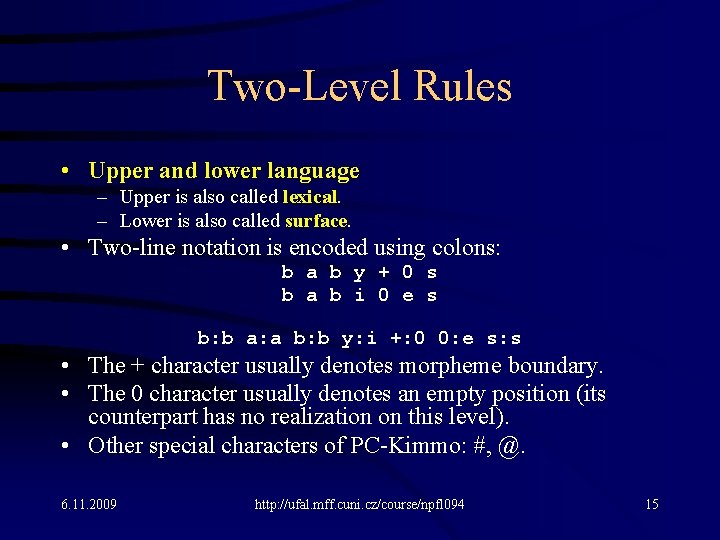
Two-Level Rules • Upper and lower language – Upper is also called lexical. – Lower is also called surface. • Two-line notation is encoded using colons: b a b y + 0 s b a b i 0 e s b: b a: a b: b y: i +: 0 0: e s: s • The + character usually denotes morpheme boundary. • The 0 character usually denotes an empty position (its counterpart has no realization on this level). • Other special characters of PC-Kimmo: #, @. 6. 11. 2009 http: //ufal. mff. cuni. cz/course/npfl 094 15
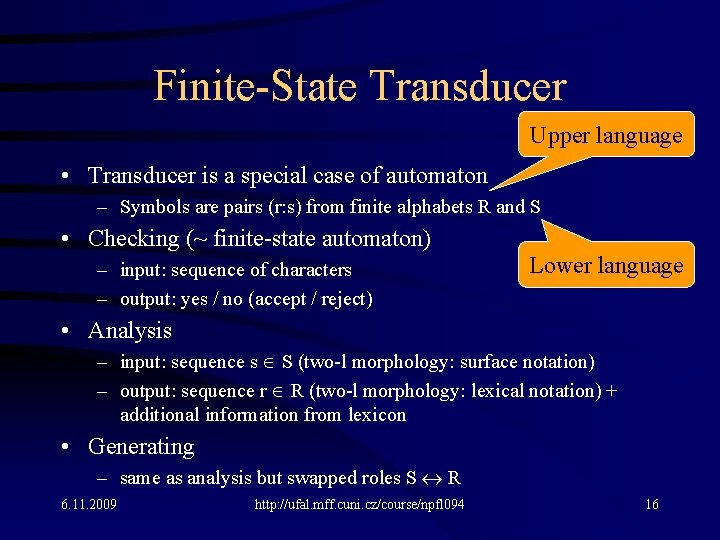
Finite-State Transducer Upper language • Transducer is a special case of automaton – Symbols are pairs (r: s) from finite alphabets R and S • Checking (~ finite-state automaton) – input: sequence of characters – output: yes / no (accept / reject) Lower language • Analysis – input: sequence s S (two-l morphology: surface notation) – output: sequence r R (two-l morphology: lexical notation) + additional information from lexicon • Generating – same as analysis but swapped roles S « R 6. 11. 2009 http: //ufal. mff. cuni. cz/course/npfl 094 16
Automaton vs. Transducer b a 1 2 o 5 b o 3 6 y b: b 2 1 o: o 5 6. 11. 2009 b: b o: o 3 6 F 7 s F 9 N: book F 10 4 8 + F 7 y: i k: k + F 4 k y: y a: a N: baby 0: e +: 0 8 s: s N: book http: //ufal. mff. cuni. cz/course/popj 1 12 s: s 11 +: 0 plural F 9 plural 17
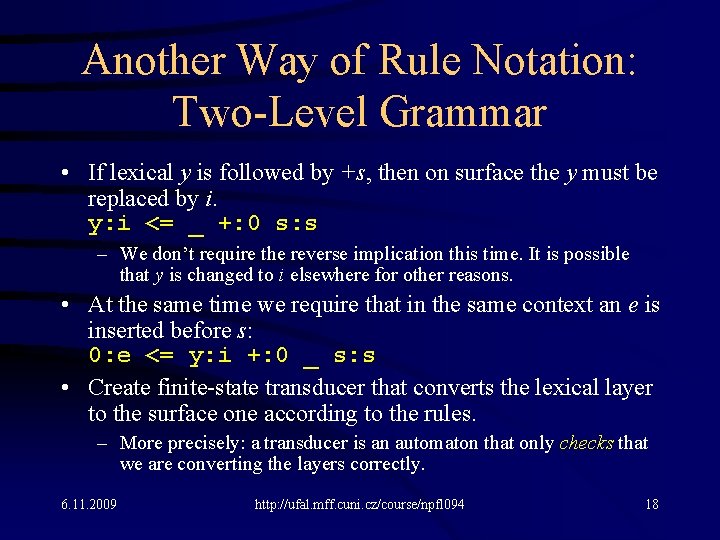
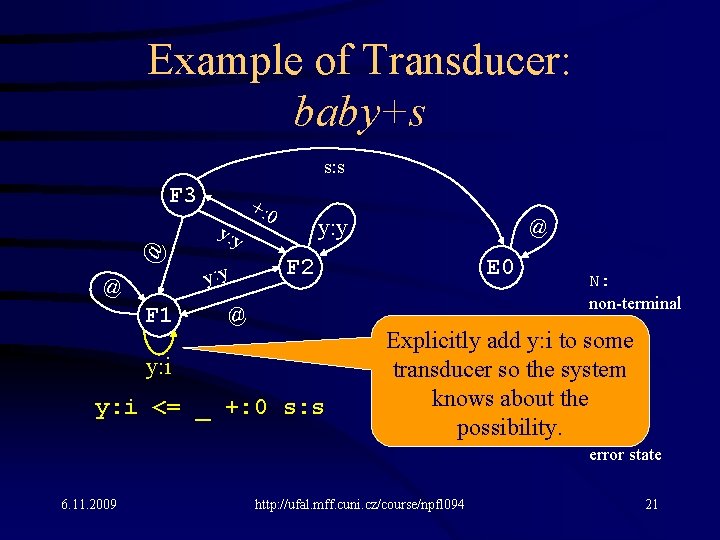
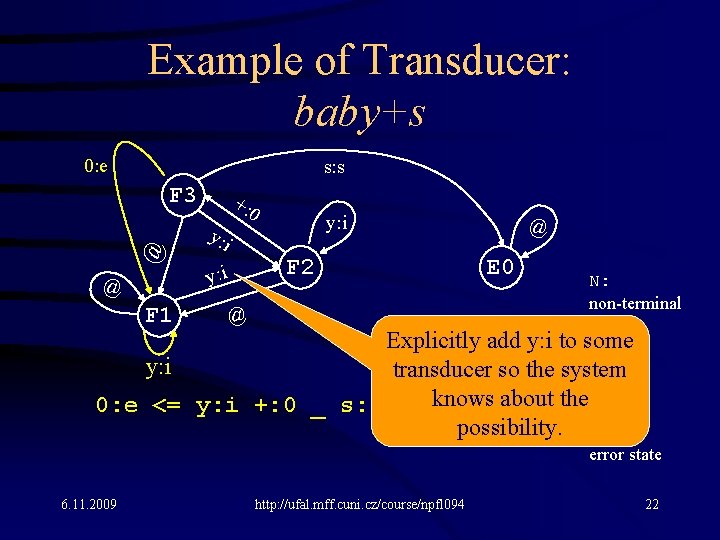
Another Way of Rule Notation: Two-Level Grammar • If lexical y is followed by +s, then on surface the y must be replaced by i. y: i <= _ +: 0 s: s – We don’t require the reverse implication this time. It is possible that y is changed to i elsewhere for other reasons. • At the same time we require that in the same context an e is inserted before s: 0: e <= y: i +: 0 _ s: s • Create finite-state transducer that converts the lexical layer to the surface one according to the rules. – More precisely: a transducer is an automaton that only checks that we are converting the layers correctly. 6. 11. 2009 http: //ufal. mff. cuni. cz/course/npfl 094 18
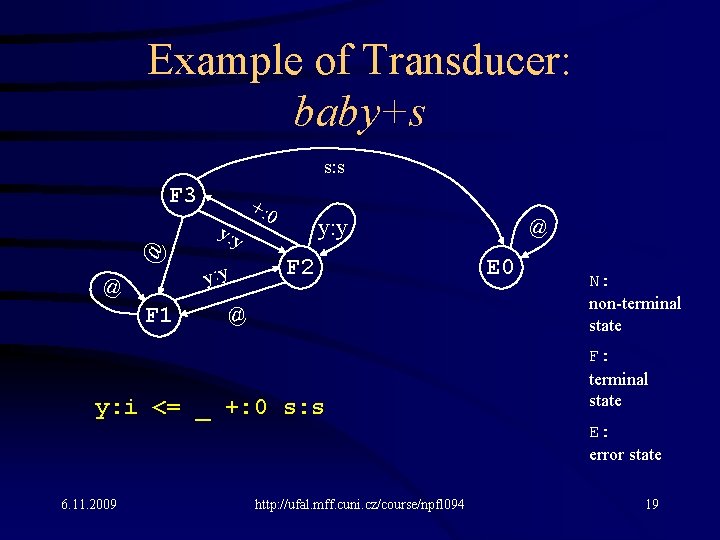
Example of Transducer: baby+s s: s @ F 3 @ F 1 y: y +: 0 y: y F 2 @ y: i <= _ +: 0 s: s @ E 0 N: non-terminal state F: terminal state E: error state 6. 11. 2009 http: //ufal. mff. cuni. cz/course/npfl 094 19
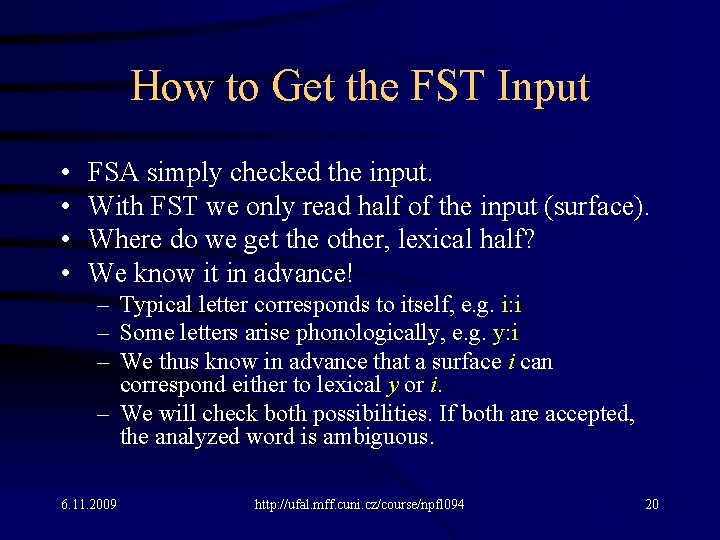
How to Get the FST Input • • FSA simply checked the input. With FST we only read half of the input (surface). Where do we get the other, lexical half? We know it in advance! – Typical letter corresponds to itself, e. g. i: i – Some letters arise phonologically, e. g. y: i – We thus know in advance that a surface i can correspond either to lexical y or i. – We will check both possibilities. If both are accepted, the analyzed word is ambiguous. 6. 11. 2009 http: //ufal. mff. cuni. cz/course/npfl 094 20
Example of Transducer: baby+s s: s @ F 3 @ F 1 y: y +: 0 y: y @ F 2 @ y: i <= _ +: 0 s: s E 0 N: non-terminal state Explicitly add y: i to some F: transducer so the system terminal knows about the state possibility. E: error state 6. 11. 2009 http: //ufal. mff. cuni. cz/course/npfl 094 21
Example of Transducer: baby+s 0: e s: s @ F 3 @ F 1 +: 0 y: i F 2 y: i @ @ E 0 N: non-terminal state Explicitly add y: i to some F: y: i transducer so the system terminal knows about the state 0: e <= y: i +: 0 _ s: s possibility. E: error state 6. 11. 2009 http: //ufal. mff. cuni. cz/course/npfl 094 22
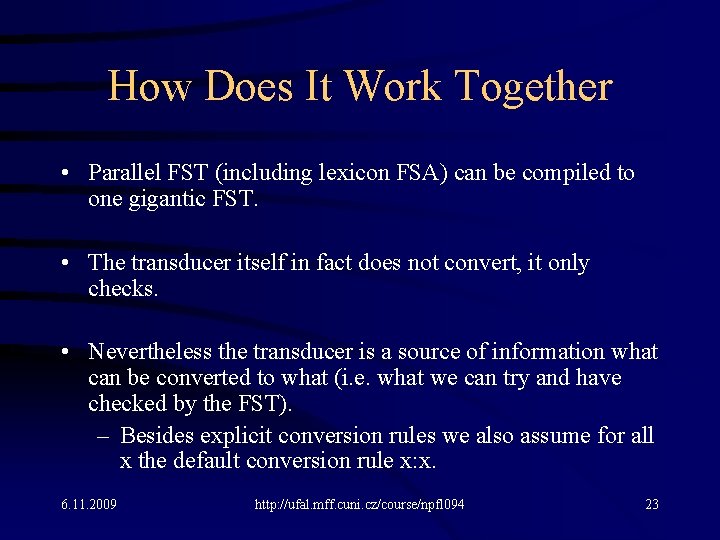
How Does It Work Together • Parallel FST (including lexicon FSA) can be compiled to one gigantic FST. • The transducer itself in fact does not convert, it only checks. • Nevertheless the transducer is a source of information what can be converted to what (i. e. what we can try and have checked by the FST). – Besides explicit conversion rules we also assume for all x the default conversion rule x: x. 6. 11. 2009 http: //ufal. mff. cuni. cz/course/npfl 094 23
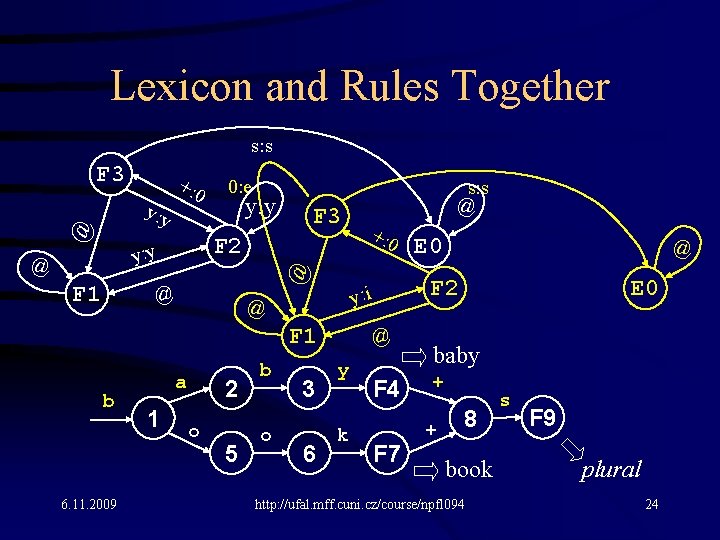
Lexicon and Rules Together s: s F 3 @ y: y +: 0 F 3 @ F 1 y: y F 2 y: y @ 0: e @ F 1 b 6. 11. 2009 a 1 2 o 5 o 3 6 +: 0 @ y k E 0 @ F 2 y: i @ b s: s @ F 4 F 7 E 0 baby + + 8 book http: //ufal. mff. cuni. cz/course/npfl 094 s F 9 plural 24
Two-Level Morphological Analysis 1. Initialize set of paths P = {}. 2. Read input (surface) symbols one-by-one. 3. For each lexical symbol x generate the pair (x: 0), i. e. , check whether it can correspond to an empty surface symbol. 4. Extend all paths in P by the new pair (x: 0). 5. Check all new extensions against the phonological transducer and the lexical automaton. Remove disallowed path prefixes (unfinished solutions). 6. 11. 2009 http: //ufal. mff. cuni. cz/course/npfl 094 25
Two-Level Morphological Analysis 6. Repeat 4– 5 until the maximum possible number of subsequent zeroes is reached. 7. Generate all possible lexical symbols (of all transducers) for the current symbol. Create pairs. 8. Extend each path in P by all such pairs. 9. Check all paths in P (the next transition in FST/FSA). Remove all impossible paths. 10. Repeat since step 3 until input finishes. 11. Discard paths in non-accepting states. 12. Collect glosses from the lexicon from all paths that survived. 6. 11. 2009 http: //ufal. mff. cuni. cz/course/npfl 094 26
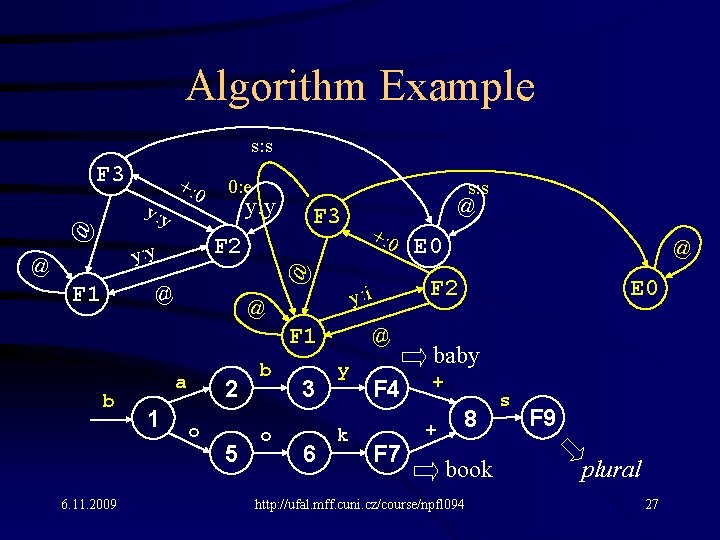
Algorithm Example s: s F 3 @ y: y +: 0 F 3 @ F 1 y: y F 2 y: y @ 0: e @ F 1 b 6. 11. 2009 a 1 2 o 5 o 3 6 +: 0 @ y k E 0 @ F 2 y: i @ b s: s @ F 4 F 7 E 0 baby + + 8 book http: //ufal. mff. cuni. cz/course/npfl 094 s F 9 plural 27
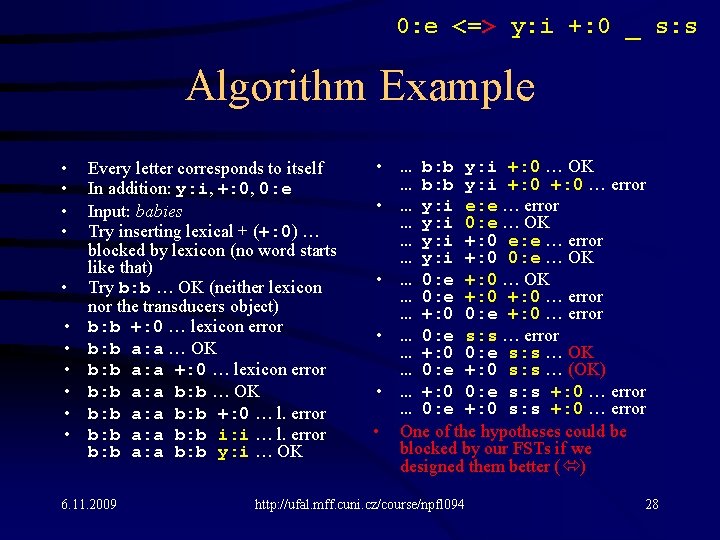
0: e <=> y: i +: 0 _ s: s Algorithm Example • • • Every letter corresponds to itself In addition: y: i, +: 0, 0: e Input: babies Try inserting lexical + (+: 0) … blocked by lexicon (no word starts like that) Try b: b … OK (neither lexicon nor the transducers object) b: b +: 0 … lexicon error b: b a: a … OK b: b a: a +: 0 … lexicon error b: b a: a b: b … OK b: b a: a b: b +: 0 … l. error b: b a: a b: b i: i … l. error b: b a: a b: b y: i … OK 6. 11. 2009 • … b: b y: i +: 0 … OK … b: b y: i +: 0 … error • … y: i e: e … error … y: i 0: e … OK … y: i +: 0 e: e … error … y: i +: 0 0: e … OK • … 0: e +: 0 … OK … 0: e +: 0 … error … +: 0 0: e +: 0 … error • … 0: e s: s … error … +: 0 0: e s: s … OK … 0: e +: 0 s: s … (OK) • … +: 0 0: e s: s +: 0 … error … 0: e +: 0 s: s +: 0 … error • One of the hypotheses could be blocked by our FSTs if we designed them better ( ) http: //ufal. mff. cuni. cz/course/npfl 094 28
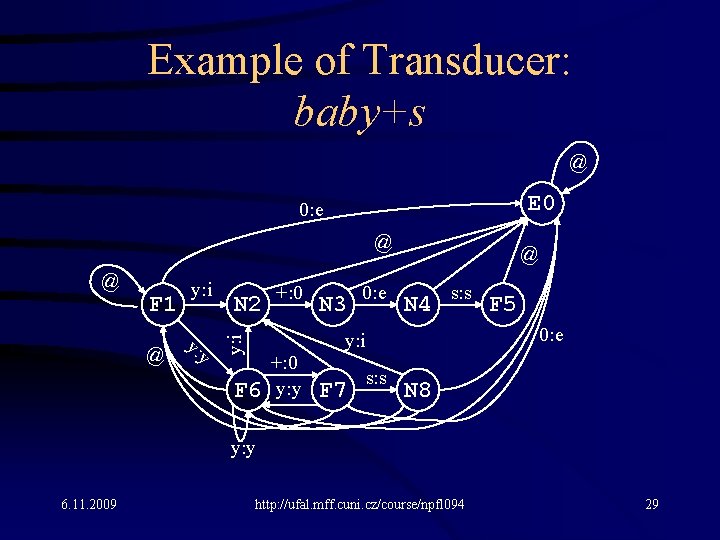
Example of Transducer: baby+s @ E 0 0: e @ F 1 @ y: i y: y N 2 +: 0 N 3 0: e N 4 s: s F 6 +: 0 y: y F 7 s: s F 5 0: e y: i @ @ N 8 y: y 6. 11. 2009 http: //ufal. mff. cuni. cz/course/npfl 094 29
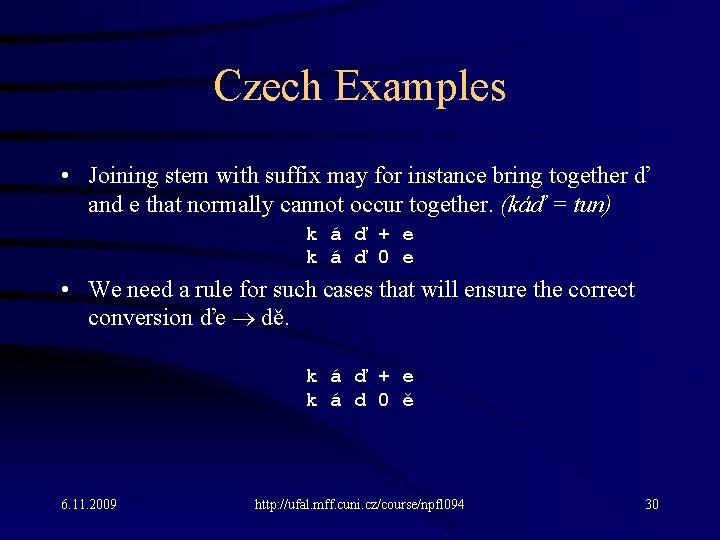
Czech Examples • Joining stem with suffix may for instance bring together ď and e that normally cannot occur together. (káď = tun) k á ď + e k á ď 0 e • We need a rule for such cases that will ensure the correct conversion ďe dě. k á ď + e k á d 0 ě 6. 11. 2009 http: //ufal. mff. cuni. cz/course/npfl 094 30
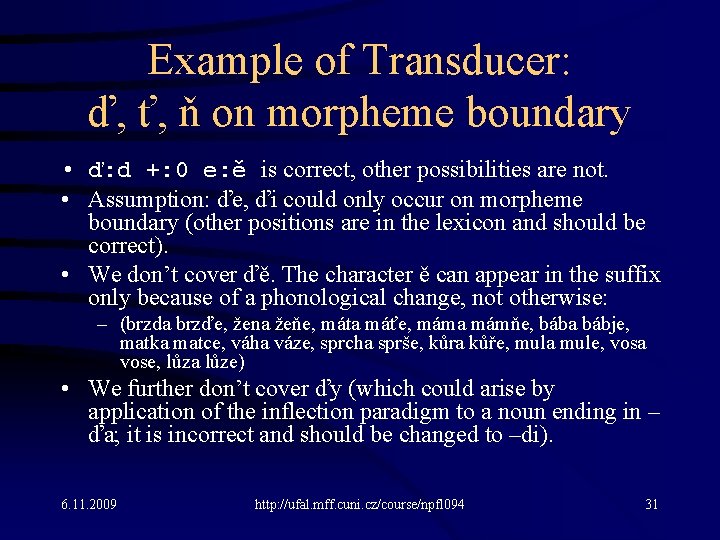
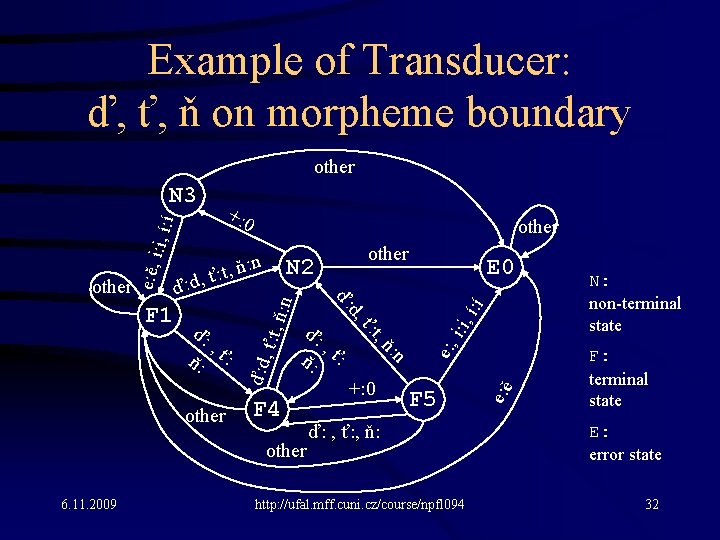
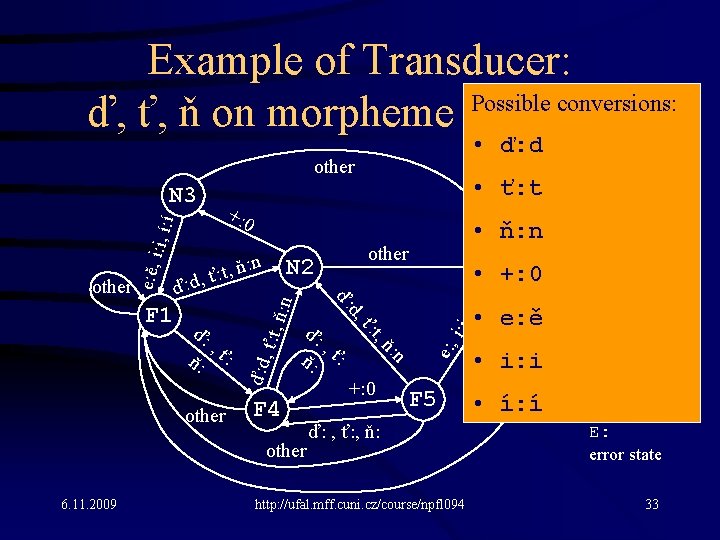
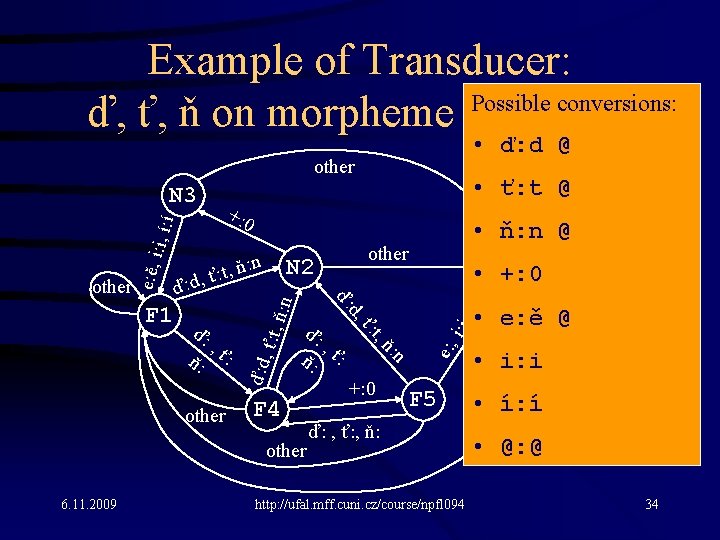
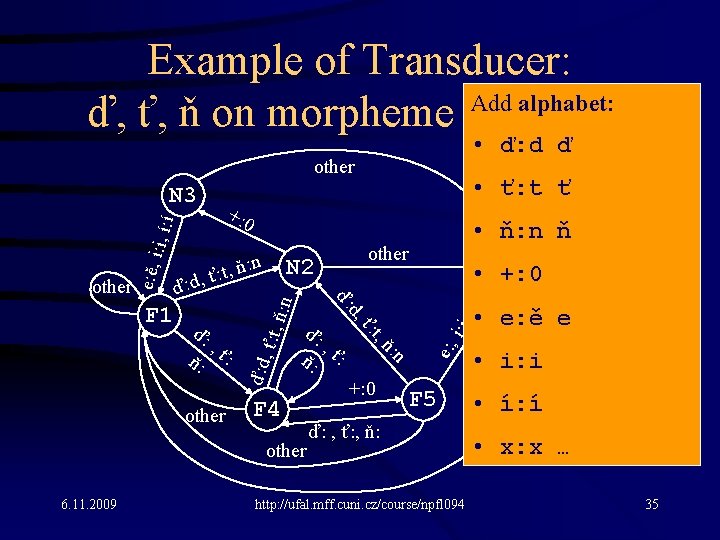
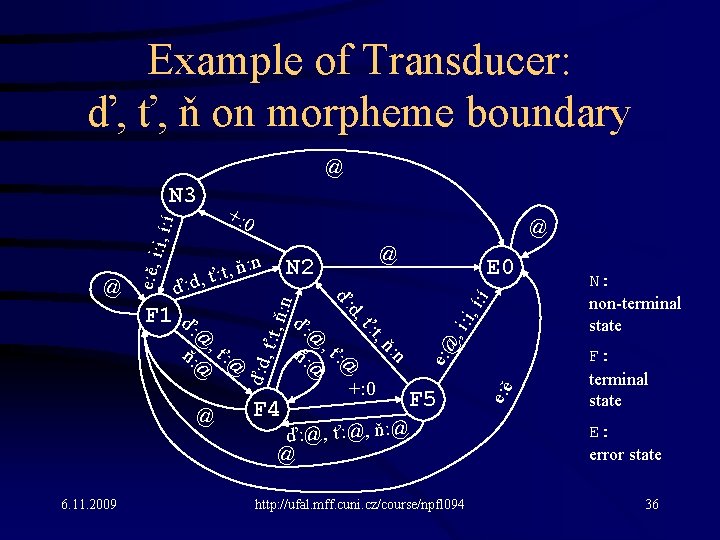
Example of Transducer: ď, ť, ň on morpheme boundary • ď: d +: 0 e: ě is correct, other possibilities are not. • Assumption: ďe, ďi could only occur on morpheme boundary (other positions are in the lexicon and should be correct). • We don’t cover ďě. The character ě can appear in the suffix only because of a phonological change, not otherwise: – (brzda brzďe, žena žeňe, máta máťe, máma mámňe, bába bábje, matka matce, váha váze, sprcha sprše, kůra kůře, mula mule, vosa vose, lůza lůze) • We further don’t cover ďy (which could arise by application of the inflection paradigm to a noun ending in – ďa; it is incorrect and should be changed to –di). 6. 11. 2009 http: //ufal. mff. cuni. cz/course/npfl 094 31
Example of Transducer: ď, ť, ň on morpheme boundary other +: 0 í , í: i: i +: 0 F 5 ď: , ť: , ň: http: //ufal. mff. cuni. cz/course/npfl 094 e: ě ď: d, ť: t, n ň: t, other F 4 ď: , ť ň: : ť: ď: , ť ň: : E 0 d, ň: n N 2 other 6. 11. 2009 other e: , ň: n , t : ť : d, ď F 1 other ď: other e: ě, i : i, í: í N 3 N: non-terminal state F: terminal state E: error state 32
Example of Transducer: Possible conversions: ď, ť, ň on morpheme boundary • ď: d other +: 0 í , í: +: 0 F 5 ď: , ť: , ň: http: //ufal. mff. cuni. cz/course/npfl 094 • i: i e: ě n ň: t, i: i ň: n ť: ď: d, ť: t, • e: ě d, other F 4 ď: , ť ň: : other 6. 11. 2009 other N 2 ď: , ť ň: : other • ň: n E 0 • +: 0 e: , ň: n , t : ť : d, ď F 1 • ť: t ď: other e: ě, i : i, í: í N 3 • í: í N: non-terminal state F: terminal state E: error state 33
Example of Transducer: Possible conversions: ď, ť, ň on morpheme boundary • ď: d @ other +: 0 í , í: +: 0 F 5 ď: , ť: , ň: http: //ufal. mff. cuni. cz/course/npfl 094 N: non-terminal state • í: í F: terminal state • @: @ E: error state • i: i e: ě n ň: t, i: i ň: n ť: ď: d, ť: t, • e: ě @ d, other F 4 ď: , ť ň: : other 6. 11. 2009 other N 2 ď: , ť ň: : other • ň: n @ E 0 • +: 0 e: , ň: n , t : ť : d, ď F 1 • ť: t @ ď: other e: ě, i : i, í: í N 3 34
Example of Transducer: Add alphabet: ď, ť, ň on morpheme boundary • ď: d ď other +: 0 í , í: +: 0 F 5 ď: , ť: , ň: http: //ufal. mff. cuni. cz/course/npfl 094 N: non-terminal state • í: í F: terminal state • x: x … E: error state • i: i e: ě n ň: t, i: i ň: n ť: ď: d, ť: t, • e: ě e d, other F 4 ď: , ť ň: : other 6. 11. 2009 other N 2 ď: , ť ň: : other • ň: n ň E 0 • +: 0 e: , ň: n , t : ť : d, ď F 1 • ť: t ť ď: other e: ě, i : i, í: í N 3 35
Example of Transducer: ď, ť, ň on morpheme boundary @ +: 0 @ : í , i: i, í F 5 ď: @, ť: @, ň: @ @ http: //ufal. mff. cuni. cz/course/npfl 094 e: ě ď: d, ť: t, n 6. 11. 2009 ň: @, ť: @ +: 0 ň: @ F 4 @ t, ň: @, ť: @ ď: ť: @ E 0 d, F 1 ď: N 2 ň: n ď @ e: @ ň: n , t : ť : d, ď: @ e: ě, i : i, í: í N 3 N: non-terminal state F: terminal state E: error state 36
Transducer Encoding in a Matrix RULE "[ď: d | ň: n | ť: t] <=> _ +: 0 [e: ě | i: i | í: í]" 5 12 ď ň ť + e i í e @ d n t @ @ @ 0 ě i í @ @ 1: 2 2 2 4 4 4 1 0 1 1 2. 0 0 0 3. 0 0 0 0 1 1 1 0 0 4: 2 2 2 4 4 4 5 1 1 1 5: 2 2 2 4 4 4 1 0 0 1 6. 11. 2009 http: //ufal. mff. cuni. cz/course/npfl 094 37
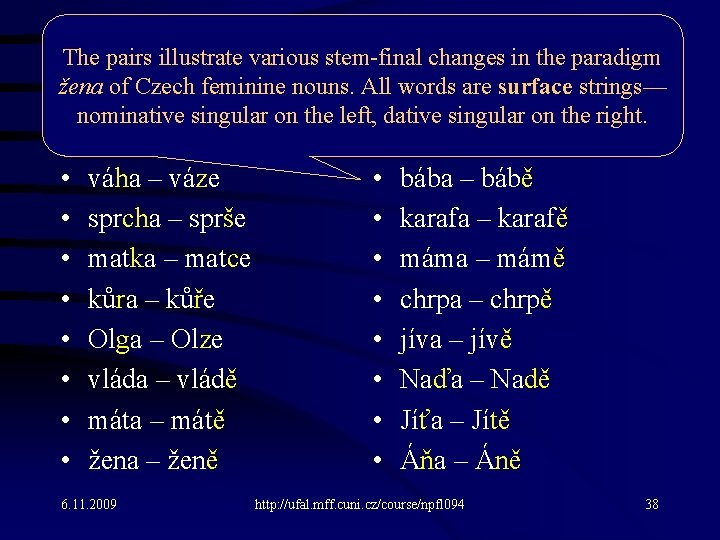
The pairs illustrate various stem-final changes in the paradigm žena of Czech feminine nouns. All words are surface strings— nominative singular on the left, dative singular on the right. Palatalization váha – váze • • váha – váze sprcha – sprše matka – matce kůra – kůře Olga – Olze vláda – vládě máta – mátě žena – ženě 6. 11. 2009 • • bába – bábě karafa – karafě máma – mámě chrpa – chrpě jíva – jívě Naďa – Nadě Jíťa – Jítě Áňa – Áně http: //ufal. mff. cuni. cz/course/npfl 094 38
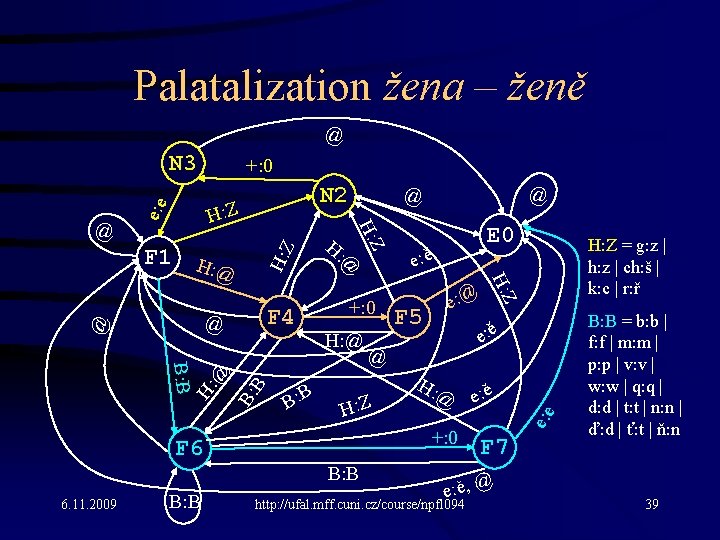
Palatalization žena – ženě @ N 3 N 2 F 4 B B: H: B: B @ @ @ B: B @ +: 0 H: @ F 5 e: @ H: Z = g: z | h: z | ch: š | k: c | r: ř e: ě H: @ +: 0 B: B e: ě @ H: Z F 6 6. 11. 2009 E 0 H: Z F 1 H: @ H: e: ě e: e H: Z @ @ H: Z @ +: 0 F 7 e: ě, @ http: //ufal. mff. cuni. cz/course/npfl 094 B: B = b: b | f: f | m: m | p: p | v: v | w: w | q: q | d: d | t: t | n: n | ď: d | ť: t | ň: n 39
PC Kimmo Demonstration • r ženě matce Bláže Nadě… • Separate paradigms žena and růže using continuation classes • r Nadi • g Naď+y 6. 11. 2009 http: //ufal. mff. cuni. cz/course/npfl 094 40
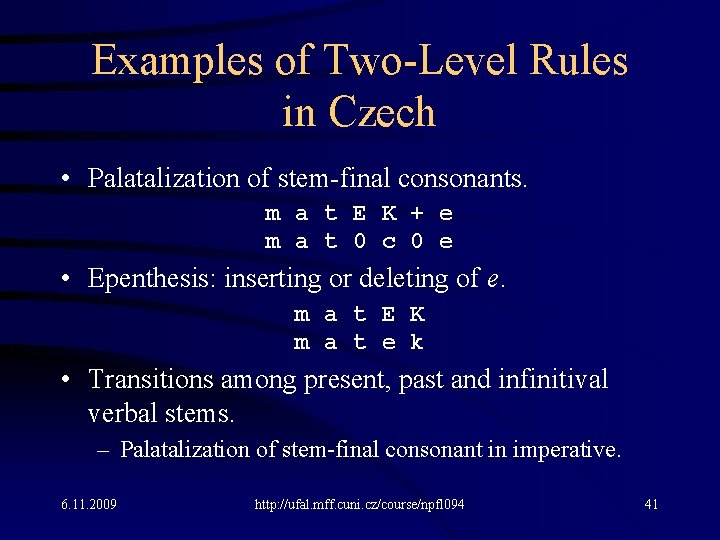
Examples of Two-Level Rules in Czech • Palatalization of stem-final consonants. m a t E K + e m a t 0 c 0 e • Epenthesis: inserting or deleting of e. m a t E K m a t e k • Transitions among present, past and infinitival verbal stems. – Palatalization of stem-final consonant in imperative. 6. 11. 2009 http: //ufal. mff. cuni. cz/course/npfl 094 41
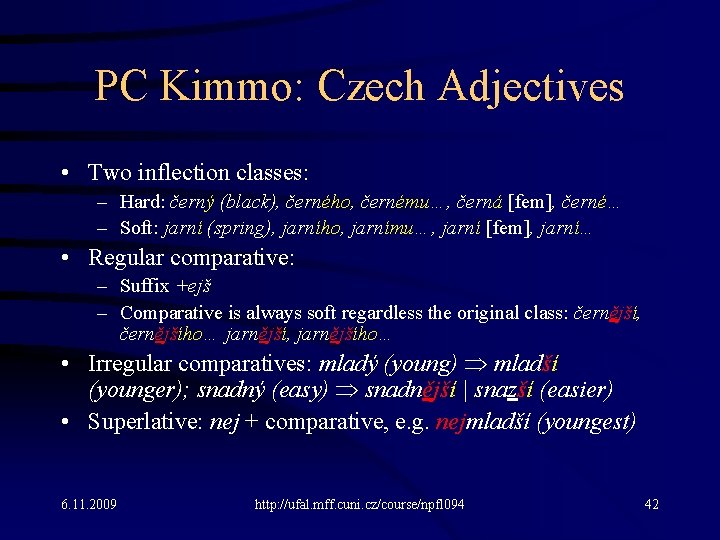
PC Kimmo: Czech Adjectives • Two inflection classes: – Hard: černý (black), černého, černému…, černá [fem], černé… – Soft: jarní (spring), jarního, jarnímu…, jarní [fem], jarní… • Regular comparative: – Suffix +ejš – Comparative is always soft regardless the original class: černější, černějšího… jarnější, jarnějšího… • Irregular comparatives: mladý (young) mladší (younger); snadný (easy) snadnější | snazší (easier) • Superlative: nej + comparative, e. g. nejmladší (youngest) 6. 11. 2009 http: //ufal. mff. cuni. cz/course/npfl 094 42
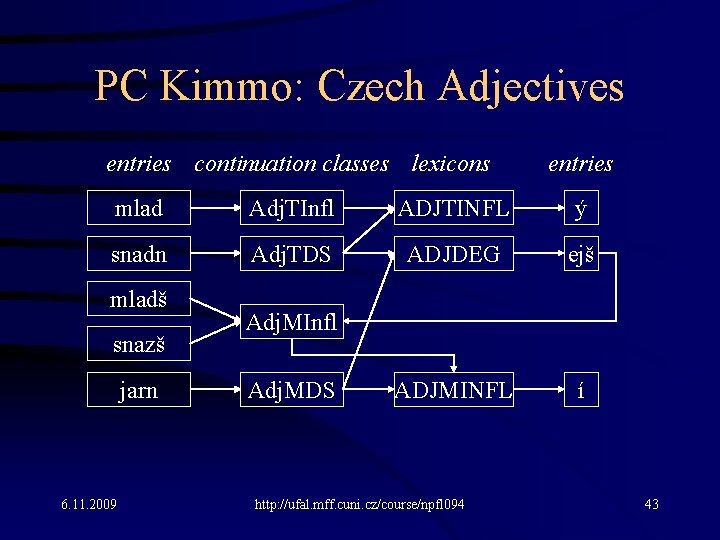
PC Kimmo: Czech Adjectives entries continuation classes lexicons entries mlad Adj. TInfl ADJTINFL ý snadn Adj. TDS ADJDEG ejš ADJMINFL í mladš snazš jarn 6. 11. 2009 Adj. MInfl Adj. MDS http: //ufal. mff. cuni. cz/course/npfl 094 43
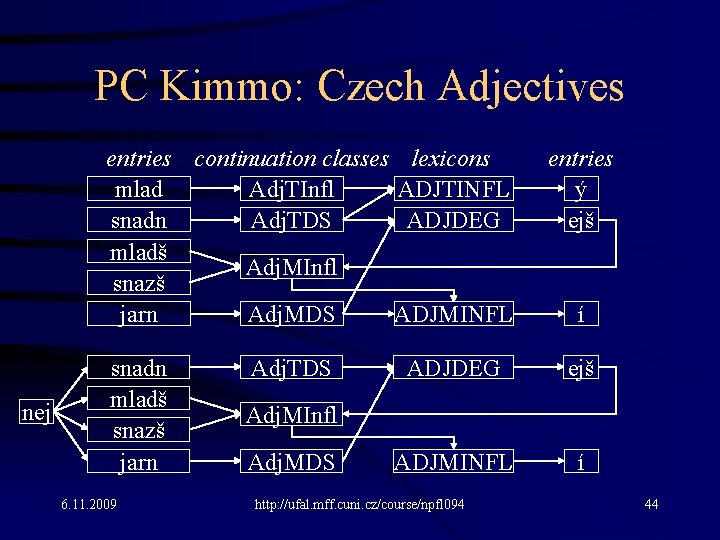
PC Kimmo: Czech Adjectives entries continuation classes lexicons mlad Adj. TInfl ADJTINFL snadn Adj. TDS ADJDEG mladš Adj. MInfl snazš jarn Adj. MDS ADJMINFL nej snadn mladš snazš jarn 6. 11. 2009 Adj. TDS entries ý ejš í ADJDEG ejš ADJMINFL í Adj. MInfl Adj. MDS http: //ufal. mff. cuni. cz/course/npfl 094 44
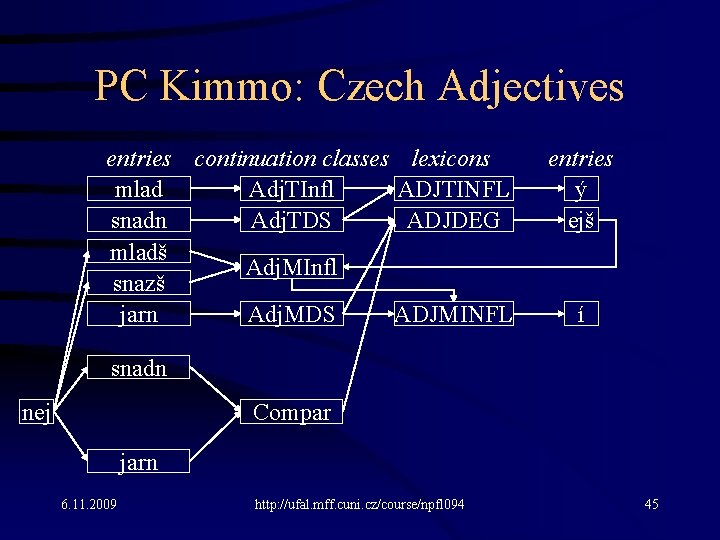
PC Kimmo: Czech Adjectives entries continuation classes lexicons mlad Adj. TInfl ADJTINFL snadn Adj. TDS ADJDEG mladš Adj. MInfl snazš jarn Adj. MDS ADJMINFL entries ý ejš í snadn nej Compar jarn 6. 11. 2009 http: //ufal. mff. cuni. cz/course/npfl 094 45
Long-Distance Dependencies • Disadvantage of finite-state morphology: – Capturing of long-distance dependencies is clumsy! 6. 11. 2009 http: //ufal. mff. cuni. cz/course/npfl 094 46
PC Kimmo Demonstration • Adjectives: irregular comparison • r mladý mladší *mladější • r snadný snazší snadnější • r jarní jarnější • Palatalization works here, too: jarn + ejš + í = jarnější • r nejmladší *nejmladý 6. 11. 2009 http: //ufal. mff. cuni. cz/course/npfl 094 47
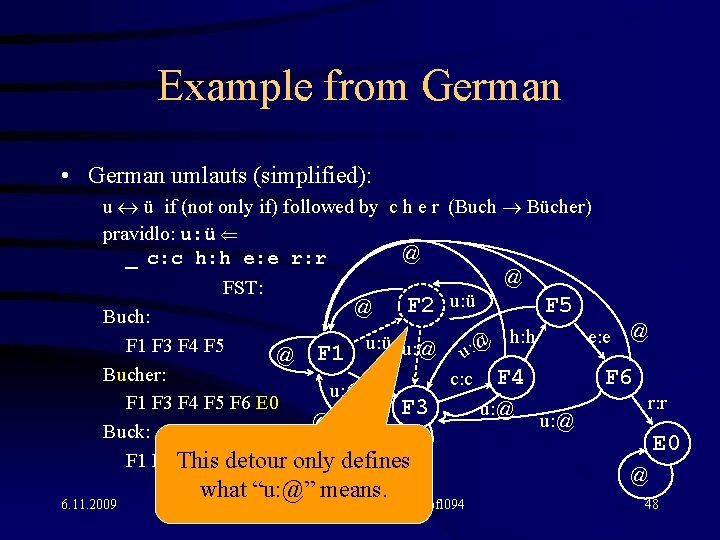
Example from German • German umlauts (simplified): u « ü if (not only if) followed by c h e r (Buch Bücher) pravidlo: u: ü Ü @ _ c: c h: h e: e r: r @ FST: u: ü F 2 F 5 @ Buch: h: h e: e @ u: ü u: @ @ F 1 F 3 F 4 F 5 u: @ F 1 Bucher: F 6 c: c F 4 u: @ F 1 F 3 F 4 F 5 F 6 E 0 r: r F 3 u: @ @ u: @ Buck: E 0 F 1 F 3 F 4 F 1 This detour only defines u: @ @ 6. 11. 2009 what “u: @” means. http: //ufal. mff. cuni. cz/course/npfl 094 48
Example from German • Buch / Bücher, Dach / Dächer, Loch / Löcher • Context should also contain +: 0 and perhaps test end of word (#) – Otherwise Sucherei (searching) will be considered wrong! – Not only must we recognize that there is a suffix. It must be a plural suffix and the stem must be marked for plural umlauting. – Counterexamples: • Kocher (cooker), here the er suffix only derives from the verb kochen (to cook). Kocher is identical in singular and plural! We don’t want to confuse it with Köcher (quiver), nor to consider umlaut-less Kocher an error! • Besucher (visitor), derived from Besuch (visit), same singular and plural, there is no *Besücher! • Capturing long-distance dependencies is clumsy. – E. g. Kraut / Kräuter has different intervening symbols so it looks like a different rule. – A transducer could be more general and allow anything until +er but would it overgenerate? 6. 11. 2009 http: //ufal. mff. cuni. cz/course/npfl 094 49
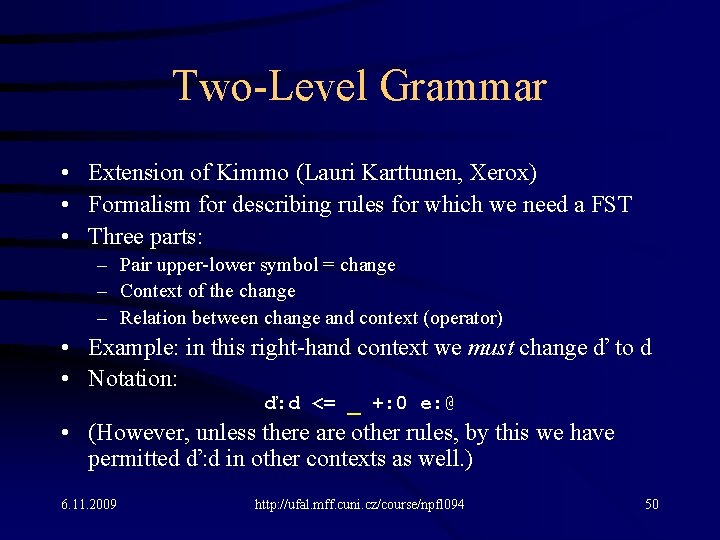
Two-Level Grammar • Extension of Kimmo (Lauri Karttunen, Xerox) • Formalism for describing rules for which we need a FST • Three parts: – Pair upper-lower symbol = change – Context of the change – Relation between change and context (operator) • Example: in this right-hand context we must change ď to d • Notation: ď: d <= _ +: 0 e: @ • (However, unless there are other rules, by this we have permitted ď: d in other contexts as well. ) 6. 11. 2009 http: //ufal. mff. cuni. cz/course/npfl 094 50
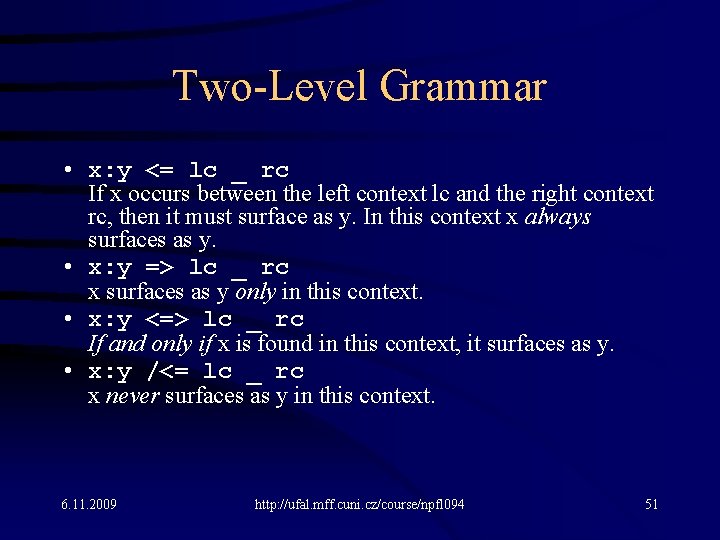
Two-Level Grammar • x: y <= lc _ rc If x occurs between the left context lc and the right context rc, then it must surface as y. In this context x always surfaces as y. • x: y => lc _ rc x surfaces as y only in this context. • x: y <=> lc _ rc If and only if x is found in this context, it surfaces as y. • x: y /<= lc _ rc x never surfaces as y in this context. 6. 11. 2009 http: //ufal. mff. cuni. cz/course/npfl 094 51
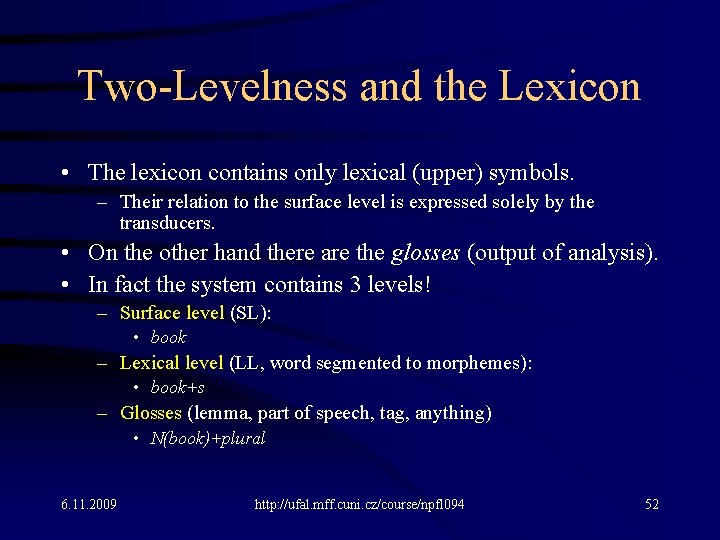
Two-Levelness and the Lexicon • The lexicon contains only lexical (upper) symbols. – Their relation to the surface level is expressed solely by the transducers. • On the other hand there are the glosses (output of analysis). • In fact the system contains 3 levels! – Surface level (SL): • book – Lexical level (LL, word segmented to morphemes): • book+s – Glosses (lemma, part of speech, tag, anything) • N(book)+plural 6. 11. 2009 http: //ufal. mff. cuni. cz/course/npfl 094 52
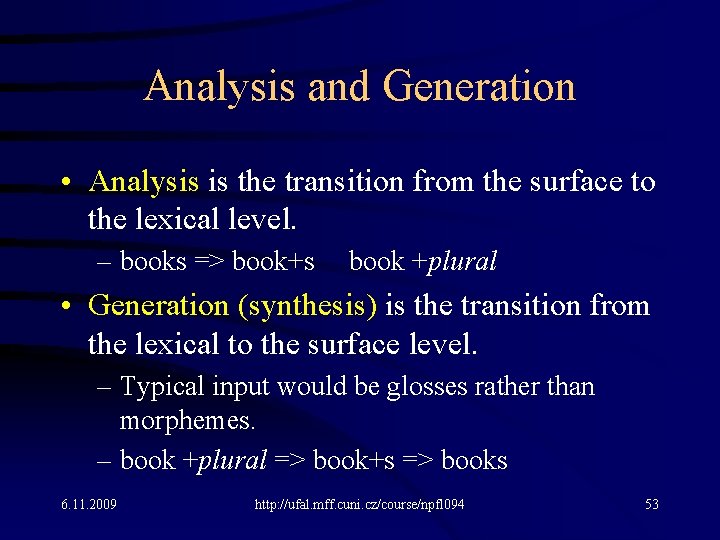
Analysis and Generation • Analysis is the transition from the surface to the lexical level. – books => book+s book +plural • Generation (synthesis) is the transition from the lexical to the surface level. – Typical input would be glosses rather than morphemes. – book +plural => book+s => books 6. 11. 2009 http: //ufal. mff. cuni. cz/course/npfl 094 53
Lexicon for Analysis • • Implemented as FSA (trie). Compiled from a list of strings and inter-lexicon links. Sublexicons for stems, prefixes, suffixes. Notes (glosses) at the end of each sublexicon. b 6. 11. 2009 a 1 2 o 5 n o 3 6 k k bank F 4 F 7 + + 8 book http: //ufal. mff. cuni. cz/course/npfl 094 s F 9 plural 54
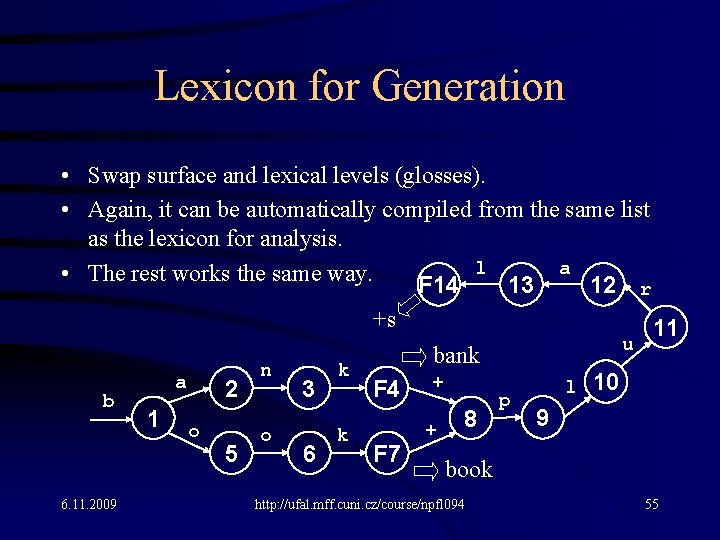
Lexicon for Generation • Swap surface and lexical levels (glosses). • Again, it can be automatically compiled from the same list as the lexicon for analysis. l a • The rest works the same way. F 14 13 12 r +s 11 u bank n k a + l 10 2 3 F 4 p b 9 1 o 8 + o k 5 6 F 7 book 6. 11. 2009 http: //ufal. mff. cuni. cz/course/npfl 094 55
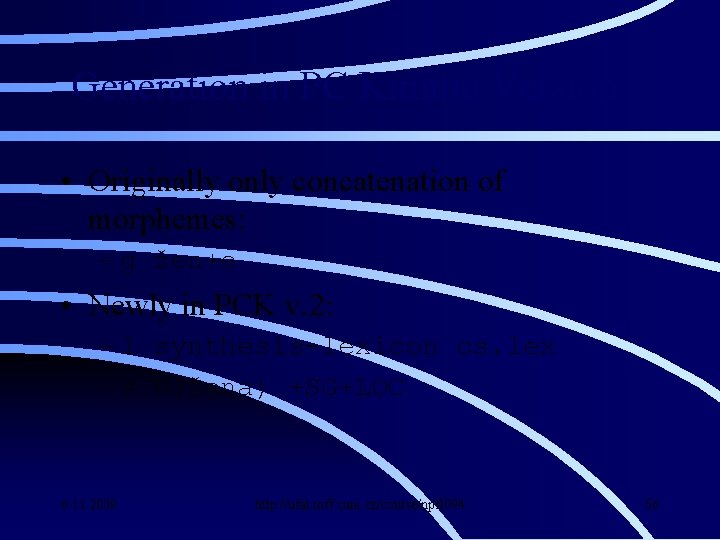
Generation in PC Kimmo Version 2 • Originally only concatenation of morphemes: – g žen+e • Newly in PCK v. 2: – l synthesis-lexicon cs. lex – s N(žena) +SG+LOC 6. 11. 2009 http: //ufal. mff. cuni. cz/course/npfl 094 56
Morphological and Syntactic Analysis Multi-Level Finite State Rules Daniel Zeman http: //ufal. mff. cuni. cz/~zeman/
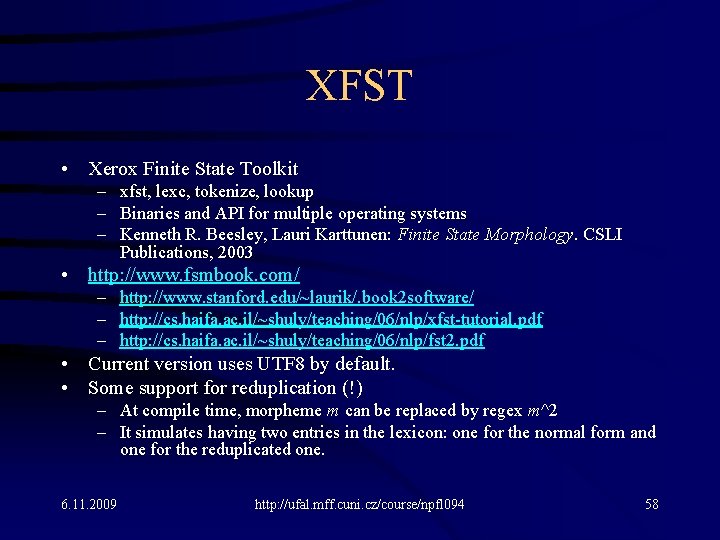
XFST • Xerox Finite State Toolkit – xfst, lexc, tokenize, lookup – Binaries and API for multiple operating systems – Kenneth R. Beesley, Lauri Karttunen: Finite State Morphology. CSLI Publications, 2003 • http: //www. fsmbook. com/ – http: //www. stanford. edu/~laurik/. book 2 software/ – http: //cs. haifa. ac. il/~shuly/teaching/06/nlp/xfst-tutorial. pdf – http: //cs. haifa. ac. il/~shuly/teaching/06/nlp/fst 2. pdf • Current version uses UTF 8 by default. • Some support for reduplication (!) – At compile time, morpheme m can be replaced by regex m^2 – It simulates having two entries in the lexicon: one for the normal form and one for the reduplicated one. 6. 11. 2009 http: //ufal. mff. cuni. cz/course/npfl 094 58
HFST (Helsinki) • Helsinki Finite-State Transducer Technology – http: //www. ling. helsinki. fi/kieliteknologia/tutki mus/hfst/ – Licensed under GNU LGPL 3. 0 – Finnish lexicon and rules available 6. 11. 2009 http: //ufal. mff. cuni. cz/course/npfl 094 59
Foma • Open-source finite-state toolkit – In contrast, xfst comes without sources and with some copyright restrictions • Claims compatibility with Xerox tools – But also supports Perl-style regular expressions • Now integrated in Apertium (open-source rulebased machine translation framework) • Home: https: //code. google. com/p/foma/ – Publication: http: //www. aclweb. org/anthologynew/E/E 09 -2008. pdf 6. 11. 2009 http: //ufal. mff. cuni. cz/course/npfl 094 60
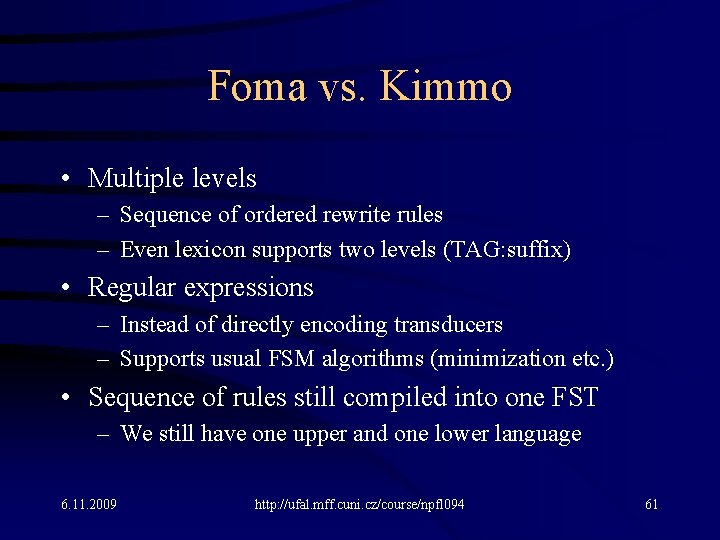
Foma vs. Kimmo • Multiple levels – Sequence of ordered rewrite rules – Even lexicon supports two levels (TAG: suffix) • Regular expressions – Instead of directly encoding transducers – Supports usual FSM algorithms (minimization etc. ) • Sequence of rules still compiled into one FST – We still have one upper and one lower language 6. 11. 2009 http: //ufal. mff. cuni. cz/course/npfl 094 61
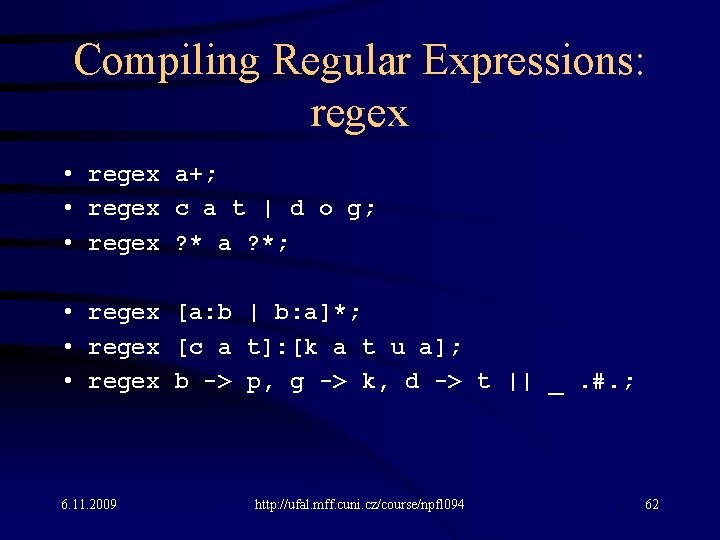
Compiling Regular Expressions: regex • regex a+; • regex c a t | d o g; • regex ? * a ? *; • regex [a: b | b: a]*; • regex [c a t]: [k a t u a]; • regex b -> p, g -> k, d -> t || _. #. ; 6. 11. 2009 http: //ufal. mff. cuni. cz/course/npfl 094 62
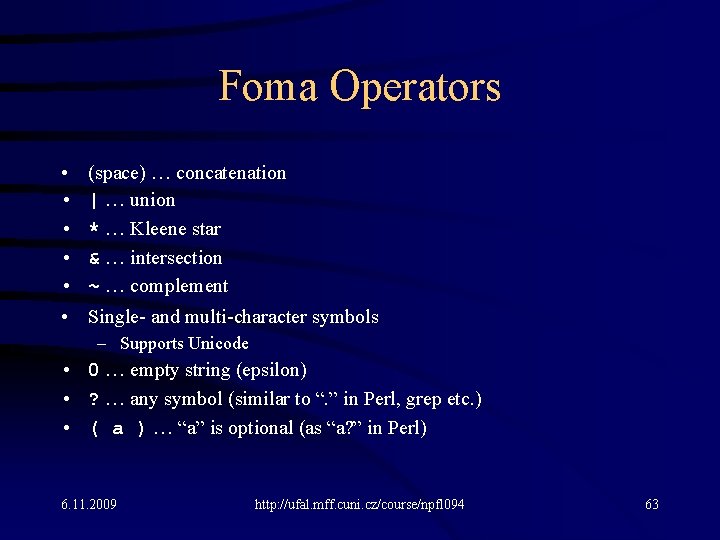
Foma Operators • • • (space) … concatenation | … union * … Kleene star & … intersection ~ … complement Single- and multi-character symbols – Supports Unicode • 0 … empty string (epsilon) • ? … any symbol (similar to “. ” in Perl, grep etc. ) • ( a ) … “a” is optional (as “a? ” in Perl) 6. 11. 2009 http: //ufal. mff. cuni. cz/course/npfl 094 63
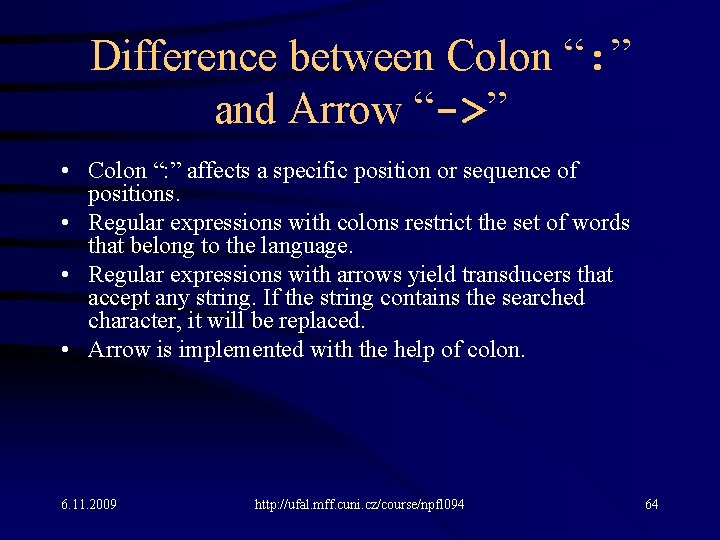
Difference between Colon “: ” and Arrow “->” • Colon “: ” affects a specific position or sequence of positions. • Regular expressions with colons restrict the set of words that belong to the language. • Regular expressions with arrows yield transducers that accept any string. If the string contains the searched character, it will be replaced. • Arrow is implemented with the help of colon. 6. 11. 2009 http: //ufal. mff. cuni. cz/course/npfl 094 64
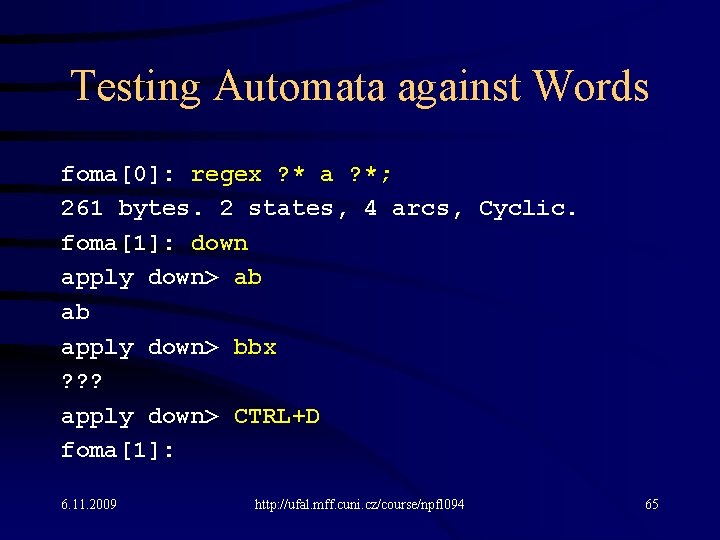
Testing Automata against Words foma[0]: regex ? * a ? *; 261 bytes. 2 states, 4 arcs, Cyclic. foma[1]: down apply down> ab ab apply down> bbx ? ? ? apply down> CTRL+D foma[1]: 6. 11. 2009 http: //ufal. mff. cuni. cz/course/npfl 094 65
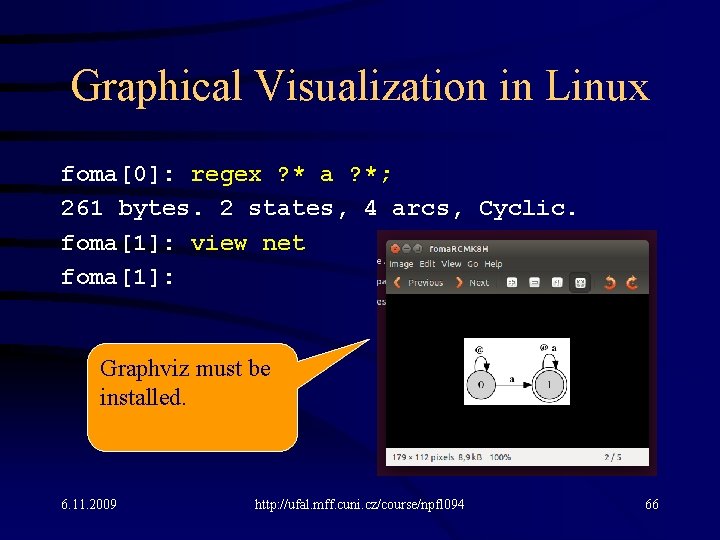
Graphical Visualization in Linux foma[0]: regex ? * a ? *; 261 bytes. 2 states, 4 arcs, Cyclic. foma[1]: view net foma[1]: Graphviz must be installed. 6. 11. 2009 http: //ufal. mff. cuni. cz/course/npfl 094 66
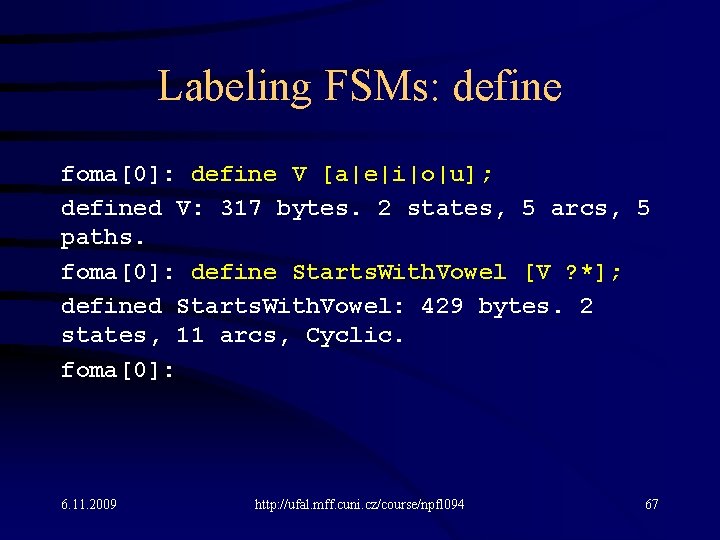
Labeling FSMs: define foma[0]: define V [a|e|i|o|u]; defined V: 317 bytes. 2 states, 5 arcs, 5 paths. foma[0]: define Starts. With. Vowel [V ? *]; defined Starts. With. Vowel: 429 bytes. 2 states, 11 arcs, Cyclic. foma[0]: 6. 11. 2009 http: //ufal. mff. cuni. cz/course/npfl 094 67
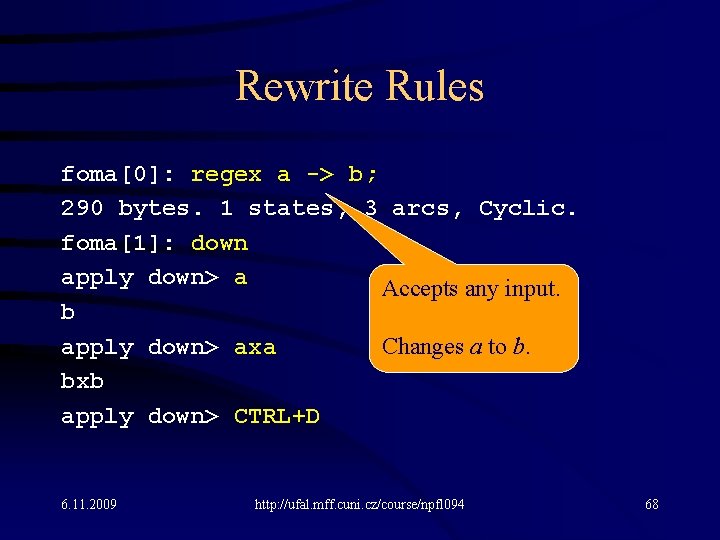
Rewrite Rules foma[0]: regex a -> b; 290 bytes. 1 states, 3 arcs, Cyclic. foma[1]: down apply down> a Accepts any input. b apply down> axa Changes a to b. bxb apply down> CTRL+D 6. 11. 2009 http: //ufal. mff. cuni. cz/course/npfl 094 68
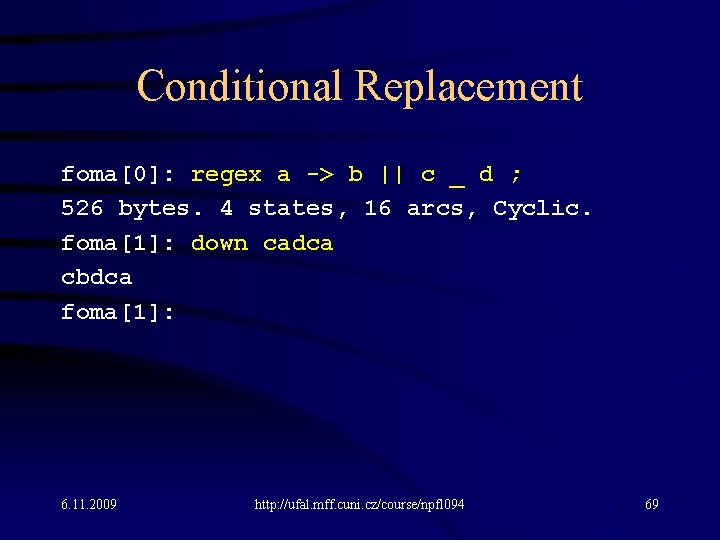
Conditional Replacement foma[0]: regex a -> b || c _ d ; 526 bytes. 4 states, 16 arcs, Cyclic. foma[1]: down cadca cbdca foma[1]: 6. 11. 2009 http: //ufal. mff. cuni. cz/course/npfl 094 69
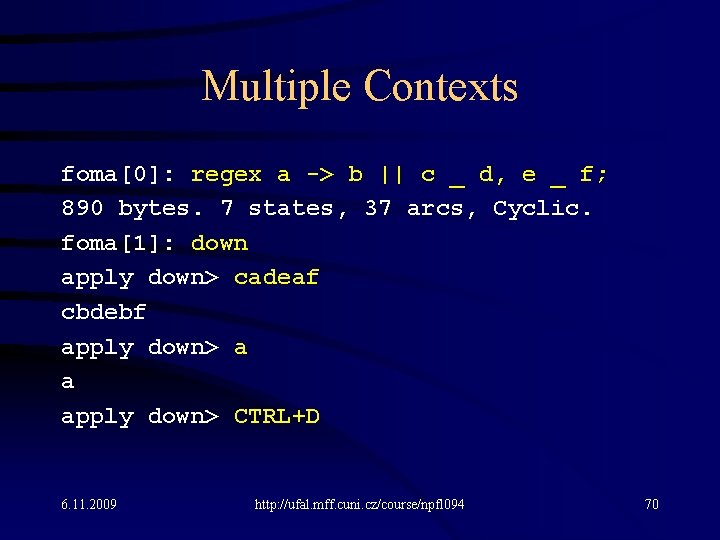
Multiple Contexts foma[0]: regex a -> b || c _ d, e _ f; 890 bytes. 7 states, 37 arcs, Cyclic. foma[1]: down apply down> cadeaf cbdebf apply down> a a apply down> CTRL+D 6. 11. 2009 http: //ufal. mff. cuni. cz/course/npfl 094 70
Parallel Rules End-of-Word Symbol foma[0]: regex b -> p, g -> k, d -> t || _. #. ; 634 bytes. 3 states, 20 arcs, Cyclic. foma[1]: down apply down> cab cap apply down> dog dok apply down> dad dat 6. 11. 2009 http: //ufal. mff. cuni. cz/course/npfl 094 71
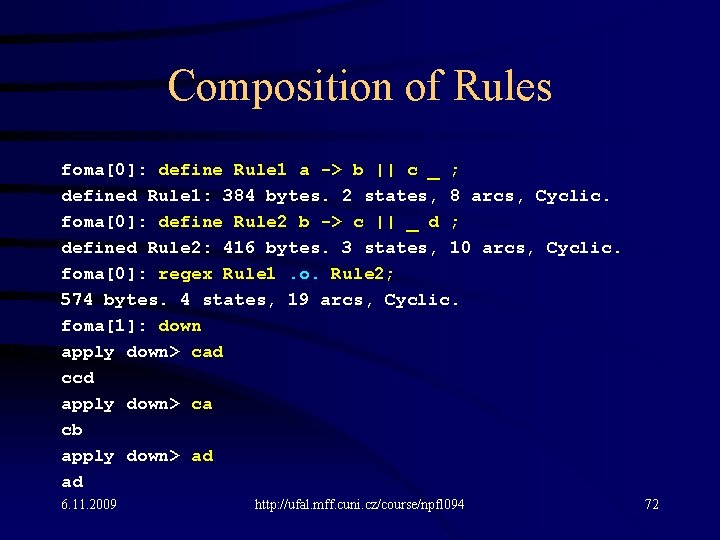
Composition of Rules foma[0]: define Rule 1 a -> b || c _ ; defined Rule 1: 384 bytes. 2 states, 8 arcs, Cyclic. foma[0]: define Rule 2 b -> c || _ d ; defined Rule 2: 416 bytes. 3 states, 10 arcs, Cyclic. foma[0]: regex Rule 1. o. Rule 2; 574 bytes. 4 states, 19 arcs, Cyclic. foma[1]: down apply down> cad ccd apply down> ca cb apply down> ad ad 6. 11. 2009 http: //ufal. mff. cuni. cz/course/npfl 094 72
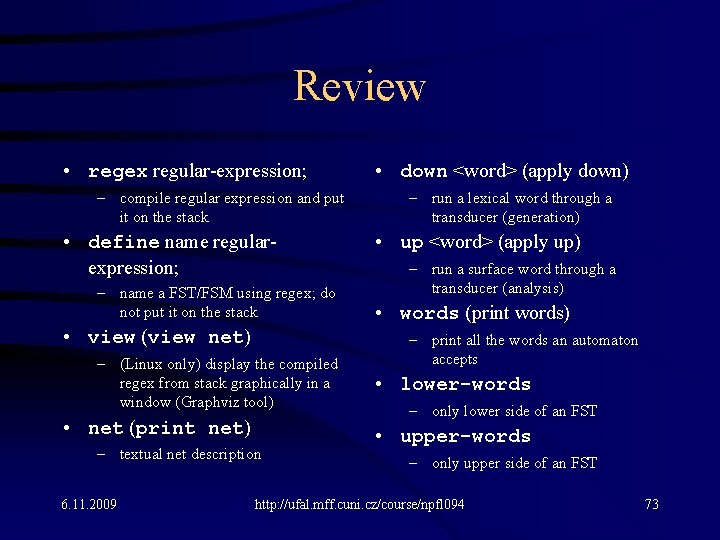
Review • regex regular-expression; – compile regular expression and put it on the stack • define name regularexpression; – name a FST/FSM using regex; do not put it on the stack • view (view net) – (Linux only) display the compiled regex from stack graphically in a window (Graphviz tool) • net (print net) – textual net description 6. 11. 2009 • down <word> (apply down) – run a lexical word through a transducer (generation) • up <word> (apply up) – run a surface word through a transducer (analysis) • words (print words) – print all the words an automaton accepts • lower-words – only lower side of an FST • upper-words – only upper side of an FST http: //ufal. mff. cuni. cz/course/npfl 094 73
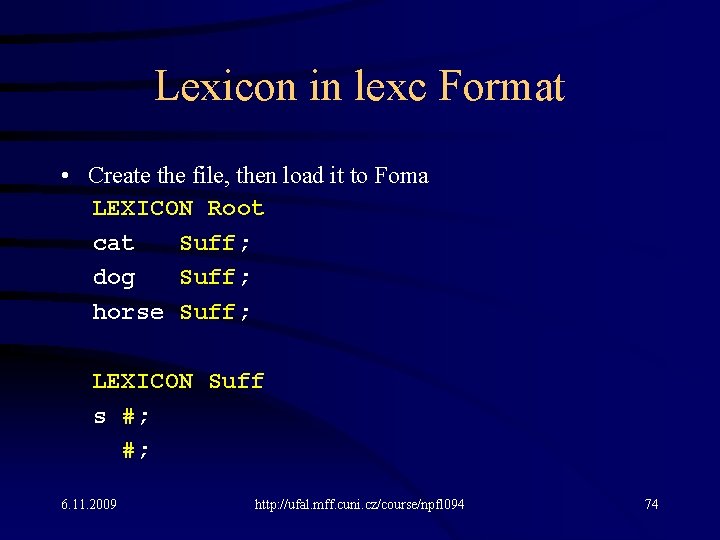
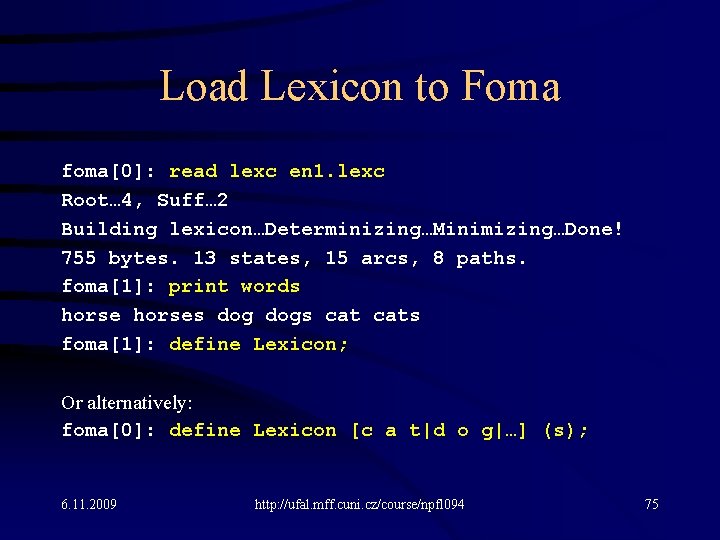
Lexicon in lexc Format • Create the file, then load it to Foma LEXICON Root cat Suff; dog Suff; horse Suff; LEXICON Suff s #; 6. 11. 2009 http: //ufal. mff. cuni. cz/course/npfl 094 74
Load Lexicon to Foma foma[0]: read lexc en 1. lexc Root… 4, Suff… 2 Building lexicon…Determinizing…Minimizing…Done! 755 bytes. 13 states, 15 arcs, 8 paths. foma[1]: print words horses dogs cats foma[1]: define Lexicon; Or alternatively: foma[0]: define Lexicon [c a t|d o g|…] (s); 6. 11. 2009 http: //ufal. mff. cuni. cz/course/npfl 094 75
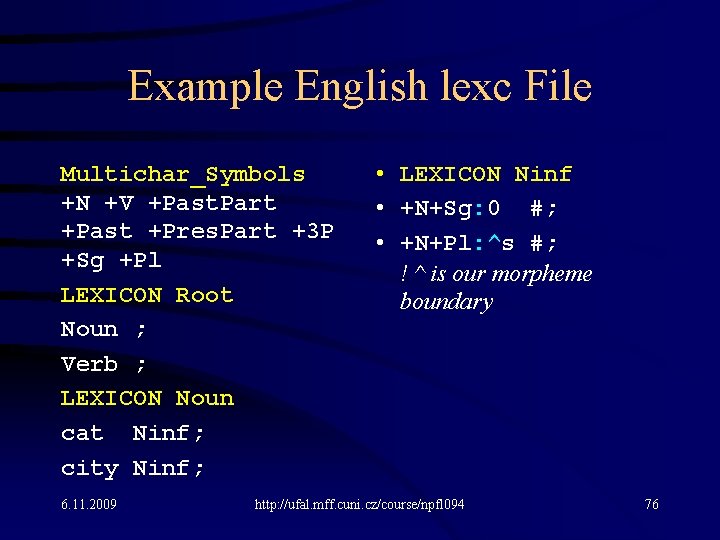
Example English lexc File Multichar_Symbols +N +V +Past. Part +Past +Pres. Part +3 P +Sg +Pl LEXICON Root Noun ; Verb ; LEXICON Noun cat Ninf; city Ninf; 6. 11. 2009 • LEXICON Ninf • +N+Sg: 0 #; • +N+Pl: ^s #; ! ^ is our morpheme boundary http: //ufal. mff. cuni. cz/course/npfl 094 76
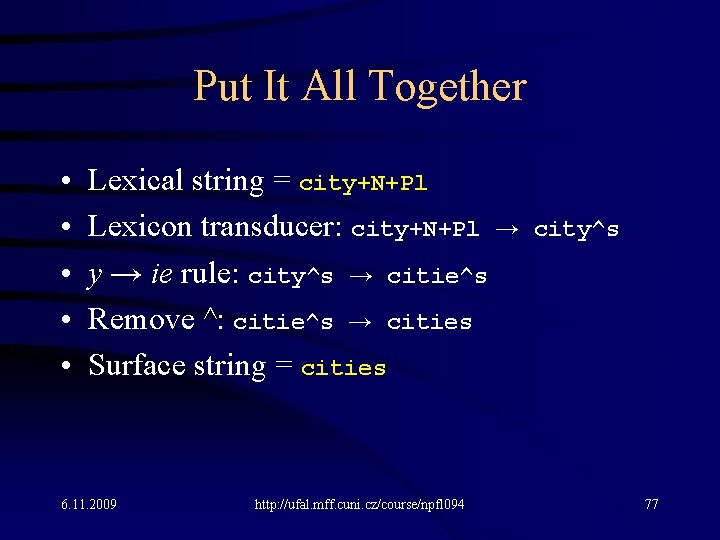
Put It All Together • • • Lexical string = city+N+Pl Lexicon transducer: city+N+Pl → city^s y → ie rule: city^s → citie^s Remove ^: citie^s → cities Surface string = cities 6. 11. 2009 http: //ufal. mff. cuni. cz/course/npfl 094 77
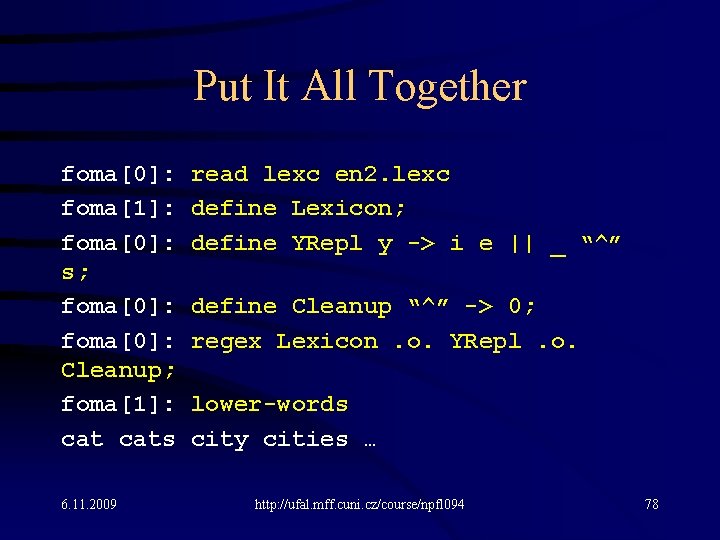
Put It All Together foma[0]: read lexc en 2. lexc foma[1]: define Lexicon; foma[0]: define YRepl y -> i e || _ “^” s; foma[0]: define Cleanup “^” -> 0; foma[0]: regex Lexicon. o. YRepl. o. Cleanup; foma[1]: lower-words cats city cities … 6. 11. 2009 http: //ufal. mff. cuni. cz/course/npfl 094 78
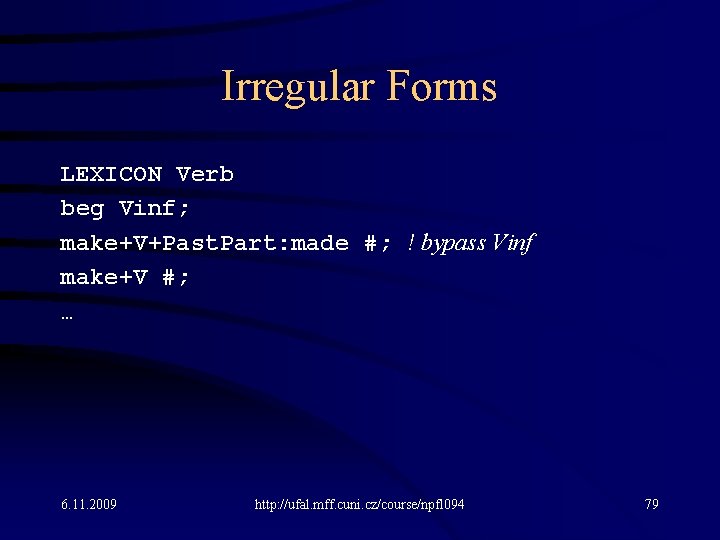
Irregular Forms LEXICON Verb beg Vinf; make+V+Past. Part: made #; ! bypass Vinf make+V #; … 6. 11. 2009 http: //ufal. mff. cuni. cz/course/npfl 094 79
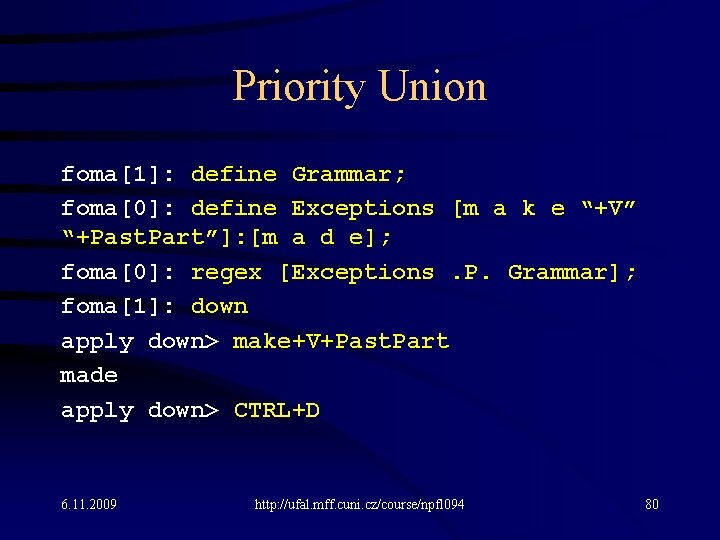
Priority Union foma[1]: define Grammar; foma[0]: define Exceptions [m a k e “+V” “+Past. Part”]: [m a d e]; foma[0]: regex [Exceptions. P. Grammar]; foma[1]: down apply down> make+V+Past. Part made apply down> CTRL+D 6. 11. 2009 http: //ufal. mff. cuni. cz/course/npfl 094 80
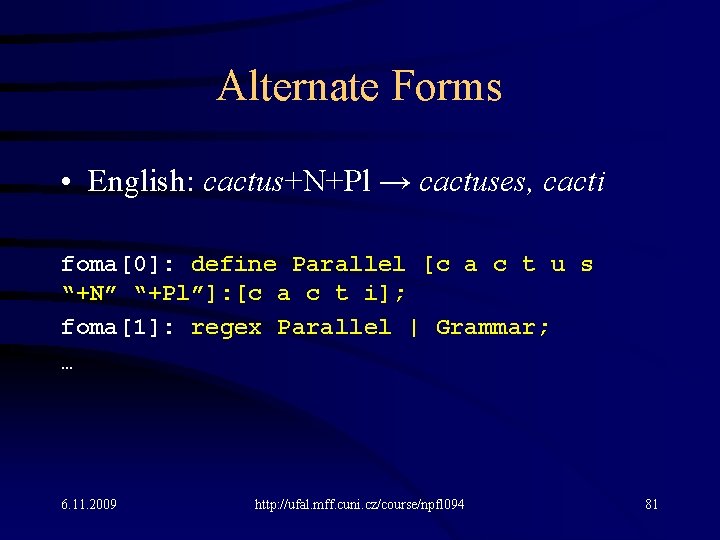
Alternate Forms • English: cactus+N+Pl → cactuses, cacti foma[0]: define Parallel [c a c t u s “+N” “+Pl”]: [c a c t i]; foma[1]: regex Parallel | Grammar; … 6. 11. 2009 http: //ufal. mff. cuni. cz/course/npfl 094 81
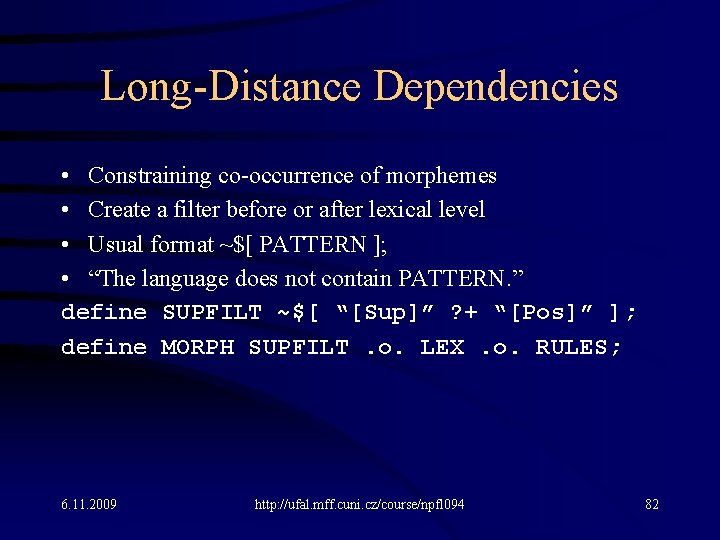
Long-Distance Dependencies • Constraining co-occurrence of morphemes • Create a filter before or after lexical level • Usual format ~$[ PATTERN ]; • “The language does not contain PATTERN. ” define SUPFILT ~$[ “[Sup]” ? + “[Pos]” ]; define MORPH SUPFILT. o. LEX. o. RULES; 6. 11. 2009 http: //ufal. mff. cuni. cz/course/npfl 094 82
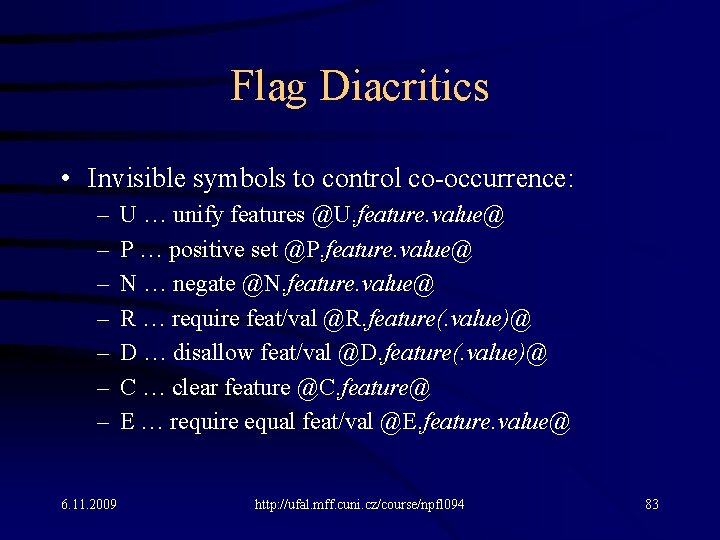
Flag Diacritics • Invisible symbols to control co-occurrence: – – – – 6. 11. 2009 U … unify features @U. feature. value@ P … positive set @P. feature. value@ N … negate @N. feature. value@ R … require feat/val @R. feature(. value)@ D … disallow feat/val @D. feature(. value)@ C … clear feature @C. feature@ E … require equal feat/val @E. feature. value@ http: //ufal. mff. cuni. cz/course/npfl 094 83
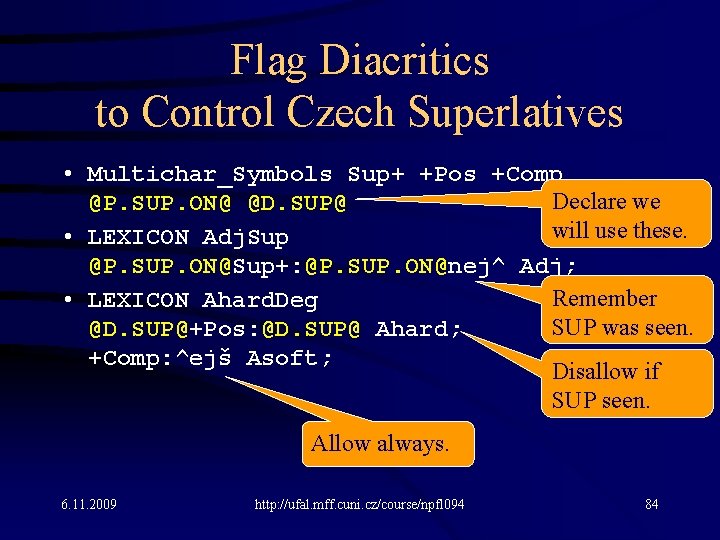
Flag Diacritics to Control Czech Superlatives • Multichar_Symbols Sup+ +Pos +Comp Declare we @P. SUP. ON@ @D. SUP@ will use these. • LEXICON Adj. Sup @P. SUP. ON@Sup+: @P. SUP. ON@nej^ Adj; Remember • LEXICON Ahard. Deg SUP was seen. @D. SUP@+Pos: @D. SUP@ Ahard; +Comp: ^ejš Asoft; Disallow if SUP seen. Allow always. 6. 11. 2009 http: //ufal. mff. cuni. cz/course/npfl 094 84
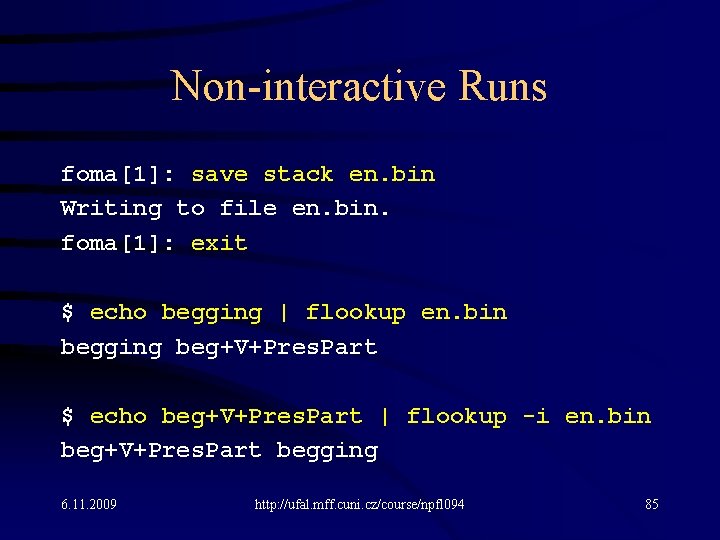
Non-interactive Runs foma[1]: save stack en. bin Writing to file en. bin. foma[1]: exit $ echo begging | flookup en. bin begging beg+V+Pres. Part $ echo beg+V+Pres. Part | flookup -i en. bin beg+V+Pres. Part begging 6. 11. 2009 http: //ufal. mff. cuni. cz/course/npfl 094 85
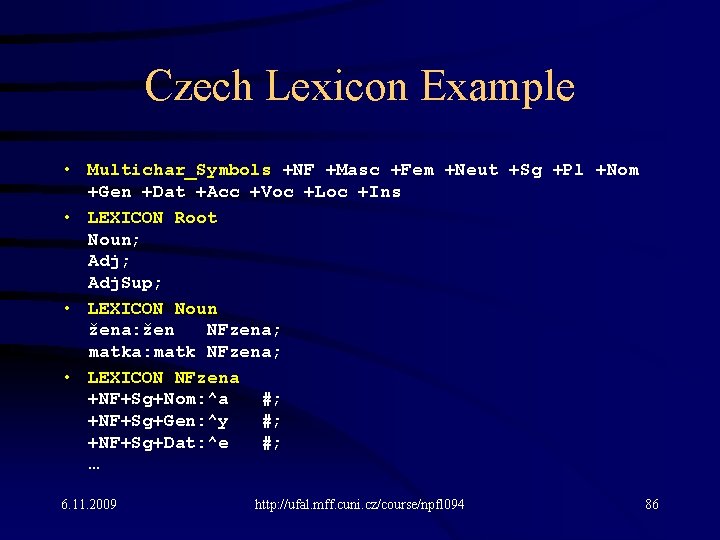
Czech Lexicon Example • Multichar_Symbols +NF +Masc +Fem +Neut +Sg +Pl +Nom +Gen +Dat +Acc +Voc +Loc +Ins • LEXICON Root Noun; Adj. Sup; • LEXICON Noun žena: žen NFzena; matka: matk NFzena; • LEXICON NFzena +NF+Sg+Nom: ^a #; +NF+Sg+Gen: ^y #; +NF+Sg+Dat: ^e #; … 6. 11. 2009 http: //ufal. mff. cuni. cz/course/npfl 094 86
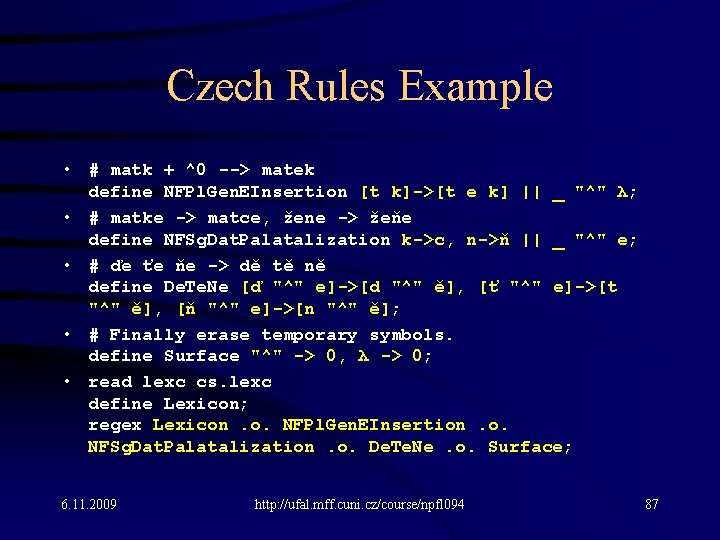
Czech Rules Example • # matk + ^0 --> matek define NFPl. Gen. EInsertion [t k]->[t e k] || _ "^" λ; • # matke -> matce, žene -> žeňe define NFSg. Dat. Palatalization k->c, n->ň || _ "^" e; • # ďe ťe ňe -> dě tě ně define De. Te. Ne [ď "^" e]->[d "^" ě], [ť "^" e]->[t "^" ě], [ň "^" e]->[n "^" ě]; • # Finally erase temporary symbols. define Surface "^" -> 0, λ -> 0; • read lexc cs. lexc define Lexicon; regex Lexicon. o. NFPl. Gen. EInsertion. o. NFSg. Dat. Palatalization. o. De. Te. Ne. o. Surface; 6. 11. 2009 http: //ufal. mff. cuni. cz/course/npfl 094 87
Foma: Czech Demo • foma -l cs. foma • foma[0]: view net 6. 11. 2009 http: //ufal. mff. cuni. cz/course/npfl 094 88
Homework • See the end of the lab web • http: //ufal. mff. cuni. cz/~zeman/vy uka/morfosynt/lab-twolm/index. html • Assigned: 18. 11. 2019 • Deadline: 3. 1. 2020 • WARNING: NO CLASS NOV 25! 6. 11. 2009 http: //ufal. mff. cuni. cz/course/npfl 094 89
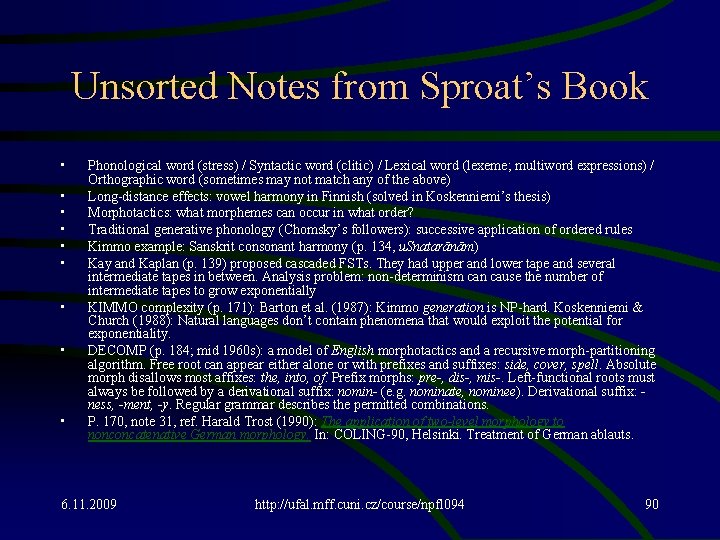
Unsorted Notes from Sproat’s Book • • • Phonological word (stress) / Syntactic word (clitic) / Lexical word (lexeme; multiword expressions) / Orthographic word (sometimes may not match any of the above) Long-distance effects: vowel harmony in Finnish (solved in Koskenniemi’s thesis) Morphotactics: what morphemes can occur in what order? Traditional generative phonology (Chomsky’s followers): successive application of ordered rules Kimmo example: Sanskrit consonant harmony (p. 134, u. Snatarānām) Kay and Kaplan (p. 139) proposed cascaded FSTs. They had upper and lower tape and several intermediate tapes in between. Analysis problem: non-determinism can cause the number of intermediate tapes to grow exponentially KIMMO complexity (p. 171): Barton et al. (1987): Kimmo generation is NP-hard. Koskenniemi & Church (1988): Natural languages don’t contain phenomena that would exploit the potential for exponentiality. DECOMP (p. 184; mid 1960 s): a model of English morphotactics and a recursive morph-partitioning algorithm. Free root can appear either alone or with prefixes and suffixes: side, cover, spell. Absolute morph disallows most affixes: the, into, of. Prefix morphs: pre-, dis-, mis-. Left-functional roots must always be followed by a derivational suffix: nomin- (e. g. nominate, nominee). Derivational suffix: ness, -ment, -y. Regular grammar describes the permitted combinations. P. 170, note 31, ref. Harald Trost (1990): The application of two-level morphology to nonconcatenative German morphology. In: COLING-90, Helsinki. Treatment of German ablauts. 6. 11. 2009 http: //ufal. mff. cuni. cz/course/npfl 094 90