
Students Syntactic Mistakes in Writing Seven Different Types

- Slides: 22
Students’ Syntactic Mistakes in Writing Seven Different Types of SQL Queries and its Application to Predicting Students’ Success SIGCSE ’ 16, March 02 -05, 2016, Memphis, TN, USA Alireza Ahadi, Vahid Behbood 2016/11/29 yusuke 1
Author �Alireza Ahadi Academic Mentor, School of Software University of Technology Sydney Bioinformatics, Data analytics, Databases, Programming. … 2
Abstract � syntactic mistakes little attention has been given to student’s mistake in writing SQL statements represents the first large scale quantitative analysis of the student’s syntactic mistakes in writing different types of SQL queries v Over 160 thousand snapshots of SQL queries were collected from over 2000 students across eight years 3
1. Introduction � A better understanding of student SQL errors and misconceptions improve the teaching and learning of SQL also serve the writing of textbooks and other instructional materials � semantic or syntactic errors SQL queries may contain these as with any other computer language The focus of the previous studies of novices in writing SQL queries has been on the nature of semantic errors 4
1. Introduction � quantitatively study the syntactic errors use data collected over eight years, from 2300 students review these mistakes among seven different types of SQL queries and compare syntactic errors of students who were successful versus students who were unsuccessful in writing a correct query vhow this information can be used to train a rule- based classifier to predict student success 5
2. Related work � online SQL tutoring/assessment tools focus on the functionality of the tool itself, or on how the system supports a certain pedagogical model do not analyze the data collected by those systems to determine the syntactic errors v. There are some papers in which authors review different semantic errors encountered in writing SQL queries • all those works give a fundamental understanding of semantic errors in SQL, none of them reviewed syntactic errors 6
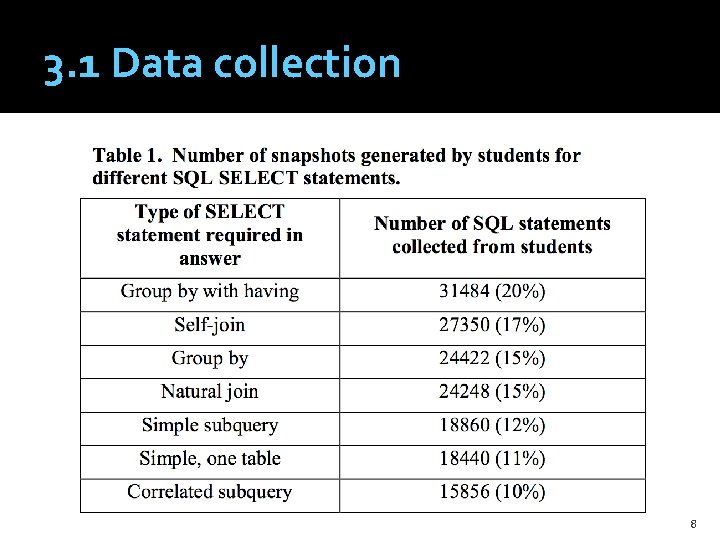
3. Method n 3. 1 Data collection n a total number of ~161000 SQL SELECT statements from ~2300 students n collected data in an online assessment system, Asse. SQL n students in this study were all novice undergraduate students n Each semester there is an online SQL test assessing student’s performance in writing SQL SELECT statements n students were allowed 50 minutes to attempt seven SQL questions 7
3. 1 Data collection 8
3. Method � 3. 2 Error categorization all the students’ SQL statements were re-executed in Postgre. SQL and the execution results generated by the DBMS were collected v syntactic error Ø error message which is returned by Postgre. SQL engine 9
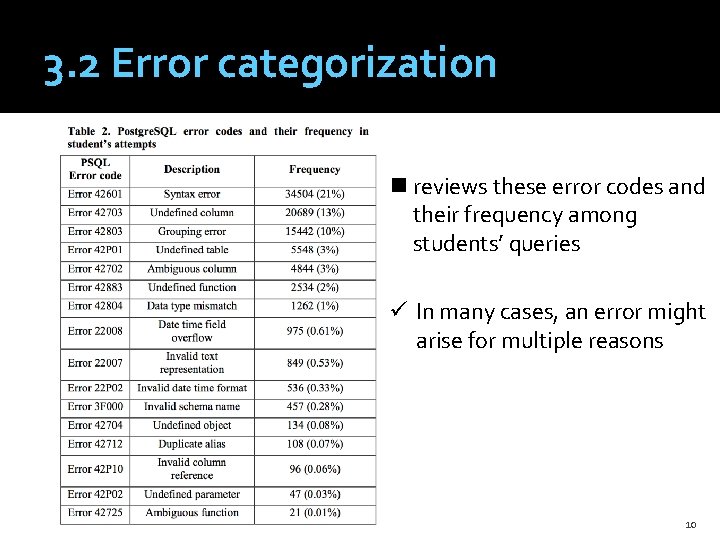
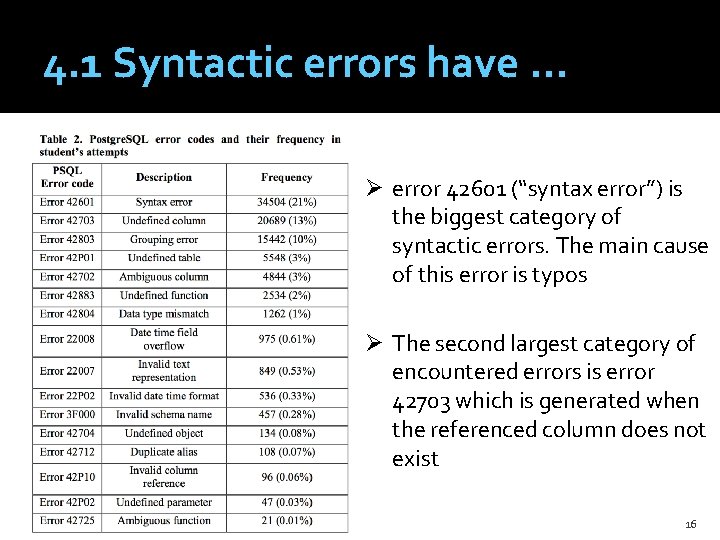
3. 2 Error categorization n reviews these error codes and their frequency among students’ queries ü In many cases, an error might arise for multiple reasons 10
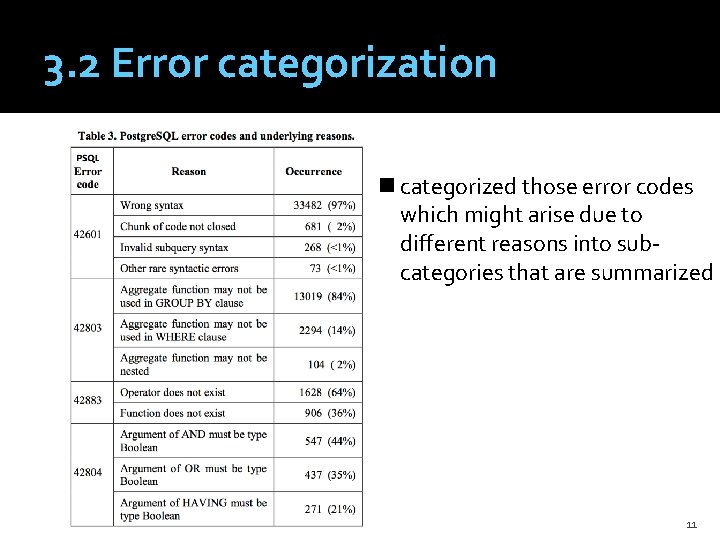
3. 2 Error categorization n categorized those error codes which might arise due to different reasons into subcategories that are summarized 11
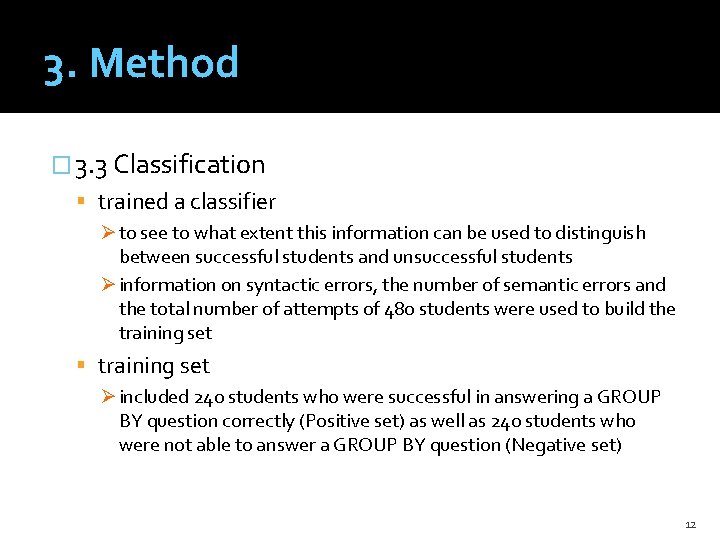
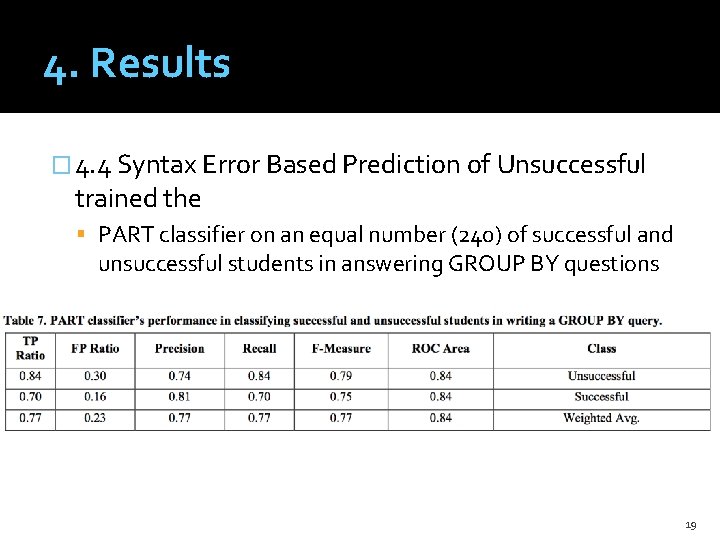
3. Method � 3. 3 Classification trained a classifier Ø to see to what extent this information can be used to distinguish between successful students and unsuccessful students Ø information on syntactic errors, the number of semantic errors and the total number of attempts of 480 students were used to build the training set Ø included 240 students who were successful in answering a GROUP BY question correctly (Positive set) as well as 240 students who were not able to answer a GROUP BY question (Negative set) 12
3. 3 Classification � PART classifier ü PART handles missing values caused by student queries which no syntactic errors of a given kind ü PART provides a clear explanation of the rules generated within the C 4. 5 iterations 13
4. Results � 4. 1 Syntactic Errors Have a High Frequency Ratio Among Students’ Attempts Among ~161000 students’ attempts, more than half of those attempts result in a syntactic error (54%) Around 40% of all executions do not include a syntactic error, but include semantic errors →only the remaining 6% of executions result in a successful execution capable of producing the correct result table 14
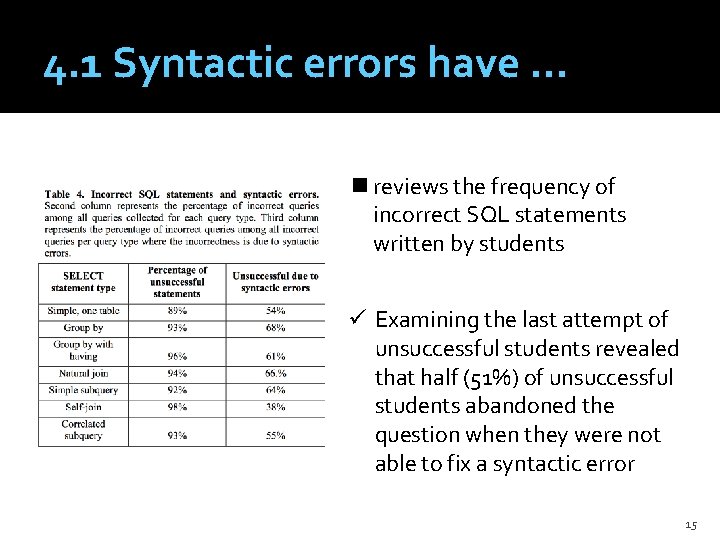
4. 1 Syntactic errors have … n reviews the frequency of incorrect SQL statements written by students ü Examining the last attempt of unsuccessful students revealed that half (51%) of unsuccessful students abandoned the question when they were not able to fix a syntactic error 15
4. 1 Syntactic errors have … Ø error 42601 (“syntax error”) is the biggest category of syntactic errors. The main cause of this error is typos Ø The second largest category of encountered errors is error 42703 which is generated when the referenced column does not exist 16
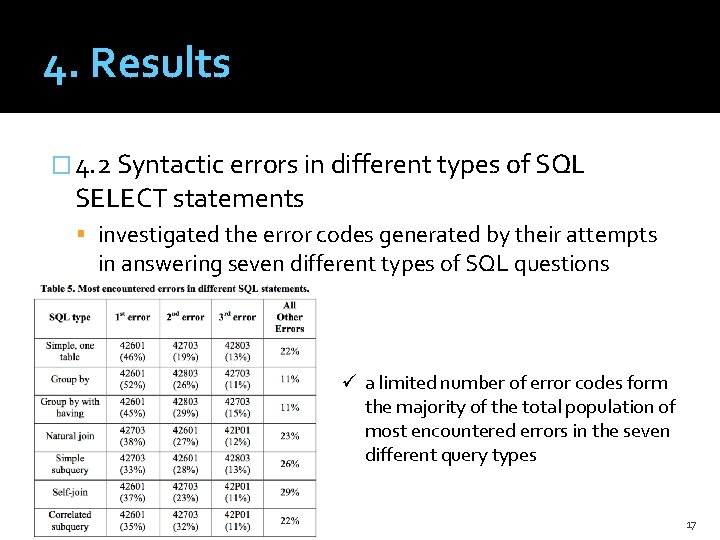
4. Results � 4. 2 Syntactic errors in different types of SQL SELECT statements investigated the error codes generated by their attempts in answering seven different types of SQL questions ü a limited number of error codes form the majority of the total population of most encountered errors in the seven different query types 17
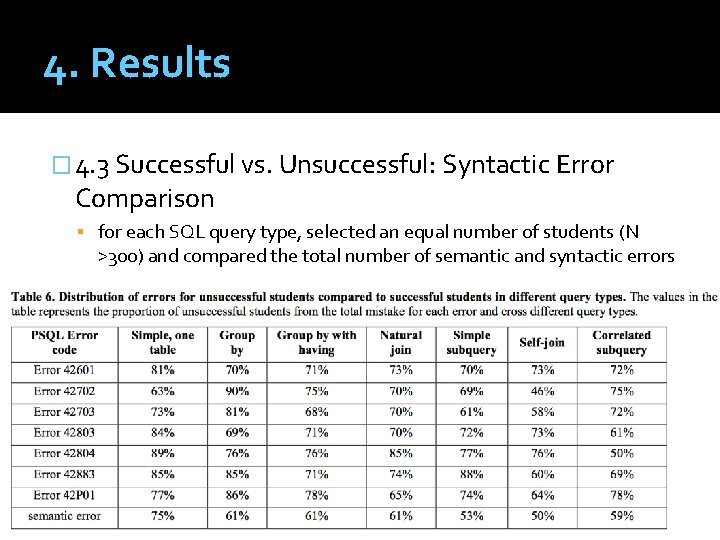
4. Results � 4. 3 Successful vs. Unsuccessful: Syntactic Error Comparison for each SQL query type, selected an equal number of students (N >300) and compared the total number of semantic and syntactic errors 18
4. Results � 4. 4 Syntax Error Based Prediction of Unsuccessful trained the PART classifier on an equal number (240) of successful and unsuccessful students in answering GROUP BY questions 19
5. Discussion � the majority of students’ mistakes in writing SQL SELECT statements Ø either syntax errors Ø an incorrect referred column in different clauses of the SELECT statement pthe complexity of the provided entity relationship diagram leads students to make a mistake in choosing the right field name � error 42803 is the third most common mistake in writing a simple SELECT statement on one table it almost always occurred in the WHERE clause 20
5. Discussion � error 42 P 01 (i. e. undefined table) is observed in four different types of queries: a) When there is a need to perform a natural join between two relations b) When writing a simple subquery c) When there is a need to join a table to itself d) When writing a correlated subquery Ø This might be an indicator of students’ lack of skill in identifying the correct tables from which to extract the desired information 21
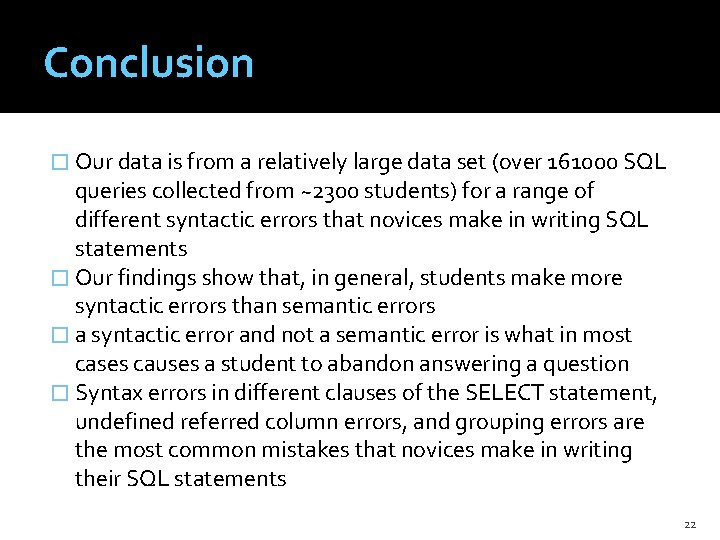
Conclusion � Our data is from a relatively large data set (over 161000 SQL queries collected from ~2300 students) for a range of different syntactic errors that novices make in writing SQL statements � Our findings show that, in general, students make more syntactic errors than semantic errors � a syntactic error and not a semantic error is what in most cases causes a student to abandon answering a question � Syntax errors in different clauses of the SELECT statement, undefined referred column errors, and grouping errors are the most common mistakes that novices make in writing their SQL statements 22