selected slides from Keys to Literacy Coach Training

- Slides: 51
selected slides from: Keys to Literacy Coach Training ©Joan Sedita, www. keystoliteracy. net
Which KTL instructional practices are being used in your school or district? ©Joan Sedita, www. keystoliteracy. com
Connections Among Routines • There a number of training topics that appear in all of the Keys to Literacy programs. • View the chart that identifies these topics. • The repetition of topics in multiple programs promotes consistent application of literacy standards across comprehension, writing, and vocabulary. ©Joan Sedita, www. keystoliteracy. com
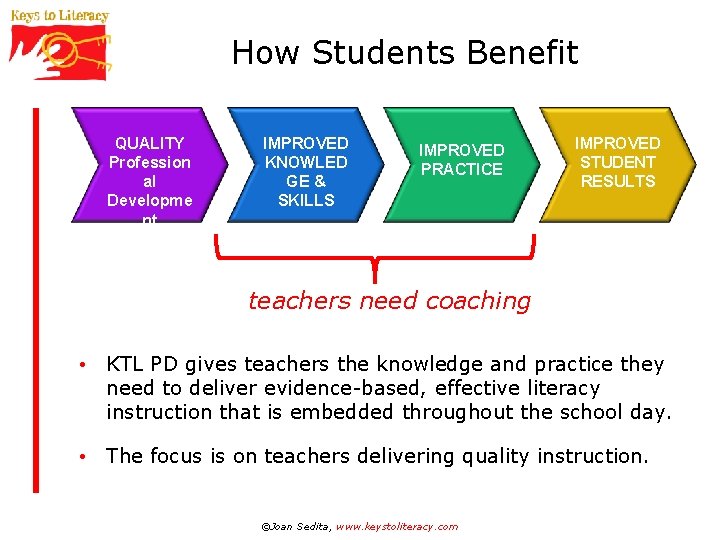
How Students Benefit QUALITY Profession al Developme nt IMPROVED KNOWLED GE & SKILLS IMPROVED PRACTICE IMPROVED STUDENT RESULTS teachers need coaching • KTL PD gives teachers the knowledge and practice they need to deliver evidence-based, effective literacy instruction that is embedded throughout the school day. • The focus is on teachers delivering quality instruction. ©Joan Sedita, www. keystoliteracy. com
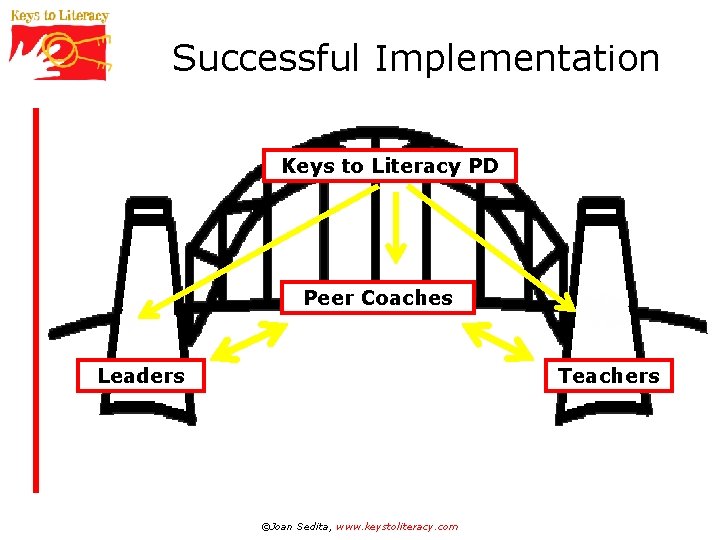
Successful Implementation Keys to Literacy PD Peer Coaches Leaders Teachers ©Joan Sedita, www. keystoliteracy. com
KTL PD Model ©Joan Sedita, www. keystoliteracy. com
Peer Coaching ©Joan Sedita, www. keystoliteracy. com
Peer Coaching: Broad Definition “Coaching: a cooperative, ideally collaborative relationship, with both parties mutually engaged in efforts to provide better services for students. ” Hasbrouck and Denton, 2005 ©Joan Sedita, www. keystoliteracy. com
Why is coaching so important? • Research has identified peer coaching as a highly effective element of successful professional development. • Coaches are used to tighten the connection between formal training and teachers’ application of instructional practices. • Successful coaching is provided by accomplished peers and includes supportive critiques of practice, and classroom observation and modeling. ©Joan Sedita, www. keystoliteracy. com
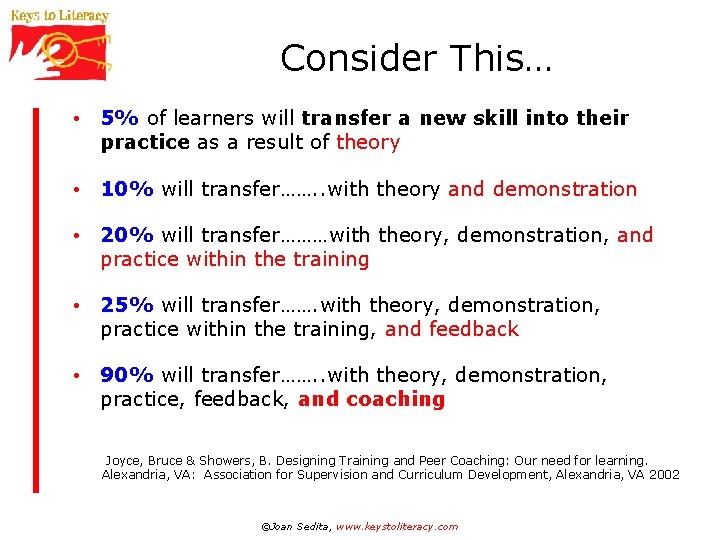
Consider This… • 5% of learners will transfer a new skill into their practice as a result of theory • 10% will transfer……. . with theory and demonstration • 20% will transfer………with theory, demonstration, and practice within the training • 25% will transfer……. with theory, demonstration, practice within the training, and feedback • 90% will transfer……. . with theory, demonstration, practice, feedback, and coaching Joyce, Bruce & Showers, B. Designing Training and Peer Coaching: Our need for learning. Alexandria, VA: Association for Supervision and Curriculum Development, Alexandria, VA 2002 ©Joan Sedita, www. keystoliteracy. com
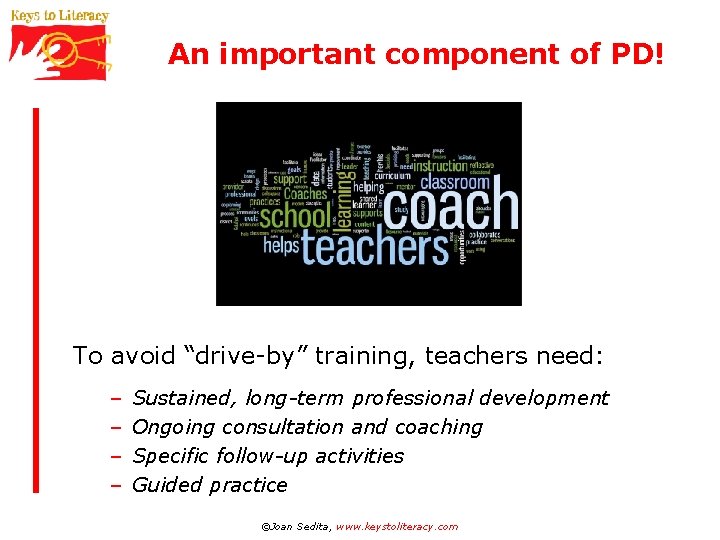
An important component of PD! To avoid “drive-by” training, teachers need: – – Sustained, long-term professional development Ongoing consultation and coaching Specific follow-up activities Guided practice ©Joan Sedita, www. keystoliteracy. com
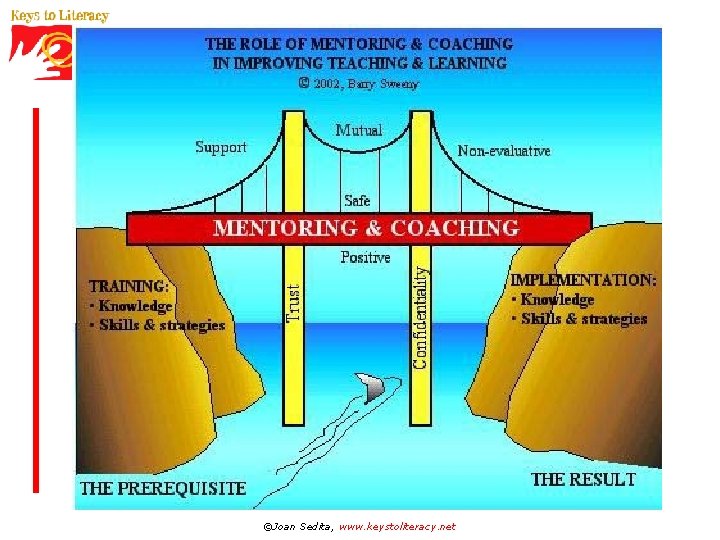
©Joan Sedita, www. keystoliteracy. net
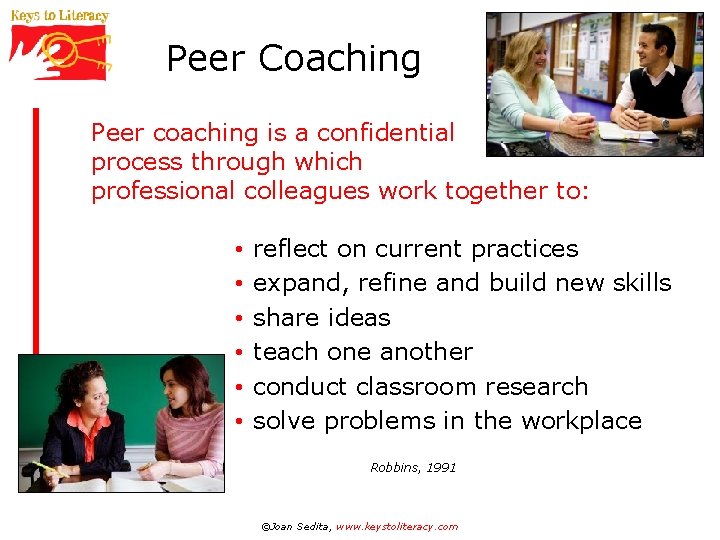
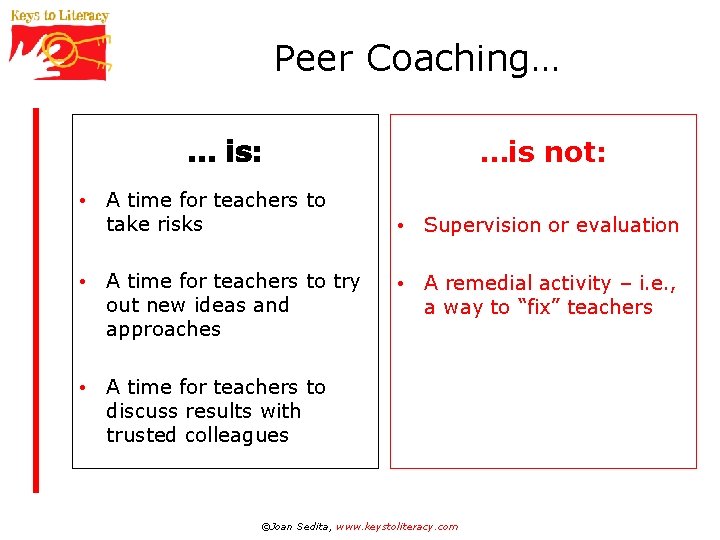
Peer Coaching Peer coaching is a confidential process through which professional colleagues work together to: • • • reflect on current practices expand, refine and build new skills share ideas teach one another conduct classroom research solve problems in the workplace Robbins, 1991 ©Joan Sedita, www. keystoliteracy. com
Peer Coaching… … is: • A time for teachers to take risks • A time for teachers to try out new ideas and approaches …is not: • Supervision or evaluation • A remedial activity – i. e. , a way to “fix” teachers • A time for teachers to discuss results with trusted colleagues ©Joan Sedita, www. keystoliteracy. com
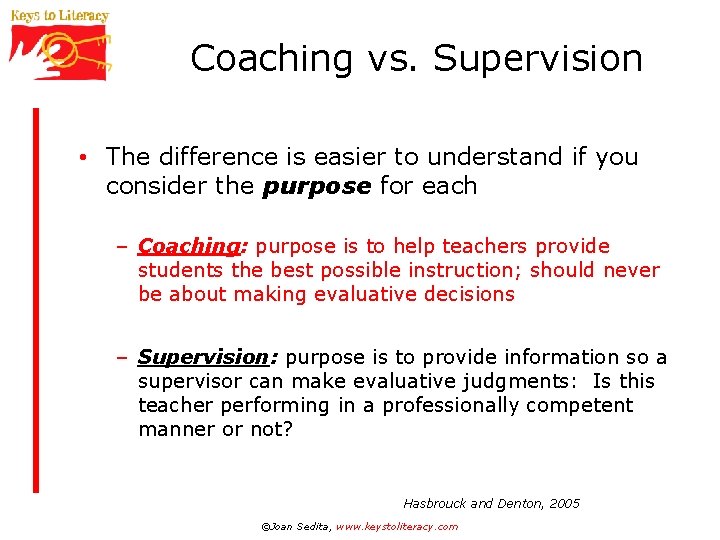
Coaching vs. Supervision • The difference is easier to understand if you consider the purpose for each – Coaching: purpose is to help teachers provide students the best possible instruction; should never be about making evaluative decisions – Supervision: purpose is to provide information so a supervisor can make evaluative judgments: Is this teacher performing in a professionally competent manner or not? Hasbrouck and Denton, 2005 ©Joan Sedita, www. keystoliteracy. com
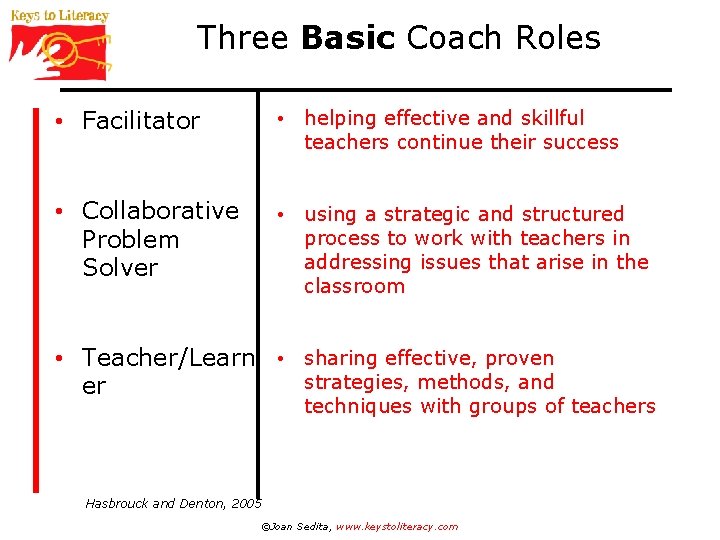
Three Basic Coach Roles • Facilitator • helping effective and skillful teachers continue their success • Collaborative Problem Solver • using a strategic and structured process to work with teachers in addressing issues that arise in the classroom • Teacher/Learn • sharing effective, proven strategies, methods, and er techniques with groups of teachers Hasbrouck and Denton, 2005 ©Joan Sedita, www. keystoliteracy. com
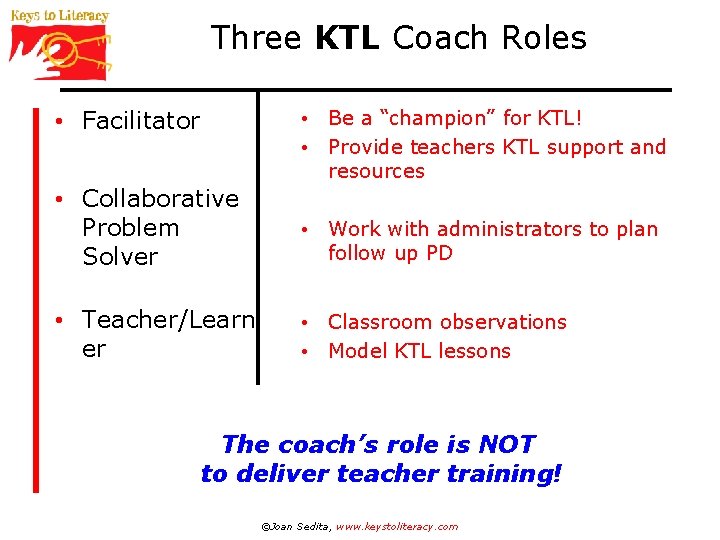
Three KTL Coach Roles • Facilitator • Be a “champion” for KTL! • Provide teachers KTL support and resources • Collaborative Problem Solver • Work with administrators to plan follow up PD • Teacher/Learn er • Classroom observations • Model KTL lessons The coach’s role is NOT to deliver teacher training! ©Joan Sedita, www. keystoliteracy. com
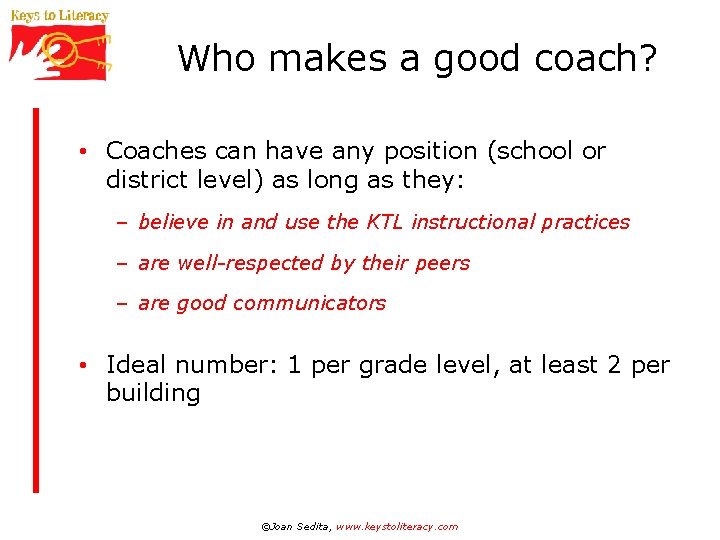
Who makes a good coach? • Coaches can have any position (school or district level) as long as they: – believe in and use the KTL instructional practices – are well-respected by their peers – are good communicators • Ideal number: 1 per grade level, at least 2 per building ©Joan Sedita, www. keystoliteracy. com
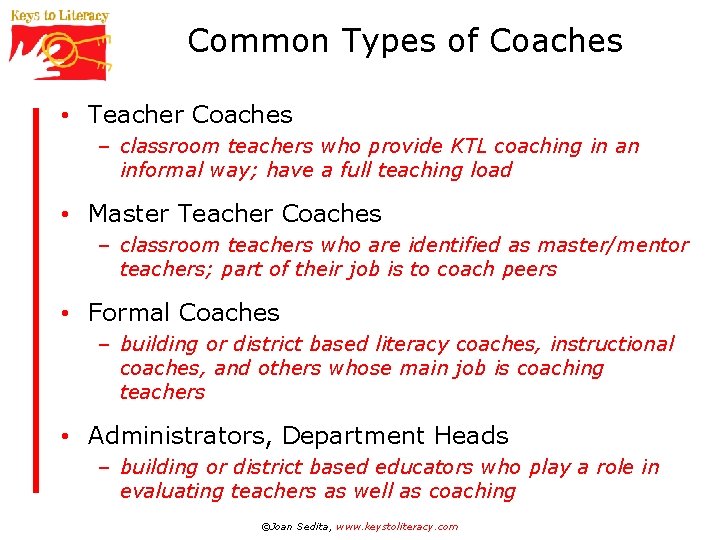
Common Types of Coaches • Teacher Coaches – classroom teachers who provide KTL coaching in an informal way; have a full teaching load • Master Teacher Coaches – classroom teachers who are identified as master/mentor teachers; part of their job is to coach peers • Formal Coaches – building or district based literacy coaches, instructional coaches, and others whose main job is coaching teachers • Administrators, Department Heads – building or district based educators who play a role in evaluating teachers as well as coaching ©Joan Sedita, www. keystoliteracy. com
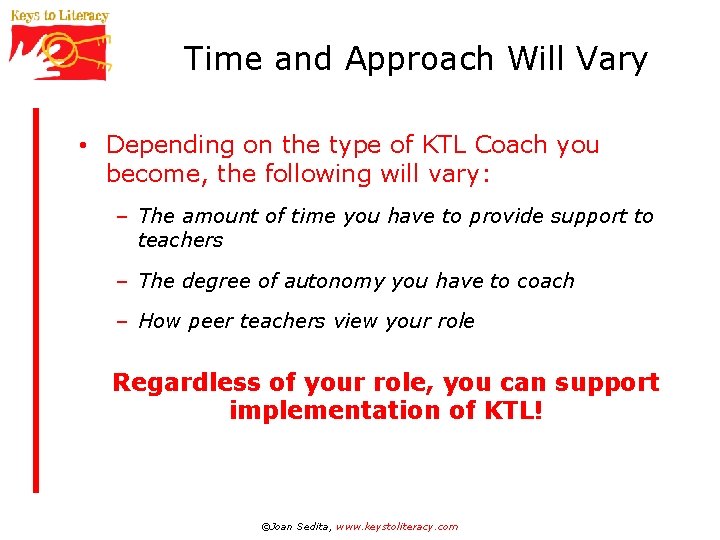
Time and Approach Will Vary • Depending on the type of KTL Coach you become, the following will vary: – The amount of time you have to provide support to teachers – The degree of autonomy you have to coach – How peer teachers view your role Regardless of your role, you can support implementation of KTL! ©Joan Sedita, www. keystoliteracy. com
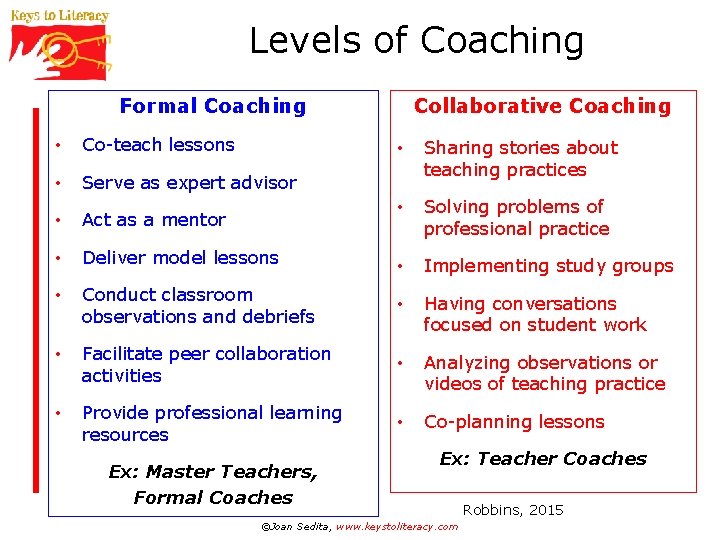
Levels of Coaching Formal Coaching • Co-teach lessons • Serve as expert advisor • Act as a mentor • Deliver model lessons • Collaborative Coaching • Sharing stories about teaching practices • Solving problems of professional practice • Implementing study groups Conduct classroom observations and debriefs • Having conversations focused on student work • Facilitate peer collaboration activities • Analyzing observations or videos of teaching practice • Provide professional learning resources • Co-planning lessons Ex: Master Teachers, Formal Coaches Ex: Teacher Coaches ©Joan Sedita, www. keystoliteracy. com Robbins, 2015
Working with Teachers ©Joan Sedita, www. keystoliteracy. com
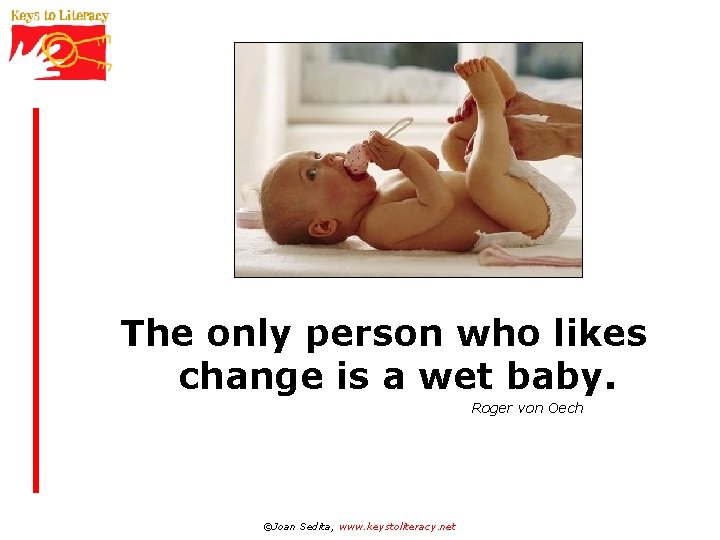
The only person who likes change is a wet baby. Roger von Oech ©Joan Sedita, www. keystoliteracy. net
Concerns Based Adoption Model (CBAM) • CHANGE: – Is a PROCESS, not an event – it takes time – Is a highly PERSONAL EXPERIENCE – Entails DEVELOPMENTAL growth in feelings and skills • IMPLEMENTATION MUST BE RELATED TO: – The PEOPLE first • Support for individuals involved in change is needed to make change stick • Personal concerns about change are different for everyone – The INNOVATION second Adapted from: Hord et. al. , Taking Charge of Change, Alexandria, VA: ASCK and Austin, TX: SEDL, 1987. From: Deborah Roody (Deb 1 roody@mac. com) ©Joan Sedita, www. keystoliteracy. net
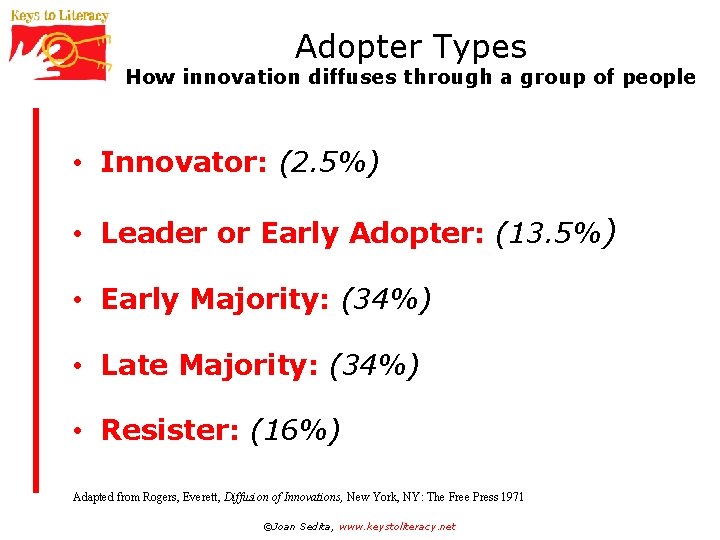
Adopter Types How innovation diffuses through a group of people • Innovator: (2. 5%) • Leader or Early Adopter: (13. 5%) • Early Majority: (34%) • Late Majority: (34%) • Resister: (16%) Adapted from Rogers, Everett, Diffusion of Innovations, New York, NY: The Free Press 1971 ©Joan Sedita, www. keystoliteracy. net
Kinds of Follow Up ©Joan Sedita, www. keystoliteracy. com
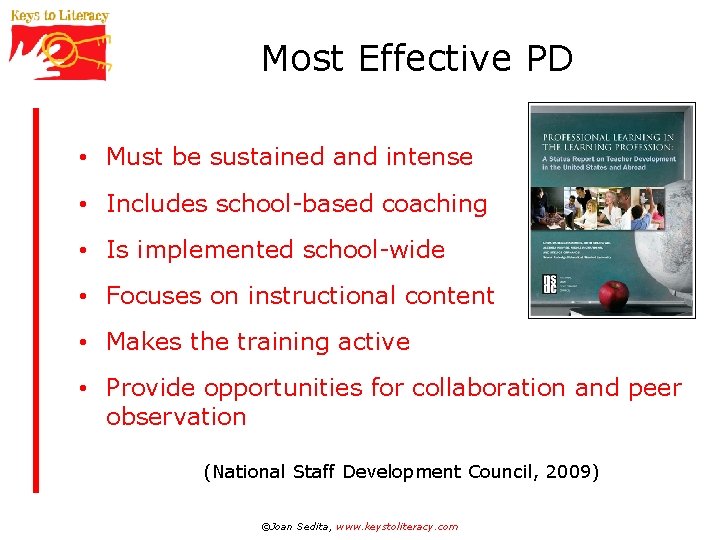
Most Effective PD • Must be sustained and intense • Includes school-based coaching • Is implemented school-wide • Focuses on instructional content • Makes the training active • Provide opportunities for collaboration and peer observation (National Staff Development Council, 2009) ©Joan Sedita, www. keystoliteracy. com
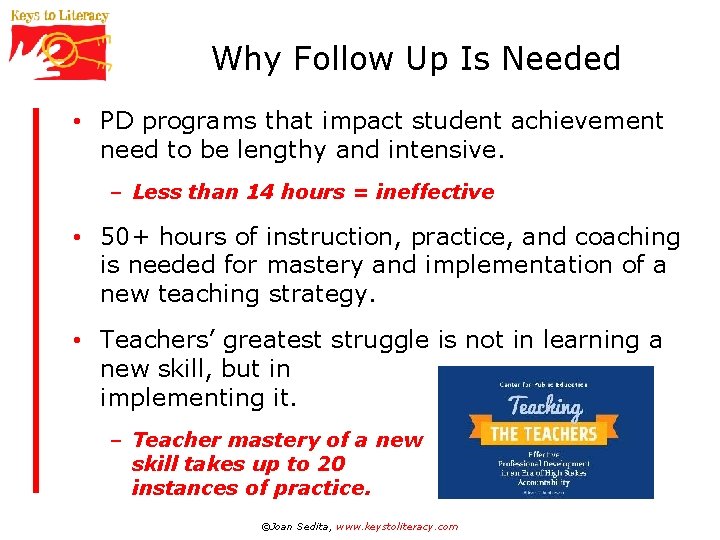
Why Follow Up Is Needed • PD programs that impact student achievement need to be lengthy and intensive. – Less than 14 hours = ineffective • 50+ hours of instruction, practice, and coaching is needed for mastery and implementation of a new teaching strategy. • Teachers’ greatest struggle is not in learning a new skill, but in implementing it. – Teacher mastery of a new skill takes up to 20 instances of practice. ©Joan Sedita, www. keystoliteracy. com
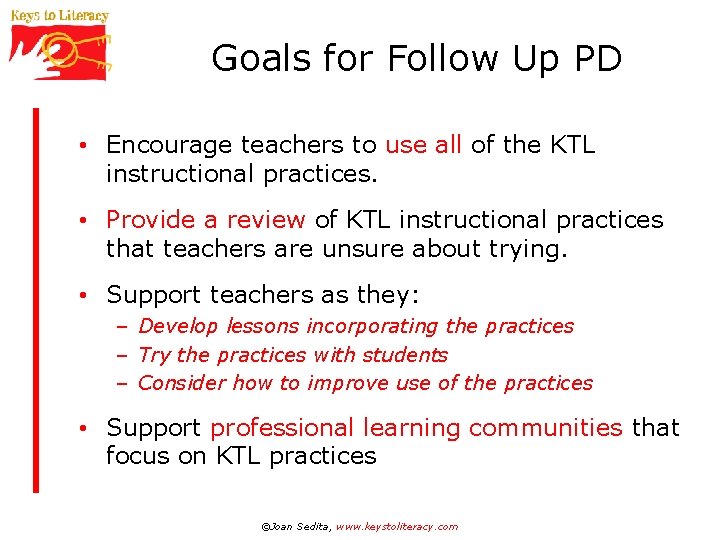
Goals for Follow Up PD • Encourage teachers to use all of the KTL instructional practices. • Provide a review of KTL instructional practices that teachers are unsure about trying. • Support teachers as they: – Develop lessons incorporating the practices – Try the practices with students – Consider how to improve use of the practices • Support professional learning communities that focus on KTL practices ©Joan Sedita, www. keystoliteracy. com
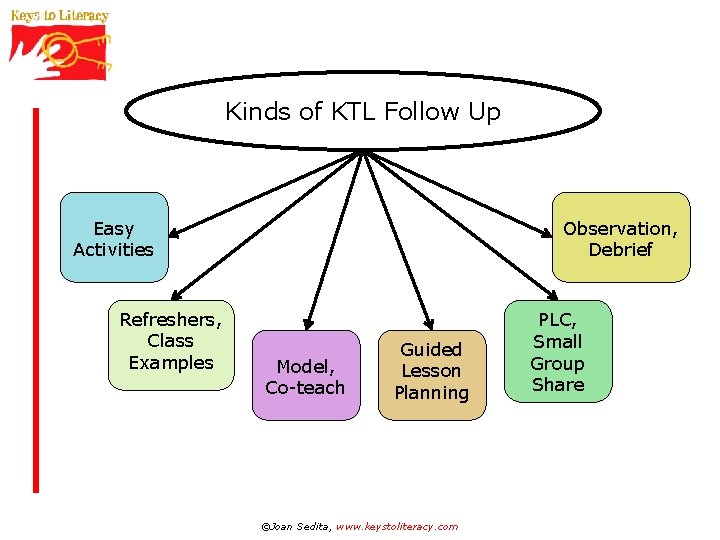
Kinds of KTL Follow Up Easy Activities Refreshers, Class Examples Observation, Debrief Model, Co-teach Guided Lesson Planning ©Joan Sedita, www. keystoliteracy. com PLC, Small Group Share
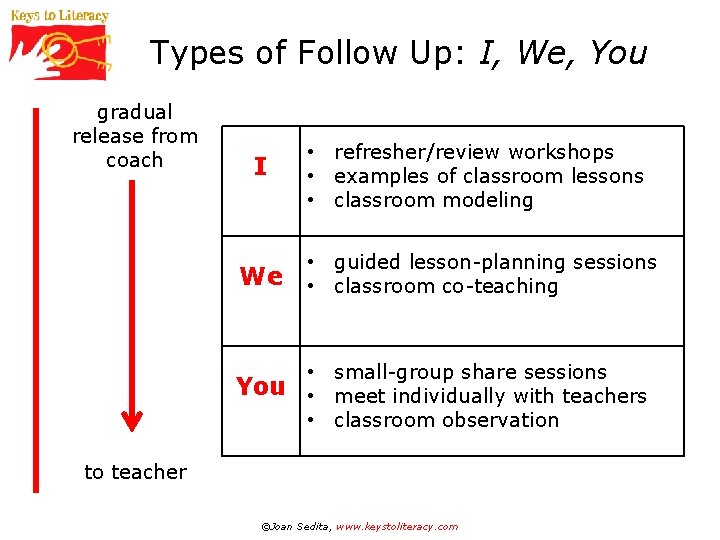
Types of Follow Up: I, We, You gradual release from coach I • refresher/review workshops • examples of classroom lessons • classroom modeling We • guided lesson-planning sessions • classroom co-teaching You • small-group share sessions • meet individually with teachers • classroom observation to teacher ©Joan Sedita, www. keystoliteracy. com
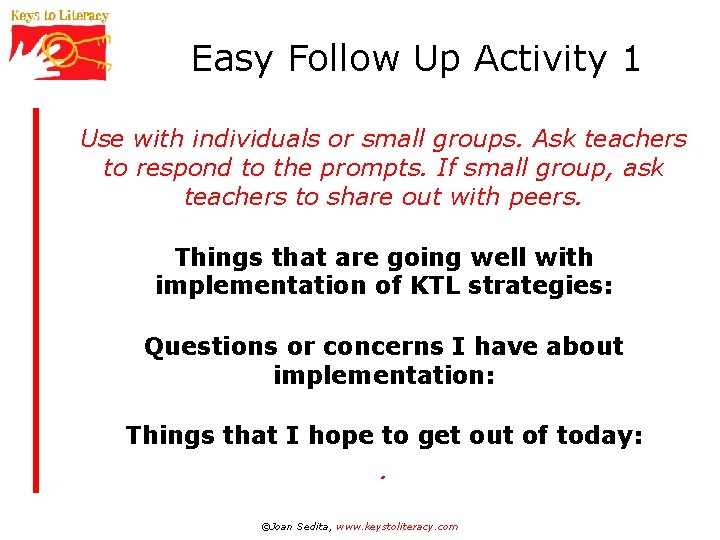
Easy Follow Up Activity 1 Use with individuals or small groups. Ask teachers to respond to the prompts. If small group, ask teachers to share out with peers. Things that are going well with implementation of KTL strategies: Questions or concerns I have about implementation: Things that I hope to get out of today: . ©Joan Sedita, www. keystoliteracy. com
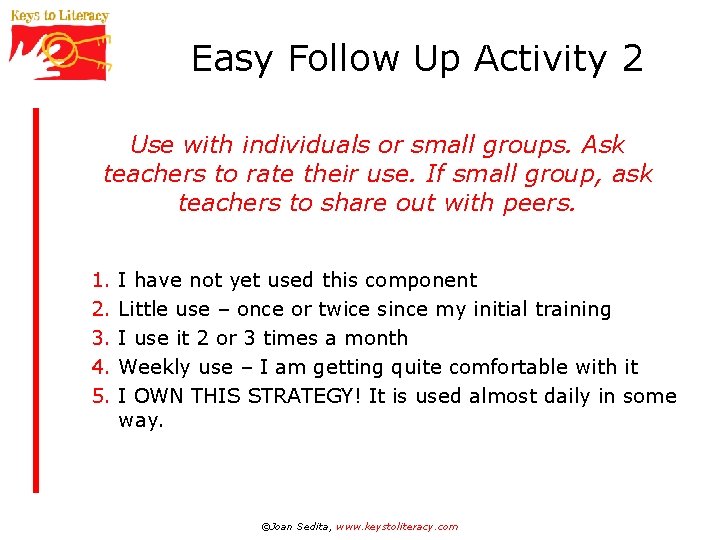
Easy Follow Up Activity 2 Use with individuals or small groups. Ask teachers to rate their use. If small group, ask teachers to share out with peers. 1. 2. 3. 4. 5. I have not yet used this component Little use – once or twice since my initial training I use it 2 or 3 times a month Weekly use – I am getting quite comfortable with it I OWN THIS STRATEGY! It is used almost daily in some way. ©Joan Sedita, www. keystoliteracy. com
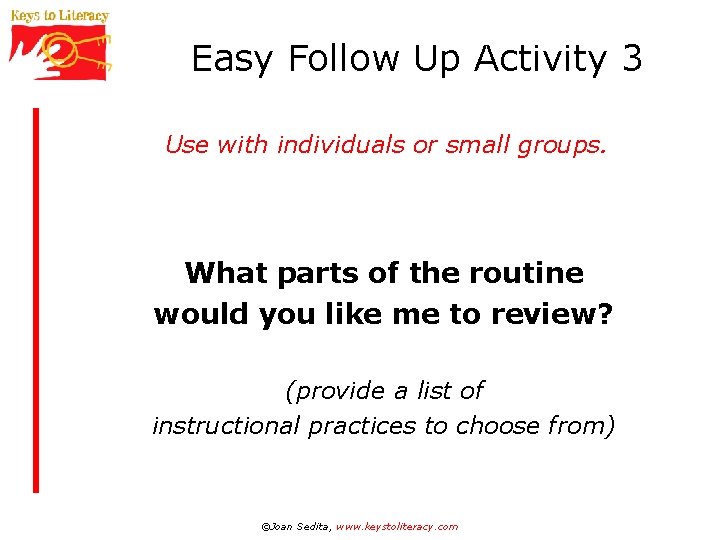
Easy Follow Up Activity 3 Use with individuals or small groups. What parts of the routine would you like me to review? (provide a list of instructional practices to choose from) ©Joan Sedita, www. keystoliteracy. com
Find Time For Coaching ©Joan Sedita, www. keystoliteracy. com
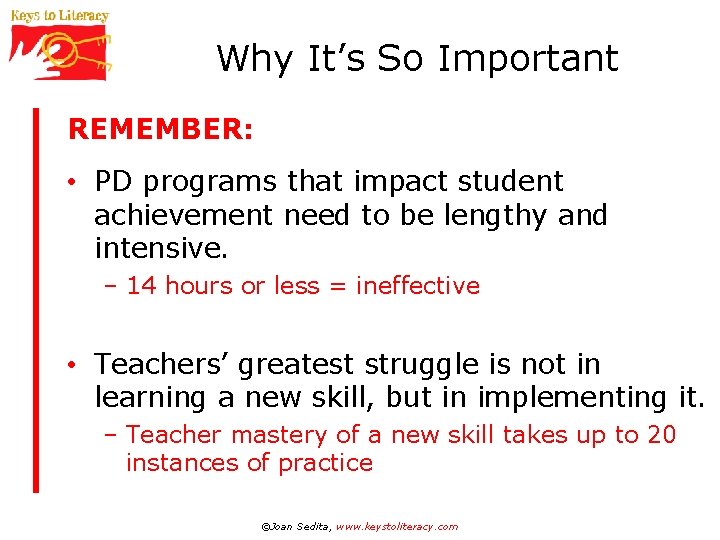
Why It’s So Important REMEMBER: • PD programs that impact student achievement need to be lengthy and intensive. – 14 hours or less = ineffective • Teachers’ greatest struggle is not in learning a new skill, but in implementing it. – Teacher mastery of a new skill takes up to 20 instances of practice ©Joan Sedita, www. keystoliteracy. com
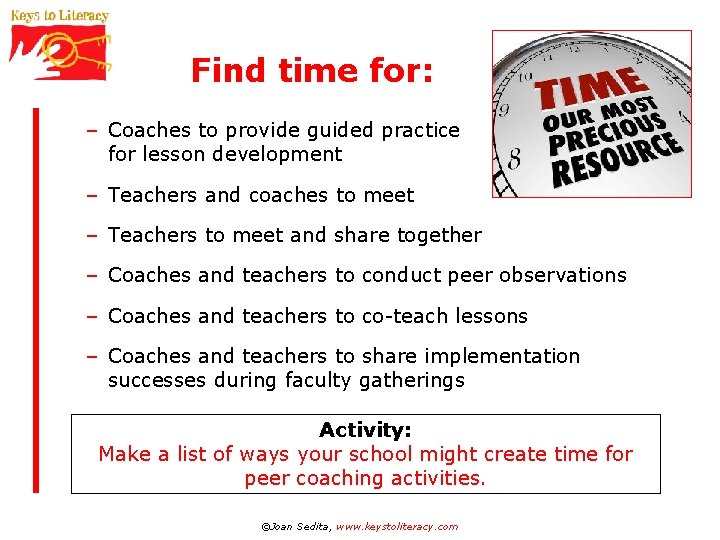
Find time for: – Coaches to provide guided practice for lesson development – Teachers and coaches to meet – Teachers to meet and share together – Coaches and teachers to conduct peer observations – Coaches and teachers to co-teach lessons – Coaches and teachers to share implementation successes during faculty gatherings Activity: Make a list of ways your school might create time for peer coaching activities. ©Joan Sedita, www. keystoliteracy. com
Promoting Implementation ©Joan Sedita, www. keystoliteracy. com
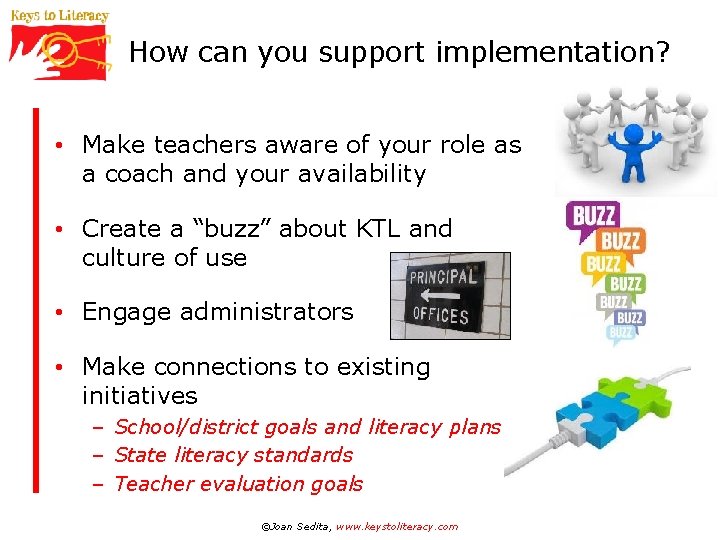
How can you support implementation? • Make teachers aware of your role as a coach and your availability • Create a “buzz” about KTL and culture of use • Engage administrators • Make connections to existing initiatives – School/district goals and literacy plans – State literacy standards – Teacher evaluation goals ©Joan Sedita, www. keystoliteracy. com
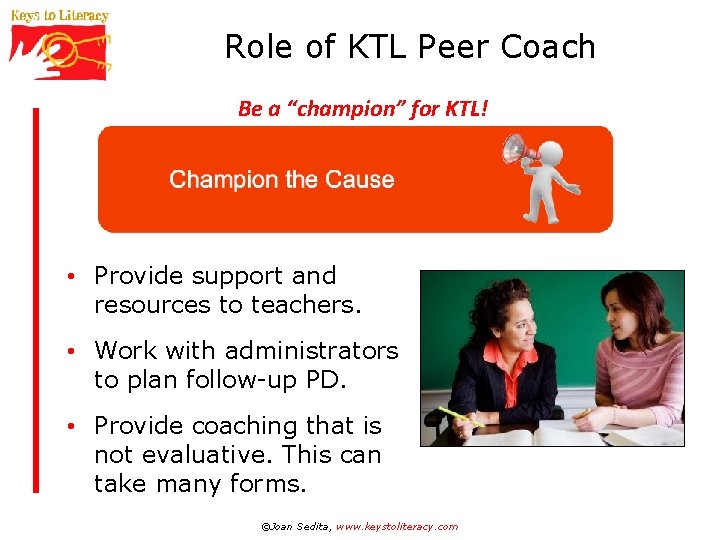
Role of KTL Peer Coach Be a “champion” for KTL! • Provide support and resources to teachers. • Work with administrators to plan follow-up PD. • Provide coaching that is not evaluative. This can take many forms. ©Joan Sedita, www. keystoliteracy. com
Defining Your Role • Clearly define for yourself and others your role as a peer coach. This will vary depending on your position • Take the lead in working with your administrator to define your role and how that will be communicated to staff. • Keep in mind that having peer coaches is new for many administrators and teachers. ©Joan Sedita, www. keystoliteracy. com
“Buzz” Ideas • KTL posters, bulletin boards (classroom, schoolwide) • A school or district KTL e-newsletter, blog, tweets • A list-serve or shared document site for posting KTL lessons and classroom examples • Use blogs and social media • Teacher use and interest surveys • Administrator and staff use of strategies ©Joan Sedita, www. keystoliteracy. com
Classroom Examples • Collect classroom examples of KTL use: student work, teacher lessons • Make available to staff (via school intranet, shared documents, hard copy notebooks) • Start with the samples provided by KTL (at coach resource website) ©Joan Sedita, www. keystoliteracy. com
Effective Leadership: Suggestions to Give Your Administrators • Attend training • Provide a vision for KTL use • Develop, communicate explicit rollout plan • Define expectations for teacher use; provide accountability • Incorporate an evaluative element • Conduct walk-throughs • Use activities and incorporate terminology from KTL routines ©Joan Sedita, www. keystoliteracy. com
How can administrators support coaches? • Provide a stipend or incentive • Inform faculty • Train two or more per building • Meet with coaches • Make time for coaches to meet with teachers and each other • Facilitate opportunities for coaches to observe classrooms, arrange peer observations, and co-teach lessons • Schedule follow-up coach support sessions with KTL Trainers ©Joan Sedita, www. keystoliteracy. com
How can coaches support administrators? • Share implementation tools – Walk-through checklist • Ask to meet on a regular basis to provide updates to administrator about implementation • Encourage administrators to update KTL PD plans based on coach’s input about teacher needs ©Joan Sedita, www. keystoliteracy. com
Help administrators communicate to staff: • How and why KTL professional development was chosen for use in the school/district • How the PD aligns with district, building, and teacher goals • Expectations for implementation • Training plans and schedules as fare in advance as possible Review the school-level planning questions. How can you use this with your building administrator? ©Joan Sedita, www. keystoliteracy. com
Assessing Implementation How can one tell if teachers are using KTL? • Lesson plans • Artifacts: classroom displays, student work • Use a KTL Walk-Through Checklist • Teacher personal PD plans • Teacher Surveys There is a difference between partial and full implementation! ©Joan Sedita, www. keystoliteracy. com
Make Connections to Existing Initiatives ©Joan Sedita, www. keystoliteracy. com
Examples: School/District Plans • District Strategic Plan – Identified Instructional Practices: – Purposeful text/task complexity • KTL Key Comprehension & Close Reading – Robust vocabulary instruction • KTL Key Vocabulary Routine • District Objective – To increase academic excellence in ELA – Provide vocabulary training to all elementary teachers • KTL Key Vocabulary Routine – Develop and implement common grade level graphic organizers K-8 • KTL topic webs and two-column notes • District Literacy Plan – Goal 1 - By June, 90% of students will be able to produce writing in multiple genres across content-areas that demonstrates proficiency of grade-level expectations established by Common Core Standards • KTL Keys to Content Writing ©Joan Sedita, www. keystoliteracy. com
Alignment to State Literacy Standards • KTL instructional practices align with major common core shifts: – Teachers of all subjects must teach literacy – Teach students to apply comprehension and writing using challenging text – Teach literacy using a balance of informational and literary text – Focus on text-based answers and writing from sources – Teach academic vocabulary explicitly • View alignment to specific literacy standards in the training books. ©Joan Sedita, www. keystoliteracy. com