
Training Of Trainers TOT Coachs introduction PHD candidate



- Slides: 25
Training Of Trainers TOT
Coach`s introduction PHD candidate : mrs: Farhia Hussein Abdullahi. MASTERS OF PUPLIC HEALTH AT KAMPLA UNIVERSITY. BACHELOR OF GENARAL NURSING. BACHELOR OF POST BASIC MIDWIFERY. TRAINER OF INTERNATIONAL ELECTRONIC UNIVERSITY. E-MAIL: FILSAN 110@GMAIL. COM FARHIA. ABDULLAHI@SAVETHECHILDREN. ORG CELL PHONE: 0615852636/ 618852636 SKYPE CARFONEY.
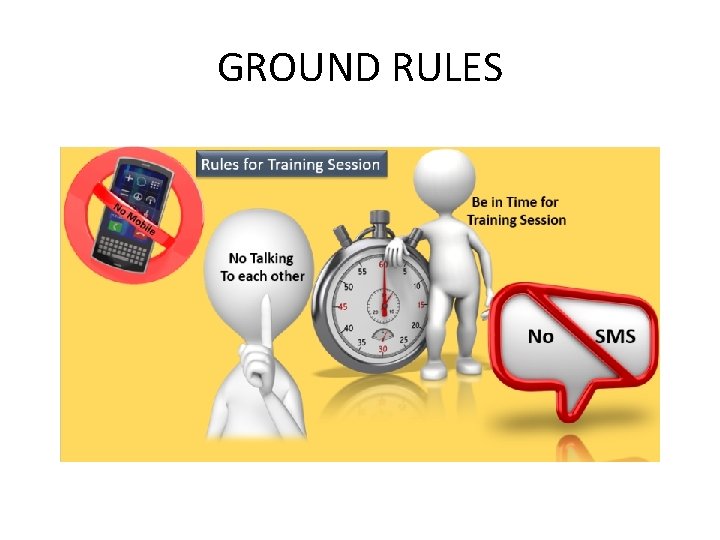
GROUND RULES
Work Shop Ground Rules • • Please Mobile Silent / off, if you need to respond , kindly step out side. Respect , get respect. Please participate No, side talks. Raise your hand , if you have question. Please feel free to take personal breaks as needed. Any other ground rules to add?
Programme outline: 1. 2. 3. 4. 5. The concept of training. Basic skills for effective training, self control. What Makes a Good Trainer Your Facilitation Skills Developing your training style
Training is a Process not an event
The concept of the training Training : Training is teaching, or developing in oneself or others, any skills and knowledge that relate to specific useful competencies.
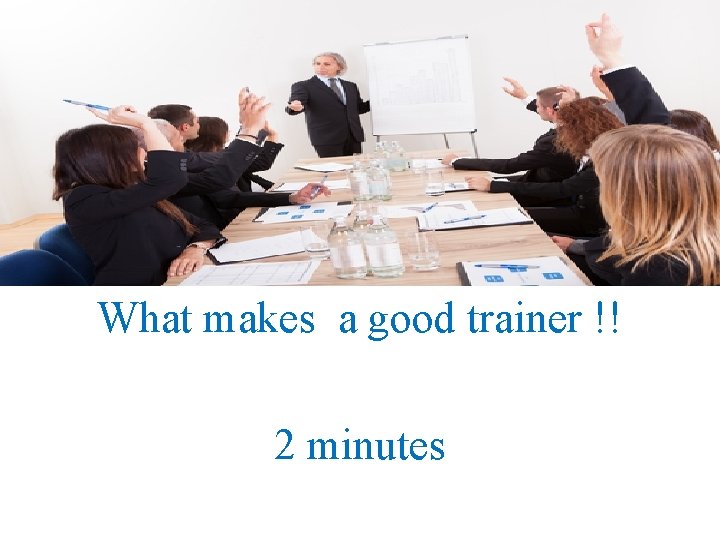
What makes a good trainer !! 2 minutes
What Makes a Good Trainer • Assessing your delivery skills • Characteristics of an effective training Program • Elements of a successful training program
If I had six hours to chop down a tree, I’d spend the first four hours sharpening the axe. - Abraham Lincon
Assessing your delivery skills Polishing your delivery skills Whether delivering a presentation at an academic conference or giving a lecture, polished delivery skills can mean the difference between an effective presentation/lecture and an ineffective one. Involving the audience • Eye contact is the key to a successful delivery since it helps you to make a connection with your audience. • Another way of involving the audience is by using question strategies. • You can also use examples, or stories relevant to both your topic and your audience. Direct questions (brainstorming) and other activities (discussion groups, role plays) are also good ways to involve your audience and maintain their attention.
Assessing your delivery skills Showing enthusiasm • You need to look and sound enthused in order to enthuse your audience. • enthusiasm by varying your facial expressions. Allow your expression to match your content and smile occasionally. • Movements and gestures add variety and interest to your presentation, and help to express your energy and enthusiasm. • Vary the speed and pitch of your voice to keep your audience awake and attentive. • Never overlook yourself as your best visual aid and as the best source of motivation for your audience.
Characteristics of an effective training Program • Start with a training needs assessment: This is a systematic process to determine who needs to be trained (i. e. , who needs improved KSAs), what they need training on (i. e. , what tasks need to be improved), and how the training process will be supported and aligned with strategic objectives. • Identify and communicate purpose, objectives, and outcome: These are identified based on the results of the training needs assessment and must be communicated to trainees in a clear and easy to understand way. • Relevant content: To be effective, training must include content that is directly linked to trainee job experiences. This makes intuitive sense, but when ignored it can reduce the impact of training on performance to zero.
Elements of a successful training program • • Perform a training need assessment Keep Adult learning Principles in mind. Develop a learning objectives Design training materials Implement the training Evaluate the training Repeat the training when necessary
Your Facilitation Skills • • • The art of facilitation Developing your training style Planning and preparing your training sessions Focusing your energy on the training sessions. Overcoming nervousness
The art of facilitation 1. 2. 3. 4. Some Basic Premises of Facilitation: The facilitator leads discussion but does not dominate. The facilitator is knowledgeable enough about a topic to be able to provide guiding questions. The facilitator is not an answer provider, but rather a tour guide. The facilitator promotes the concept of “safe space”.
Facilitation requires an understanding of the following: • Community – what are the guiding norms of the community with whom you are facilitating a discussion? . • Observation – The facilitator becomes a guide on the journey with the group. • Flexibility – Facilitators must be ready for non linear discussion. • Imagination – Facilitators permit participants to use their imagination to brainstorm. • Patience – one of the most frustrating parts of facilitating a conversation, particularly when you are knowledgeable about a topic, is that you have to be patient and understand that it may take others longer to arrive at a conclusion.
Facilitation requires an understanding of the following: • Balance – Effective facilitation balances the challenging and supporting of others. The voices of the individual and organization are heard and respected. Some other balances you may recognize: community vs. chapter; detail orientation vs. imagination. • Affirmation – Good facilitators affirm individuals and recognize the ideas of others. • Silence – Arguably the hardest thing for a facilitator is to permit silence. • Challenge – Facilitation, very literally, means “making things easier”, however, facilitators must challenge their participants to think differently and explore other options.
Developing your training style The most successful trainers will be those who are flexible, that is, they can adapt their training style to meet learners’ needs.
Trainers must be learner focused. They must view themselves as facilitators of learning and guides to the learners.
Learner Focused & Trainer Focused 5 minutes
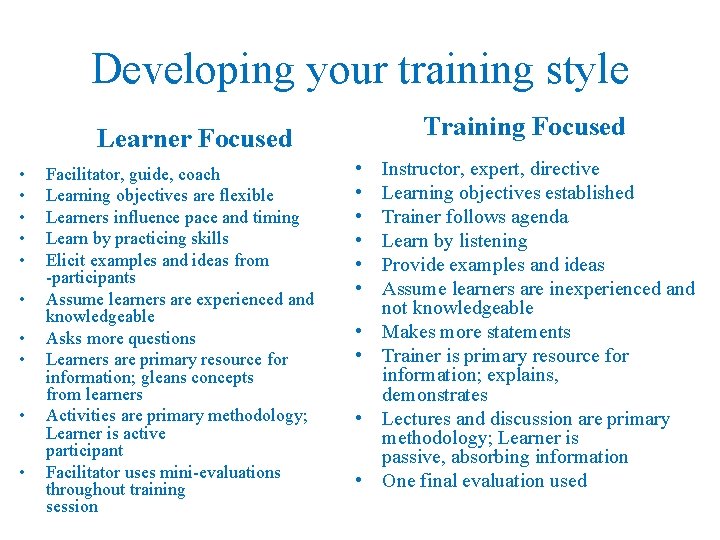
Developing your training style Training Focused Learner Focused • • • Facilitator, guide, coach Learning objectives are flexible Learners influence pace and timing Learn by practicing skills Elicit examples and ideas from participants Assume learners are experienced and knowledgeable Asks more questions Learners are primary resource for information; gleans concepts from learners Activities are primary methodology; Learner is active participant Facilitator uses mini evaluations throughout training session • • • Instructor, expert, directive Learning objectives established Trainer follows agenda Learn by listening Provide examples and ideas Assume learners are inexperienced and not knowledgeable Makes more statements Trainer is primary resource for information; explains, demonstrates Lectures and discussion are primary methodology; Learner is passive, absorbing information One final evaluation used
Question & Answer
THANK YOU !!! Mrs. FARHIA HUSSEIN ABDULLAHI MPH AT KAMPALA UNIVERSITY.
Kulan danbe oo xiisa leh