DPAS II for Administrators Training for Principals Supervising

- Slides: 51
DPAS II for Administrators: Training for Principals Supervising Assistant Principals Summer 2015 This power point is a collaborative project between New Leaders and the Delaware Academy for School Leadership. Please write your name and district on the table tent.
Session Outcomes As a result of active participation, Principals will: 1. Be prepared to implement the DPAS II for Assistant Principals in SY 15 -16 2. Increase their understanding of Delaware’s definition of effective school leadership 3. Increase their skills in key areas of evaluation, including: assessing the quality of student performance targets, helping Assistant Principals establish leadership practice priorities, and providing accurate and actionable feedback to individual Assistant Principals
Today’s Agenda 1. Welcome and overview of the day 2. Review the Purpose of Assistant Principal Evaluation 3. Overview of the Guide for Evaluating Assistant Principals 4. Goal Setting • Assessing the quality of student performance targets • Helping Assistant Principals establish leadership practice priorities 5. Evidence Collection 6. Implementation: Early Adopters Sharing Practices 7. Close the day
Think about your own experience as an Assistant Principal. Think about how you were evaluated. Write down your reflections of these questions: – What was the process? – How did your supervisor know how you were doing in your job? – What aspects of being an Assistant Principal were the focus of your evaluation? – In what ways was your evaluation helpful? In what ways was it not helpful? • Turn to a partner and share your reflections with a neighbor.
Leadership Matters Leadership is second only to classroom instruction among all school-related factors that contribute to what students learn at School leaders improve teaching and learning indirectly and most powerfully through their influence on staff motivation, commitment, and working conditions. School leadership was the most important condition affecting teachers’ willingness to remain teaching at their school. --Ken Leithwood
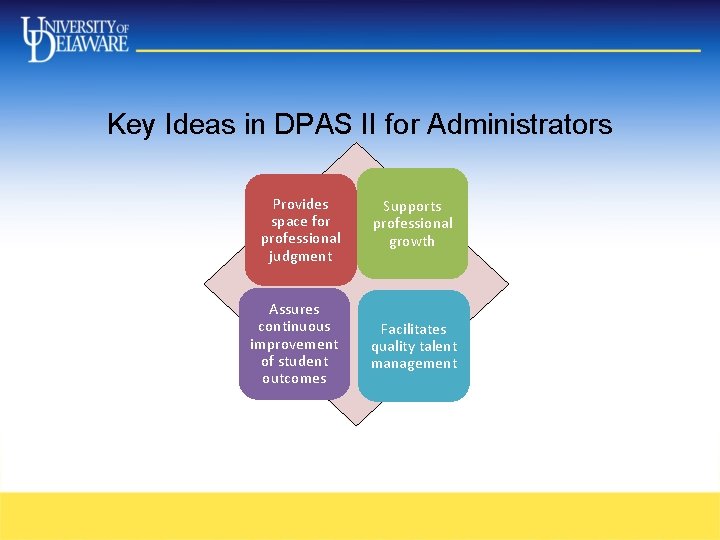
Key Ideas in DPAS II for Administrators Provides space for professional judgment Supports professional growth Assures continuous improvement of student outcomes Facilitates quality talent management
The Guide Delaware Performance Appraisal System Building greater skills and knowledge for educators DPAS-II Guide for Administrators (Assistant Principals) Supervisor Guide for Evaluating Assistant Principals Updated July 2015 Draft
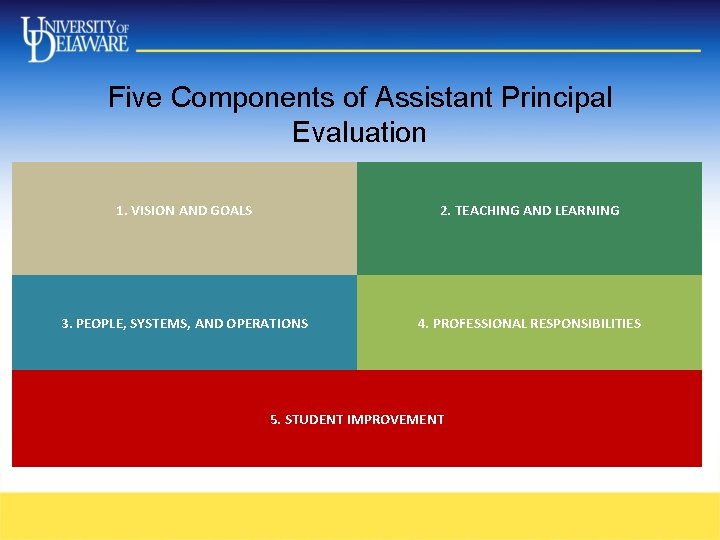
Five Components of Assistant Principal Evaluation 1. VISION AND GOALS 2. TEACHING AND LEARNING 3. PEOPLE, SYSTEMS, AND OPERATIONS 4. PROFESSIONAL RESPONSIBILITIES 5. STUDENT IMPROVEMENT
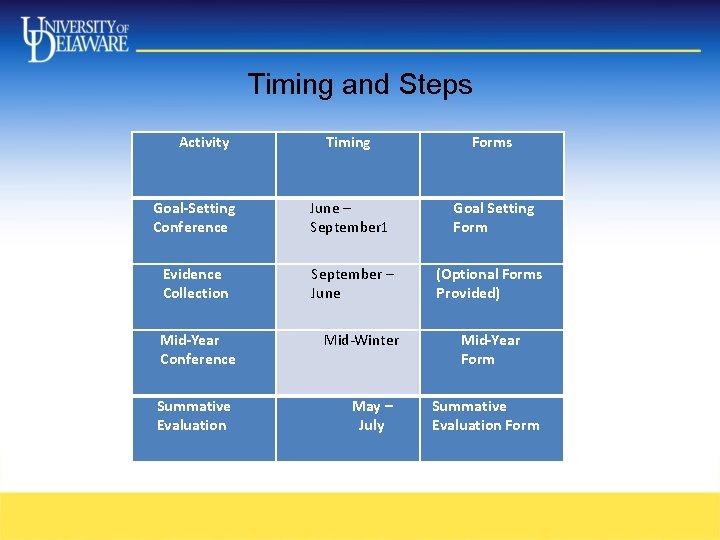
Timing and Steps Activity Timing Forms Goal-Setting Conference June – September 1 Goal Setting Form Evidence Collection September – June (Optional Forms Provided) Mid-Year Conference Mid-Winter Summative Evaluation May – July Mid-Year Form Summative Evaluation Form
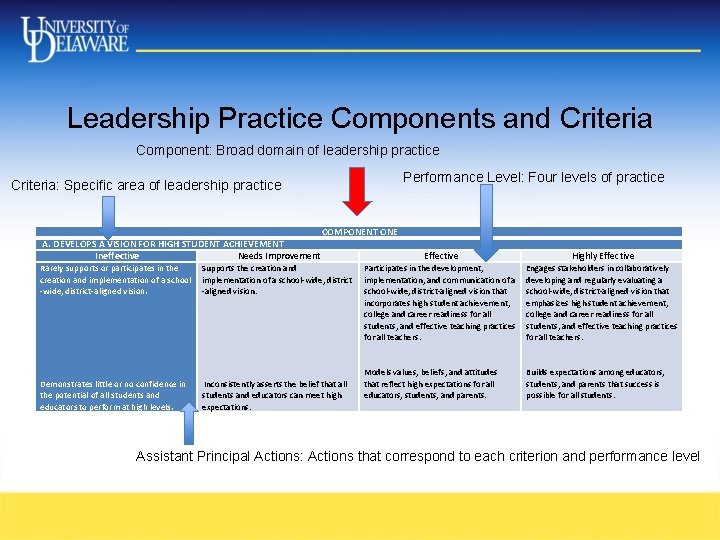
Leadership Practice Components and Criteria Component: Broad domain of leadership practice Performance Level: Four levels of practice Criteria: Specific area of leadership practice A. DEVELOPS A VISION FOR HIGH STUDENT ACHIEVEMENT Ineffective Needs Improvement Rarely supports or participates in the creation and implementation of a school -wide, district-aligned vision. Demonstrates little or no confidence in the potential of all students and educators to perform at high levels. COMPONENT ONE Supports the creation and implementation of a school-wide, district -aligned vision. Inconsistently asserts the belief that all students and educators can meet high expectations. Effective Highly Effective Participates in the development, implementation, and communication of a school-wide, district-aligned vision that incorporates high student achievement, college and career readiness for all students, and effective teaching practices for all teachers. Models values, beliefs, and attitudes that reflect high expectations for all educators, students, and parents. Engages stakeholders in collaboratively developing and regularly evaluating a school-wide, district-aligned vision that emphasizes high student achievement, college and career readiness for all students, and effective teaching practices for all teachers. Builds expectations among educators, students, and parents that success is possible for all students. Assistant Principal Actions: Actions that correspond to each criterion and performance level
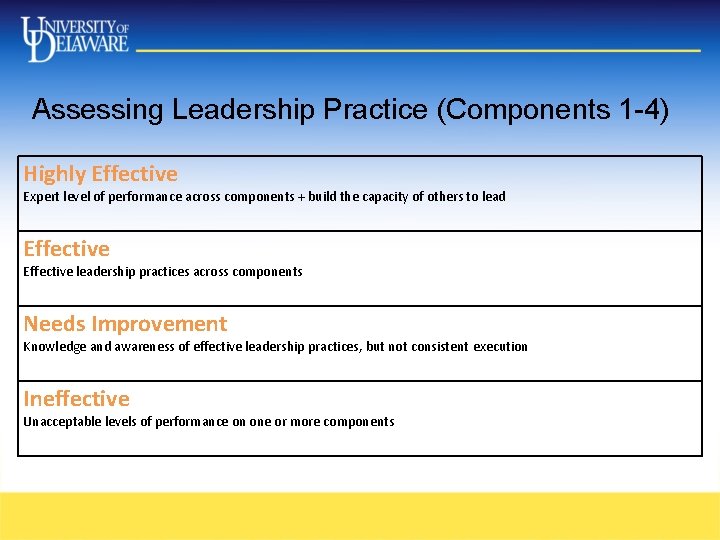
Assessing Leadership Practice (Components 1 -4) Highly Effective Expert level of performance across components + build the capacity of others to lead Effective leadership practices across components Needs Improvement Knowledge and awareness of effective leadership practices, but not consistent execution Ineffective Unacceptable levels of performance on one or more components
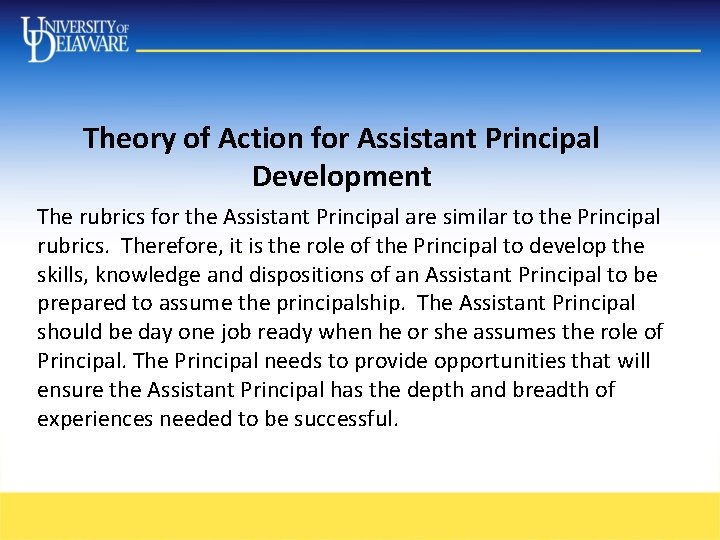
Theory of Action for Assistant Principal Development The rubrics for the Assistant Principal are similar to the Principal rubrics. Therefore, it is the role of the Principal to develop the skills, knowledge and dispositions of an Assistant Principal to be prepared to assume the principalship. The Assistant Principal should be day one job ready when he or she assumes the role of Principal. The Principal needs to provide opportunities that will ensure the Assistant Principal has the depth and breadth of experiences needed to be successful.
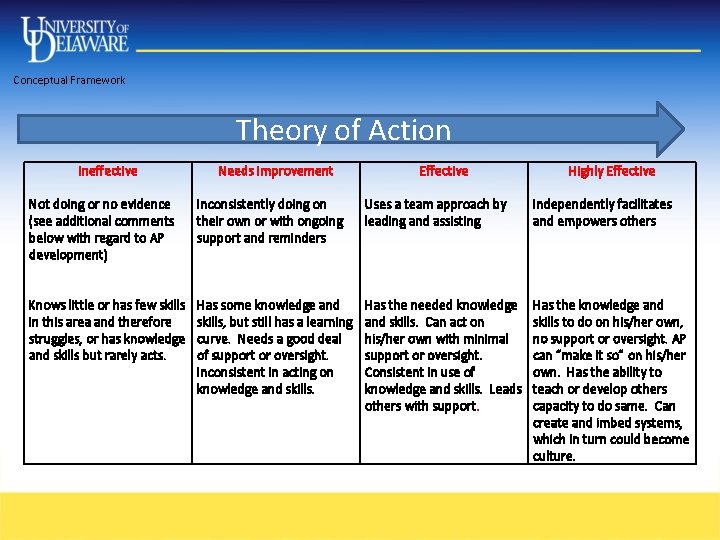
Conceptual Framework Theory of Action Ineffective Needs Improvement Effective Highly Effective Not doing or no evidence (see additional comments below with regard to AP development) Knows little or has few skills in this area and therefore struggles, or has knowledge and skills but rarely acts. Inconsistently doing on their own or with ongoing support and reminders Has some knowledge and skills, but still has a learning curve. Needs a good deal of support or oversight. Inconsistent in acting on knowledge and skills. Uses a team approach by leading and assisting Has the needed knowledge and skills. Can act on his/her own with minimal support or oversight. Consistent in use of knowledge and skills. Leads others with support. Independently facilitates and empowers others Has the knowledge and skills to do on his/her own, no support or oversight. AP can “make it so” on his/her own. Has the ability to teach or develop others capacity to do same. Can create and imbed systems, which in turn could become culture.
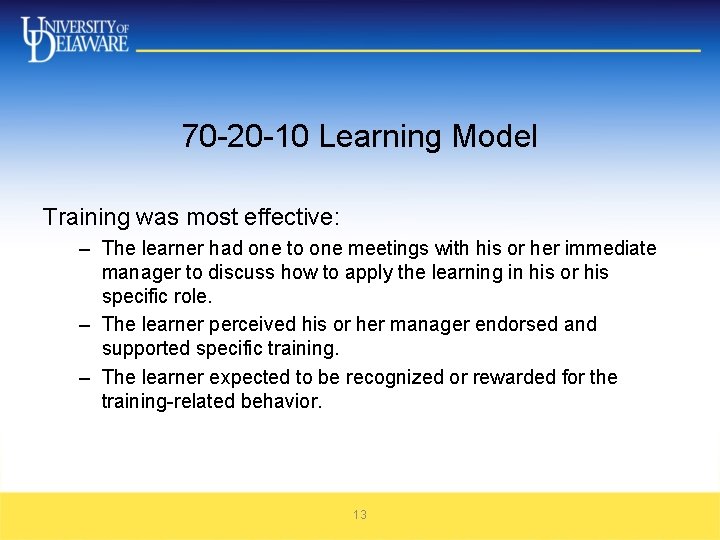
70 -20 -10 Learning Model Training was most effective: – The learner had one to one meetings with his or her immediate manager to discuss how to apply the learning in his or his specific role. – The learner perceived his or her manager endorsed and supported specific training. – The learner expected to be recognized or rewarded for the training-related behavior. 13
Processing • Each group will be assigned a section of the Guide. Chart key ideas about that section. Did any QUESTIONS surface about your role evaluating your Assistant Principal?
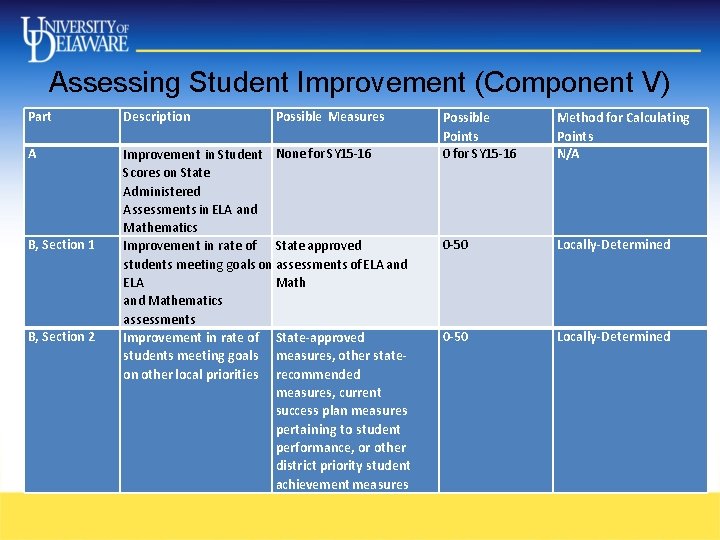
Assessing Student Improvement (Component V) Part Description A Improvement in Student None for SY 15 -16 Scores on State Administered Assessments in ELA and Mathematics Improvement in rate of State approved students meeting goals on assessments of ELA and ELA Math and Mathematics assessments Improvement in rate of State-approved students meeting goals measures, other stateon other local priorities recommended measures, current success plan measures pertaining to student performance, or other district priority student achievement measures B, Section 1 B, Section 2 Possible Measures Possible Points 0 for SY 15 -16 Method for Calculating Points N/A 0 -50 Locally-Determined
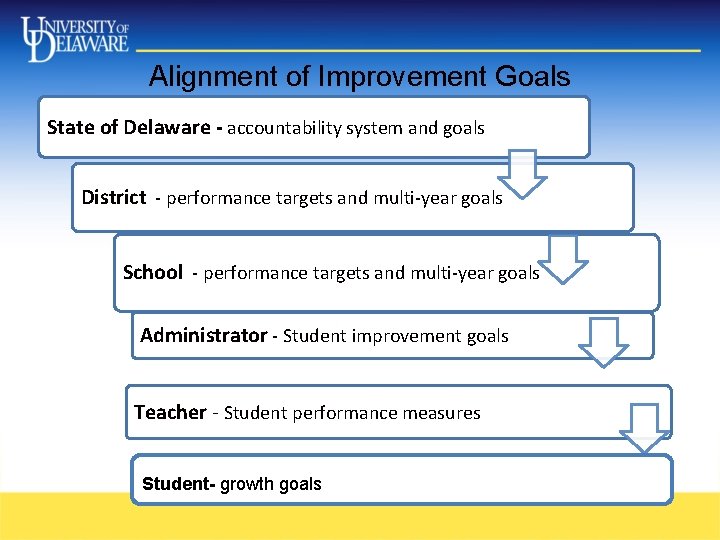
Alignment of Improvement Goals State of Delaware - accountability system and goals District - performance targets and multi-year goals School - performance targets and multi-year goals Administrator - Student improvement goals Teacher - Student performance measures Student- growth goals
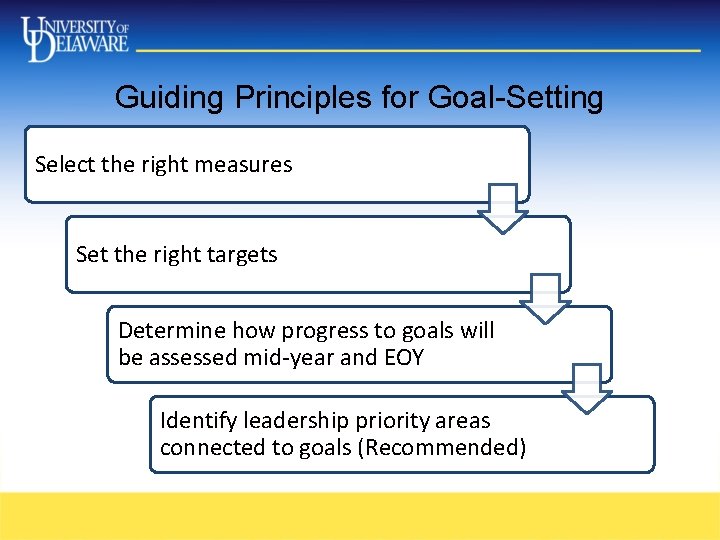
Guiding Principles for Goal-Setting Select the right measures Set the right targets Determine how progress to goals will be assessed mid-year and EOY Identify leadership priority areas connected to goals (Recommended)
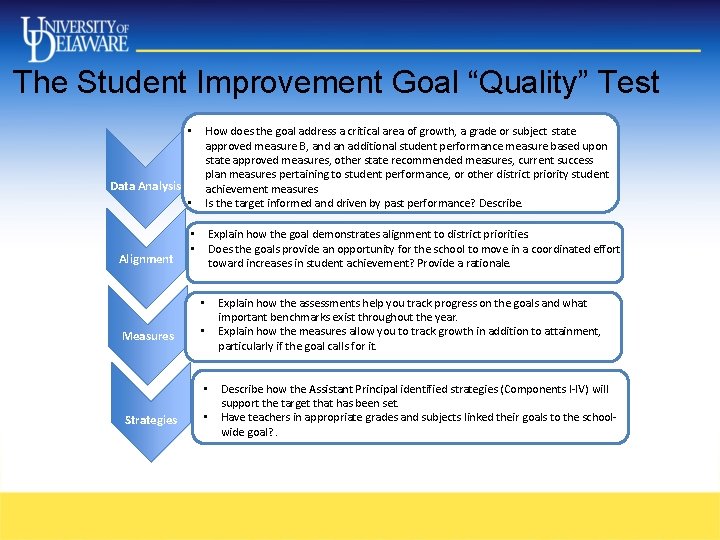
The Student Improvement Goal “Quality” Test • Data Analysis • Alignment How does the goal address a critical area of growth, a grade or subject state approved measure B, and an additional student performance measure based upon state approved measures, other state recommended measures, current success plan measures pertaining to student performance, or other district priority student achievement measures Is the target informed and driven by past performance? Describe. Explain how the goal demonstrates alignment to district priorities. Does the goals provide an opportunity for the school to move in a coordinated effort toward increases in student achievement? Provide a rationale. • • • Measures • • Strategies • Explain how the assessments help you track progress on the goals and what important benchmarks exist throughout the year. Explain how the measures allow you to track growth in addition to attainment, particularly if the goal calls for it. Describe how the Assistant Principal identified strategies (Components I-IV) will support the target that has been set. Have teachers in appropriate grades and subjects linked their goals to the schoolwide goal? .
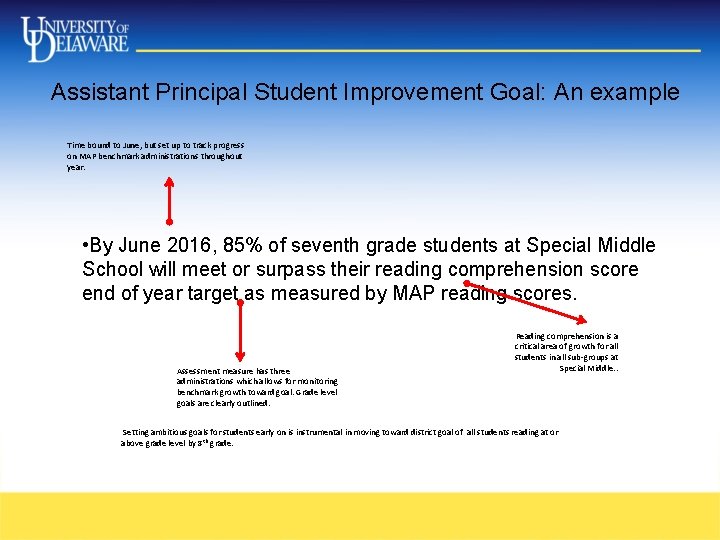
Assistant Principal Student Improvement Goal: An example Time bound to June, but set up to track progress on MAP benchmark administrations throughout year. • By June 2016, 85% of seventh grade students at Special Middle School will meet or surpass their reading comprehension score end of year target as measured by MAP reading scores. Assessment measure has three administrations which allows for monitoring benchmark growth toward goal. Grade level goals are clearly outlined. Reading comprehension is a critical area of growth for all students in all sub-groups at Special Middle. . Setting ambitious goals for students early on is instrumental in moving toward district goal of all students reading at or above grade level by 8 th grade.
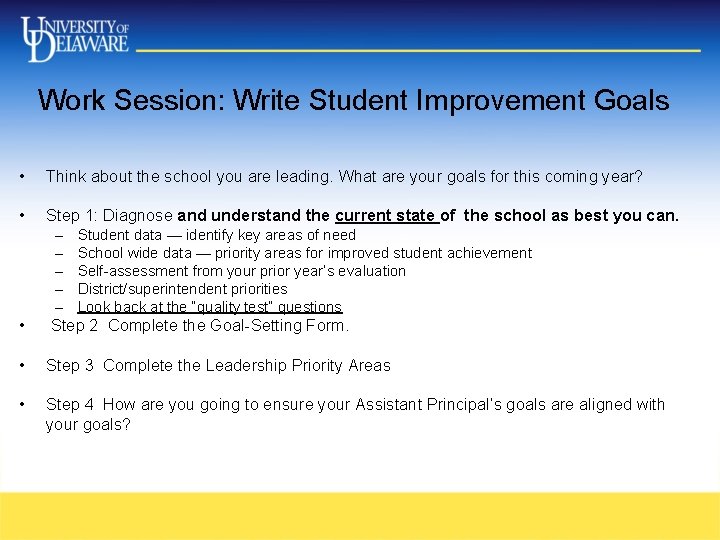
Work Session: Write Student Improvement Goals • Think about the school you are leading. What are your goals for this coming year? • Step 1: Diagnose and understand the current state of the school as best you can. – – – Student data — identify key areas of need School wide data — priority areas for improved student achievement Self-assessment from your prior year’s evaluation District/superintendent priorities Look back at the “quality test” questions • Step 2: Complete the Goal-Setting Form. • Step 3: Complete the Leadership Priority Areas • Step 4: How are you going to ensure your Assistant Principal’s goals are aligned with your goals?
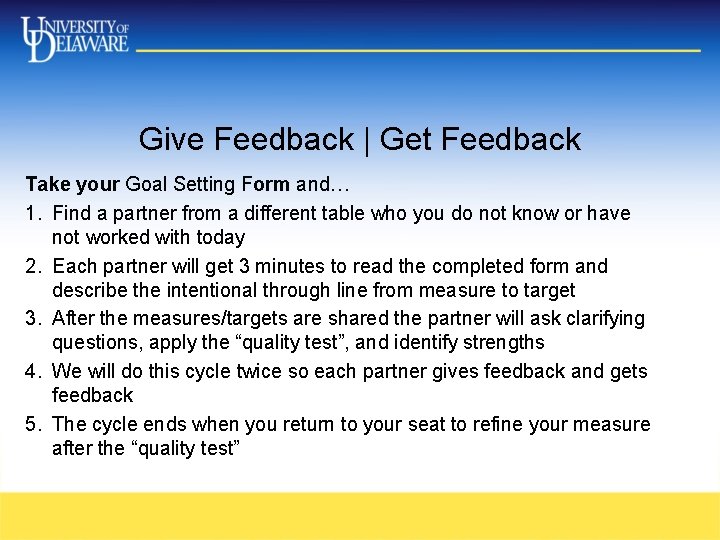
Give Feedback | Get Feedback Take your Goal Setting Form and… 1. Find a partner from a different table who you do not know or have not worked with today 2. Each partner will get 3 minutes to read the completed form and describe the intentional through line from measure to target 3. After the measures/targets are shared the partner will ask clarifying questions, apply the “quality test”, and identify strengths 4. We will do this cycle twice so each partner gives feedback and gets feedback 5. The cycle ends when you return to your seat to refine your measure after the “quality test”
Checking for Understanding What strikes you as critical when carrying out this process in your own district? What questions, concerns, ideas do you have about goal setting?
Effective Leadership Brainstorm • Take 5 minutes on your own to list what it takes – skills, knowledge, habits, mindsets – to be an effective Assistant Principal in your school district • Share and compare with your table group. Where are there similarities? Differences? • Together as a team, prioritize the top ten from the lists and put them up on chart paper. Post the paper when you are finished. • Take a gallery walk.
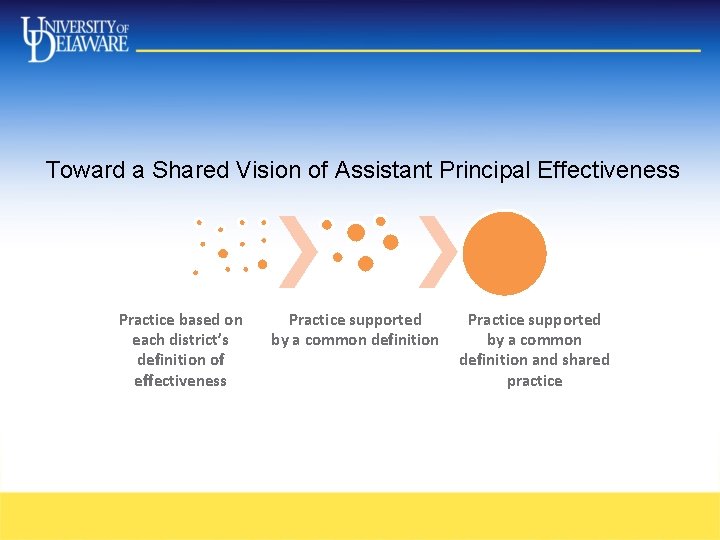
Toward a Shared Vision of Assistant Principal Effectiveness Practice based on each district’s definition of effectiveness Practice supported by a common definition and shared practice
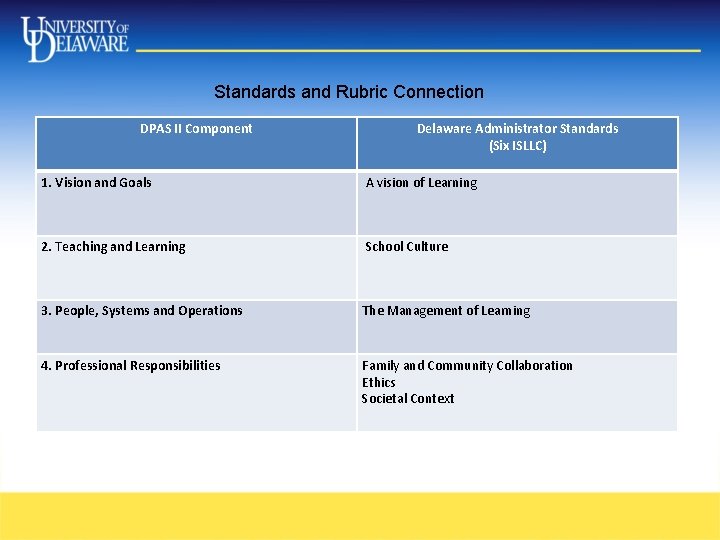
Standards and Rubric Connection DPAS II Component Delaware Administrator Standards (Six ISLLC) 1. Vision and Goals A vision of Learning 2. Teaching and Learning School Culture 3. People, Systems and Operations The Management of Learning 4. Professional Responsibilities Family and Community Collaboration Ethics Societal Context
Rubric Design • Directly linked to ISLLC standards. • Each component has four or five criteria and are the basis upon which the performance of an administrator is evaluated. • Each criterion has four performance levels described in the rubric.
Content and Language of the Rubric • Provides lens for evaluating administrators • Articulates new performance descriptors for highly effective and effective leadership • Provides common language to describe leadership practice • Puts focus on evidence to describe level of performance • Orients feedback toward professional growth with descriptors
Read Component 1: Vision and Goals across the performance levels. Begin at the criterion level. Next read the indicator language across from “ineffective to highly effective. ”
Rubric Language What evidence could you collect for Component 1: Vision and Goals ? What distinguishes each level? Refer to the Theory of Action.
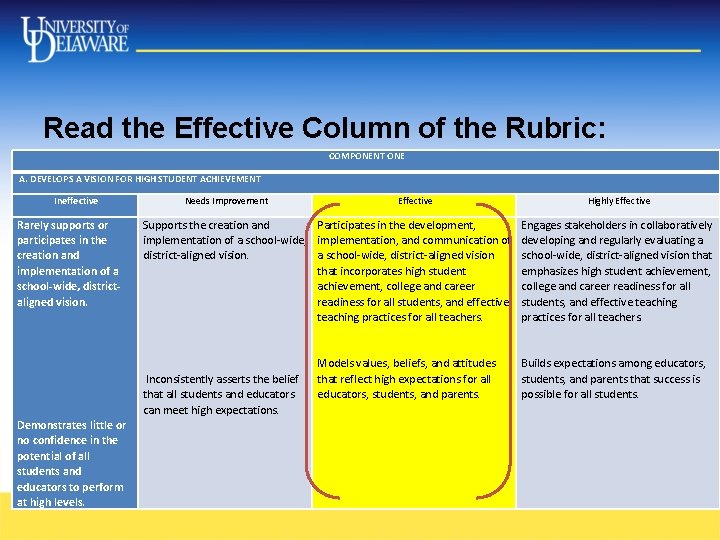
Read the Effective Column of the Rubric: COMPONENT ONE A. DEVELOPS A VISION FOR HIGH STUDENT ACHIEVEMENT Ineffective Rarely supports or participates in the creation and implementation of a school-wide, districtaligned vision. Demonstrates little or no confidence in the potential of all students and educators to perform at high levels. Needs Improvement Effective Highly Effective Supports the creation and implementation of a school-wide, district-aligned vision. Inconsistently asserts the belief that all students and educators can meet high expectations. Participates in the development, implementation, and communication of a school-wide, district-aligned vision that incorporates high student achievement, college and career readiness for all students, and effective teaching practices for all teachers. Models values, beliefs, and attitudes that reflect high expectations for all educators, students, and parents. Engages stakeholders in collaboratively developing and regularly evaluating a school-wide, district-aligned vision that emphasizes high student achievement, college and career readiness for all students, and effective teaching practices for all teachers. Builds expectations among educators, students, and parents that success is possible for all students.
Discussion • What features stand out to you as you read down the “effective” column in Component One: Vision and Goals? • Note areas in Component One: Vision and Goals that aligns to your table’s brainstorm about what it takes to be an effective Assistant Principal in your district. • What area(s) present challenges to determining effectiveness? Why?
Video Note taking • Directions: ØTake notes while you view the video clip ØWe will only collect evidence for Component One: Vision and Goals. ØAs you watch the video, only record evidence that you can see or hear. Try to suspend any judgment. https: //drive. google. com/file/d/0 By 7 Fy. Yptw 7 Wnbm. Ew. RUdk UElo. Rj. A/view? usp=sharing
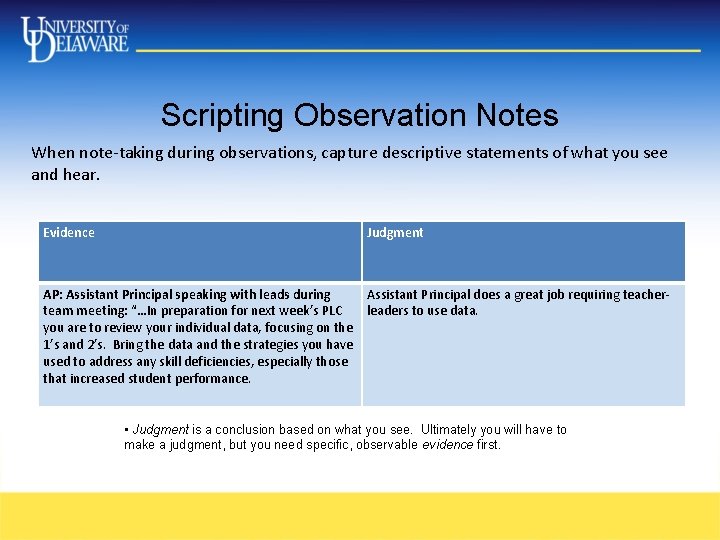
Scripting Observation Notes When note-taking during observations, capture descriptive statements of what you see and hear. Evidence Judgment AP: Assistant Principal speaking with leads during Assistant Principal does a great job requiring teacherteam meeting: “…In preparation for next week’s PLC leaders to use data. you are to review your individual data, focusing on the 1’s and 2’s. Bring the data and the strategies you have used to address any skill deficiencies, especially those that increased student performance. • Judgment is a conclusion based on what you see. Ultimately you will have to make a judgment, but you need specific, observable evidence first.
Put Component 1 into Practice: Video Case Study • • Video Debrief : What evidence of Assistant Principal practice in Component One: Vision and Goals were you able to see in this video? – What did you see and hear in this video that aligns to Component One: vision and goals? Come to agreements about WHAT you saw and heard as a table. – Based on the evidence collected, how would you describe the practice on the performance continuum? (Highly Effective, Needs Improvement, Ineffective? ) Why? – Calibrate as a table and be ready to defend your answer with concrete evidence.
Read Component 2: Teaching and Learning Read the full text of component 2. Criteria and Performance levels. ØPay special attention to the distinctions in language between Effective and Highly Effective. ØWhat does your group notice about the distinctions between an effective Assistant Principal and a highly effective Assistant Principal?
Distinctions Effective Highly Effective
Evidence Collection – Video Practice • Assistant Principal Conference with teacher. • Leverage Leadership – Clip 3 Leverage Leadership • Take Notes. • This is a coaching conference – not a Post Conference. 43
Rubric Study: Components 3 -4 Read the practice descriptors across the performance levels from “Ineffective to Highly Effective” for the assigned Component. 1. List five opportunities where you could collect evidence of Component 3 and 4. 2. What would you collect and how would you collect? 3. How could you plan these opportunities to ensure you had the evidence you needed? 4. Chart
Sharing Best Practices – Early Adopters - What prep work do you and your Assistant Principals do in advance to set goals? – How do you plan for your conversations? (focus, materials) – How do you make the links between student improvement goals and leadership performance areas? – Walk through your own process for assessing the quality of student improvement goal. – How do you think the revised rubric and the Theory of Action will impact your practice? – What has been most challenging? Have you devised ways to address the challenges? – What tools and methods are you using to generate evidence? • Additional questions?
Let’s Practice On the handout, cite evidence, develop questions for the assistant principal, what artifacts would you request, and what domain and criteria would this fall.
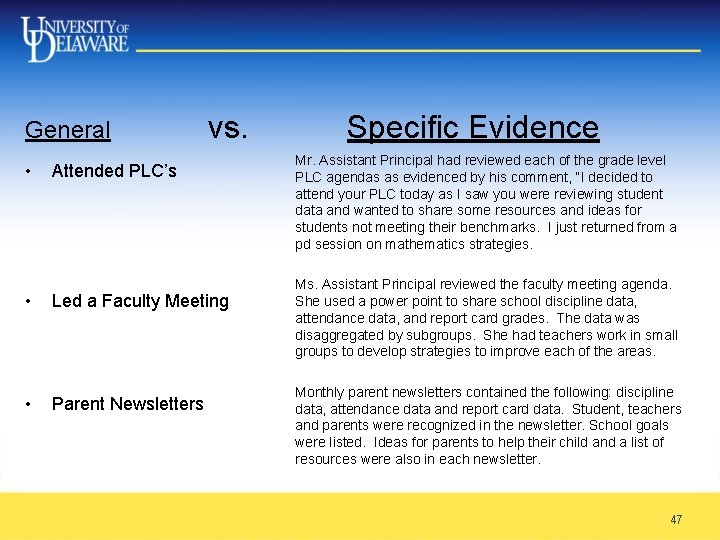
General • vs. Attended PLC’s • Led a Faculty Meeting • Parent Newsletters Specific Evidence Mr. Assistant Principal had reviewed each of the grade level PLC agendas as evidenced by his comment, “I decided to attend your PLC today as I saw you were reviewing student data and wanted to share some resources and ideas for students not meeting their benchmarks. I just returned from a pd session on mathematics strategies. Ms. Assistant Principal reviewed the faculty meeting agenda. She used a power point to share school discipline data, attendance data, and report card grades. The data was disaggregated by subgroups. She had teachers work in small groups to develop strategies to improve each of the areas. Monthly parent newsletters contained the following: discipline data, attendance data and report card data. Student, teachers and parents were recognized in the newsletter. School goals were listed. Ideas for parents to help their child and a list of resources were also in each newsletter. 47
Videos of two to three minutes to practice evidence collection and component and criteria identification https: //www. youtube. com/watch? v= AKr. Iw. ZNNgl. M English – talking in class https: //www. youtube. com/watch? v= 6 KK-ds. G 7 i 8 o – politically correct https: //www. youtube. com/watch? v= d. T 0 yh. Qau 8 Lk – Calls the room • https: //www. youtube. com/watch? v =5 Xx. V 14 r. OXt. Yh. Kdkw 6 year senior
During the walkthrough, the Assistant Principal’s radio blasts “Administrator needed in Room 205 immediately to remove a student. ” The Assistant Principal says, “I need to go” and immediately jogs to Room 205. Upon arrival at the room, there are two other Assistant Principals dealing with the situation. What questions would you ask? What component and criteria would this provide evidence?
On your way to a PLC that the Assistant Principal supervises, he says, “I expect all teachers to use data to plan for instruction. This group of teachers are looking at the data from the RTI screener. ” You notice that the teachers are having a superficial discussion of the data and appear to not see how to make the connection to their daily planning. The Assistant Principal does not contribute to the conversation.
51 Following up on the after school program, the Assistant Principal says, “The Boys & Girls Club use the library two days a week for extended learning time activities for our ESOL students. I asked Mrs. Herrera, the ESOL teacher, to collaborate with the program coordinator so they support the work we are doing with students related to reading and math. ”
When the Principal asks the Assistant Principal the status of ensuring all 35 teachers could use google doc, she responded, “Twenty -five teachers will be coming in to use the lab at 3: 30 today. The community college agreed to offer a free class on using Google Docs to our teachers on site from 3: 30 -4: 30. ” 52
When the Principal asked for an update on summer school, the Assistant Principal responded, “We have 200 students registered for summer school this year. Our primary focus is teaching reading skills such as vocabulary and reading comprehension. All students not meeting standards were invited and of the 150 who qualified, 125 are attending. I am still making follow up calls to those who have not responded. I have scheduled the buses, consulted with food service, and have hired staff. Our orientation meeting is next week. I created a handbook to explain expectations for students and staff. I have also planned an orientation meeting for parents and two family nights to give them ideas on how they can help at home, The district literacy specialist will lead it and all staff will attend. ” 53
In reviewing the Assistant Principal’s walkthrough data, you determine that he has completed five per day for the last past four months. Feedback is specific and aligned to his goals. All probationary teachers have been evaluated at least one time and five teachers that the Assistant Principal indicated as having concerns had been evaluated also. Feedback to these teachers were specific and actionable. This was aligned with his Leadership Priority goal to be more visible and become more familiar with teachers and curriculum.
Getting Ready for Implementation • Take 15 minutes to sketch out key actions step for yourself? – What do I need to communicate now to Assistant Principals I supervise? – What actions do I need to take before the school year starts? – What questions do I still have? • Find a new partner and share your action steps. – Facilitators will float to give feedback and address questions.
Wrap up • Complete evaluation form, please • Thank you so much for your contributions today!