
National Association of Student Financial Aid Administrators Federal
- Slides: 36
National Association of Student Financial Aid Administrators Federal Update Megan Coval COSUAA April 2019 © 2019 NASFAA
Slide 2 © 2019 NASFAA Agenda • Inside the Beltway • Outlook - Higher Education Act Reauthorization » House » Senate » FAFSA Act - Federal Budget & Funding • Department of Education Update • NASFAA Update
Slide 3 © 2019 NASFAA Inside the Beltway
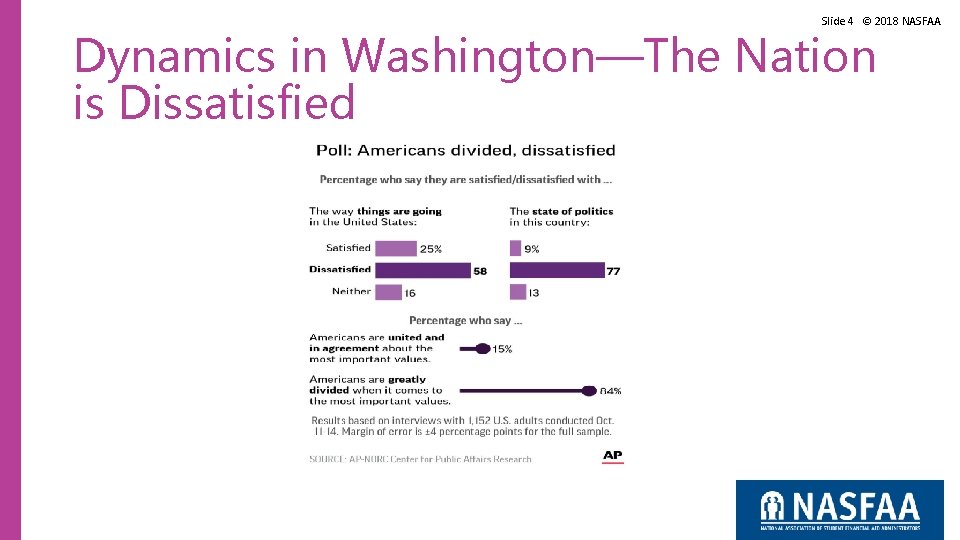
Slide 4 © 2018 NASFAA Dynamics in Washington—The Nation is Dissatisfied
Slide 5 © 2018 NASFAA Dynamics in Washington- The Nation is Tired • The takeaway: ” 14% of America, roughly half left and half right, consistently shouts, posts and votes, while 67% of us are exhausted. ” Source: "Hidden Tribes: A Study of America’s Polarized Landscape. " Source: Axios AM’s Mike Allen
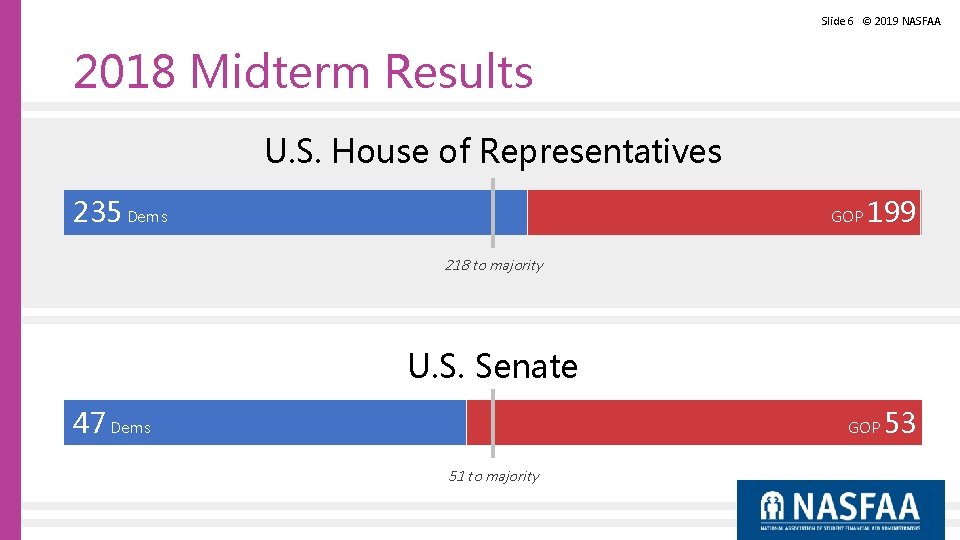
Slide 6 © 2019 NASFAA 2018 Midterm Results U. S. House of Representatives 235 Dems GOP 199 218 to majority U. S. Senate 47 Dems GOP 53 51 to majority
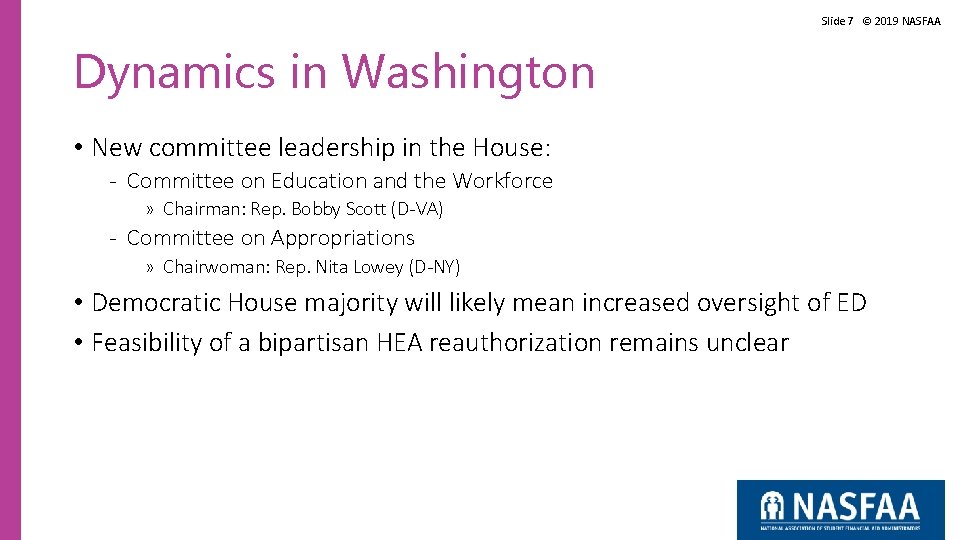
Slide 7 © 2019 NASFAA Dynamics in Washington • New committee leadership in the House: - Committee on Education and the Workforce » Chairman: Rep. Bobby Scott (D-VA) - Committee on Appropriations » Chairwoman: Rep. Nita Lowey (D-NY) • Democratic House majority will likely mean increased oversight of ED • Feasibility of a bipartisan HEA reauthorization remains unclear
Slide 8 © 2019 NASFAA
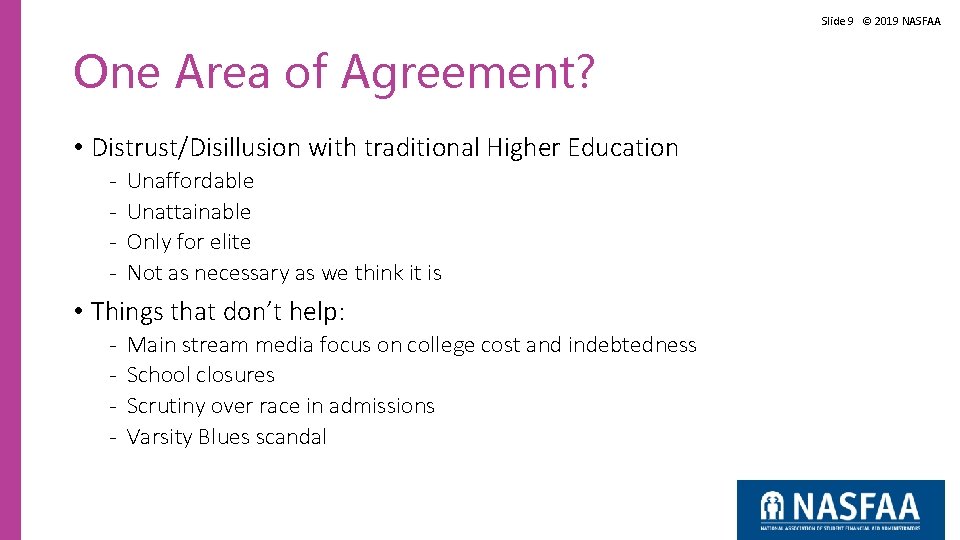
Slide 9 © 2019 NASFAA One Area of Agreement? • Distrust/Disillusion with traditional Higher Education - Unaffordable Unattainable Only for elite Not as necessary as we think it is • Things that don’t help: - Main stream media focus on college cost and indebtedness School closures Scrutiny over race in admissions Varsity Blues scandal
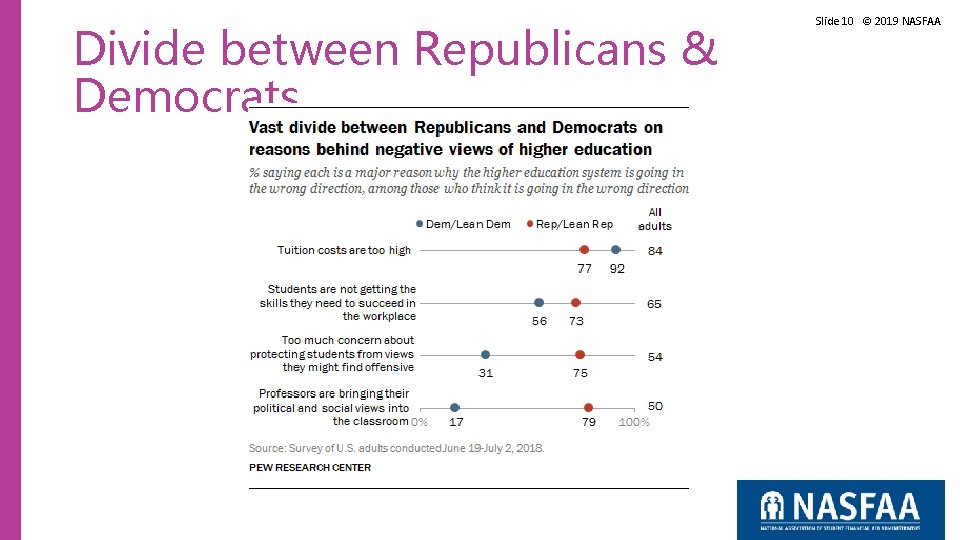
Divide between Republicans & Democrats Slide 10 © 2019 NASFAA
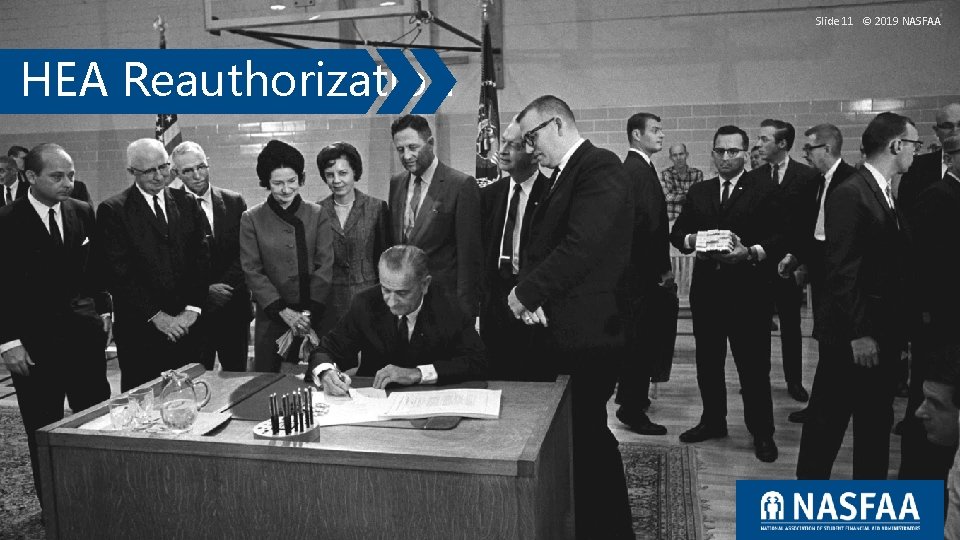
Slide 11 © 2019 NASFAA HEA Reauthorization
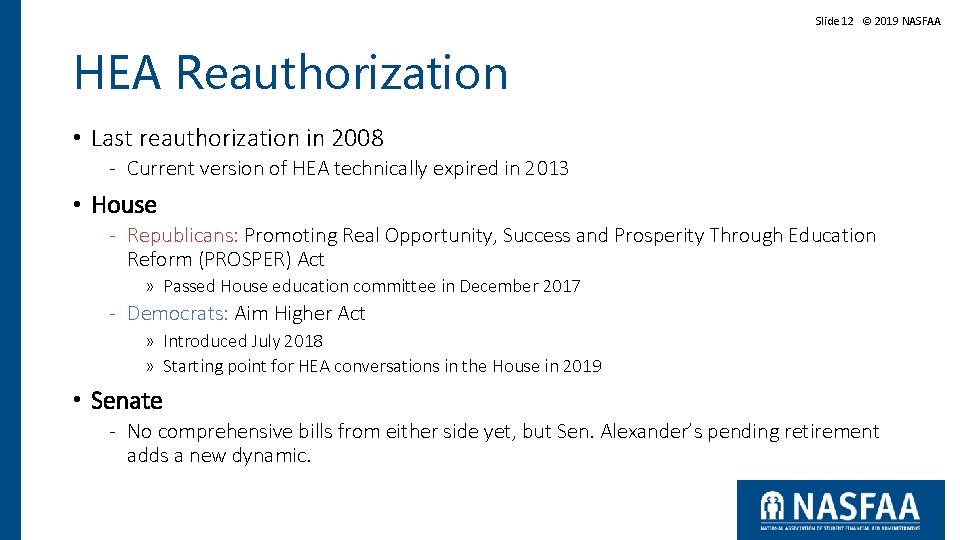
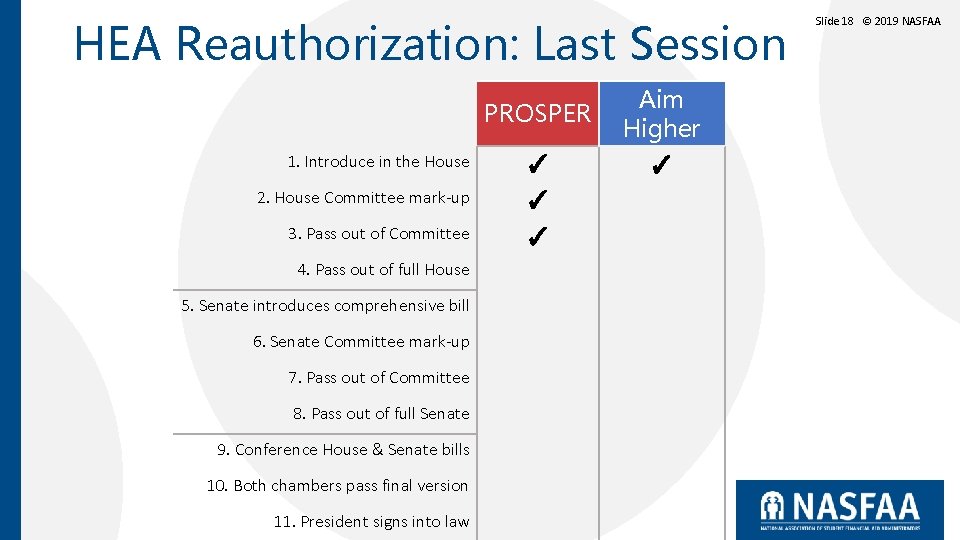
Slide 12 © 2019 NASFAA HEA Reauthorization • Last reauthorization in 2008 - Current version of HEA technically expired in 2013 • House - Republicans: Promoting Real Opportunity, Success and Prosperity Through Education Reform (PROSPER) Act » Passed House education committee in December 2017 - Democrats: Aim Higher Act » Introduced July 2018 » Starting point for HEA conversations in the House in 2019 • Senate - No comprehensive bills from either side yet, but Sen. Alexander’s pending retirement adds a new dynamic.
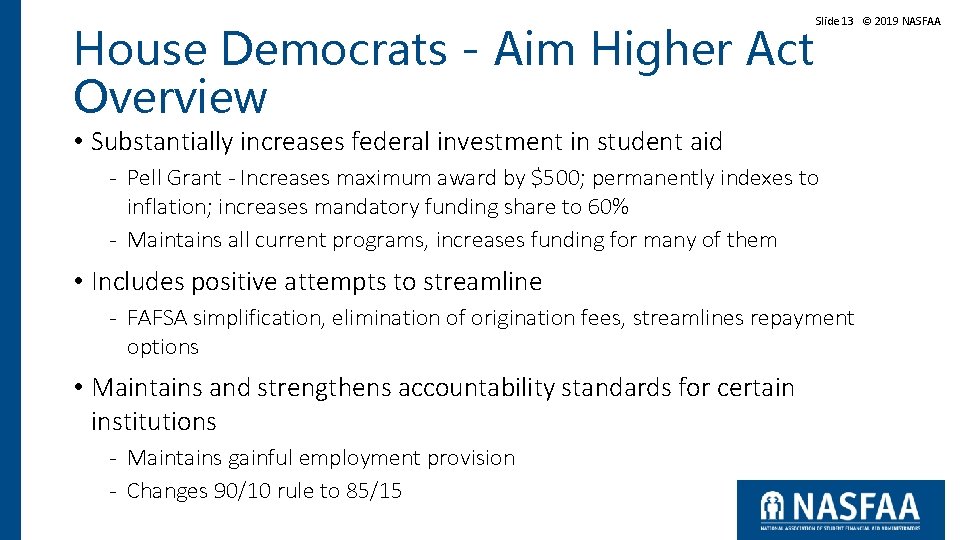
House Democrats - Aim Higher Act Overview Slide 13 © 2019 NASFAA • Substantially increases federal investment in student aid - Pell Grant - Increases maximum award by $500; permanently indexes to inflation; increases mandatory funding share to 60% - Maintains all current programs, increases funding for many of them • Includes positive attempts to streamline - FAFSA simplification, elimination of origination fees, streamlines repayment options • Maintains and strengthens accountability standards for certain institutions - Maintains gainful employment provision - Changes 90/10 rule to 85/15
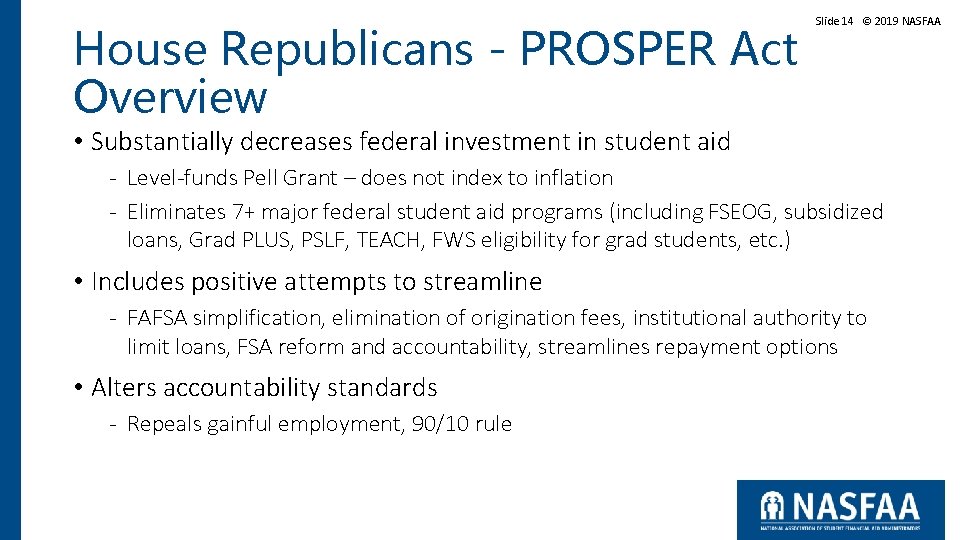
House Republicans - PROSPER Act Overview Slide 14 © 2019 NASFAA • Substantially decreases federal investment in student aid - Level-funds Pell Grant – does not index to inflation - Eliminates 7+ major federal student aid programs (including FSEOG, subsidized loans, Grad PLUS, PSLF, TEACH, FWS eligibility for grad students, etc. ) • Includes positive attempts to streamline - FAFSA simplification, elimination of origination fees, institutional authority to limit loans, FSA reform and accountability, streamlines repayment options • Alters accountability standards - Repeals gainful employment, 90/10 rule
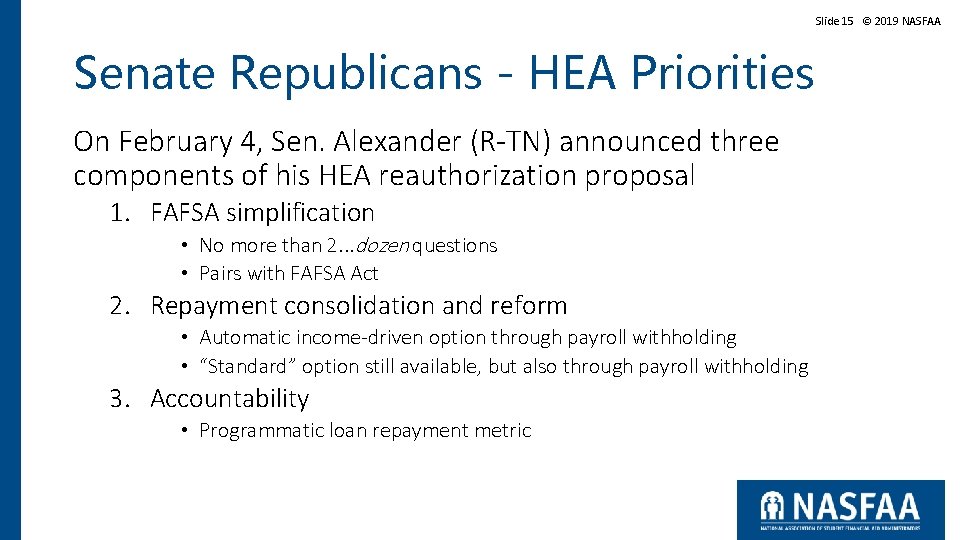
Slide 15 © 2019 NASFAA Senate Republicans - HEA Priorities On February 4, Sen. Alexander (R-TN) announced three components of his HEA reauthorization proposal 1. FAFSA simplification • No more than 2. . . dozen questions • Pairs with FAFSA Act 2. Repayment consolidation and reform • Automatic income-driven option through payroll withholding • “Standard” option still available, but also through payroll withholding 3. Accountability • Programmatic loan repayment metric
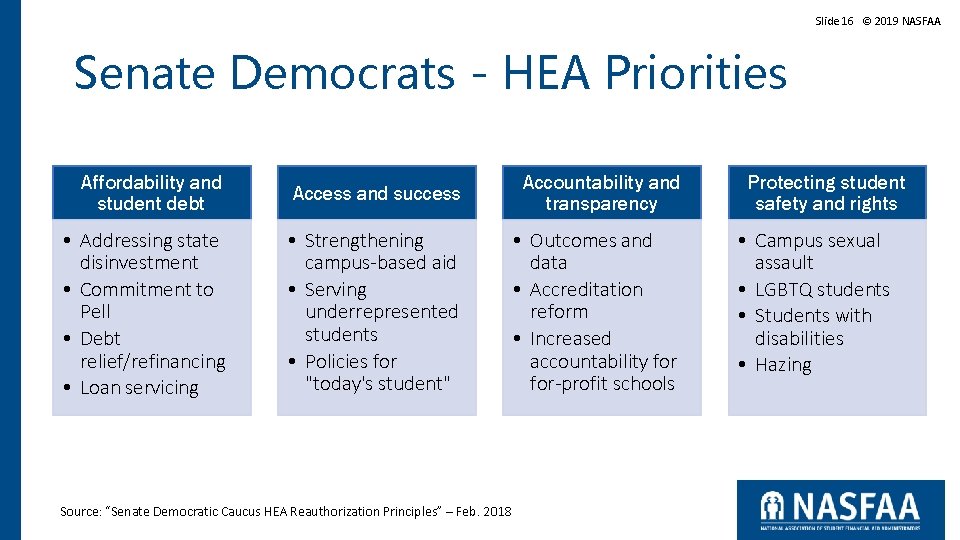
Slide 16 © 2019 NASFAA Senate Democrats - HEA Priorities Affordability and student debt Access and success Accountability and transparency • Addressing state disinvestment • Commitment to Pell • Debt relief/refinancing • Loan servicing • Strengthening campus-based aid • Serving underrepresented students • Policies for "today's student" • Outcomes and data • Accreditation reform • Increased accountability for-profit schools Source: “Senate Democratic Caucus HEA Reauthorization Principles” – Feb. 2018 Protecting student safety and rights • Campus sexual assault • LGBTQ students • Students with disabilities • Hazing
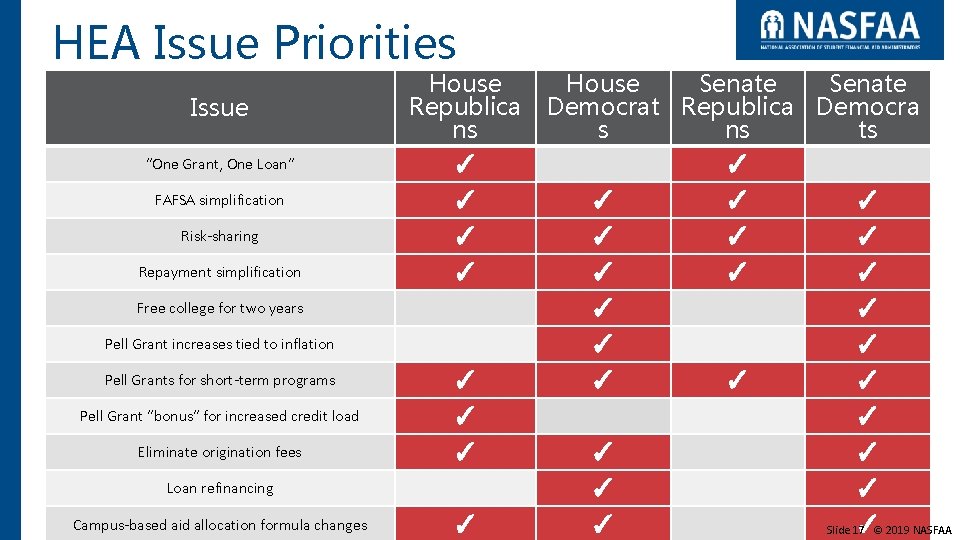
HEA Issue Priorities Issue “One Grant, One Loan” FAFSA simplification Risk-sharing Repayment simplification House Republica ns ✓ ✓ Free college for two years Pell Grant increases tied to inflation Pell Grants for short-term programs Pell Grant “bonus” for increased credit load Eliminate origination fees ✓ ✓ ✓ Loan refinancing Campus-based aid allocation formula changes ✓ House Senate Democrat Republica Democra s ns ts ✓ ✓ ✓ ✓ ✓ ✓ Slide 17 © 2019 NASFAA
HEA Reauthorization: Last Session PROSPER 1. Introduce in the House 2. House Committee mark-up ✓ ✓ 3. Pass out of Committee ✓ 4. Pass out of full House 5. Senate introduces comprehensive bill 6. Senate Committee mark-up 7. Pass out of Committee 8. Pass out of full Senate 9. Conference House & Senate bills 10. Both chambers pass final version 11. President signs into law Aim Higher ✓ Slide 18 © 2019 NASFAA
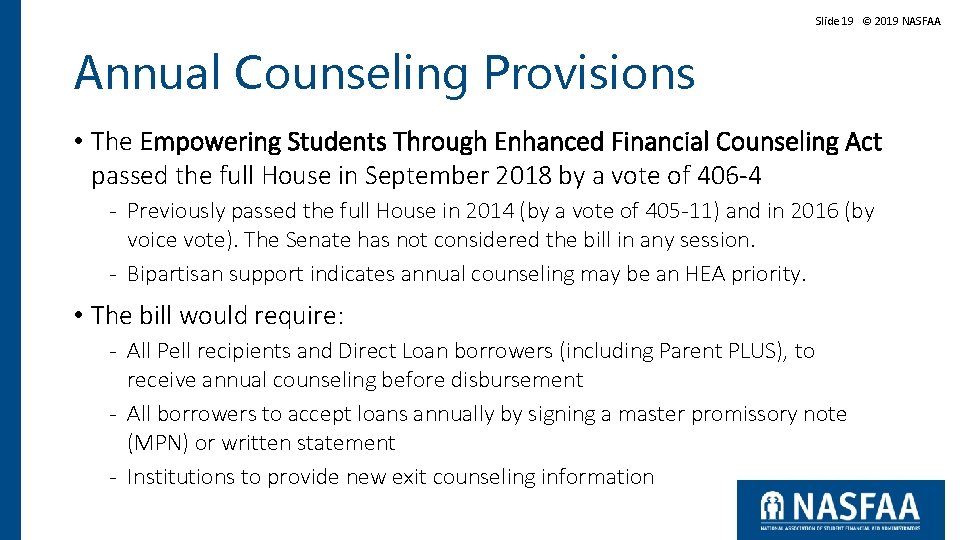
Slide 19 © 2019 NASFAA Annual Counseling Provisions • The Empowering Students Through Enhanced Financial Counseling Act passed the full House in September 2018 by a vote of 406 -4 - Previously passed the full House in 2014 (by a vote of 405 -11) and in 2016 (by voice vote). The Senate has not considered the bill in any session. - Bipartisan support indicates annual counseling may be an HEA priority. • The bill would require: - All Pell recipients and Direct Loan borrowers (including Parent PLUS), to receive annual counseling before disbursement - All borrowers to accept loans annually by signing a master promissory note (MPN) or written statement - Institutions to provide new exit counseling information
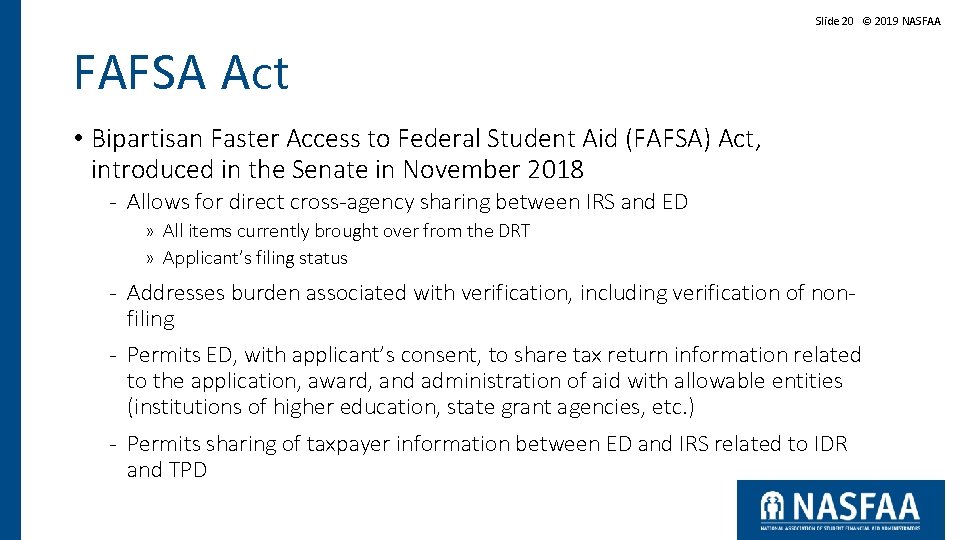
Slide 20 © 2019 NASFAA FAFSA Act • Bipartisan Faster Access to Federal Student Aid (FAFSA) Act, introduced in the Senate in November 2018 - Allows for direct cross-agency sharing between IRS and ED » All items currently brought over from the DRT » Applicant’s filing status - Addresses burden associated with verification, including verification of nonfiling - Permits ED, with applicant’s consent, to share tax return information related to the application, award, and administration of aid with allowable entities (institutions of higher education, state grant agencies, etc. ) - Permits sharing of taxpayer information between ED and IRS related to IDR and TPD
Federal Budget & Funding Slide 21 © 2019 NASFAA
Slide 22 © 2019 NASFAA FY 2019 Appropriations Update • House and Senate leaders agreed on funding levels for FY 2019 defense, labor, health, and education programs in September 2018 • President Trump signed the package into law on September 28 • First “regular order, ” on-time passage of education funding in over two decades (since 1996)
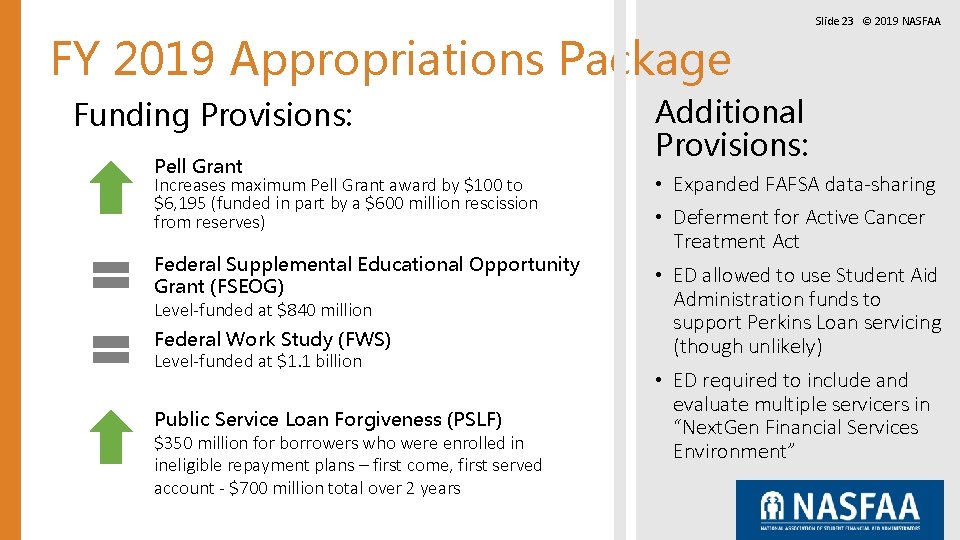
FY 2019 Appropriations Package Funding Provisions: Pell Grant Increases maximum Pell Grant award by $100 to $6, 195 (funded in part by a $600 million rescission from reserves) Federal Supplemental Educational Opportunity Grant (FSEOG) Level-funded at $840 million Federal Work Study (FWS) Level-funded at $1. 1 billion Public Service Loan Forgiveness (PSLF) $350 million for borrowers who were enrolled in ineligible repayment plans – first come, first served account - $700 million total over 2 years Slide 23 © 2019 NASFAA Additional Provisions: • Expanded FAFSA data-sharing • Deferment for Active Cancer Treatment Act • ED allowed to use Student Aid Administration funds to support Perkins Loan servicing (though unlikely) • ED required to include and evaluate multiple servicers in “Next. Gen Financial Services Environment”
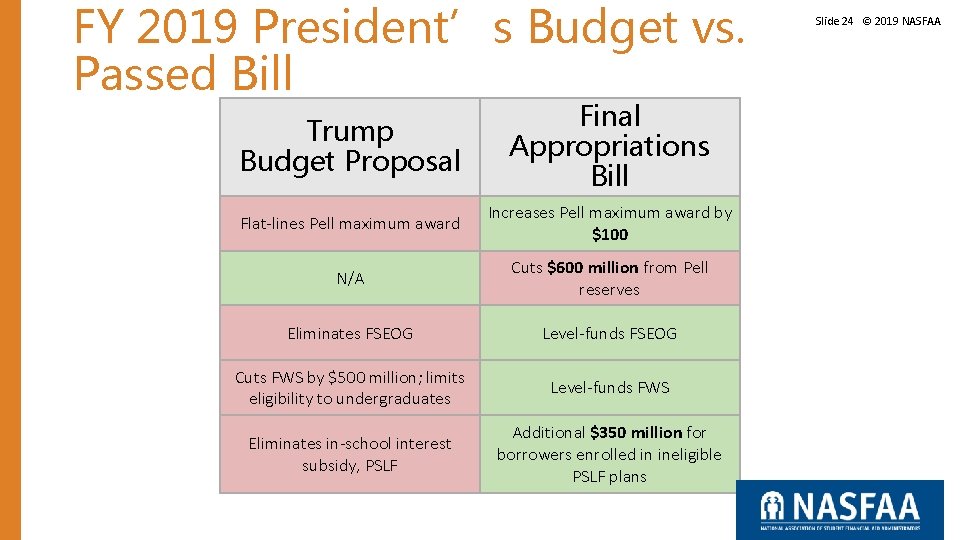
FY 2019 President’s Budget vs. Passed Bill Trump Budget Proposal Final Appropriations Bill Flat-lines Pell maximum award Increases Pell maximum award by $100 N/A Cuts $600 million from Pell reserves Eliminates FSEOG Level-funds FSEOG Cuts FWS by $500 million; limits eligibility to undergraduates Level-funds FWS Eliminates in-school interest subsidy, PSLF Additional $350 million for borrowers enrolled in ineligible PSLF plans Slide 24 © 2019 NASFAA
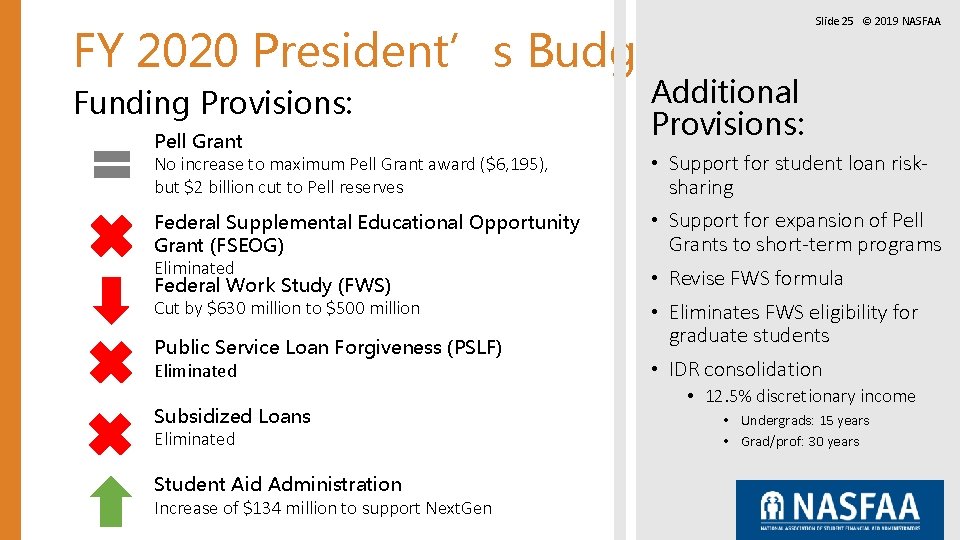
FY 2020 President’s Budget Funding Provisions: Pell Grant No increase to maximum Pell Grant award ($6, 195), but $2 billion cut to Pell reserves Federal Supplemental Educational Opportunity Grant (FSEOG) Eliminated Federal Work Study (FWS) Cut by $630 million to $500 million Public Service Loan Forgiveness (PSLF) Eliminated Subsidized Loans Eliminated Student Aid Administration Increase of $134 million to support Next. Gen Slide 25 © 2019 NASFAA Additional Provisions: • Support for student loan risksharing • Support for expansion of Pell Grants to short-term programs • Revise FWS formula • Eliminates FWS eligibility for graduate students • IDR consolidation • 12. 5% discretionary income • Undergrads: 15 years • Grad/prof: 30 years
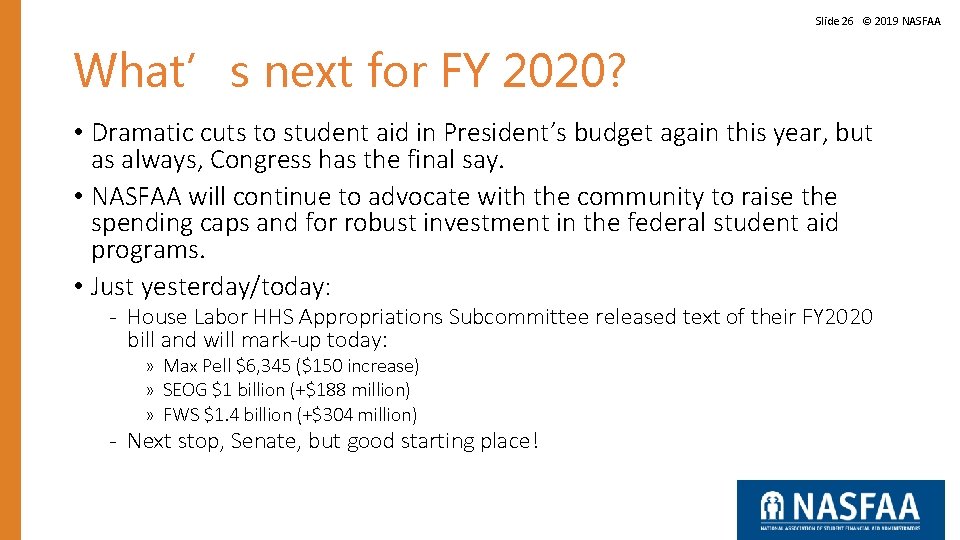
Slide 26 © 2019 NASFAA What’s next for FY 2020? • Dramatic cuts to student aid in President’s budget again this year, but as always, Congress has the final say. • NASFAA will continue to advocate with the community to raise the spending caps and for robust investment in the federal student aid programs. • Just yesterday/today: - House Labor HHS Appropriations Subcommittee released text of their FY 2020 bill and will mark-up today: » Max Pell $6, 345 ($150 increase) » SEOG $1 billion (+$188 million) » FWS $1. 4 billion (+$304 million) - Next stop, Senate, but good starting place!
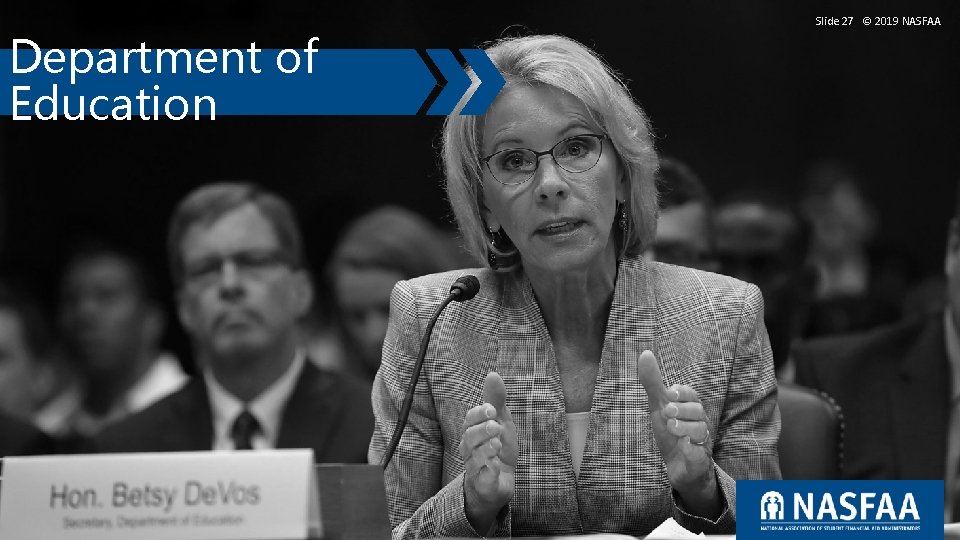
Department of Education Slide 27 © 2019 NASFAA
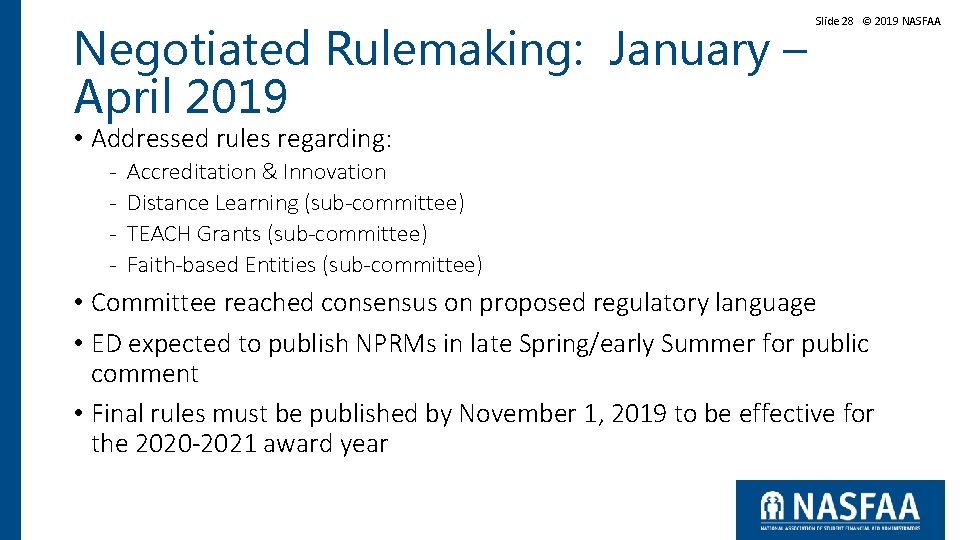
Negotiated Rulemaking: January – April 2019 Slide 28 © 2019 NASFAA • Addressed rules regarding: - Accreditation & Innovation Distance Learning (sub-committee) TEACH Grants (sub-committee) Faith-based Entities (sub-committee) • Committee reached consensus on proposed regulatory language • ED expected to publish NPRMs in late Spring/early Summer for public comment • Final rules must be published by November 1, 2019 to be effective for the 2020 -2021 award year
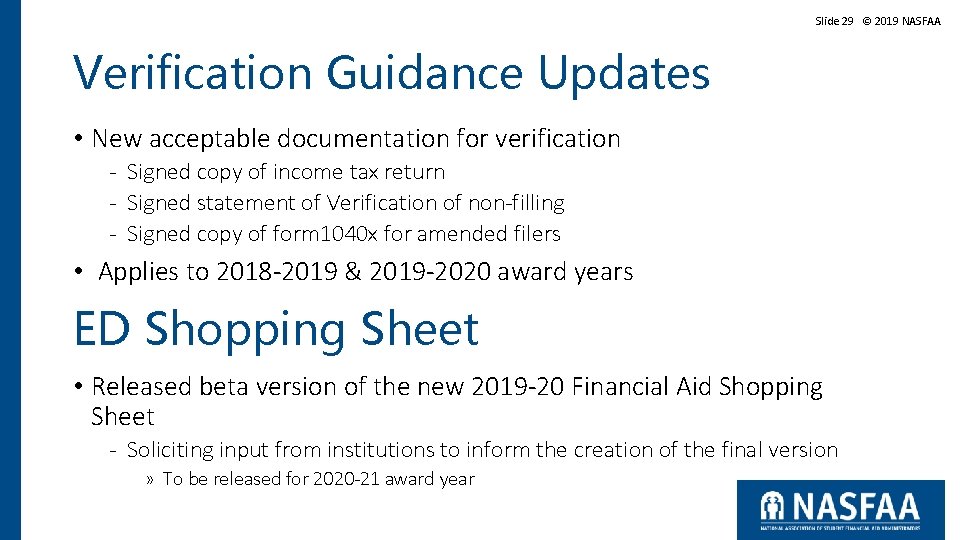
Slide 29 © 2019 NASFAA Verification Guidance Updates • New acceptable documentation for verification - Signed copy of income tax return - Signed statement of Verification of non-filling - Signed copy of form 1040 x for amended filers • Applies to 2018 -2019 & 2019 -2020 award years ED Shopping Sheet • Released beta version of the new 2019 -20 Financial Aid Shopping Sheet - Soliciting input from institutions to inform the creation of the final version » To be released for 2020 -21 award year
Slide 30 © 2019 NASFAA ED EA on Aid Offers • Released last week • Items to “avoid” • Community not consulted • Some conflicts with CFP
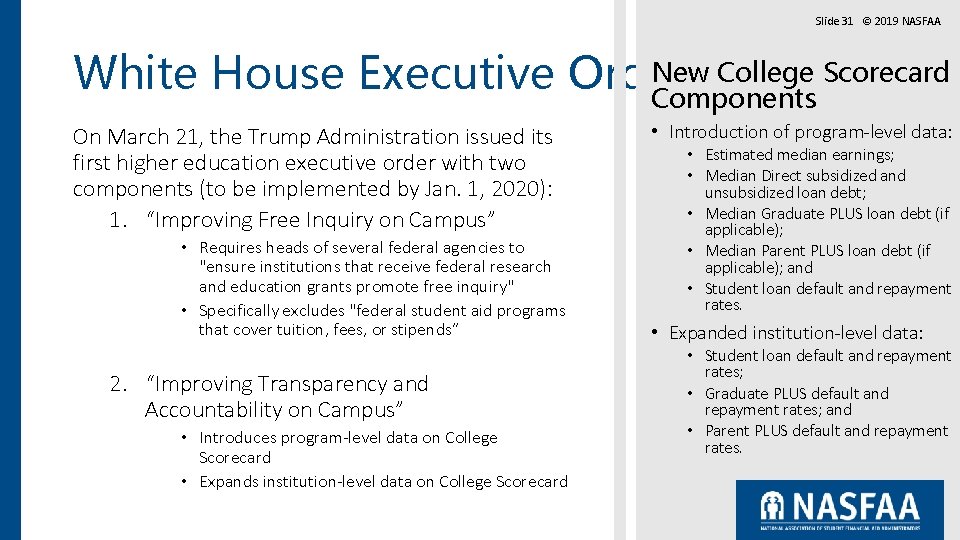
Slide 31 © 2019 NASFAA New College Scorecard White House Executive Order Components On March 21, the Trump Administration issued its first higher education executive order with two components (to be implemented by Jan. 1, 2020): 1. “Improving Free Inquiry on Campus” • Requires heads of several federal agencies to "ensure institutions that receive federal research and education grants promote free inquiry" • Specifically excludes "federal student aid programs that cover tuition, fees, or stipends” 2. “Improving Transparency and Accountability on Campus” • Introduces program-level data on College Scorecard • Expands institution-level data on College Scorecard • Introduction of program-level data: • Estimated median earnings; • Median Direct subsidized and unsubsidized loan debt; • Median Graduate PLUS loan debt (if applicable); • Median Parent PLUS loan debt (if applicable); and • Student loan default and repayment rates. • Expanded institution-level data: • Student loan default and repayment rates; • Graduate PLUS default and repayment rates; and • Parent PLUS default and repayment rates.
Slide 32 © 2019 NASFAA Update
NASFAA’s Recent Work on Award Notifications Slide 33 © 2019 NASFAA • In June 2018, the NASFAA Board of Directors voted to endorse a recommendation to Congress to standardize terms and elements on award notifications • Recommendation would incorporate NASFAA Code of Conduct into statute • For more information: • nasfaa. org/Improving_Award_Notifications
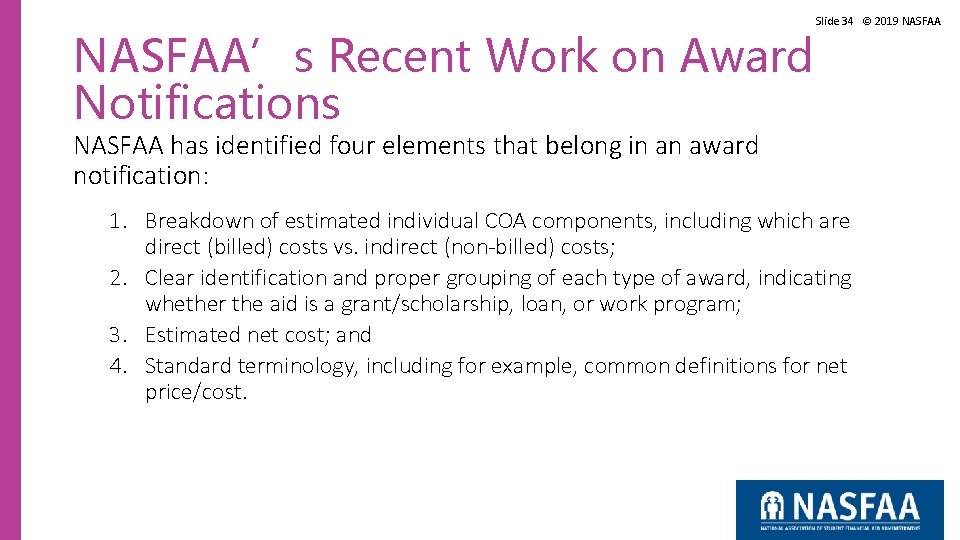
NASFAA’s Recent Work on Award Notifications Slide 34 © 2019 NASFAA has identified four elements that belong in an award notification: 1. Breakdown of estimated individual COA components, including which are direct (billed) costs vs. indirect (non-billed) costs; 2. Clear identification and proper grouping of each type of award, indicating whether the aid is a grant/scholarship, loan, or work program; 3. Estimated net cost; and 4. Standard terminology, including for example, common definitions for net price/cost.
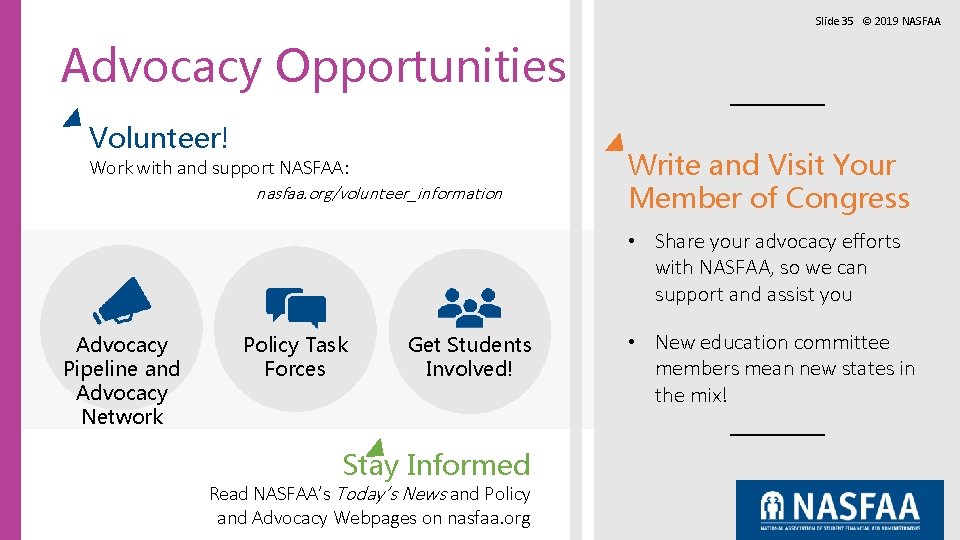
Slide 35 © 2019 NASFAA Advocacy Opportunities Volunteer! Work with and support NASFAA: nasfaa. org/volunteer_information Write and Visit Your Member of Congress • Share your advocacy efforts with NASFAA, so we can support and assist you Advocacy Pipeline and Advocacy Network Policy Task Forces Get Students Involved! Stay Informed Read NASFAA’s Today’s News and Policy and Advocacy Webpages on nasfaa. org • New education committee members mean new states in the mix!