RIFT ROUTING IN FAT TREES Krzysztof Grzegorz Szarkowicz


- Slides: 37
RIFT: ROUTING IN FAT TREES Krzysztof Grzegorz Szarkowicz PLM, kszarkowicz@juniper. net © 2018 Juniper Networks
DISCLAIMERS AND EXPECTATIONS THIS IS A INTRODUCTORY MATERIAL BASED ON CURRENT OPEN STANDARDS (DRAFTS) NONE OF THOSE THINGS CONSTITUTE COMMITMENTS TO PRODUCT SPECIFICATIONS, OFFERINGS OR RELEASE DATES BY JUNIPER AT THIS POINT IN TIME © 2018 Juniper Networks 2
AGENDA Introduction to DC Fabric Routing RIFT Introduction Automatic Disaggregation North Flooding Reduction Zero Touch Provisioning (ZTP) Weighted Bandwidth Load Balancing (and more features) Summary © 2018 Juniper Networks 3
DC FABRIC: TRENDS Hyper-scalers are Establishing the Things to Come • Vast Amount of Bandwidth Close to Producer & Consumer Necessary • • IP Fabrics in DC (Server Farms) Metro (Caches) • Those Topologies are Becoming Uniform, Local and Regular • WAN-Style Traffic Engineering & Protection Replaced by Wide Fan-Out & Distributed Systems Redundancy (Rather Than Chassis & FRR) IP Fabric is Becoming the New “RAM Chip” to Consume Bandwidth • No’one Configures RAM Banks and CAS/RAS Manually in Every Laptop • IP Fabrics HW is Largely Commodity Already • IP Fabrics Will “OPEX Commoditize” Customers are Hosting Their Content & Critical Business Processes • Hybrid Cloud for Many Reasons, One of Them to Keep Real-Estate from Hyper-scalers • Need to Build Own Fabrics • Impossible to Sustain Proprietary OPEX Efforts © 2018 Juniper Networks 4
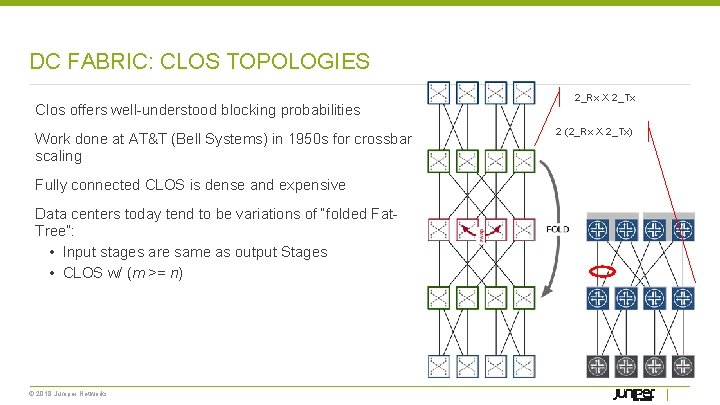
DC FABRIC: CLOS TOPOLOGIES Clos offers well-understood blocking probabilities Work done at AT&T (Bell Systems) in 1950 s for crossbar scaling Fully connected CLOS is dense and expensive Data centers today tend to be variations of “folded Fat. Tree”: • Input stages are same as output Stages • CLOS w/ (m >= n) © 2018 Juniper Networks 2_Rx X 2_Tx 2 (2_Rx X 2_Tx)
DC FABRIC: ROUTING PROTOCOL CHALLENGES Current routing protocols are geared towards • Irregular network topologies • Low degree of connectivity DC Fabric • Typically regular topology (CLOS, folded Fat-Tree) • Very high degree of connectivity (hyper-scale DCs) No perfect match between current routing protocols and DC Fabric • Routing protocols are complex (to deal with irregular topologies) • Routing protocols are • Fast, but not scalable to 100 k nodes (link-state) • Slow, when scalable to 100 k nodes (distance-vector) © 2018 Juniper Networks
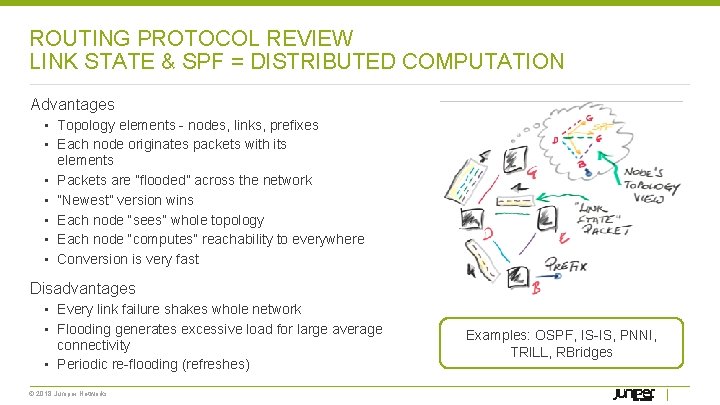
ROUTING PROTOCOL REVIEW LINK STATE & SPF = DISTRIBUTED COMPUTATION Advantages • Topology elements - nodes, links, prefixes • Each node originates packets with its elements • Packets are ”flooded” across the network • ”Newest” version wins • Each node “sees” whole topology • Each node “computes” reachability to everywhere • Conversion is very fast Disadvantages • Every link failure shakes whole network • Flooding generates excessive load for large average connectivity • Periodic re-flooding (refreshes) © 2018 Juniper Networks Examples: OSPF, IS-IS, PNNI, TRILL, RBridges
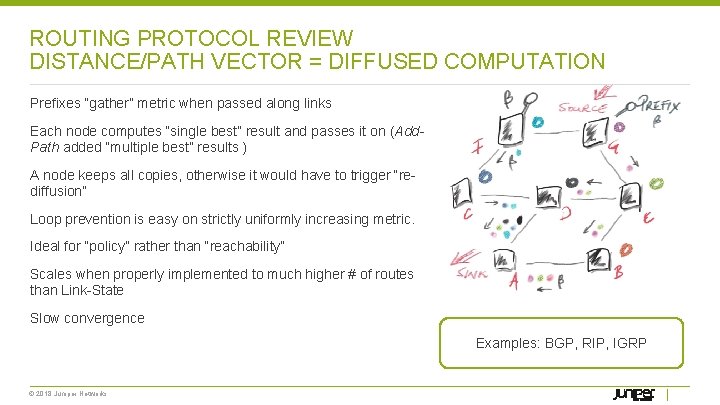
ROUTING PROTOCOL REVIEW DISTANCE/PATH VECTOR = DIFFUSED COMPUTATION Prefixes “gather” metric when passed along links Each node computes “single best” result and passes it on (Add. Path added “multiple best” results ) A node keeps all copies, otherwise it would have to trigger “rediffusion” Loop prevention is easy on strictly uniformly increasing metric. Ideal for “policy” rather than “reachability” Scales when properly implemented to much higher # of routes than Link-State Slow convergence Examples: BGP, RIP, IGRP © 2018 Juniper Networks
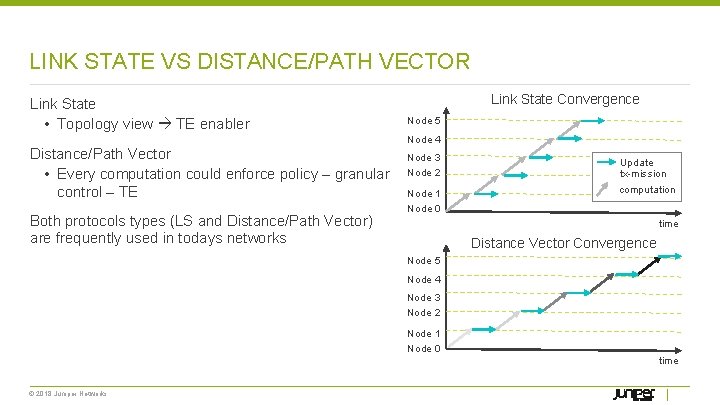
LINK STATE VS DISTANCE/PATH VECTOR Link State • Topology view TE enabler Link State Convergence Node 5 Node 4 Distance/Path Vector • Every computation could enforce policy – granular control – TE Both protocols types (LS and Distance/Path Vector) are frequently used in todays networks Node 3 Node 2 Update tx-mission Node 1 Node 0 computation time Distance Vector Convergence Node 5 Node 4 Node 3 Node 2 Node 1 Node 0 © 2018 Juniper Networks time
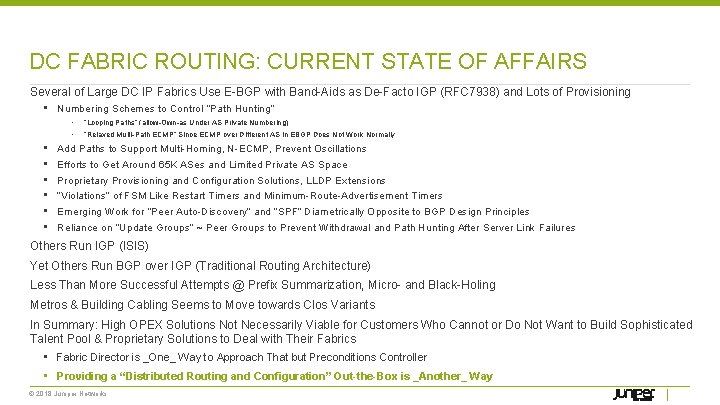
DC FABRIC ROUTING: CURRENT STATE OF AFFAIRS Several of Large DC IP Fabrics Use E-BGP with Band-Aids as De-Facto IGP (RFC 7938) and Lots of Provisioning • Numbering Schemes to Control “Path Hunting” • • ”Looping Paths” (allow-Own-as Under AS Private Numbering) • “Relaxed Multi-Path ECMP” Since ECMP over Different AS in EBGP Does Not Work Normally Add Paths to Support Multi-Homing, N-ECMP, Prevent Oscillations Efforts to Get Around 65 K ASes and Limited Private AS Space Proprietary Provisioning and Configuration Solutions, LLDP Extensions “Violations” of FSM Like Restart Timers and Minimum-Route-Advertisement Timers Emerging Work for “Peer Auto-Discovery” and “SPF” Diametrically Opposite to BGP Design Principles Reliance on “Update Groups” ~ Peer Groups to Prevent Withdrawal and Path Hunting After Server Link Failures Others Run IGP (ISIS) Yet Others Run BGP over IGP (Traditional Routing Architecture) Less Than More Successful Attempts @ Prefix Summarization, Micro- and Black-Holing Metros & Building Cabling Seems to Move towards Clos Variants In Summary: High OPEX Solutions Not Necessarily Viable for Customers Who Cannot or Do Not Want to Build Sophisticated Talent Pool & Proprietary Solutions to Deal with Their Fabrics • Fabric Director is _One_ Way to Approach That but Preconditions Controller • Providing a “Distributed Routing and Configuration” Out-the-Box is _Another_ Way © 2018 Juniper Networks
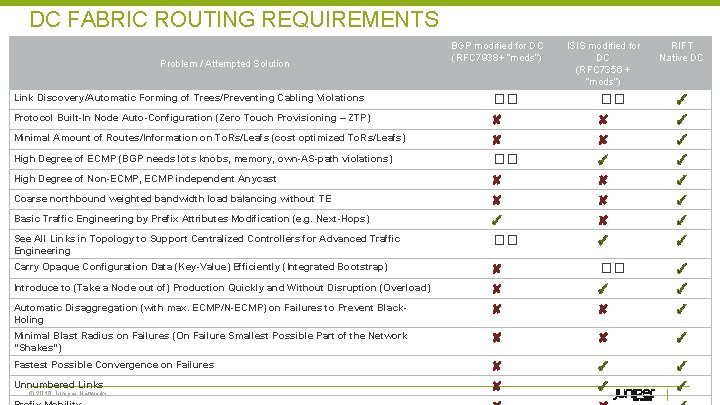
DC FABRIC ROUTING REQUIREMENTS Problem / Attempted Solution BGP modified for DC (RFC 7938+ “mods”) ISIS modified for DC (RFC 7356 + “mods”) RIFT Native DC Link Discovery/Automatic Forming of Trees/Preventing Cabling Violations �� �� ✓ Protocol Built-In Node Auto-Configuration (Zero Touch Provisioning – ZTP) ✘ ✘ ✓ Minimal Amount of Routes/Information on To. Rs/Leafs (cost optimized To. Rs/Leafs) ✘ ✘ ✓ High Degree of ECMP (BGP needs lots knobs, memory, own-AS-path violations) �� ✓ ✓ High Degree of Non-ECMP, ECMP independent Anycast ✘ ✘ ✓ Coarse northbound weighted bandwidth load balancing without TE ✘ ✘ ✓ Basic Traffic Engineering by Prefix Attributes Modification (e. g. Next-Hops) ✓ ✘ ✓ See All Links in Topology to Support Centralized Controllers for Advanced Traffic Engineering �� ✓ ✓ Carry Opaque Configuration Data (Key-Value) Efficiently (Integrated Bootstrap) ✘ �� ✓ Introduce to (Take a Node out of) Production Quickly and Without Disruption (Overload) ✘ ✓ ✓ Automatic Disaggregation (with max. ECMP/N-ECMP) on Failures to Prevent Black. Holing ✘ ✘ ✓ Minimal Blast Radius on Failures (On Failure Smallest Possible Part of the Network “Shakes”) ✘ ✘ ✓ Fastest Possible Convergence on Failures ✘ ✓ ✓ Unnumbered Links ✘ ✓ ✓ © 2018 Juniper Networks
AGENDA Introduction to DC Fabric Routing RIFT Introduction Automatic Disaggregation North Flooding Reduction Zero Touch Provisioning (ZTP) Weighted Bandwidth Load Balancing (and more features) Summary © 2018 Juniper Networks 12
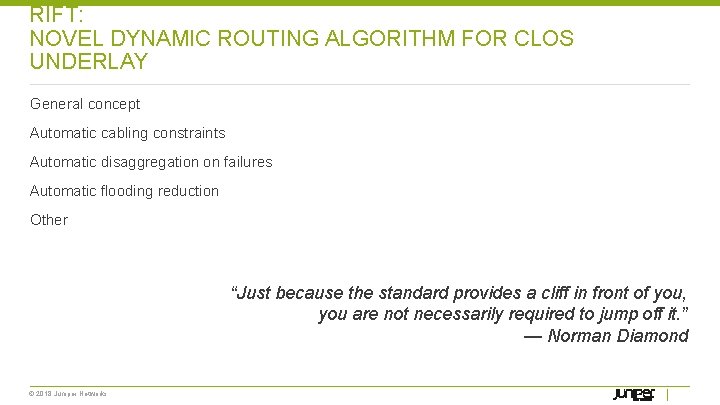
RIFT: NOVEL DYNAMIC ROUTING ALGORITHM FOR CLOS UNDERLAY General concept Automatic cabling constraints Automatic disaggregation on failures Automatic flooding reduction Other “Just because the standard provides a cliff in front of you, you are not necessarily required to jump off it. ” — Norman Diamond © 2018 Juniper Networks
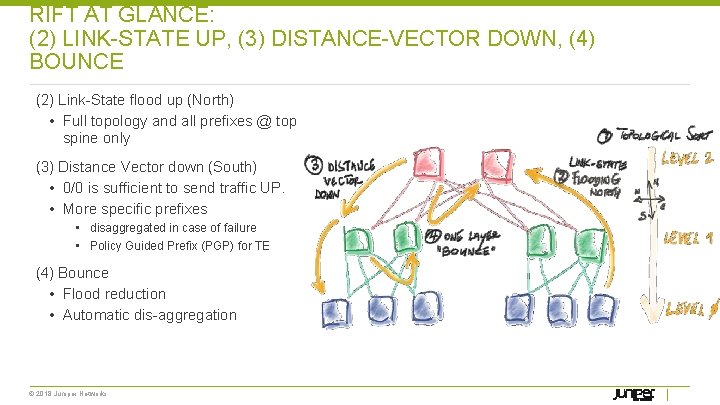
RIFT AT GLANCE: (2) LINK-STATE UP, (3) DISTANCE-VECTOR DOWN, (4) BOUNCE (2) Link-State flood up (North) • Full topology and all prefixes @ top spine only (3) Distance Vector down (South) • 0/0 is sufficient to send traffic UP. • More specific prefixes • disaggregated in case of failure • Policy Guided Prefix (PGP) for TE (4) Bounce • Flood reduction • Automatic dis-aggregation © 2018 Juniper Networks
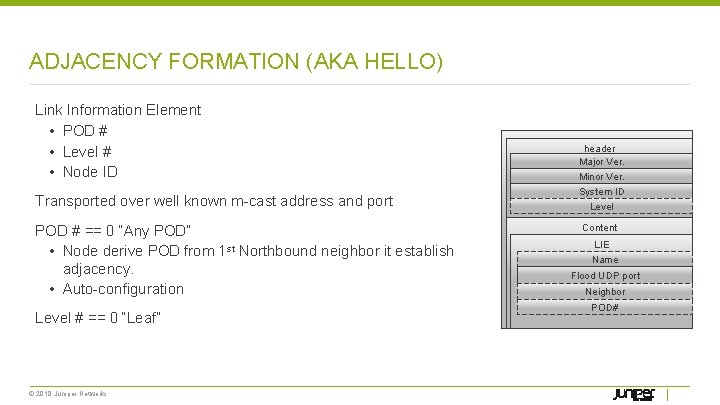
ADJACENCY FORMATION (AKA HELLO) Link Information Element • POD # • Level # • Node ID header Major Ver. Minor Ver. Transported over well known m-cast address and port System ID Level POD # == 0 “Any POD” • Node derive POD from 1 st Northbound neighbor it establish adjacency. • Auto-configuration Level # == 0 “Leaf” © 2018 Juniper Networks Content LIE Name Flood UDP port Neighbor POD#
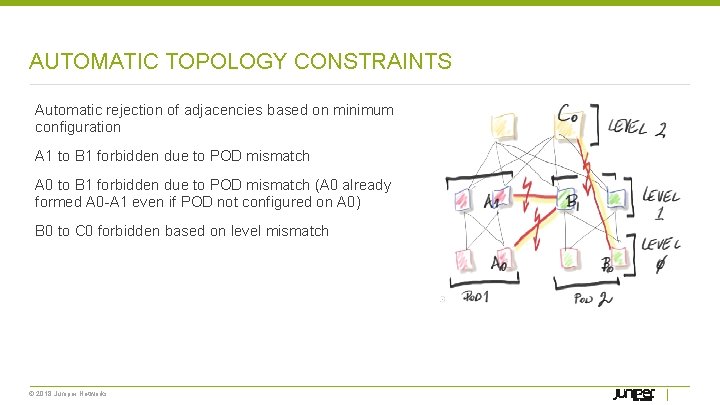
AUTOMATIC TOPOLOGY CONSTRAINTS Automatic rejection of adjacencies based on minimum configuration A 1 to B 1 forbidden due to POD mismatch A 0 to B 1 forbidden due to POD mismatch (A 0 already formed A 0 -A 1 even if POD not configured on A 0) B 0 to C 0 forbidden based on level mismatch © 2018 Juniper Networks
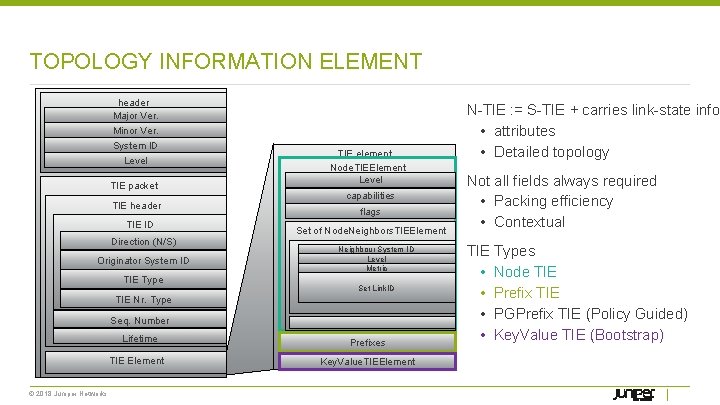
TOPOLOGY INFORMATION ELEMENT header Major Ver. Minor Ver. System ID Level TIE packet TIE header TIE ID Direction (N/S) Originator System ID TIE Type TIE element Node. TIEElement Level capabilities flags Set of Node. Neighbors. TIEElement Neighbour System ID Level Metric Set Link. ID TIE Nr. Type Seq. Number Lifetime TIE Element © 2018 Juniper Networks Prefixes Key. Value. TIEElement N-TIE : = S-TIE + carries link-state info • attributes • Detailed topology Not all fields always required • Packing efficiency • Contextual TIE Types • Node TIE • Prefix TIE • PGPrefix TIE (Policy Guided) • Key. Value TIE (Bootstrap)
AGENDA Introduction to DC Fabric Routing RIFT Introduction Automatic Disaggregation North Flooding Reduction Zero Touch Provisioning (ZTP) Weighted Bandwidth Load Balancing (and more features) Summary © 2018 Juniper Networks 18
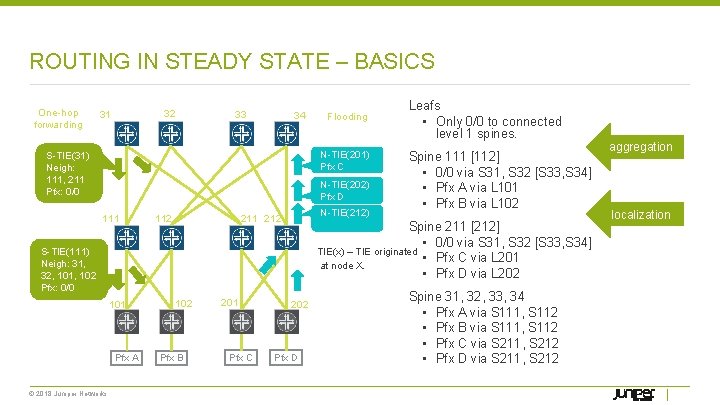
ROUTING IN STEADY STATE – BASICS One-hop forwarding 32 31 33 34 Flooding N-TIE(201) Pfx C S-TIE(31) Neigh: 111, 211 Pfx: 0/0 N-TIE(202) Pfx D 111 112 N-TIE(212) 211 212 Pfx A © 2018 Juniper Networks 102 Pfx B 201 Pfx C Spine 111 [112] • 0/0 via S 31, S 32 [S 33, S 34] • Pfx A via L 101 • Pfx B via L 102 Spine 211 [212] • 0/0 via S 31, S 32 [S 33, S 34] TIE(x) – TIE originated • Pfx C via L 201 at node X. • Pfx D via L 202 S-TIE(111) Neigh: 31, 32, 101, 102 Pfx: 0/0 101 Leafs • Only 0/0 to connected level 1 spines. 202 Pfx D Spine 31, 32, 33, 34 • Pfx A via S 111, S 112 • Pfx B via S 111, S 112 • Pfx C via S 211, S 212 • Pfx D via S 211, S 212 aggregation localization
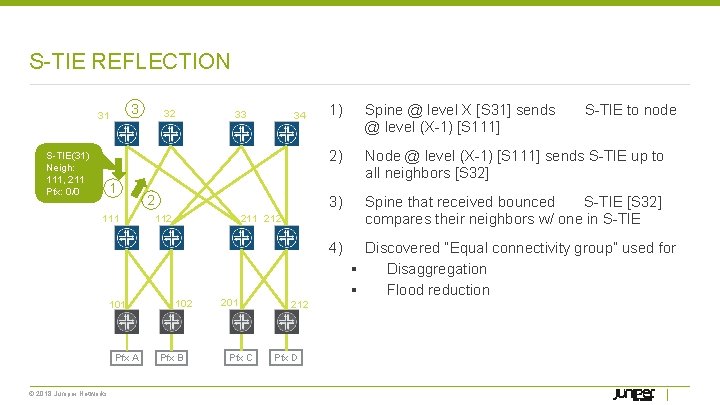
S-TIE REFLECTION 3 31 S-TIE(31) Neigh: 111, 211 Pfx: 0/0 1 111 101 Pfx A © 2018 Juniper Networks 32 33 34 2 112 1) Spine @ level X [S 31] sends @ level (X-1) [S 111] 2) Node @ level (X-1) [S 111] sends S-TIE up to all neighbors [S 32] 3) Spine that received bounced S-TIE [S 32] compares their neighbors w/ one in S-TIE 4) Discovered “Equal connectivity group” used for § Disaggregation § Flood reduction 211 212 102 Pfx B 201 Pfx C 212 Pfx D S-TIE to node
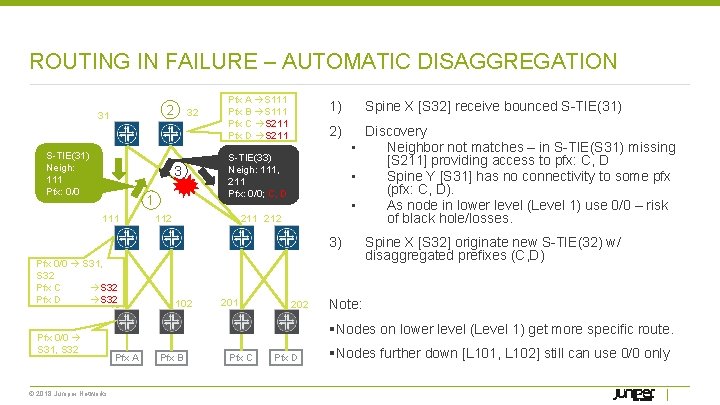
ROUTING IN FAILURE – AUTOMATIC DISAGGREGATION 2 31 S-TIE(31) Neigh: 111 Pfx: 0/0 32 3 1 111 Pfx A S 111 Pfx B S 111 Pfx C S 211 Pfx D S 211 1) 2) S-TIE(33) Neigh: 111, 211 Pfx: 0/0; C, D 112 211 212 Spine X [S 32] receive bounced S-TIE(31) Discovery • Neighbor not matches – in S-TIE(S 31) missing [S 211] providing access to pfx: C, D • Spine Y [S 31] has no connectivity to some pfx (pfx: C, D). • As node in lower level (Level 1) use 0/0 – risk of black hole/losses. 3) Pfx 0/0 S 31, S 32 Pfx C S 32 Pfx D S 32 101 Pfx 0/0 S 31, S 32 © 2018 Juniper Networks 102 201 202 Spine X [S 32] originate new S-TIE(32) w/ disaggregated prefixes (C, D) Note: §Nodes on lower level (Level 1) get more specific route. Pfx A Pfx B Pfx C Pfx D §Nodes further down [L 101, L 102] still can use 0/0 only
AGENDA Introduction to DC Fabric Routing RIFT Introduction Automatic Disaggregation North Flooding Reduction Zero Touch Provisioning (ZTP) Weighted Bandwidth Load Balancing (and more features) Summary © 2018 Juniper Networks 22
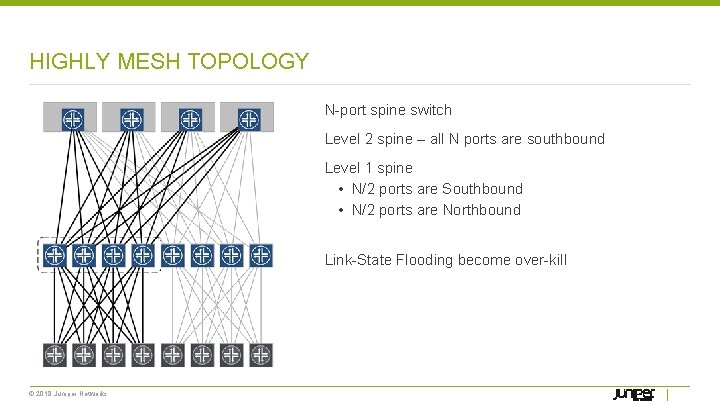
HIGHLY MESH TOPOLOGY N-port spine switch Level 2 spine – all N ports are southbound Level 1 spine • N/2 ports are Southbound • N/2 ports are Northbound Link-State Flooding become over-kill © 2018 Juniper Networks
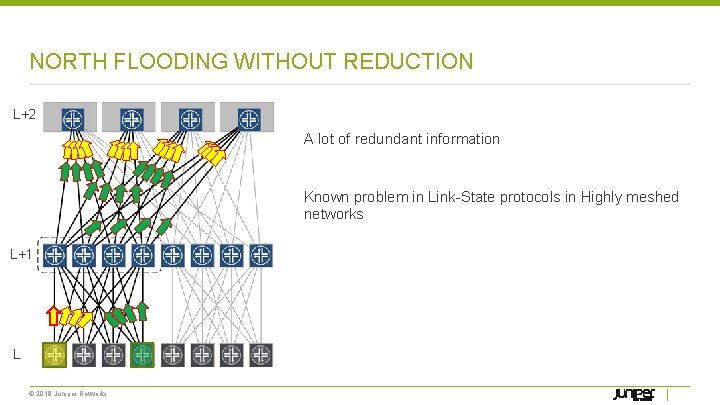
NORTH FLOODING WITHOUT REDUCTION L+2 A lot of redundant information Known problem in Link-State protocols in Highly meshed networks L+1 L © 2018 Juniper Networks
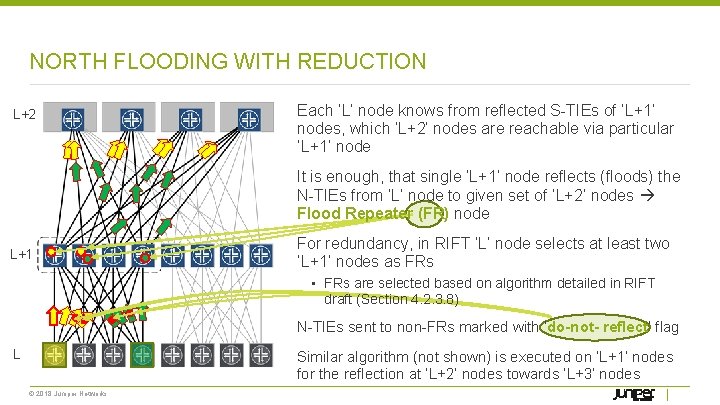
NORTH FLOODING WITH REDUCTION L+2 Each ‘L’ node knows from reflected S-TIEs of ‘L+1’ nodes, which ‘L+2’ nodes are reachable via particular ‘L+1’ node It is enough, that single ‘L+1’ node reflects (floods) the N-TIEs from ‘L’ node to given set of ‘L+2’ nodes Flood Repeater (FR) node L+1 For redundancy, in RIFT ‘L’ node selects at least two ‘L+1’ nodes as FRs • FRs are selected based on algorithm detailed in RIFT draft (Section 4. 2. 3. 8) N-TIEs sent to non-FRs marked with ‘do-not- reflect’ flag L Similar algorithm (not shown) is executed on ‘L+1’ nodes for the reflection at ‘L+2’ nodes towards ‘L+3’ nodes © 2018 Juniper Networks
AGENDA Introduction to DC Fabric Routing RIFT Introduction Automatic Disaggregation North Flooding Reduction Zero Touch Provisioning (ZTP) Weighted Bandwidth Load Balancing (and more features) Summary © 2018 Juniper Networks 26
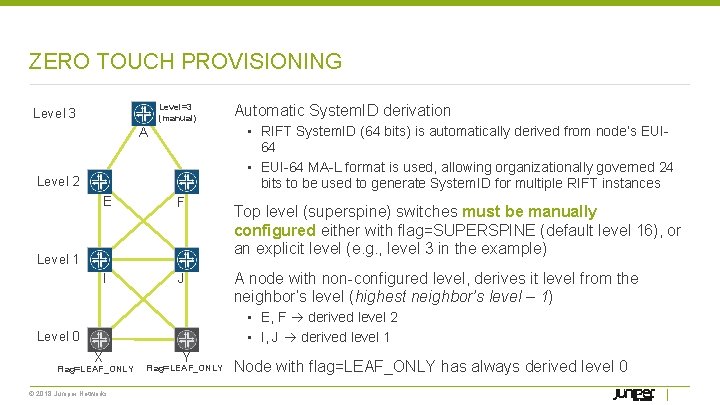
ZERO TOUCH PROVISIONING Level=3 (manual) Level 3 A Level 2 E F I J Level 1 Automatic System. ID derivation • RIFT System. ID (64 bits) is automatically derived from node’s EUI 64 • EUI-64 MA-L format is used, allowing organizationally governed 24 bits to be used to generate System. ID for multiple RIFT instances Top level (superspine) switches must be manually configured either with flag=SUPERSPINE (default level 16), or an explicit level (e. g. , level 3 in the example) A node with non-configured level, derives it level from the neighbor’s level (highest neighbor’s level – 1) • E, F derived level 2 • I, J derived level 1 Level 0 X Flag=LEAF_ONLY © 2018 Juniper Networks Y Flag=LEAF_ONLY Node with flag=LEAF_ONLY has always derived level 0
AGENDA Introduction to DC Fabric Routing RIFT Introduction Automatic Disaggregation North Flooding Reduction Zero Touch Provisioning (ZTP) Weighted Bandwidth Load Balancing (and more features) Summary © 2018 Juniper Networks 28
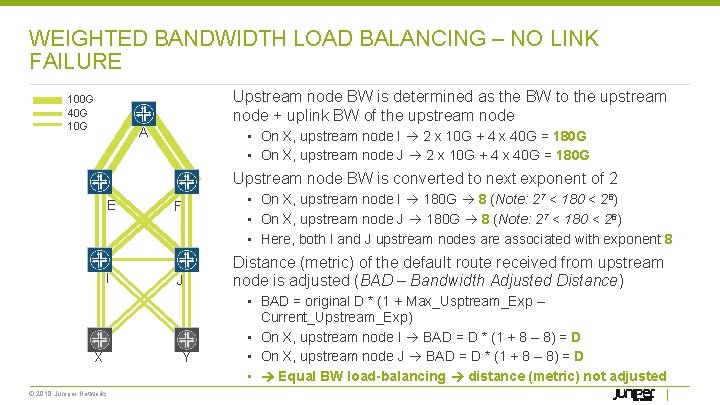
WEIGHTED BANDWIDTH LOAD BALANCING – NO LINK FAILURE Upstream node BW is determined as the BW to the upstream node + uplink BW of the upstream node 100 G 40 G 10 G A • On X, upstream node I 2 x 10 G + 4 x 40 G = 180 G • On X, upstream node J 2 x 10 G + 4 x 40 G = 180 G Upstream node BW is converted to next exponent of 2 E I X © 2018 Juniper Networks • On X, upstream node I 180 G 8 (Note: 27 < 180 < 28) • On X, upstream node J 180 G 8 (Note: 27 < 180 < 28) • Here, both I and J upstream nodes are associated with exponent 8 F J Y Distance (metric) of the default route received from upstream node is adjusted (BAD – Bandwidth Adjusted Distance) • BAD = original D * (1 + Max_Usptream_Exp – Current_Upstream_Exp) • On X, upstream node I BAD = D * (1 + 8 – 8) = D • On X, upstream node J BAD = D * (1 + 8 – 8) = D • Equal BW load-balancing distance (metric) not adjusted
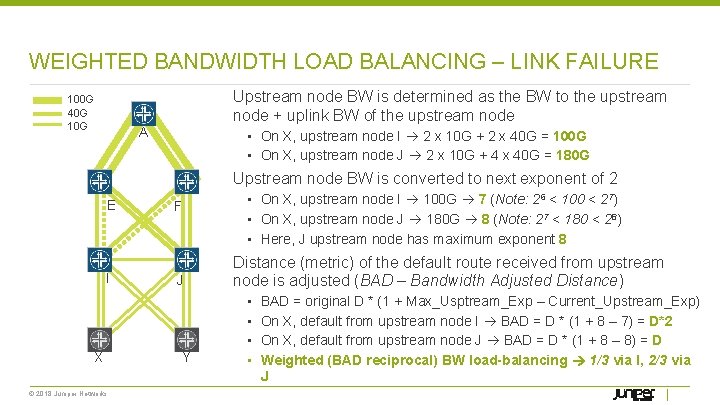
WEIGHTED BANDWIDTH LOAD BALANCING – LINK FAILURE Upstream node BW is determined as the BW to the upstream node + uplink BW of the upstream node 100 G 40 G 10 G A • On X, upstream node I 2 x 10 G + 2 x 40 G = 100 G • On X, upstream node J 2 x 10 G + 4 x 40 G = 180 G Upstream node BW is converted to next exponent of 2 E I X © 2018 Juniper Networks • On X, upstream node I 100 G 7 (Note: 26 < 100 < 27) • On X, upstream node J 180 G 8 (Note: 27 < 180 < 28) • Here, J upstream node has maximum exponent 8 F J Y Distance (metric) of the default route received from upstream node is adjusted (BAD – Bandwidth Adjusted Distance) • • BAD = original D * (1 + Max_Usptream_Exp – Current_Upstream_Exp) On X, default from upstream node I BAD = D * (1 + 8 – 7) = D*2 On X, default from upstream node J BAD = D * (1 + 8 – 8) = D Weighted (BAD reciprocal) BW load-balancing 1/3 via I, 2/3 via J
WEIGHTED BANDWIDTH LOAD BALANCING Only default route load-balancing is influenced by BW changes upstream • Disaggregated routes are not affected by default, but weighted BW load-balancing might be enabled for disaggregated routes as well Change in bandwidth influences weighted BW load-balancing across maximum two levels • Each level does it for itself & the level above (so it’s recursive, leafs start from the bottom) • BW change between node A (level 3) and node X (level 2) doesn’t influence load-balancing at X (level 0) © 2018 Juniper Networks
MOREOVER Traffic engineering is included via “flooded distance vector overlay” including filtering policies like BGP PGP (Policy Guided Prefix) Special considerations for direct East-West forwarding Packet formats are completely model based Channel agnostic delivery, could be QUIC, TCP, UDT Purging (given complexity) is omitted Key-Value Store is supported (e. g. service configuration during flooding) Overload bit (like Overload in IS-IS) Lightweight RIFT version on leafs (only North RIFT, no South RIFT) cheap leaf devices Mobility © 2018 Juniper Networks
AGENDA Introduction to DC Fabric Routing RIFT Introduction Automatic Disaggregation North Flooding Reduction Zero Touch Provisioning (ZTP) Weighted Bandwidth Load Balancing (and more features) Summary © 2018 Juniper Networks 33
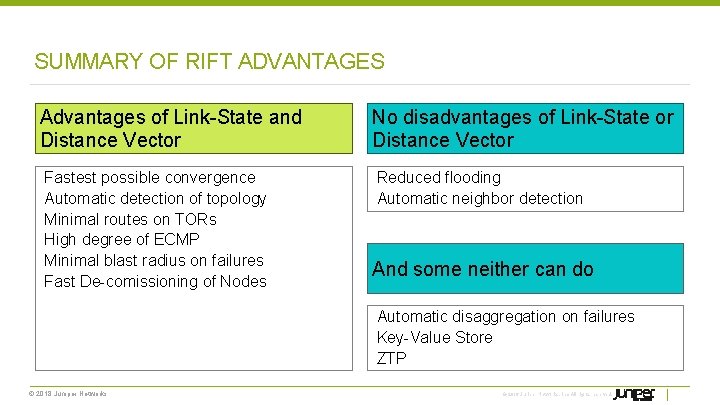
SUMMARY OF RIFT ADVANTAGES Advantages of Link-State and Distance Vector No disadvantages of Link-State or Distance Vector Fastest possible convergence Automatic detection of topology Minimal routes on TORs High degree of ECMP Minimal blast radius on failures Fast De-comissioning of Nodes Reduced flooding Automatic neighbor detection And some neither can do Automatic disaggregation on failures Key-Value Store ZTP © 2018 Juniper Networks © 2016 Juniper Networks, Inc. All rights reserved.
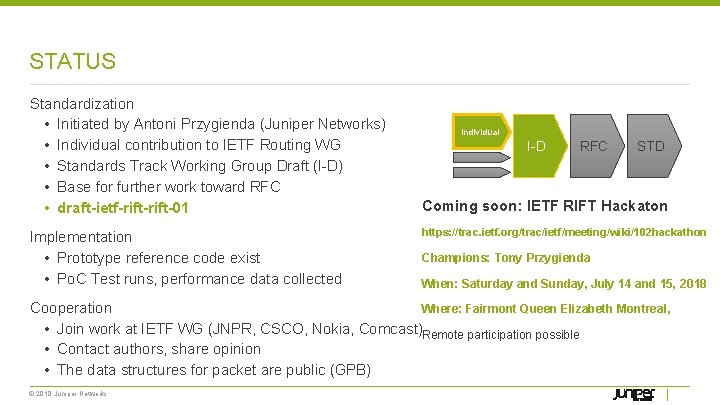
STATUS Standardization • Initiated by Antoni Przygienda (Juniper Networks) • Individual contribution to IETF Routing WG • Standards Track Working Group Draft (I-D) • Base for further work toward RFC • draft-ietf-rift-01 Implementation • Prototype reference code exist • Po. C Test runs, performance data collected individual I-D RFC STD Coming soon: IETF RIFT Hackaton https: //trac. ietf. org/trac/ietf/meeting/wiki/102 hackathon Champions: Tony Przygienda When: Saturday and Sunday, July 14 and 15, 2018 Cooperation Where: Fairmont Queen Elizabeth Montreal, • Join work at IETF WG (JNPR, CSCO, Nokia, Comcast)Remote participation possible • Contact authors, share opinion • The data structures for packet are public (GPB) © 2018 Juniper Networks
EARLY JUNIPER IMPLEMENTATION Packaged Pre-Production Code • https: //www. juniper. net/us/en/dm/free-rift-trial/ • Flooding/Hello/SPF/RIB/Flood Reduction • Optional REDIS Analytics for Link-State DB, Routes and Statistics Implemented Very Heavily Multi-Threaded to Fully Utilize Modern CPU Architectures • Memory and Thread Safe Unlike C Carries Its Own Topology Environment for Heavy-Duty Testing Easily Portable Across All Modern OS Platforms (OSX, Linux) © 2018 Juniper Networks CONFIDENTIAL
THANK YOU kszarkowicz@juniper. net © 2018 Juniper Networks