
RIFT Hackathon IETF 102 1 Participants Dmitry Afanasiev
- Slides: 11
RIFT Hackathon IETF 102 1
Participants Dmitry Afanasiev Don Fedyk Tony Przygienda Bruno Rijsman Jeff Tantsura Pascal Thubert Ilya Vershkov Zhaohui (Jeffrey) Zhang (Yandex) (HPE) (Juniper) (No affiliation) (Nuage Networks) (Cisco) (Mellanox) (Juniper) 2
Participating RIFT Implementations • Vendor RIFT implementation • Open source Python RIFT implementation 3
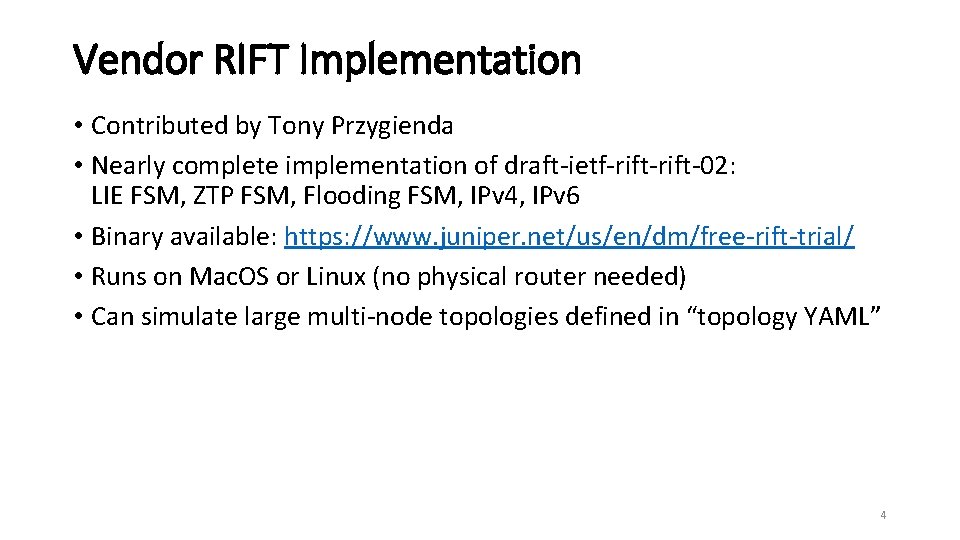
Vendor RIFT Implementation • Contributed by Tony Przygienda • Nearly complete implementation of draft-ietf-rift-02: LIE FSM, ZTP FSM, Flooding FSM, IPv 4, IPv 6 • Binary available: https: //www. juniper. net/us/en/dm/free-rift-trial/ • Runs on Mac. OS or Linux (no physical router needed) • Can simulate large multi-node topologies defined in “topology YAML” 4
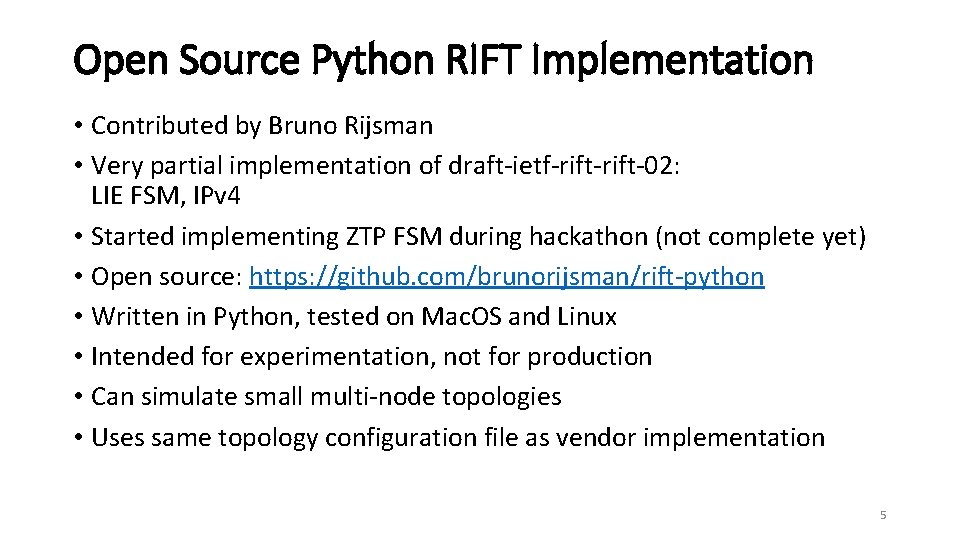
Open Source Python RIFT Implementation • Contributed by Bruno Rijsman • Very partial implementation of draft-ietf-rift-02: LIE FSM, IPv 4 • Started implementing ZTP FSM during hackathon (not complete yet) • Open source: https: //github. com/brunorijsman/rift-python • Written in Python, tested on Mac. OS and Linux • Intended for experimentation, not for production • Can simulate small multi-node topologies • Uses same topology configuration file as vendor implementation 5
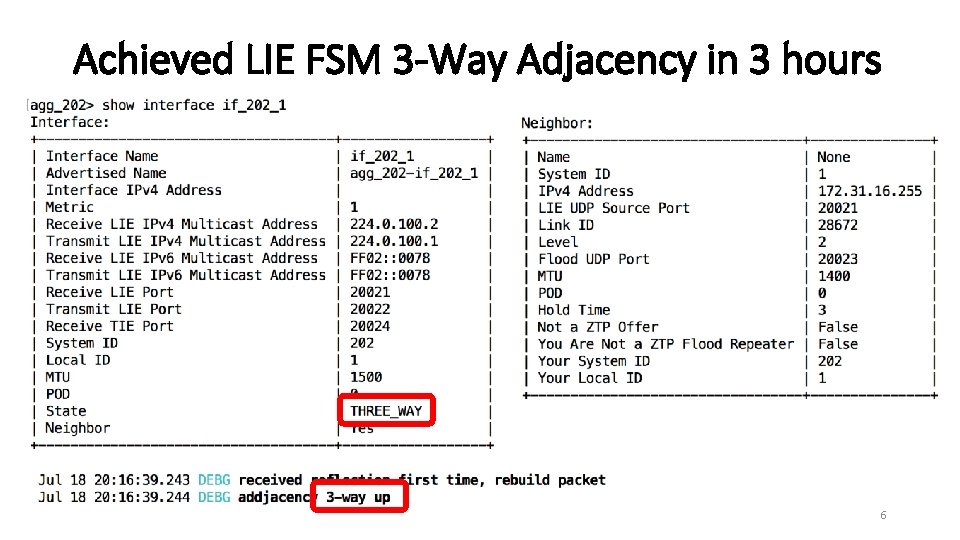
Achieved LIE FSM 3 -Way Adjacency in 3 hours 6
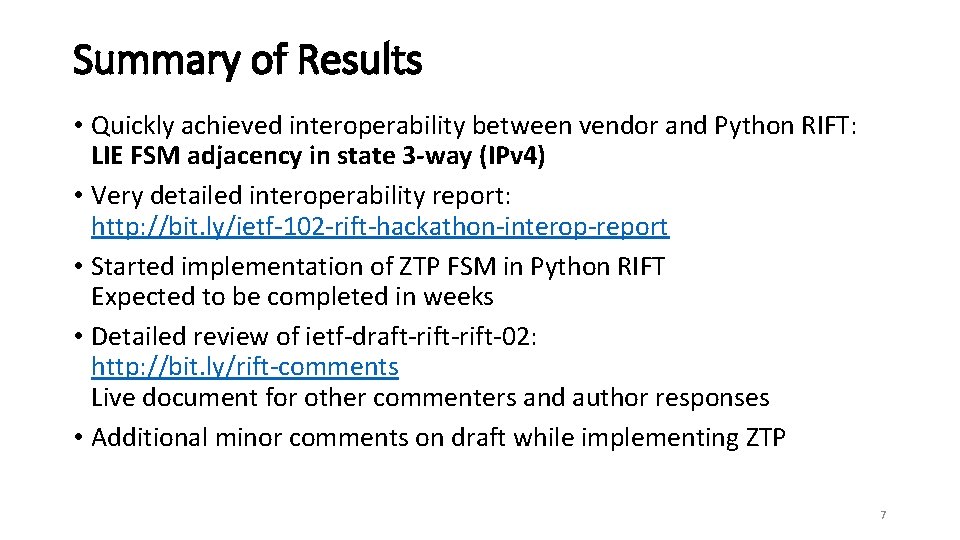
Summary of Results • Quickly achieved interoperability between vendor and Python RIFT: LIE FSM adjacency in state 3 -way (IPv 4) • Very detailed interoperability report: http: //bit. ly/ietf-102 -rift-hackathon-interop-report • Started implementation of ZTP FSM in Python RIFT Expected to be completed in weeks • Detailed review of ietf-draft-rift-02: http: //bit. ly/rift-comments Live document for other commenters and author responses • Additional minor comments on draft while implementing ZTP 7
Summary of Lessons Learned • Model-based protocol encoding works and has great benefits • Multicast is very platform dependent • Attending a hackathon is very useful even for non-coders 8
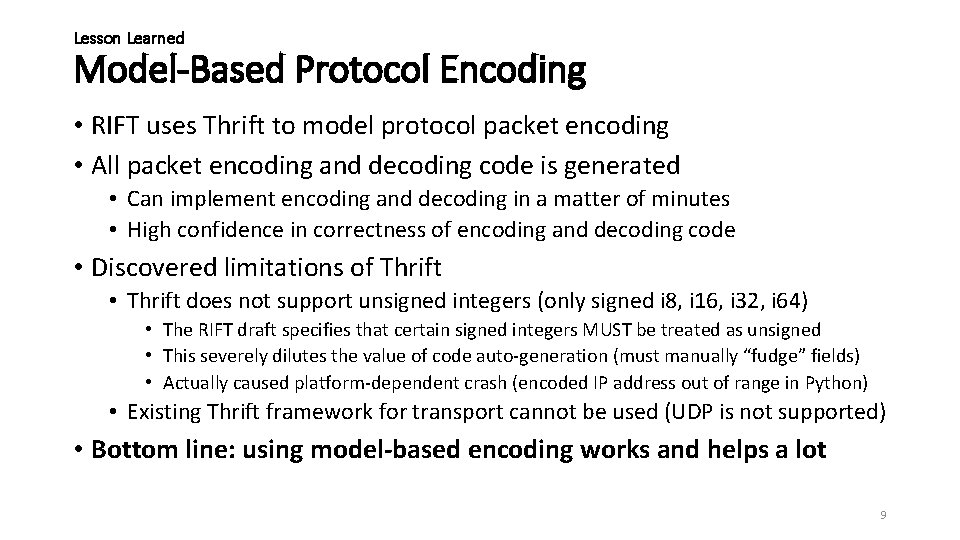
Lesson Learned Model-Based Protocol Encoding • RIFT uses Thrift to model protocol packet encoding • All packet encoding and decoding code is generated • Can implement encoding and decoding in a matter of minutes • High confidence in correctness of encoding and decoding code • Discovered limitations of Thrift • Thrift does not support unsigned integers (only signed i 8, i 16, i 32, i 64) • The RIFT draft specifies that certain signed integers MUST be treated as unsigned • This severely dilutes the value of code auto-generation (must manually “fudge” fields) • Actually caused platform-dependent crash (encoded IP address out of range in Python) • Existing Thrift framework for transport cannot be used (UDP is not supported) • Bottom line: using model-based encoding works and helps a lot 9
Lesson Learned Multicast is Very Platform-Dependent • Particularly IPv 6 multicasts • Different socket options across platforms • Different behavior of same socket options across platforms 10
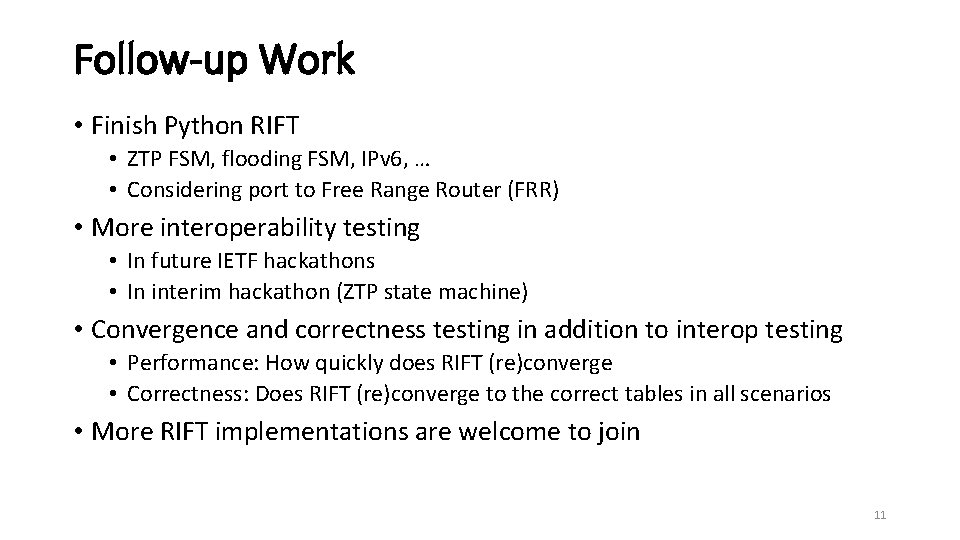
Follow-up Work • Finish Python RIFT • ZTP FSM, flooding FSM, IPv 6, … • Considering port to Free Range Router (FRR) • More interoperability testing • In future IETF hackathons • In interim hackathon (ZTP state machine) • Convergence and correctness testing in addition to interop testing • Performance: How quickly does RIFT (re)converge • Correctness: Does RIFT (re)converge to the correct tables in all scenarios • More RIFT implementations are welcome to join 11