RealTime Systems Dave Ojika ImageProcessing Semester Roadmap n
- Slides: 40
Real-Time Systems Dave Ojika
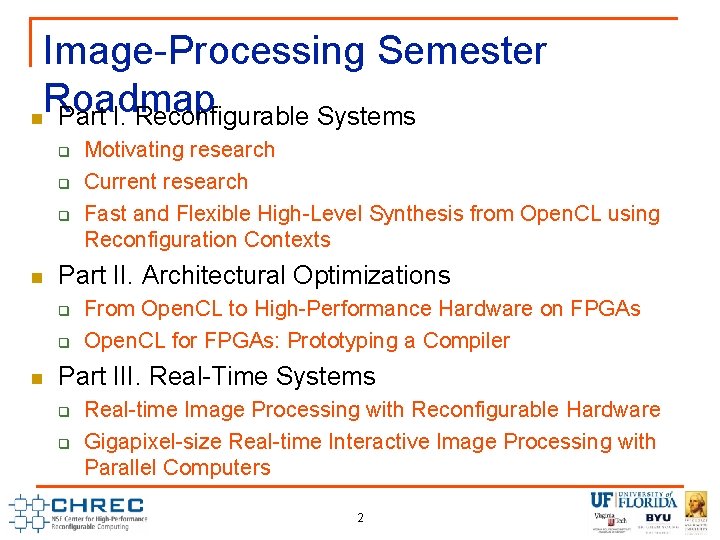
Image-Processing Semester Roadmap n Part I. Reconfigurable Systems q q q n Part II. Architectural Optimizations q q n Motivating research Current research Fast and Flexible High-Level Synthesis from Open. CL using Reconfiguration Contexts From Open. CL to High-Performance Hardware on FPGAs Open. CL for FPGAs: Prototyping a Compiler Part III. Real-Time Systems q q Real-time Image Processing with Reconfigurable Hardware Gigapixel-size Real-time Interactive Image Processing with Parallel Computers 2
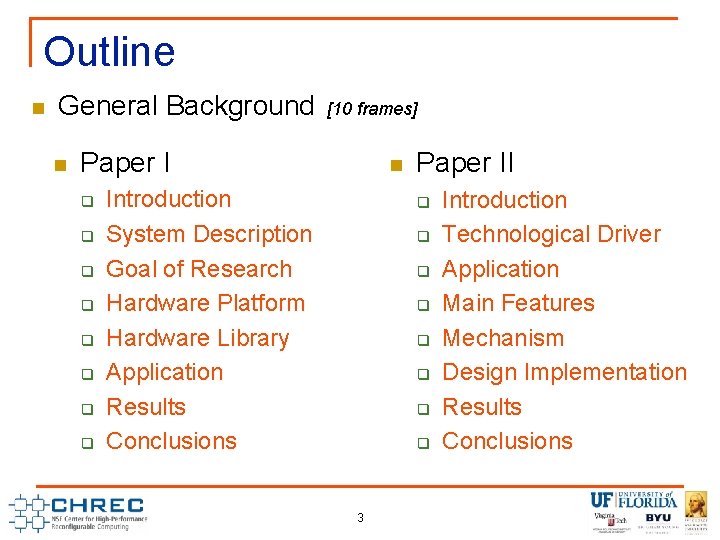
Outline n General Background n [10 frames] Paper I q q q q n Introduction System Description Goal of Research Hardware Platform Hardware Library Application Results Conclusions Paper II q q q q 3 Introduction Technological Driver Application Main Features Mechanism Design Implementation Results Conclusions
Machine Vision n Machine vision or computer vision (CV) can substitute human vision for a number of application tasks such as q q q Target tracking Robot guidance Tasks inspection n Autonomous operation aided by machine vision q 4 Real-time operation highly critical!
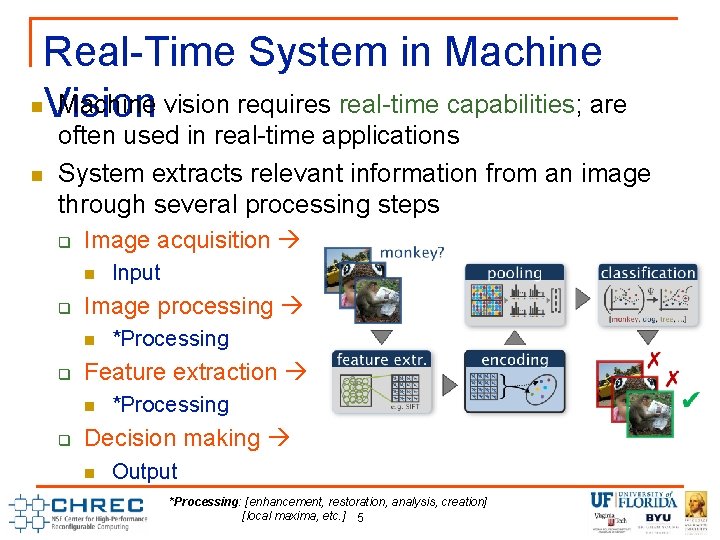
Real-Time System in Machine n. Vision Machine vision requires real-time capabilities; are n often used in real-time applications System extracts relevant information from an image through several processing steps q Image acquisition n q Image processing n q *Processing Feature extraction n q Input *Processing Decision making n Output *Processing: [enhancement, restoration, analysis, creation] [local maxima, etc. ] 5
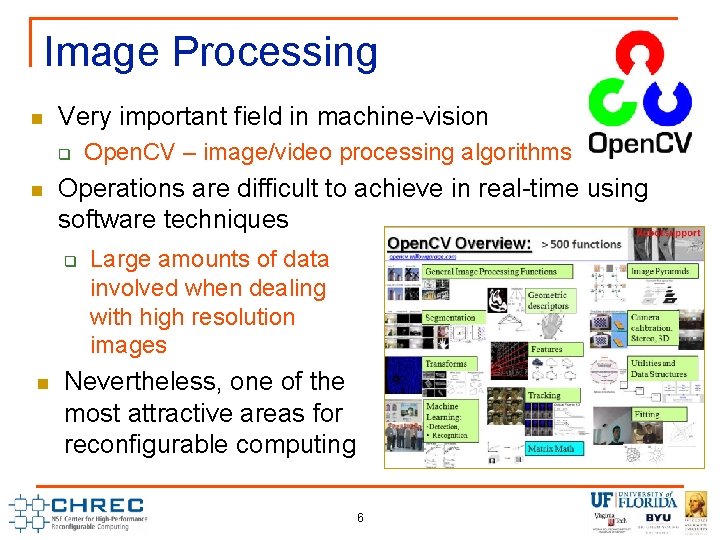
Image Processing n Very important field in machine-vision q n Operations are difficult to achieve in real-time using software techniques q n Open. CV – image/video processing algorithms Large amounts of data involved when dealing with high resolution images Nevertheless, one of the most attractive areas for reconfigurable computing 6
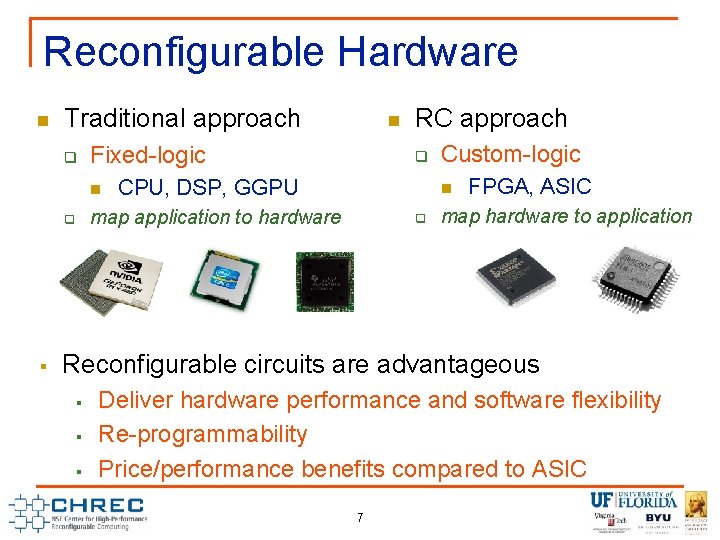
Reconfigurable Hardware n Traditional approach q Fixed-logic n RC approach q CPU, DSP, GGPU Custom-logic n map application to hardware q § n q FPGA, ASIC map hardware to application Reconfigurable circuits are advantageous § § § Deliver hardware performance and software flexibility Re-programmability Price/performance benefits compared to ASIC 7
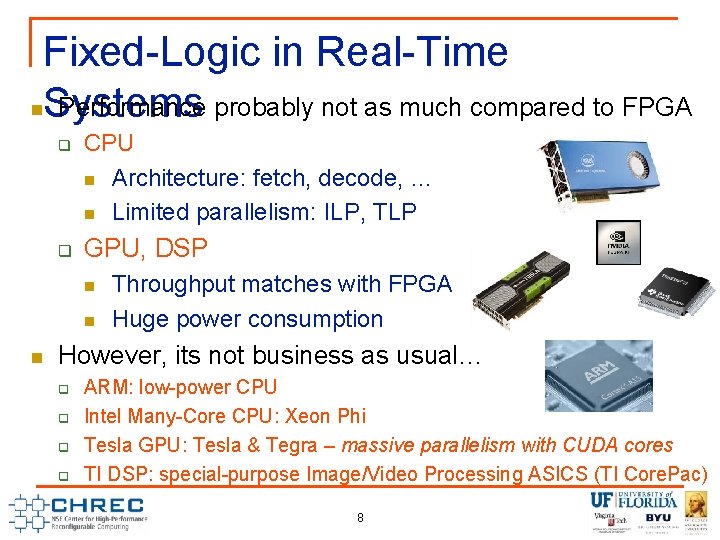
Fixed-Logic in Real-Time n. Systems Performance probably not as much compared to FPGA q q CPU n Architecture: fetch, decode, … n Limited parallelism: ILP, TLP GPU, DSP n n n Throughput matches with FPGA Huge power consumption However, its not business as usual… q q ARM: low-power CPU Intel Many-Core CPU: Xeon Phi Tesla GPU: Tesla & Tegra – massive parallelism with CUDA cores TI DSP: special-purpose Image/Video Processing ASICS (TI Core. Pac) 8
Fixed-Logic in Real-Time Systems n (cont. ) CPUs pure-software approach utilize fast clock (to deal with sequential operations) - are quickly inhibited by laws of physics n However many advanced techniques: OOO, speculative execution, dynamic scheduling, branch prediction § n Not enough to solve problem of data-parallel image/video apps Multicore and many-core processors (SMP) have become almost the standard in high performance computing For many embarrassingly parallel apps, FPGA preferred GPU and DSP have been traditional used for image/video processing, but are very power hungry Focus on of this presentation is on use of reconfigurable hardware to maintain real-time constraints § n v 9
REAL-TIME IMAGE PROCESSING WITH RECONFIGURABLE HARDWARE 10
Introduction n A PCI-based system for image processing using hardware/software technique q “PCI-based reconfigurable system for real-time image processing using reconfigurable hardware” n n n Real-Time: Image Processing: Reconfigurable Hardware: PCI: And, the rest is grammar… focus of this whole talk choice domain application area choice architecture link between 2 and 3 Motivation n n Image processing app require huge amounts of data Software-based approach too difficult to achieve real-time 11
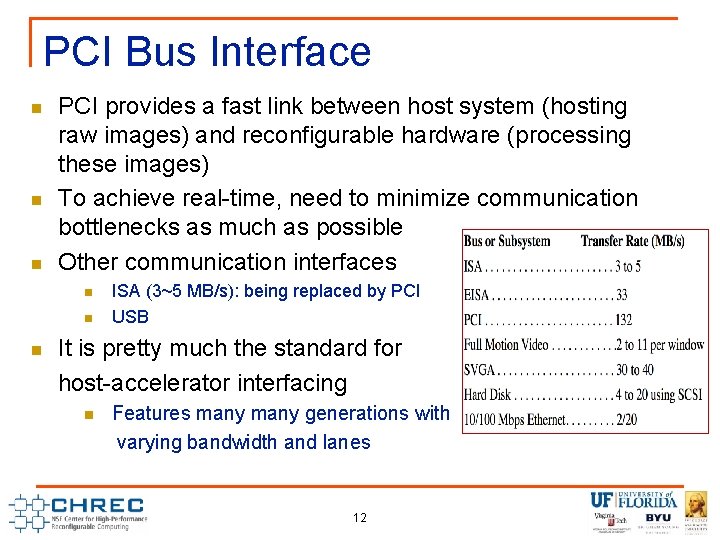
PCI Bus Interface n n n PCI provides a fast link between host system (hosting raw images) and reconfigurable hardware (processing these images) To achieve real-time, need to minimize communication bottlenecks as much as possible Other communication interfaces n n n ISA (3~5 MB/s): being replaced by PCI USB It is pretty much the standard for host-accelerator interfacing n Features many generations with varying bandwidth and lanes 12
System Description n n HOT 2 -XL (a PCI board) used as co-processor for image processing Environment based on library of hardware modules that implement a some of the most common operations in image processing Also implemented, is a Visual C++ application in order to validate hardware design System is an integrated hardware and software environment dedicated to processing images in real-time q q Software processes are executed by the CPU Hardware processes are implemented on the FPGA n Essentially an area of hardware-software co-design n A continuously growing area of research q Deals with optimal solutions for partition a task into hardware and software domains q Area, power, performance, etc. trade-offs 13
Goal of Research n Make real-time machine vision system suitable for both scientific purposes and commercial applications q q q Maximize both flexibility and efficiency (throughput) Reduce cost A Parato-optimal design problem? 14
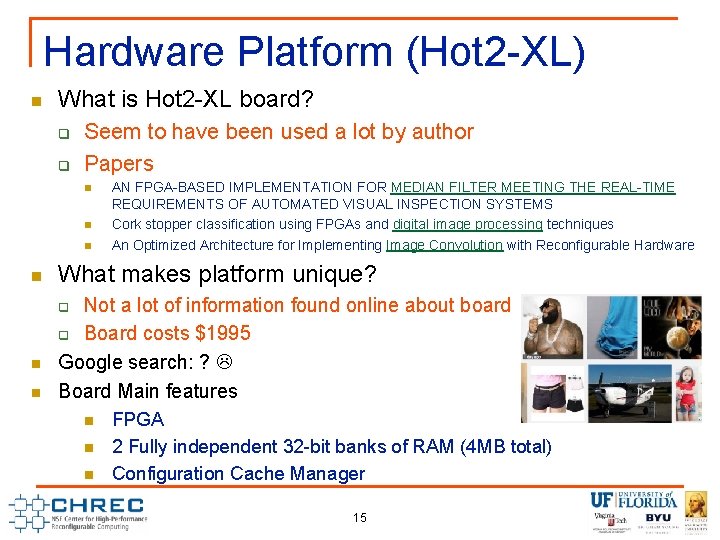
Hardware Platform (Hot 2 -XL) n What is Hot 2 -XL board? q q Seem to have been used a lot by author Papers n n AN FPGA-BASED IMPLEMENTATION FOR MEDIAN FILTER MEETING THE REAL-TIME REQUIREMENTS OF AUTOMATED VISUAL INSPECTION SYSTEMS Cork stopper classification using FPGAs and digital image processing techniques An Optimized Architecture for Implementing Image Convolution with Reconfigurable Hardware What makes platform unique? Not a lot of information found online about board q Board costs $1995 Google search: ? Board Main features q n n n FPGA 2 Fully independent 32 -bit banks of RAM (4 MB total) Configuration Cache Manager 15
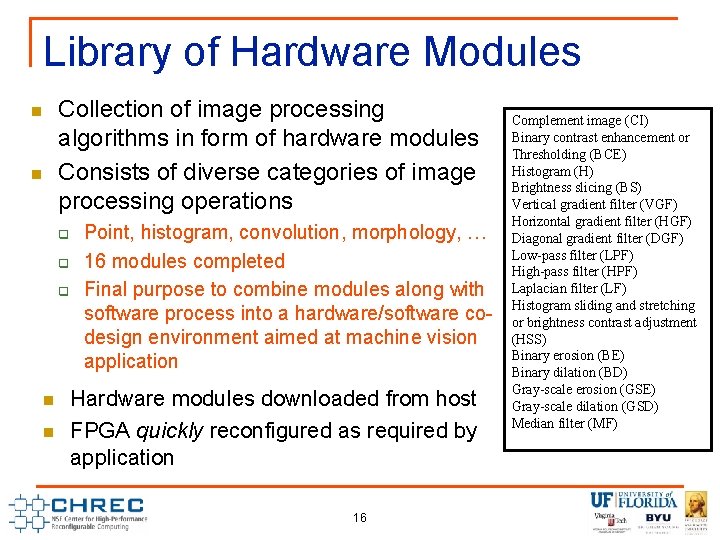
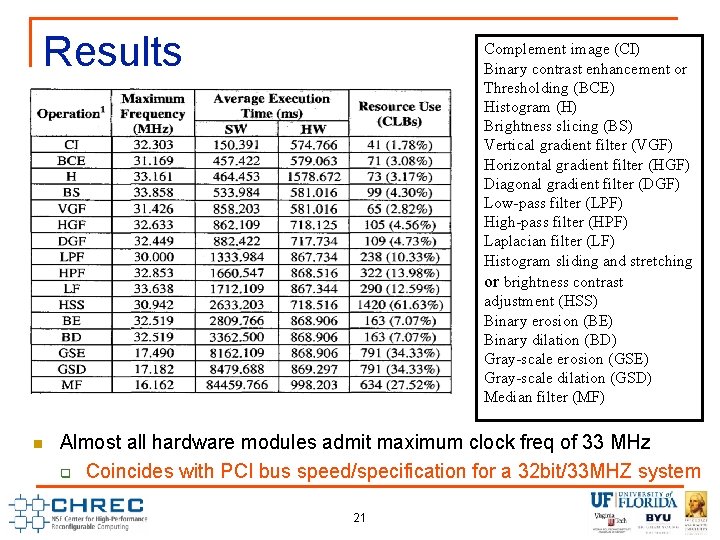
Library of Hardware Modules n n Collection of image processing algorithms in form of hardware modules Consists of diverse categories of image processing operations q q q n n Point, histogram, convolution, morphology, … 16 modules completed Final purpose to combine modules along with software process into a hardware/software codesign environment aimed at machine vision application Hardware modules downloaded from host FPGA quickly reconfigured as required by application 16 Complement image (CI) Binary contrast enhancement or Thresholding (BCE) Histogram (H) Brightness slicing (BS) Vertical gradient filter (VGF) Horizontal gradient filter (HGF) Diagonal gradient filter (DGF) Low-pass filter (LPF) High-pass filter (HPF) Laplacian filter (LF) Histogram sliding and stretching or brightness contrast adjustment (HSS) Binary erosion (BE) Binary dilation (BD) Gray-scale erosion (GSE) Gray-scale dilation (GSD) Median filter (MF)
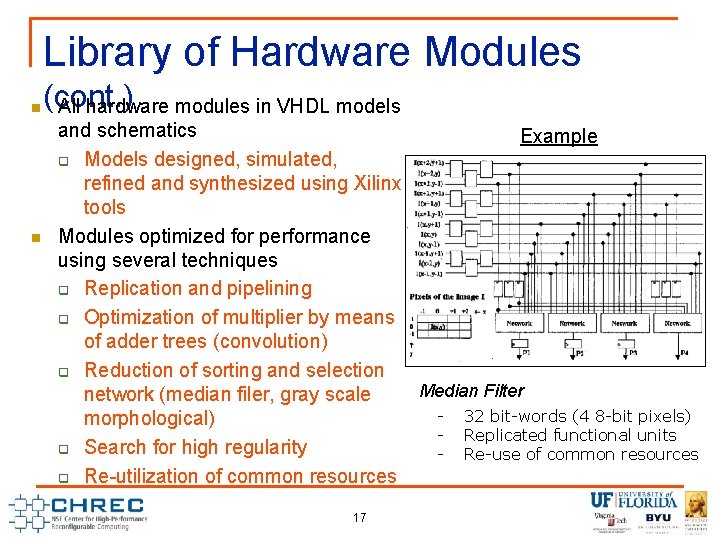
Library of Hardware Modules n n (cont. ) All hardware modules in VHDL models and schematics Example q Models designed, simulated, refined and synthesized using Xilinx tools Modules optimized for performance using several techniques q Replication and pipelining q Optimization of multiplier by means of adder trees (convolution) q Reduction of sorting and selection Median Filter network (median filer, gray scale - 32 bit-words (4 8 -bit pixels) morphological) - Replicated functional units q Search for high regularity - Re-use of common resources q Re-utilization of common resources 17
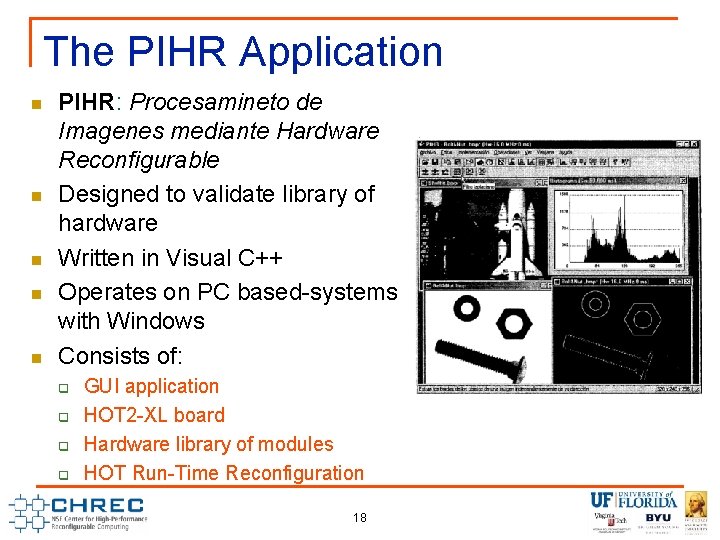
The PIHR Application n n PIHR: Procesamineto de Imagenes mediante Hardware Reconfigurable Designed to validate library of hardware Written in Visual C++ Operates on PC based-systems with Windows Consists of: q q GUI application HOT 2 -XL board Hardware library of modules HOT Run-Time Reconfiguration 18
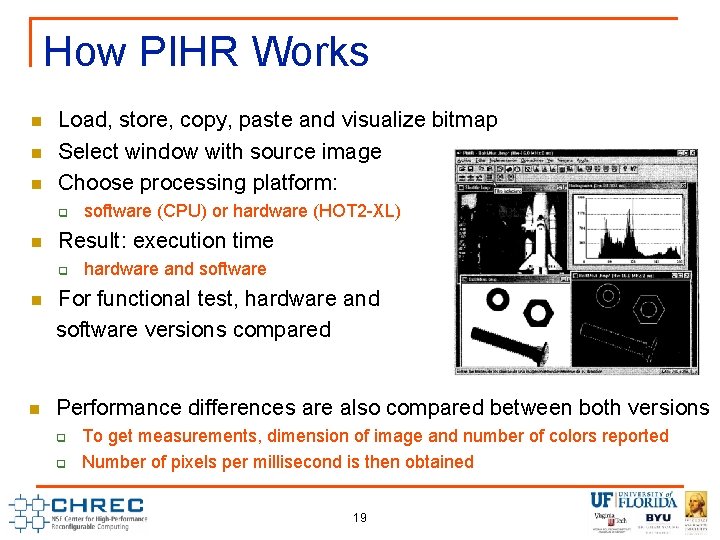
How PIHR Works n n n Load, store, copy, paste and visualize bitmap Select window with source image Choose processing platform: q n software (CPU) or hardware (HOT 2 -XL) Result: execution time q hardware and software n For functional test, hardware and software versions compared n Performance differences are also compared between both versions q q To get measurements, dimension of image and number of colors reported Number of pixels per millisecond is then obtained 19
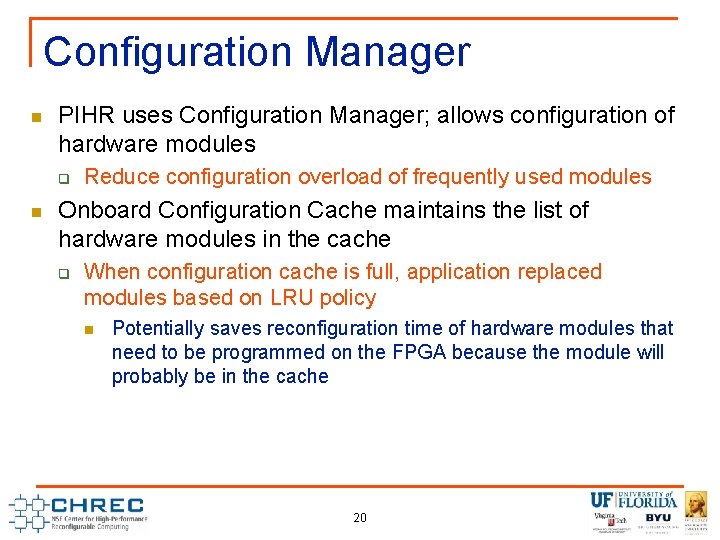
Configuration Manager n PIHR uses Configuration Manager; allows configuration of hardware modules q n Reduce configuration overload of frequently used modules Onboard Configuration Cache maintains the list of hardware modules in the cache q When configuration cache is full, application replaced modules based on LRU policy n Potentially saves reconfiguration time of hardware modules that need to be programmed on the FPGA because the module will probably be in the cache 20
Results n Complement image (CI) Binary contrast enhancement or Thresholding (BCE) Histogram (H) Brightness slicing (BS) Vertical gradient filter (VGF) Horizontal gradient filter (HGF) Diagonal gradient filter (DGF) Low-pass filter (LPF) High-pass filter (HPF) Laplacian filter (LF) Histogram sliding and stretching or brightness contrast adjustment (HSS) Binary erosion (BE) Binary dilation (BD) Gray-scale erosion (GSE) Gray-scale dilation (GSD) Median filter (MF) Almost all hardware modules admit maximum clock freq of 33 MHz q Coincides with PCI bus speed/specification for a 32 bit/33 MHZ system 21
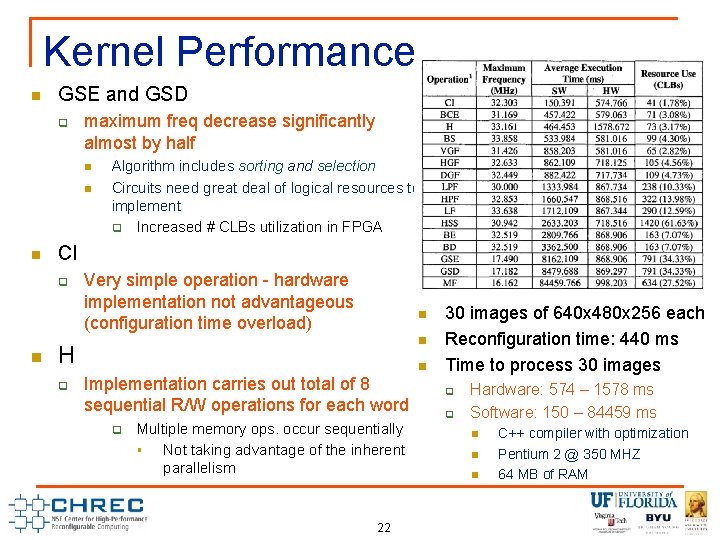
Kernel Performance n GSE and GSD q maximum freq decrease significantly almost by half n n n CI q n Algorithm includes sorting and selection Circuits need great deal of logical resources to implement q Increased # CLBs utilization in FPGA Very simple operation - hardware implementation not advantageous (configuration time overload) n n H q Implementation carries out total of 8 sequential R/W operations for each word q Multiple memory ops. occur sequentially § Not taking advantage of the inherent parallelism 22 n 30 images of 640 x 480 x 256 each Reconfiguration time: 440 ms Time to process 30 images q q Hardware: 574 – 1578 ms Software: 150 – 84459 ms n n n C++ compiler with optimization Pentium 2 @ 350 MHZ 64 MB of RAM
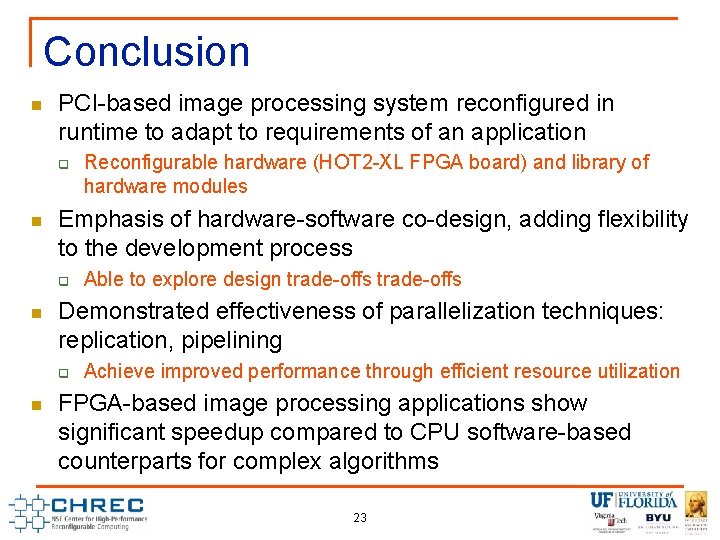
Conclusion n PCI-based image processing system reconfigured in runtime to adapt to requirements of an application q n Emphasis of hardware-software co-design, adding flexibility to the development process q n Able to explore design trade-offs Demonstrated effectiveness of parallelization techniques: replication, pipelining q n Reconfigurable hardware (HOT 2 -XL FPGA board) and library of hardware modules Achieve improved performance through efficient resource utilization FPGA-based image processing applications show significant speedup compared to CPU software-based counterparts for complex algorithms 23
GIGAPIXEL-SIZE REAL-TIME INTERACTIVE IMAGE PROCESSING WITH PARALLEL COMPUTERS 24
Pi. CEIS n What is it? q q n Parallel Computation Environment for Imaging Science Image processing package designed for efficient execution on massively parallel computers Effective use of aggregate resources of the computing system Large and accurate production processing using existing of the shelf hardware Goal: q q q Reduce difficulty in writing scalable parallel programs Reduce time to add new functionalities Provide real-time interactive image processing 25
Introduction n Large images are pervasive q n Some Hi-Res image sources q q n High-resolution and multi-spectral cameras from satellites, nuclear magnetic resonance IKONOS Digital imagery Space Digital imaging SPOT Possible to process large images quickly & effectively q Fundamental problems and requirements for improving processing of satellite images remain unchanged since the 60’s n Spatial & spectral resolution, radiometric resolution, network and memory bandwidth constraints and display output requirements 26
Technological ‘Driver’ n More advanced satellites constantly put in place q n High performance serial processing becoming pervasive with software and low cost high-end devices (Pentium 4, Athlon, Itanium-2) q n Systems not sufficient enough to process large images Specialized parallel hardware can handle large images q n Post-processing beyond workstations and small shared memory imperative Unusable for multiple applications due to large hardware/software development cost Cluster of off-the-shelf hardware maybe cost effective – development of software still lagging 27
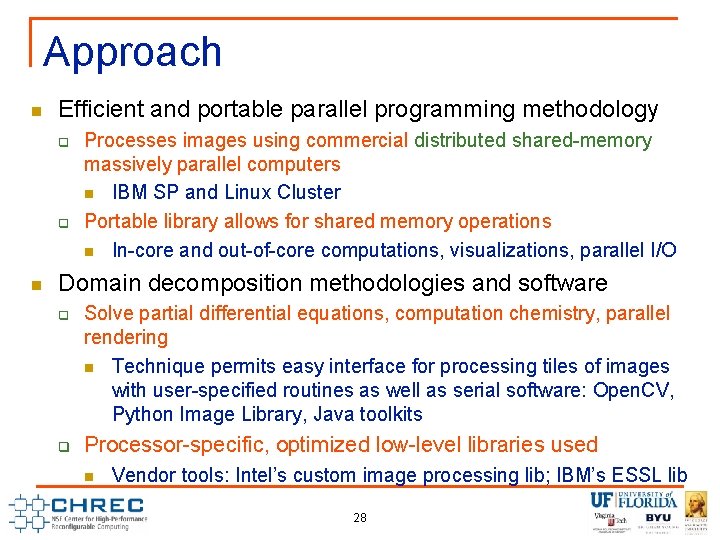
Approach n Efficient and portable parallel programming methodology q q n Processes images using commercial distributed shared-memory massively parallel computers n IBM SP and Linux Cluster Portable library allows for shared memory operations n In-core and out-of-core computations, visualizations, parallel I/O Domain decomposition methodologies and software q q Solve partial differential equations, computation chemistry, parallel rendering n Technique permits easy interface for processing tiles of images with user-specified routines as well as serial software: Open. CV, Python Image Library, Java toolkits Processor-specific, optimized low-level libraries used n Vendor tools: Intel’s custom image processing lib; IBM’s ESSL lib 28
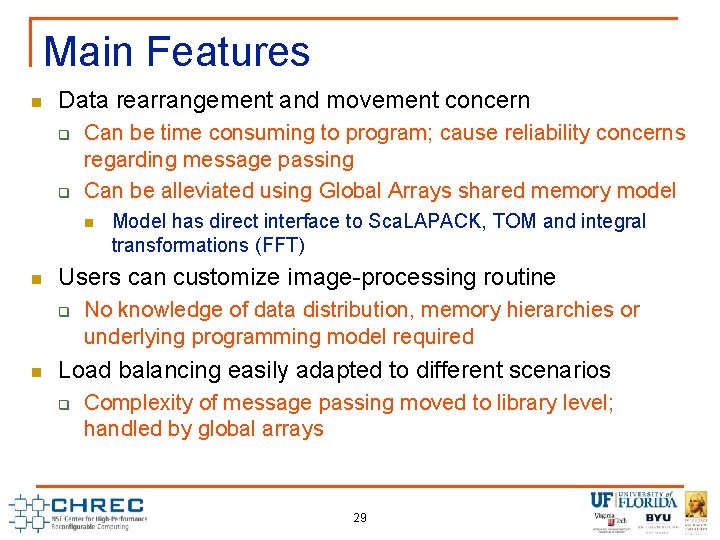
Main Features n Data rearrangement and movement concern q q Can be time consuming to program; cause reliability concerns regarding message passing Can be alleviated using Global Arrays shared memory model n n Users can customize image-processing routine q n Model has direct interface to Sca. LAPACK, TOM and integral transformations (FFT) No knowledge of data distribution, memory hierarchies or underlying programming model required Load balancing easily adapted to different scenarios q Complexity of message passing moved to library level; handled by global arrays 29
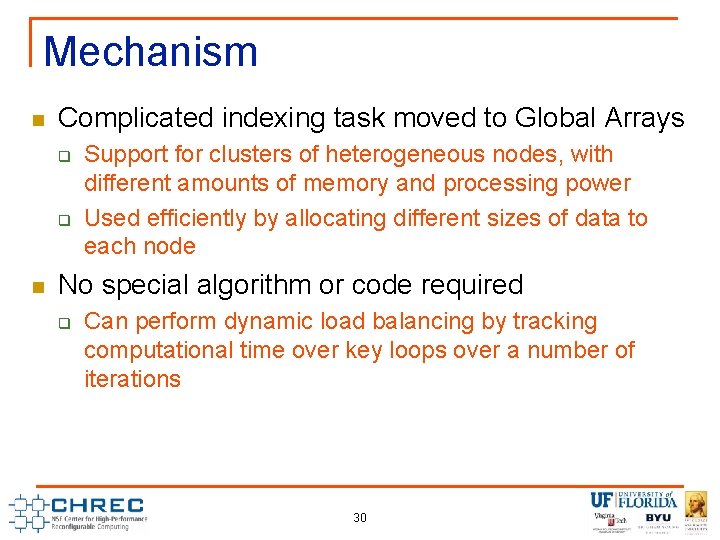
Mechanism n Complicated indexing task moved to Global Arrays q q n Support for clusters of heterogeneous nodes, with different amounts of memory and processing power Used efficiently by allocating different sizes of data to each node No special algorithm or code required q Can perform dynamic load balancing by tracking computational time over key loops over a number of iterations 30
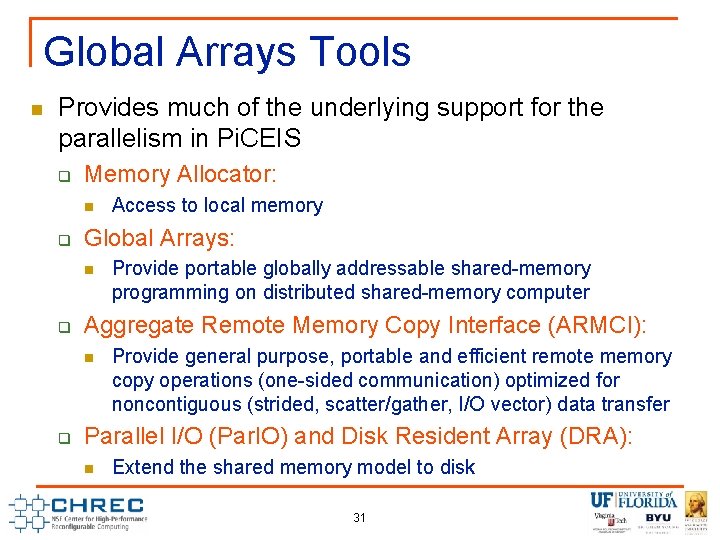
Global Arrays Tools n Provides much of the underlying support for the parallelism in Pi. CEIS q Memory Allocator: n q Global Arrays: n q Provide portable globally addressable shared-memory programming on distributed shared-memory computer Aggregate Remote Memory Copy Interface (ARMCI): n q Access to local memory Provide general purpose, portable and efficient remote memory copy operations (one-sided communication) optimized for noncontiguous (strided, scatter/gather, I/O vector) data transfer Parallel I/O (Par. IO) and Disk Resident Array (DRA): n Extend the shared memory model to disk 31
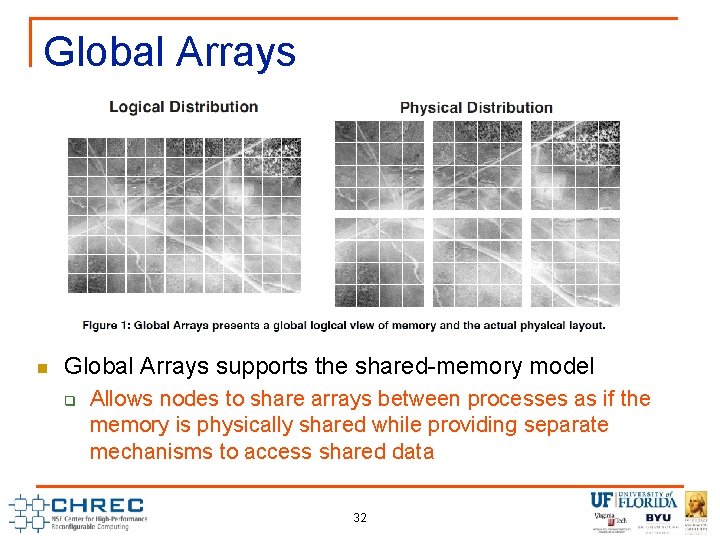
Global Arrays n Global Arrays supports the shared-memory model q Allows nodes to share arrays between processes as if the memory is physically shared while providing separate mechanisms to access shared data 32
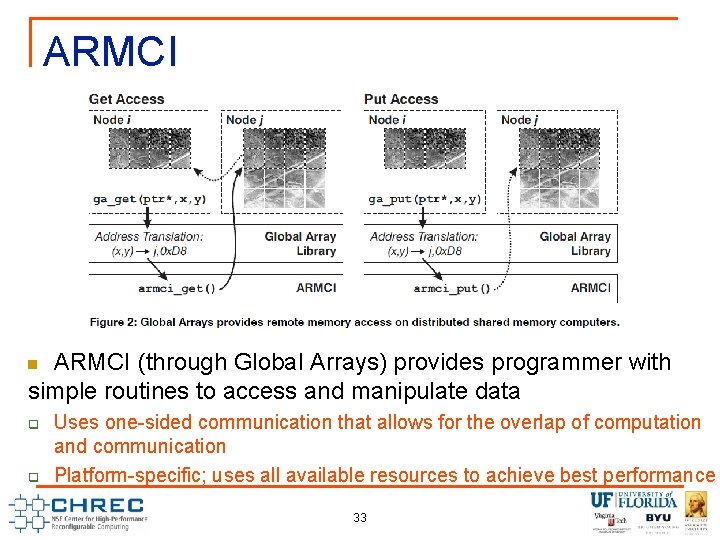
ARMCI (through Global Arrays) provides programmer with simple routines to access and manipulate data n q q Uses one-sided communication that allows for the overlap of computation and communication Platform-specific; uses all available resources to achieve best performance 33
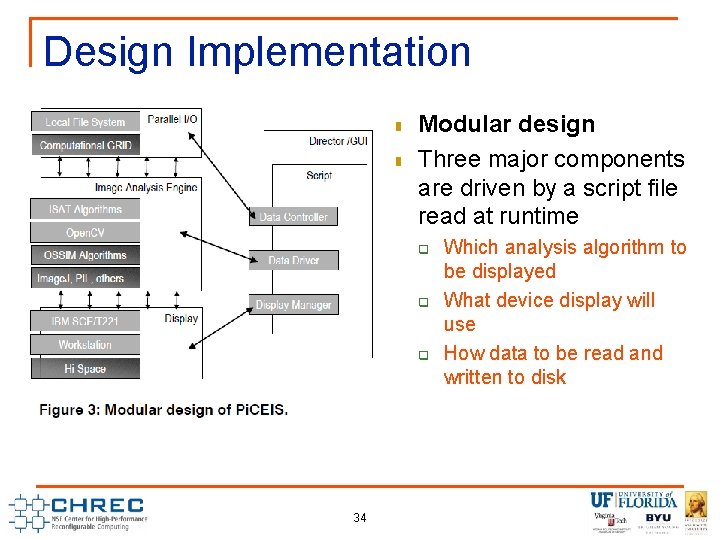
Design Implementation n n Modular design Three major components are driven by a script file read at runtime q q q 34 Which analysis algorithm to be displayed What device display will use How data to be read and written to disk
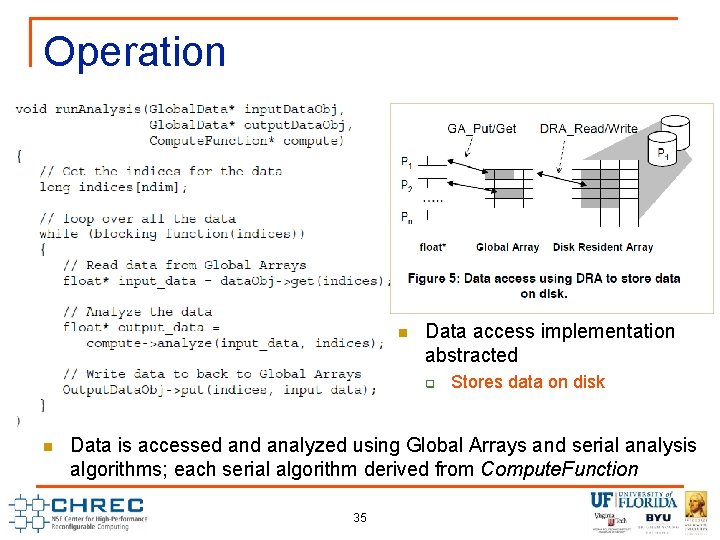
Operation n Data access implementation abstracted q n Stores data on disk Data is accessed analyzed using Global Arrays and serial analysis algorithms; each serial algorithm derived from Compute. Function 35
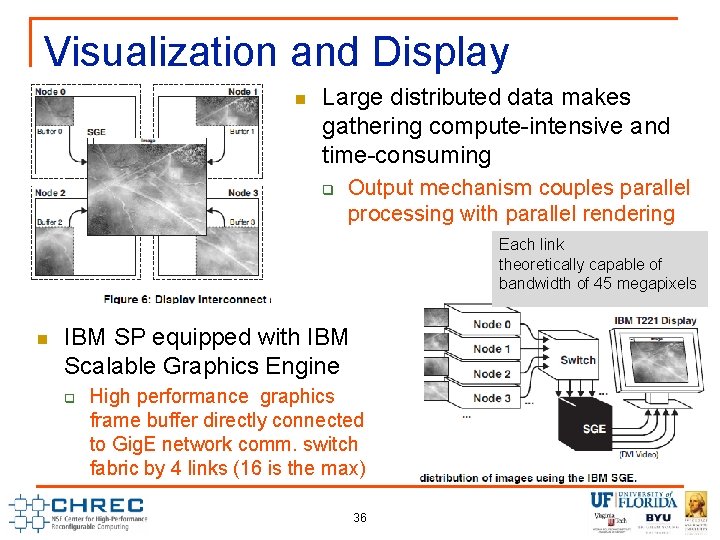
Visualization and Display n Large distributed data makes gathering compute-intensive and time-consuming q Output mechanism couples parallel processing with parallel rendering Each link theoretically capable of bandwidth of 45 megapixels n IBM SP equipped with IBM Scalable Graphics Engine q High performance graphics frame buffer directly connected to Gig. E network comm. switch fabric by 4 links (16 is the max) 36
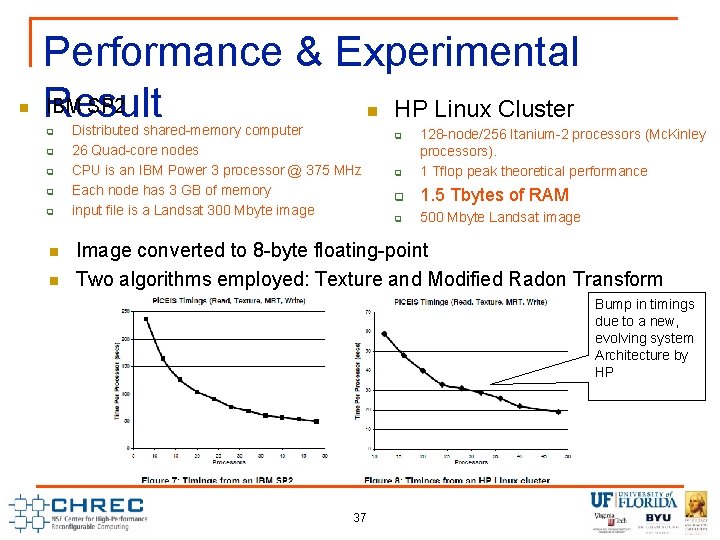
n Performance & Experimental IBM SP 2 Result HP Linux Cluster n q q q n n Distributed shared-memory computer 26 Quad-core nodes CPU is an IBM Power 3 processor @ 375 MHz Each node has 3 GB of memory input file is a Landsat 300 Mbyte image q 128 -node/256 Itanium-2 processors (Mc. Kinley processors). 1 Tflop peak theoretical performance q 1. 5 Tbytes of RAM q 500 Mbyte Landsat image q Image converted to 8 -byte floating-point Two algorithms employed: Texture and Modified Radon Transform Bump in timings due to a new, evolving system Architecture by HP 37
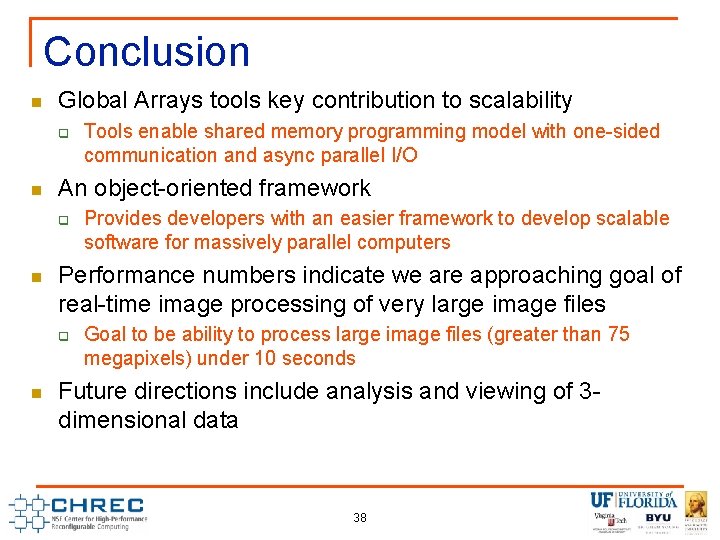
Conclusion n Global Arrays tools key contribution to scalability q n An object-oriented framework q n Provides developers with an easier framework to develop scalable software for massively parallel computers Performance numbers indicate we are approaching goal of real-time image processing of very large image files q n Tools enable shared memory programming model with one-sided communication and async parallel I/O Goal to be ability to process large image files (greater than 75 megapixels) under 10 seconds Future directions include analysis and viewing of 3 dimensional data 38
Q&A 39
Thank you 40