
IQECho Middleware Principles for Realtime Interaction Across Heterogeneous
- Slides: 18
IQ-ECho: Middleware Principles for Real-time Interaction Across Heterogeneous Hardware/Software Platforms Karsten Schwan Greg Eisenhauer Matt Wolf Mustaq Ahamad (Nagi Rao - ORNL Constantinos Dovrolis) College of Computing Georgia Tech schwan/eisen/mwolf@cc. gatech. edu http: //www. cc. gatech. edu/systems/projects/IQECho/
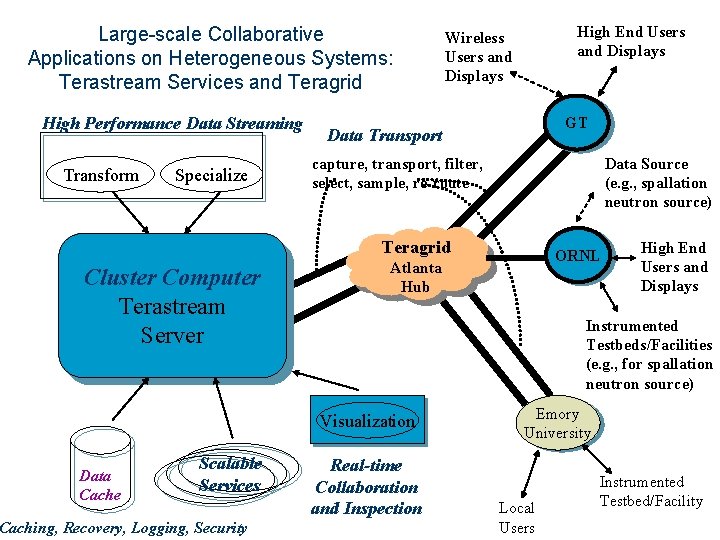
Large-scale Collaborative Applications on Heterogeneous Systems: Terastream Services and Teragrid High Performance Data Streaming Transform Specialize High End Users and Displays Wireless Users and Displays GT Data Transport capture, transport, filter, select, sample, re-route Data Source (e. g. , spallation neutron source) Teragrid Cluster Computer Terastream Server Atlanta Hub Scalable Services Caching, Recovery, Logging, Security High End Users and Displays Instrumented Testbeds/Facilities (e. g. , for spallation neutron source) Visualization Data Cache ORNL Real-time Collaboration and Inspection Emory University Local Users Instrumented Testbed/Facility
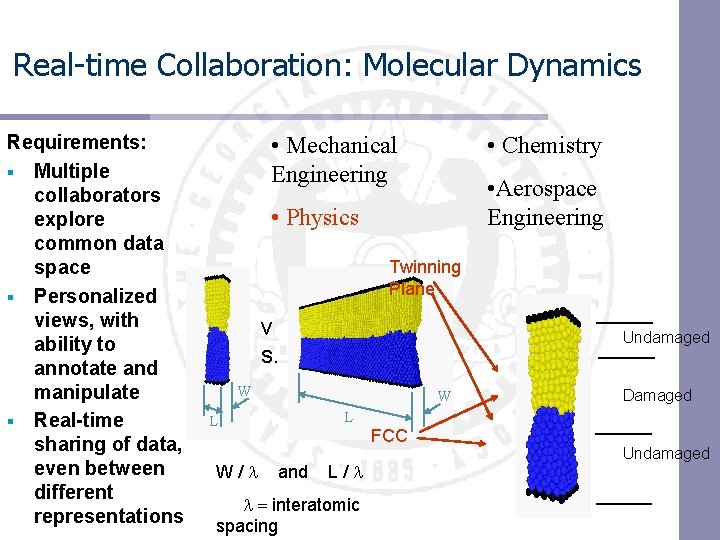
Real-time Collaboration: Molecular Dynamics Requirements: § Multiple collaborators explore common data space § Personalized views, with ability to annotate and manipulate § Real-time sharing of data, even between different representations • Mechanical Engineering • Chemistry • Aerospace Engineering • Physics Twinning Plane v s. Undamaged W W L L W/l Damaged FCC and L/l l = interatomic spacing Undamaged
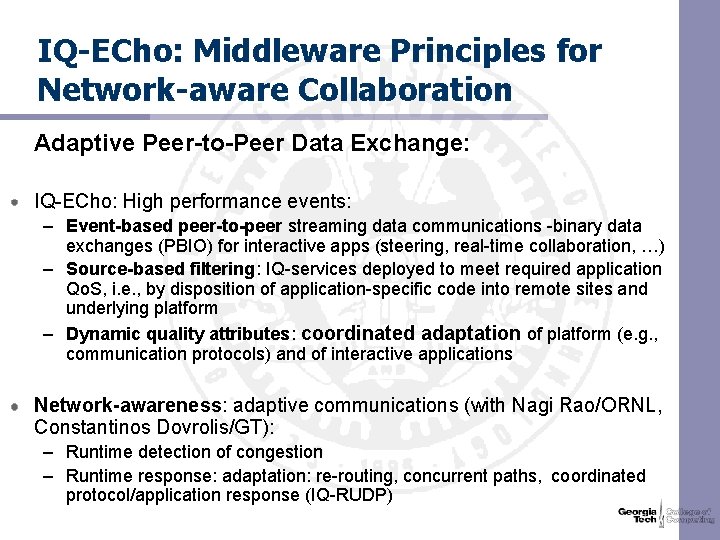
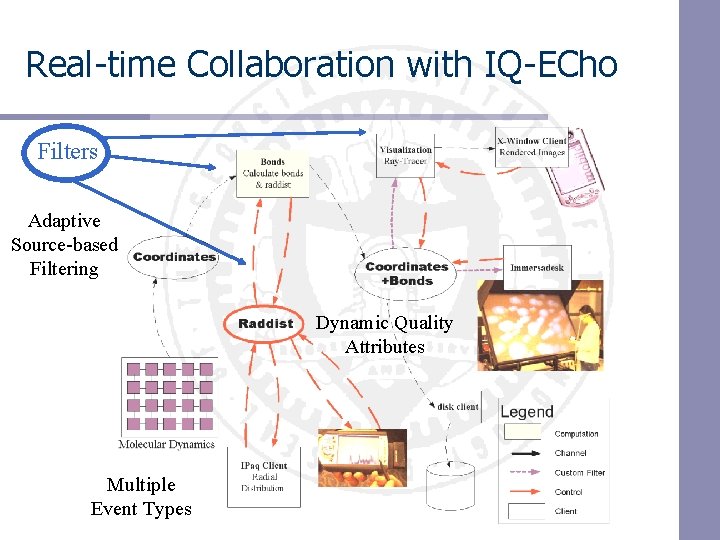
IQ-ECho: Middleware Principles for Network-aware Collaboration Adaptive Peer-to-Peer Data Exchange: IQ-ECho: High performance events: – Event-based peer-to-peer streaming data communications -binary data exchanges (PBIO) for interactive apps (steering, real-time collaboration, …) – Source-based filtering: IQ-services deployed to meet required application Qo. S, i. e. , by disposition of application-specific code into remote sites and underlying platform – Dynamic quality attributes: coordinated adaptation of platform (e. g. , communication protocols) and of interactive applications Network-awareness: adaptive communications (with Nagi Rao/ORNL, Constantinos Dovrolis/GT): – Runtime detection of congestion – Runtime response: adaptation: re-routing, concurrent paths, coordinated protocol/application response (IQ-RUDP)
Real-time Collaboration with IQ-ECho Filters Adaptive Source-based Filtering Dynamic Quality Attributes Multiple Event Types
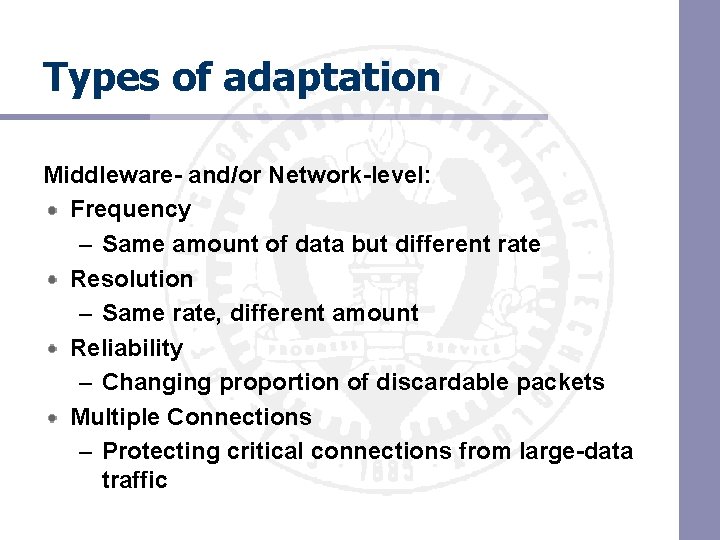
Types of adaptation Middleware- and/or Network-level: Frequency – Same amount of data but different rate Resolution – Same rate, different amount Reliability – Changing proportion of discardable packets Multiple Connections – Protecting critical connections from large-data traffic
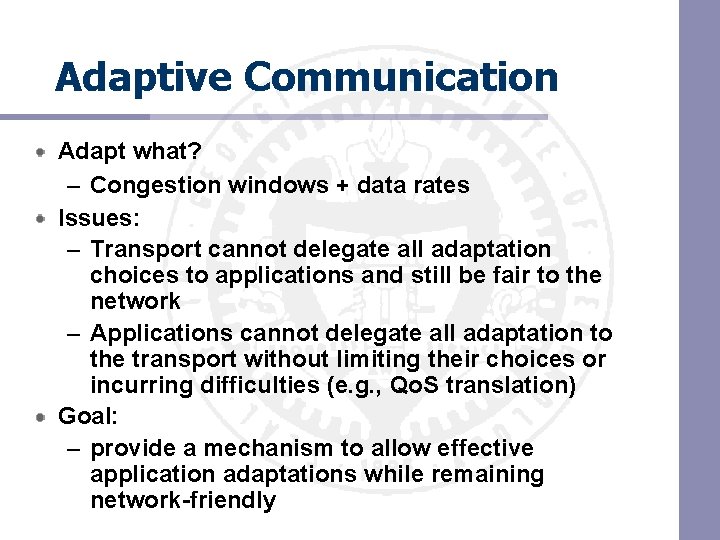
Adaptive Communication Adapt what? – Congestion windows + data rates Issues: – Transport cannot delegate all adaptation choices to applications and still be fair to the network – Applications cannot delegate all adaptation to the transport without limiting their choices or incurring difficulties (e. g. , Qo. S translation) Goal: – provide a mechanism to allow effective application adaptations while remaining network-friendly
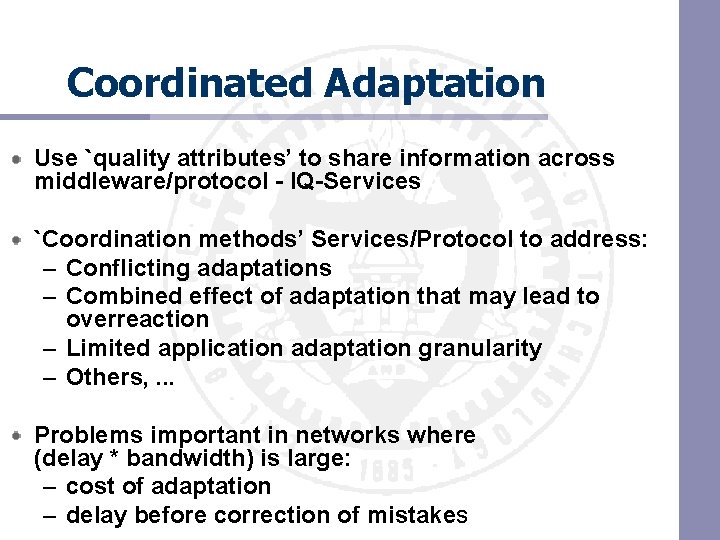
Coordinated Adaptation Use `quality attributes’ to share information across middleware/protocol - IQ-Services `Coordination methods’ Services/Protocol to address: – Conflicting adaptations – Combined effect of adaptation that may lead to overreaction – Limited application adaptation granularity – Others, . . . Problems important in networks where (delay * bandwidth) is large: – cost of adaptation – delay before correction of mistakes
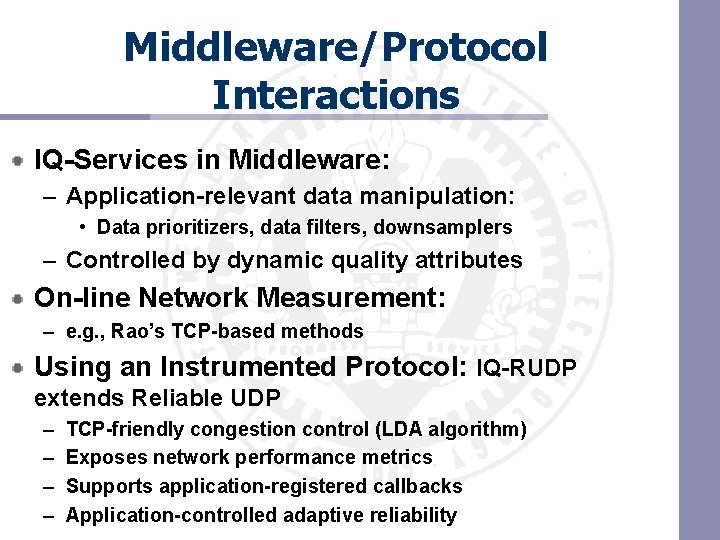
Middleware/Protocol Interactions IQ-Services in Middleware: – Application-relevant data manipulation: • Data prioritizers, data filters, downsamplers – Controlled by dynamic quality attributes On-line Network Measurement: – e. g. , Rao’s TCP-based methods Using an Instrumented Protocol: IQ-RUDP extends Reliable UDP – – TCP-friendly congestion control (LDA algorithm) Exposes network performance metrics Supports application-registered callbacks Application-controlled adaptive reliability
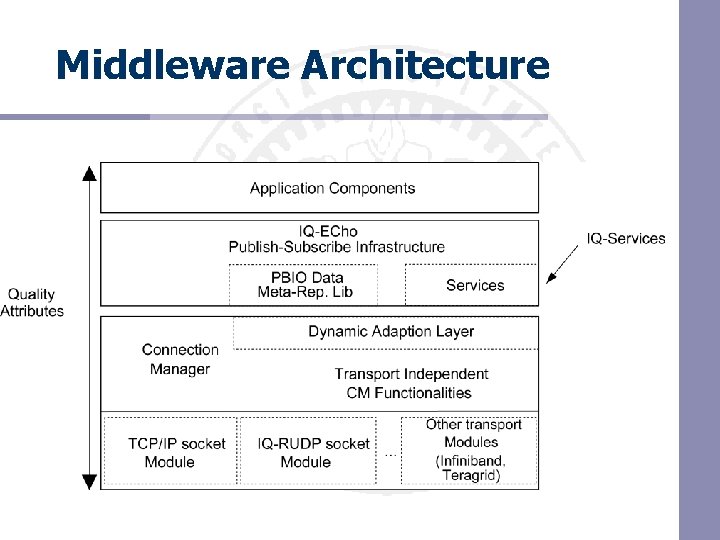
Middleware Architecture
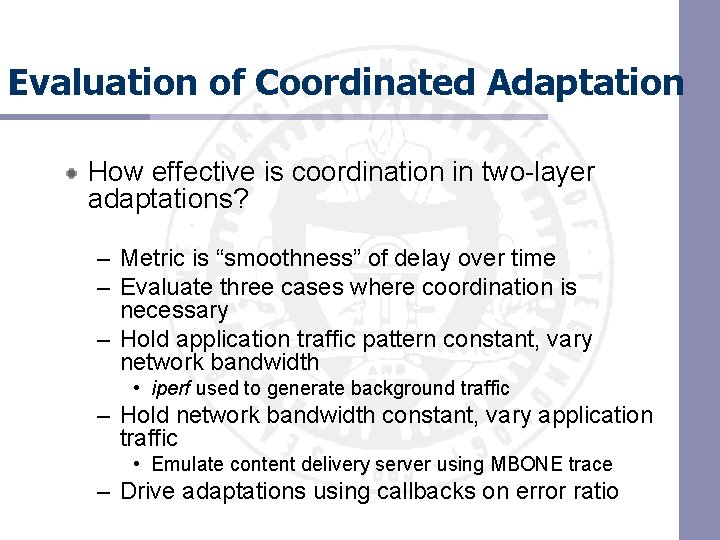
Evaluation of Coordinated Adaptation How effective is coordination in two-layer adaptations? – Metric is “smoothness” of delay over time – Evaluate three cases where coordination is necessary – Hold application traffic pattern constant, vary network bandwidth • iperf used to generate background traffic – Hold network bandwidth constant, vary application traffic • Emulate content delivery server using MBONE trace – Drive adaptations using callbacks on error ratio
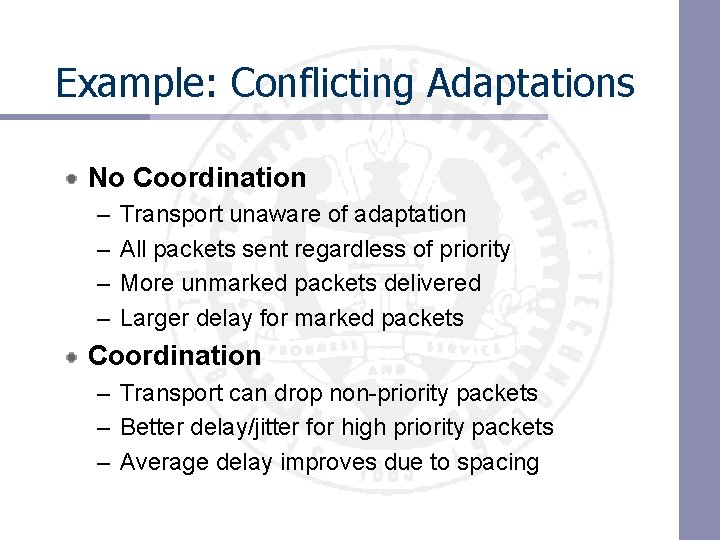
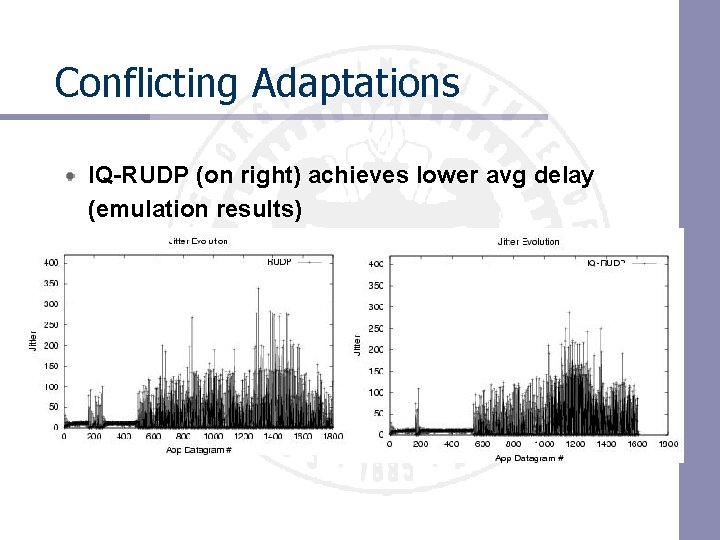
Example: Conflicting Adaptations No Coordination – – Transport unaware of adaptation All packets sent regardless of priority More unmarked packets delivered Larger delay for marked packets Coordination – Transport can drop non-priority packets – Better delay/jitter for high priority packets – Average delay improves due to spacing
Conflicting Adaptations IQ-RUDP (on right) achieves lower avg delay (emulation results)
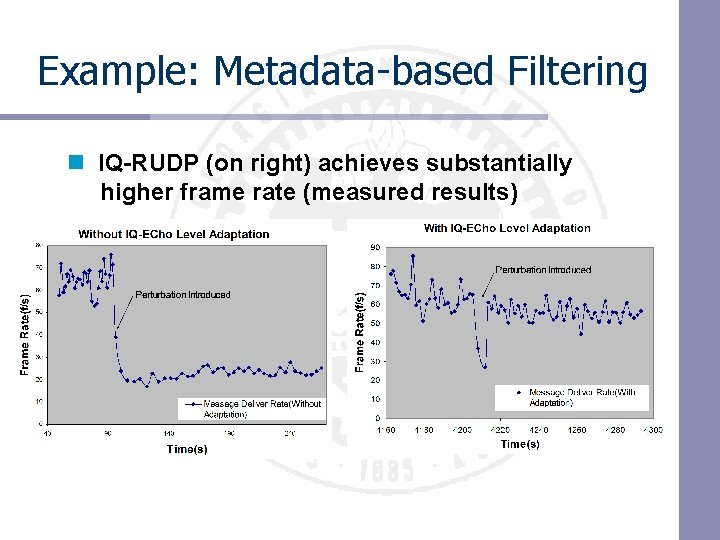
Example: Metadata-based Filtering n IQ-RUDP (on right) achieves substantially higher frame rate (measured results)
Conclusions and Status Key technologies: • Adaptive, lightweight middleware services – software release of IQ-ECho available soon (installation at ORNL in progress) • Coordinated middleware/network (re)actions (through quality attributes) – generalizes to other network efforts (e. g. , Net 100) • Heterogeneous, distributed collaboration with high end data streams: – Smartpointer (MD - SC 2002) Evaluation on wide area networks • Internet, GT/ORNL link (yet to come) Focus on integration • Mx. N services, AG 2. x
Ongoing Efforts and Leverage Deployment and Evaluation (Year 3): – Realistic applications and testbeds: • deploy remote collaboration infrastructure (with ORNL) and experiment across ORNL/GT Gigabit Testbed (with N. Rao, ORNL) • experiment with other data sets (e. g. , spallation neutron source), other protocols, other network measurement methods (NSF/DOE) – CCA/OGSI integration: • CCA integration: use Mx. N service as challenge example (joint with James Kohl - ORNL) • OGSI integration challenge example: remote graphics services for AG -> OGSI, directory services Leverage: CERCS and GT/ORNL efforts: – NSF Netreact project • integrated network measurement - w. Dovrolis, Rao – NSF XML project - dynamic metadata – Teragrid and GT/ORNL and GT/NRL: high end network links
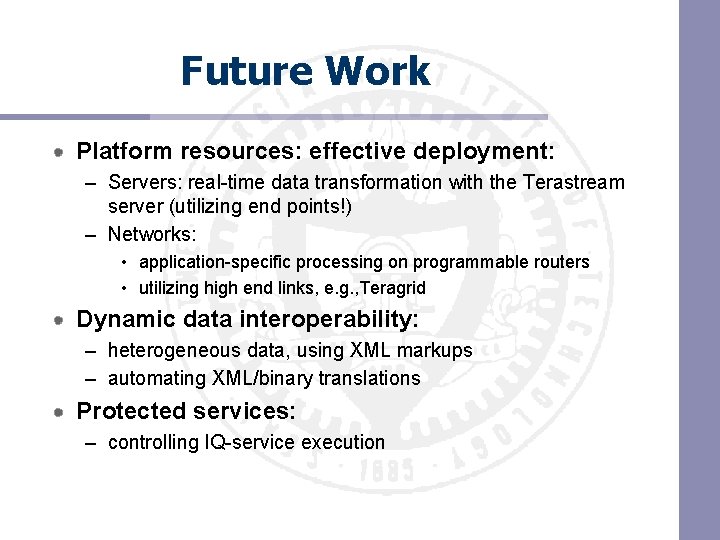
Future Work Platform resources: effective deployment: – Servers: real-time data transformation with the Terastream server (utilizing end points!) – Networks: • application-specific processing on programmable routers • utilizing high end links, e. g. , Teragrid Dynamic data interoperability: – heterogeneous data, using XML markups – automating XML/binary translations Protected services: – controlling IQ-service execution
Publications Qi He and Karsten Schwan, “IQ-RUDP: Coordinating Application Adaptation with Network Transport”, High Performance Distributed Computing (HPDC 11), July 2002. Matt Wolf, Zhongtang Cai, Weiyun Huang, Karsten Schwan, ``Smart. Pointers: Personalized Scientific Data Portals in Your Hand'', Supercomputing 2002. Fabian Bustamante, Patrick Widener, Karsten Schwan, ``Scalable Directory Services Using Proactivity'', Supercomputing 2002. Patrick Widener, Greg Eisenhauer, Karsten Schwan, and Fabián E. Bustamante, "Open Metadata Formats: Efficient XML-Based Communication for High Performance Computing", Cluster Computing: The Journal of Networks, Software Tools, and Applications, 2003. Greg Eisenhauer, Fabián Bustamante and Karsten Schwan, "Native Data Representation: An Efficient Wire Format for High-Performance Computing", IEEE Transactions on Parallel and Distributed Systems, 2003.