Quantum Network Coding Harumichi Nishimura Graduate School of




- Slides: 45
Quantum Network Coding Harumichi Nishimura 西村治道 Graduate School of Science, Osaka Prefecture University 大阪府立大学理学系研究科 March 30, 2011, Institute of Network Coding
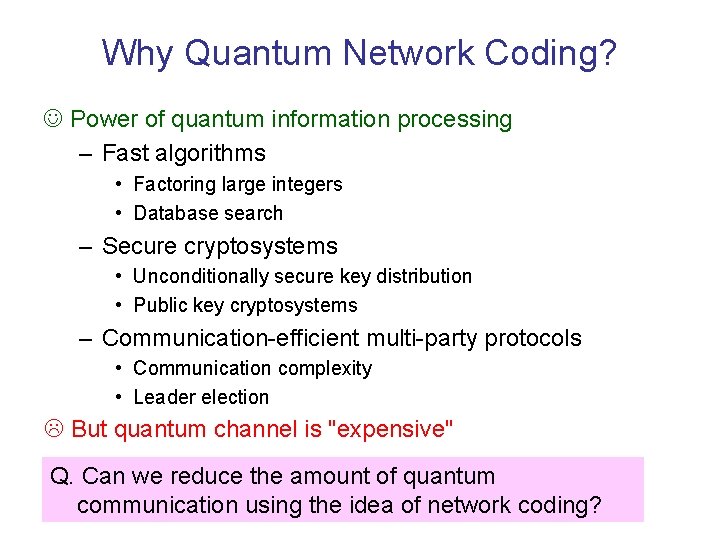
Why Quantum Network Coding? J Power of quantum information processing – Fast algorithms • Factoring large integers • Database search – Secure cryptosystems • Unconditionally secure key distribution • Public key cryptosystems – Communication-efficient multi-party protocols • Communication complexity • Leader election L But quantum channel is "expensive" Q. Can we reduce the amount of quantum communication using the idea of network coding?
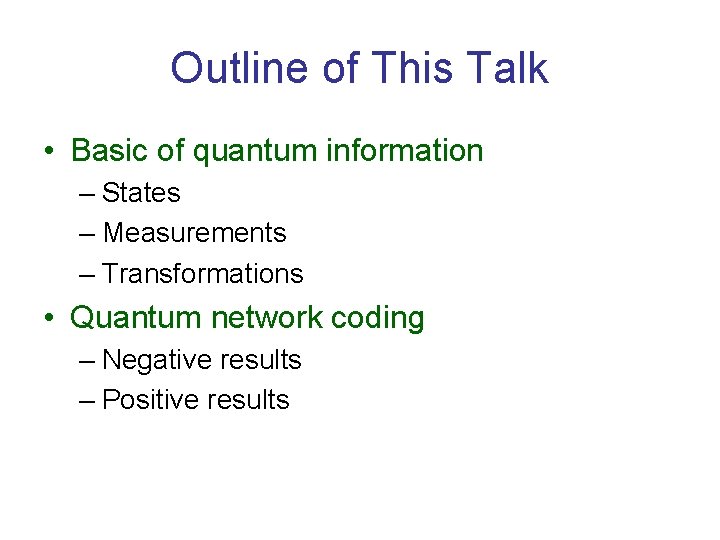
Outline of This Talk • Basic of quantum information – States – Measurements – Transformations • Quantum network coding – Negative results – Positive results
Basic of Quantum Information
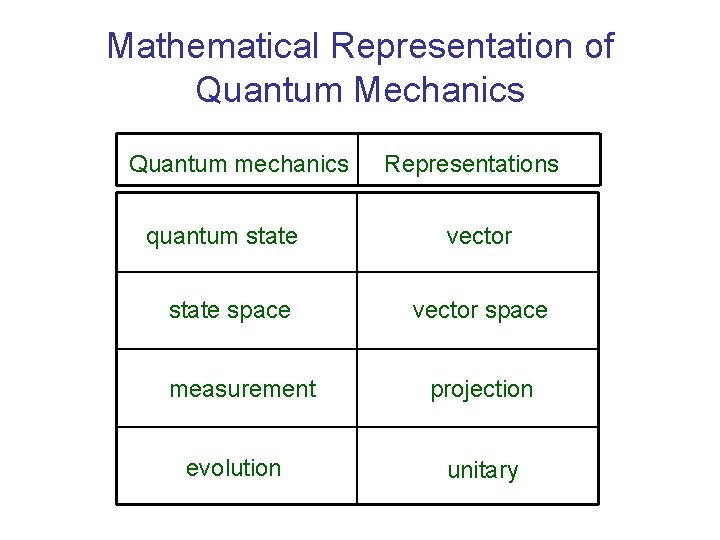
Mathematical Representation of Quantum Mechanics Quantum mechanics quantum state space measurement evolution Representations vector space projection unitary
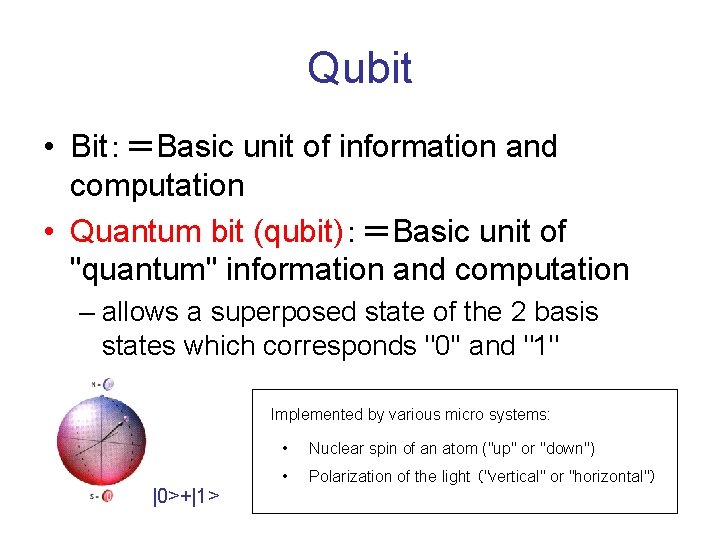
Qubit • Bit:=Basic unit of information and computation • Quantum bit (qubit):=Basic unit of "quantum" information and computation – allows a superposed state of the 2 basis states which corresponds "0'' and "1" Implemented by various micro systems: |0>+|1> • Nuclear spin of an atom ("up" or "down") • Polarization of the light ("vertical" or "horizontal")
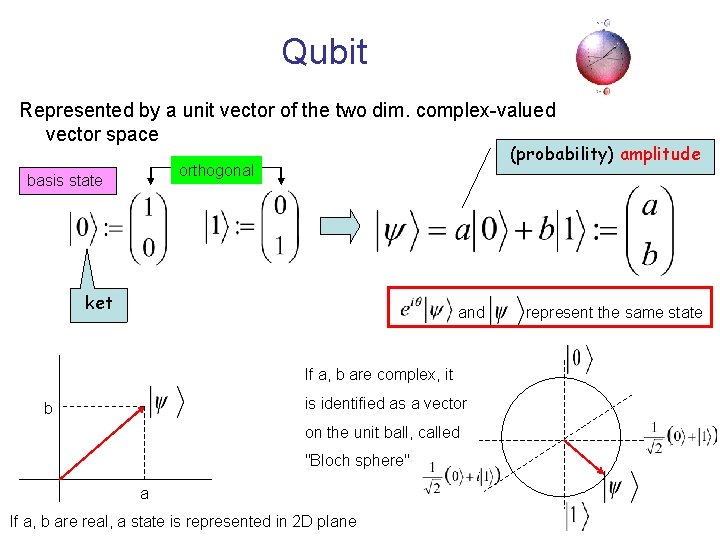
Qubit Represented by a unit vector of the two dim. complex-valued vector space (probability) amplitude orthogonal basis state ket and If a, b are complex, it is identified as a vector b on the unit ball, called "Bloch sphere" a If a, b are real, a state is represented in 2 D plane represent the same state
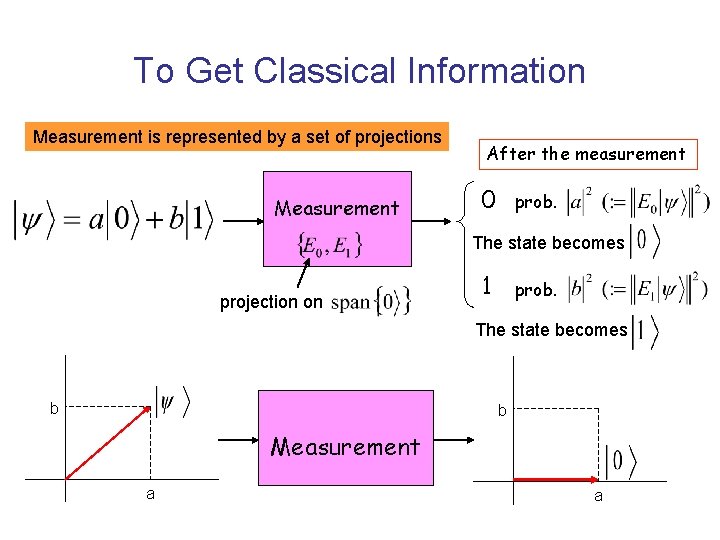
To Get Classical Information Measurement is represented by a set of projections Measurement After the measurement 0 prob. The state becomes projection on 1 prob. The state becomes b b Measurement a a
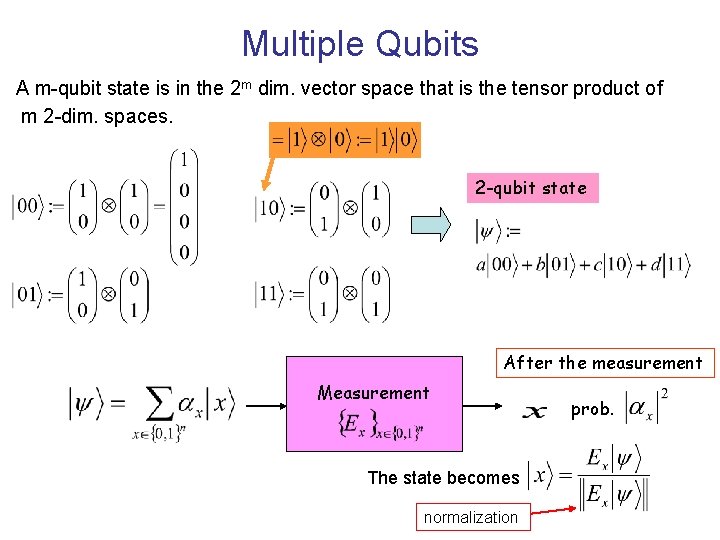
Multiple Qubits A m-qubit state is in the 2 m dim. vector space that is the tensor product of m 2 -dim. spaces. 2 -qubit state After the measurement Measurement The state becomes normalization prob.
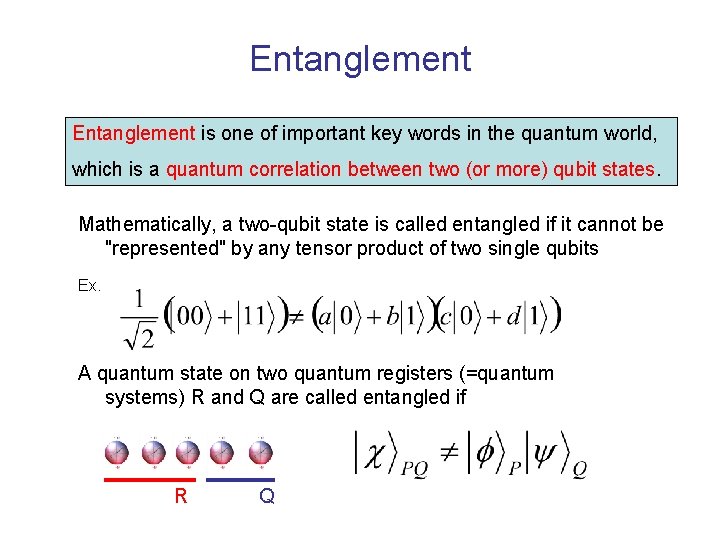
Entanglement is one of important key words in the quantum world, which is a quantum correlation between two (or more) qubit states. Mathematically, a two-qubit state is called entangled if it cannot be "represented" by any tensor product of two single qubits Ex. A quantum state on two quantum registers (=quantum systems) R and Q are called entangled if R Q
Partial Measurement State after getting 0: = 2 -qubit state Result 0 (prob. 2/3) Measure 2 nd qubit Result 1 (prob. 1/3)
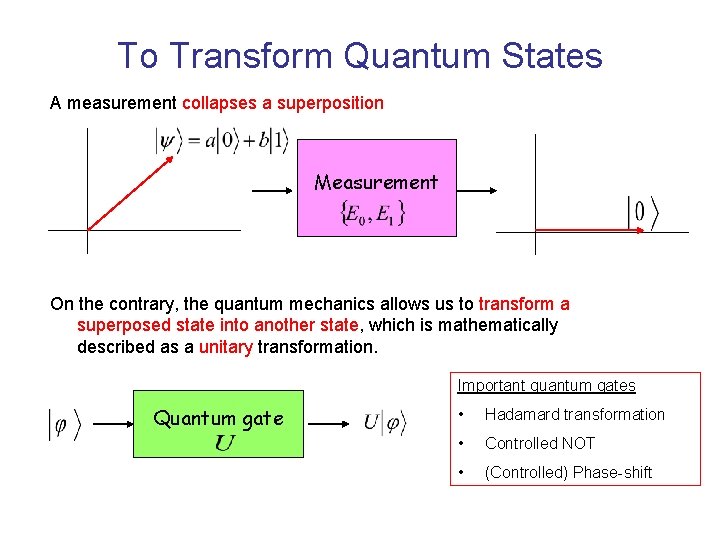
To Transform Quantum States A measurement collapses a superposition Measurement On the contrary, the quantum mechanics allows us to transform a superposed state into another state, which is mathematically described as a unitary transformation. Important quantum gates Quantum gate • Hadamard transformation • Controlled NOT • (Controlled) Phase-shift
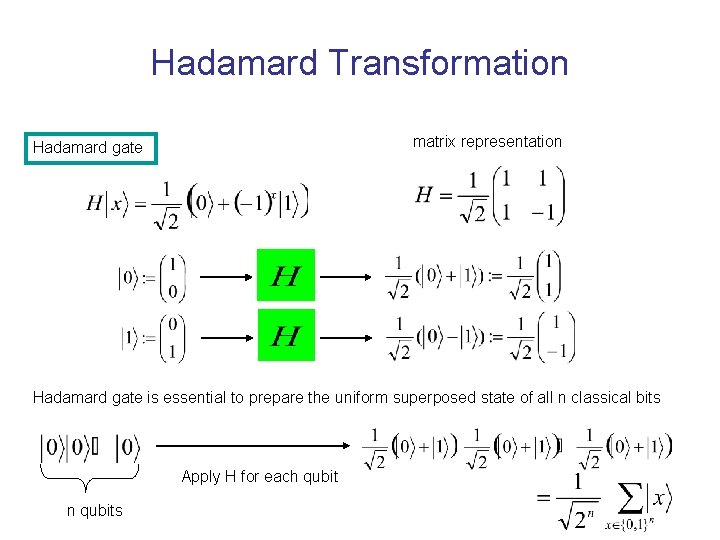
Hadamard Transformation matrix representation Hadamard gate is essential to prepare the uniform superposed state of all n classical bits Apply H for each qubit n qubits
Controlled NOT gate control part matrix representation target part Notice: CN is essentially "classical" transformation since it flips the target part if the control part is 1. But the fact that CN can apply to any superposed state is very important in quantum information processing. Toffoli gate (Controlled-Controlled NOT) Basic Fact Any function f computed efficiently by a classical computer can be computed efficiently using only Toffoli gates, which means that the transformation can be efficiently implemented by quantum computing
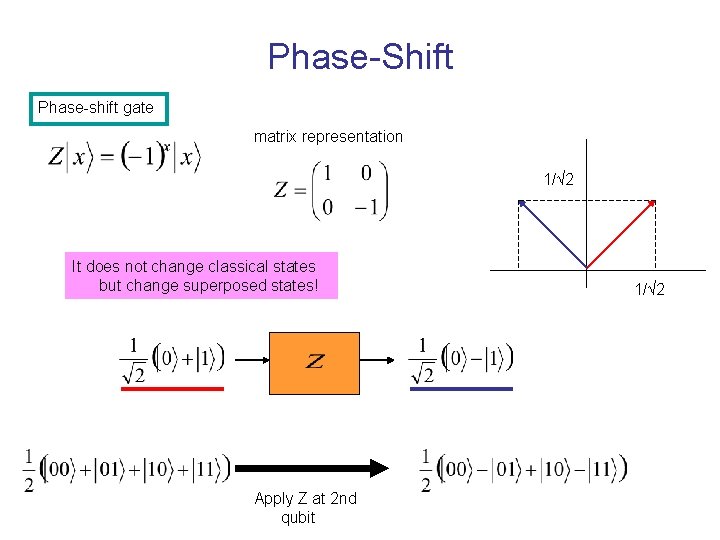
Phase-Shift Phase-shift gate matrix representation 1/√ 2 It does not change classical states but change superposed states! Apply Z at 2 nd qubit 1/√ 2
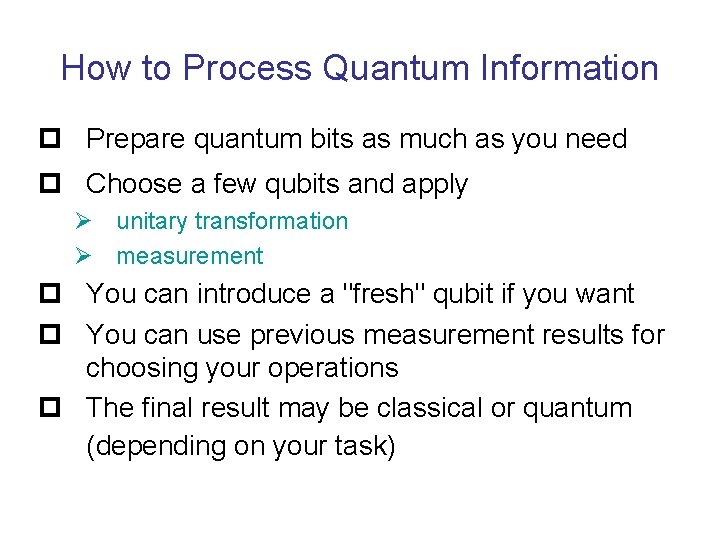
How to Process Quantum Information p Prepare quantum bits as much as you need p Choose a few qubits and apply Ø unitary transformation Ø measurement p You can introduce a "fresh" qubit if you want p You can use previous measurement results for choosing your operations p The final result may be classical or quantum (depending on your task)
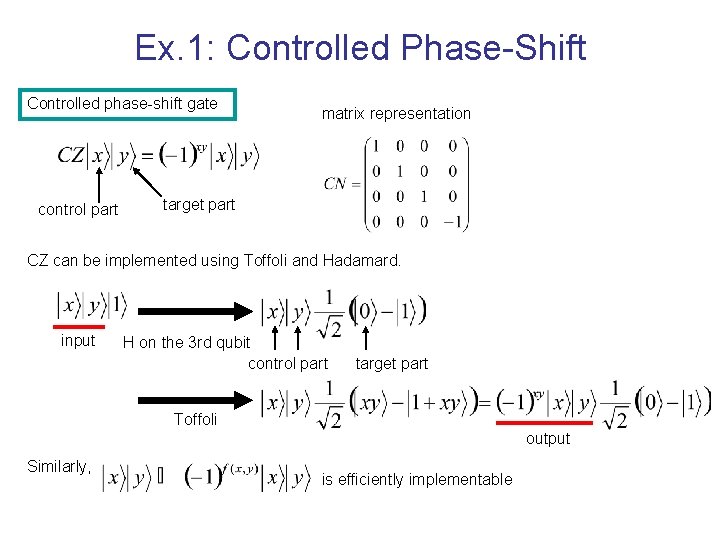
Ex. 1: Controlled Phase-Shift Controlled phase-shift gate control part matrix representation target part CZ can be implemented using Toffoli and Hadamard. input H on the 3 rd qubit control part target part Toffoli output Similarly, is efficiently implementable
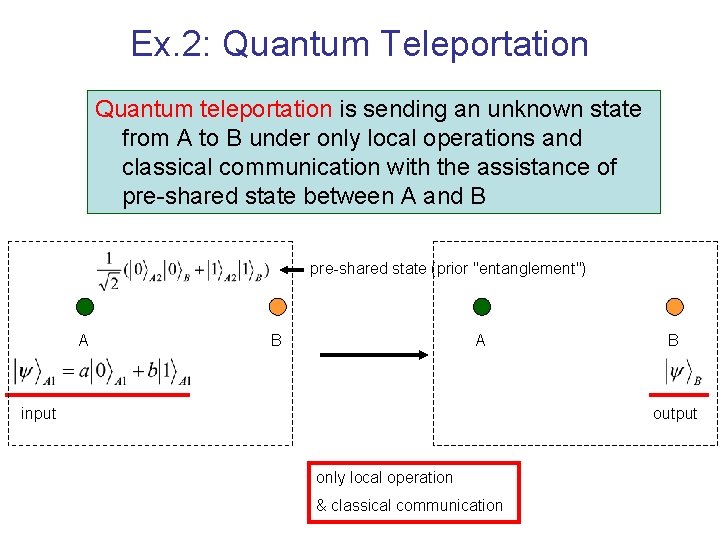
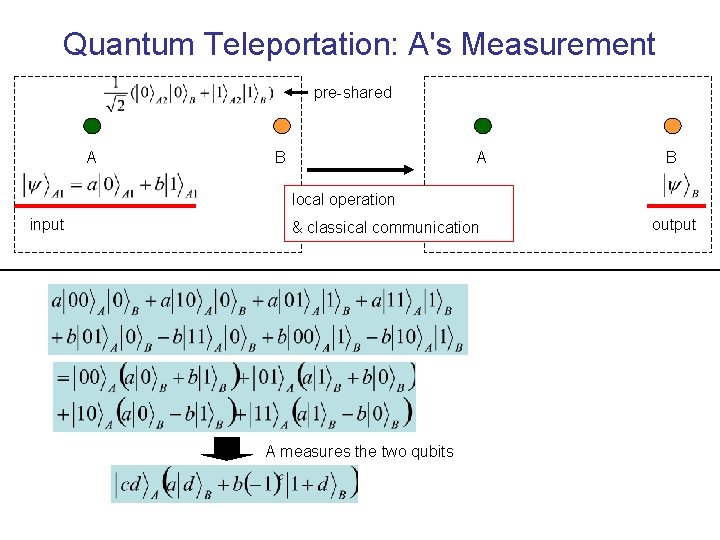
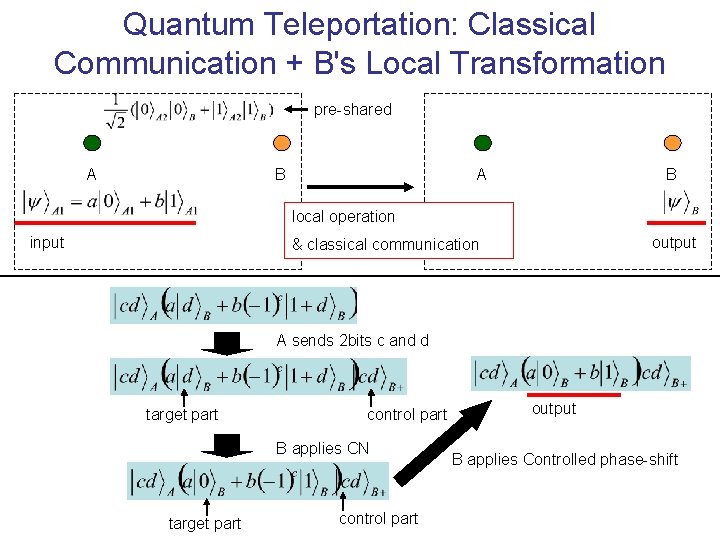
Ex. 2: Quantum Teleportation Quantum teleportation is sending an unknown state from A to B under only local operations and classical communication with the assistance of pre-shared state between A and B pre-shared state (prior "entanglement") A B A input B output only local operation & classical communication
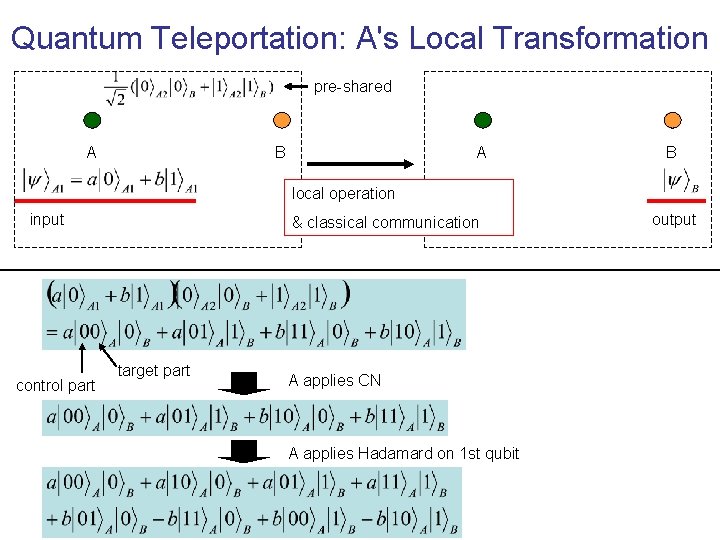
Quantum Teleportation: A's Local Transformation pre-shared A B local operation input control part & classical communication target part A applies CN A applies Hadamard on 1 st qubit output
Quantum Teleportation: A's Measurement pre-shared A B local operation input & classical communication A measures the two qubits output
Quantum Teleportation: Classical Communication + B's Local Transformation pre-shared A B local operation input output & classical communication A sends 2 bits c and d target part control part B applies CN target part control part output B applies Controlled phase-shift
Quantum Network Coding
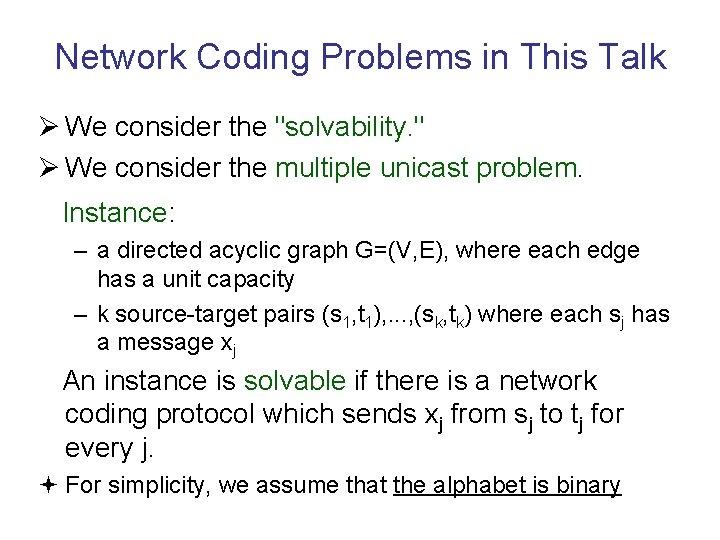
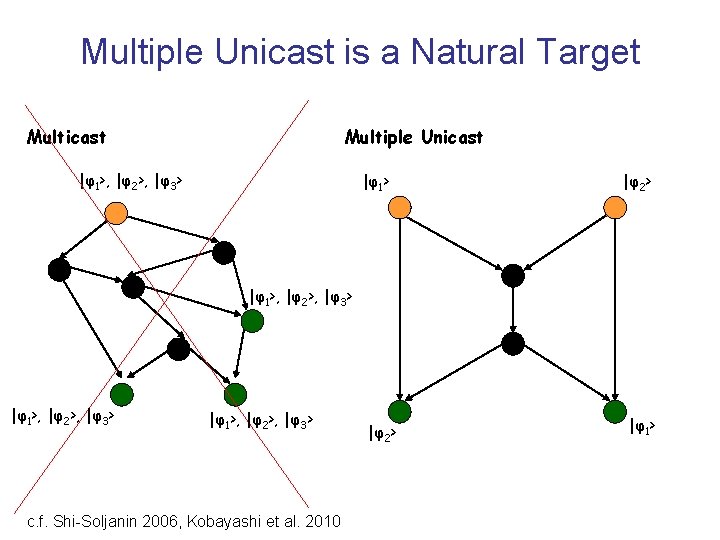
Network Coding Problems in This Talk Ø We consider the "solvability. " Ø We consider the multiple unicast problem. Instance: – a directed acyclic graph G=(V, E), where each edge has a unit capacity – k source-target pairs (s 1, t 1), . . . , (sk, tk) where each sj has a message xj An instance is solvable if there is a network coding protocol which sends xj from sj to tj for every j. ª For simplicity, we assume that the alphabet is binary
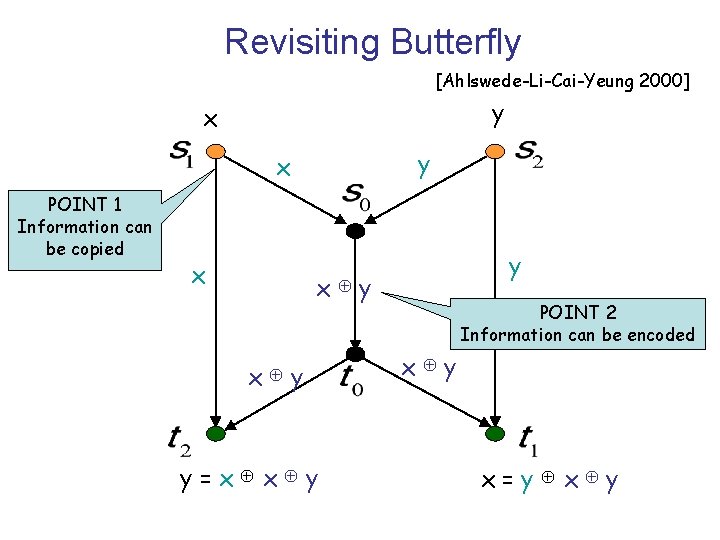
Revisiting Butterfly [Ahlswede-Li-Cai-Yeung 2000] y x POINT 1 Information can be copied x y x⊕y y=x⊕x⊕y POINT 2 Information can be encoded x⊕y x=y⊕x⊕y
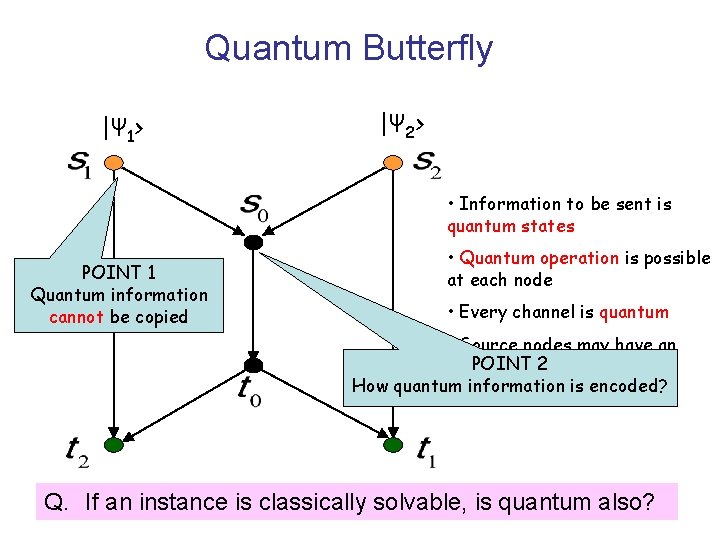
Quantum Butterfly |Ψ 1> |Ψ 2> • Information to be sent is quantum states POINT 1 Quantum information cannot be copied • Quantum operation is possible at each node • Every channel is quantum • Source nodes may have an POINT state 2 entangled How quantum information is encoded? Q. If an instance is classically solvable, is quantum also?
Quantum Information cannot be Copied (No-cloning theorem: Wootters-Zurek) An "unknown" quantum state cannot be cloned. X
Multiple Unicast is a Natural Target Multicast Multiple Unicast |φ1>, |φ2>, |φ3> |φ1> |φ2> |φ1>, |φ2>, |φ3> c. f. Shi-Soljanin 2006, Kobayashi et al. 2010 |φ2> |φ1>
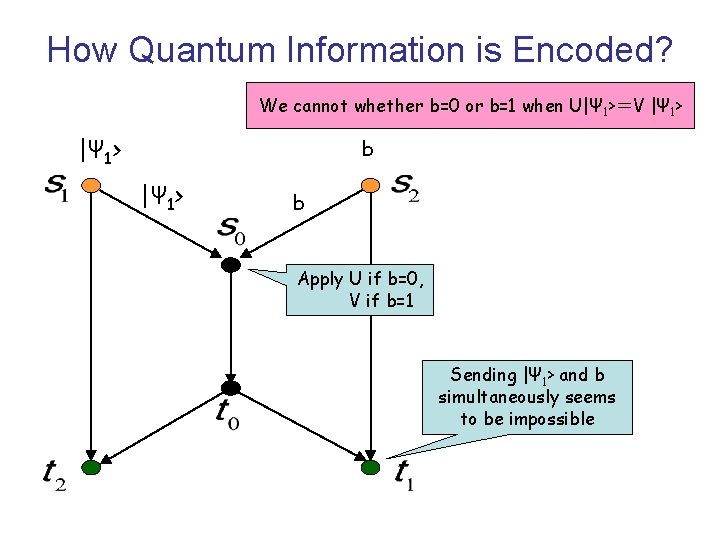
How Quantum Information is Encoded? We cannot whether b=0 or b=1 when U|Ψ 1>=V |Ψ 1> b Apply U if b=0, V if b=1 Sending |Ψ 1> and b simultaneously seems to be impossible
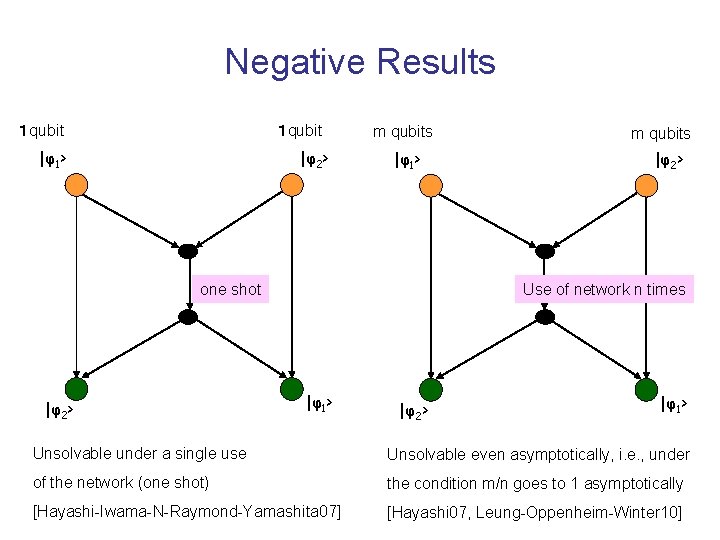
Negative Results 1 qubit |φ1> |φ2> m qubits |φ1> one shot |φ2> m qubits |φ2> Use of network n times |φ1> |φ2> |φ1> Unsolvable under a single use Unsolvable even asymptotically, i. e. , under of the network (one shot) the condition m/n goes to 1 asymptotically [Hayashi-Iwama-N-Raymond-Yamashita 07] [Hayashi 07, Leung-Oppenheim-Winter 10]
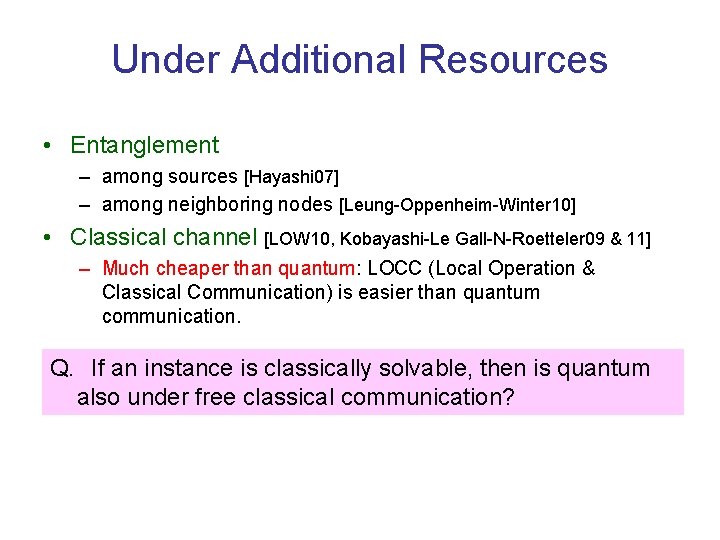
Under Additional Resources • Entanglement – among sources [Hayashi 07] – among neighboring nodes [Leung-Oppenheim-Winter 10] • Classical channel [LOW 10, Kobayashi-Le Gall-N-Roetteler 09 & 11] – Much cheaper than quantum: LOCC (Local Operation & Classical Communication) is easier than quantum communication. Q. If an instance is classically solvable, then is quantum also under free classical communication?
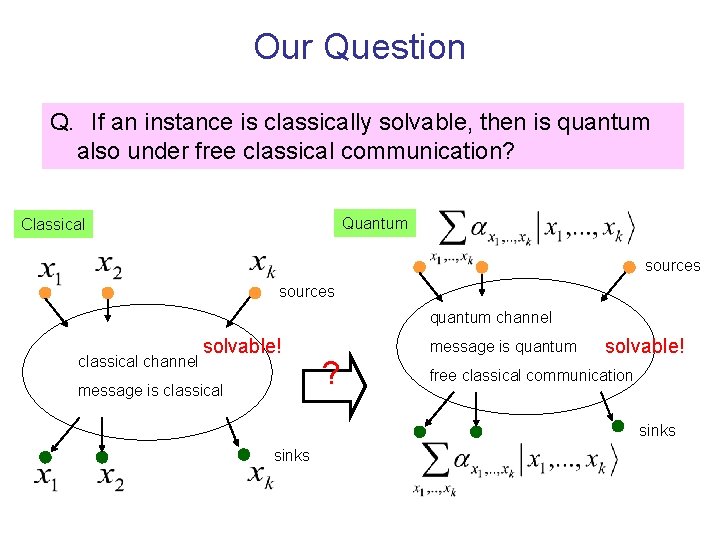
Our Question Q. If an instance is classically solvable, then is quantum also under free classical communication? Quantum Classical sources quantum channel classical channel solvable! message is classical ? message is quantum solvable! free classical communication sinks
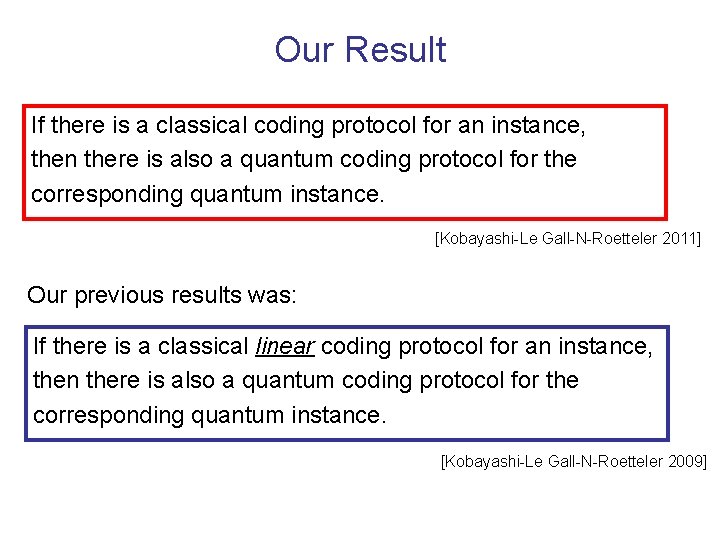
Our Result If there is a classical coding protocol for an instance, then there is also a quantum coding protocol for the corresponding quantum instance. [Kobayashi-Le Gall-N-Roetteler 2011] Our previous results was: If there is a classical linear coding protocol for an instance, then there is also a quantum coding protocol for the corresponding quantum instance. [Kobayashi-Le Gall-N-Roetteler 2009]
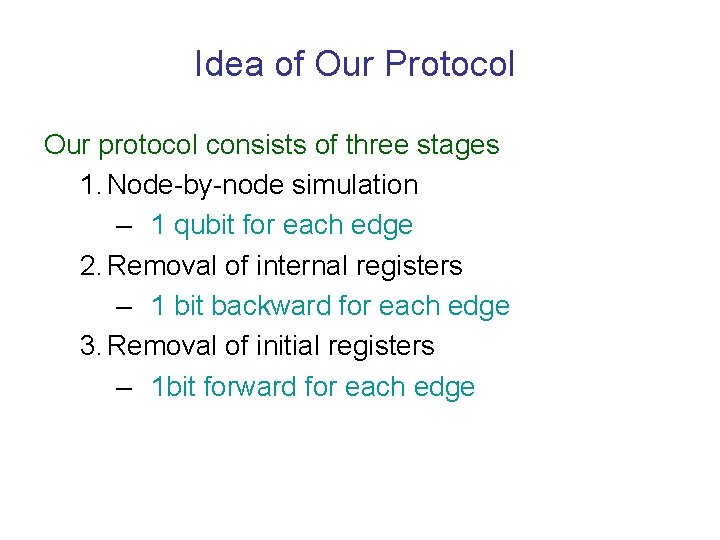
Idea of Our Protocol Our protocol consists of three stages 1. Node-by-node simulation – 1 qubit for each edge 2. Removal of internal registers – 1 bit backward for each edge 3. Removal of initial registers – 1 bit forward for each edge
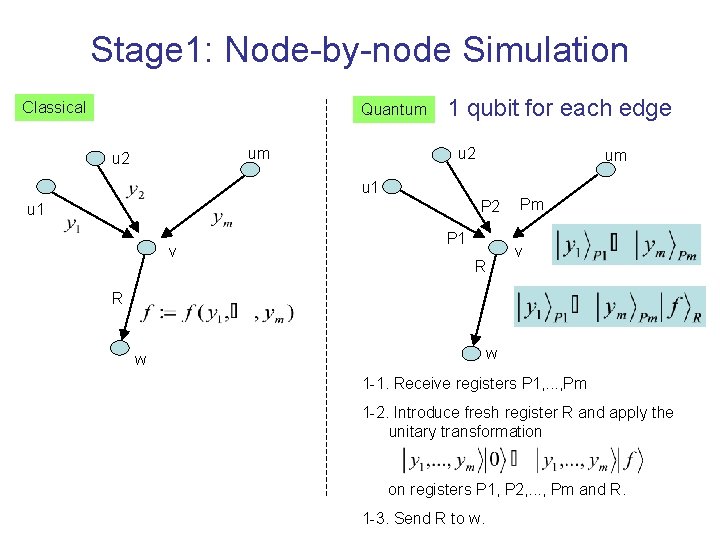
Stage 1: Node-by-node Simulation Classical Quantum um u 2 1 qubit for each edge u 2 um u 1 P 2 u 1 v P 1 R Pm v R w w 1 -1. Receive registers P 1, . . . , Pm 1 -2. Introduce fresh register R and apply the unitary transformation on registers P 1, P 2, . . . , Pm and R. 1 -3. Send R to w.
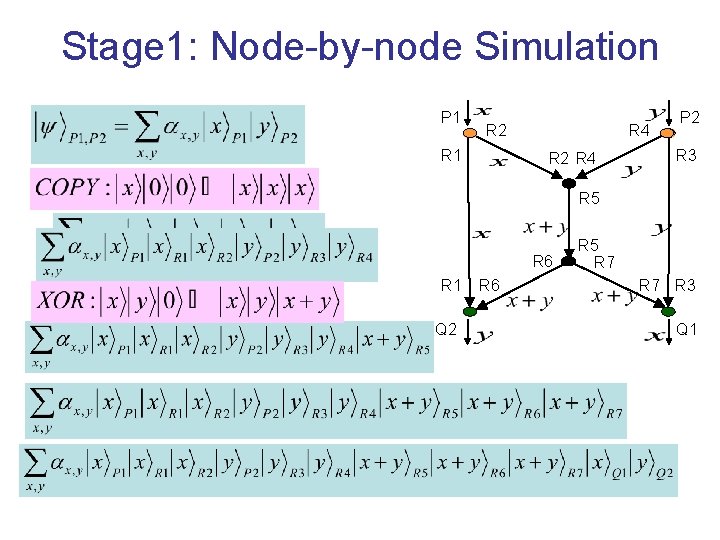
Stage 1: Node-by-node Simulation P 1 R 2 R 1 R 4 R 2 R 4 P 2 R 3 R 5 R 6 R 1 Q 2 R 6 R 5 R 7 R 3 Q 1
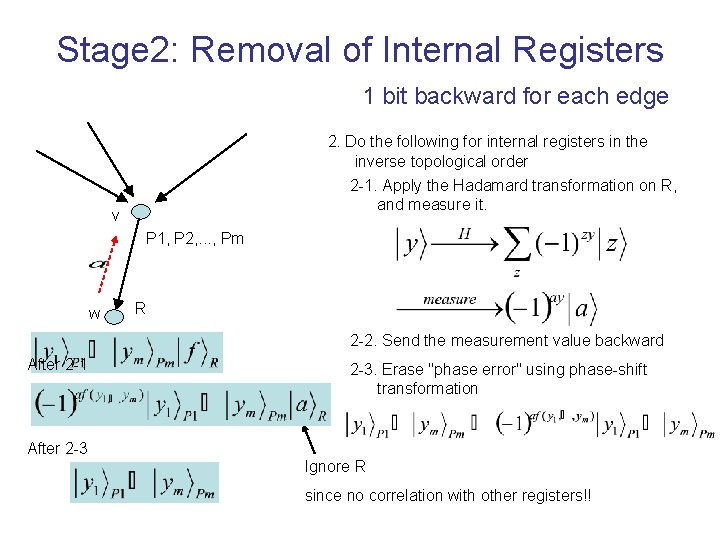
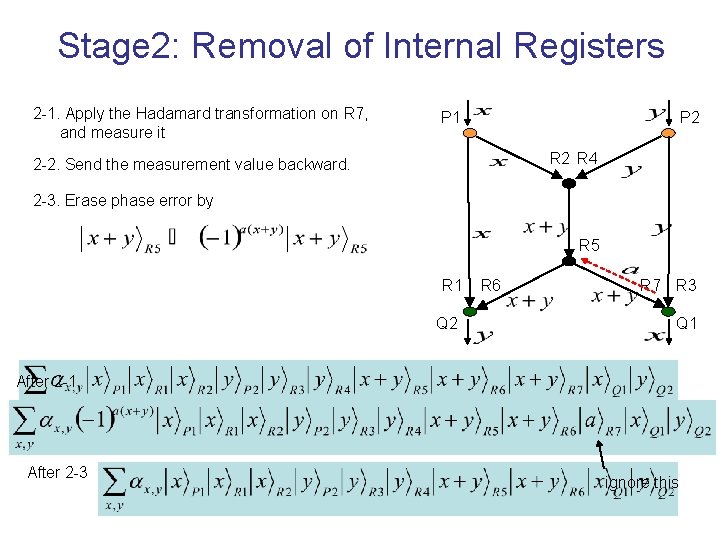
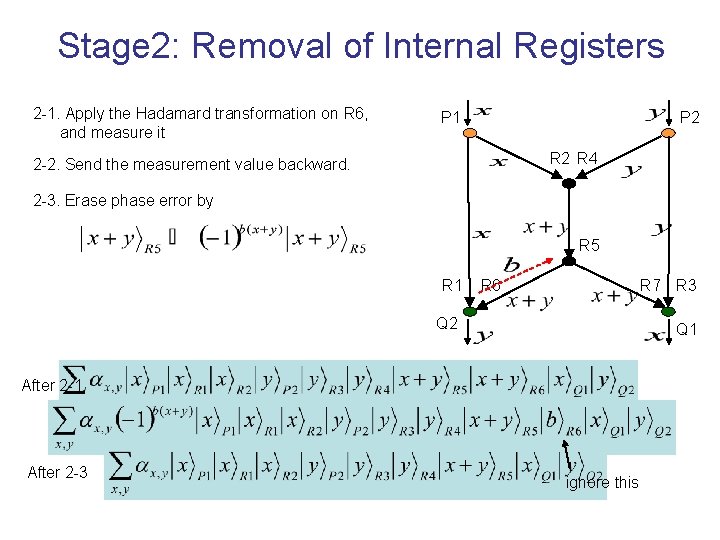
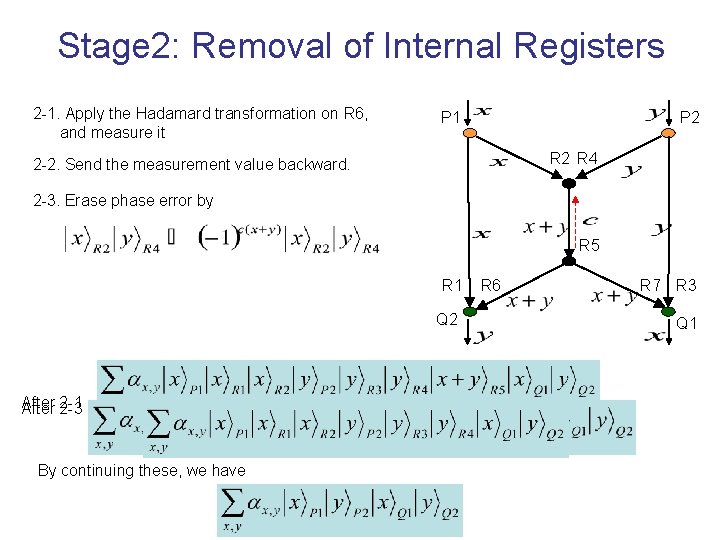
Stage 2: Removal of Internal Registers 1 bit backward for each edge 2. Do the following for internal registers in the inverse topological order 2 -1. Apply the Hadamard transformation on R, and measure it. v P 1, P 2, . . . , Pm w R 2 -2. Send the measurement value backward After 2 -1 2 -3. Erase ''phase error" using phase-shift transformation After 2 -3 Ignore R since no correlation with other registers!!
Stage 2: Removal of Internal Registers 2 -1. Apply the Hadamard transformation on R 7, and measure it P 1 P 2 R 4 2 -2. Send the measurement value backward. 2 -3. Erase phase error by R 5 R 1 Q 2 R 6 R 7 R 3 Q 1 After 2 -3 ignore this
Stage 2: Removal of Internal Registers 2 -1. Apply the Hadamard transformation on R 6, and measure it P 1 P 2 R 4 2 -2. Send the measurement value backward. 2 -3. Erase phase error by R 5 R 1 R 6 R 7 R 3 Q 2 Q 1 After 2 -3 ignore this
Stage 2: Removal of Internal Registers 2 -1. Apply the Hadamard transformation on R 6, and measure it P 1 P 2 R 4 2 -2. Send the measurement value backward. 2 -3. Erase phase error by R 5 R 1 Q 2 After 2 -1 2 -3 By continuing these, we have R 6 R 7 R 3 Q 1
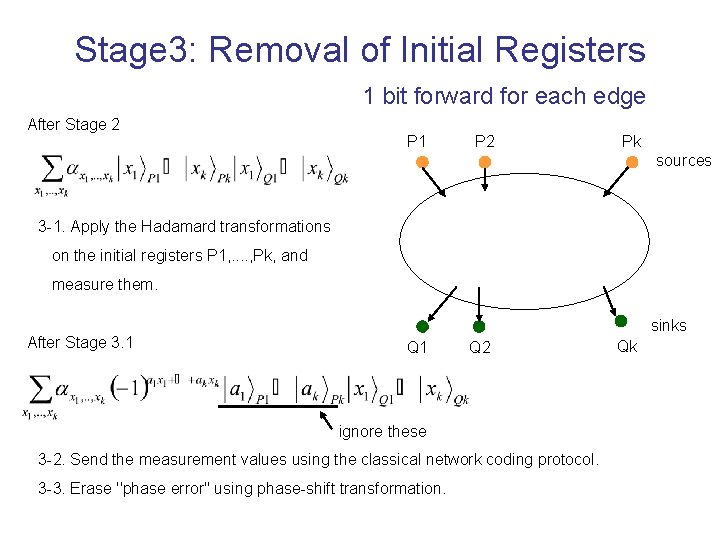
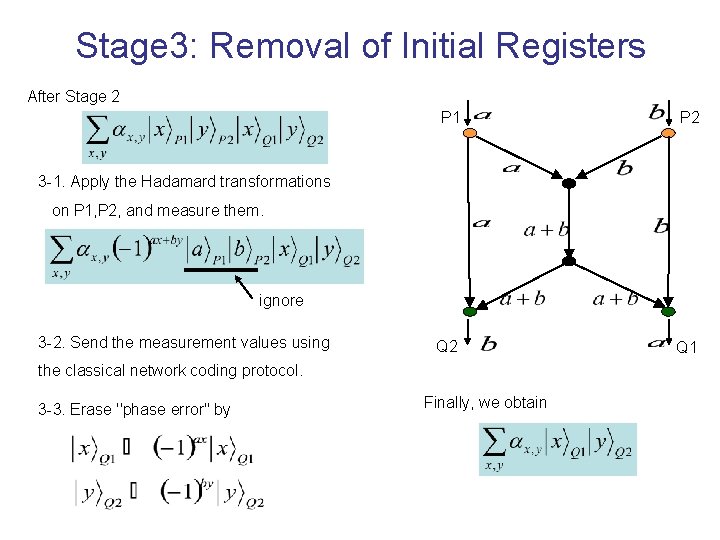
Stage 3: Removal of Initial Registers 1 bit forward for each edge After Stage 2 P 1 P 2 Pk sources 3 -1. Apply the Hadamard transformations on the initial registers P 1, . . , Pk, and measure them. After Stage 3. 1 sinks Q 1 Q 2 ignore these 3 -2. Send the measurement values using the classical network coding protocol. 3 -3. Erase ''phase error" using phase-shift transformation. Qk
Stage 3: Removal of Initial Registers After Stage 2 P 1 P 2 Q 1 3 -1. Apply the Hadamard transformations on P 1, P 2, and measure them. ignore 3 -2. Send the measurement values using the classical network coding protocol. 3 -3. Erase ''phase error" by Finally, we obtain
Comments for Free Classical Communication • KLNR 11 reduces the amount of classical communication compared to KLNR 09 – k*m*#(node) where m: =max fan-in of all nodes [KLNR 09] – 1 bit forward +1 bit backward for each edge = total 2*#(edge) [KLNR 11] • Sending classical bits backward is necessary – Quantum butterfly is not solvable even for the case where free classical communication is allowed in the direction of edges. [Leung-Oppenheim-Winter 2010]
Summary • No additional assistance – Butterfly is not solvable [HINRY 07, LOW 10, H 07] – Routing is optimal for a few cases [LOW 10] • 2 source-sink pairs • shallow networks (including butterfly) • Under free classical communication – If an instance is classically solvable, then the corresponding instance is also quantumly solvable [KLNR 11] – Additional classical communication is efficient – Outer/inner bound for a few cases [LOW 10]
Future Work Generally; • Advantage from classical, say, for security or complexity • Lossy quantum channels • Application (such as wireless communication in classical case), etc. [No additional resources] Q. If an instance is quantumly solvable with network coding, then is it solvable with routing? A. Unknown. Yes under only a few special cases [LOW 10] [Under free classical communication] An instance is classically solvable [KLNR 11] ? The corresponding quantum instance is quantumly solvable
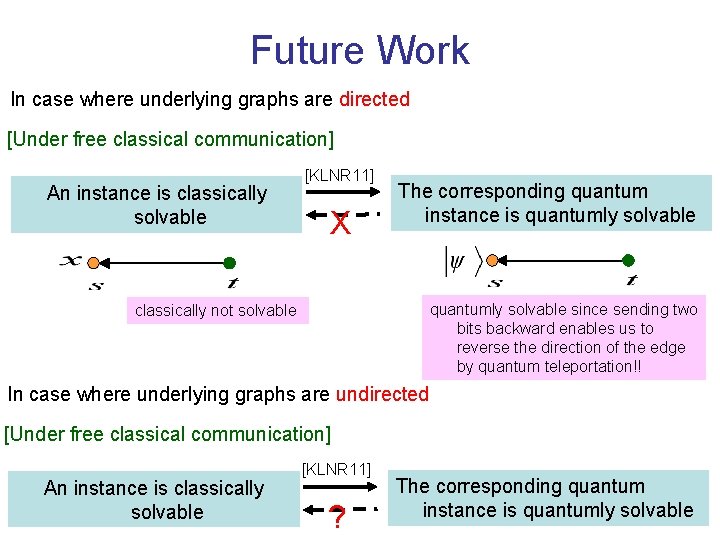
Future Work In case where underlying graphs are directed [Under free classical communication] An instance is classically solvable [KLNR 11] X The corresponding quantum instance is quantumly solvable since sending two bits backward enables us to reverse the direction of the edge by quantum teleportation!! classically not solvable In case where underlying graphs are undirected [Under free classical communication] An instance is classically solvable [KLNR 11] ? The corresponding quantum instance is quantumly solvable