A quantum leap Researchers create supersecure computer network

- Slides: 7
A quantum leap: Researchers create super-secure computer network Seungjai Min Hansang Bae Hwanjo Heo
Quantum Cryptography? • Uses light particles, photons through optical fiber instead of electric waves on wire • A defining discovery in physics: that subatomic particles can exist in multiple states at once until something interacts with them. • Eavesdropping on the photons, such as setting up a photo detector to read the code, makes the codes unusable and can be detected.
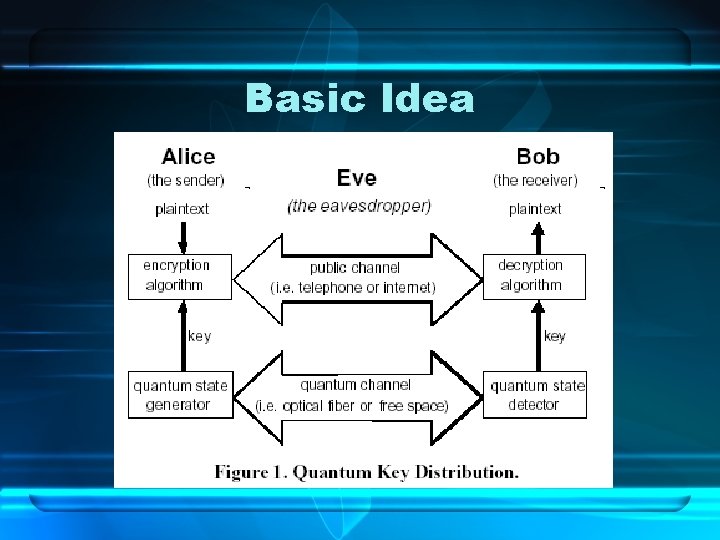
Basic Idea
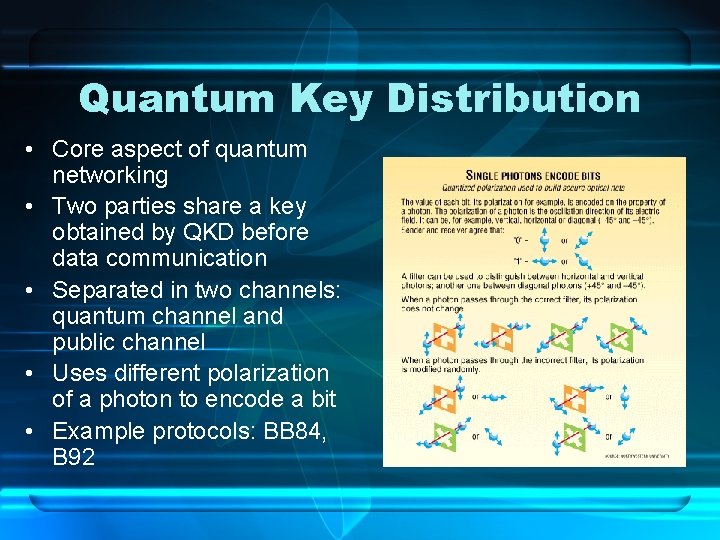
Quantum Key Distribution • Core aspect of quantum networking • Two parties share a key obtained by QKD before data communication • Separated in two channels: quantum channel and public channel • Uses different polarization of a photon to encode a bit • Example protocols: BB 84, B 92
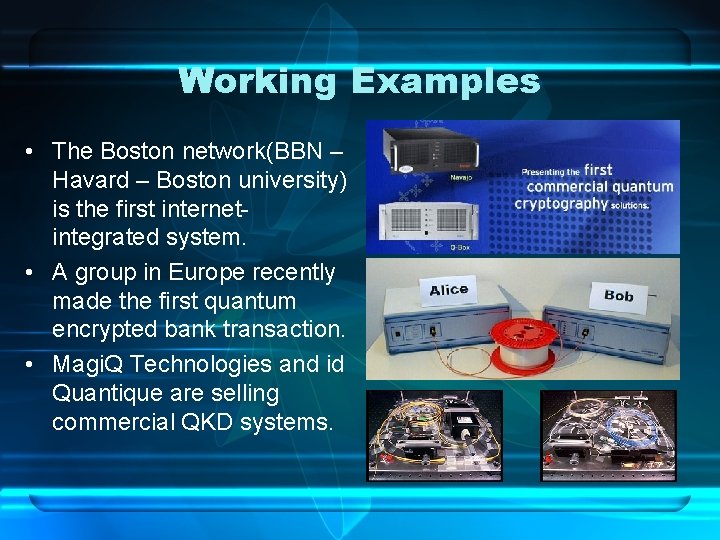
Working Examples • The Boston network(BBN – Havard – Boston university) is the first internetintegrated system. • A group in Europe recently made the first quantum encrypted bank transaction. • Magi. Q Technologies and id Quantique are selling commercial QKD systems.
Pros & Cons • Nearly Impossible to steal, even with a superpowered computer • Detect if someone is listening • “Secure” – randomness, no cloning • Distance Limitations • Availability – Expensive (Magi. Q sells it at $50, 000 per piece) – Vulnerable to DOS – Keys can’t keep up with data transmission
Questions?