Privacy of Location Trajectory ChiYin Chow Department of


- Slides: 57
Privacy of Location Trajectory Chi-Yin Chow Department of Computer Science City University of Hong Kong Mohamed F. Mokbel Department of Computer Science and Engineering University of Minnesota
Outline • Introduction • Protecting Trajectory Privacy in Locationbased Services • Protecting Privacy in Trajectory Publication • Future Research Directions 2
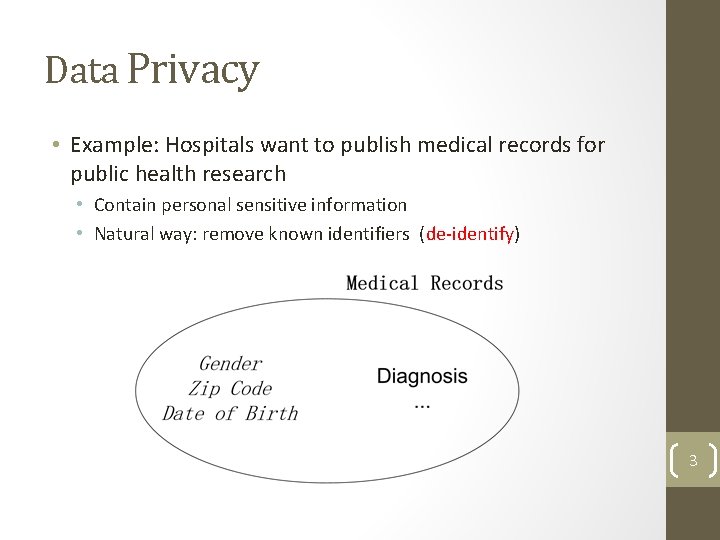
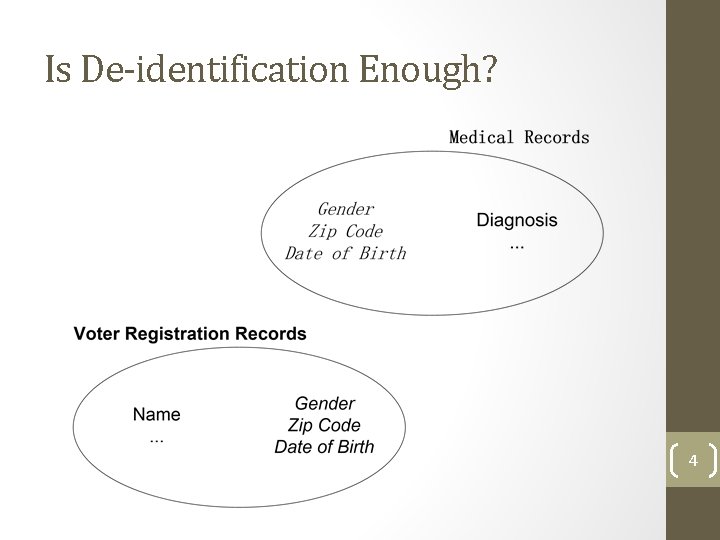
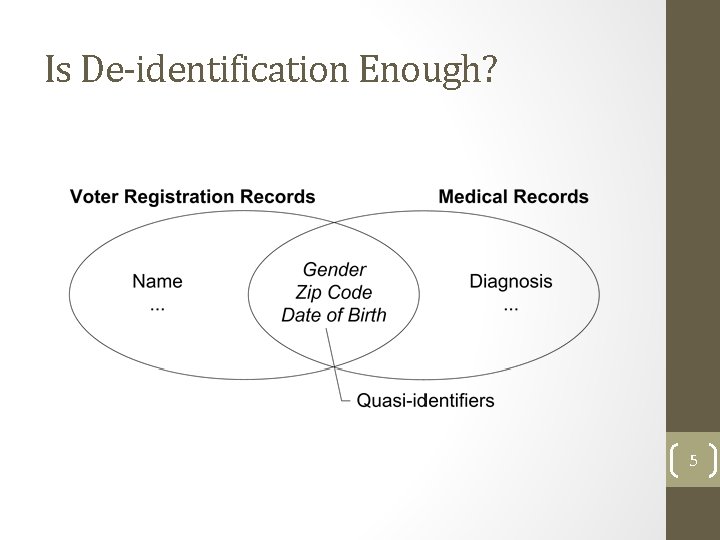
Data Privacy • Example: Hospitals want to publish medical records for public health research • Contain personal sensitive information • Natural way: remove known identifiers (de-identify) 3
Is De-identification Enough? 4
Is De-identification Enough? 5
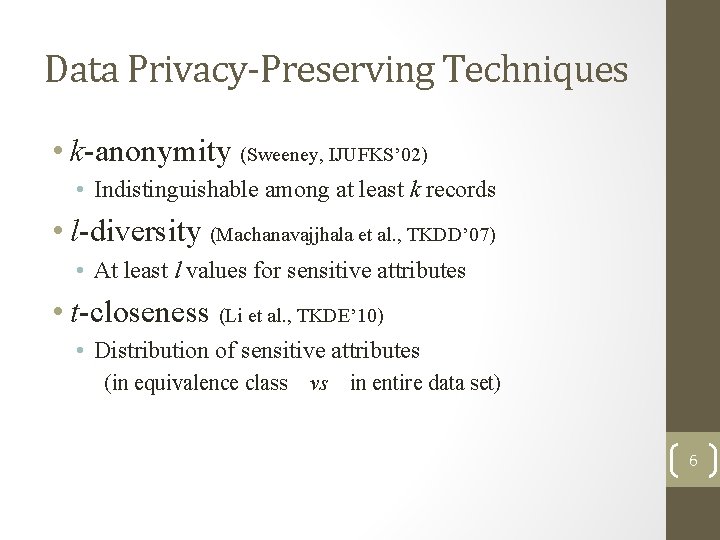
Data Privacy-Preserving Techniques • k-anonymity (Sweeney, IJUFKS’ 02) • Indistinguishable among at least k records • l-diversity (Machanavajjhala et al. , TKDD’ 07) • At least l values for sensitive attributes • t-closeness (Li et al. , TKDE’ 10) • Distribution of sensitive attributes (in equivalence class vs in entire data set) 6
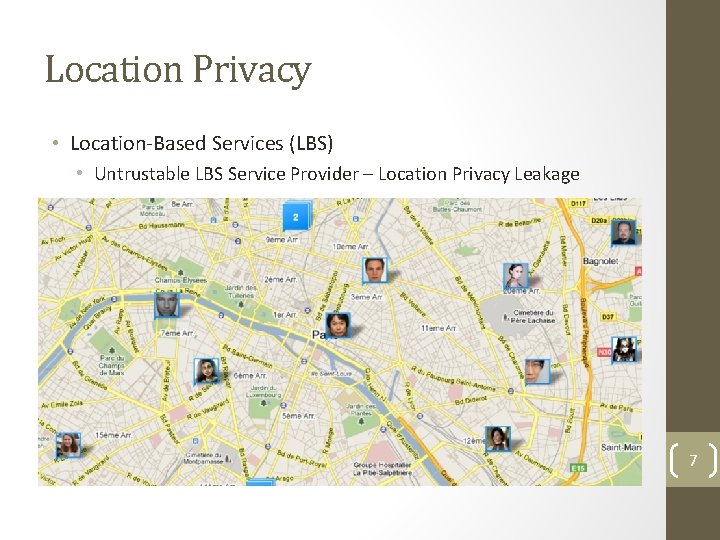
Location Privacy • Location-Based Services (LBS) • Untrustable LBS Service Provider – Location Privacy Leakage 7
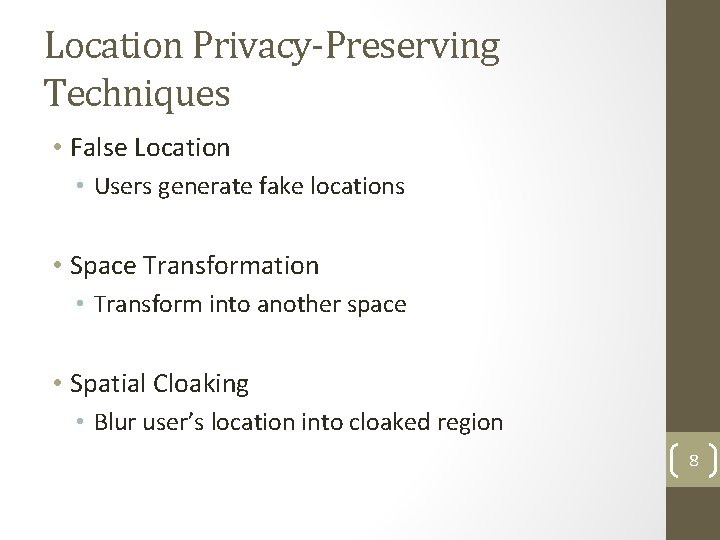
Location Privacy-Preserving Techniques • False Location • Users generate fake locations • Space Transformation • Transform into another space • Spatial Cloaking • Blur user’s location into cloaked region 8
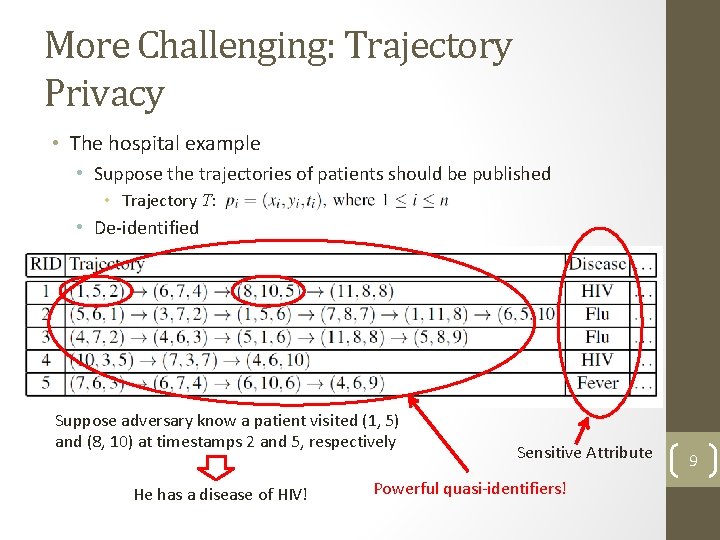
More Challenging: Trajectory Privacy • The hospital example • Suppose the trajectories of patients should be published • Trajectory T: • De-identified Suppose adversary know a patient visited (1, 5) and (8, 10) at timestamps 2 and 5, respectively He has a disease of HIV! Sensitive Attribute Powerful quasi-identifiers! 9
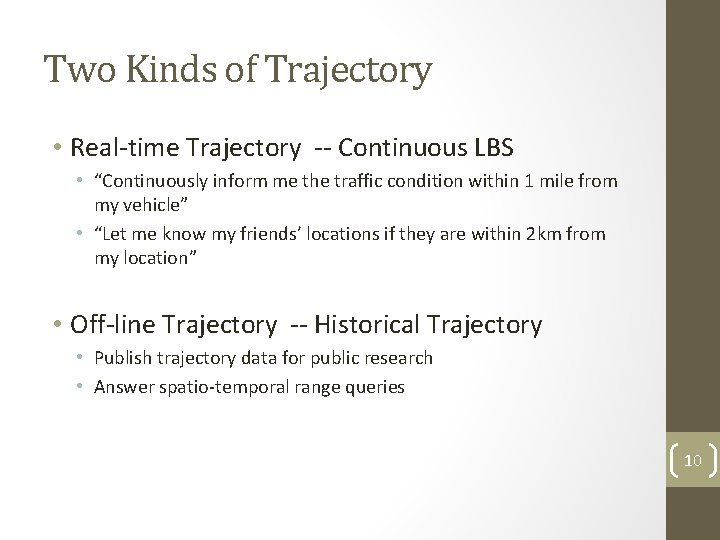
Two Kinds of Trajectory • Real-time Trajectory -- Continuous LBS • “Continuously inform me the traffic condition within 1 mile from my vehicle” • “Let me know my friends’ locations if they are within 2 km from my location” • Off-line Trajectory -- Historical Trajectory • Publish trajectory data for public research • Answer spatio-temporal range queries 10
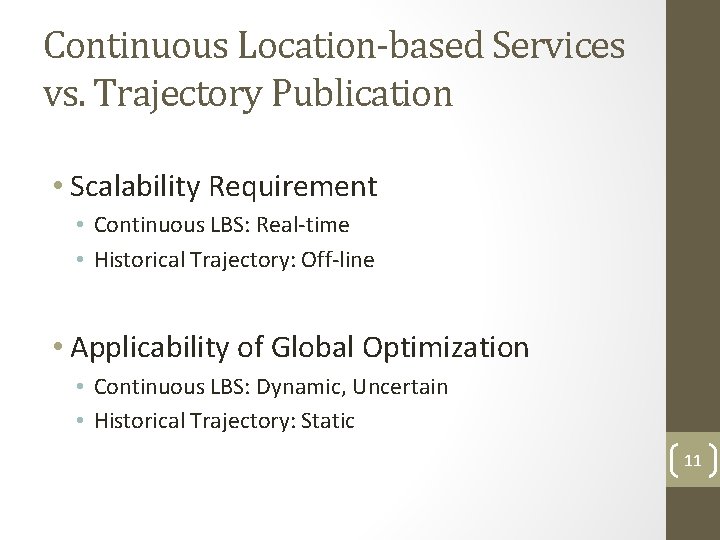
Continuous Location-based Services vs. Trajectory Publication • Scalability Requirement • Continuous LBS: Real-time • Historical Trajectory: Off-line • Applicability of Global Optimization • Continuous LBS: Dynamic, Uncertain • Historical Trajectory: Static 11
Outline • Introduction • Protecting Trajectory Privacy in Locationbased Services • Protecting Privacy in Trajectory Publication • Future Research Directions 12
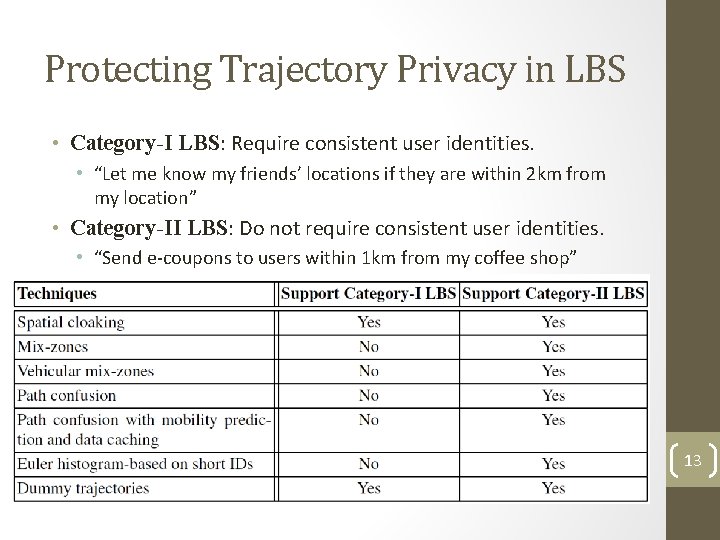
Protecting Trajectory Privacy in LBS • Category-I LBS: Require consistent user identities. • “Let me know my friends’ locations if they are within 2 km from my location” • Category-II LBS: Do not require consistent user identities. • “Send e-coupons to users within 1 km from my coffee shop” 13
Protecting Trajectory Privacy in LBS • Spatial cloaking • Mix-zones • Vehicular mix-zones • Path confusion with mobility prediction and data caching • Euler histogram-based on short IDs • Dummy trajectories 14
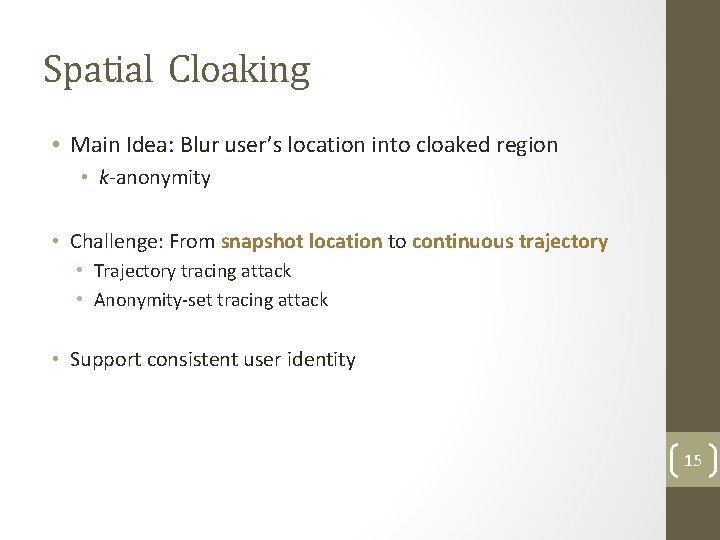
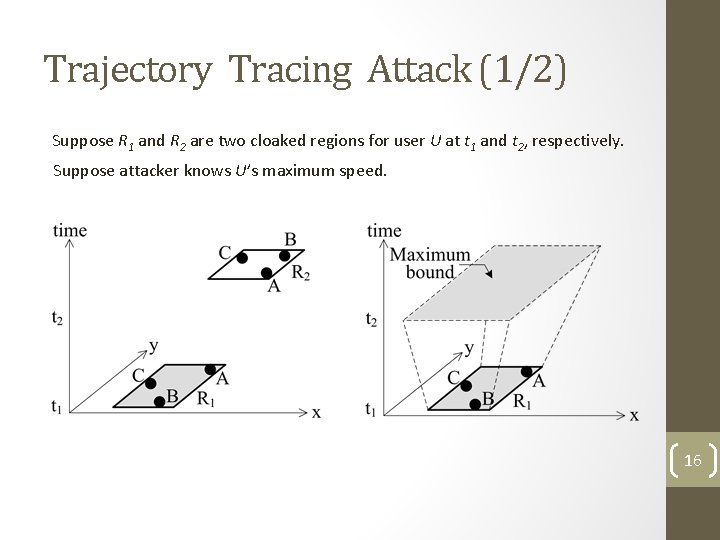
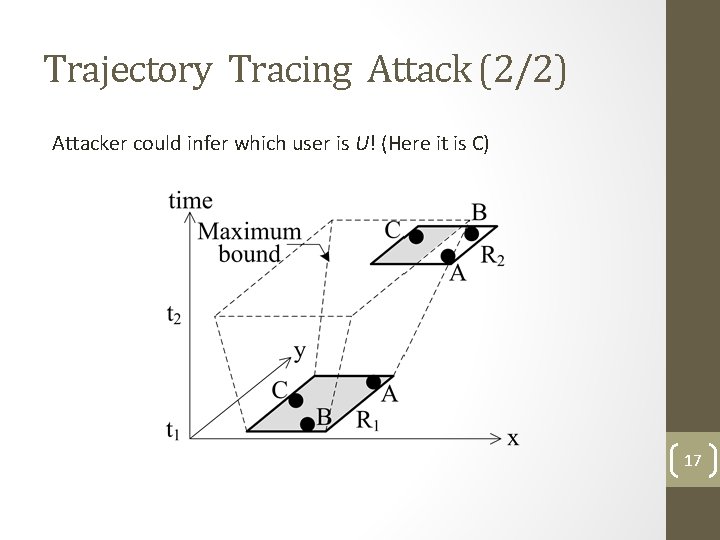
Spatial Cloaking • Main Idea: Blur user’s location into cloaked region • k-anonymity • Challenge: From snapshot location to continuous trajectory • Trajectory tracing attack • Anonymity-set tracing attack • Support consistent user identity 15
Trajectory Tracing Attack (1/2) Suppose R 1 and R 2 are two cloaked regions for user U at t 1 and t 2, respectively. Suppose attacker knows U’s maximum speed. 16
Trajectory Tracing Attack (2/2) Attacker could infer which user is U! (Here it is C) 17
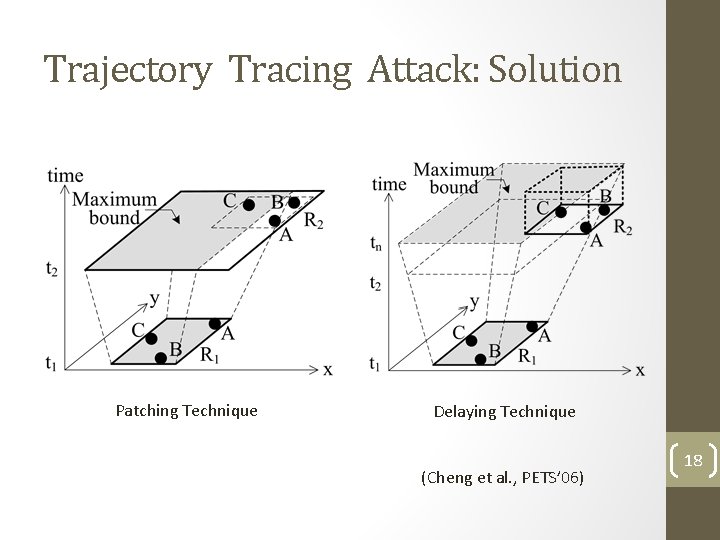
Trajectory Tracing Attack: Solution Patching Technique Delaying Technique (Cheng et al. , PETS’ 06) 18
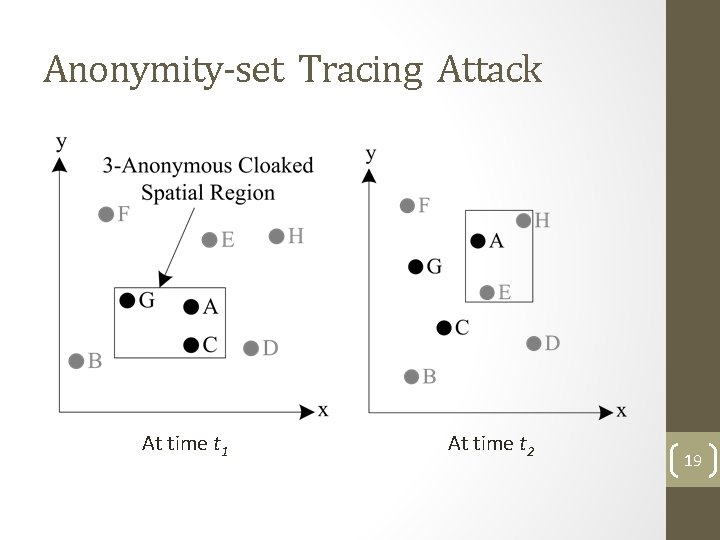
Anonymity-set Tracing Attack At time t 1 At time t 2 19
Anonymity-set Tracing Attack: Solution • Solution 1: Group-based Approach • Solution 2: Distortion-based Approach • Solution 3: Prediction-based Approach 20
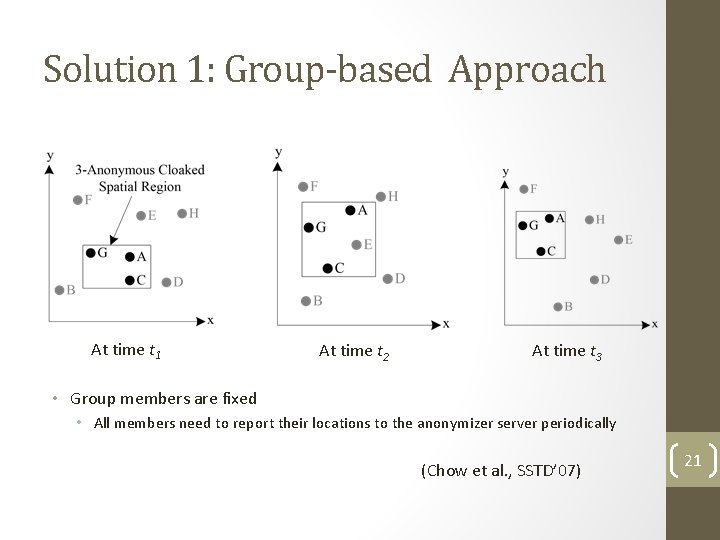
Solution 1: Group-based Approach At time t 1 At time t 2 At time t 3 • Group members are fixed • All members need to report their locations to the anonymizer server periodically (Chow et al. , SSTD’ 07) 21
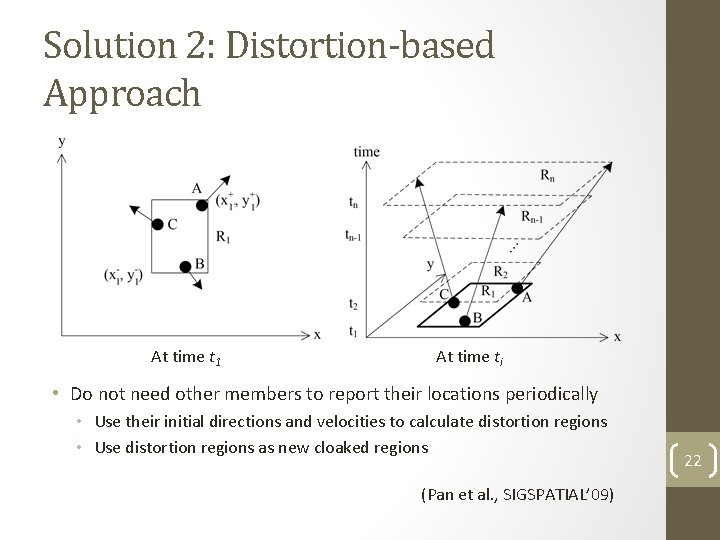
Solution 2: Distortion-based Approach At time t 1 At time ti • Do not need other members to report their locations periodically • Use their initial directions and velocities to calculate distortion regions • Use distortion regions as new cloaked regions (Pan et al. , SIGSPATIAL’ 09) 22
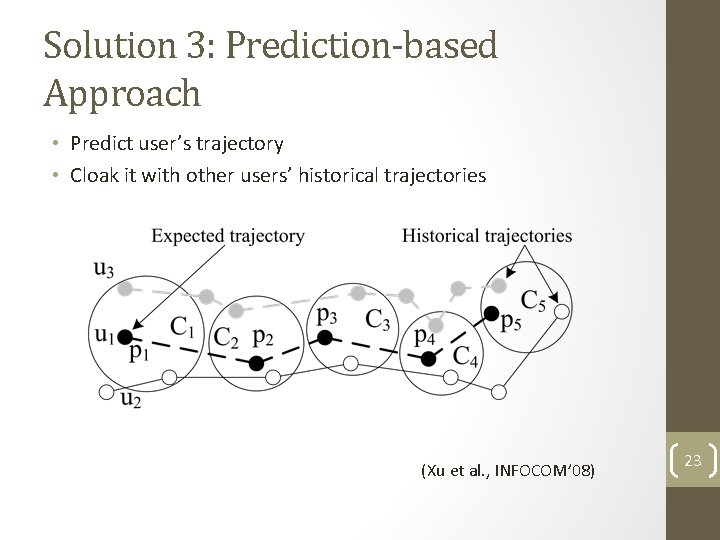
Solution 3: Prediction-based Approach • Predict user’s trajectory • Cloak it with other users’ historical trajectories (Xu et al. , INFOCOM’ 08) 23
Protecting Trajectory Privacy in LBS • Spatial cloaking • Mix-zones • Vehicular mix-zones • Path confusion with mobility prediction and data caching • Euler histogram-based on short IDs • Dummy trajectories 24
Mix-Zones (1/2) • Main Idea: • Users change pseudonyms when entering mix-zones • Do not reveal their location when they are in mix-zones • k-anonymity • Not support consistent user identity 25
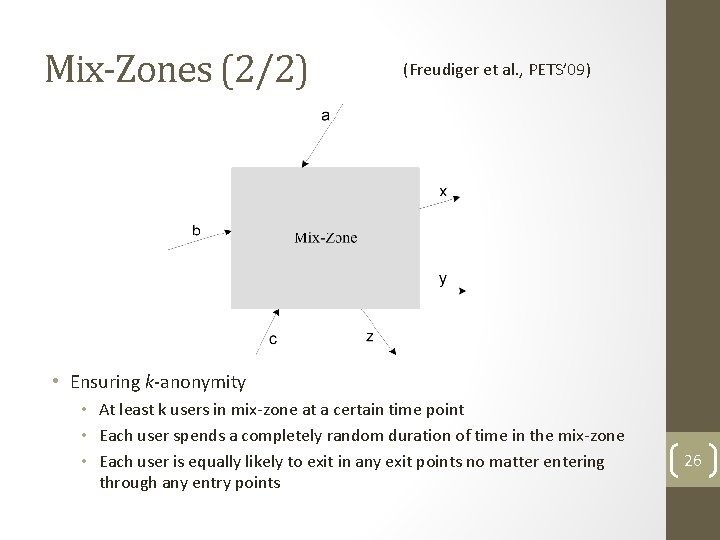
Mix-Zones (2/2) (Freudiger et al. , PETS’ 09) • Ensuring k-anonymity • At least k users in mix-zone at a certain time point • Each user spends a completely random duration of time in the mix-zone • Each user is equally likely to exit in any exit points no matter entering through any entry points 26
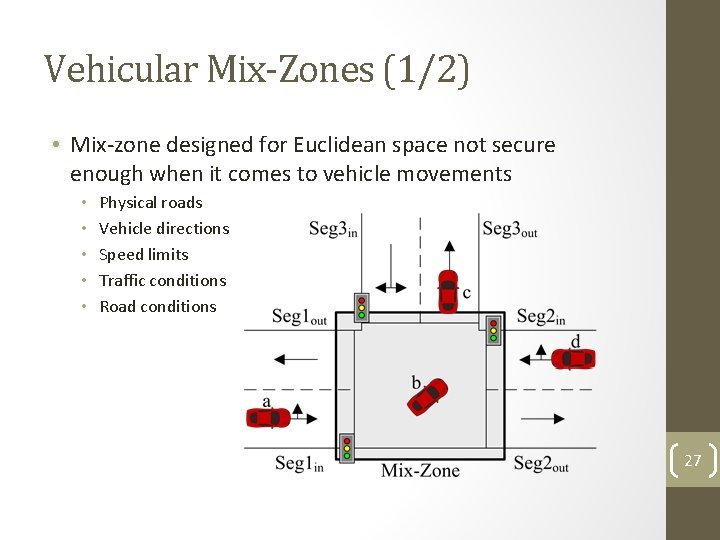
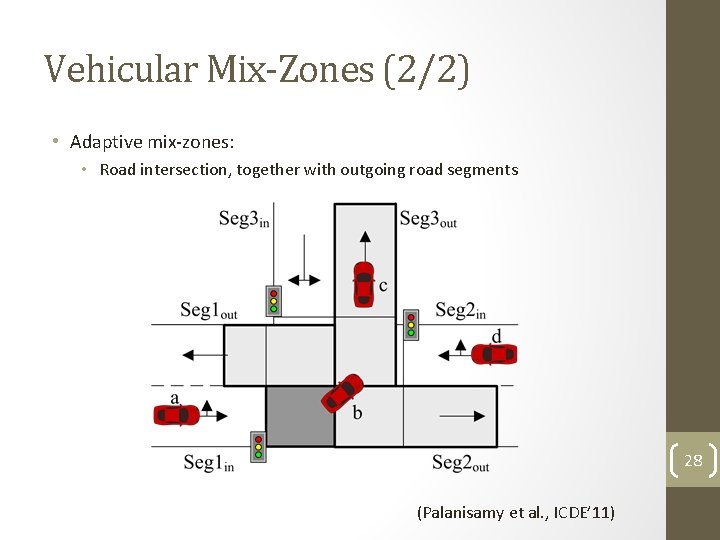
Vehicular Mix-Zones (1/2) • Mix-zone designed for Euclidean space not secure enough when it comes to vehicle movements • • • Physical roads Vehicle directions Speed limits Traffic conditions Road conditions 27
Vehicular Mix-Zones (2/2) • Adaptive mix-zones: • Road intersection, together with outgoing road segments 28 (Palanisamy et al. , ICDE’ 11)
Protecting Trajectory Privacy in LBS • Spatial cloaking • Mix-zones • Vehicular mix-zones • Path confusion with mobility prediction and data caching • Euler histogram-based on short IDs • Dummy trajectories 29
Path Confusion • Goal: Avoid linking consecutive location samples to individual vehicles • Main Idea: A central server controls the release of location data to satisfy “time-to-confusion” • Not support consistent user identity (Gruteser et al. , Mobi. Sys’ 03) 30
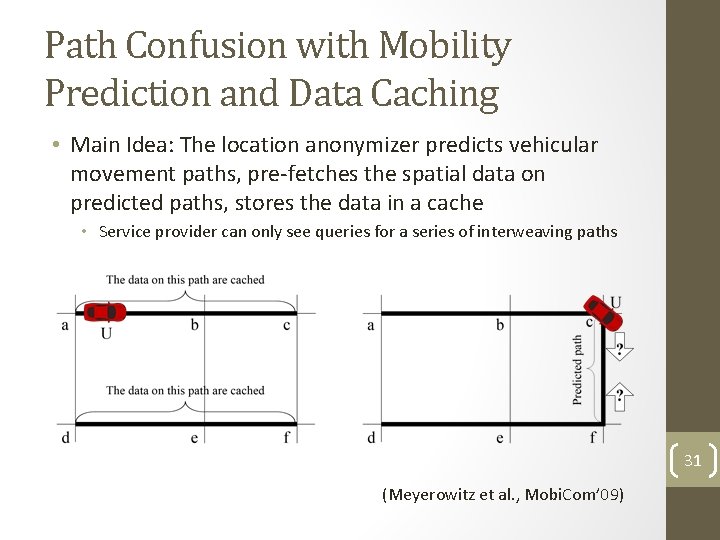
Path Confusion with Mobility Prediction and Data Caching • Main Idea: The location anonymizer predicts vehicular movement paths, pre-fetches the spatial data on predicted paths, stores the data in a cache • Service provider can only see queries for a series of interweaving paths 31 (Meyerowitz et al. , Mobi. Com’ 09)
Protecting Trajectory Privacy in LBS • Spatial cloaking • Mix-zones • Vehicular mix-zones • Path confusion with mobility prediction and data caching • Euler histogram-based on short IDs • Dummy trajectories 32
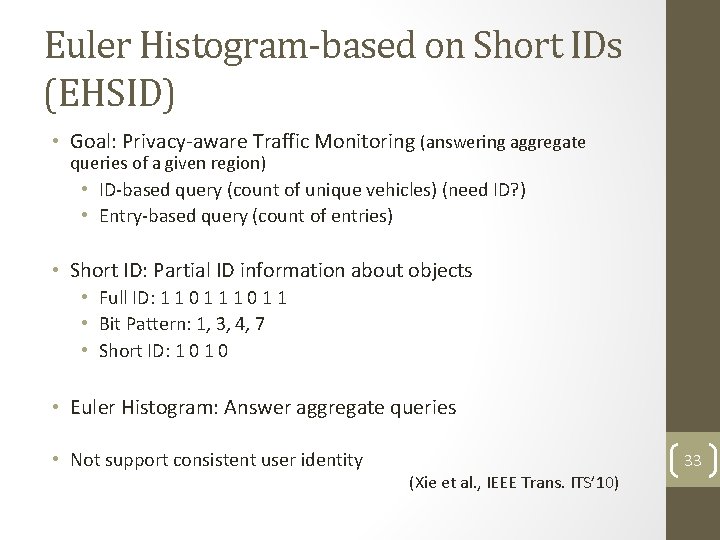
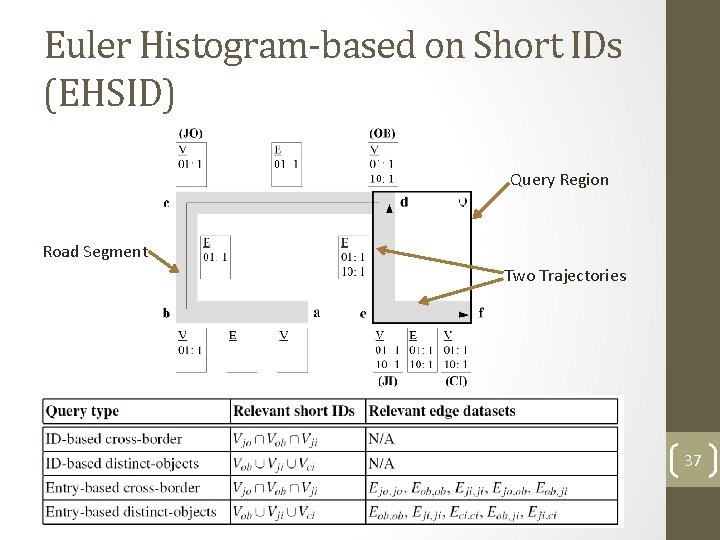
Euler Histogram-based on Short IDs (EHSID) • Goal: Privacy-aware Traffic Monitoring (answering aggregate queries of a given region) • ID-based query (count of unique vehicles) (need ID? ) • Entry-based query (count of entries) • Short ID: Partial ID information about objects • Full ID: 1 1 0 1 1 • Bit Pattern: 1, 3, 4, 7 • Short ID: 1 0 • Euler Histogram: Answer aggregate queries • Not support consistent user identity 33 (Xie et al. , IEEE Trans. ITS’ 10)
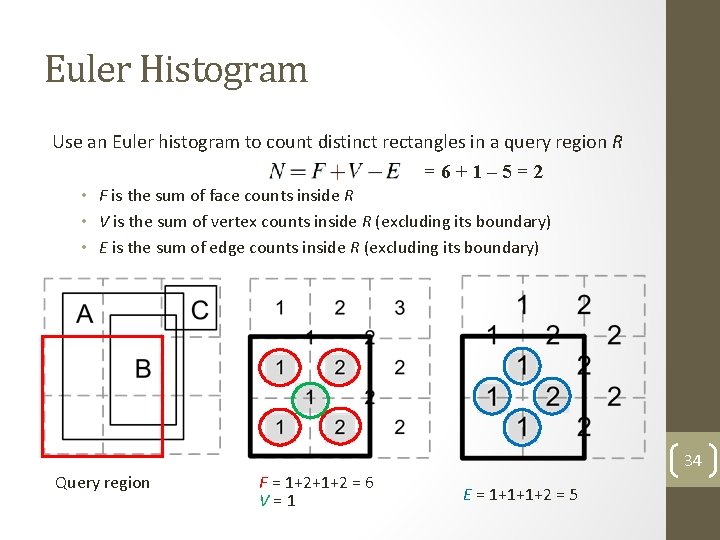
Euler Histogram Use an Euler histogram to count distinct rectangles in a query region R =6+1– 5=2 • F is the sum of face counts inside R • V is the sum of vertex counts inside R (excluding its boundary) • E is the sum of edge counts inside R (excluding its boundary) 34 Query region F = 1+2+1+2 = 6 V=1 E = 1+1+1+2 = 5
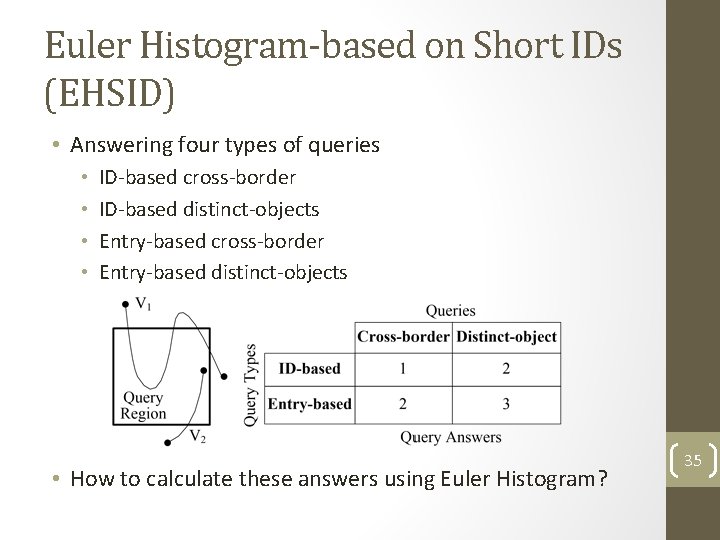
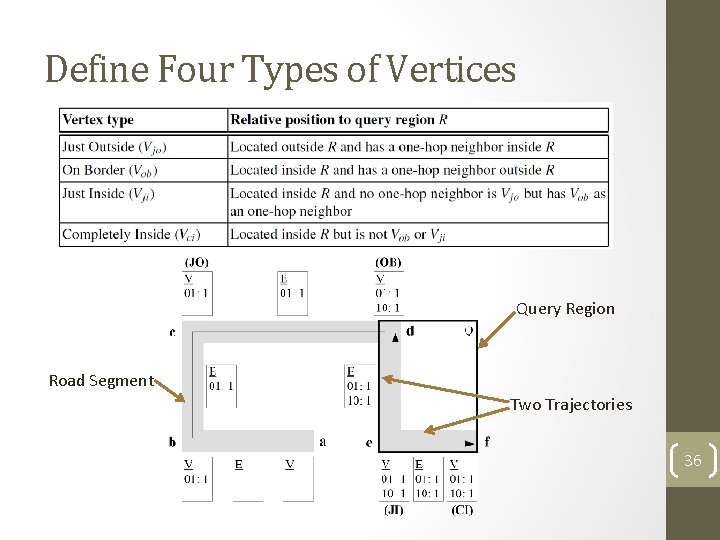
Euler Histogram-based on Short IDs (EHSID) • Answering four types of queries • • ID-based cross-border ID-based distinct-objects Entry-based cross-border Entry-based distinct-objects • How to calculate these answers using Euler Histogram? 35
Define Four Types of Vertices Query Region Road Segment Two Trajectories 36
Euler Histogram-based on Short IDs (EHSID) Query Region Road Segment Two Trajectories 37
Protecting Trajectory Privacy in LBS • Spatial cloaking • Mix-zones • Vehicular mix-zones • Path confusion with mobility prediction and data caching • Euler histogram-based on short IDs • Dummy trajectories 38
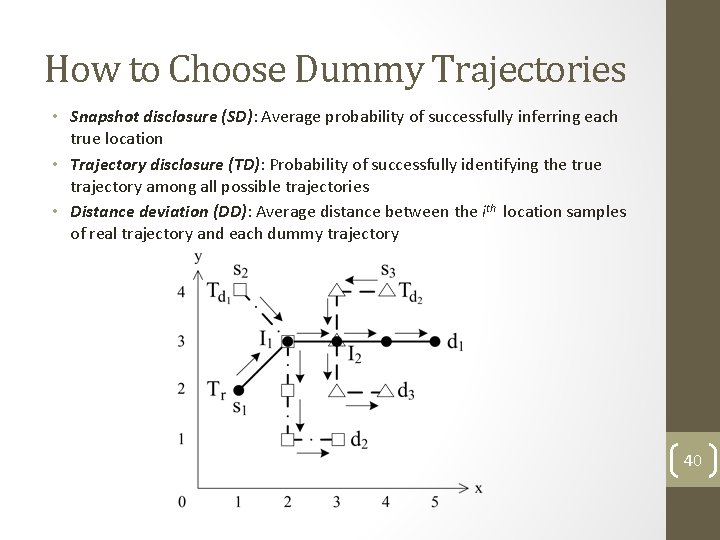
Dummy Trajectories • Main Idea: User generate fake location trajectories • How to choose dummy trajectories? • How to measure the degree of privacy protection? • Support consistent user identity (You et al. , PALMS’ 07) 39
How to Choose Dummy Trajectories • Snapshot disclosure (SD): Average probability of successfully inferring each true location • Trajectory disclosure (TD): Probability of successfully identifying the true trajectory among all possible trajectories • Distance deviation (DD): Average distance between the ith location samples of real trajectory and each dummy trajectory 40
Outline • Introduction • Protecting Trajectory Privacy in Locationbased Services • Protecting Privacy in Trajectory Publication • Future Research Directions 41
Protecting Privacy in Trajectory Publication • Clustering-based Anonymization Approach • Generalization-based Anonymization Approach • Suppression-based Anonymization Approach • Grid-based Anonymization Approach 42
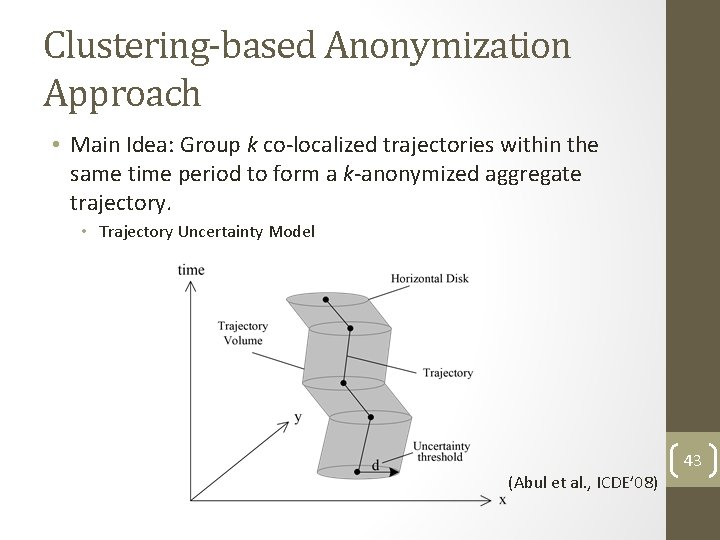
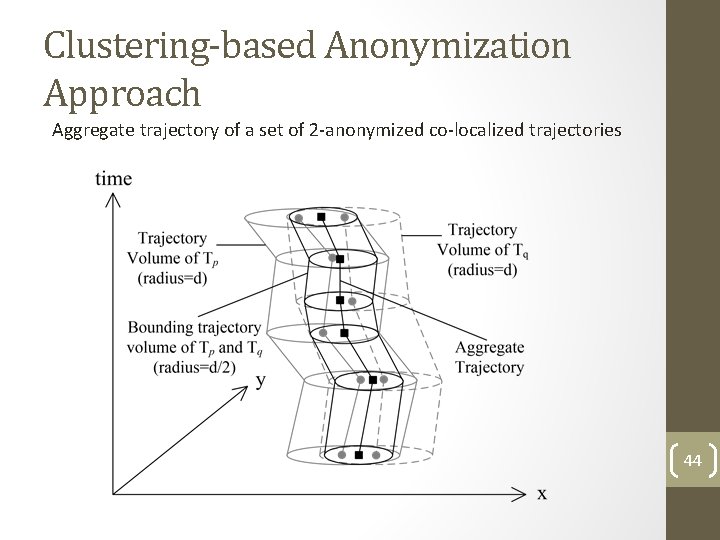
Clustering-based Anonymization Approach • Main Idea: Group k co-localized trajectories within the same time period to form a k-anonymized aggregate trajectory. • Trajectory Uncertainty Model 43 (Abul et al. , ICDE’ 08)
Clustering-based Anonymization Approach Aggregate trajectory of a set of 2 -anonymized co-localized trajectories 44
Protecting Privacy in Trajectory Publication • Clustering-based Anonymization Approach • Generalization-based Anonymization Approach • Suppression-based Anonymization Approach • Grid-based Anonymization Approach 45
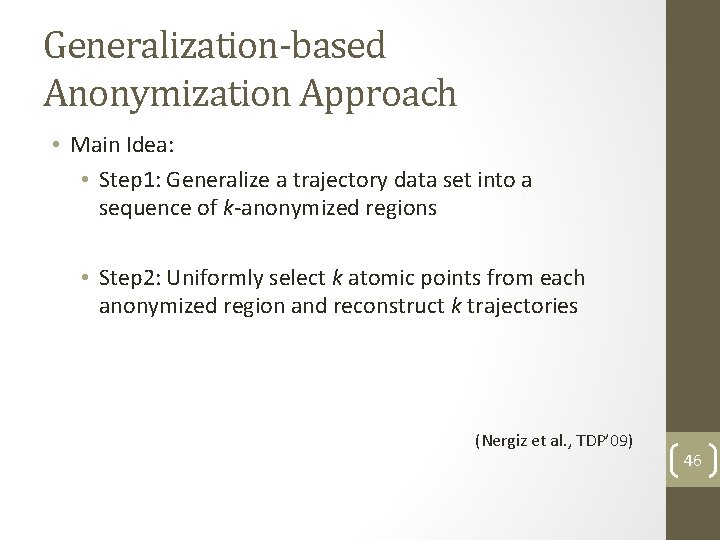
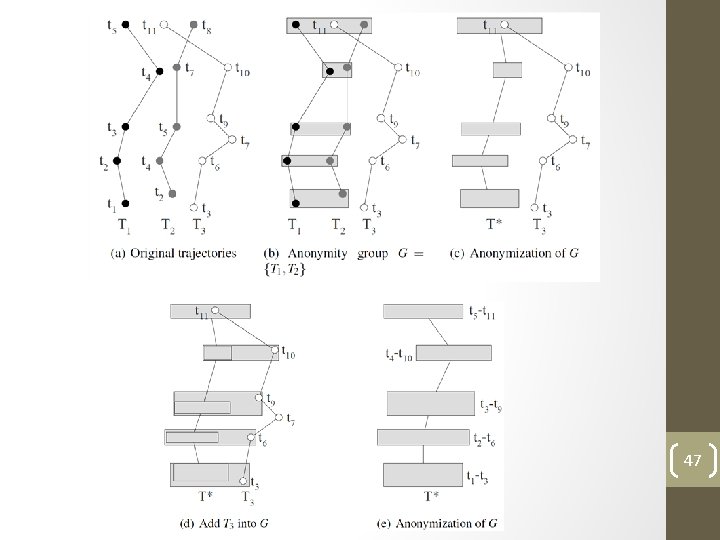
Generalization-based Anonymization Approach • Main Idea: • Step 1: Generalize a trajectory data set into a sequence of k-anonymized regions • Step 2: Uniformly select k atomic points from each anonymized region and reconstruct k trajectories (Nergiz et al. , TDP’ 09) 46
47
48
Protecting Privacy in Trajectory Publication • Clustering-based Anonymization Approach • Generalization-based Anonymization Approach • Suppression-based Anonymization Approach • Grid-based Anonymization Approach 49
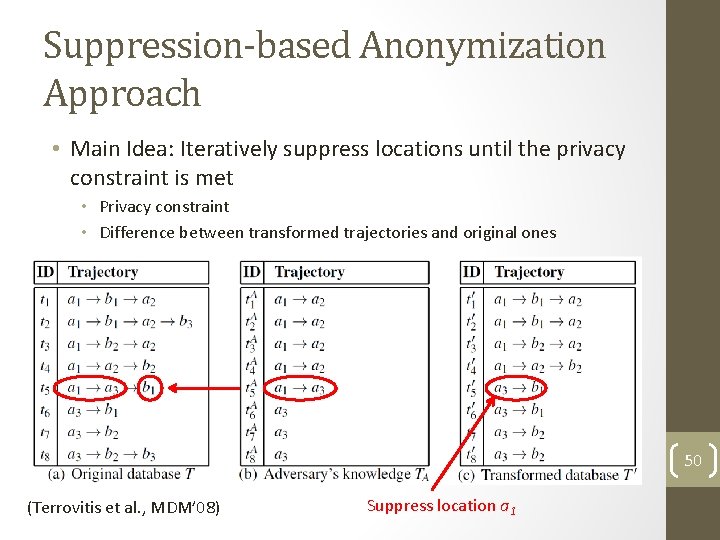
Suppression-based Anonymization Approach • Main Idea: Iteratively suppress locations until the privacy constraint is met • Privacy constraint • Difference between transformed trajectories and original ones 50 (Terrovitis et al. , MDM’ 08) Suppress location a 1
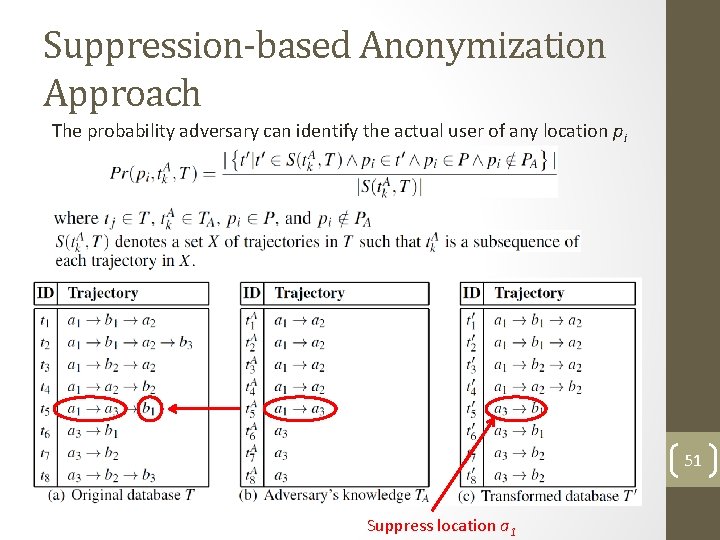
Suppression-based Anonymization Approach The probability adversary can identify the actual user of any location pi 51 Suppress location a 1
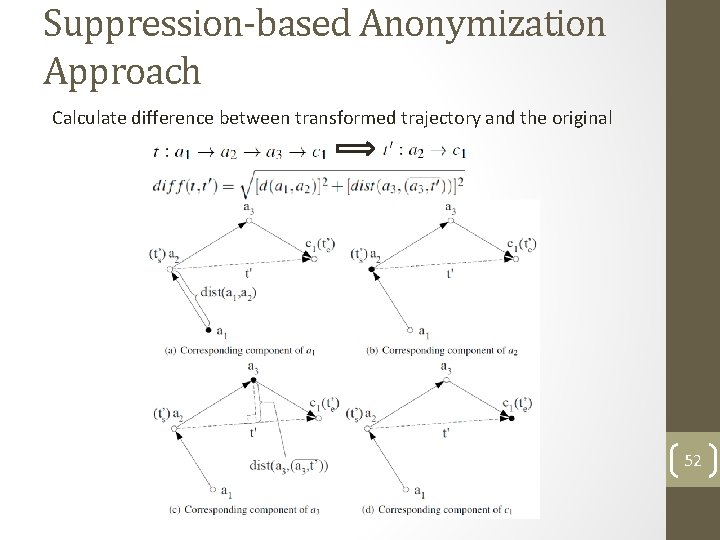
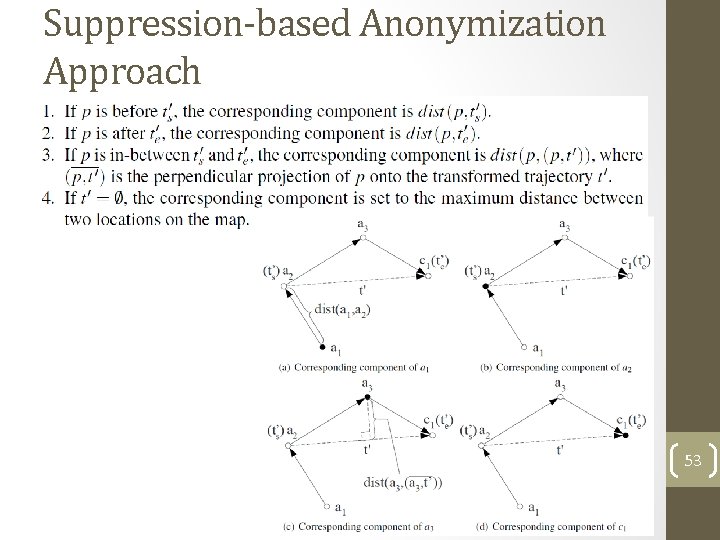
Suppression-based Anonymization Approach Calculate difference between transformed trajectory and the original 52
Suppression-based Anonymization Approach 53
Protecting Privacy in Trajectory Publication • Clustering-based Anonymization Approach • Generalization-based Anonymization Approach • Suppression-based Anonymization Approach • Grid-based Anonymization Approach 54
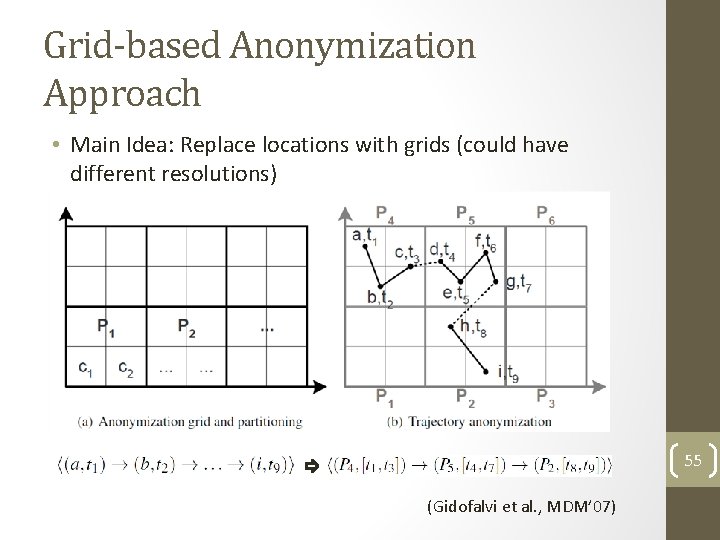
Grid-based Anonymization Approach • Main Idea: Replace locations with grids (could have different resolutions) 55 (Gidofalvi et al. , MDM’ 07)
Outline • Introduction • Protecting Trajectory Privacy in Locationbased Services • Protecting Privacy in Trajectory Publication • Future Research Directions 56
Future Directions • Personalized LBS (require more user semantics) • User preferences and background information could be used as quasi-identifiers • Trajectory publication supporting more complex queries • Spatio-temporal data analysis 57