
SEG 4110 Advanced Software Design and Reengineering TOPIC
- Slides: 29
SEG 4110 - Advanced Software Design and Reengineering TOPIC M Secure Software Development
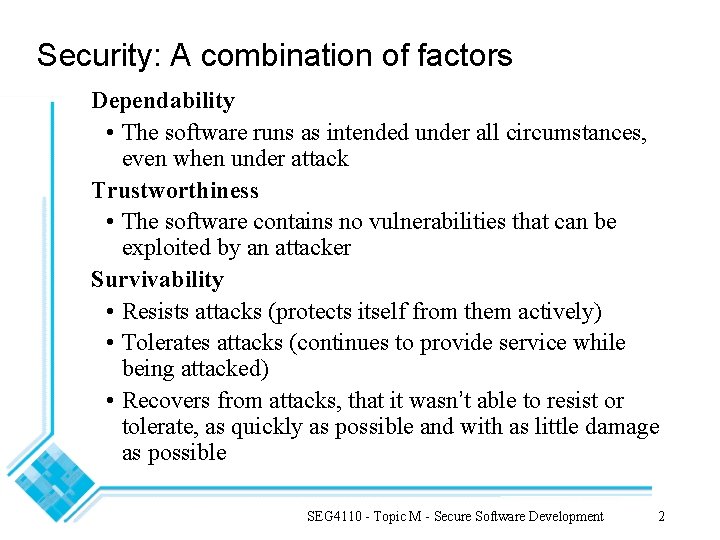
Security: A combination of factors Dependability • The software runs as intended under all circumstances, even when under attack Trustworthiness • The software contains no vulnerabilities that can be exploited by an attacker Survivability • Resists attacks (protects itself from them actively) • Tolerates attacks (continues to provide service while being attacked) • Recovers from attacks, that it wasn’t able to resist or tolerate, as quickly as possible and with as little damage as possible SEG 4110 - Topic M - Secure Software Development 2
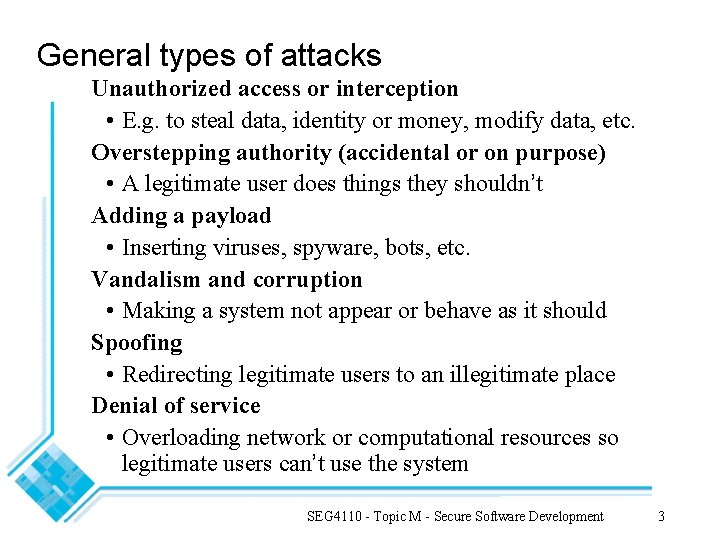
General types of attacks Unauthorized access or interception • E. g. to steal data, identity or money, modify data, etc. Overstepping authority (accidental or on purpose) • A legitimate user does things they shouldn’t Adding a payload • Inserting viruses, spyware, bots, etc. Vandalism and corruption • Making a system not appear or behave as it should Spoofing • Redirecting legitimate users to an illegitimate place Denial of service • Overloading network or computational resources so legitimate users can’t use the system SEG 4110 - Topic M - Secure Software Development 3
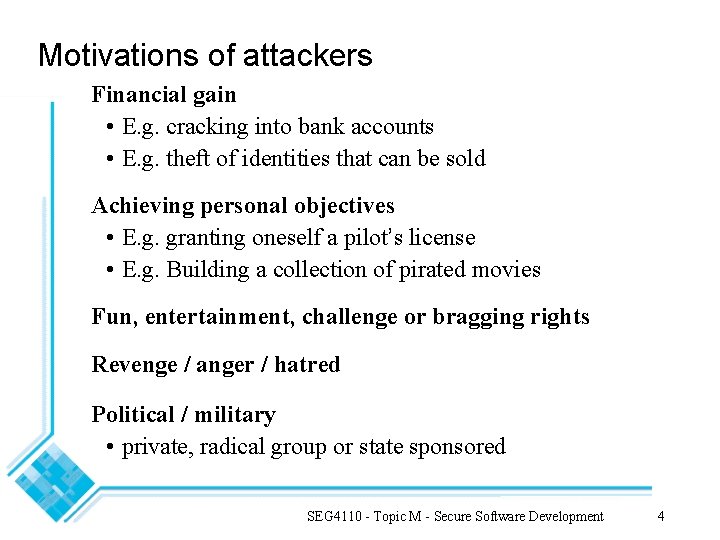
Motivations of attackers Financial gain • E. g. cracking into bank accounts • E. g. theft of identities that can be sold Achieving personal objectives • E. g. granting oneself a pilot’s license • E. g. Building a collection of pirated movies Fun, entertainment, challenge or bragging rights Revenge / anger / hatred Political / military • private, radical group or state sponsored SEG 4110 - Topic M - Secure Software Development 4
Some thoughts on attack frequency A significant proportion of successful attacks are by ‘insiders’ • E. g. employees committing fraud • Physical security can be breached —Watching password entry over-the-shoulder, reading written passwords, accessing the physical disk or RAM, bypassing the network Much attacking today is automated: Botnets Attackers may try millions of random attacks until they find a ‘weak link’ • They will only keep attacking one target if is is extremely valuable SEG 4110 - Topic M - Secure Software Development 5
Systems thinking A system is only as secure as its weakest link • Often this is the —Operating system —Reused components —Network —Human —Paper records —Hardware So analyse every possible aspect of the system for its impact on security SEG 4110 - Topic M - Secure Software Development 6
Cryptography as one key to security Beware: cryptography is only one tool in security • Some people assume it is the only or main tool Private key cryptography • Sender and recipient know the secret key and algorithm Public key cryptography • You encrypt using the public key published by the recipient • The result can only be decrypted using a mathematically related private key • Cracking relies on factoring extraordinarily large numbers —Infeasible to to this quickly, although often can be done —The more ‘bits’ in the key, the more computer power needed SEG 4110 - Topic M - Secure Software Development 7
Attacks on cryptographically protected systems - 1 On-line • If the key is related to a human-created non-random password, then try common password choices —Dictionary words (“dictionary attacks”) —Passwords the user has used on other systems Off-line • Getting a sample of the data and using a dedicated computer to algorithmically try combinations • For a random password and good algorithms, an attack has to be exhaustive, making it very hard SEG 4110 - Topic M - Secure Software Development 8
Attacks on cryptographically protected systems - 2 Social engineering • Tricking someone to reveal a key (e. g. phishing) Weak password-resetting protocols Man-in-the-middle • Inserting software that will relay cryptographic keys before they are used Keystroke logging SEG 4110 - Topic M - Secure Software Development 9
Attacks on cryptographically protected systems - 3 There are many ‘hackers’ tools available on the Internet • E. g. for doing dictionary attacks • Try these against your own system to see how secure it will be SEG 4110 - Topic M - Secure Software Development 10
Secure passwords - 1 Note that a password is rarely as secure as the number of bits in a cryptographic key • Not as long • Not as random Nevertheless encourage / require users to use • Longer passwords (8+ characters) • Combination of character types —Lower/upper case, numbers, special characters • Minimal duplicate characters • No password similar to a recently used password • Not containing dictionary words Password managers should be allowed SEG 4110 - Topic M - Secure Software Development 11
Secure passwords - 2 Back up password protection with other schemes • Two-factor authentication • Slow then block access after multiple failed attempts • Detect and prevent automated entry —e. g. very quick response to prompt • Add extra checks when access comes from unexpected place or time —Non-normal IP address range —Late at night • Check ability to answer pre-saved questions —But beware of those that reveal personal information • CAPTCHAS SEG 4110 - Topic M - Secure Software Development 12
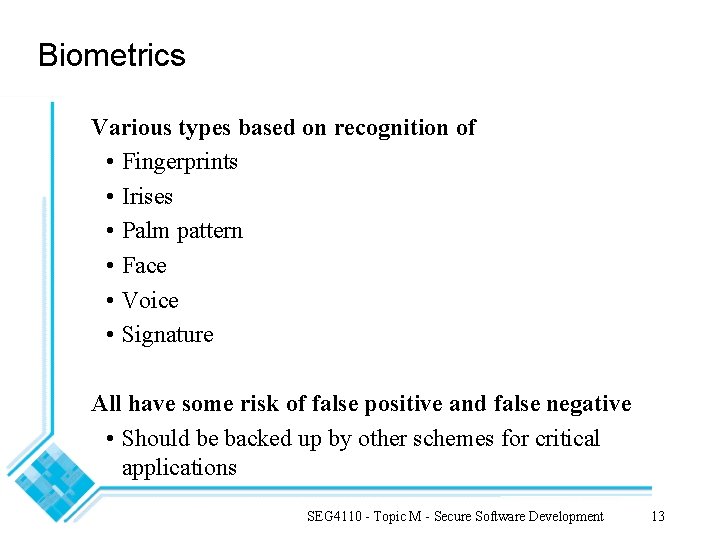
Biometrics Various types based on recognition of • Fingerprints • Irises • Palm pattern • Face • Voice • Signature All have some risk of false positive and false negative • Should be backed up by other schemes for critical applications SEG 4110 - Topic M - Secure Software Development 13
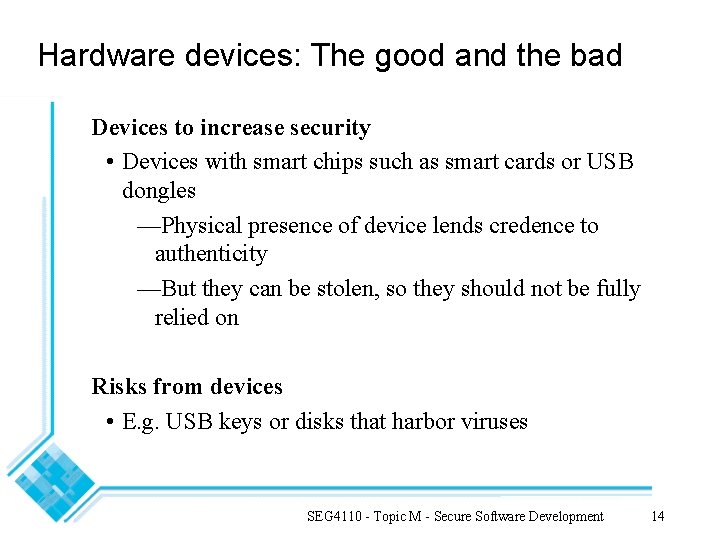
Hardware devices: The good and the bad Devices to increase security • Devices with smart chips such as smart cards or USB dongles —Physical presence of device lends credence to authenticity —But they can be stolen, so they should not be fully relied on Risks from devices • E. g. USB keys or disks that harbor viruses SEG 4110 - Topic M - Secure Software Development 14
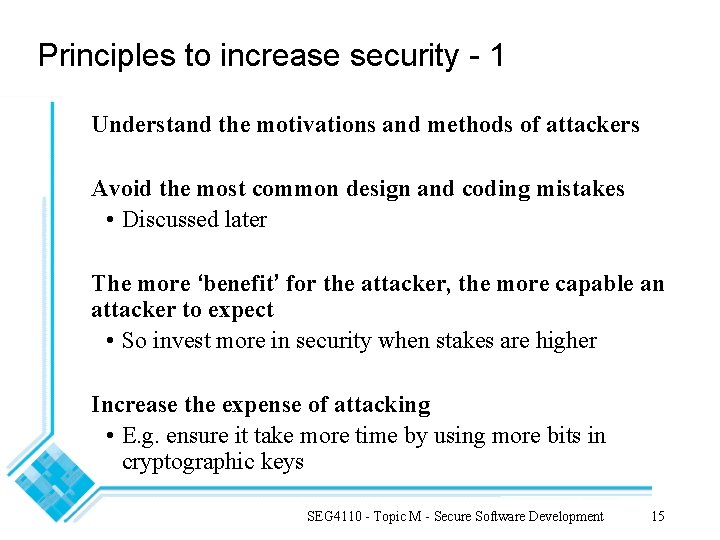
Principles to increase security - 1 Understand the motivations and methods of attackers Avoid the most common design and coding mistakes • Discussed later The more ‘benefit’ for the attacker, the more capable an attacker to expect • So invest more in security when stakes are higher Increase the expense of attacking • E. g. ensure it take more time by using more bits in cryptographic keys SEG 4110 - Topic M - Secure Software Development 15
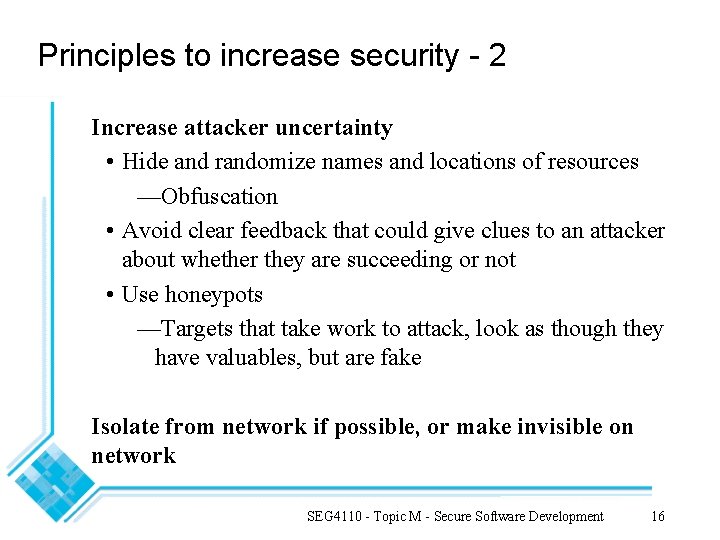
Principles to increase security - 2 Increase attacker uncertainty • Hide and randomize names and locations of resources —Obfuscation • Avoid clear feedback that could give clues to an attacker about whether they are succeeding or not • Use honeypots —Targets that take work to attack, look as though they have valuables, but are fake Isolate from network if possible, or make invisible on network SEG 4110 - Topic M - Secure Software Development 16
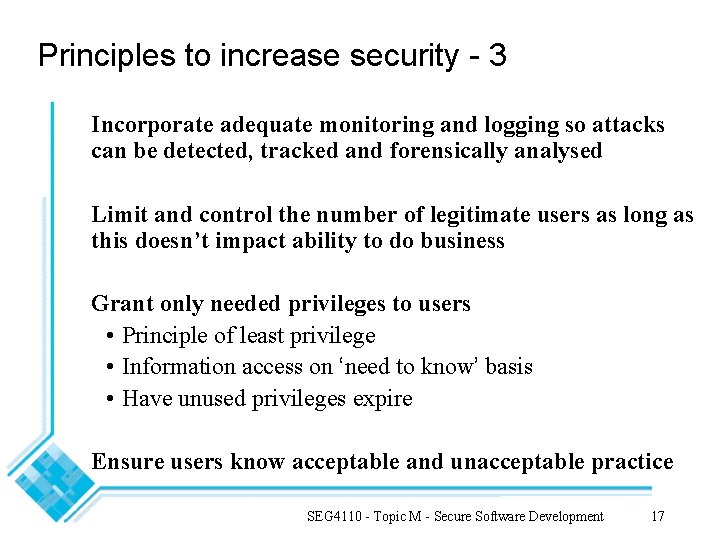
Principles to increase security - 3 Incorporate adequate monitoring and logging so attacks can be detected, tracked and forensically analysed Limit and control the number of legitimate users as long as this doesn’t impact ability to do business Grant only needed privileges to users • Principle of least privilege • Information access on ‘need to know’ basis • Have unused privileges expire Ensure users know acceptable and unacceptable practice SEG 4110 - Topic M - Secure Software Development 17
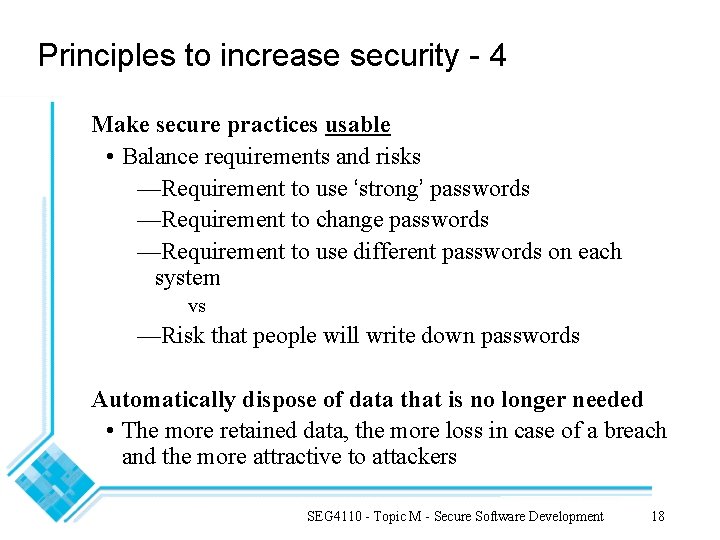
Principles to increase security - 4 Make secure practices usable • Balance requirements and risks —Requirement to use ‘strong’ passwords —Requirement to change passwords —Requirement to use different passwords on each system vs —Risk that people will write down passwords Automatically dispose of data that is no longer needed • The more retained data, the more loss in case of a breach and the more attractive to attackers SEG 4110 - Topic M - Secure Software Development 18
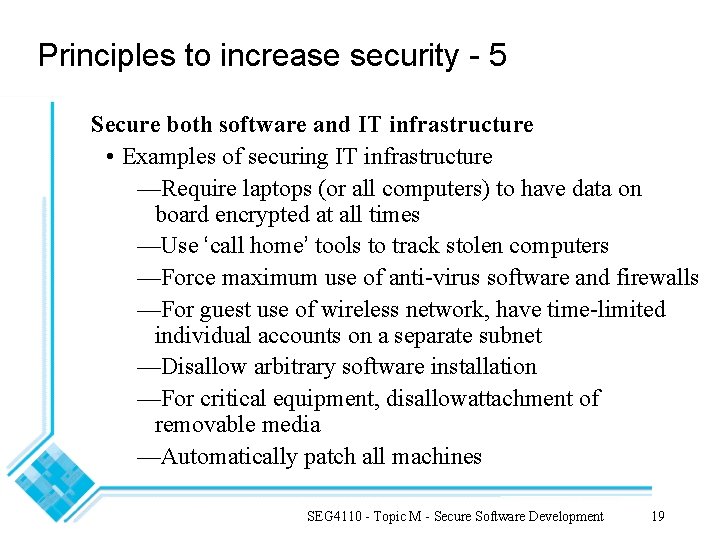
Principles to increase security - 5 Secure both software and IT infrastructure • Examples of securing IT infrastructure —Require laptops (or all computers) to have data on board encrypted at all times —Use ‘call home’ tools to track stolen computers —Force maximum use of anti-virus software and firewalls —For guest use of wireless network, have time-limited individual accounts on a separate subnet —Disallow arbitrary software installation —For critical equipment, disallowattachment of removable media —Automatically patch all machines SEG 4110 - Topic M - Secure Software Development 19
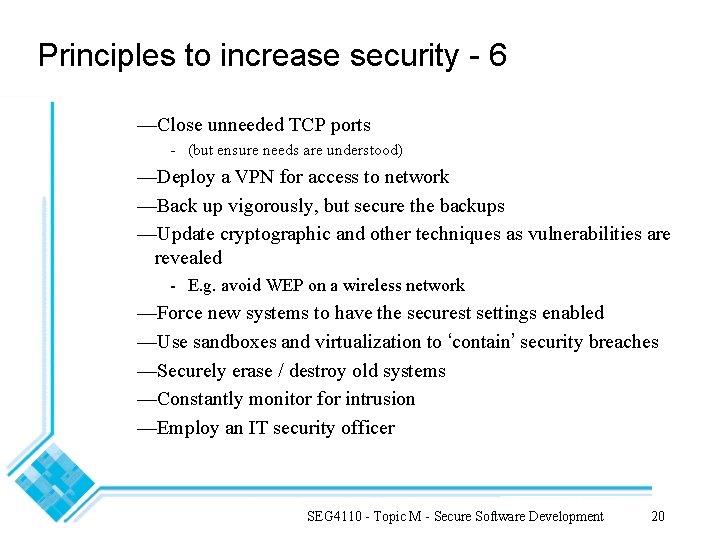
Principles to increase security - 6 —Close unneeded TCP ports - (but ensure needs are understood) —Deploy a VPN for access to network —Back up vigorously, but secure the backups —Update cryptographic and other techniques as vulnerabilities are revealed - E. g. avoid WEP on a wireless network —Force new systems to have the securest settings enabled —Use sandboxes and virtualization to ‘contain’ security breaches —Securely erase / destroy old systems —Constantly monitor for intrusion —Employ an IT security officer SEG 4110 - Topic M - Secure Software Development 20
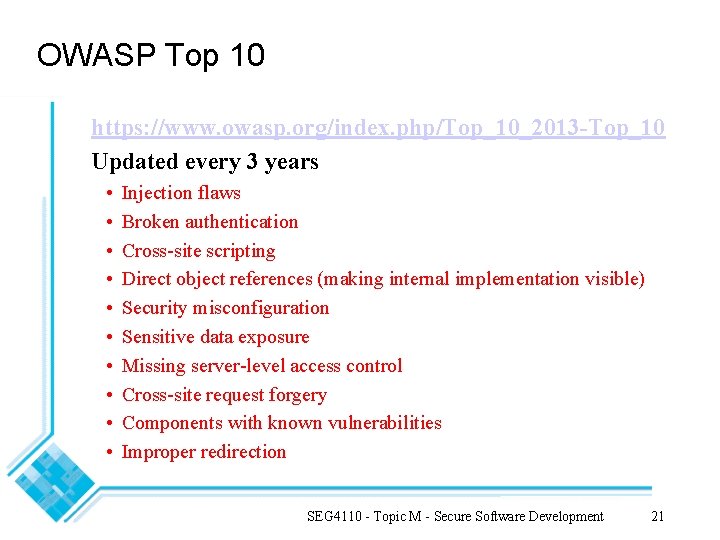
OWASP Top 10 https: //www. owasp. org/index. php/Top_10_2013 -Top_10 Updated every 3 years • • • Injection flaws Broken authentication Cross-site scripting Direct object references (making internal implementation visible) Security misconfiguration Sensitive data exposure Missing server-level access control Cross-site request forgery Components with known vulnerabilities Improper redirection SEG 4110 - Topic M - Secure Software Development 21
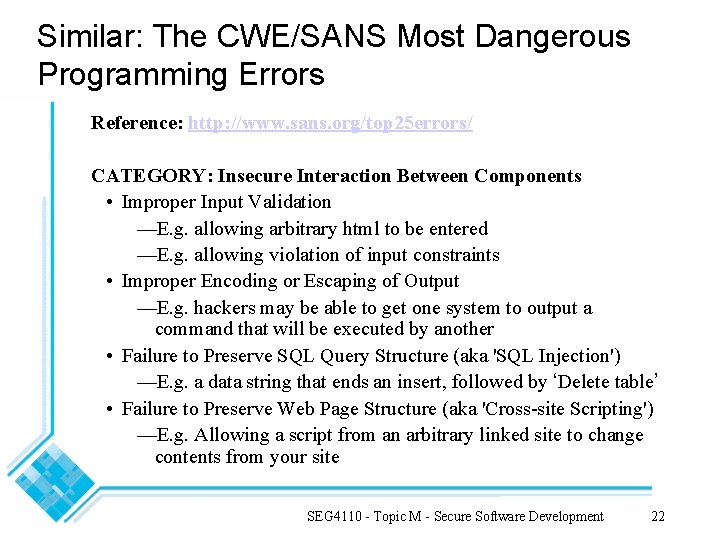
Similar: The CWE/SANS Most Dangerous Programming Errors Reference: http: //www. sans. org/top 25 errors/ CATEGORY: Insecure Interaction Between Components • Improper Input Validation —E. g. allowing arbitrary html to be entered —E. g. allowing violation of input constraints • Improper Encoding or Escaping of Output —E. g. hackers may be able to get one system to output a command that will be executed by another • Failure to Preserve SQL Query Structure (aka 'SQL Injection') —E. g. a data string that ends an insert, followed by ‘Delete table’ • Failure to Preserve Web Page Structure (aka 'Cross-site Scripting') —E. g. Allowing a script from an arbitrary linked site to change contents from your site SEG 4110 - Topic M - Secure Software Development 22
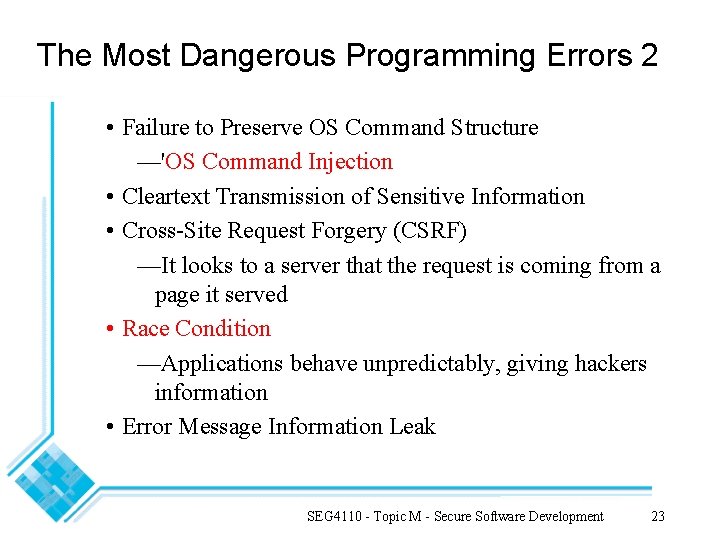
The Most Dangerous Programming Errors 2 • Failure to Preserve OS Command Structure —'OS Command Injection • Cleartext Transmission of Sensitive Information • Cross-Site Request Forgery (CSRF) —It looks to a server that the request is coming from a page it served • Race Condition —Applications behave unpredictably, giving hackers information • Error Message Information Leak SEG 4110 - Topic M - Secure Software Development 23
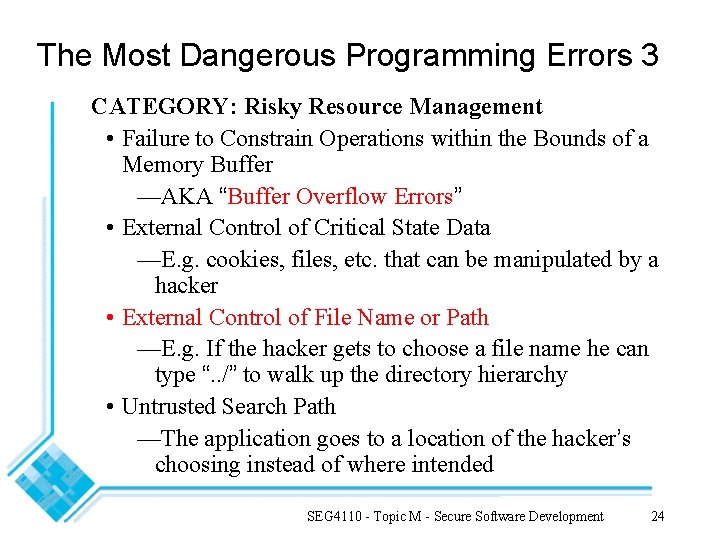
The Most Dangerous Programming Errors 3 CATEGORY: Risky Resource Management • Failure to Constrain Operations within the Bounds of a Memory Buffer —AKA “Buffer Overflow Errors” • External Control of Critical State Data —E. g. cookies, files, etc. that can be manipulated by a hacker • External Control of File Name or Path —E. g. If the hacker gets to choose a file name he can type “. . /” to walk up the directory hierarchy • Untrusted Search Path —The application goes to a location of the hacker’s choosing instead of where intended SEG 4110 - Topic M - Secure Software Development 24
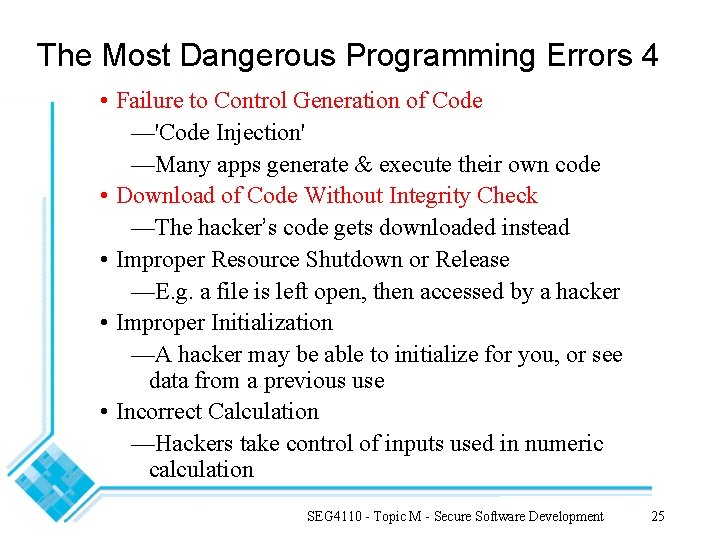
The Most Dangerous Programming Errors 4 • Failure to Control Generation of Code —'Code Injection' —Many apps generate & execute their own code • Download of Code Without Integrity Check —The hacker’s code gets downloaded instead • Improper Resource Shutdown or Release —E. g. a file is left open, then accessed by a hacker • Improper Initialization —A hacker may be able to initialize for you, or see data from a previous use • Incorrect Calculation —Hackers take control of inputs used in numeric calculation SEG 4110 - Topic M - Secure Software Development 25
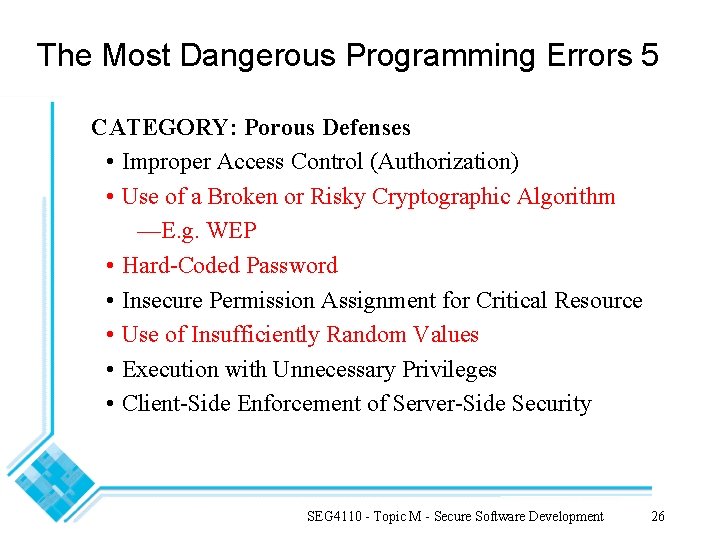
The Most Dangerous Programming Errors 5 CATEGORY: Porous Defenses • Improper Access Control (Authorization) • Use of a Broken or Risky Cryptographic Algorithm —E. g. WEP • Hard-Coded Password • Insecure Permission Assignment for Critical Resource • Use of Insufficiently Random Values • Execution with Unnecessary Privileges • Client-Side Enforcement of Server-Side Security SEG 4110 - Topic M - Secure Software Development 26
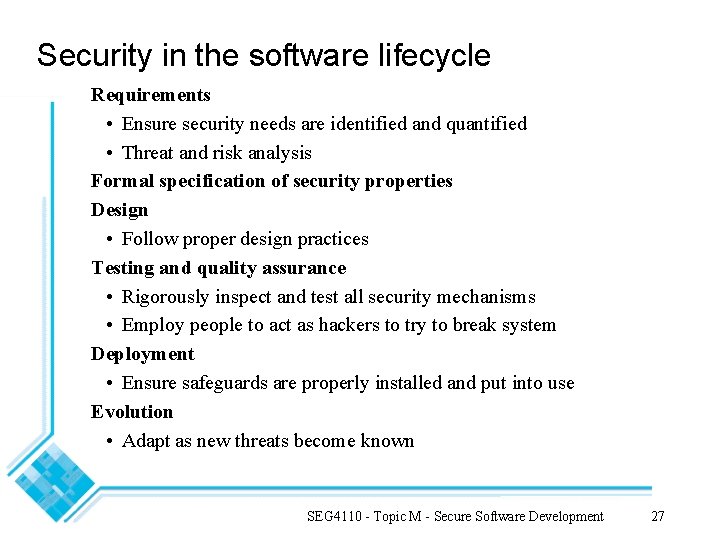
Security in the software lifecycle Requirements • Ensure security needs are identified and quantified • Threat and risk analysis Formal specification of security properties Design • Follow proper design practices Testing and quality assurance • Rigorously inspect and test all security mechanisms • Employ people to act as hackers to try to break system Deployment • Ensure safeguards are properly installed and put into use Evolution • Adapt as new threats become known SEG 4110 - Topic M - Secure Software Development 27
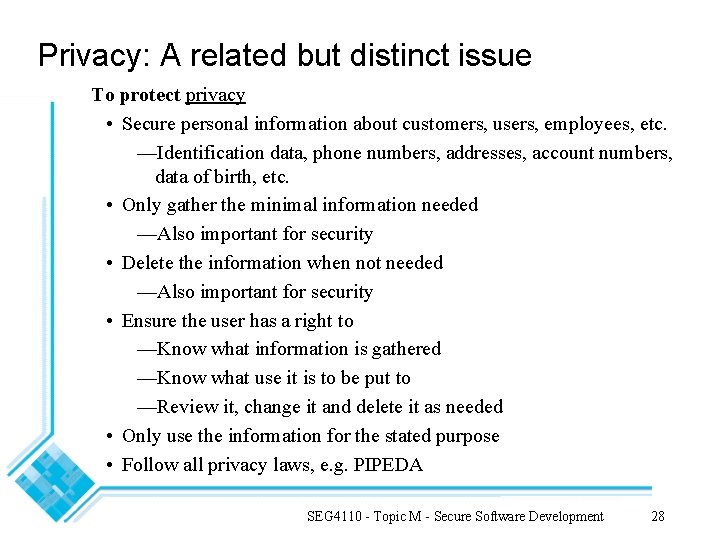
Privacy: A related but distinct issue To protect privacy • Secure personal information about customers, users, employees, etc. —Identification data, phone numbers, addresses, account numbers, data of birth, etc. • Only gather the minimal information needed —Also important for security • Delete the information when not needed —Also important for security • Ensure the user has a right to —Know what information is gathered —Know what use it is to be put to —Review it, change it and delete it as needed • Only use the information for the stated purpose • Follow all privacy laws, e. g. PIPEDA SEG 4110 - Topic M - Secure Software Development 28
A useful web site on security From the US government: • Build security in —https: //buildsecurityin. us-cert. gov/daisy/bsi/547 BSI. html SEG 4110 - Topic M - Secure Software Development 29