PRAGMATICS LI 2013 NATHALIE F MARTIN So What




- Slides: 42
PRAGMATICS LI 2013 NATHALIE F. MARTIN
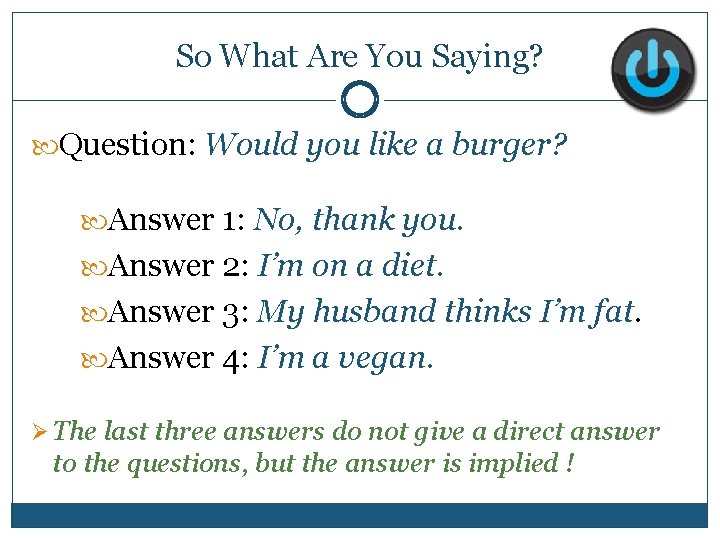
So What Are You Saying? Question: Would you like a burger? Answer 1: No, thank you. Answer 2: I’m on a diet. Answer 3: My husband thinks I’m fat. Answer 4: I’m a vegan. Ø The last three answers do not give a direct answer to the questions, but the answer is implied !
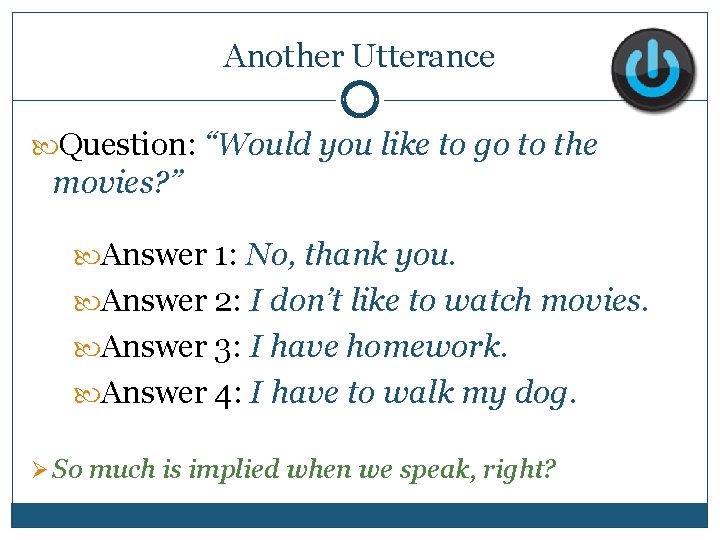
Another Utterance Question: “Would you like to go to the movies? ” Answer 1: No, thank you. Answer 2: I don’t like to watch movies. Answer 3: I have homework. Answer 4: I have to walk my dog. Ø So much is implied when we speak, right?
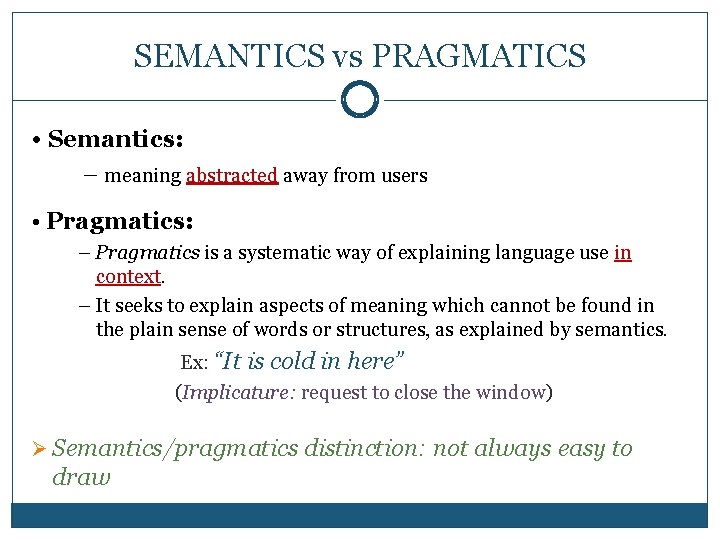
SEMANTICS vs PRAGMATICS • Semantics: – meaning abstracted away from users abstracted • Pragmatics: – Pragmatics is a systematic way of explaining language use in context – It seeks to explain aspects of meaning which cannot be found in the plain sense of words or structures, as explained by semantics. Ex: “It is cold in here” (Implicature: request to close the window) Ø Semantics/pragmatics distinction: not always easy to draw
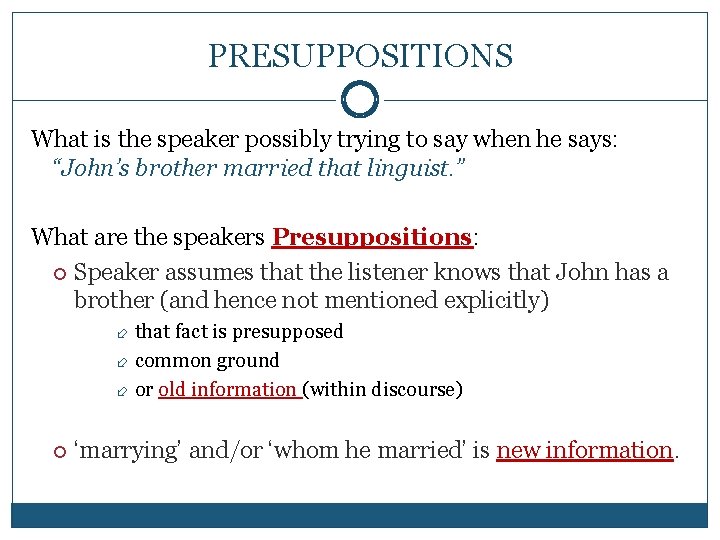
PRESUPPOSITIONS What is the speaker possibly trying to say when he says: “John’s brother married that linguist. ” What are the speakers Presuppositions: Presuppositions Speaker assumes that the listener knows that John has a brother (and hence not mentioned explicitly) that fact is presupposed common ground or old information (within discourse) old information ‘marrying’ and/or ‘whom he married’ is new information
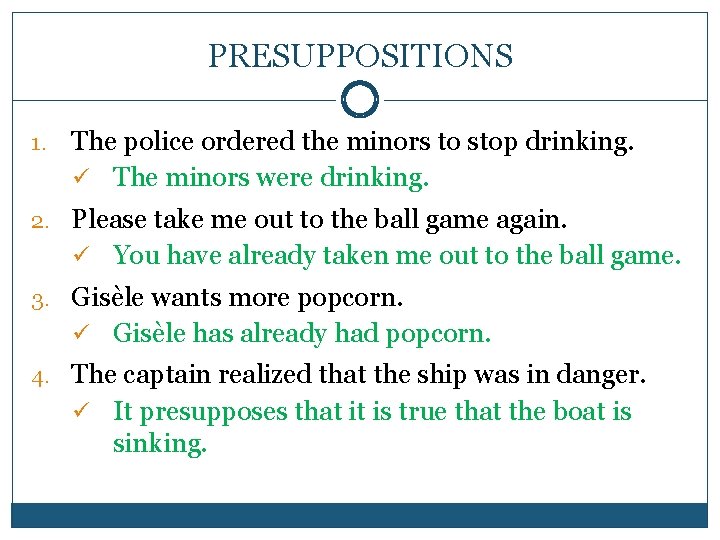
PRESUPPOSITIONS 1. The police ordered the minors to stop drinking. ü The minors were drinking. 2. Please take me out to the ball game again. ü You have already taken me out to the ball game. 3. Gisèle wants more popcorn. ü Gisèle has already had popcorn. 4. The captain realized that the ship was in danger. ü It presupposes that it is true that the boat is sinking.
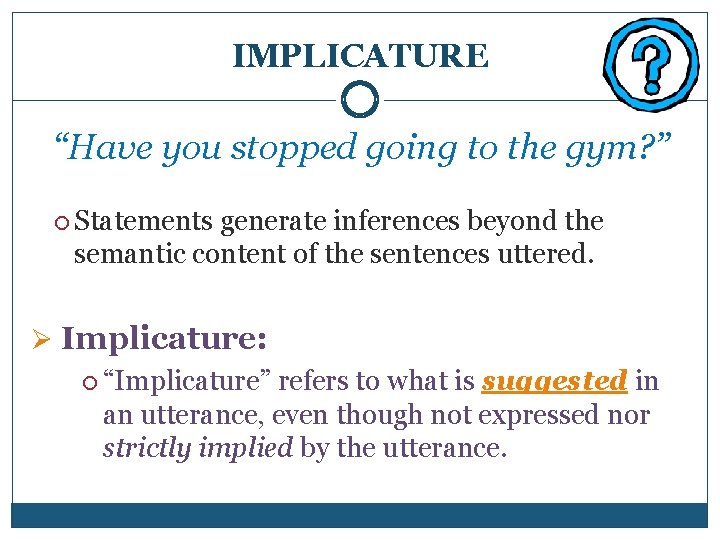
IMPLICATURE “Have you stopped going to the gym? ” Statements generate inferences beyond the semantic content of the sentences uttered. Ø Implicature: “Implicature” refers to what is suggested in an utterance, even though not expressed nor strictly implied by the utterance.
Tim Hawkins on Marriage http: //www. youtube. com/watch? v=i. K 2 Oak. Mo. W_c
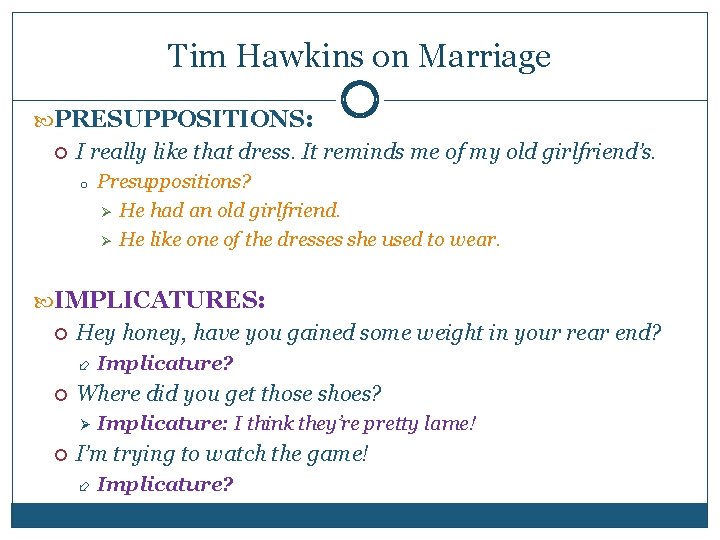
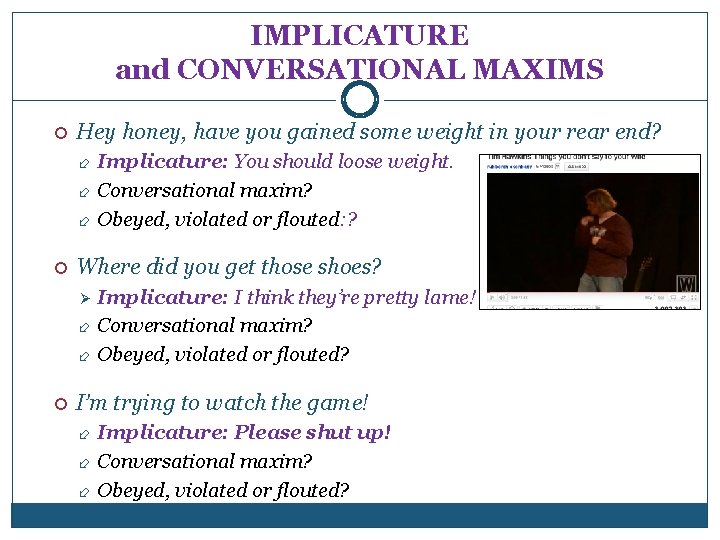
Tim Hawkins on Marriage PRESUPPOSITIONS: I really like that dress. It reminds me of my old girlfriend’s. o Presuppositions? Ø He had an old girlfriend. Ø He like one of the dresses she used to wear. IMPLICATURES: Hey honey, have you gained some weight in your rear end? Where did you get those shoes? Ø Implicature? Implicature: I think they’re pretty lame! I’m trying to watch the game! Implicature?
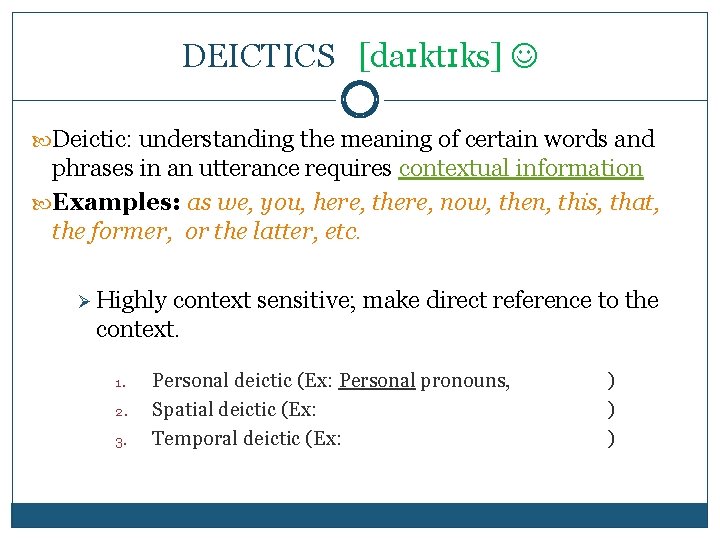
DEICTICS [daɪktɪks] Deictic: understanding the meaning of certain words and phrases in an utterance requires contextual information Examples: as we, you, here, there, now, then, this, that, the former, or the latter, etc. Ø Highly context sensitive; make direct reference to the context. 1. 2. 3. Personal deictic (Ex: Personal pronouns, Spatial deictic (Ex: Temporal deictic (Ex: ) ) )
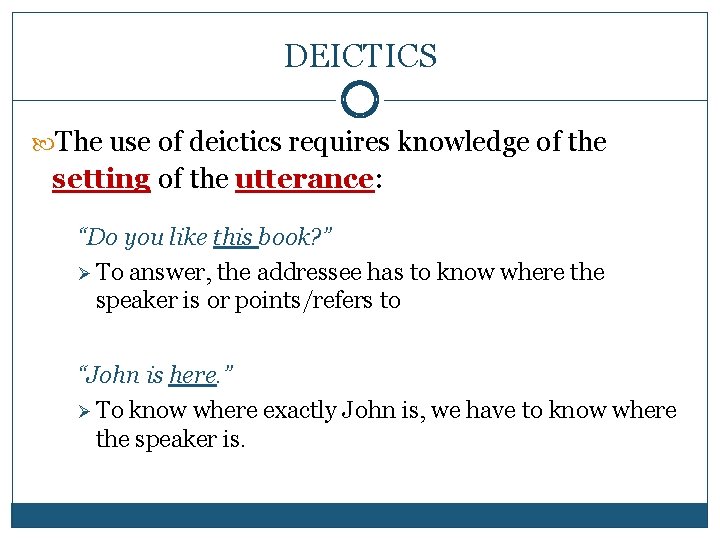
DEICTICS The use of deictics requires knowledge of the setting of the utterance: utterance “Do you like this book? ” Ø To answer, the addressee has to know where the speaker is or points/refers to “John is here. ” Ø To know where exactly John is, we have to know where the speaker is.
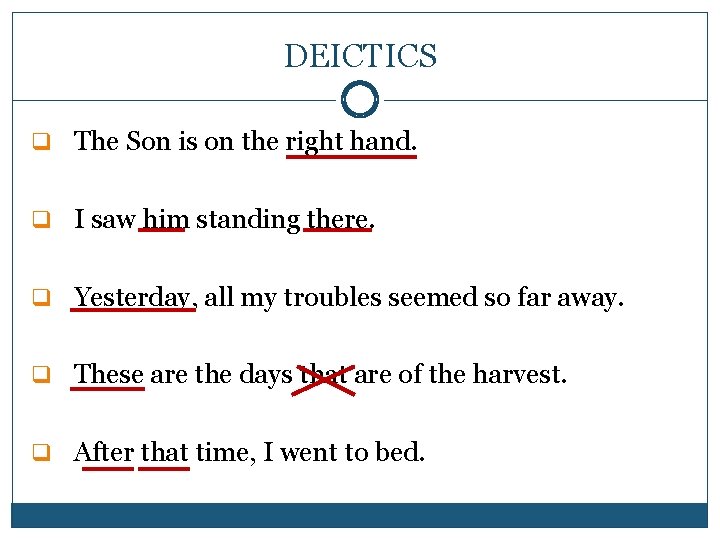
DEICTICS q The Son is on the right hand. q I saw him standing there. q Yesterday, all my troubles seemed so far away. q These are the days that are of the harvest. q After that time, I went to bed.
Speech Act Theory JOHN L. AUSTIN
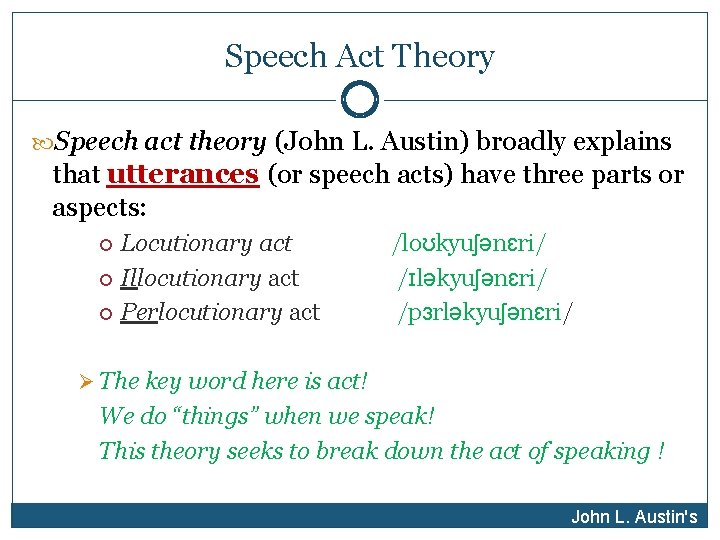
Speech Act Theory Speech act theory (John L. Austin) broadly explains that utterances (or speech acts) have three parts or aspects: Locutionary act Illocutionary act Perlocutionary act /loʊkyuʃənɛri/ /ɪləkyuʃənɛri/ /pɜrləkyuʃənɛri/ Ø The key word here is act! We do “things” when we speak! This theory seeks to break down the act of speaking ! John L. Austin's
Speech Act Theory Locutionary acts: simply the speech that has taken place Illocutionary force: are the real actions which are performed by the utterance In other words : where saying equals doing. Ex: betting, pleading, declaration, welcoming, warning, etc. Perlocutionary force: are the effects of the utterance on the listener. John L. Austin's
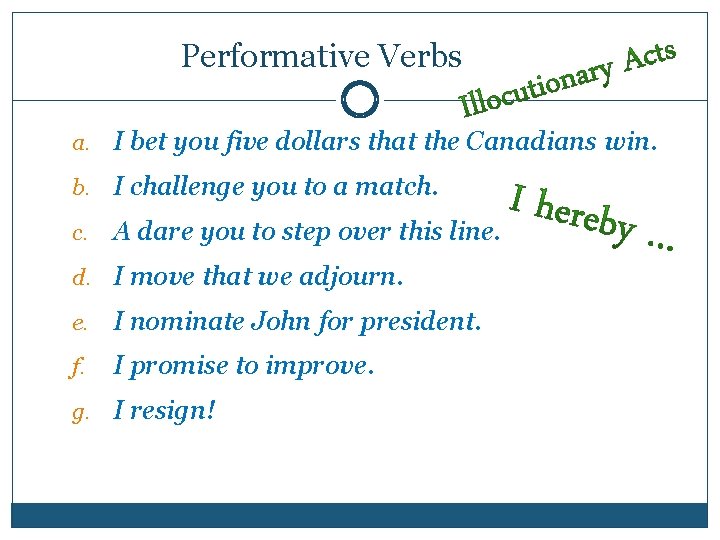
Performative Verbs a. I bet you five dollars that the Canadians win. b. I challenge you to a match. c. A dare you to step over this line. d. I move that we adjourn. e. I nominate John for president. f. I promise to improve. g. I resign!
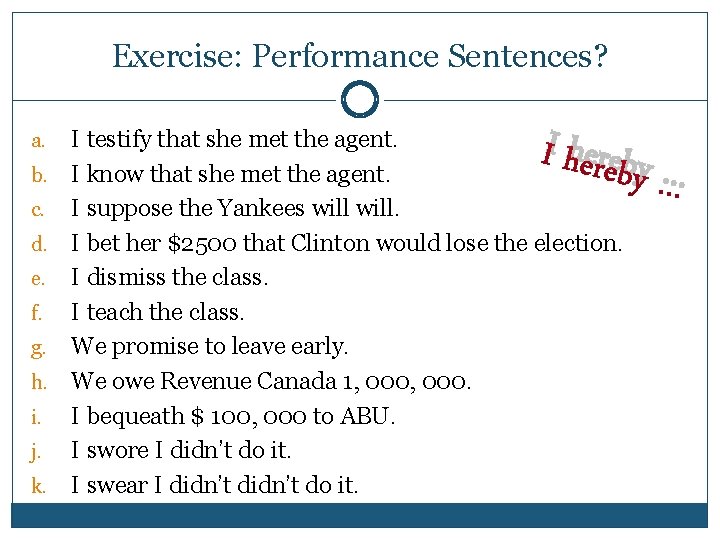
Exercise: Performance Sentences? a. b. c. d. e. f. g. h. i. j. k. I hereb I testify that she met the agent. I know that she met the agent. I suppose the Yankees will. I bet her $2500 that Clinton would lose the election. I dismiss the class. I teach the class. We promise to leave early. We owe Revenue Canada 1, 000. I bequeath $ 100, 000 to ABU. I swore I didn’t do it. I swear I didn’t do it. y…
CONVERSATIONAL MAXIMS H. PAUL GRICE
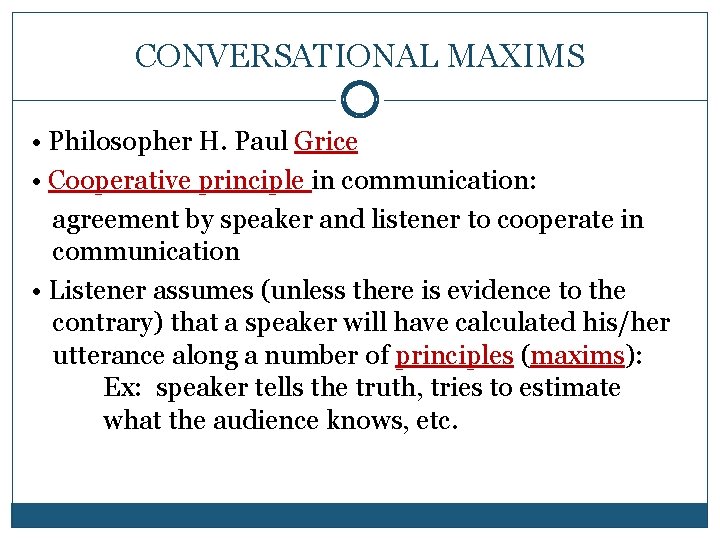
CONVERSATIONAL MAXIMS • Philosopher H. Paul Grice • Cooperative principle in communication: Cooperative principle agreement by speaker and listener to cooperate in communication • Listener assumes (unless there is evidence to the contrary) that a speaker will have calculated his/her utterance along a number of principles ( principles maxims): maxims Ex: speaker tells the truth, tries to estimate what the audience knows, etc.
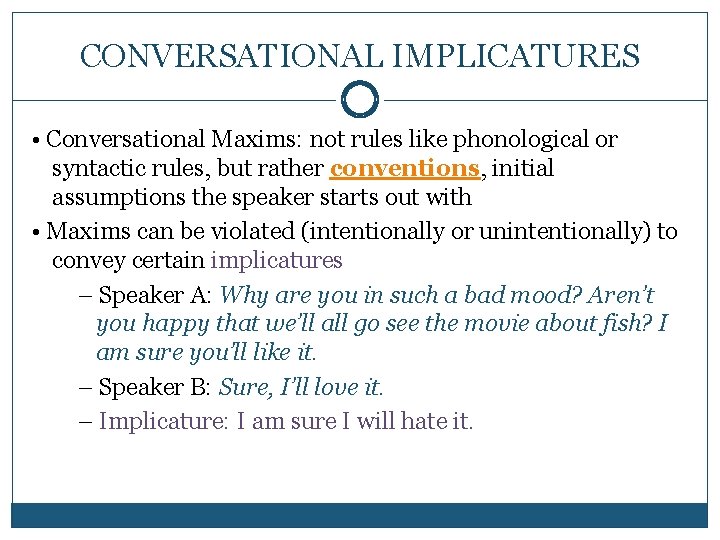
CONVERSATIONAL IMPLICATURES • Conversational Maxims: not rules like phonological or syntactic rules, but rather conventions, initial conventions assumptions the speaker starts out with • Maxims can be violated (intentionally or unintentionally) to convey certain implicatures – Speaker A: Why are you in such a bad mood? Aren’t you happy that we’ll all go see the movie about fish? I am sure you’ll like it. – Speaker B: Sure, I’ll love it. – Implicature: I am sure I will hate it.
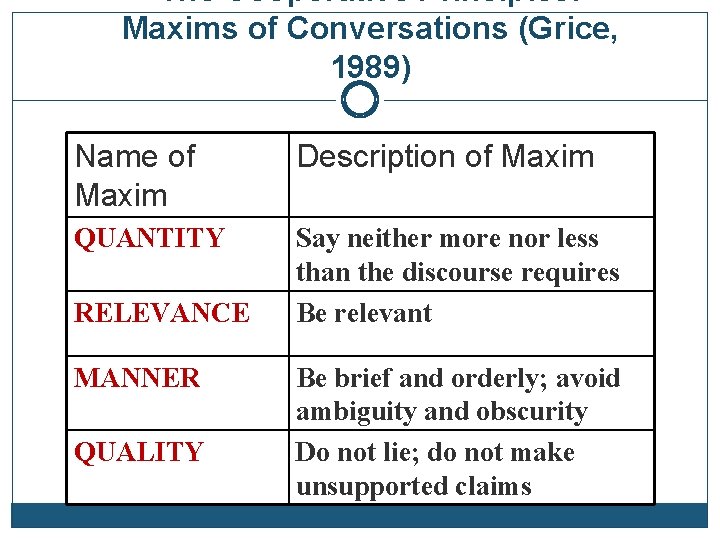
The Cooperative Principles: Maxims of Conversations (Grice, 1989) Name of Maxim Description of Maxim QUANTITY Say neither more nor less than the discourse requires Be relevant RELEVANCE MANNER QUALITY Be brief and orderly; avoid ambiguity and obscurity Do not lie; do not make unsupported claims
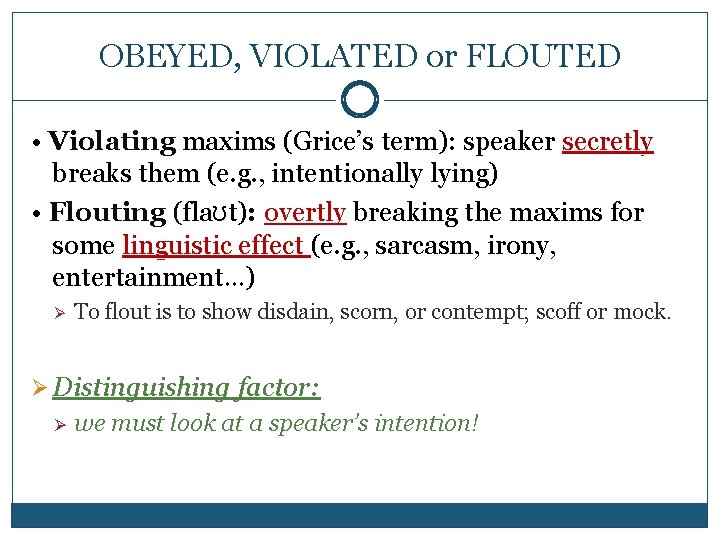
OBEYED, VIOLATED or FLOUTED • Violating maxims (Grice’s term): speaker secretly breaks them (e. g. , intentionally lying) • Flouting (flaʊt): overtly breaking the maxims for some linguistic effect (e. g. , sarcasm, irony, linguistic effect entertainment…) Ø To flout is to show disdain, scorn, or contempt; scoff or mock. Ø Distinguishing factor: Ø we must look at a speaker’s intention!
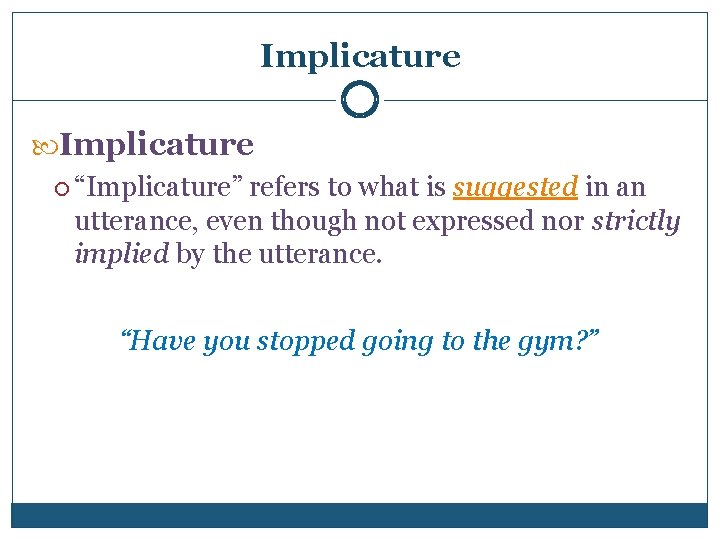
Implicature “Implicature” refers to what is suggested in an utterance, even though not expressed nor strictly implied by the utterance. “Have you stopped going to the gym? ”
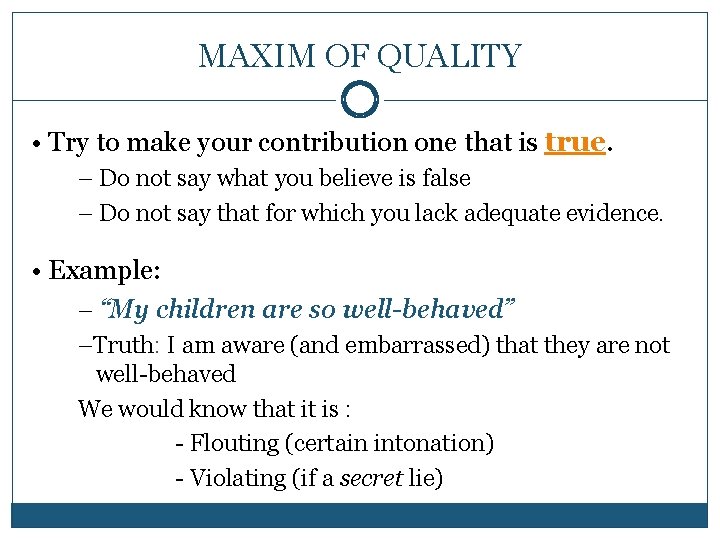
MAXIM OF QUALITY • Try to make your contribution one that is true. – Do not say what you believe is false – Do not say that for which you lack adequate evidence. • Example: – “My children are so well-behaved” –Truth: I am aware (and embarrassed) that they are not well-behaved We would know that it is : - Flouting (certain intonation) - Violating (if a secret lie)
MAXIM OF QUANTITY • Make your contribution as informative as is required for the current purposes of the exchange (i. e. , no more or less informative). • Example: – Speaker A: What did you have for lunch today? – Speaker B: I had cottage cheese. Ø Flouted or Violated: if the speaker also had pizza and banana split.
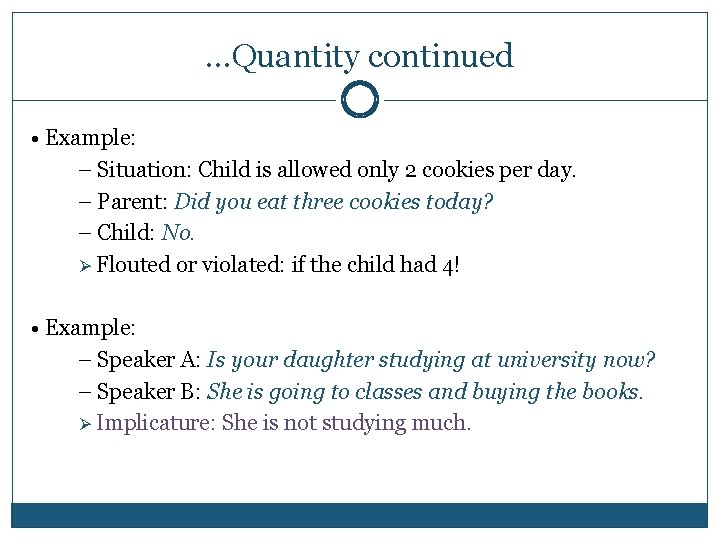
…Quantity continued • Example: – Situation: Child is allowed only 2 cookies per day. – Parent: Did you eat three cookies today? – Child: No. Ø Flouted or violated: if the child had 4! • Example: – Speaker A: Is your daughter studying at university now? – Speaker B: She is going to classes and buying the books. Ø Implicature: She is not studying much.
MAXIM OF RELEVANCE • Make your contributions relevant Examples: – Question: Are you … ? – In response to anything: Is the Pope Catholic? – Implicature: Your question is so obvious… – Speaker A: Can you tell me the time? – Speaker B: Yes.
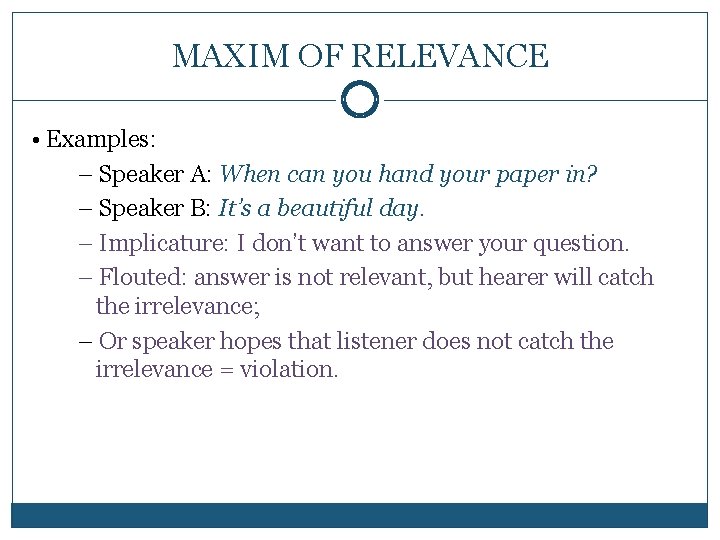
MAXIM OF RELEVANCE • Examples: – Speaker A: When can you hand your paper in? – Speaker B: It’s a beautiful day. – Implicature: I don’t want to answer your question. – Flouted: answer is not relevant, but hearer will catch the irrelevance; – Or speaker hopes that listener does not catch the irrelevance = violation.
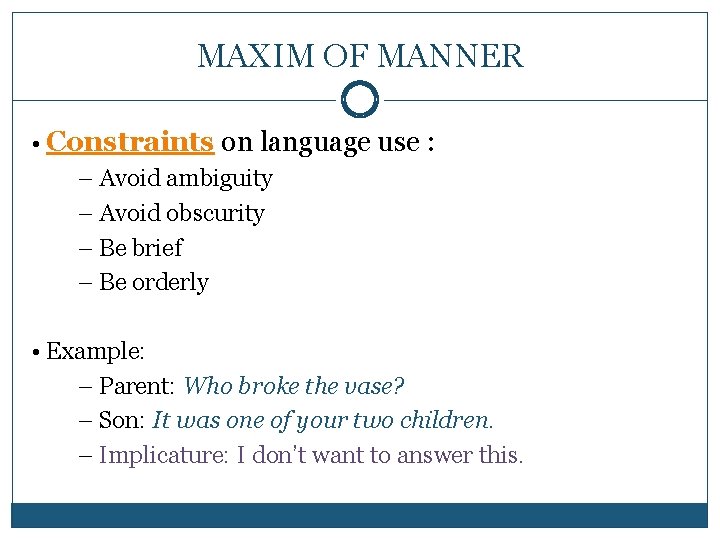
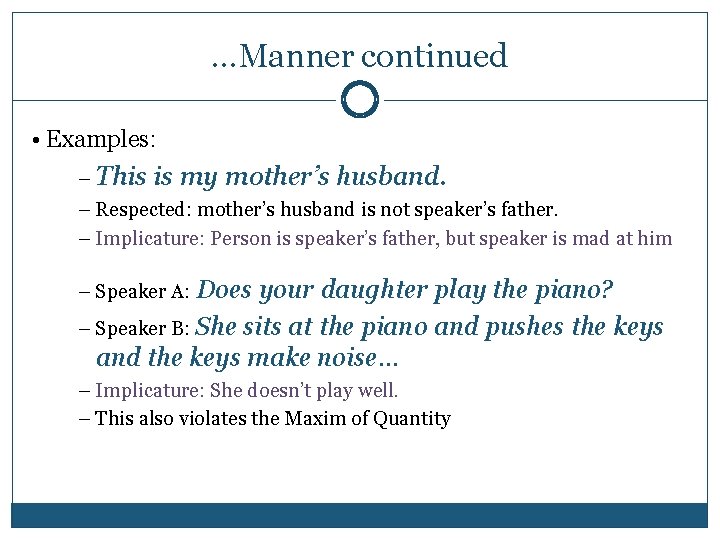
MAXIM OF MANNER • Constraints on language use : – Avoid ambiguity – Avoid obscurity – Be brief – Be orderly • Example: – Parent: Who broke the vase? – Son: It was one of your two children. – Implicature: I don’t want to answer this.
…Manner continued • Examples: – This is my mother’s husband. – Respected: mother’s husband is not speaker’s father. – Implicature: Person is speaker’s father, but speaker is mad at him – Speaker A: Does your daughter play the piano? – Speaker B: She sits at the piano and pushes the keys and the keys make noise… – Implicature: She doesn’t play well. – This also violates the Maxim of Quantity
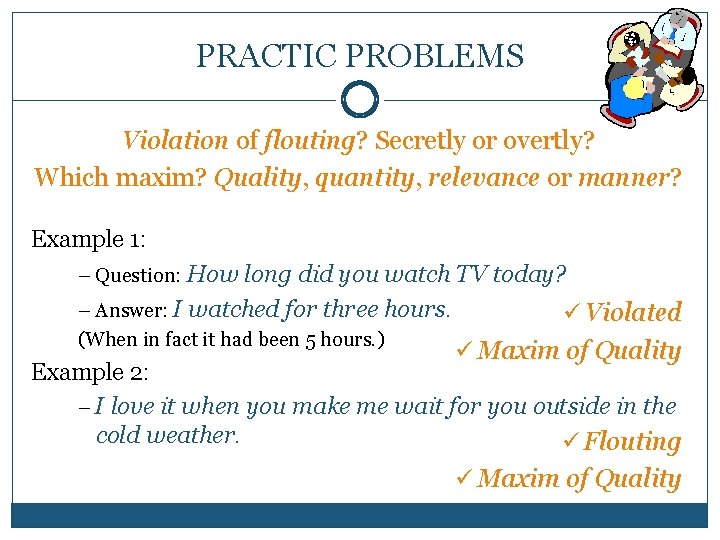
PRACTIC PROBLEMS Violation of flouting? Secretly or overtly? Which maxim? Quality, quantity, relevance or manner? Example 1: – Question: How long did you watch TV today? – Answer: I watched for three hours. (When in fact it had been 5 hours. ) ü Violated ü Maxim of Quality Example 2: – I love it when you make me wait for you outside in the cold weather. ü Flouting ü Maxim of Quality
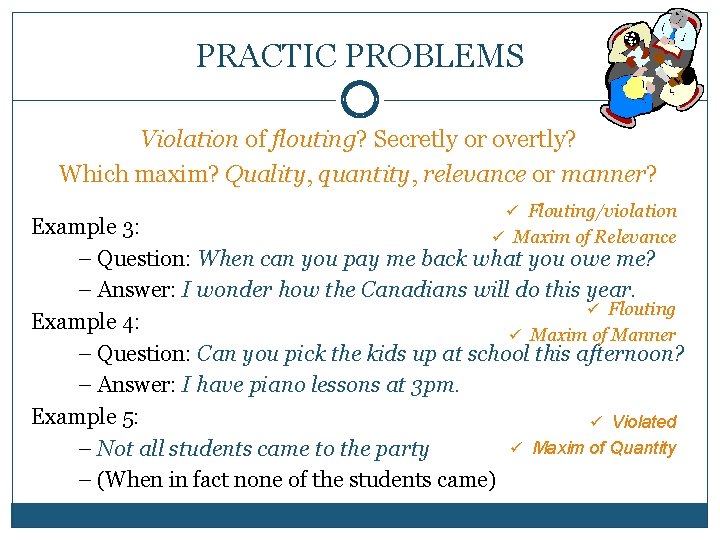
PRACTIC PROBLEMS Violation of flouting? Secretly or overtly? Which maxim? Quality, quantity, relevance or manner? ü Flouting/violation Example 3: ü Maxim of Relevance – Question: When can you pay me back what you owe me? – Answer: I wonder how the Canadians will do this year. ü Flouting Example 4: ü Maxim of Manner – Question: Can you pick the kids up at school this afternoon? – Answer: I have piano lessons at 3 pm. Example 5: ü Violated ü Maxim of Quantity – Not all students came to the party – (When in fact none of the students came)
The Art of Not « Really » Telling Lies What did you get me for Christmas? Ø Truth: I got you a « Jars of Clay » CD. Possible answers: Ø Implicature and conversational maxim: Ø Violated or flouted? Ø Did you get me a guitar case? Ø Truth: No Possible answers: Ø Implicature and conversational maxim: Ø Violated or flouted? Ø
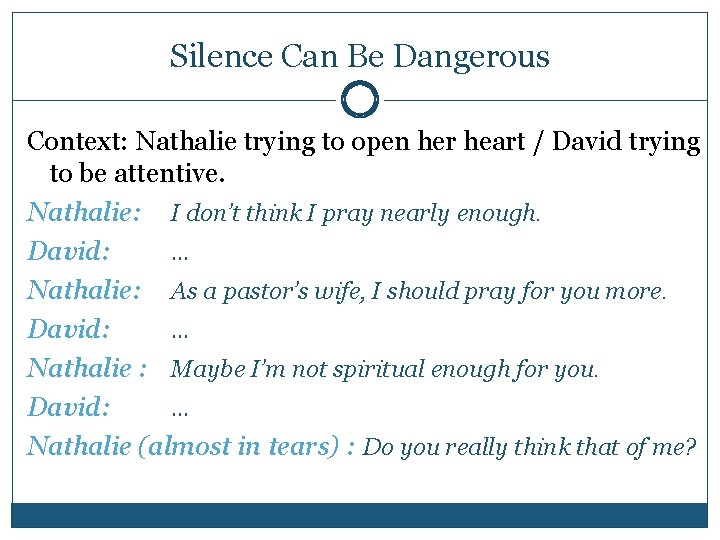
Silence Can Be Dangerous Context: Nathalie trying to open her heart / David trying to be attentive. Nathalie: I don’t think I pray nearly enough. David: … Nathalie: As a pastor’s wife, I should pray for you more. David: … Nathalie : Maybe I’m not spiritual enough for you. David: … Nathalie (almost in tears) : Do you really think that of me?
IMPLICATURE and CONVERSATIONAL MAXIMS Hey honey, have you gained some weight in your rear end? Implicature: You should loose weight. Conversational maxim? Obeyed, violated or flouted: ? Where did you get those shoes? Implicature: I think they’re pretty lame! Conversational maxim? Obeyed, violated or flouted? Ø I’m trying to watch the game! Implicature: Please shut up! Conversational maxim? Obeyed, violated or flouted?
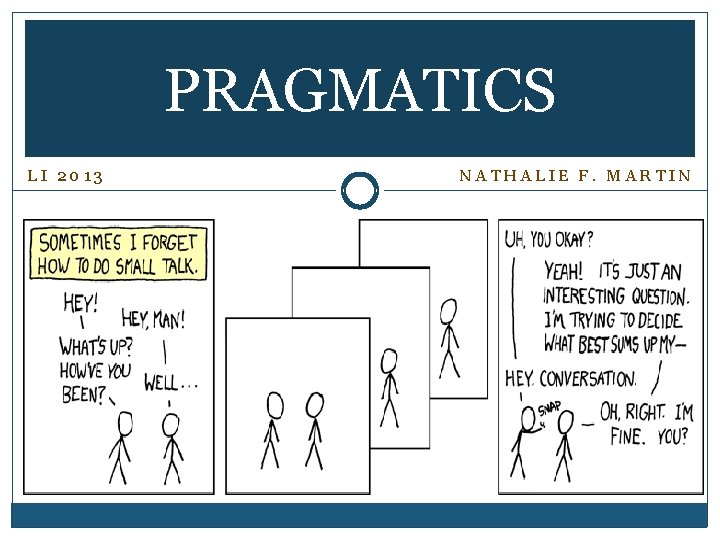
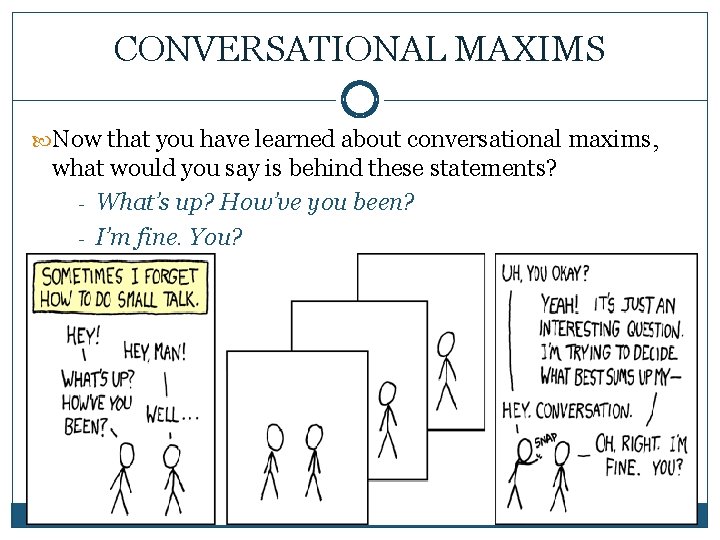
CONVERSATIONAL MAXIMS Now that you have learned about conversational maxims, what would you say is behind these statements? - What’s up? How’ve you been? - I’m fine. You?
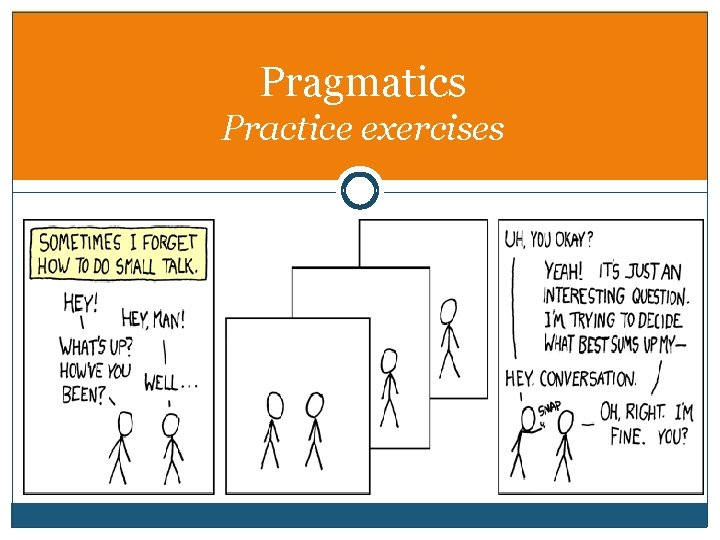
Pragmatics Practice exercises
Examples: 1. I’m a multimillionaire (Actually, I’m penniless. ) Violated maxim: Quality Explanation: The speaker has failed to tell the truth. 2. A: When am I going to get back the money I lent you? B: Boy, it’s hot in here! Violated maxim: Relevance Explanation: B’s answer is not related to A’s question. 3. A: What should I do to get rid of this headache, Doctor? B: Take some medicine. Violated maxim: Quantity Explanation: B has not provided enough information.
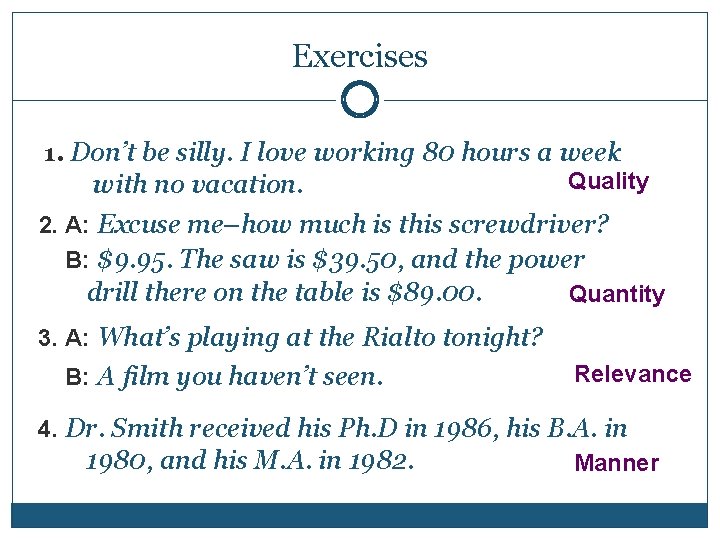
Exercises 1. Don’t be silly. I love working 80 hours a week Quality with no vacation. 2. A: Excuse me–how much is this screwdriver? B: $9. 95. The saw is $39. 50, and the power drill there on the table is $89. 00. Quantity 3. A: What’s playing at the Rialto tonight? B: A film you haven’t seen. Relevance 4. Dr. Smith received his Ph. D in 1986, his B. A. in 1980, and his M. A. in 1982. Manner
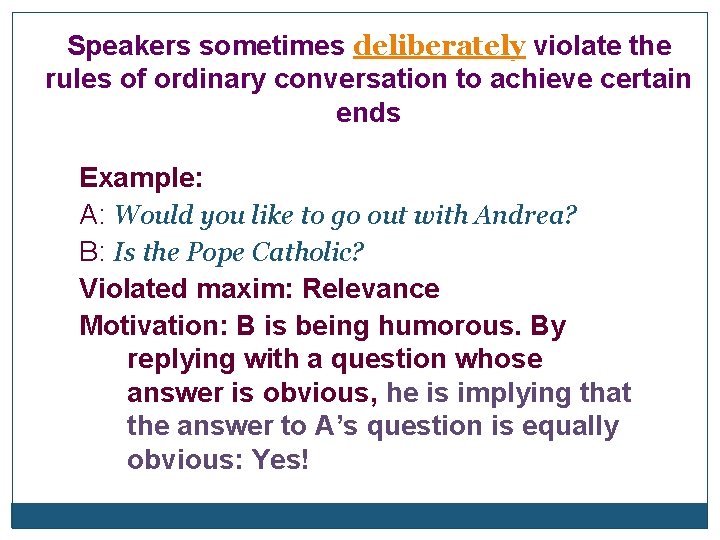
Speakers sometimes deliberately violate the rules of ordinary conversation to achieve certain ends Example: A: Would you like to go out with Andrea? B: Is the Pope Catholic? Violated maxim: Relevance Motivation: B is being humorous. By replying with a question whose answer is obvious, he is implying that the answer to A’s question is equally obvious: Yes!
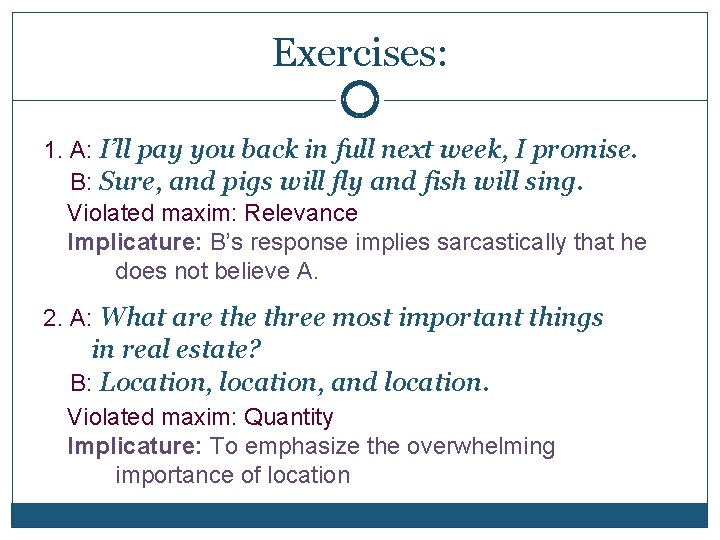
Exercises: 1. A: I’ll pay you back in full next week, I promise. B: Sure, and pigs will fly and fish will sing. Violated maxim: Relevance Implicature: B’s response implies sarcastically that he does not believe A. 2. A: What are three most important things in real estate? B: Location, location, and location. Violated maxim: Quantity Implicature: To emphasize the overwhelming importance of location
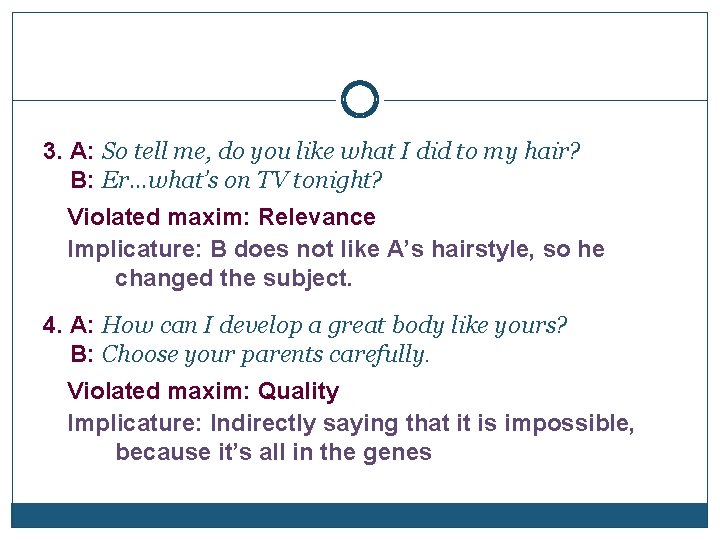
3. A: So tell me, do you like what I did to my hair? B: Er…what’s on TV tonight? Violated maxim: Relevance Implicature: B does not like A’s hairstyle, so he changed the subject. 4. A: How can I develop a great body like yours? B: Choose your parents carefully. Violated maxim: Quality Implicature: Indirectly saying that it is impossible, because it’s all in the genes