Photosynthesis Autotrophs and Heterotrophs All life on Earth
- Slides: 54
Photosynthesis
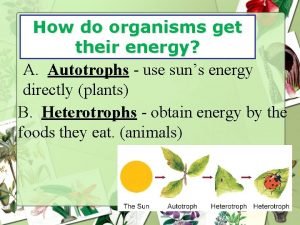
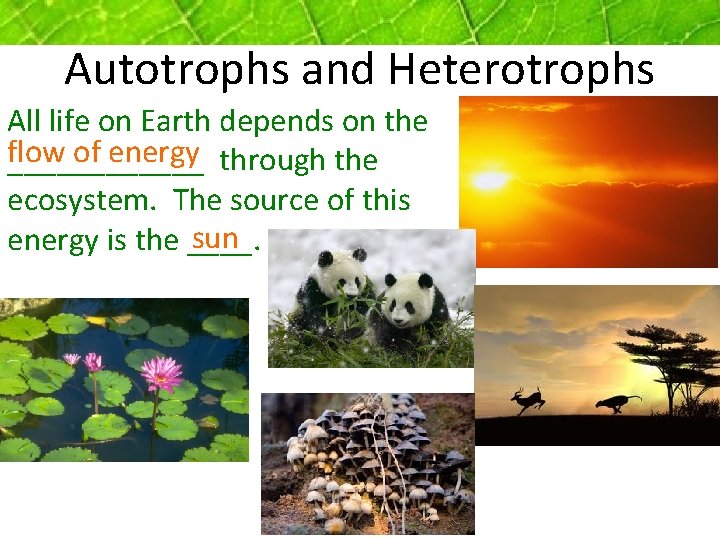
Autotrophs and Heterotrophs All life on Earth depends on the flow of energy ______ through the ecosystem. The source of this sun energy is the ____.
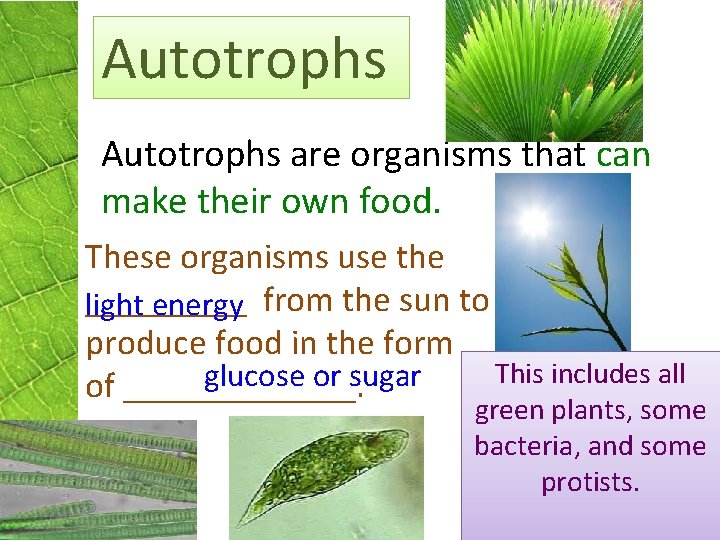
Autotrophs are organisms that can make their own food. These organisms use the _____ from the sun to light energy produce food in the form This includes all glucose or sugar of _______. green plants, some bacteria, and some protists.
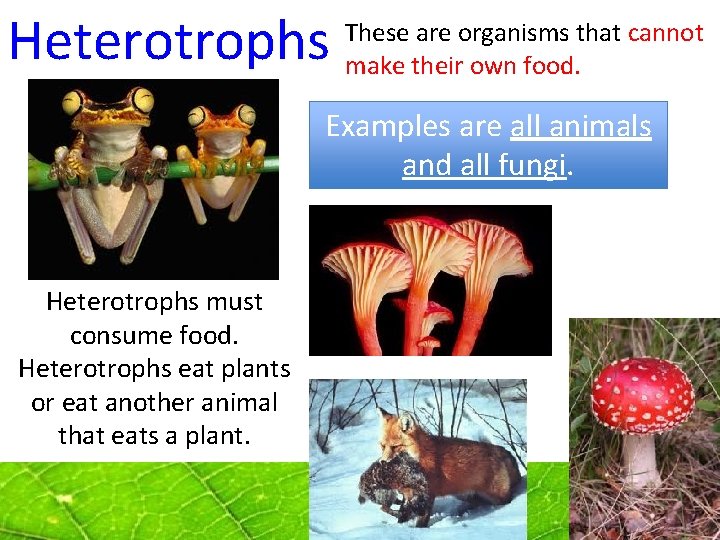
Heterotrophs These are organisms that cannot make their own food. Examples are all animals and all fungi. Heterotrophs must consume food. Heterotrophs eat plants or eat another animal that eats a plant.
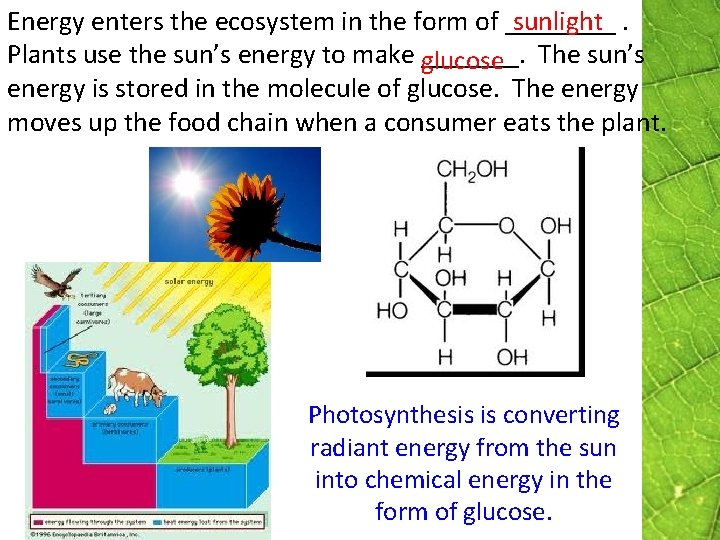
Energy enters the ecosystem in the form of ____. sunlight Plants use the sun’s energy to make _______. The sun’s glucose energy is stored in the molecule of glucose. The energy moves up the food chain when a consumer eats the plant. Photosynthesis is converting radiant energy from the sun into chemical energy in the form of glucose.
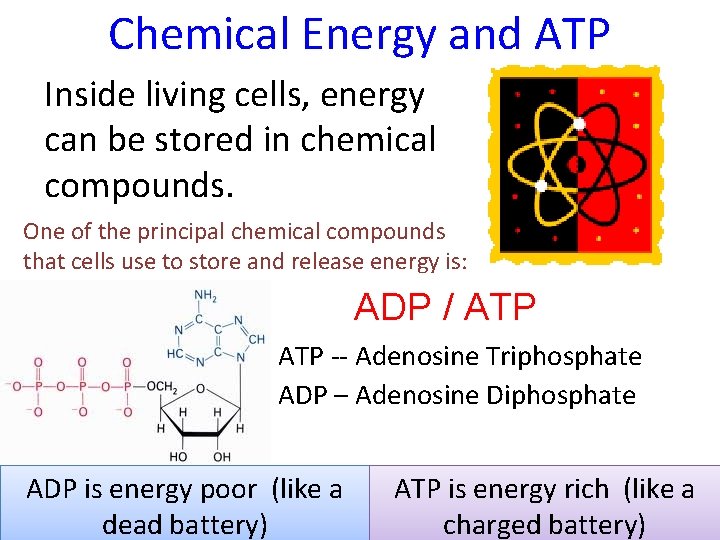
Chemical Energy and ATP Inside living cells, energy can be stored in chemical compounds. One of the principal chemical compounds that cells use to store and release energy is: ADP / ATP -- Adenosine Triphosphate ADP – Adenosine Diphosphate ADP is energy poor (like a dead battery) ATP is energy rich (like a charged battery)
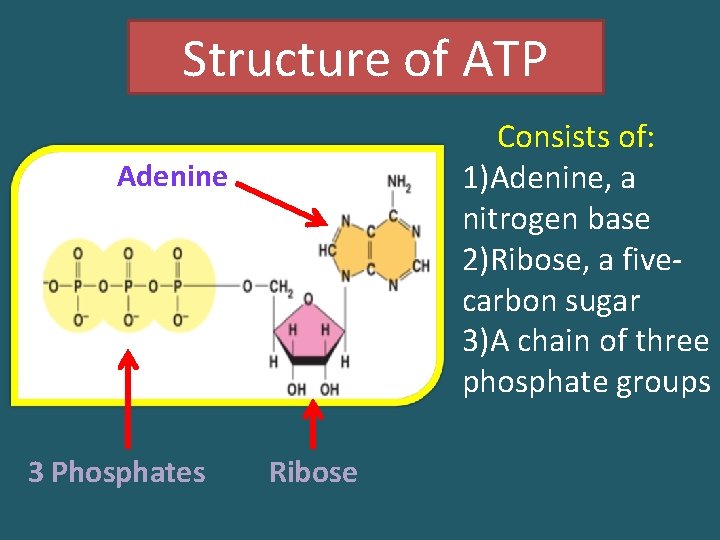
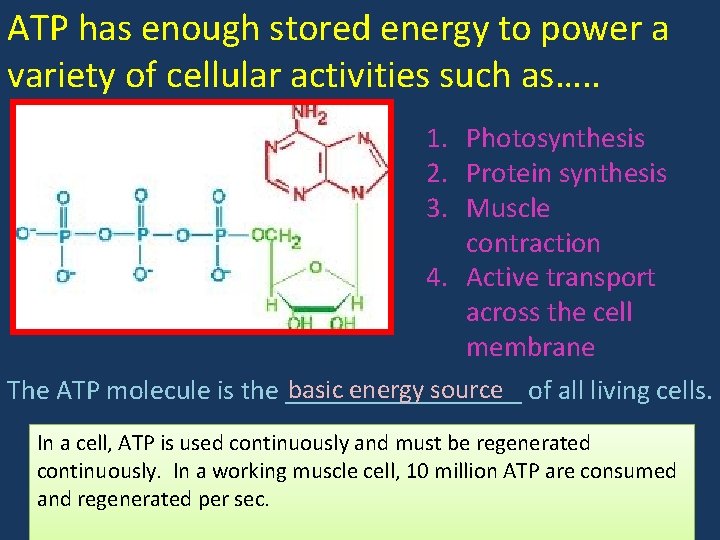
Structure of ATP Consists of: 1)Adenine, a nitrogen base 2)Ribose, a fivecarbon sugar 3)A chain of three phosphate groups Adenine 3 Phosphates Ribose
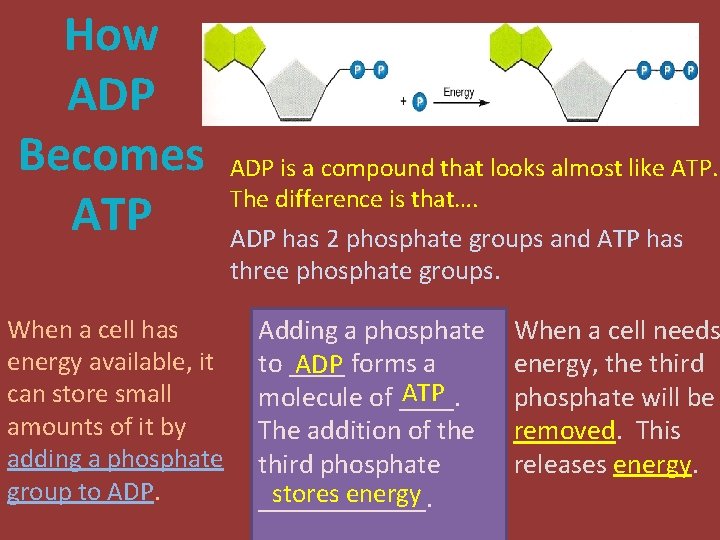
How ADP Becomes ATP When a cell has energy available, it can store small amounts of it by adding a phosphate group to ADP is a compound that looks almost like ATP. The difference is that…. ADP has 2 phosphate groups and ATP has three phosphate groups. Adding a phosphate to ____ forms a ADP ATP molecule of ____. The addition of the third phosphate stores energy ______. When a cell needs energy, the third phosphate will be removed. This releases energy.
ATP has enough stored energy to power a variety of cellular activities such as…. . 1. Photosynthesis 2. Protein synthesis 3. Muscle contraction 4. Active transport across the cell membrane basic energy source The ATP molecule is the _________ of all living cells. In a cell, ATP is used continuously and must be regenerated continuously. In a working muscle cell, 10 million ATP are consumed and regenerated per sec.
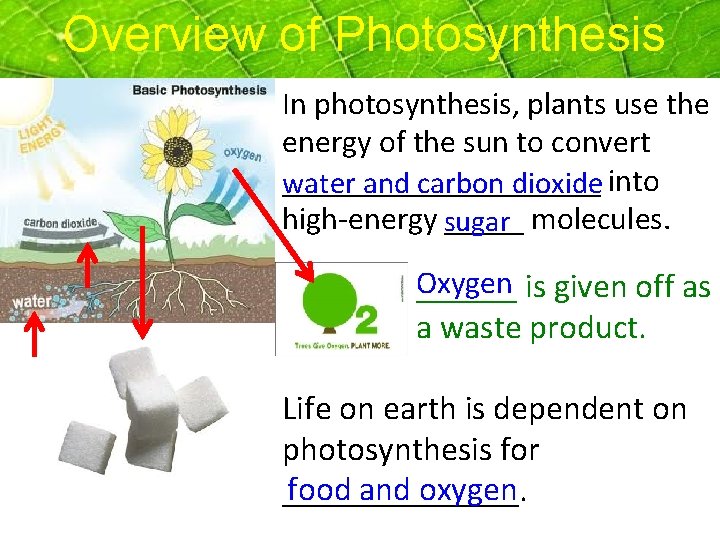
Overview of Photosynthesis In photosynthesis, plants use the energy of the sun to convert __________ into water and carbon dioxide high-energy _____ molecules. sugar Oxygen ______ is given off as a waste product. Life on earth is dependent on photosynthesis for food and oxygen _______.
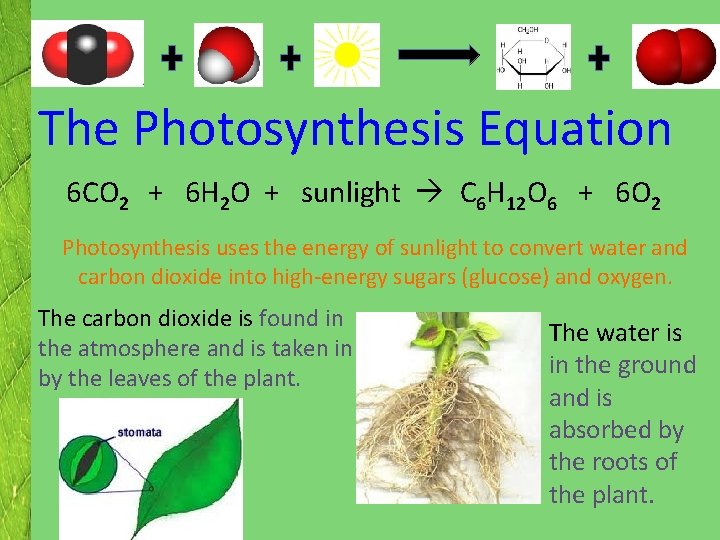
The Photosynthesis Equation 6 CO 2 + 6 H 2 O + sunlight C 6 H 12 O 6 + 6 O 2 Photosynthesis uses the energy of sunlight to convert water and carbon dioxide into high-energy sugars (glucose) and oxygen. The carbon dioxide is found in the atmosphere and is taken in by the leaves of the plant. The water is in the ground and is absorbed by the roots of the plant.
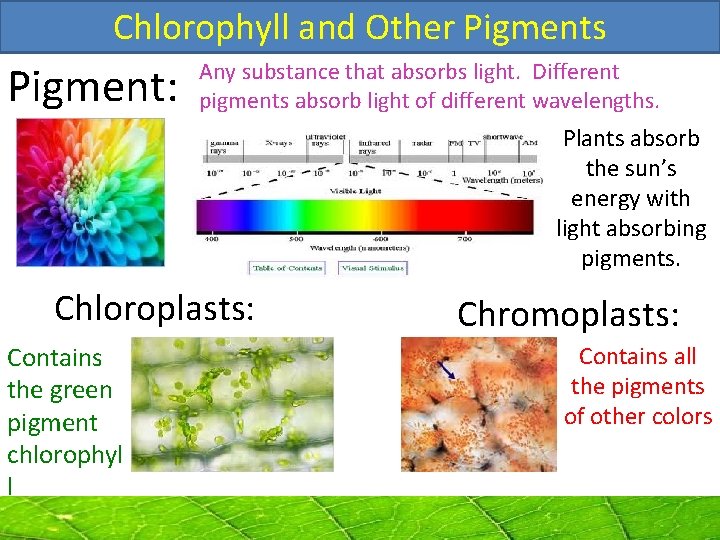
Chlorophyll and Other Pigments Pigment: Any substance that absorbs light. Different pigments absorb light of different wavelengths. Plants absorb the sun’s energy with light absorbing pigments. Chloroplasts: Contains the green pigment chlorophyl l Chromoplasts: Contains all the pigments of other colors
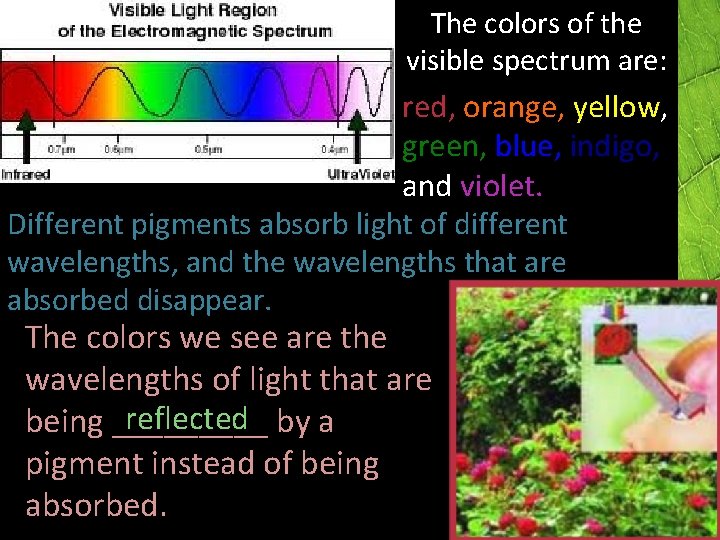
The colors of the visible spectrum are: red, orange, yellow, green, blue, indigo, and violet. Different pigments absorb light of different wavelengths, and the wavelengths that are absorbed disappear. The colors we see are the wavelengths of light that are reflected being _____ by a pigment instead of being absorbed.
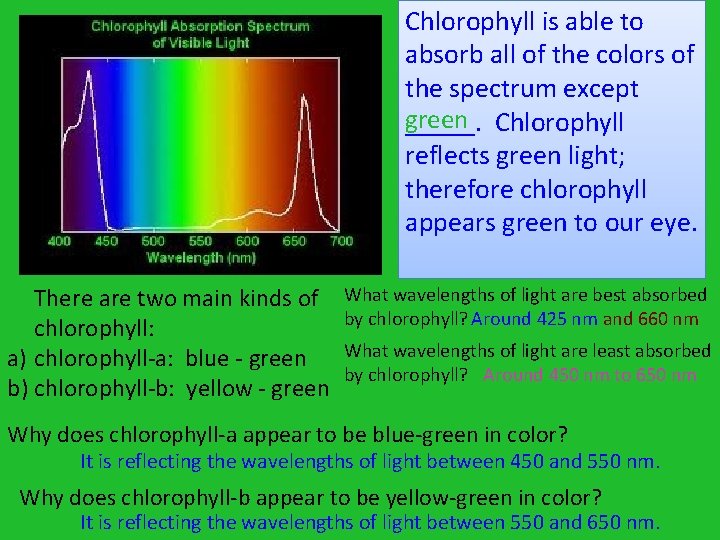
Chlorophyll is able to absorb all of the colors of the spectrum except green _____. Chlorophyll reflects green light; therefore chlorophyll appears green to our eye. There are two main kinds of chlorophyll: a) chlorophyll-a: blue - green b) chlorophyll-b: yellow - green What wavelengths of light are best absorbed by chlorophyll? Around 425 nm and 660 nm What wavelengths of light are least absorbed by chlorophyll? Around 450 nm to 650 nm Why does chlorophyll-a appear to be blue-green in color? It is reflecting the wavelengths of light between 450 and 550 nm. Why does chlorophyll-b appear to be yellow-green in color? It is reflecting the wavelengths of light between 550 and 650 nm.
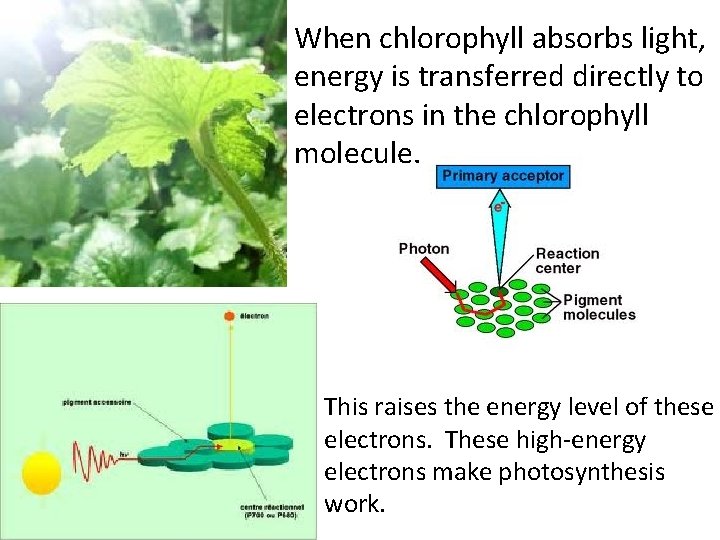
When chlorophyll absorbs light, energy is transferred directly to electrons in the chlorophyll molecule. This raises the energy level of these electrons. These high-energy electrons make photosynthesis work.
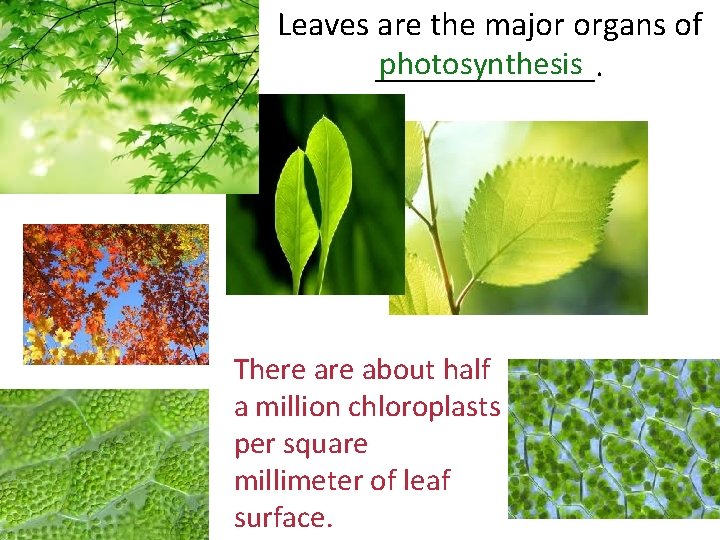
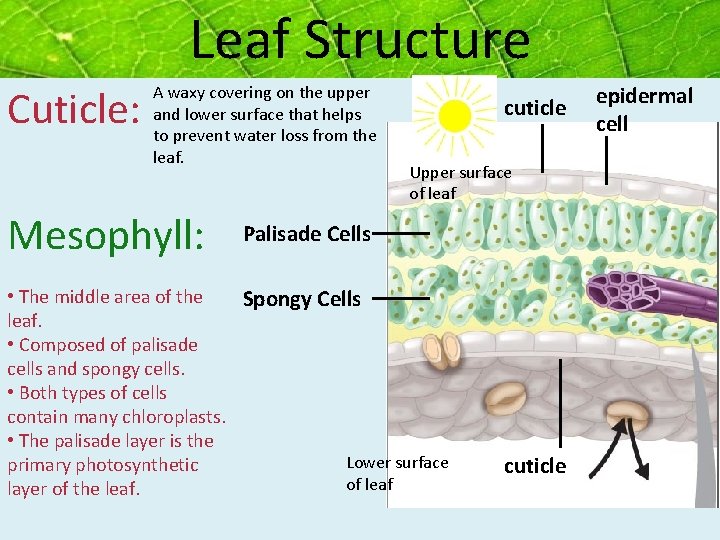
Leaves are the major organs of photosynthesis _______. There about half a million chloroplasts per square millimeter of leaf surface.
Leaf Structure Cuticle: A waxy covering on the upper and lower surface that helps to prevent water loss from the leaf. Mesophyll: cuticle Upper surface of leaf Palisade Cells • The middle area of the Spongy Cells leaf. • Composed of palisade cells and spongy cells. • Both types of cells contain many chloroplasts. • The palisade layer is the Lower surface primary photosynthetic of leaf layer of the leaf. cuticle epidermal cell
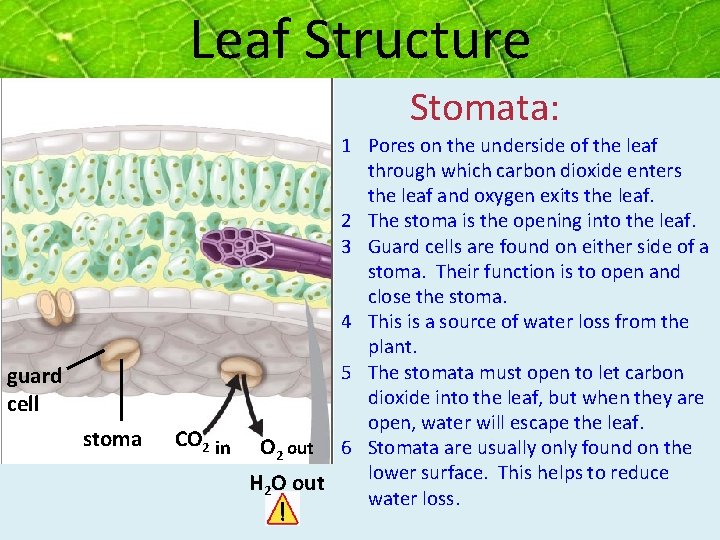
Leaf Structure Stomata: guard cell stoma 1 Pores on the underside of the leaf through which carbon dioxide enters the leaf and oxygen exits the leaf. 2 The stoma is the opening into the leaf. 3 Guard cells are found on either side of a stoma. Their function is to open and close the stoma. 4 This is a source of water loss from the plant. 5 The stomata must open to let carbon dioxide into the leaf, but when they are open, water will escape the leaf. CO 2 in O out 6 Stomata are usually only found on the 2 lower surface. This helps to reduce H 2 O out water loss.
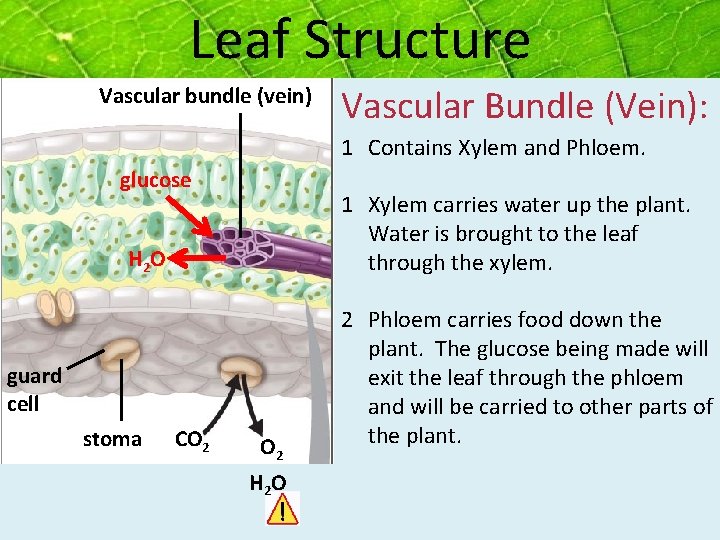
Leaf Structure Vascular bundle (vein) Vascular Bundle (Vein): 1 Contains Xylem and Phloem. glucose 1 Xylem carries water up the plant. Water is brought to the leaf through the xylem. H 2 O guard cell stoma CO 2 H 2 O 2 Phloem carries food down the plant. The glucose being made will exit the leaf through the phloem and will be carried to other parts of the plant.
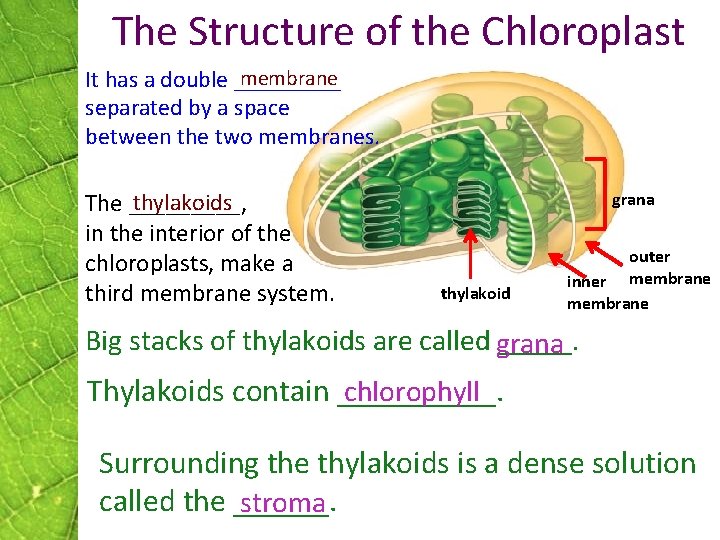
The Structure of the Chloroplast membrane It has a double _____ separated by a space between the two membranes. thylakoids The _____, in the interior of the chloroplasts, make a third membrane system. grana thylakoid outer inner membrane Big stacks of thylakoids are called _____. grana Thylakoids contain _____. chlorophyll Surrounding the thylakoids is a dense solution called the ______. stroma
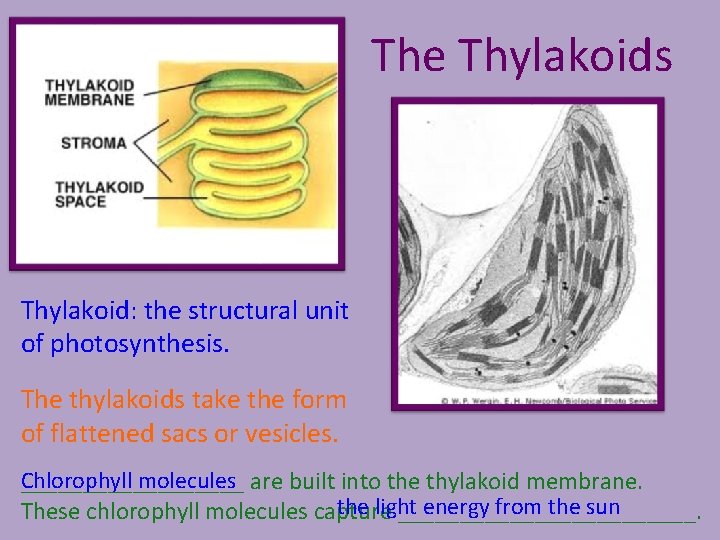
The Thylakoids Thylakoid: the structural unit of photosynthesis. The thylakoids take the form of flattened sacs or vesicles. Chlorophyll molecules _________ are built into the thylakoid membrane. the light energy from the sun These chlorophyll molecules capture ____________.
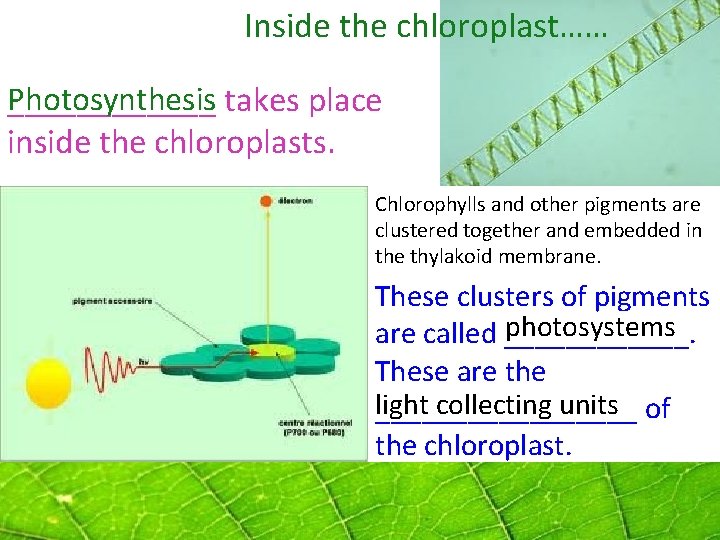
Inside the chloroplast…… Photosynthesis ______ takes place inside the chloroplasts. Chlorophylls and other pigments are clustered together and embedded in the thylakoid membrane. These clusters of pigments photosystems are called ______. These are the light collecting units _________ of the chloroplast.
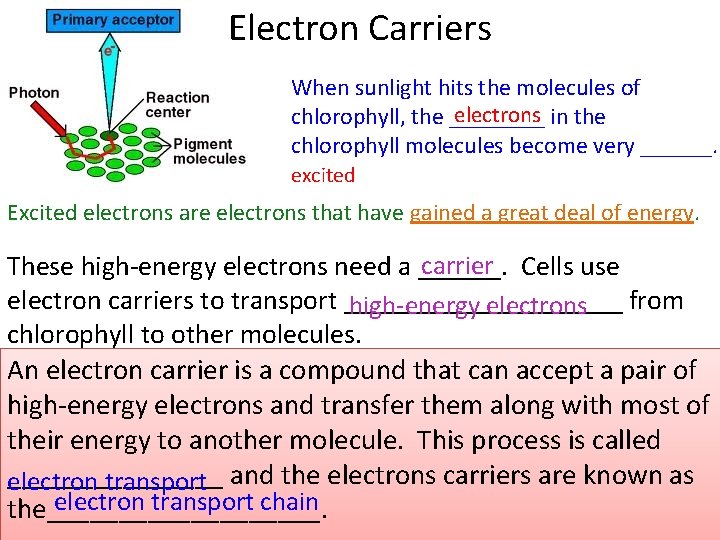
Electron Carriers When sunlight hits the molecules of electrons chlorophyll, the ____ in the chlorophyll molecules become very ______. excited Excited electrons are electrons that have gained a great deal of energy. carrier These high-energy electrons need a ______. Cells use electron carriers to transport __________ from high-energy electrons chlorophyll to other molecules. An electron carrier is a compound that can accept a pair of high-energy electrons and transfer them along with most of their energy to another molecule. This process is called ________ and the electrons carriers are known as electron transport chain the__________.
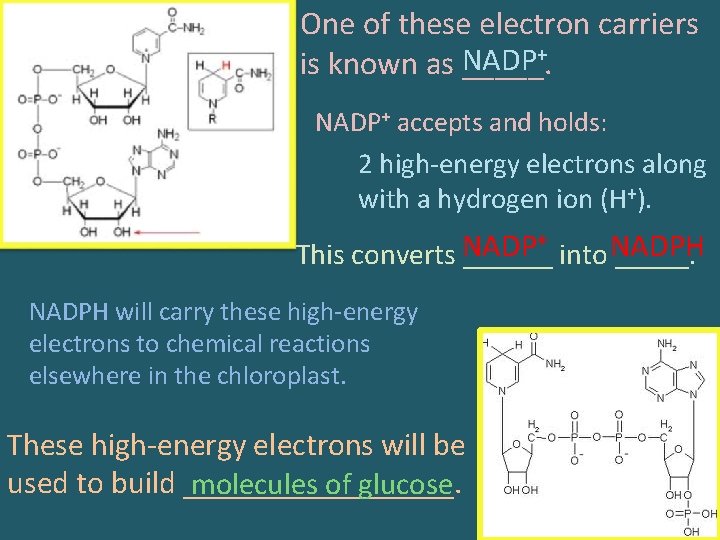
One of these electron carriers NADP+ is known as _____. NADP+ accepts and holds: 2 high-energy electrons along with a hydrogen ion (H+). + NADPH This converts ______ into _____. NADPH will carry these high-energy electrons to chemical reactions elsewhere in the chloroplast. These high-energy electrons will be used to build _________. molecules of glucose
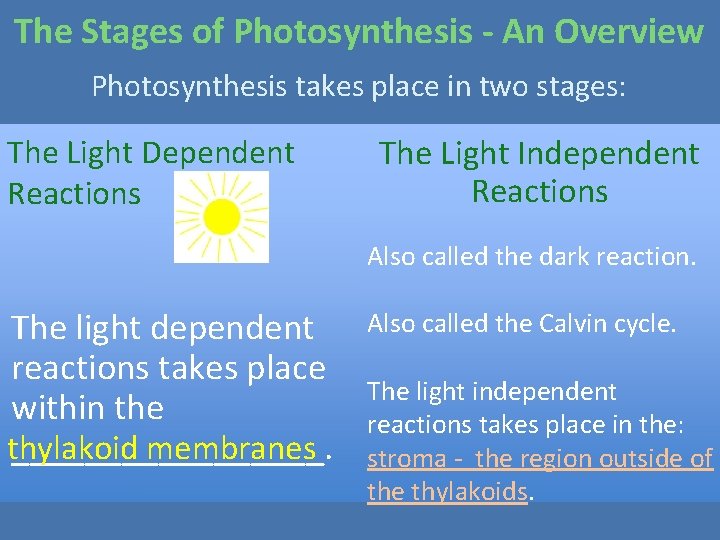
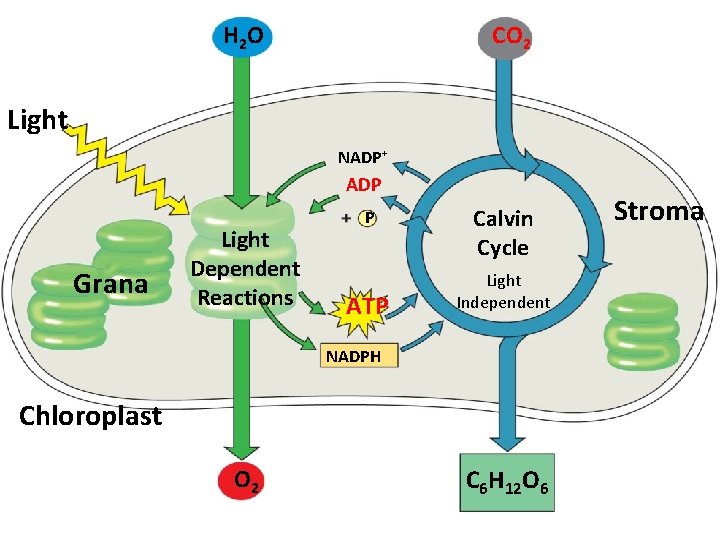
The Stages of Photosynthesis - An Overview Photosynthesis takes place in two stages: The Light Dependent Reactions The Light Independent Reactions Also called the dark reaction. The light dependent reactions takes place within the _________. thylakoid membranes Also called the Calvin cycle. The light independent reactions takes place in the: stroma - the region outside of the thylakoids.
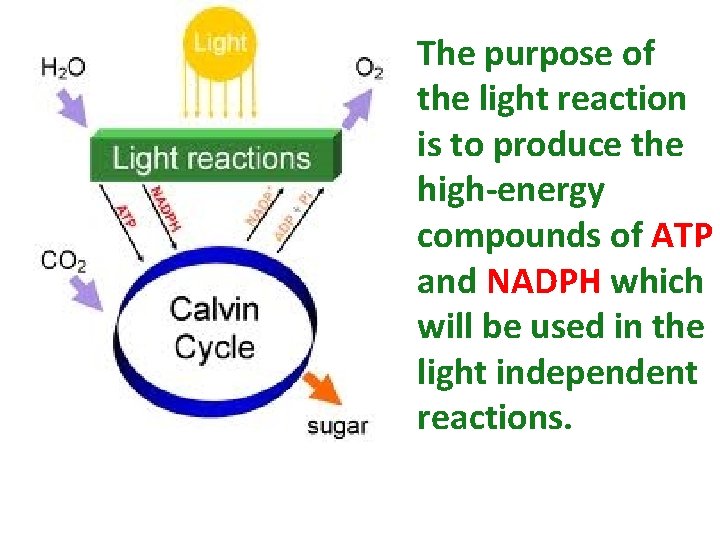
H 2 O CO 2 Light NADP+ ADP Grana Light Dependent Reactions P ATP Calvin Cycle Light Independent NADPH Chloroplast O 2 C 6 H 12 O 6 Stroma
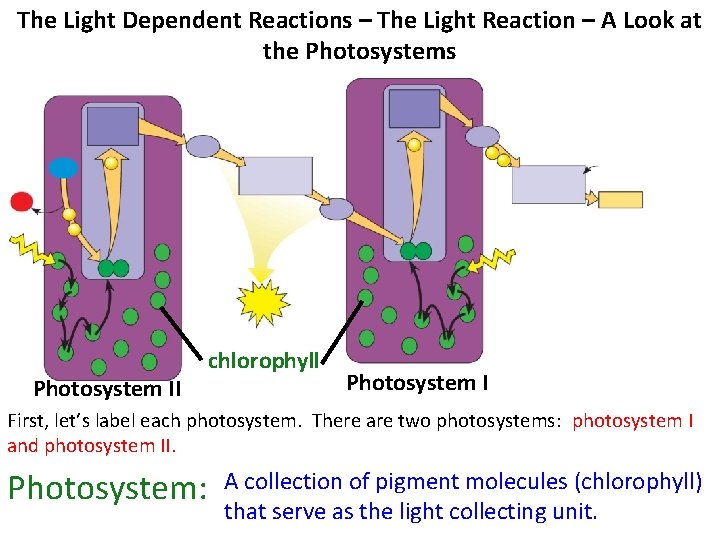
The Light Dependent Reactions – The Light Reaction – A Look at the Photosystems Photosystem II chlorophyll Photosystem I First, let’s label each photosystem. There are two photosystems: photosystem I and photosystem II. Photosystem: A collection of pigment molecules (chlorophyll) that serve as the light collecting unit.
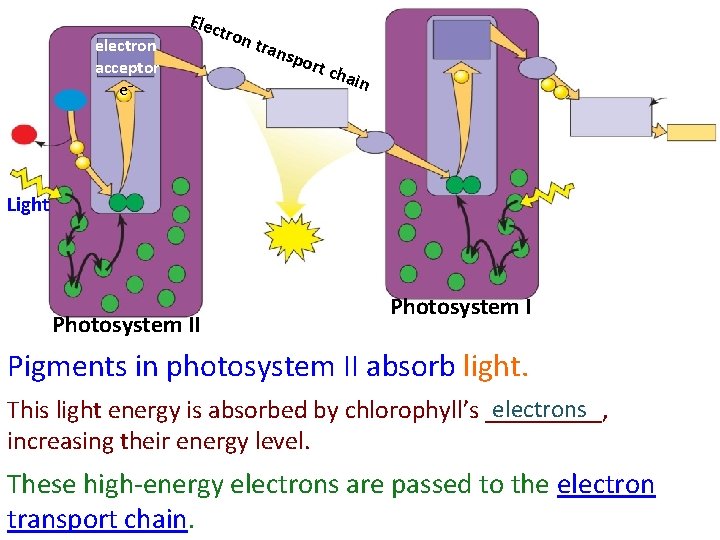
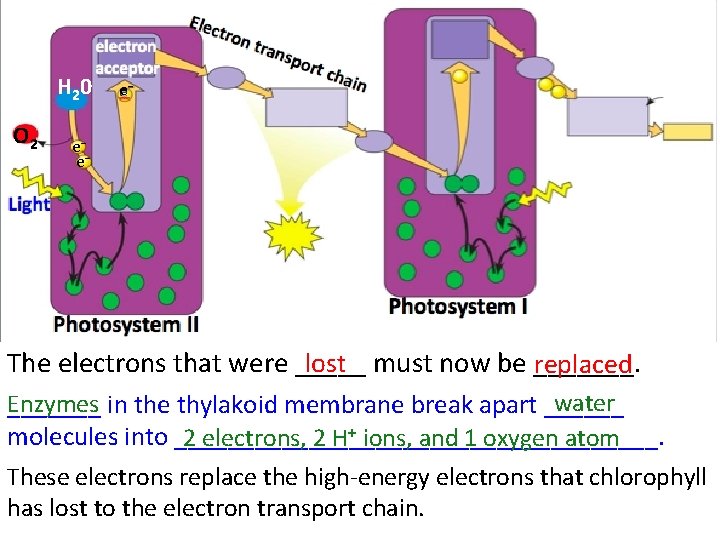
electron acceptor e− Elec tron tran spo rt chai n Light Photosystem II Photosystem I Pigments in photosystem II absorb light. electrons This light energy is absorbed by chlorophyll’s _____, increasing their energy level. These high-energy electrons are passed to the electron transport chain.
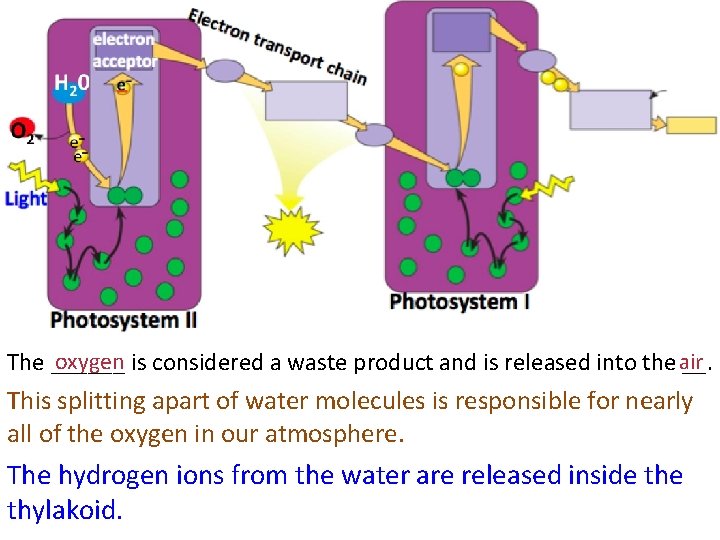
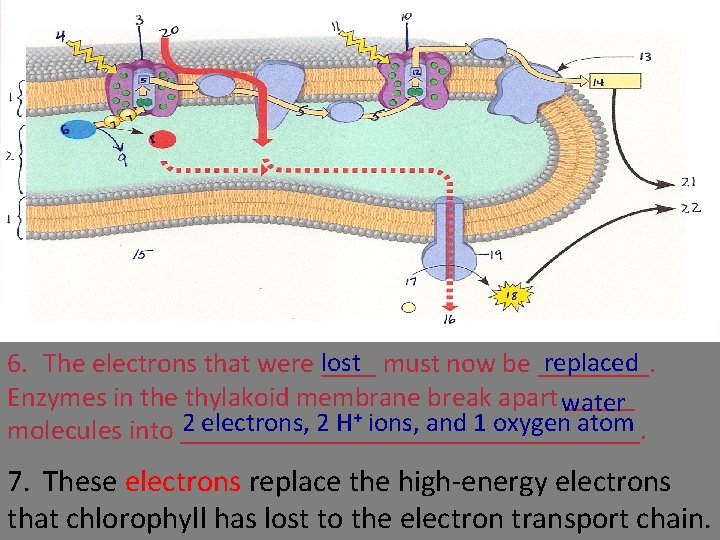
H 20 O 2 e− e− e− lost The electrons that were _____ must now be _______. replaced water Enzymes _______ in the thylakoid membrane break apart ______ molecules into __________________. 2 electrons, 2 H+ ions, and 1 oxygen atom These electrons replace the high-energy electrons that chlorophyll has lost to the electron transport chain.
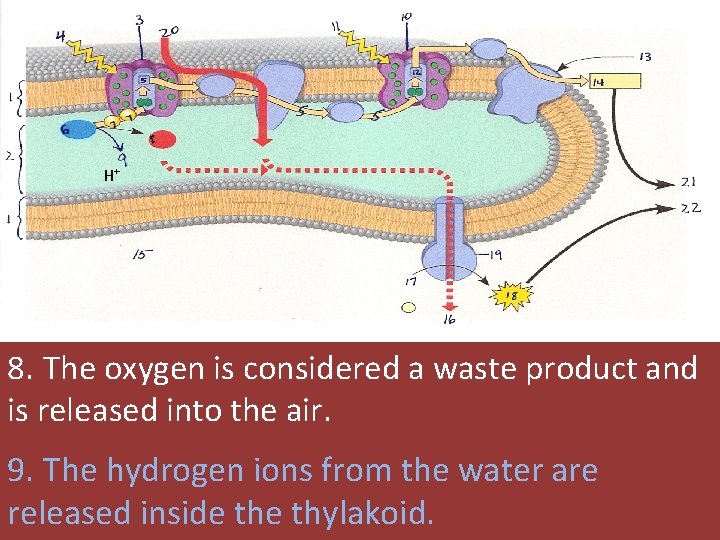
oxygen air The ______ is considered a waste product and is released into the __. This splitting apart of water molecules is responsible for nearly all of the oxygen in our atmosphere. The hydrogen ions from the water are released inside thylakoid.
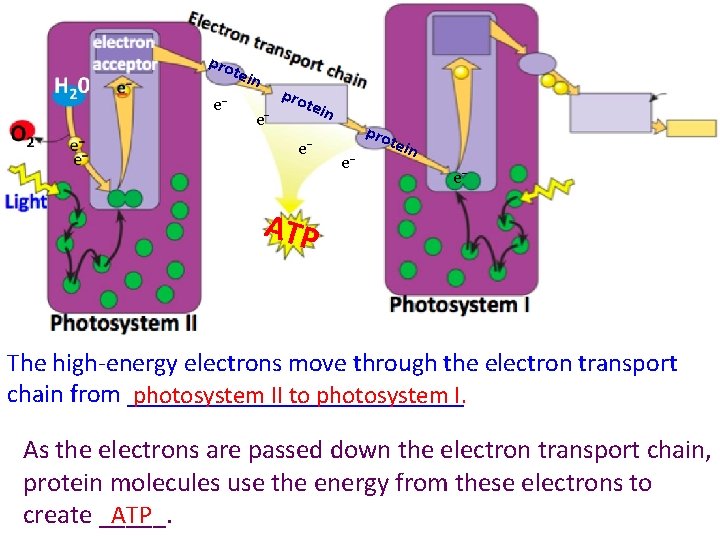
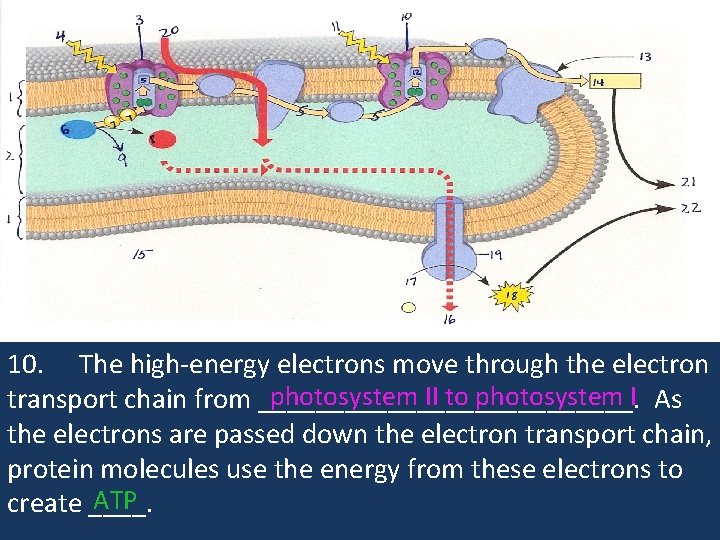
pro tein e− e− pro tein e− pro e− tein e− ATP The high-energy electrons move through the electron transport chain from _____________ photosystem II to photosystem I. As the electrons are passed down the electron transport chain, protein molecules use the energy from these electrons to ATP create _____.
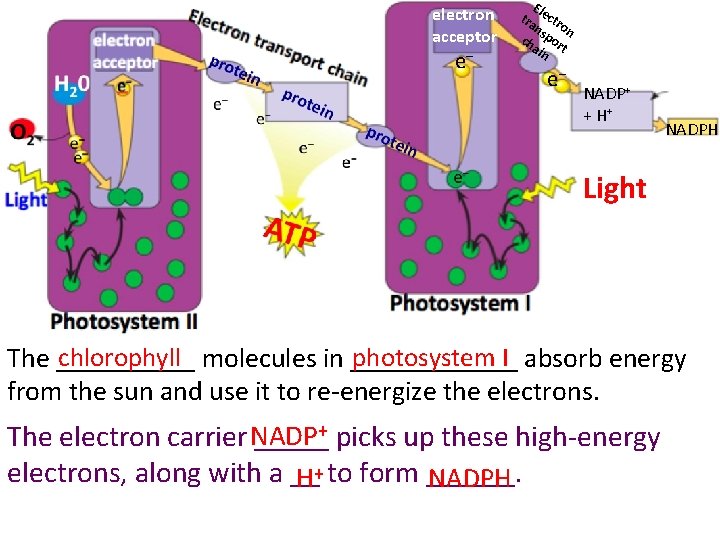
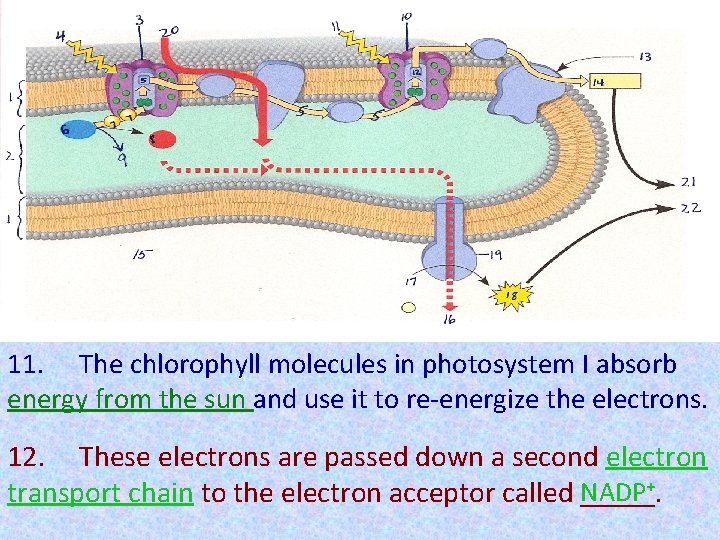
electron acceptor e− El tra ectr ns on ch por ain t e− NADP+ + H+ NADPH Light chlorophyll photosystem I The _____ molecules in ______ absorb energy from the sun and use it to re-energize the electrons. NADP+ The electron carrier _____ picks up these high-energy electrons, along with a __ to form ______. NADPH H+
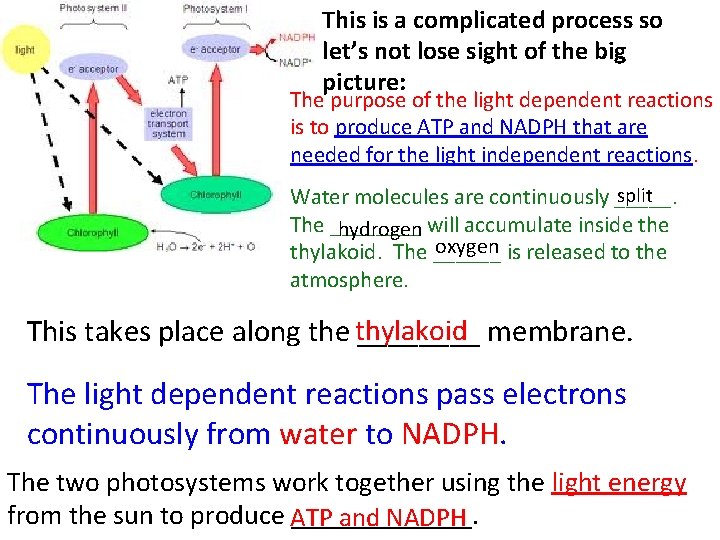
This is a complicated process so let’s not lose sight of the big picture: The purpose of the light dependent reactions is to produce ATP and NADPH that are needed for the light independent reactions. split Water molecules are continuously _____. The ____ will accumulate inside the hydrogen oxygen thylakoid. The ______ is released to the atmosphere. thylakoid This takes place along the ____ membrane. The light dependent reactions pass electrons continuously from water to NADPH. The two photosystems work together using the light energy from the sun to produce _______. ATP and NADPH
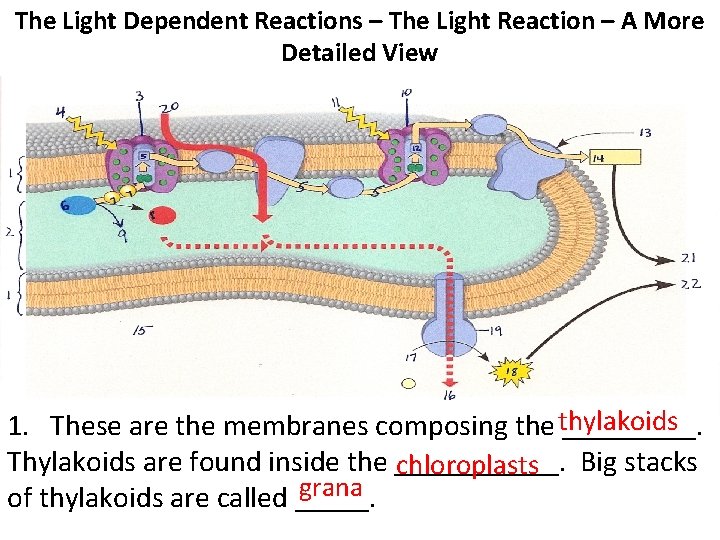
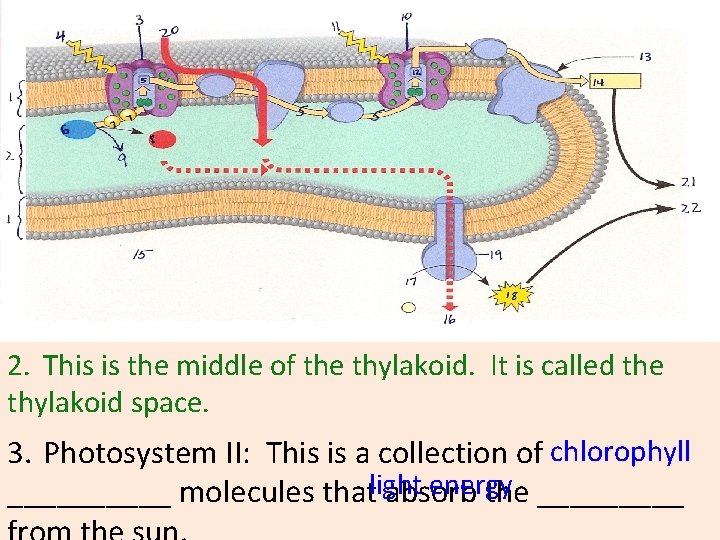
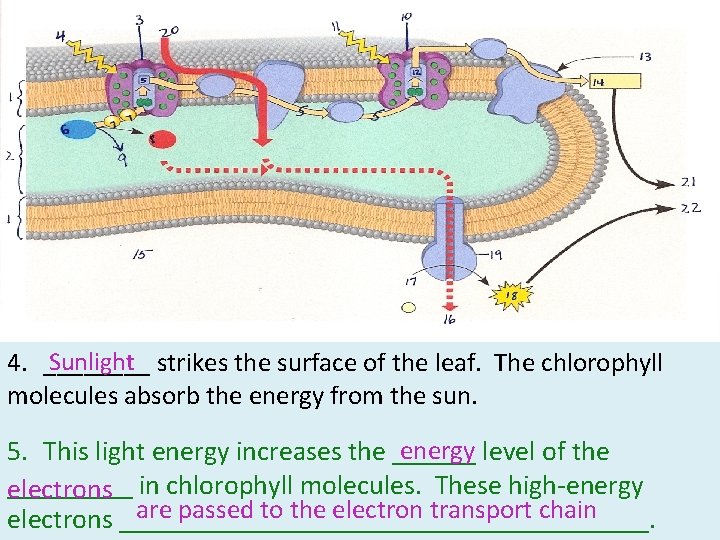
The Light Dependent Reactions – The Light Reaction – A More Detailed View thylakoids 1. These are the membranes composing the _____. Thylakoids are found inside the ______. Big stacks chloroplasts grana of thylakoids are called _____.
2. This is the middle of the thylakoid. It is called the thylakoid space. 3. Photosystem II: This is a collection of chlorophyll light energy _____ molecules that absorb the _____
Sunlight 4. ____ strikes the surface of the leaf. The chlorophyll molecules absorb the energy from the sun. energy 5. This light energy increases the ______ level of the _____ in chlorophyll molecules. These high-energy electrons are passed to the electron transport chain electrons ___________________.
lost replaced 6. The electrons that were ____ must now be ____. Enzymes in the thylakoid membrane break apart _____ water + 2 electrons, 2 H ions, and 1 oxygen atom molecules into _________________. 7. These electrons replace the high-energy electrons that chlorophyll has lost to the electron transport chain.
H+ 8. The oxygen is considered a waste product and is released into the air. 9. The hydrogen ions from the water are released inside thylakoid.
10. The high-energy electrons move through the electron photosystem II to photosystem I transport chain from _____________. As the electrons are passed down the electron transport chain, protein molecules use the energy from these electrons to ATP create ____.
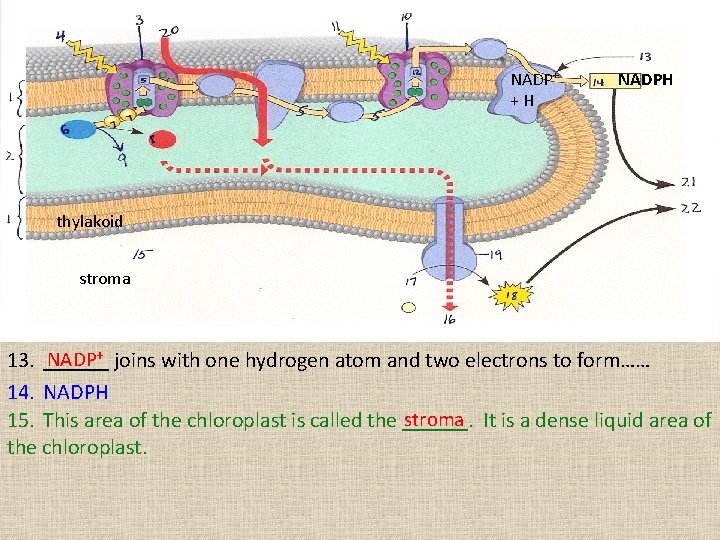
11. The chlorophyll molecules in photosystem I absorb energy from the sun and use it to re-energize the electrons. 12. These electrons are passed down a second electron NADP+ transport chain to the electron acceptor called _____.
NADP+ + H NADPH thylakoid stroma NADP+ 13. ______ joins with one hydrogen atom and two electrons to form…… 14. NADPH stroma 15. This area of the chloroplast is called the ______. It is a dense liquid area of the chloroplast.
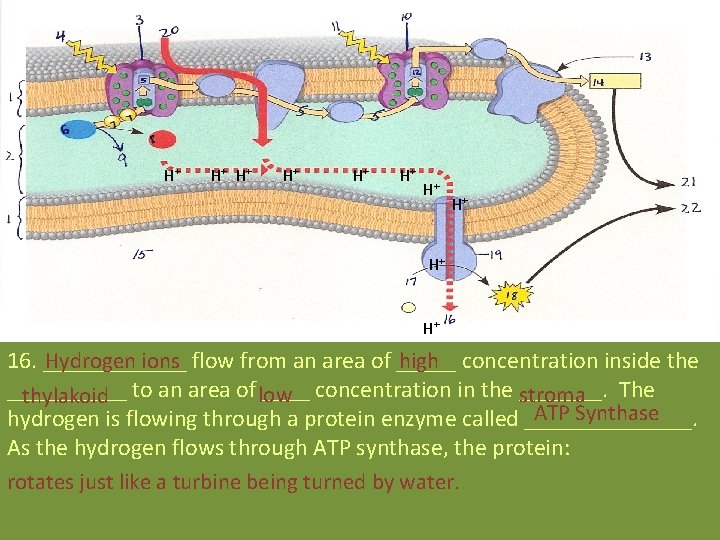
H+ H+ H+ Hydrogen ions high 16. ______ flow from an area of _____ concentration inside the _____ to an area of ____ concentration in the _______. The low stroma thylakoid ATP Synthase hydrogen is flowing through a protein enzyme called _______. As the hydrogen flows through ATP synthase, the protein: rotates just like a turbine being turned by water.
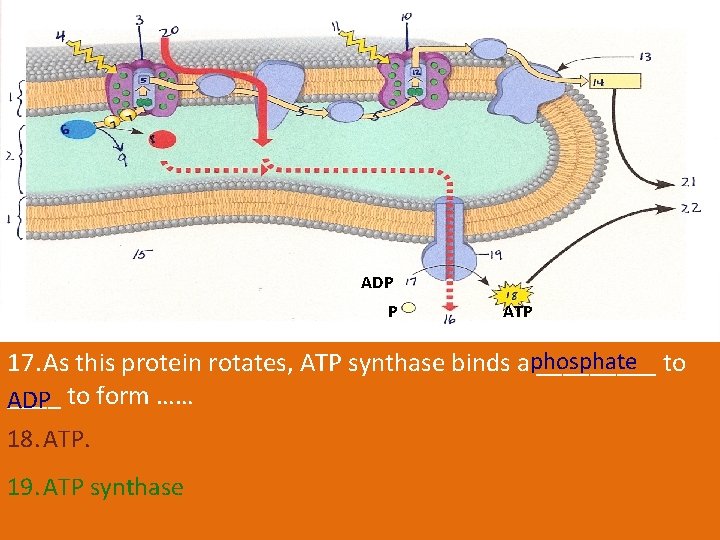
ADP P ATP phosphate 17. As this protein rotates, ATP synthase binds a _____ to form …… ADP 18. ATP. 19. ATP synthase
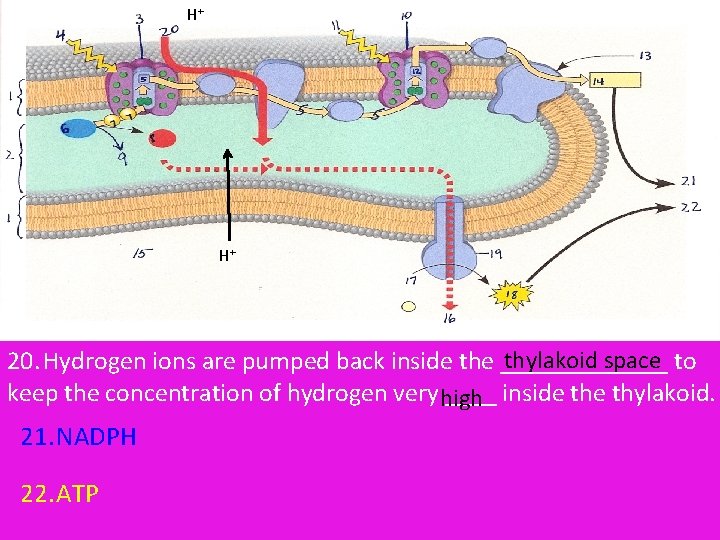
H+ H+ thylakoid space 20. Hydrogen ions are pumped back inside the _______ to keep the concentration of hydrogen very ____ inside thylakoid. high 21. NADPH 22. ATP
The purpose of the light reaction is to produce the high-energy compounds of ATP and NADPH which will be used in the light independent reactions.
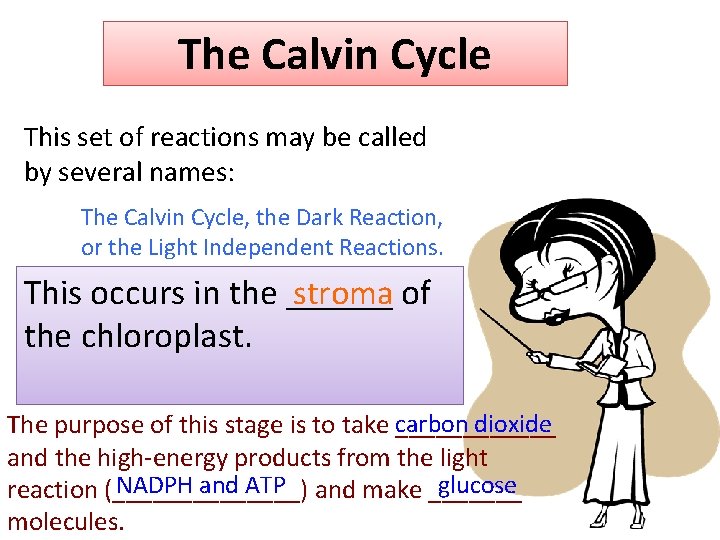
The Calvin Cycle This set of reactions may be called by several names: The Calvin Cycle, the Dark Reaction, or the Light Independent Reactions. This occurs in the ______ of stroma the chloroplast. carbon dioxide The purpose of this stage is to take ______ and the high-energy products from the light NADPH and ATP glucose reaction (_______) and make _______ molecules.
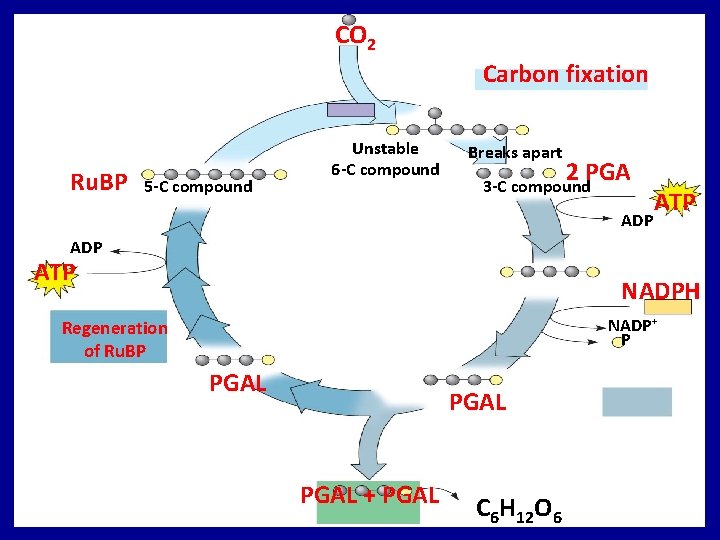
CO 2 Carbon fixation Ru. BP 5 -C compound Unstable 6 -C compound Breaks apart 2 PGA 3 -C compound ADP ATP NADPH NADP+ P Regeneration of Ru. BP PGAL + PGAL C 6 H 12 O 6
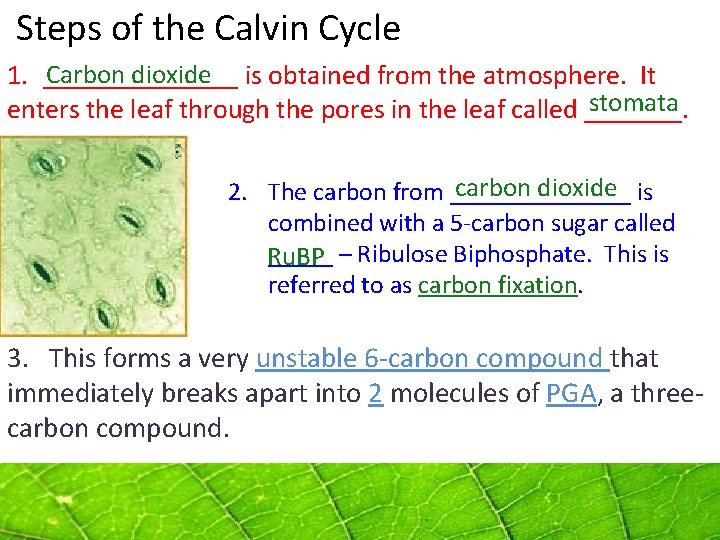
Steps of the Calvin Cycle Carbon dioxide 1. _______ is obtained from the atmosphere. It stomata enters the leaf through the pores in the leaf called _______. carbon dioxide 2. The carbon from _______ is combined with a 5 -carbon sugar called _____ – Ribulose Biphosphate. This is Ru. BP referred to as carbon fixation. 3. This forms a very unstable 6 -carbon compound that immediately breaks apart into 2 molecules of PGA, a threecarbon compound.
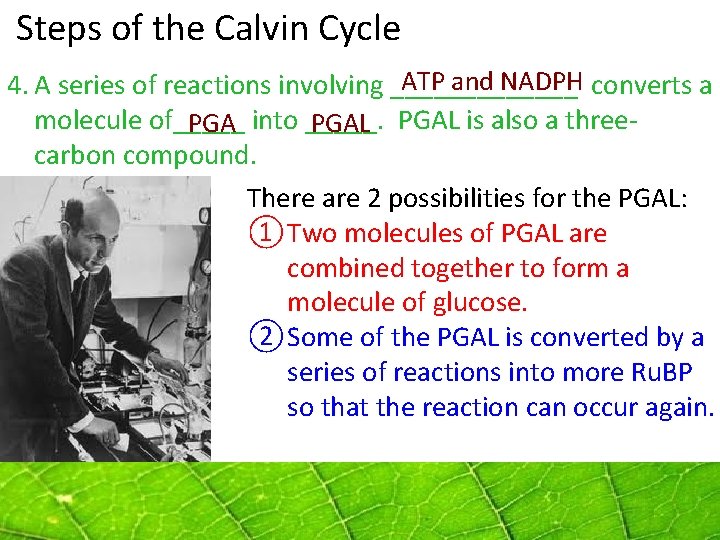
Steps of the Calvin Cycle ATP and NADPH 4. A series of reactions involving _______ converts a molecule of_____ into _____. PGAL is also a three. PGAL carbon compound. There are 2 possibilities for the PGAL: ① Two molecules of PGAL are combined together to form a molecule of glucose. ② Some of the PGAL is converted by a series of reactions into more Ru. BP so that the reaction can occur again.
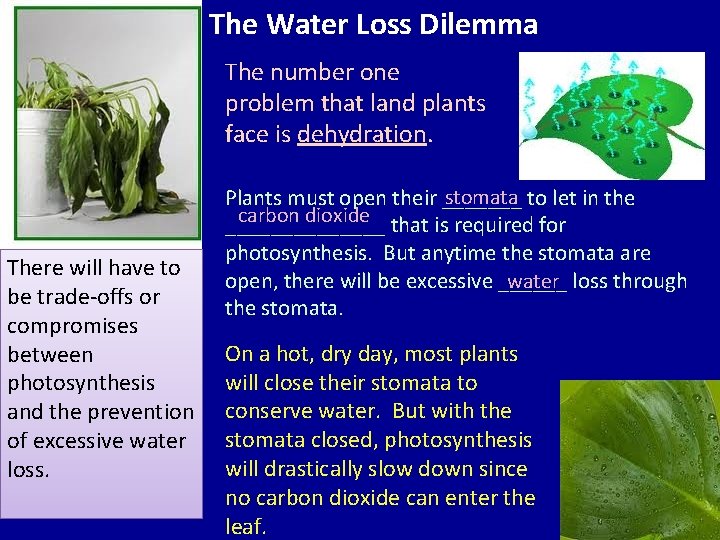
The Water Loss Dilemma The number one problem that land plants face is dehydration. There will have to be trade-offs or compromises between photosynthesis and the prevention of excessive water loss. stomata Plants must open their _______ to let in the carbon dioxide _______ that is required for photosynthesis. But anytime the stomata are open, there will be excessive ______ loss through water the stomata. On a hot, dry day, most plants will close their stomata to conserve water. But with the stomata closed, photosynthesis will drastically slow down since no carbon dioxide can enter the leaf.
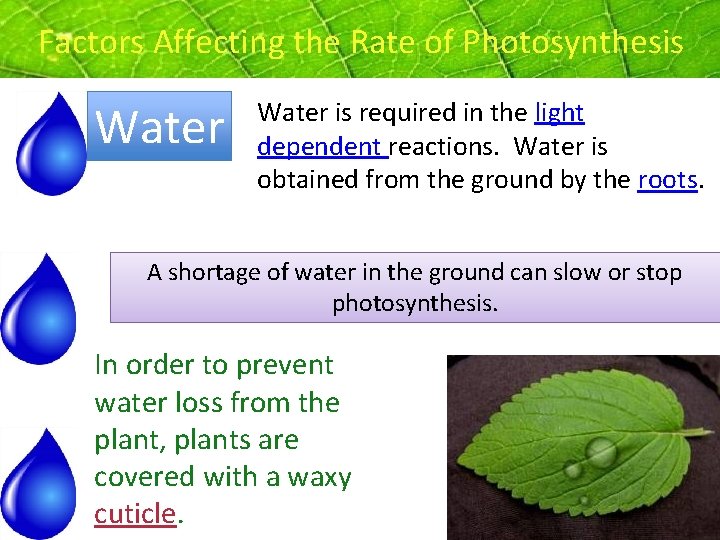
Factors Affecting the Rate of Photosynthesis Water is required in the light dependent reactions. Water is obtained from the ground by the roots. A shortage of water in the ground can slow or stop photosynthesis. In order to prevent water loss from the plant, plants are covered with a waxy cuticle.
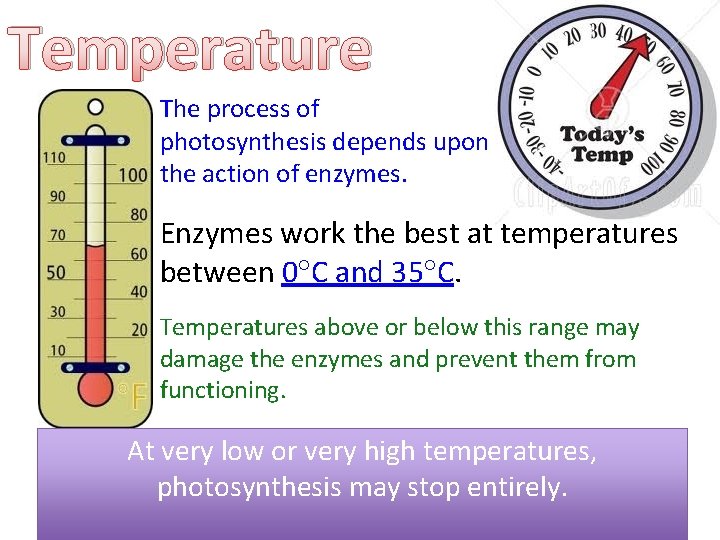
Temperature The process of photosynthesis depends upon the action of enzymes. Enzymes work the best at temperatures between 0 C and 35 C. Temperatures above or below this range may damage the enzymes and prevent them from functioning. At very low or very high temperatures, photosynthesis may stop entirely.
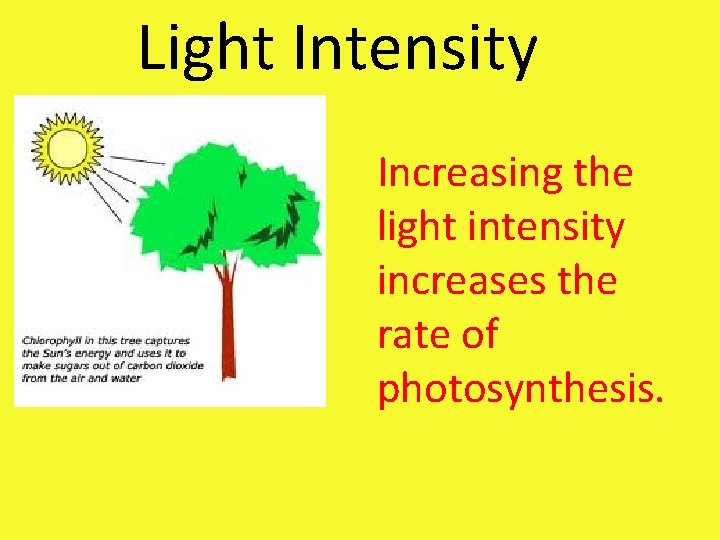
Light Intensity Increasing the light intensity increases the rate of photosynthesis.
To Sum It All Up: The energy from the sun has been stored as chemical energy in glucose.