
How Did Life Begin on Earth Is the
How Did Life Begin on Earth ? Ø Is the existence of life on Earth a lucky fluke or an inevitable consequence of the laws of nature? Ø Is it simple for life to emerge on a newly formed planet, or is it the virtually impossible product of a long series of unlikely events? Ø Earth is estimated to be about 4. 5 billion years old. But living beings seemingly didn't appear until 3. 7 billion years ago. 1
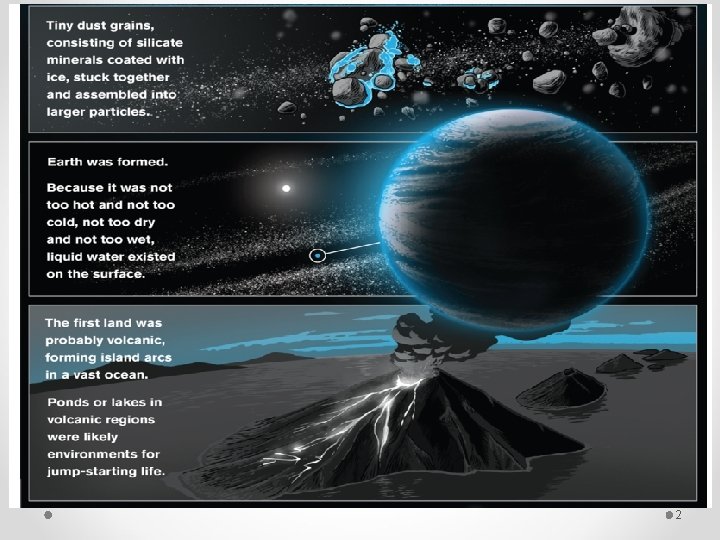
2
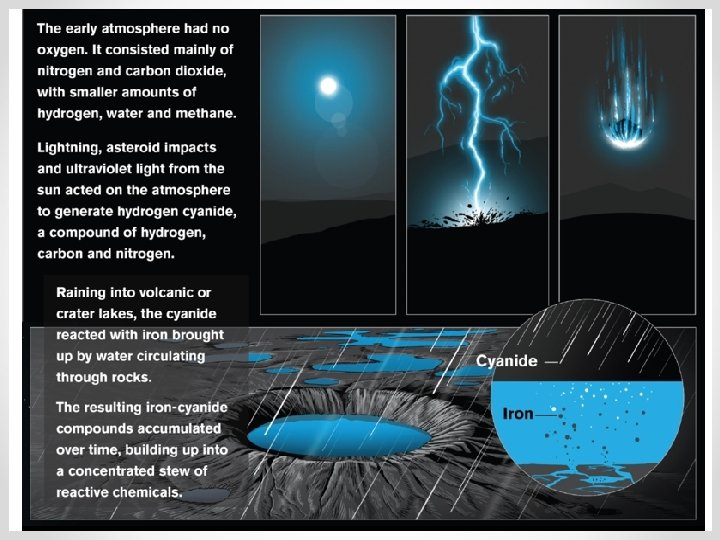
3
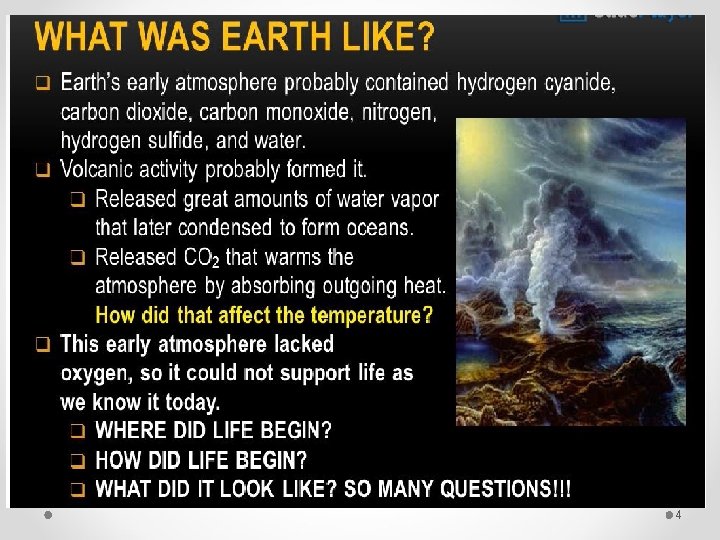
4

LIFE TIME SCALE ON THE EARTH MILLION EMERGENT CREATURES YEAR BEFORE 4000 The origin of life. Sulfur bacteria. 3900 Primitive photosynthesis. Cyanobacteria (or blue-green algae). 3860 The oldest rocks in Greenland. On the coast of ısında Isua “. 3500 Photosynthetic bacteria. Formation of biogenic carbon. Bacteria in North Pole, Australia. 3200 Cyanobacteria (blue-green algae) in Fig Tree, Swaziland. 2500 Bare (meta) bacteria. 2400 Lake Superior, Cyanobacteria in Gunflint (blue-green algae). 2100 The eubacteria. Inner cells. 5

LIFE TIME SCALE ON THE EARTH MILLION YEAR BEFORE 1800 1700 1600 1500 1300 1000 670 EMERGENT CREATURES Free oxygen gas. Purple bacteria. Mushrooms. Contemporary cell formations. Cyanobacteria (blue-green algae). Proto (first) plants. Plants. Seaweeds. The appearance of sexuality. Nucleated green algae in Australia. Animals. 6
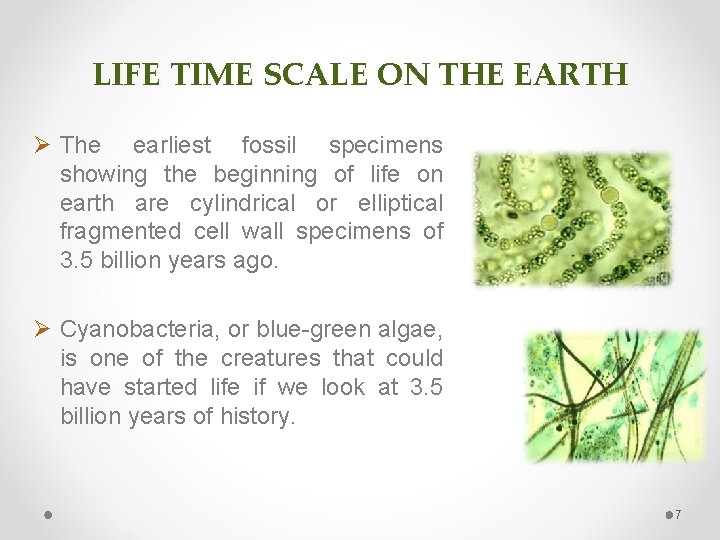
LIFE TIME SCALE ON THE EARTH Ø The earliest fossil specimens showing the beginning of life on earth are cylindrical or elliptical fragmented cell wall specimens of 3. 5 billion years ago. Ø Cyanobacteria, or blue-green algae, is one of the creatures that could have started life if we look at 3. 5 billion years of history. 7
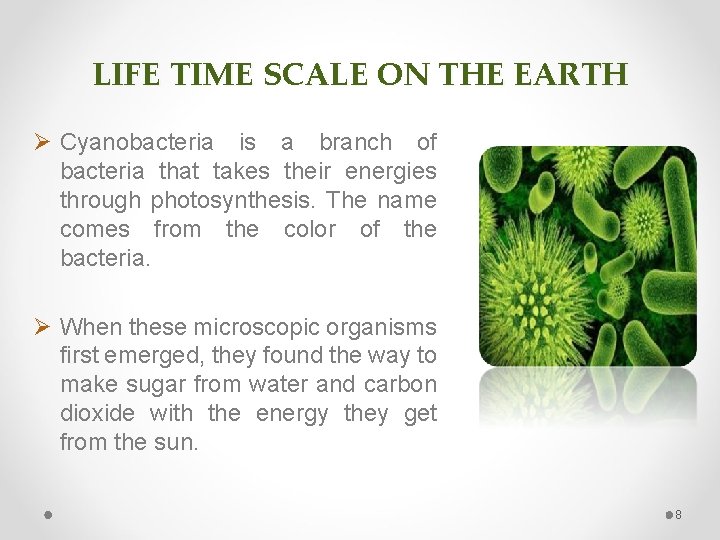
LIFE TIME SCALE ON THE EARTH Ø Cyanobacteria is a branch of bacteria that takes their energies through photosynthesis. The name comes from the color of the bacteria. Ø When these microscopic organisms first emerged, they found the way to make sugar from water and carbon dioxide with the energy they get from the sun. 8
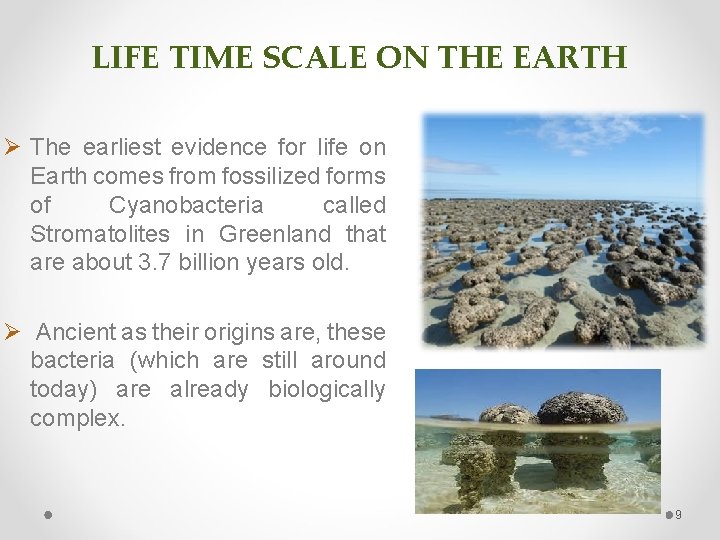
LIFE TIME SCALE ON THE EARTH Ø The earliest evidence for life on Earth comes from fossilized forms of Cyanobacteria called Stromatolites in Greenland that are about 3. 7 billion years old. Ø Ancient as their origins are, these bacteria (which are still around today) are already biologically complex. 9
- Slides: 9