
Threshold 5 LIFE What makes life so special




- Slides: 21
Threshold 5: LIFE What makes life so special? Is there life elsewhere in the Universe? And how exactly did life emerge and diversify? In many ways these remain mysteries, but we do have enough evidence to explore some possible answers. Our exploration will span more than 3. 8 billion years of Earth’s history. Defining life is harder than it seems. What Goldilocks Conditions enabled life to prosper in so many diverse forms?
Video Review: A Big History of Everything
Video: A Big History of Everything 1. Consider the possibility of a new species emerging on Earth. Based on what you learned from the video, do certain things need to happen for new species to evolve? If so, what are those things? 2. The emergence of life on Earth is a truly amazing development in the history of the Universe. • The fact that a chemical reaction in the oceans eventually resulted in something as complex as ourselves is nearly mind -boggling. • It’s no wonder that life is one of Big History’s thresholds of increasing complexity!
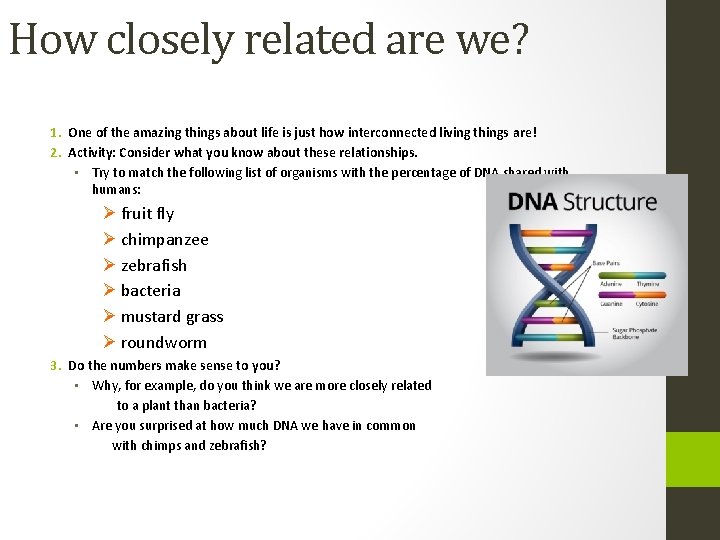
How closely related are we? 1. One of the amazing things about life is just how interconnected living things are! 2. Activity: Consider what you know about these relationships. • Try to match the following list of organisms with the percentage of DNA shared with humans: Ø fruit fly Ø chimpanzee Ø zebrafish Ø bacteria Ø mustard grass Ø roundworm 3. Do the numbers make sense to you? • Why, for example, do you think we are more closely related to a plant than bacteria? • Are you surprised at how much DNA we have in common with chimps and zebrafish?
So, what is LIFE? Scientific Explanation • Self-generation Ø Making of “self” § Human: start out as a single egg, develop from embryo to fetus, then make path from newborn to old age Ø Better known as “reproduction” • Self-maintenance Ø Getting energy and materials to survive! § We eat food, and metabolize it. § Also entail self-protection (avoiding hazards, predators, disease) Ø Our bodies regulate themselves so they can remain stable
So… What’s the difference between life and nonlife? • Activity: Claim Testing “What is life? ”
BUT WHERE DOES LIFE BEGIN? Spontaneous Generation
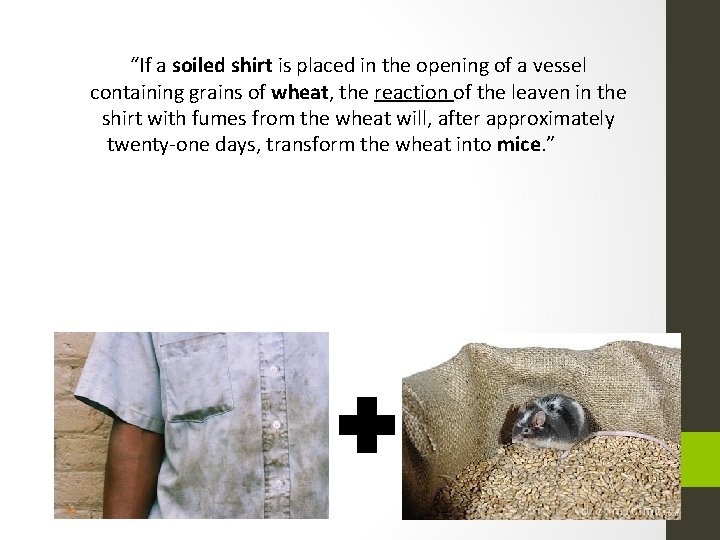
“If a soiled shirt is placed in the opening of a vessel containing grains of wheat, the reaction of the leaven in the shirt with fumes from the wheat will, after approximately twenty-one days, transform the wheat into mice. ”
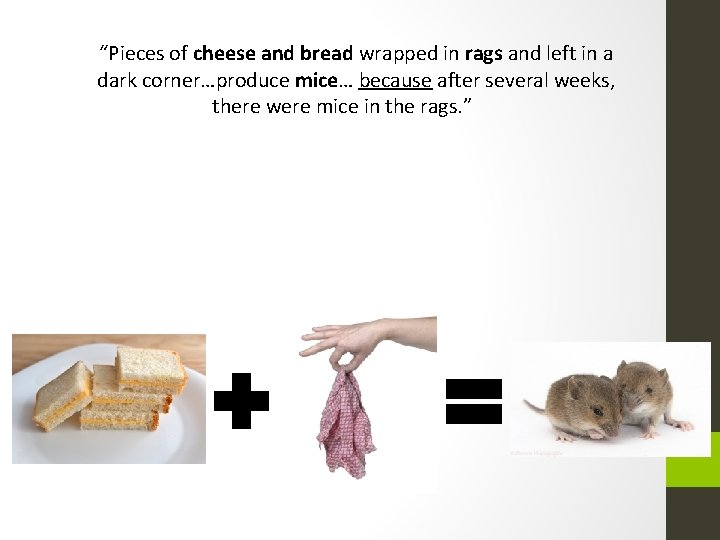
“Pieces of cheese and bread wrapped in rags and left in a dark corner…produce mice… because after several weeks, there were mice in the rags. ”
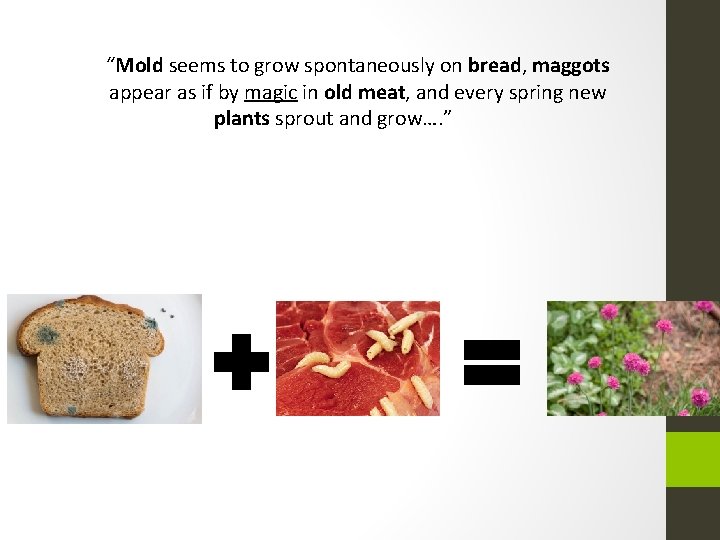
“Mold seems to grow spontaneously on bread, maggots appear as if by magic in old meat, and every spring new plants sprout and grow…. ”
• In our warm up, you looked at the idea that life could spontaneously appear, seemingly from nowhere. • Biologists have disproven the idea of spontaneous generation, but what idea has replaced it to explain the appearance of – and changes in – life?
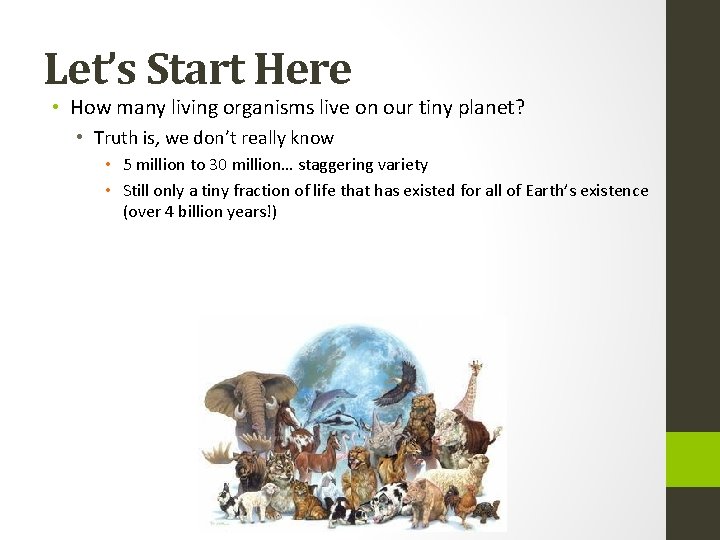
Let’s Start Here • How many living organisms live on our tiny planet? • Truth is, we don’t really know • 5 million to 30 million… staggering variety • Still only a tiny fraction of life that has existed for all of Earth’s existence (over 4 billion years!)
• Yeah… life really IS mysterious! • But we actually know quite a lot about it • characteristics of life • why life changes
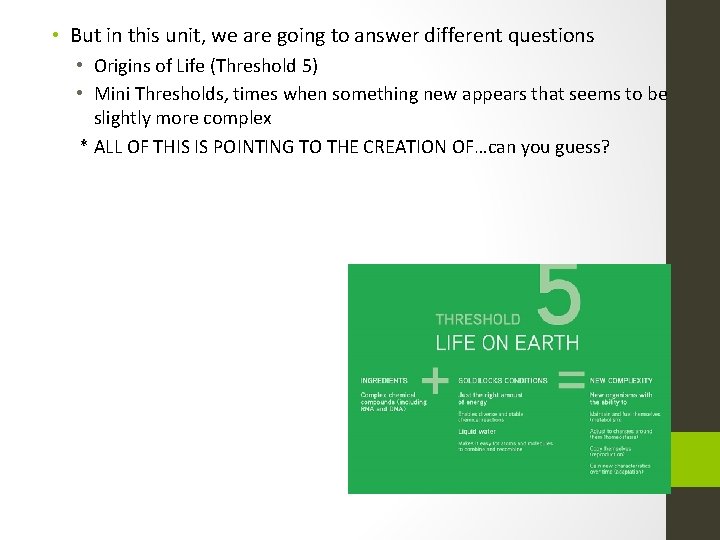
• But in this unit, we are going to answer different questions • Origins of Life (Threshold 5) • Mini Thresholds, times when something new appears that seems to be slightly more complex * ALL OF THIS IS POINTING TO THE CREATION OF…can you guess?
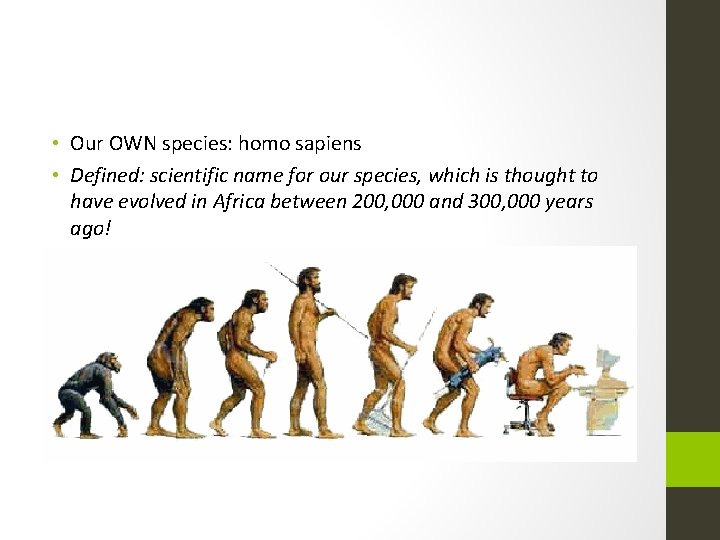
• Our OWN species: homo sapiens • Defined: scientific name for our species, which is thought to have evolved in Africa between 200, 000 and 300, 000 years ago!
Origins of Life: Threshold 5 • Threshold is when there is “increasing complexity” • Something new appears in the universe with new qualities and more complexity • What were the Goldilocks Conditions that made it possible to cross this threshold?
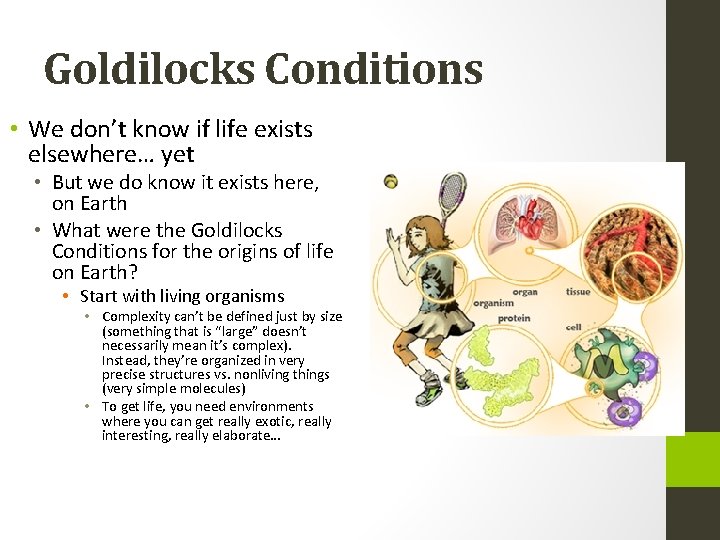
Goldilocks Conditions • We don’t know if life exists elsewhere… yet • But we do know it exists here, on Earth • What were the Goldilocks Conditions for the origins of life on Earth? • Start with living organisms • Complexity can’t be defined just by size (something that is “large” doesn’t necessarily mean it’s complex). Instead, they’re organized in very precise structures vs. nonliving things (very simple molecules) • To get life, you need environments where you can get really exotic, really interesting, really elaborate…
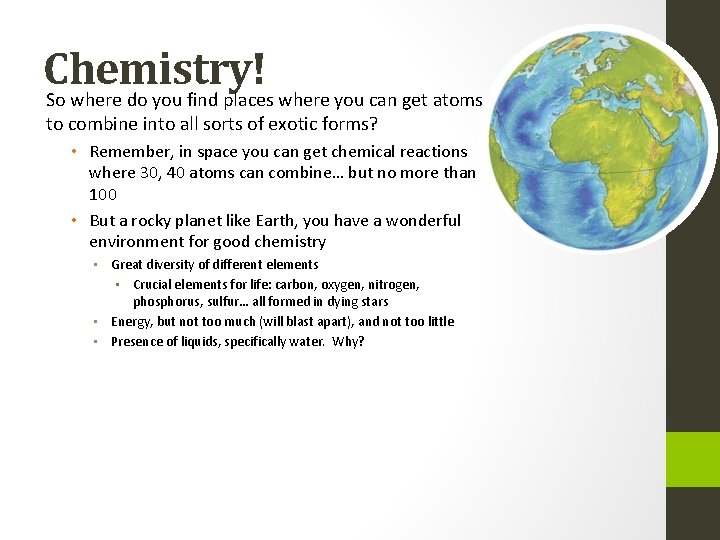
Chemistry! So where do you find places where you can get atoms to combine into all sorts of exotic forms? • Remember, in space you can get chemical reactions where 30, 40 atoms can combine… but no more than 100 • But a rocky planet like Earth, you have a wonderful environment for good chemistry • Great diversity of different elements • Crucial elements for life: carbon, oxygen, nitrogen, phosphorus, sulfur… all formed in dying stars • Energy, but not too much (will blast apart), and not too little • Presence of liquids, specifically water. Why?
• Gas: Gas Atoms are moving around incredibly fast. It’s hard for atoms to link up. • Solids: Solids Atoms are stuck, like in bad traffic. • Liquids: Liquids Just right… They can cruise past each other. It’s much easier for them to hitch up and form more elaborate structures.
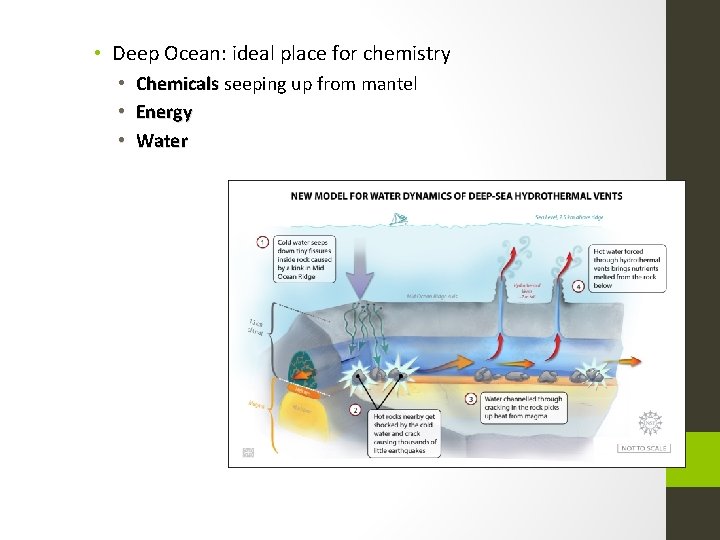
• Deep Ocean: ideal place for chemistry • Chemicals seeping up from mantel • Energy • Water
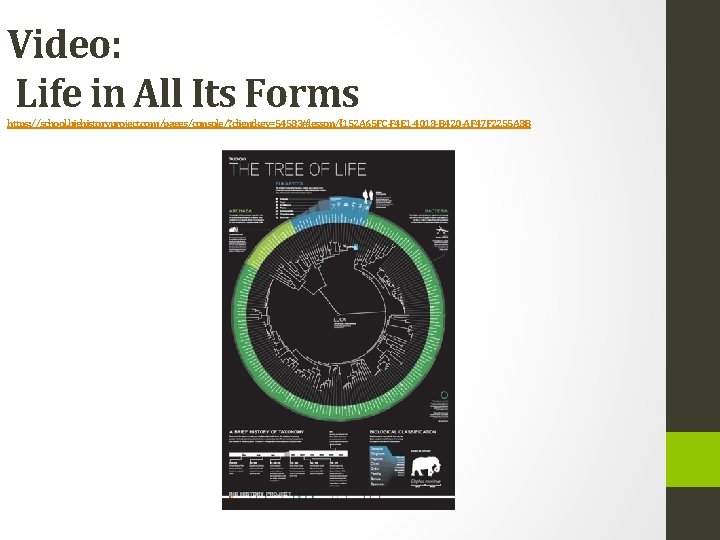
Video: Life in All Its Forms https: //school. bighistoryproject. com/pages/console/? clientkey=54583#lesson/{152 A 65 FC-F 4 E 1 -4018 -B 420 -AF 47 F 2255 A 8 B