Personal Development P 045 Yip sir www yipsir
















- Slides: 60
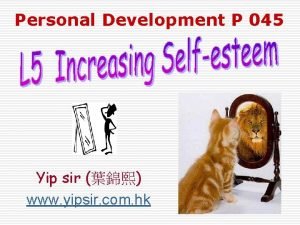
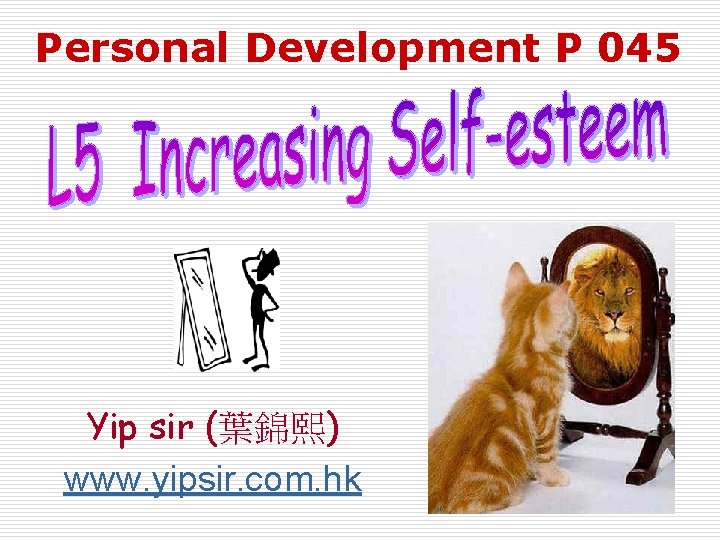
Personal Development P 045 Yip sir (葉錦熙) www. yipsir. com. hk
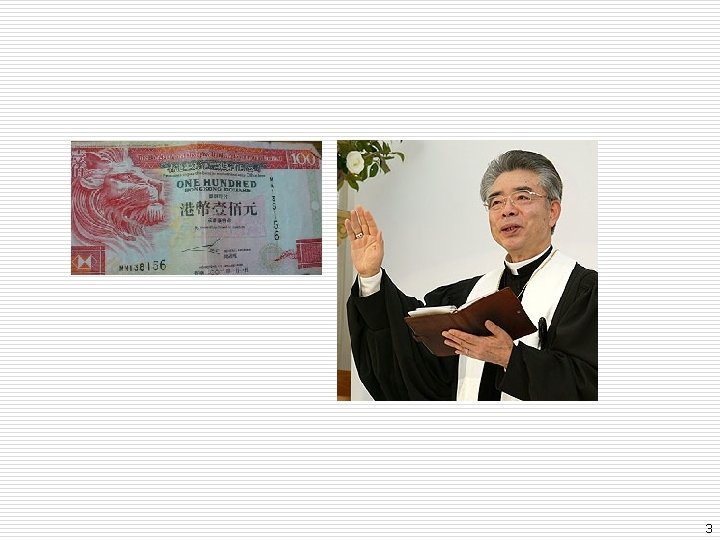
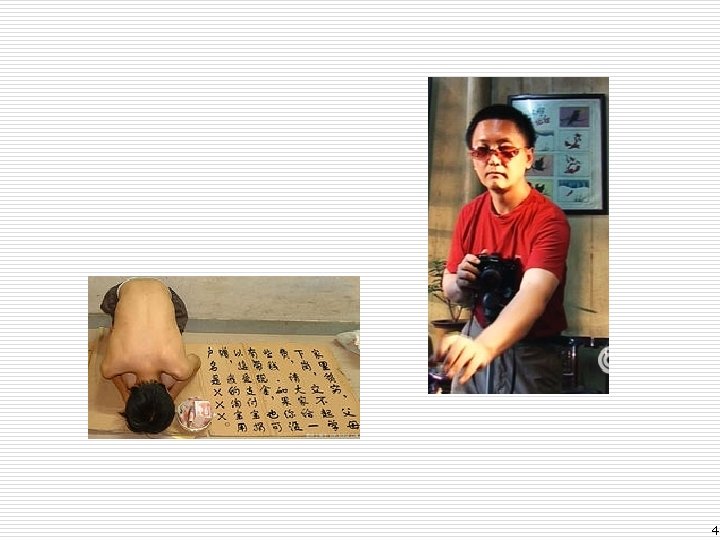
A couple of Self-esteem Stories
3
4
What is self-esteem? ? ? 5
What is Self-esteem 1. The way you feel about yourself 2. How much you like yourself 3. How valuable a person you think you are 4. How competent you think you are 6
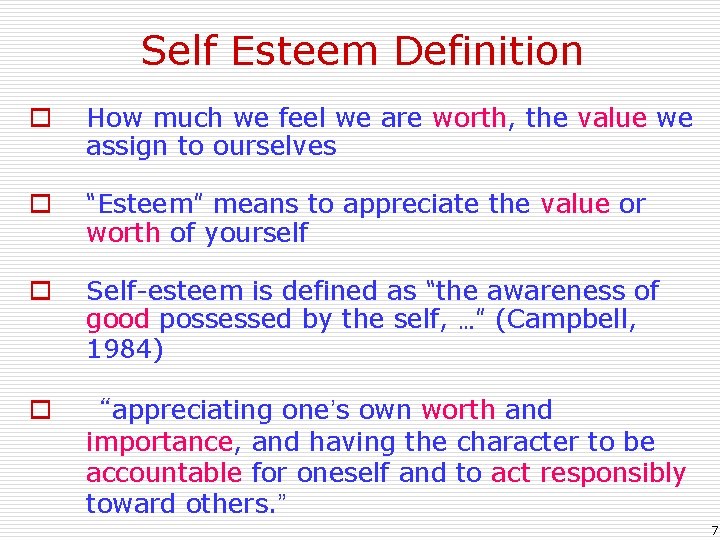
Self Esteem Definition o How much we feel we are worth, the value we assign to ourselves o “Esteem” means to appreciate the value or worth of yourself o Self-esteem is defined as “the awareness of good possessed by the self, …” (Campbell, 1984) o “appreciating one’s own worth and importance, and having the character to be accountable for oneself and to act responsibly toward others. ” 7
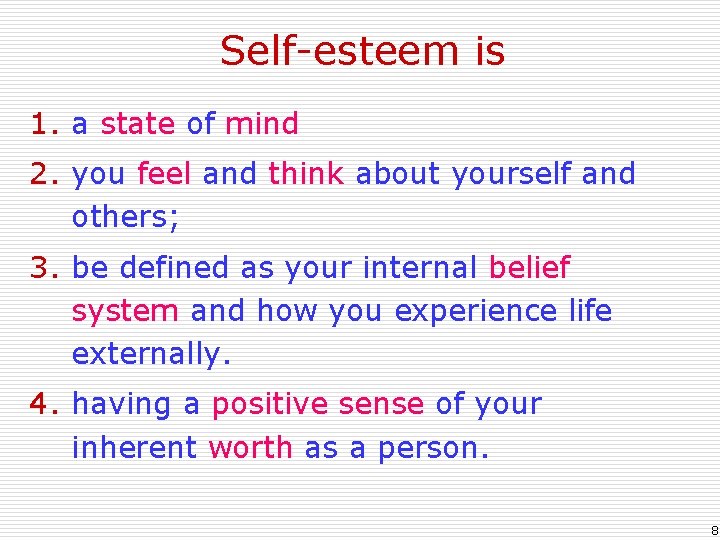
Self-esteem is 1. a state of mind 2. you feel and think about yourself and others; 3. be defined as your internal belief system and how you experience life externally. 4. having a positive sense of your inherent worth as a person. 8
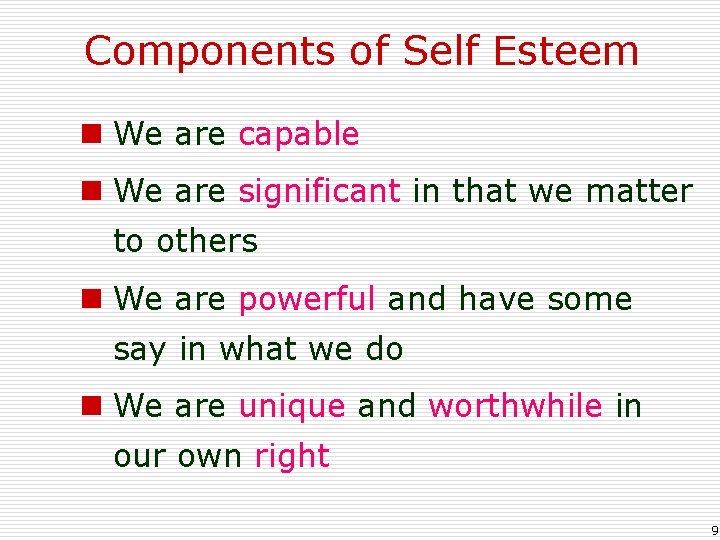
Components of Self Esteem n We are capable n We are significant in that we matter to others n We are powerful and have some say in what we do n We are unique and worthwhile in our own right 9
Activity Personal Evaluation How is your self-esteem high or low self-esteem? W 5 -1(a) 12
Please tick in □ as appropriate: 1. I feel successful in school (D) □ □ □ 2. I feel satisfied with my present school work. (D) □□□□□ 3. I consider myself to be a risk taker. (H) □□□□□ 4. I feel that continuing my education is important. (L) □□□□□ 5. I consciously look for the good in others. (B) □□□□□ …. 13
120 -150 = Very High Self-Esteem 90 -119 = Moderately High Self. Esteem 60 -89 = Average Self-Esteem 31 -55 = Moderately Low Self. Esteem 0 -30 = Low Self-Esteem 14
Differences between High and Low Self-esteems 15
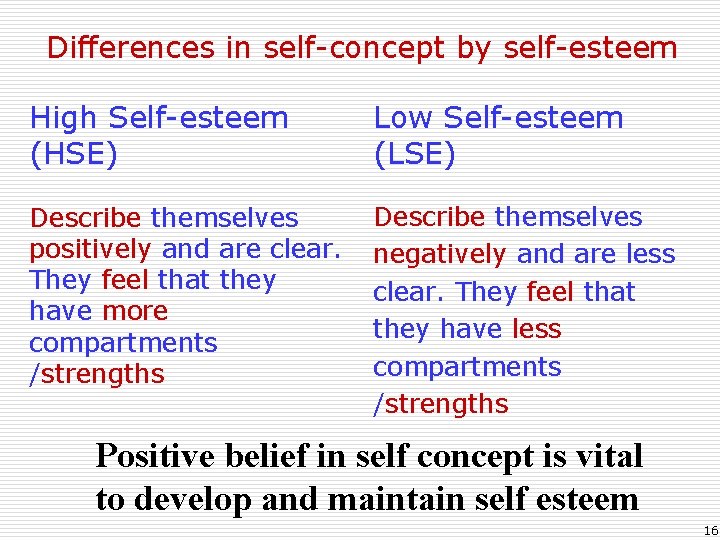
Differences in self-concept by self-esteem High Self-esteem (HSE) Low Self-esteem (LSE) Describe themselves positively and are clear. They feel that they have more compartments /strengths Describe themselves negatively and are less clear. They feel that they have less compartments /strengths Positive belief in self concept is vital to develop and maintain self esteem 16
Approach to Achievement Situations 1. High self-esteem o o o 2. Confident about succeeding in task. Not overly concerned with failing. Look at setting as an opportunity to do well. Low self-esteem o o Considerable uncertainty, Doubt their positive attributes, Expect negative attributes. Concerned about failing, may even prepare for failure. 17
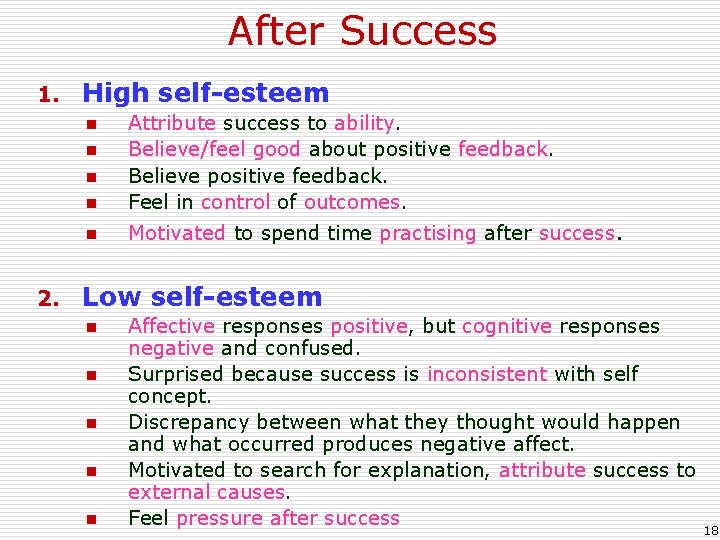
After Success 1. High self-esteem n Attribute success to ability. Believe/feel good about positive feedback. Believe positive feedback. Feel in control of outcomes. n Motivated to spend time practising after success. n n n 2. Low self-esteem n n n Affective responses positive, but cognitive responses negative and confused. Surprised because success is inconsistent with self concept. Discrepancy between what they thought would happen and what occurred produces negative affect. Motivated to search for explanation, attribute success to external causes. Feel pressure after success 18
After Failure 1. High self-esteem n n Surprised because doesn’t fit into their self perception. Work harder to get success next time. 2. Low self-esteem n n n Not surprised, because consistent with their past experiences. Decrease motivation because they feel they will fail again. Withdraw from tasks. 19
Theory of Self-Esteem Carl Rogers 20
Being Achievement Recognition Carl Rogers’ Theory of Self-esteem 21
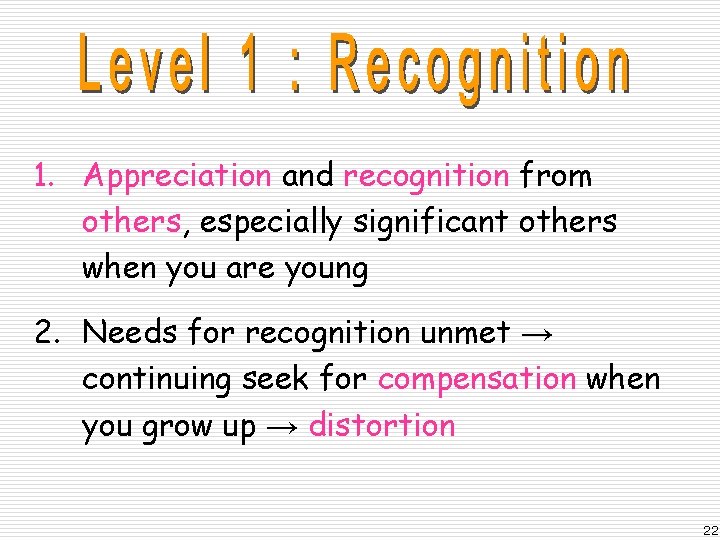
1. Appreciation and recognition from others, especially significant others when you are young 2. Needs for recognition unmet → continuing seek for compensation when you grow up → distortion 22
Entering an independent stage → grounding on achievement 23
1. Appreciate the inner worth of an individual 2. Positive sense of existence 3. Ability to savor life 24
Esteem Builders Borba, Michele (1989) 25
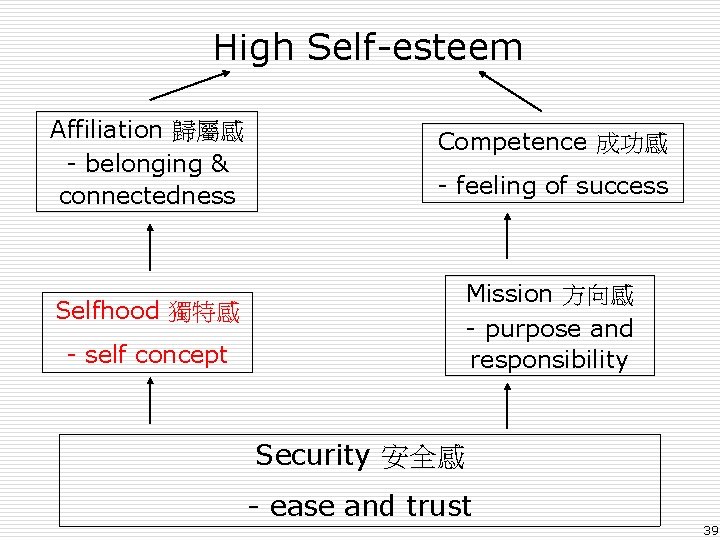
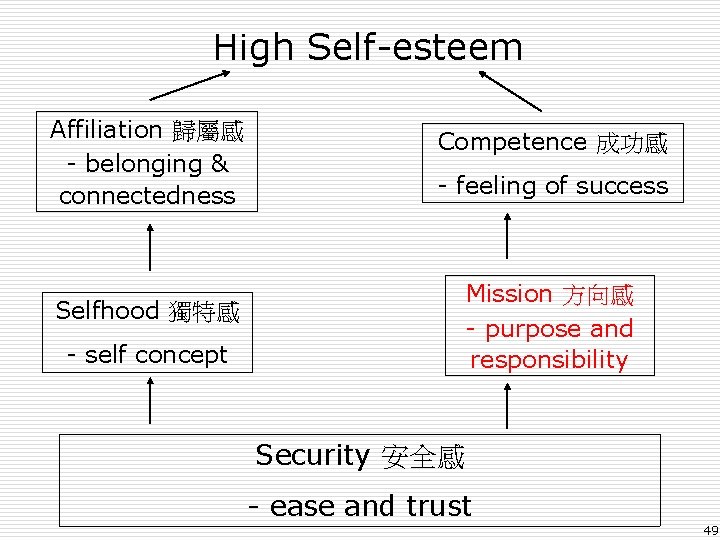
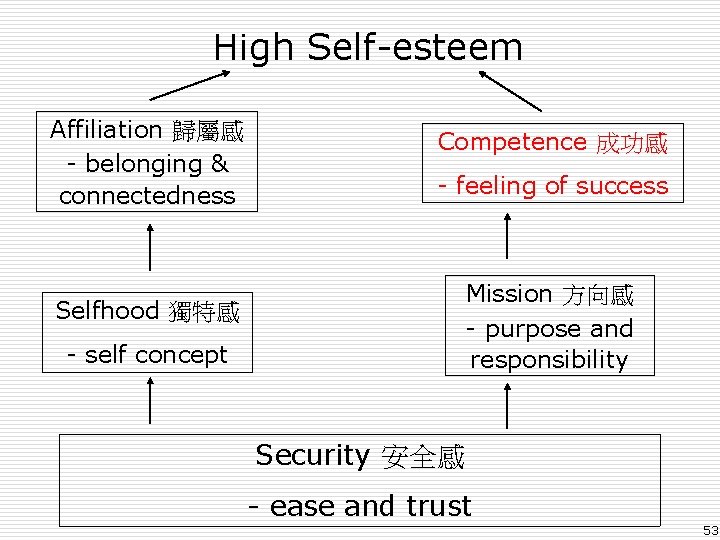
High Self-esteem Affiliation 歸屬感 - belonging & connectedness Competence 成功感 - feeling of success Mission 方向感 - purpose and responsibility Selfhood 獨特感 - self concept Security 安全感 - ease and trust 26
High Self-esteem Affiliation 歸屬感 - belonging & connectedness Competence 成功感 - feeling of success Mission 方向感 - purpose and responsibility Selfhood 獨特感 - self concept Security 安全感 - ease and trust 27
1. Building Security 安全感 (ease and trust) W 5 -2(a) 28
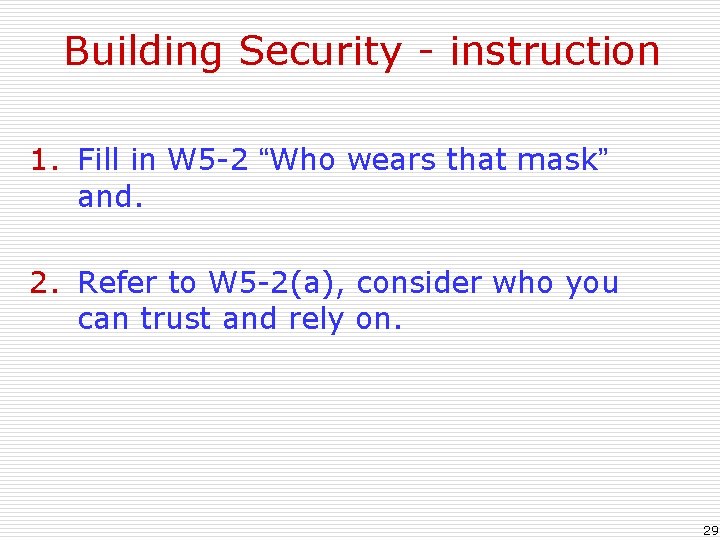
Building Security - instruction 1. Fill in W 5 -2 “Who wears that mask” and. 2. Refer to W 5 -2(a), consider who you can trust and rely on. 29
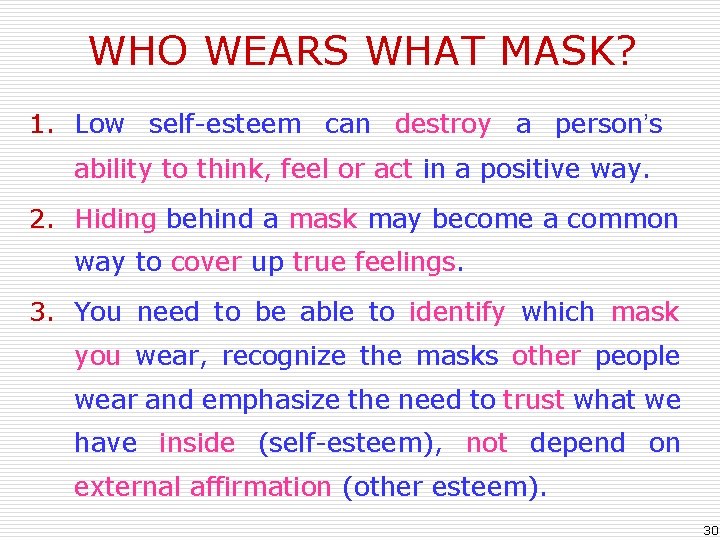
WHO WEARS WHAT MASK? 1. Low self-esteem can destroy a person’s ability to think, feel or act in a positive way. 2. Hiding behind a mask may become a common way to cover up true feelings. 3. You need to be able to identify which mask you wear, recognize the masks other people wear and emphasize the need to trust what we have inside (self-esteem), not depend on external affirmation (other esteem). 30
Building Security 1. Think about people with whom relate daily (significant others, friends, peers) 2. List (first names only) any people who wear the following masks. Include yourself when appropriate. 31
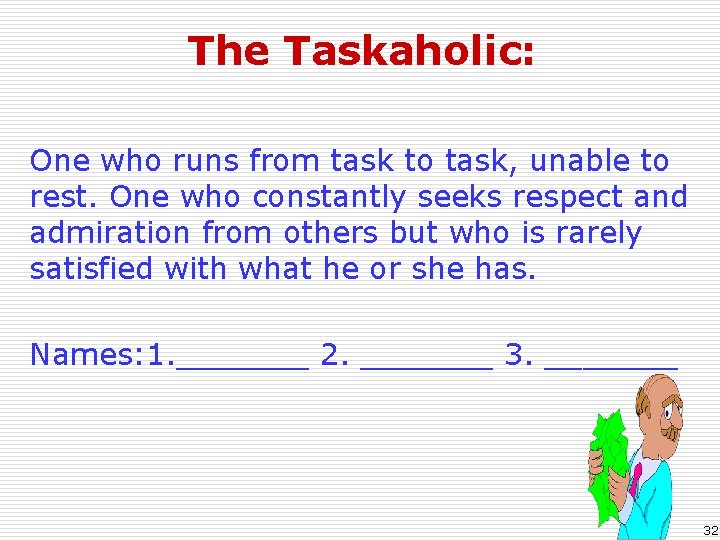
The Taskaholic: One who runs from task to task, unable to rest. One who constantly seeks respect and admiration from others but who is rarely satisfied with what he or she has. Names: 1. _______ 2. _______ 32
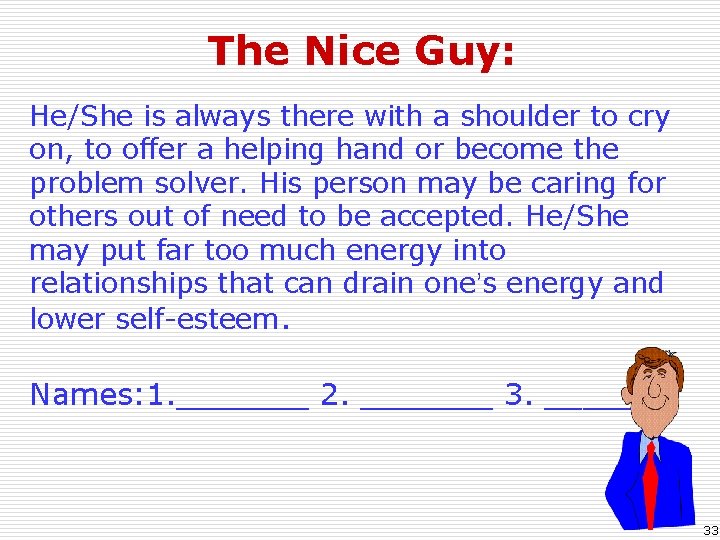
The Nice Guy: He/She is always there with a shoulder to cry on, to offer a helping hand or become the problem solver. His person may be caring for others out of need to be accepted. He/She may put far too much energy into relationships that can drain one’s energy and lower self-esteem. Names: 1. _______ 2. _______ 33
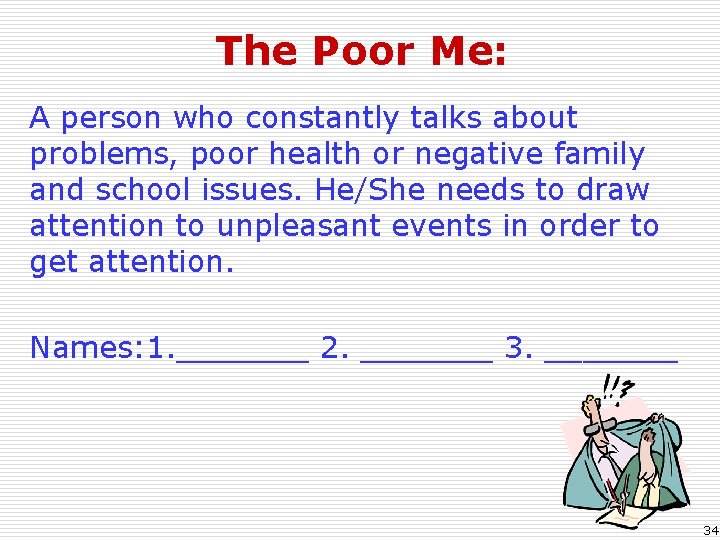
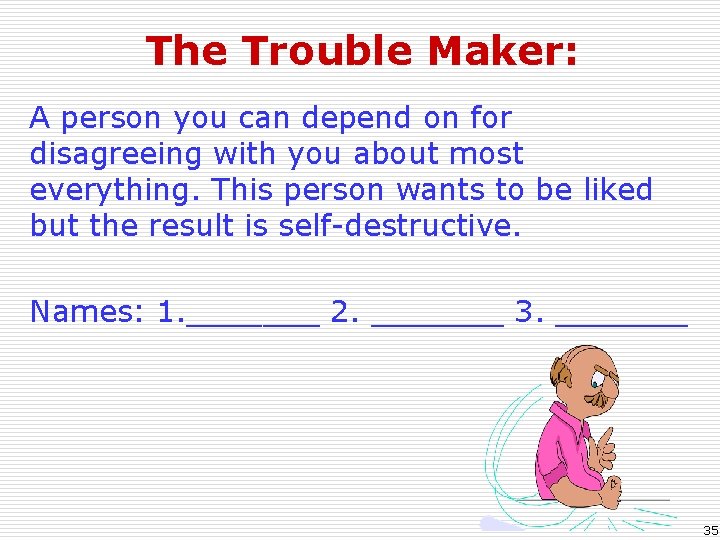
The Poor Me: A person who constantly talks about problems, poor health or negative family and school issues. He/She needs to draw attention to unpleasant events in order to get attention. Names: 1. _______ 2. _______ 34
The Trouble Maker: A person you can depend on for disagreeing with you about most everything. This person wants to be liked but the result is self-destructive. Names: 1. _______ 2. _______ 35
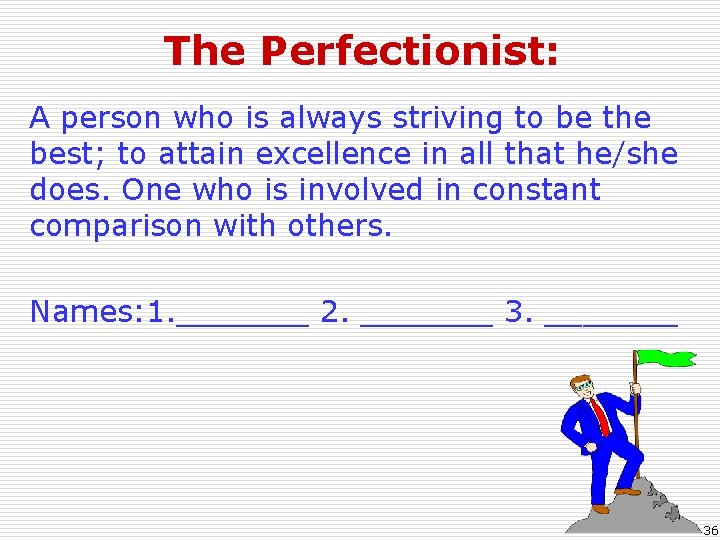
The Perfectionist: A person who is always striving to be the best; to attain excellence in all that he/she does. One who is involved in constant comparison with others. Names: 1. _______ 2. _______ 36
Other Masks: People who are always feeling tired, sick or who have a weak handshake and indirect eye contact. People who constantly feel depressed, anxious or withdrawn. People who are easily angered or always seem to project negative attitude. Names: 1. _______ 2. ______ 3. _______ 37
Building Security - debriefing If you recognize a mask that you wear or can now identify ones that others wear, you have a good starting point to understand how to build improved selfesteem. 38
High Self-esteem Affiliation 歸屬感 - belonging & connectedness Competence 成功感 - feeling of success Mission 方向感 - purpose and responsibility Selfhood 獨特感 - self concept Security 安全感 - ease and trust 39
2. Building Selfhood 獨特感 (self concept) W 5 -3 H 5 -3 “I am Somebody” 40
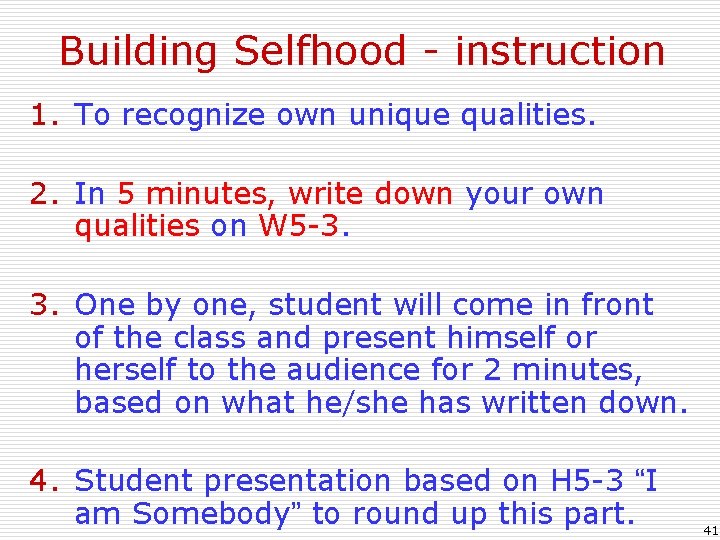
Building Selfhood - instruction 1. To recognize own unique qualities. 2. In 5 minutes, write down your own qualities on W 5 -3. 3. One by one, student will come in front of the class and present himself or herself to the audience for 2 minutes, based on what he/she has written down. 4. Student presentation based on H 5 -3 “I am Somebody” to round up this part. 41
Commercial about M E 1. Try to sell yourself so that all classmates would like to meet you. 2. For instance: Positive Say something about your looks, personality, skills, abilities, hobbies, family, dreams, favourites like sports, books, movies, songs, TV shows, etc 42
Building Selfhood - debriefing 1. “I am Somebody” 2. Every individual on earth should be entitled to choose for him- or herself what kind of person he or she wishes to be without explanation or justification to others. 3. If you look at your image in the mirror every day for thirty days and repeat aloud fifty times: “I will get an A in this course, ” your mind will accept the statement as fact. Your confidence will improve, and you will be more willing to do the things that are necessary to succeed. 4. Convincing yourself that you capable is an 43
High Self-esteem Affiliation 歸屬感 - belonging & connectedness Competence 成功感 - feeling of success Mission 方向感 - purpose and responsibility Selfhood 獨特感 - self concept Security 安全感 - ease and trust 44
3. Building Affiliation 歸屬感 (belonging & connectedness) Poster papers (12 pieces) H 5 -5 45
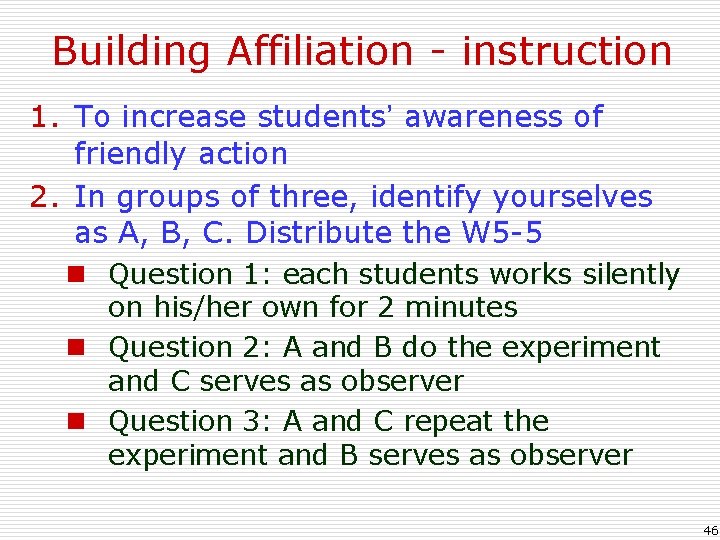
Building Affiliation - instruction 1. To increase students’ awareness of friendly action 2. In groups of three, identify yourselves as A, B, C. Distribute the W 5 -5 n Question 1: each students works silently on his/her own for 2 minutes n Question 2: A and B do the experiment and C serves as observer n Question 3: A and C repeat the experiment and B serves as observer 46
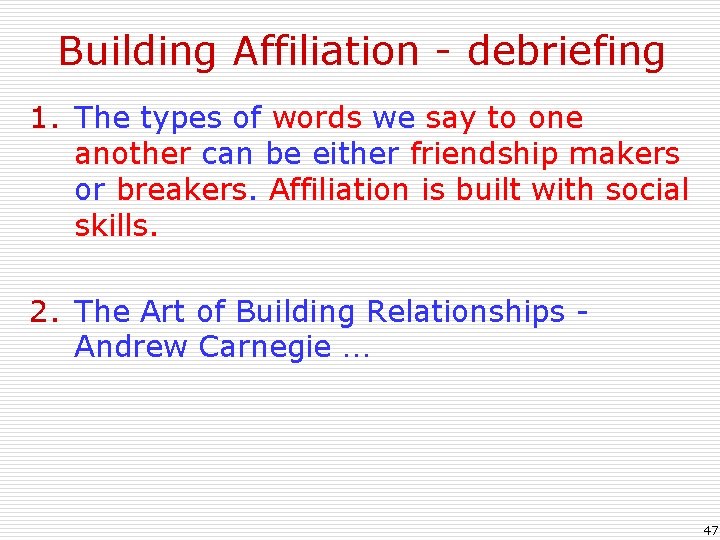
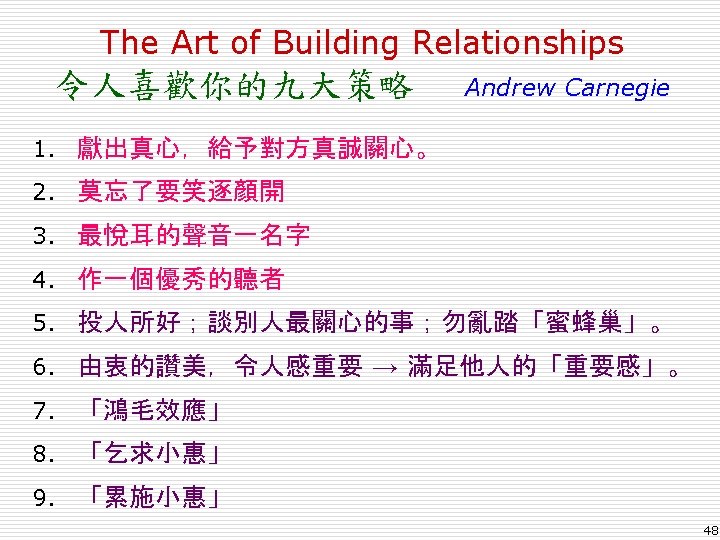
Building Affiliation - debriefing 1. The types of words we say to one another can be either friendship makers or breakers. Affiliation is built with social skills. 2. The Art of Building Relationships Andrew Carnegie … 47
High Self-esteem Affiliation 歸屬感 - belonging & connectedness Competence 成功感 - feeling of success Mission 方向感 - purpose and responsibility Selfhood 獨特感 - self concept Security 安全感 - ease and trust 49
4. Building Mission 方向感 (purpose and responsibility) W 5 -6 50
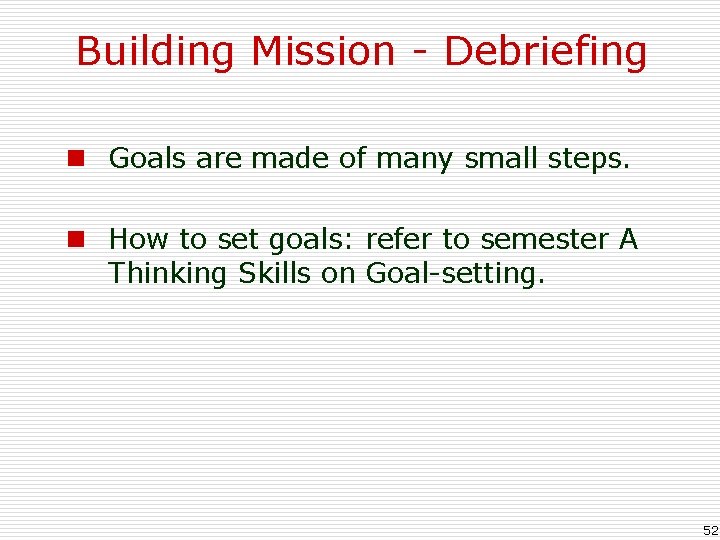
Building Mission - instruction 1. W 5 -6 to fill in. 2. In teams of 3 -4, students are to verbalize their goals and to think through ways to overcome “roadblocks” or obstacles. 51
Building Mission - Debriefing n Goals are made of many small steps. n How to set goals: refer to semester A Thinking Skills on Goal-setting. 52
High Self-esteem Affiliation 歸屬感 - belonging & connectedness Competence 成功感 - feeling of success Mission 方向感 - purpose and responsibility Selfhood 獨特感 - self concept Security 安全感 - ease and trust 53
5. Building competence 成功感 (feeling of success) H 5 -7, H 5 -7(a), H 5 -7(b) paper strips 54
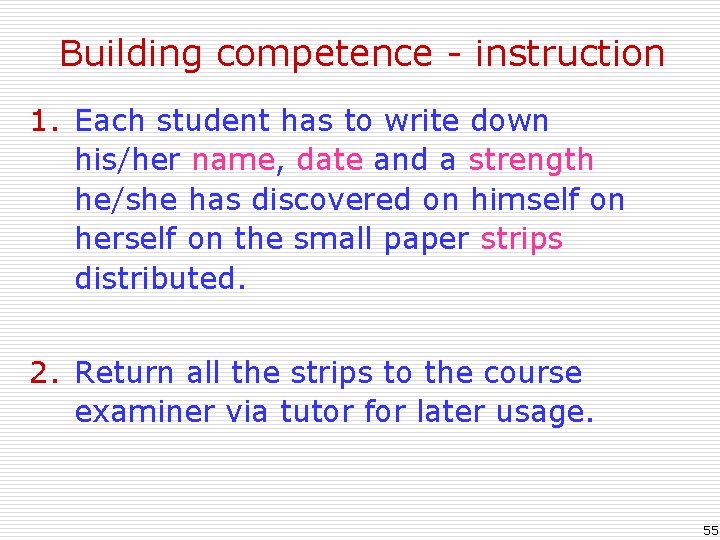
Building competence - instruction 1. Each student has to write down his/her name, date and a strength he/she has discovered on himself on herself on the small paper strips distributed. 2. Return all the strips to the course examiner via tutor for later usage. 55
Building competence - debriefing 1. Ways to build self esteem n To take on special projects n To show expertise in just one or two areas at a time n To teach a skill to someone else n To assign well-defined daily activities n Acknowledge and reward all success n To share their feelings when successfully accomplishing a task/assignment 56
Building competence - debriefing 2. Building personal self esteem n Focus on the positive n Identify positive traits n Determine traits you value most n List and replay past successes n Remember cause for success n Share successes that have worked for you 57
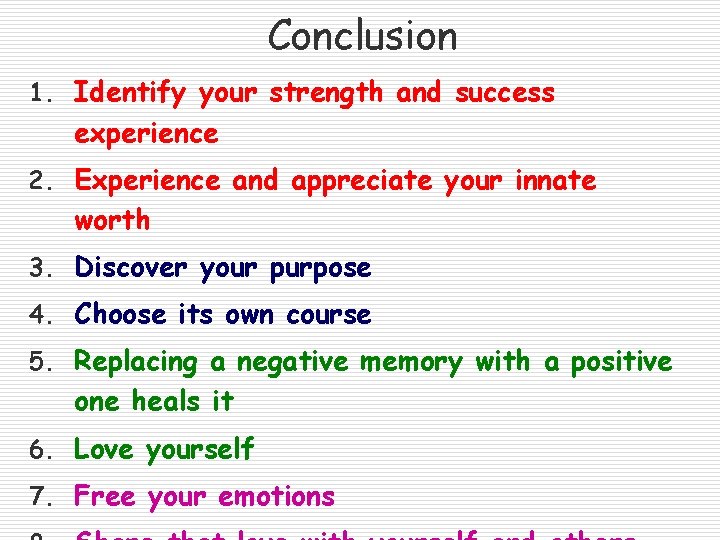
Conclusion 1. Identify your strength and success experience 2. Experience and appreciate your innate worth 3. Discover your purpose 4. Choose its own course 5. Replacing a negative memory with a positive one heals it 6. Love yourself 7. Free your emotions
The end 60