
Yip sir www yipsir com hk Tutor IP









- Slides: 32
Yip sir (葉錦熙) www. yipsir. com. hk
Tutor IP Kam Hee, Ivan 葉錦熙 (BSW, MA, RSW) PT Lecturer of City. U since 1996 Teaching Personal Development and supervising social work students as well Interest and expert in learning psychology and mnemonic skills
Communication 1. 6199 3347 2. toyipsir@hotmail. com 3. Website: www. yipsir. com. hk
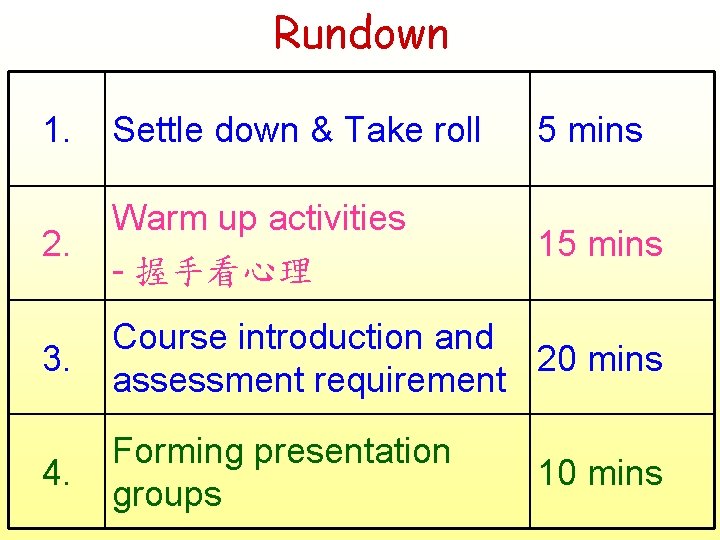
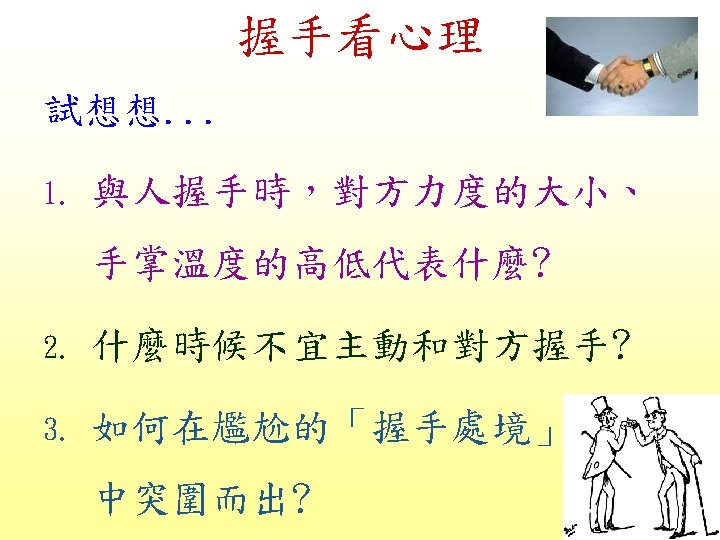
Rundown 1. Settle down & Take roll 5 mins 2. Warm up activities - 握手看心理 15 mins 3. Course introduction and 20 mins assessment requirement 4. Forming presentation groups 10 mins
敏覺力測試二 What do you see ?
敏覺力測試三 How many F’s are there in the following text? Finished files are the result of years of scientific study combined with the experience of years
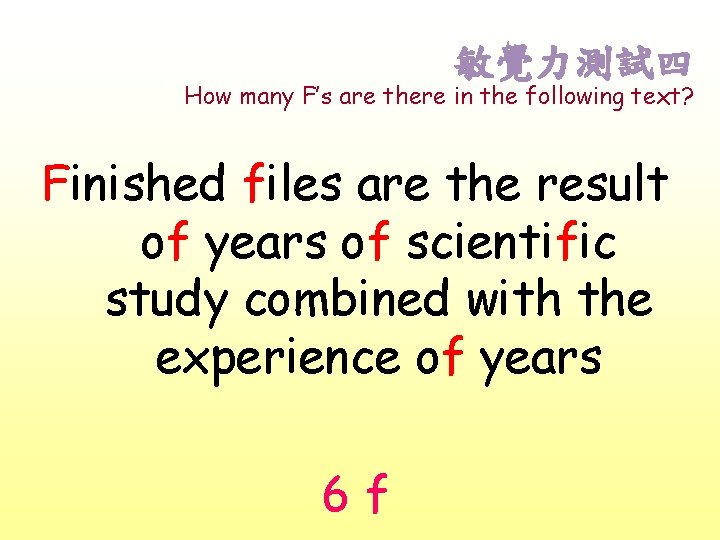
敏覺力測試四 How many F’s are there in the following text? Finished files are the result of years of scientific study combined with the experience of years 6 f
What is psychology?
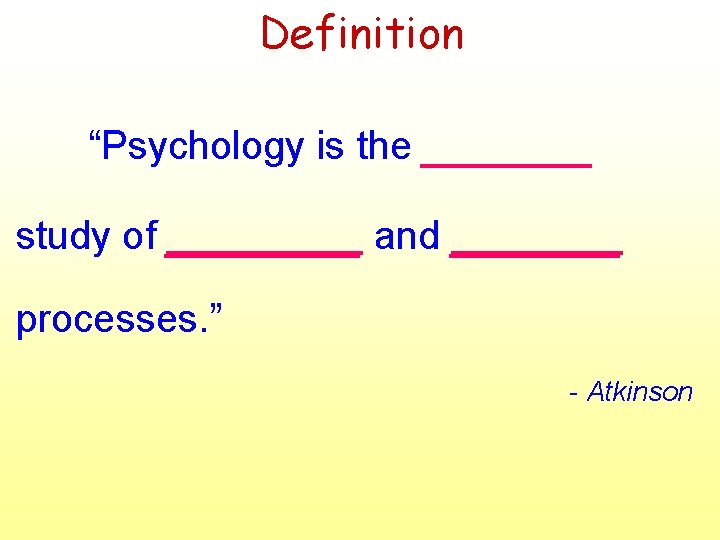
Definition “Psychology is the _______ study of ____ and _______ processes. ” - Atkinson
Definition “Psychology is the scientific study of ____ and ______ processes. ” - Atkinson
Definition “Psychology is the scientific study of behaviour and ______ processes. ” - Atkinson
Definition “Psychology is the scientific study of behaviour and mental processes. ” - Atkinson
Definition “Psychology is the science that studies behaviour and the physiological and cognitive processes that underlie it, and it is the profession that applies the accumulated knowledge of this science to practical problems. ” - Weiten
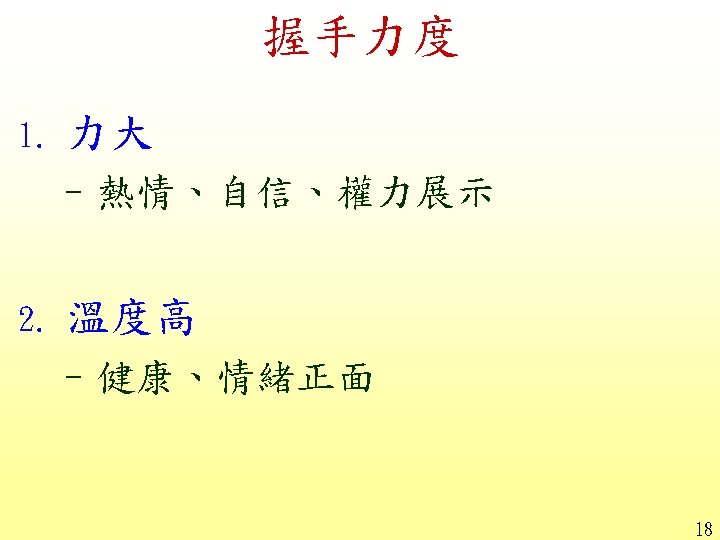
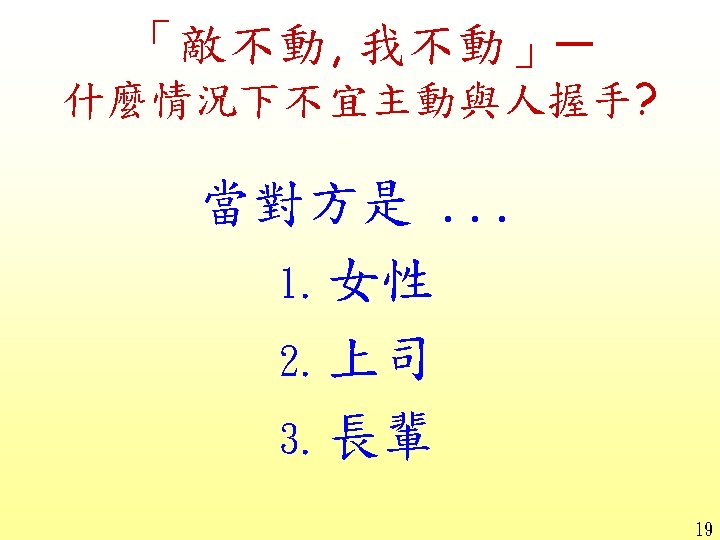
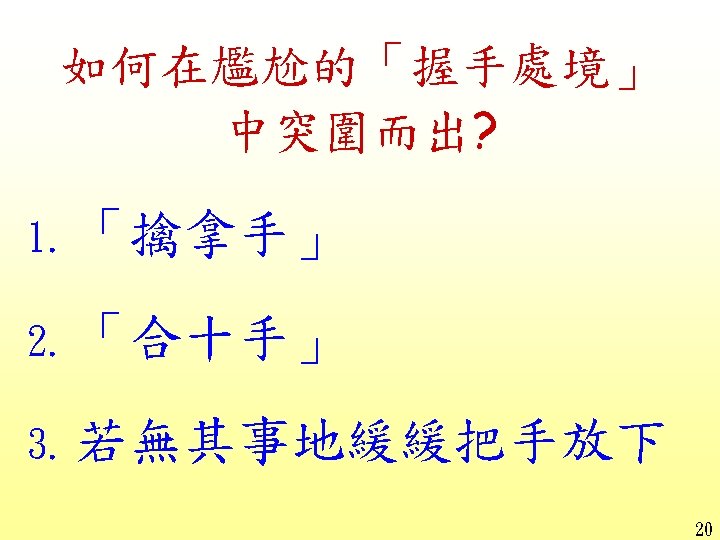
Activity one Shaking hands 「握手看心理」 • Shake hands with 5 classmates. • Try to remember your hand shaking experience 16
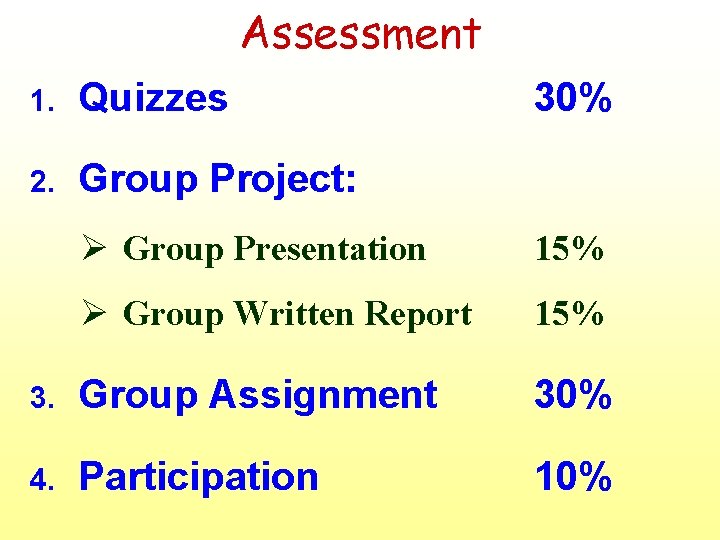
Assessment 1. Quizzes 2. Group Project: 30% Ø Group Presentation 15% Ø Group Written Report 15% 3. Group Assignment 30% 4. Participation 10%
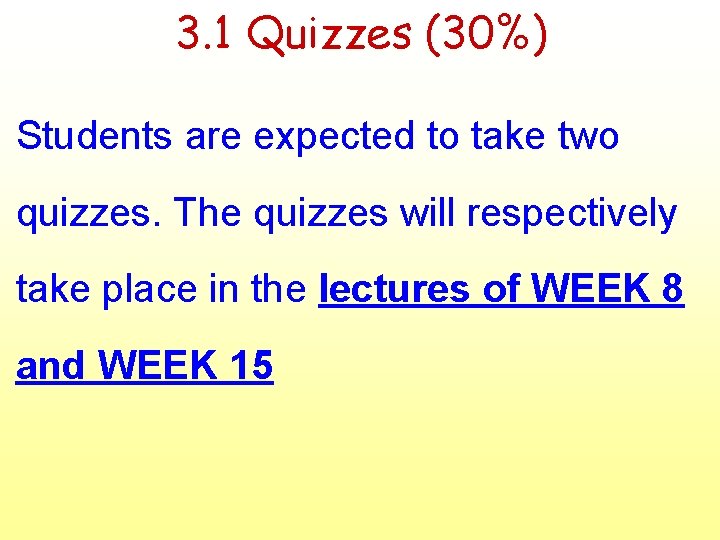
3. 1 Quizzes (30%) Students are expected to take two quizzes. The quizzes will respectively take place in the lectures of WEEK 8 and WEEK 15
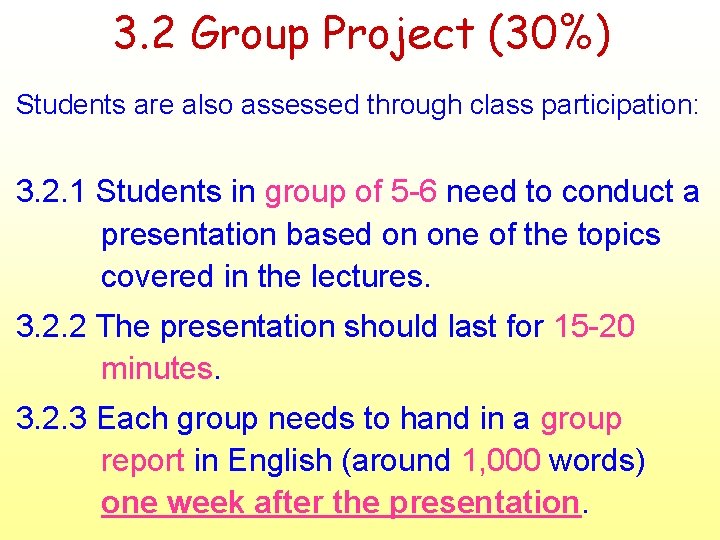
3. 2 Group Project (30%) Students are also assessed through class participation: 3. 2. 1 Students in group of 5 -6 need to conduct a presentation based on one of the topics covered in the lectures. 3. 2. 2 The presentation should last for 15 -20 minutes. 3. 2. 3 Each group needs to hand in a group report in English (around 1, 000 words) one week after the presentation.
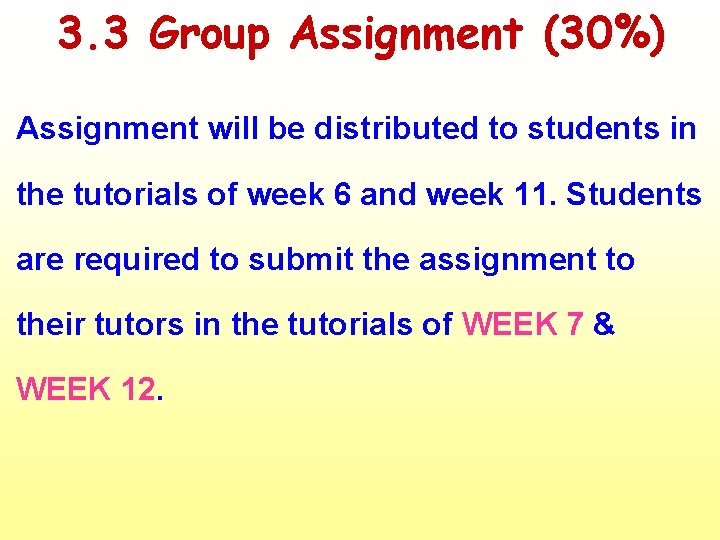
3. 3 Group Assignment (30%) Assignment will be distributed to students in the tutorials of week 6 and week 11. Students are required to submit the assignment to their tutors in the tutorials of WEEK 7 & WEEK 12.
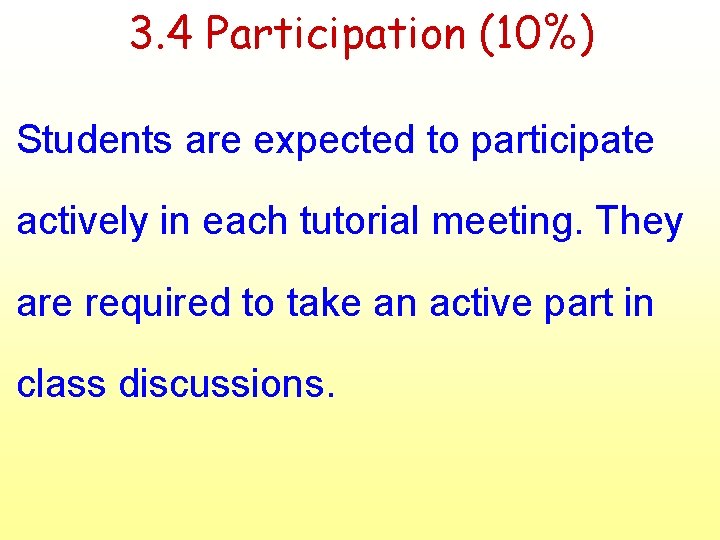
3. 4 Participation (10%) Students are expected to participate actively in each tutorial meeting. They are required to take an active part in class discussions.
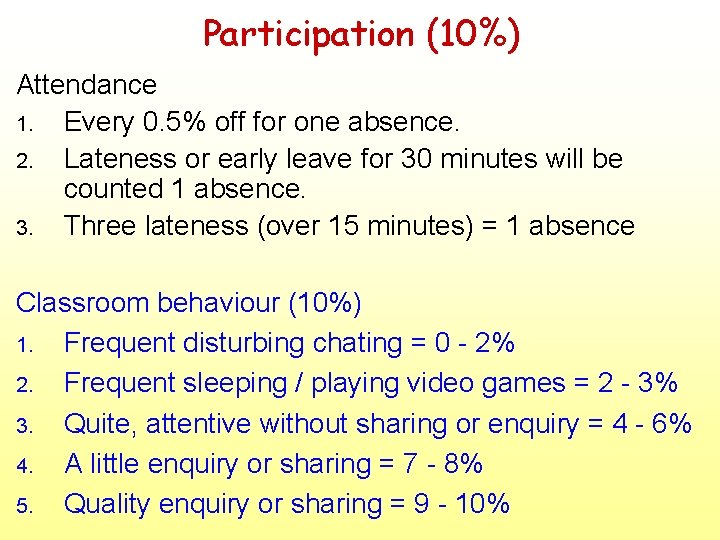
Participation (10%) Attendance 1. Every 0. 5% off for one absence. 2. Lateness or early leave for 30 minutes will be counted 1 absence. 3. Three lateness (over 15 minutes) = 1 absence Classroom behaviour (10%) 1. Frequent disturbing chating = 0 - 2% 2. Frequent sleeping / playing video games = 2 - 3% 3. Quite, attentive without sharing or enquiry = 4 - 6% 4. A little enquiry or sharing = 7 - 8% 5. Quality enquiry or sharing = 9 - 10%
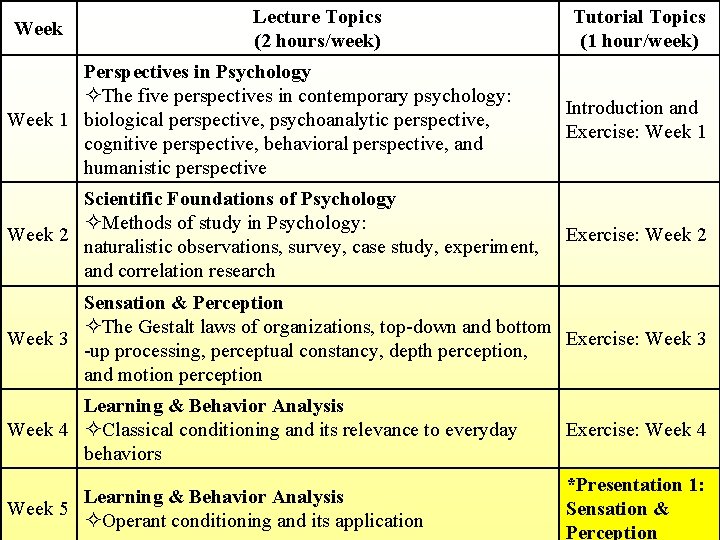
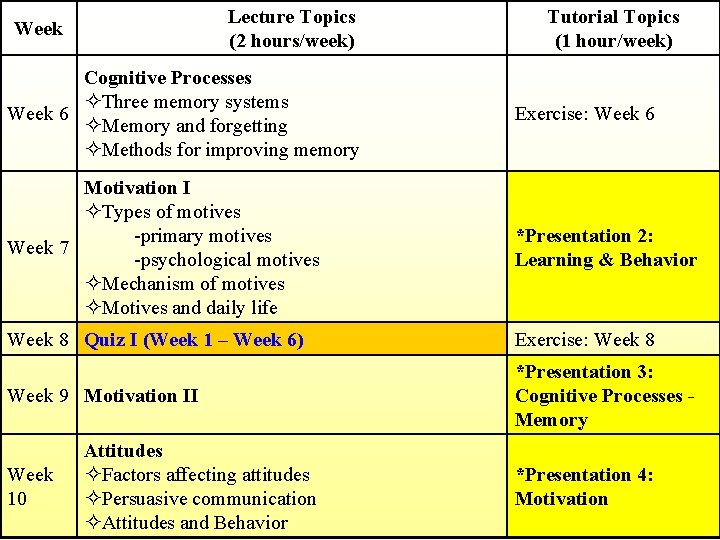
Week Lecture Topics (2 hours/week) Tutorial Topics (1 hour/week) Perspectives in Psychology The five perspectives in contemporary psychology: Week 1 biological perspective, psychoanalytic perspective, cognitive perspective, behavioral perspective, and humanistic perspective Introduction and Exercise: Week 1 Scientific Foundations of Psychology Methods of study in Psychology: Week 2 naturalistic observations, survey, case study, experiment, and correlation research Exercise: Week 2 Sensation & Perception The Gestalt laws of organizations, top-down and bottom Week 3 Exercise: Week 3 -up processing, perceptual constancy, depth perception, and motion perception Learning & Behavior Analysis Week 4 Classical conditioning and its relevance to everyday behaviors Exercise: Week 4 Learning & Behavior Analysis Week 5 Operant conditioning and its application *Presentation 1: Sensation & Perception
Lecture Topics (2 hours/week) Week Tutorial Topics (1 hour/week) Cognitive Processes Three memory systems Week 6 Memory and forgetting Methods for improving memory Exercise: Week 6 Motivation I Types of motives -primary motives Week 7 -psychological motives Mechanism of motives Motives and daily life *Presentation 2: Learning & Behavior Week 8 Quiz I (Week 1 – Week 6) Exercise: Week 8 Week 9 Motivation II *Presentation 3: Cognitive Processes Memory Week 10 Attitudes Factors affecting attitudes Persuasive communication Attitudes and Behavior *Presentation 4: Motivation
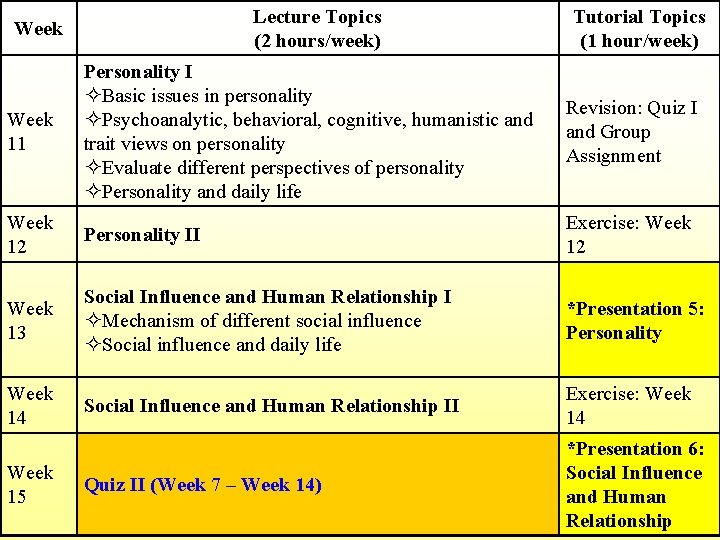
Lecture Topics (2 hours/week) Week Tutorial Topics (1 hour/week) Week 11 Personality I Basic issues in personality Psychoanalytic, behavioral, cognitive, humanistic and trait views on personality Evaluate different perspectives of personality Personality and daily life Revision: Quiz I and Group Assignment Week 12 Personality II Exercise: Week 12 Week 13 Social Influence and Human Relationship I Mechanism of different social influence Social influence and daily life *Presentation 5: Personality Week 14 Social Influence and Human Relationship II Exercise: Week 14 Quiz II (Week 7 – Week 14) *Presentation 6: Social Influence and Human Relationship Week 15
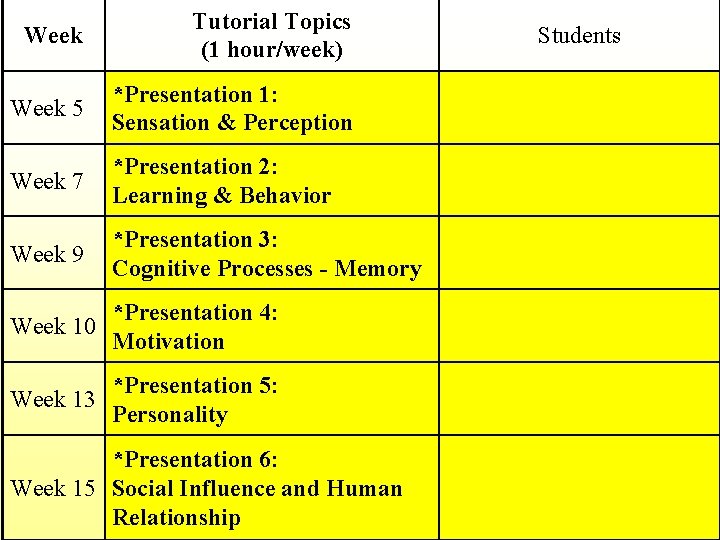
Forming presentation groups
Week Tutorial Topics (1 hour/week) Week 5 *Presentation 1: Sensation & Perception Week 7 *Presentation 2: Learning & Behavior Week 9 *Presentation 3: Cognitive Processes - Memory *Presentation 4: Week 10 Motivation Week 13 *Presentation 5: Personality *Presentation 6: Week 15 Social Influence and Human Relationship Students
The end