TENNIS AT HOME Personal development challenge 1 INTRODUCTION
- Slides: 7
TENNIS AT HOME Personal development challenge 1
INTRODUCTION FOR PARENTS & CARERS (1) DEVELOPING CHARACTER QUALITIES THROUGH TENNIS The LTA Youth Schools programme is a suite of resources developed by the LTA to inspire the next generation of players and fans. These personal development activities were originally designed for teaching in lessons such as Personal, Social, Health and Economic (PSHE) Education, but have been adapted to support home learning. This resource from the LTA gives children and their families information and activities to help them develop qualities and skills for personal development through five tennis-related challenges. The key character qualities are: resilience (which includes bouncing back); perseverance; motivation; passion (including enthusiasm) and respect. The challenges are designed for children in Key Stage 2 (Years 3 -6) (Scotland: P 4 -7). DEFINING THE KEY CHARACTER QUALITIES Here are some ways to define the key character qualities. Children might have their own understanding of them too, especially after they have done the challenges: • Resilience: when you can ‘bounce back’ and get through something which has been difficult, or made you unhappy. • Perseverance: when you keep on trying at something and don’t give up. • Motivation: doing something because you want to, not because you are told to. • Passion: you have a very strong interest in something – you are excited and enthusiastic about it; you really love it! • Respect: thinking about how what you do or say might affect others; listening and appreciating who they are / what they do.
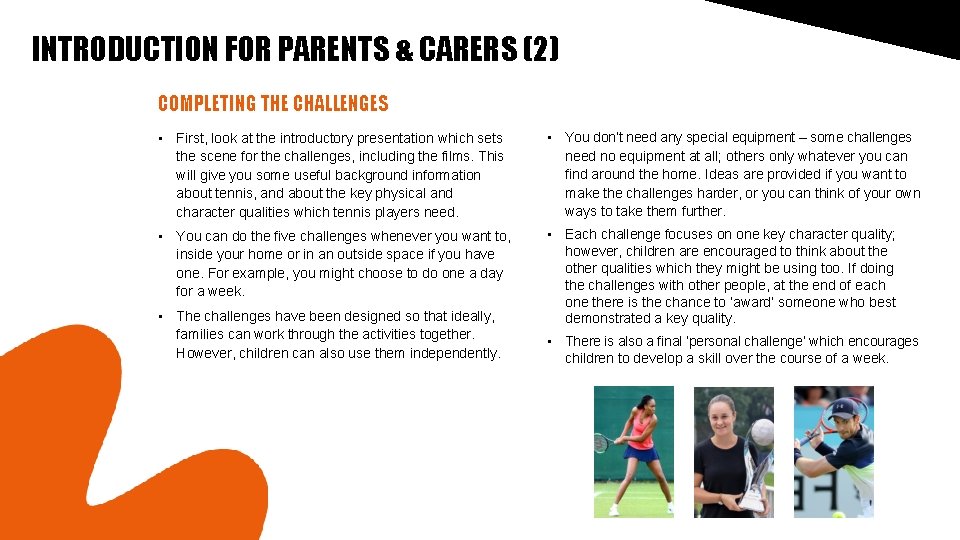
INTRODUCTION FOR PARENTS & CARERS (2) COMPLETING THE CHALLENGES • First, look at the introductory presentation which sets the scene for the challenges, including the films. This will give you some useful background information about tennis, and about the key physical and character qualities which tennis players need. • You don’t need any special equipment – some challenges need no equipment at all; others only whatever you can find around the home. Ideas are provided if you want to make the challenges harder, or you can think of your own ways to take them further. • You can do the five challenges whenever you want to, inside your home or in an outside space if you have one. For example, you might choose to do one a day for a week. • Each challenge focuses on one key character quality; however, children are encouraged to think about the other qualities which they might be using too. If doing the challenges with other people, at the end of each one there is the chance to ‘award’ someone who best demonstrated a key quality. • The challenges have been designed so that ideally, families can work through the activities together. However, children can also use them independently. • There is also a final ‘personal challenge’ which encourages children to develop a skill over the course of a week.
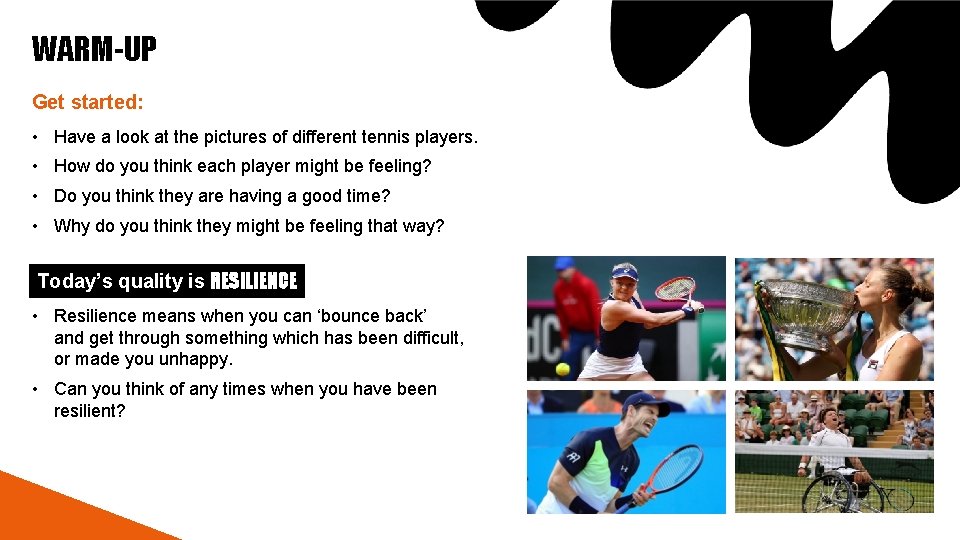
WARM-UP Get started: • Have a look at the pictures of different tennis players. • How do you think each player might be feeling? • Do you think they are having a good time? • Why do you think they might be feeling that way? Today’s quality is RESILIENCE • Resilience means when you can ‘bounce back’ and get through something which has been difficult, or made you unhappy. • Can you think of any times when you have been resilient?
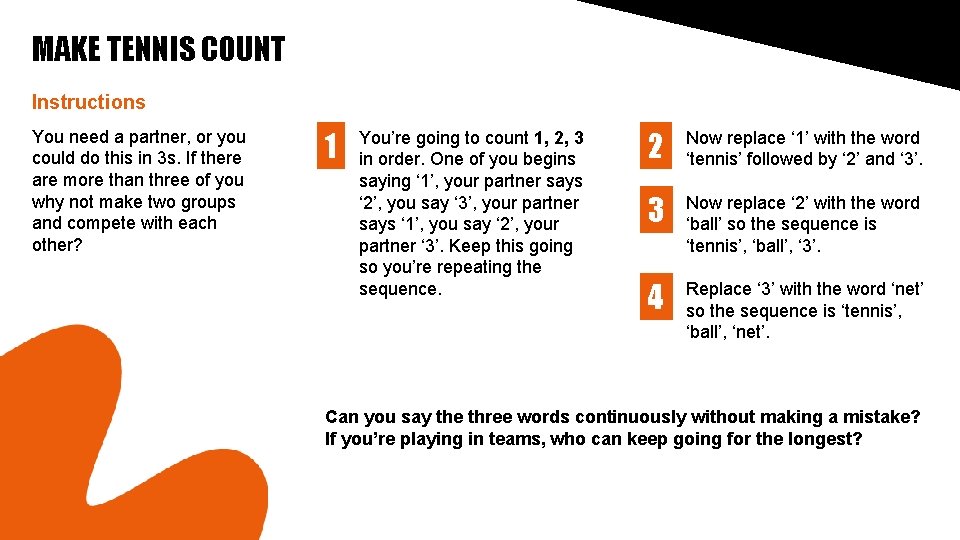
MAKE TENNIS COUNT Instructions You need a partner, or you could do this in 3 s. If there are more than three of you why not make two groups and compete with each other? 1 You’re going to count 1, 2, 3 in order. One of you begins saying ‘ 1’, your partner says ‘ 2’, you say ‘ 3’, your partner says ‘ 1’, you say ‘ 2’, your partner ‘ 3’. Keep this going so you’re repeating the sequence. 2 Now replace ‘ 1’ with the word ‘tennis’ followed by ‘ 2’ and ‘ 3’. 3 Now replace ‘ 2’ with the word ‘ball’ so the sequence is ‘tennis’, ‘ball’, ‘ 3’. 4 Replace ‘ 3’ with the word ‘net’ so the sequence is ‘tennis’, ‘ball’, ‘net’. Can you say the three words continuously without making a mistake? If you’re playing in teams, who can keep going for the longest?
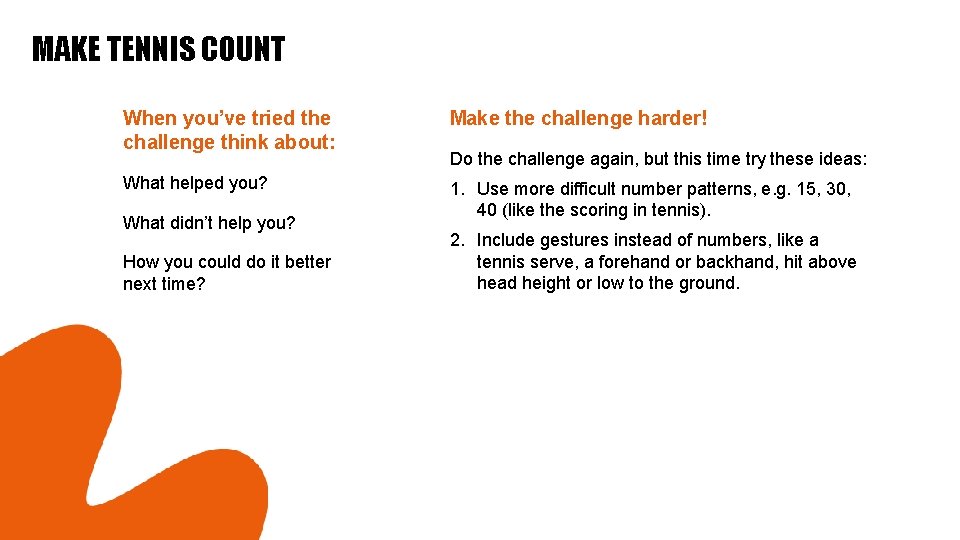
MAKE TENNIS COUNT When you’ve tried the challenge think about: Make the challenge harder! What helped you? 1. Use more difficult number patterns, e. g. 15, 30, 40 (like the scoring in tennis). What didn’t help you? How you could do it better next time? Do the challenge again, but this time try these ideas: 2. Include gestures instead of numbers, like a tennis serve, a forehand or backhand, hit above head height or low to the ground.
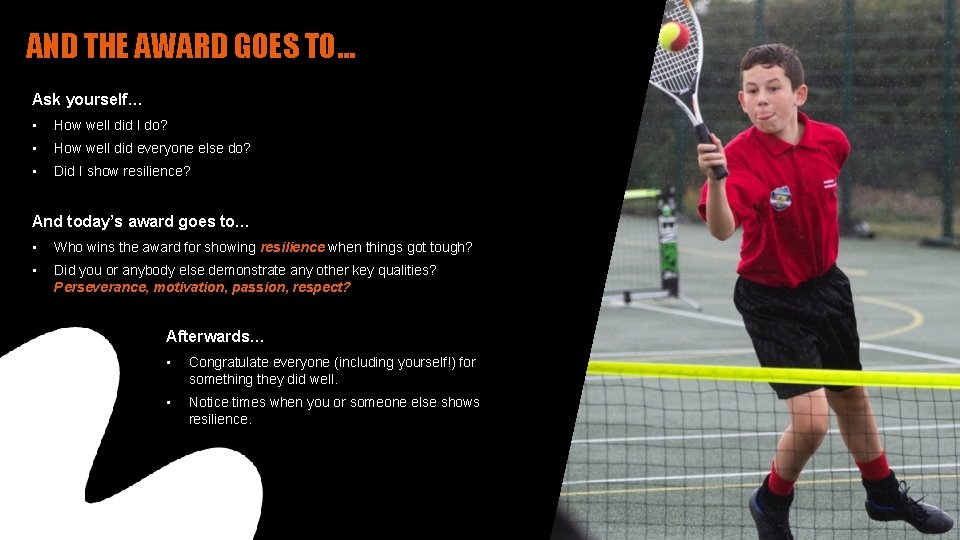
AND THE AWARD GOES TO… Ask yourself… • How well did I do? • How well did everyone else do? • Did I show resilience? And today’s award goes to… • Who wins the award for showing resilience when things got tough? • Did you or anybody else demonstrate any other key qualities? Perseverance, motivation, passion, respect? Afterwards… • Congratulate everyone (including yourself!) for something they did well. • Notice times when you or someone else shows resilience.