
Personal Development P 045 Yip sir www yipsir

















- Slides: 50
Personal Development P 045 Yip sir (葉錦熙) www. yipsir. com. hk
The Dynamic Nature of the Johari Window
The Dynamic Nature of the Johari Window 1) Openness dominant characteristic 2) Unknown dominant characteristic 3) Hidden dominant characteristic 4) Blind dominant characteristic
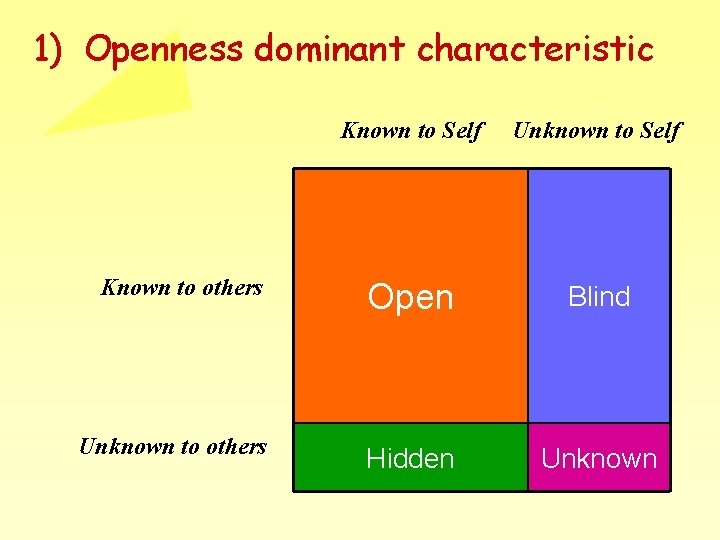
1) Openness dominant characteristic Known to Self Unknown to Self Known to others Open Blind Unknown to others Hidden Unknown
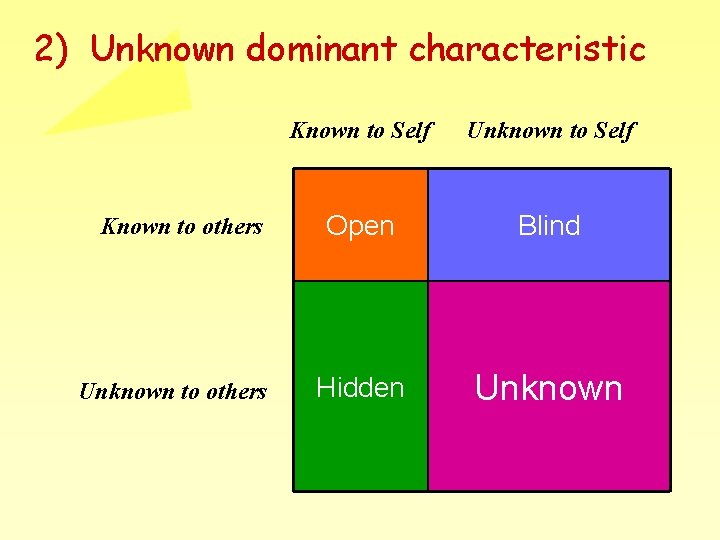
2) Unknown dominant characteristic Known to others Unknown to others Known to Self Unknown to Self Open Blind Hidden Unknown
3) Hidden dominant characteristic Known to Self Known to others Unknown to Self Open Blind Hidden Unknown
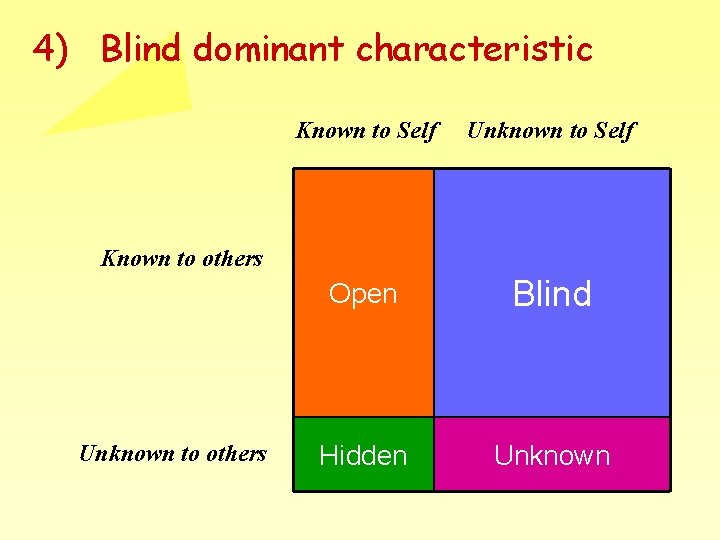
4) Blind dominant characteristic Known to Self Unknown to Self Open Blind Hidden Unknown Known to others Unknown to others
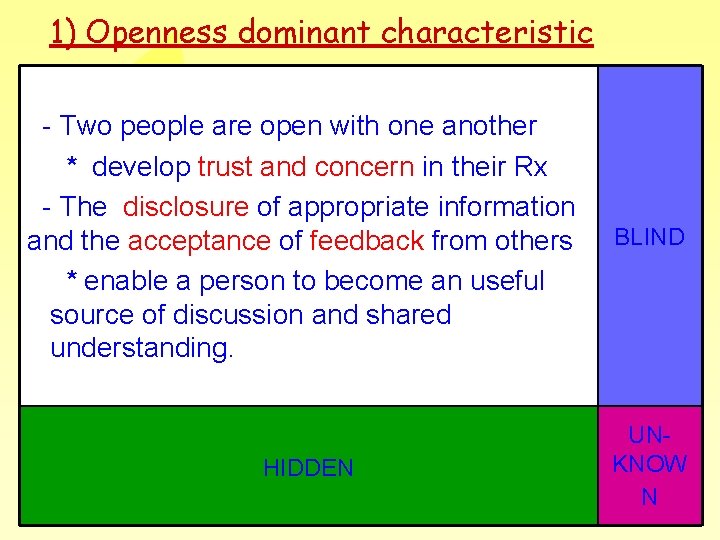
1) Openness dominant characteristic The OPEN area - information mutually known and shared by both people in good Rx. BLIND OPEN * includes those things others see in us and that we also see in ourselves, e. g. others see a person as a diligent student and the person sees him / herself as a diligent student too. HIDDEN UNKNOWN
1) Openness dominant characteristic - Two people are open with one another * develop trust and concern in their Rx - The disclosure of appropriate information and the acceptance of feedback from others * enable a person to become an useful source of discussion and shared understanding. BLIND HIDDEN UNKNOW N
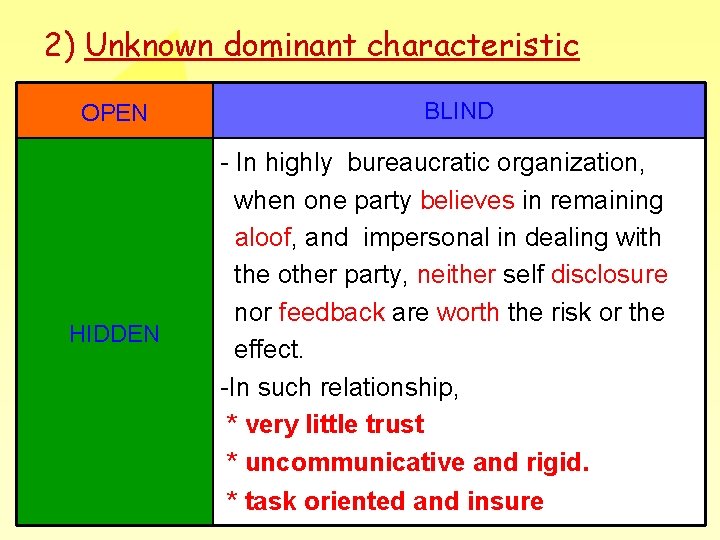
2) Unknown dominant characteristic OPEN BLIND - Things that are unknown to both ourselves and others. - This undiscovered aspect of a Rx forms the “potential” area. HIDDEN - One member of a Rx may discover something new about the other. This information may enter the blind or hidden area of the Rx , or it could be mutually shared and become part of the open area.
2) Unknown dominant characteristic OPEN HIDDEN BLIND - In highly bureaucratic organization, when one party believes in remaining aloof, and impersonal in dealing with the other party, neither self disclosure nor feedback are worth the risk or the effect. -In such relationship, * very little trust * uncommunicative and rigid. * task oriented and insure
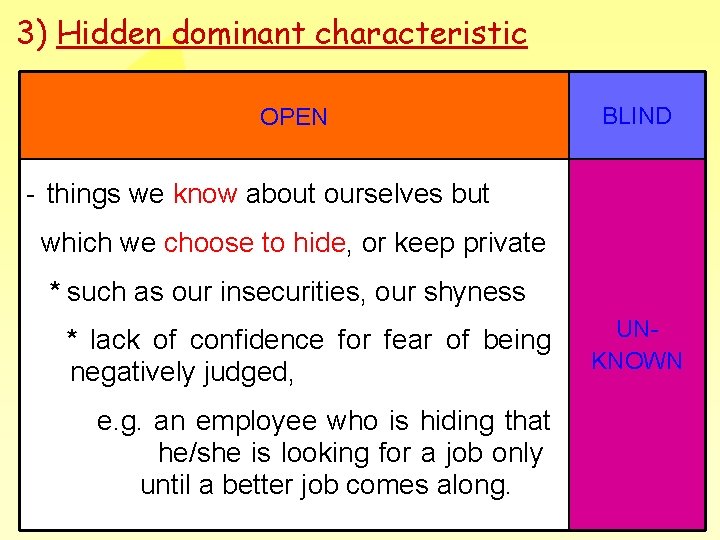
3) Hidden dominant characteristic OPEN BLIND - things we know about ourselves but which we choose to hide, or keep private * such as our insecurities, our shyness * lack of confidence for fear of being negatively judged, e. g. an employee who is hiding that he/she is looking for a job only until a better job comes along. UNKNOWN
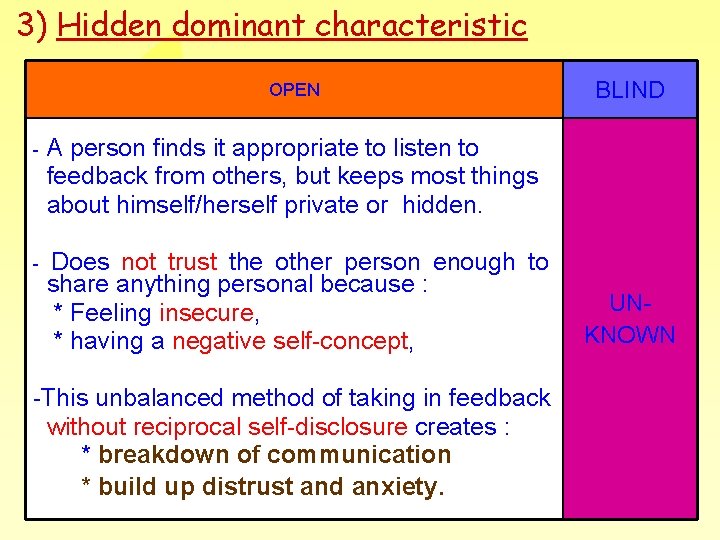
3) Hidden dominant characteristic OPEN BLIND - A person finds it appropriate to listen to feedback from others, but keeps most things about himself/herself private or hidden. - Does not trust the other person enough to share anything personal because : * Feeling insecure, * having a negative self-concept, -This unbalanced method of taking in feedback without reciprocal self-disclosure creates : * breakdown of communication * build up distrust and anxiety. UNKNOWN
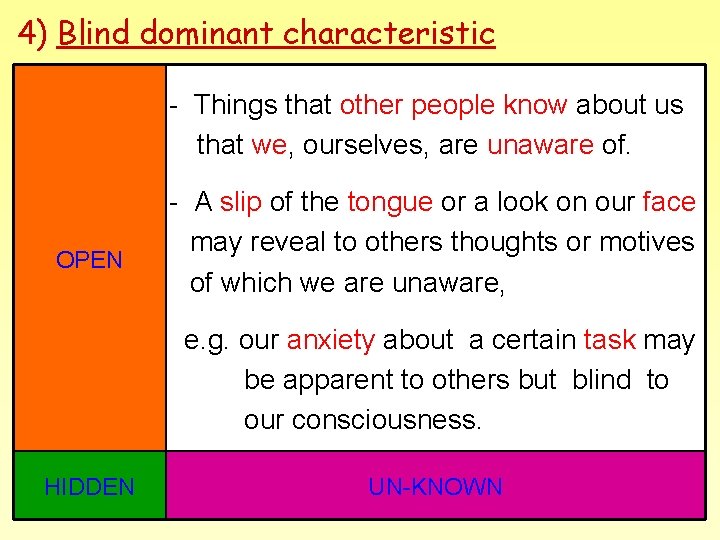
4) Blind dominant characteristic - Things that other people know about us that we, ourselves, are unaware of. OPEN - A slip of the tongue or a look on our face may reveal to others thoughts or motives of which we are unaware, e. g. our anxiety about a certain task may be apparent to others but blind to our consciousness. HIDDEN UN-KNOWN
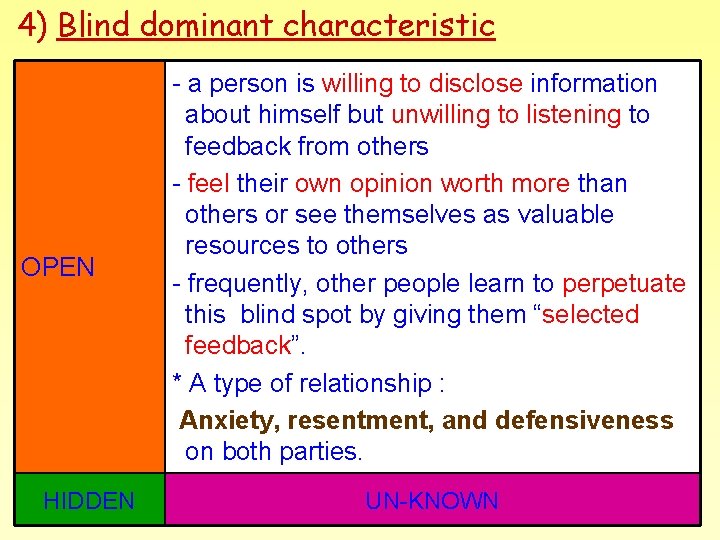
4) Blind dominant characteristic OPEN HIDDEN - a person is willing to disclose information about himself but unwilling to listening to feedback from others - feel their own opinion worth more than others or see themselves as valuable resources to others - frequently, other people learn to perpetuate this blind spot by giving them “selected feedback”. * A type of relationship : Anxiety, resentment, and defensiveness on both parties. UN-KNOWN
Summary : 1. Intra-personal dynamic is related to the development of one’s self image. 2. It takes energy to hide information from yourself. 3. To build up trustful relationship with people at home, at work or in our friendship circle through: – Often involves working to enlarge your open area while decreasing your blind and hidden areas. – To disclose of appropriate information to others – To accept feedback from others can help us to enlarge our open area
Activity 1: The Johari Window
On Sheet 1 1. 2. Form group of six. Write down three of your positive characteristics that you no one in the room know (hidden area).
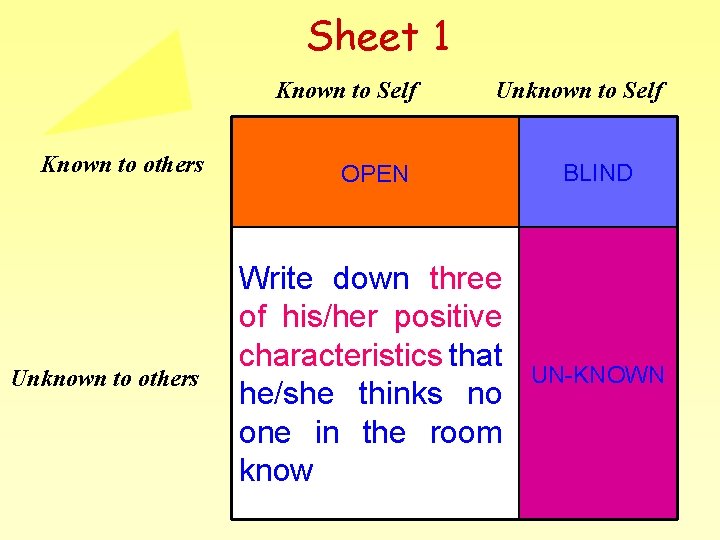
Sheet 1 Known to Self Known to others Unknown to Self OPEN BLIND Write down three of his/her positive characteristics that he/she thinks no one in the room know UN-KNOWN
On Sheet 2 1. Each student get five identical name cards. 2. On a rotating basis, write a different group member’s name (five) on the front of each card. 3. Turn the card over and write two positive characteristics of the person whose name appears on the front.
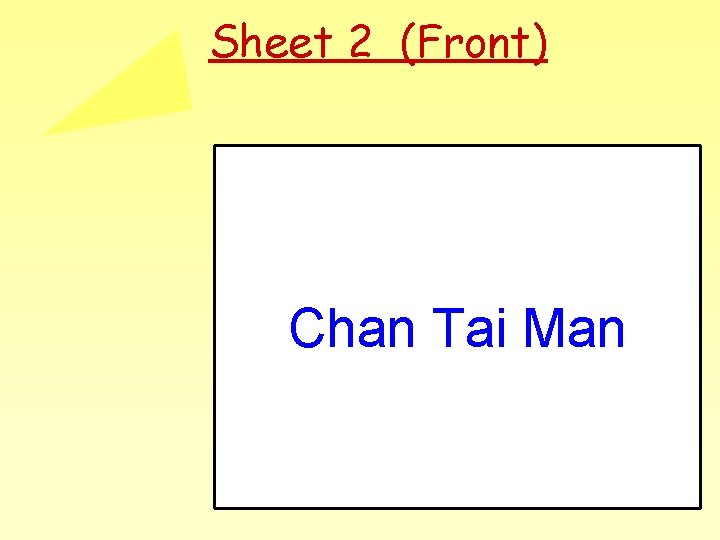
Sheet 2 (Front) Chan Tai Man
Sheet 2 (Back) Known to others Known to Self Unknown to Self Open Write two positive characteristics of the person whose name appears on the front sheet BLIND Unknown to others HIDDEN UN-KNOWN
After finishing the writing. . . 1. Place the cards with all names face down in a pile in the centre of the group. 2. One by one, each student takes a card, reads the description and decides by group consensus whom the card belongs to. The card is placed in front of that person with the name still face down. This procedure is repeated until all cards have been distributed. 3. After all papers are distributed, each student turns the papers they have been given. If someone received a paper that does not belong to him/her, return it to the person it
Discussion within small groups 1. Each person describes your reaction to the cards received. 2. Are the descriptions on the cards accurate for you?
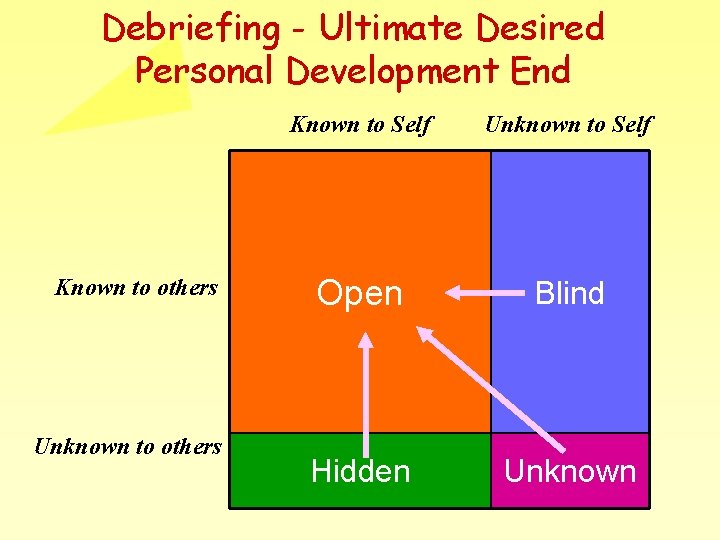
Debriefing - Ultimate Desired Personal Development End Known to others Unknown to others Known to Self Unknown to Self Open Blind Hidden Unknown
Individual work 1. Each person works independently and classifies the characteristics from the received papers into the open, hidden or blind areas of his/her Johari Window. 2. Please pay special attention to the characteristics that are in your blind area.
Mini-lecture Self-concept and Self-esteem
The Nature of Self William James : defined a basic duality of the self: * the self-concept (our knowledge of who we are) * self-awareness (the act of thinking about ourselves).
The Nature of the Self William James defined a basic duality of the self: – the known “Me, ” or self-concept (our knowledge of who we are), and – the knower, “I. ” or self-awareness (the act of thinking about ourselves).
What is Self-concept”? 1. “The sum total of the attributes, abilities, and values that an individual believes defines who he or she is, a cognitive domain of self. 2. These beliefs can be about affect, behaviour, cognitions, motives, etc.
What is “Self-Awareness”? 1. 2. 3. The ability to take a good look at yourself as you relate to your environmental, physical, and mental worlds. It is the ability of accept yourself as a unique, changing, imperfect, and growing individual. to recognize your potential as well as your limitations. Self-honesty, can see all your strengths and weaknesses clearly.
The Importance of Self-Awareness Self-awareness is being conscious of yourself in the world around you. It is understanding yourself as you function in your environments.
3 imperative domains of self-awareness 1. Physical 2. Mental 3. Environmental
Physical Self-Awareness 1. Understanding that our bodies are machines whose performance depends on good health. 2. When you take care of yourself physically, it is easier for you to deal with many other stresses in life, eg. A healthy body is less likely to catch colds or tire easily.
Improving Physical Self-Awareness 1. Control our bodies’ reactions to many stressful situations, by relaxing our bodies, we can relax our minds. 2. Use exercise, practice relaxation, take a reality check, laugh it off, slow your thoughts down, stay calm and take positive action.
Mental Self-Awareness 1. 2. Mental self-awareness is the potential within our own minds that is just waiting to be challenged. How do you see yourself: – your weakness and strengths – Success and failure Attitude is the key to healthy selfawareness. – to develop positive attitudes and positive responses to the pressures in life.
Creating Mental Self-Awareness 1. Being honest with yourself when making a decision. You can ask yourself the following questions: – Is this action what I believe I should do? – Does what I say agree with what I do? – What effect will this decision have on the other people involved? 2. Help you make the right choice with total self-honesty. – You are true to yourself → feel comfortable with yourself. – You are comfortable with yourself → can deal with the stresses of the outside world with calm and confidence.
Empathy is: 1. The awareness of and sensitivity to the feelings, thoughts and experiences of others 2. Seeing life through other persons’ eyes, experiencing their pain, curiosity, hopes, and fears.
Enhancing Empathy 1. Increasing self-awareness can help you look beyond yourself for meaning and honesty. 2. You become concerned about the others. 3. Knowing when others need help. It is reaching out a hand to lift them up. It is a “win-win” idea ─ If I help you win, then I will too.
Developing Environmental Self-Awareness 1. Understanding yourself and being conscious of the world around you contribute to your overall sense of well-being and quality of life. 2. Environmental self-awareness concerns your relationships with the world – your family, friends, and community – your responsibility as citizen of the planet Earth – you are part of a larger whole, you have respect for what is around you.
Activity 2 Case Study Group discussion “Do I really belong here? ” ─ Karen’s story
Group discussion 1. 2. Had Karen made a mistake, or was she just feeling the stress of the first day? ___________________ If you were Karen’s best friend, how could you help Karen become more self-aware physically, mentally and environmentally? * Improving physical self-awareness * Creating mental self-awareness * Developing environmental awareness ___________________
Suggestions for Karen 1. Had Karen made a mistake, or was she just feeling the stress of the first day? It seemed that Karen’s first-day jitters (神 經過敏 ) and anger were really reactions to stress, as many other fresh students may experience.
2. If you were Karen’s best friend, how would you advise Karen in the following areas : 2. 1 Improving physical self-awareness Karen could take more nutrient meals that would give her plenty of energy. She could practice some relaxation exercises to relieve her stress, take a walk at lunchtime or recess, etc.
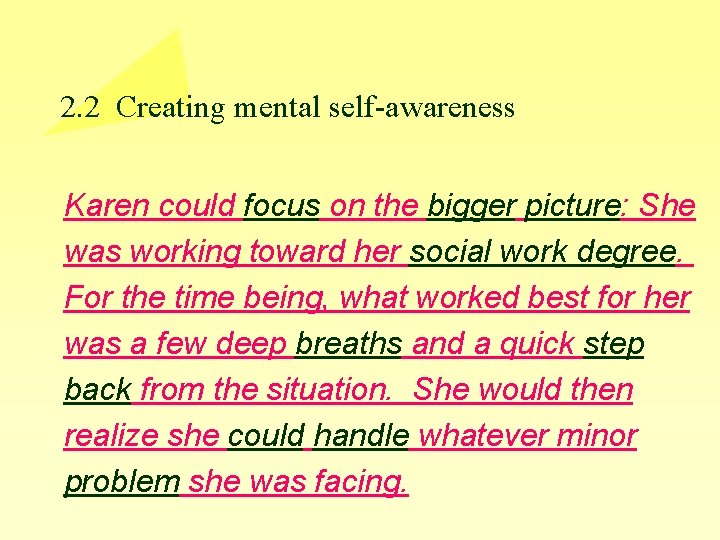
2. 2 Creating mental self-awareness Karen could focus on the bigger picture: She was working toward her social work degree. For the time being, what worked best for her was a few deep breaths and a quick step back from the situation. She would then realize she could handle whatever minor problem she was facing.
2. 3 Developing environmental awareness To become more environmentally aware of the campus is one way to overcome Karen’s feeling of disorientation. She could also studied maps to find her classrooms and always knew where they were before the first class.
Activity 4 Self Evaluation and Group Sharing 1. Increasing Self-Awareness and Planning for a Positive Change (Refer to W 2 -3) 2. This activity is planned to make you more aware of yourself within your environments (home, school, work, and community) and to plan for a tiny change in a near future.
Not True Somewhat True Very True 1. I go to movies, restaurants, etc. , with 1 2 3 4 5 6 7 8 9 10 friends. 2. I spend time thinking positively. 1 2 3 4 5 6 7 8 9 10 3. I exercise each day. 1 2 3 4 5 6 7 8 9 10 4. I enjoy time with my spouse or a special friend. 1 2 3 4 5 6 7 8 9 10 5. I have set goals for earning and spending money. 1 2 3 4 5 6 7 8 9 10 6. I am satisfied with my career choice and my career progress so far. 1 2 3 4 5 6 7 8 9 10 7. I am involved in community affairs. 1 2 3 4 5 6 7 8 9 10
Individual work and group sharing 1. 2. 3. 4. 5. Review the list and the circled numbers. Put a * in front of each item for which you circled 1 -3. Put a in front of each item for which you circled 4 – 6. Refer to step 2. List three things you could do within the next 24 hours to start making these “not true” statements true for your. _____________________________________________________ Refer to step 3. Name three things you could do this week to make these “somewhat true” items “very true”. _____________________________________________________ Share with your group mates what you have written down in Step 4 & 5.
The end