
Michael Chun Long Yip Resolving Ownerships with Invisible
Michael Chun Long Yip Resolving Ownerships with Invisible Watermarking Limits Attacks Implications From article by Scott Craver, Nasir Memon, Boon-Lock Yeo, Minerva Yeung
Introduction Ø The most important point in the article is: Current invisible watermarking schemes are not capable of confidently proving the ownership of a particular image. Ø Current = 1998 Ø Other points not going to be covered
Outline Ø Follow general structure of article. l l l l What are Watermarks? General Notation Basic Attack How to Prevent Counter Attack Counter Prevention Conclusion Ø Not going to cover Public Watermarking
What’s a Digital Watermark? Ø An identifiable sequence or pattern encoded into an image. Ø Why use watermarks? Ø Visible and Invisible Ø Spatial vs. Transform Ø Robustness Ø Public & Private schemes
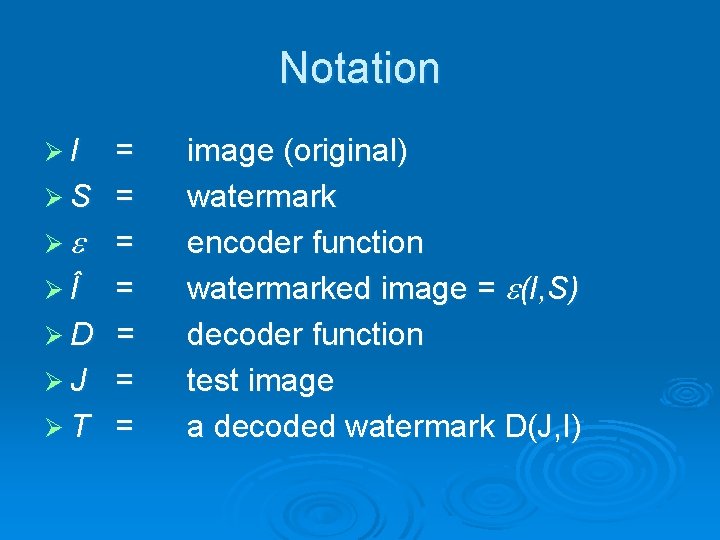
Notation ØI ØS Øe ØÎ ØD ØJ ØT = = = = image (original) watermark encoder function watermarked image = e(I, S) decoder function test image a decoded watermark D(J, I)
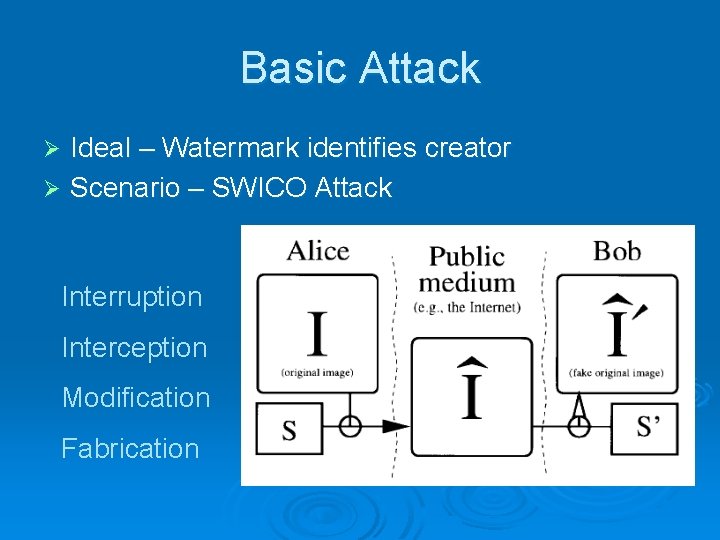
Basic Attack Ideal – Watermark identifies creator Ø Scenario – SWICO Attack Ø Interruption Interception Modification Fabrication

Prevention Ø Invertibility l l l Ø e-1 exists e-1(Î) = (Î’, S’) e(Î’, S’) = Î Cd(D(Î), S’)=1 Î & Î’ perceptually similar Feasible Solution l l l 1 -way Hash Select labels Decide on operation

Counter Attack TWICO attack Ø Quasi-Invertibility Ø l e-1 exists e-1(Î) = (Î’, S’) l e(Î’, S’) = Δ l l l Ø Cd(D(Î), S’)=1 Feasible Mix-Match Averaging
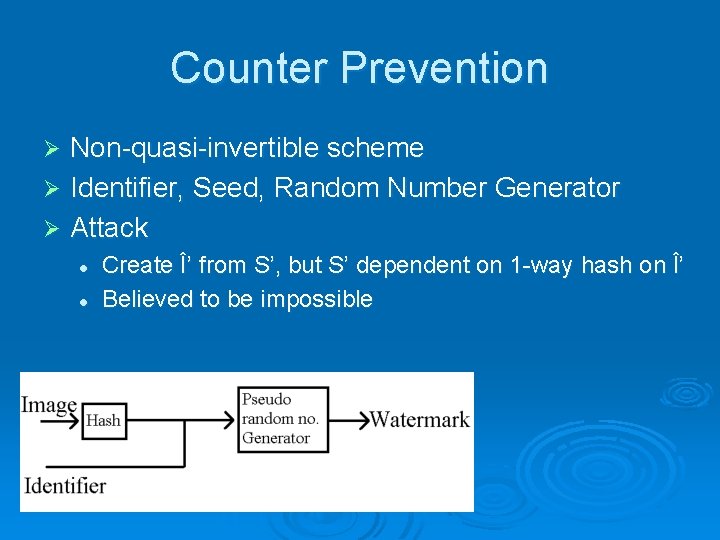
Counter Prevention Non-quasi-invertible scheme Ø Identifier, Seed, Random Number Generator Ø Attack Ø l l Create Î’ from S’, but S’ dependent on 1 -way hash on Î’ Believed to be impossible
Conclusion Ø Questions l l l Have such attacks ever existed? What about commercially available watermarks? Standards? Ø Diagrams are from the article itself
- Slides: 10