Organizations and Organizational Effectiveness CheeCheng Chen Dec 2012
- Slides: 28
Organizations and Organizational Effectiveness Chee-Cheng Chen Dec. , 2012 9/30/2020 1 -1
Learning Objectives • Explain why organizations exist and the purposes they serve • Describe the relationship between organizational theory and organizational design and change, and differentiate between organizational structure and culture 1 -2
Learning Objectives • Understand how managers can utilize the principles of organizational theory to design and change their organizations to increase organizational effectiveness • Identify the three principal ways in which managers assess and measure organizational effectiveness 1 -3
Learning Objectives • Appreciate the way in which several contingency factors influence the design of organizations 1 -4
What is an Organization? • Organization: A tool people use to coordinate their actions to obtain something they desire or value • Entrepreneurship: The process by which people recognize opportunities to satisfy needs and then gather and use resources to meet those needs 1 -5
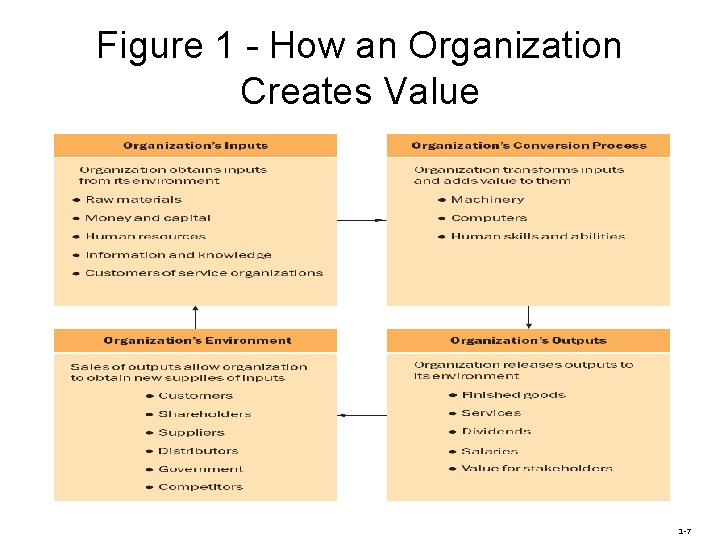
How Does an Organization Create Value? • Value creation takes place at three stages: input, conversion, and output • Each stage is affected by the environment in which the organization operates – Organizational environment: The set of forces and conditions that operate beyond an organization’s boundaries but affect its ability to acquire and use resources to create value 1 -5
Figure 1 - How an Organization Creates Value 1 -7
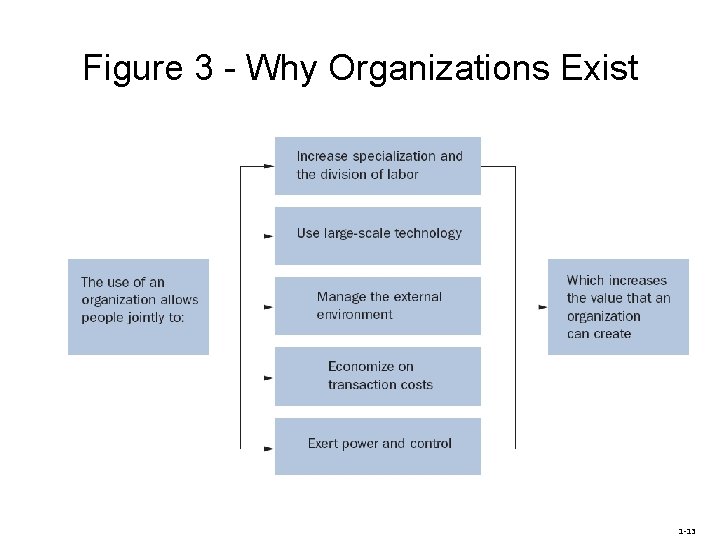
Why do Organizations Exist? • To increase specialization and the division of labor – Division of labor allows specialization – Specialization allows individuals to become experts at their job 1 -8
Why do Organizations Exist? (cont. ) • To use large-scale technology – Economies of scale: Cost savings that result when goods and services are produced in large volume on automated production lines – Economies of scope: Cost savings that result when an organization is able to use underutilized resources more effectively because they can be shared across different products or tasks
Why do Organizations Exist? (cont. ) • To manage the organizational environment – An organization’s environment is the source of valuable input resources and is the marketplace into which it releases outputs – It is the source of economic, social, and political pressures that affect an organization’s ability to obtain these resources 1 -10
Why do Organizations Exist? (cont. ) • To economize on transaction costs – Transaction costs: The costs associated with negotiating, monitoring, and governing exchanges between people • To exert power and control – Organizations can exert great pressure on individuals to conform to task and production requirements in order to increase production efficiency 1 -11
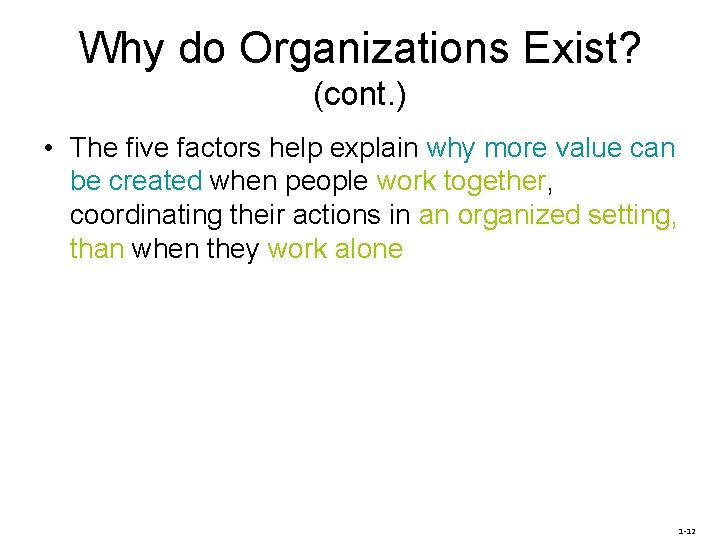
Why do Organizations Exist? (cont. ) • The five factors help explain why more value can be created when people work together, coordinating their actions in an organized setting, than when they work alone 1 -12
Figure 3 - Why Organizations Exist 1 -13
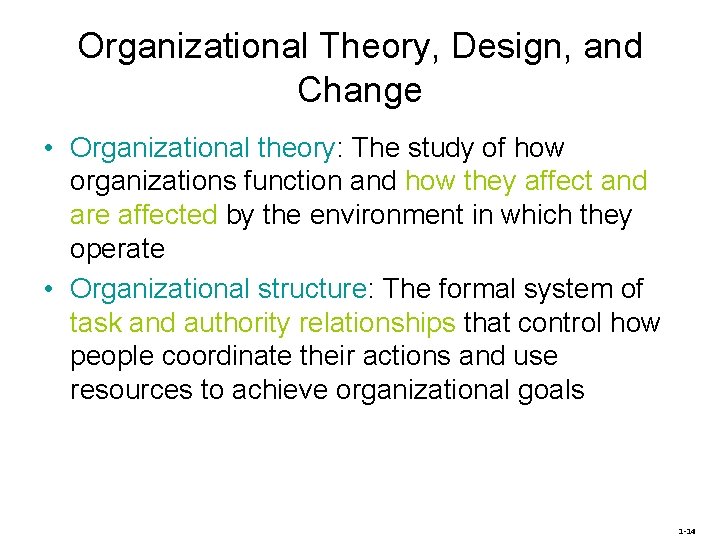
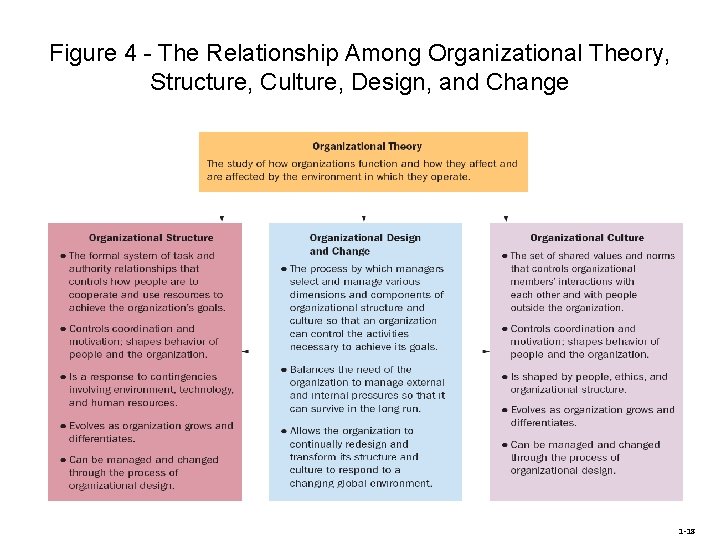
Organizational Theory, Design, and Change • Organizational theory: The study of how organizations function and how they affect and are affected by the environment in which they operate • Organizational structure: The formal system of task and authority relationships that control how people coordinate their actions and use resources to achieve organizational goals 1 -14
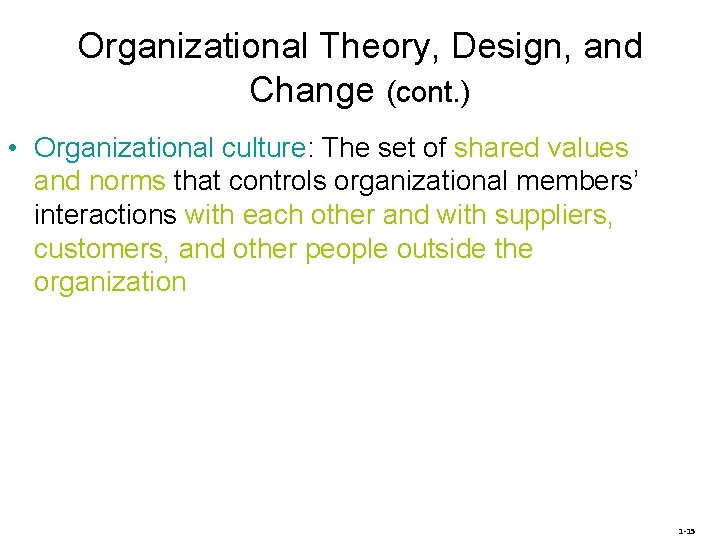
Organizational Theory, Design, and Change (cont. ) • Organizational culture: The set of shared values and norms that controls organizational members’ interactions with each other and with suppliers, customers, and other people outside the organization 1 -15
Organizational Theory, Design, and Change (cont. ) • Organizational design: The process by which managers select and manage aspects of structure and culture so that an organization can control the activities necessary to achieve its goals 1 -16
Organizational Theory, Design, and Change (cont. ) • Organizational change: The process by which organizations redesign their structures and cultures to move from their present state to some desired future state to increase their effectiveness 1 -17
Figure 4 - The Relationship Among Organizational Theory, Structure, Culture, Design, and Change 1 -18
Importance of Organizational Design and Change • Dealing with contingencies – Contingency: An event that might occur and must be planned for – The design of an organization determines how effectively an organization is able to respond to various pressures in its environment and so obtain scarce resources – Challenges organizations must be ready to face • Globalization • Changing technology 1 -19
Importance of Organizational Design and Change (cont. ) • Gaining competitive advantage – Competitive advantage: The ability of one company to outperform another because its managers are able to create more value from the resources at their disposal – Core competences: Managers’ skills and abilities in value-creating activities – Strategy: The specific pattern of decisions and actions that managers take to use core competencies to achieve a competitive advantage and outperform competitors 1 -20
Importance of Organizational Design and Change (cont. ) • Managing diversity – Differences in the race, gender, and national origin of organizational members have important implications for organizational culture and effectiveness – Learning how to effectively utilize a diverse workforce can result in better decision making and more effective workforce 1 -21
Importance of Organizational Design and Change (cont. ) • Promoting efficiency, speed, and innovation – The better an organization functions, the more value it creates – The correct organizational design can lead to faster innovation and quickly get new products to market 1 -22
The Consequences of Poor Organizational Design • Decline of the organization • Talented employees leave to take positions in growing organizations • Resources become harder to acquire • The process of value creation slows down 1 -23
How do Managers Measure Organizational Effectiveness? • Control - Having control over the external environment and having the ability to attract resources and customers • Innovation - Developing an organization’s skills and capabilities so the organization can discover new products and processes 1 -24
How do Managers Measure Organizational Effectiveness? (cont. ) • Efficiency - Means developing modern production facilities using new information technologies that can produce and distribute a company’s products in a timely and costeffective manner 1 -25
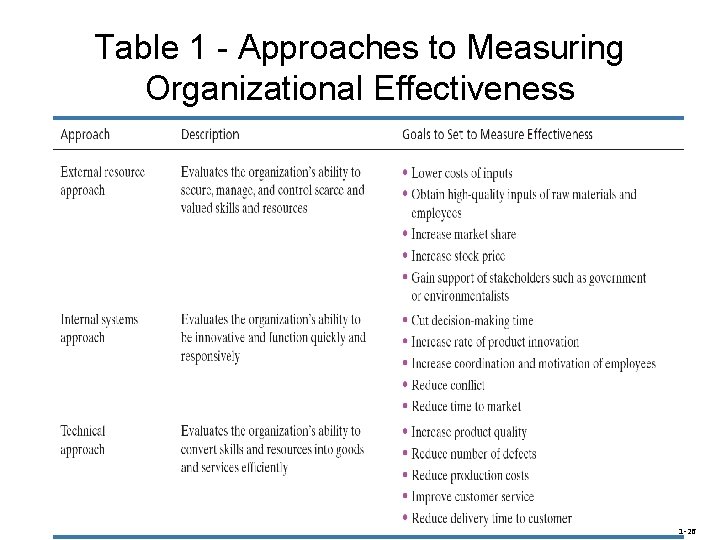
Table 1 - Approaches to Measuring Organizational Effectiveness 1 -26
Measuring Effectiveness: Organizational Goals • Official goals: Guiding principles that the organization formally states in its annual report and in other public documents • Mission: Goals that explain why the organization exists and what it should be doing • Operative goals: Specific long-term and shortterm goals that guide managers and employees as they perform the work of the organization 1 -27
Summary • Organizations are a tool people use to achieve their goals • Organizational theory is the study of how organizations function and how they affect and are affected by their environment • Organizational effectiveness must be monitored by managers 1 -31