Oklahoma Parents Center Inc Statewide Parent Training and




- Slides: 63
Oklahoma Parents Center, Inc. Statewide Parent Training and Information Center 1 -877 -553 -4332 *** www. Oklahoma. Parents. Center. org Putting Together the IEP Puzzle!!! A Training Series for Parents
Oklahoma Parents Center, Inc. Statewide Parent Training and Information Center 1 -877 -553 -4332 *** www. Oklahoma. Parents. Center. org Putting Together the IEP Puzzle!!! The contents of this presentation were developed, in part, under a grant from the U. S. Department of Education, #H 328 M 100005. However, those contents do not necessarily represent the policy of the U. S. Department of Education, and you should not assume endorsement by the Federal Government. Project Officer, David Emenheiser. This presentation is funded, in part, by a contract with the Oklahoma State Department of Education (OSDE). Views expressed in this presentation do not necessarily reflect the opinions of the OSDE.
Oklahoma Parents Center, Inc. Statewide Parent Training and Information Center 1 -877 -553 -4332 *** www. Oklahoma. Parents. Center. org 1) 2) 3) 4) Special Education 101 The IEP Meeting: An Overview The IEP: Step-by-Step through each Section Keeping it All Together: Record Keeping Basics
The Oklahoma Parents Center is dedicated to the equality of children and adults with disabilities. Our mission is to train, inform, educate and support parents, families, professionals and consumers in building partnerships that meet the needs of children and youth with the full range of disabilities ages birth through twenty-six.
Oklahoma Parents Center, Inc. Statewide Parent Training and Information Center 1 -877 -553 -4332 *** www. Oklahoma. Parents. Center. org The Individualized Education Program (IEP) Step-by-Step through each Section
Goals of this Training Overview of the IEP Discuss OK Ed. Plan Discuss each section of the IEP With special attention to: Assistive Technology Accommodations Informed Parental Consent
Overview of an IEP An Individualized Education Program (IEP) is a written document of the educational program designed to meet a child’s individual needs.
OK Ed. Plan is the online IEP system used by school districts to create, modify, and keep track of your child’s IEP.
Student Profile Section Look over all of the information about your child. Mistakes happen and it is best to get those fixed as soon as possible.
Overall Objective Statement Describe the student’s characteristics Behavioral Functional Social Current Clear Use Grade Level picture of the student this Statement as a Road Map
Current Assessments – Alternative Assessment – yes or no The OAAP Portfolio assessment is intended for a very small population of students with the most significant cognitive disabilities. Ask questions if you are unsure.
Current Assessments – Present Level of Performance Present Level of Academic Achievement and Functional Educational Performance § Inform and guide the development of the IEP § Should include results of statewide, districtwide, and individual assessments and evaluations § Address all areas of concern and success § Could also include preferences and interests
Current Descriptive Information Strengths Anticipated Effects Educational Needs Parent Concerns
Consideration of Special Factors for IEP Development Limited Blind English Proficiency or Visually Impaired Communication Deaf Needs or Hard of Hearing Assistive Technology Needs Behavior Issues
Consideration of Special Factors Limited English Proficiency #1 Limited English proficiency “Does the student have Limited English proficiency? ” Does he/she need a special education service to address language needs as they relate to the IEP?
Consideration of Special Factors Blindness or Visual impairment #2 Blindness or visual impairment “Is the student blind or visually impaired? ” Does he/she need instruction in Braille and the use of Braille?
Consideration of Special Factors Communication needs #3 Communication needs “Does the student have communication needs? ” Does the student need a particular device or service to address his/her communication needs?
Consideration of Special Factors Deafness #4 Deafness “Is the student deaf or hard of hearing? ” Does the student need a particular device or service for direct communication with peers and professional personnel in the student’s language and communication mode?
Consideration of Special Factors Assistive Technology #5 Assistive technology “Has the Team determined that Assistive Technology is necessary to implement the student’s IEP? ” a. “If Assistive Technology is required to implement the IEP, describe the Assistive Technology, devices and services that are needed.
Consideration of Special Factors Behavior #6 Behavior “Does the student’s behavior impede his/her learning or that of others? Does the student need strategies including positive behavioral interventions, supports and other strategies?
Consideration of Special Factors Service Required #7 Services Required “For any primary question above marked yes, are services required on the IEP? ” a. “If yes, define services that will be provided through this IEP. ” b. Make sure AT is included as part of the supplemental aids and services on the “services” section.
Annual Goals Annual Goal(s) A goal is a written, measurable statement that describes what a student is reasonably expected to accomplish with the time period covered by the IEP that is related to the needs described in the present levels of performance statements.
Annual Goals – (cont. ) Area of Need Person/Position Responsible ESY Score How will progress be measured? Overall Goal Comments Informed Type Target Score Progress Frequency
Annual Goals - Objectives are the interim steps a child will take to reach an annual goal. They also serve as a measurement gauge to monitor a child’s progress and determine if the child is making sufficient progress towards attaining an annual goal.
Annual Goals – Objective (cont. ) Score How will progress be measured? Begin End Type/Target Score Date ESY Overall Objective Comments
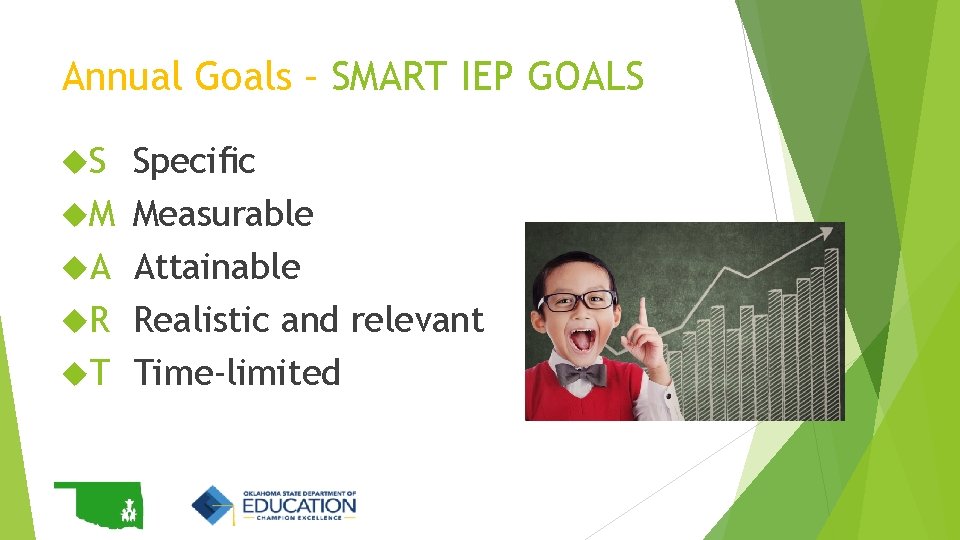
Annual Goals – SMART IEP GOALS S M A R T Specific Measurable Attainable Realistic and relevant Time-limited
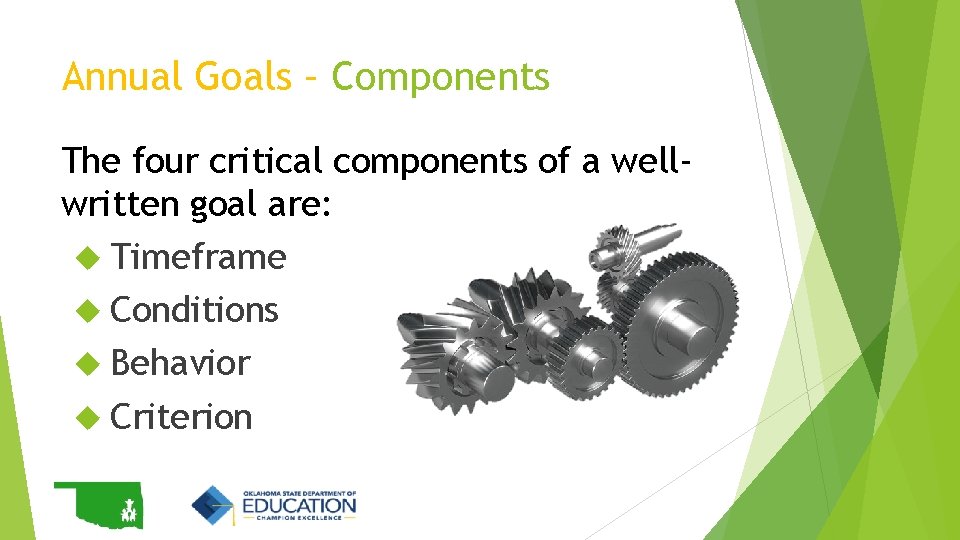
Annual Goals – Components The four critical components of a wellwritten goal are: Timeframe Conditions Behavior Criterion
Services and Supplemental Aids – IDEA Says The IEP must also contain a statement of the special education and related services and supplementary aids and services to be provided to the child, or on behalf of the child.
Services and Supplemental Aids That’s three separate, distinct, and critical elements: Special Education Services Related Services Supplemental Aids
Special Education Services Definition Special Education Services Special education is instruction that is specially designed to meet the unique needs of a child with a disability.
Special Education Services Specially Designed Instruction Service Type Number Sessions/Session Length Start Date/End Date Provider Title Location ESY
Related Services – Definition Related Services means transportation and such developmental, corrective, and other supportive services as are required to assist a child with a disability to benefit from special education.
Related Services Service Provided Service Type Number Sessions/Session Length Start Date/End Date Provider Title Location ESY
Supplemental Aids - Definition Supplemental Aids Supplementary aids and services are provided to enable children with disabilities to be educated with nondisabled children to the maximum extent appropriate.
Supplemental Aids Supplemental Aid Provided Number Sessions/Session Length Start Date/End Date Training Information Implementation Information
Services and Supplemental Aids – Physical Education Program Regular PE Adapted PE N/A
Services and Supplemental Aids – Shortened Day Is this student’s instructional week the same length as nondisabled peers? Yes No Length of the instructional week Description of Shortened Day
Accommodations – Program Participation Class/Activity Accommodation(s)
Accommodations - Definition An accommodation allows a student to complete the same assignment or test as other students, but with a change in the: Presentation; Response; Setting; and/or Timing and Scheduling.
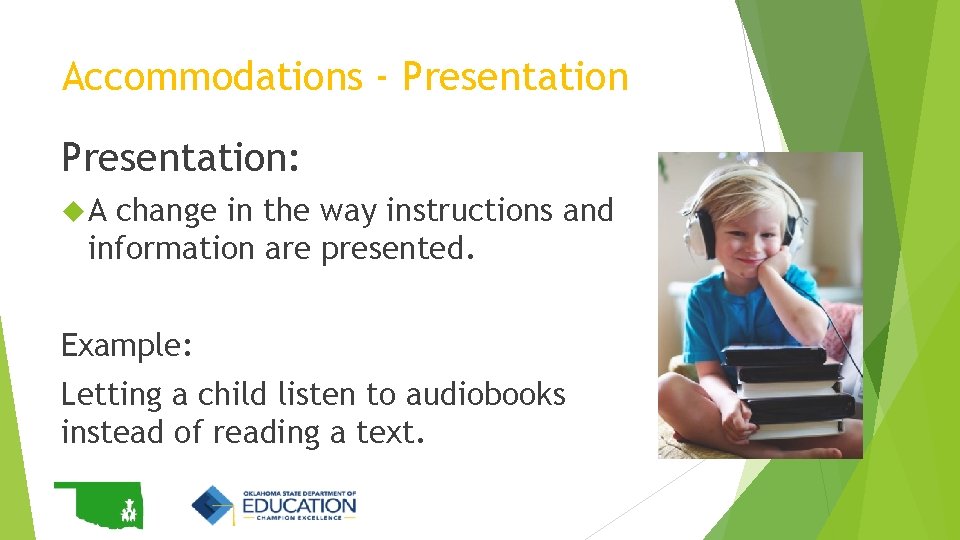
Accommodations - Presentation: A change in the way instructions and information are presented. Example: Letting a child listen to audiobooks instead of reading a text.
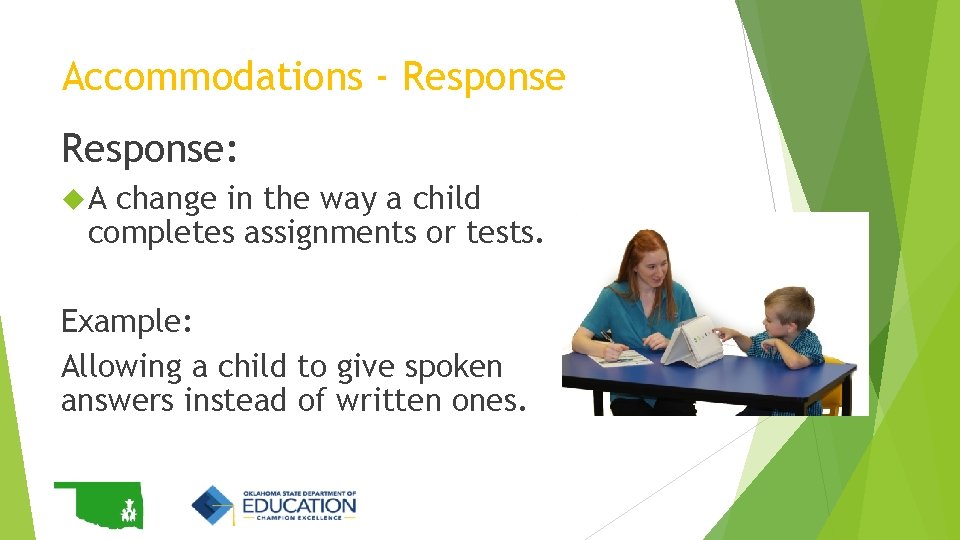
Accommodations - Response: A change in the way a child completes assignments or tests. Example: Allowing a child to give spoken answers instead of written ones.
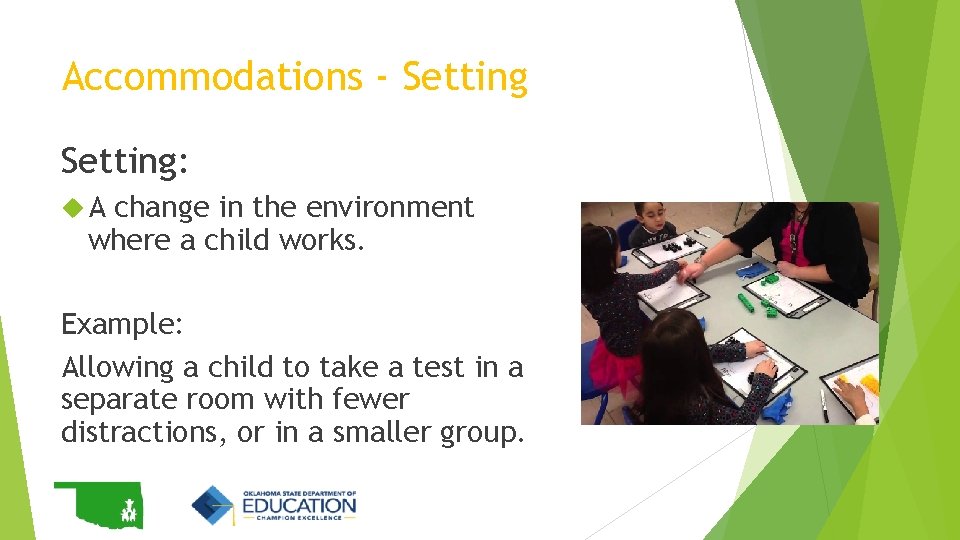
Accommodations - Setting: A change in the environment where a child works. Example: Allowing a child to take a test in a separate room with fewer distractions, or in a smaller group.
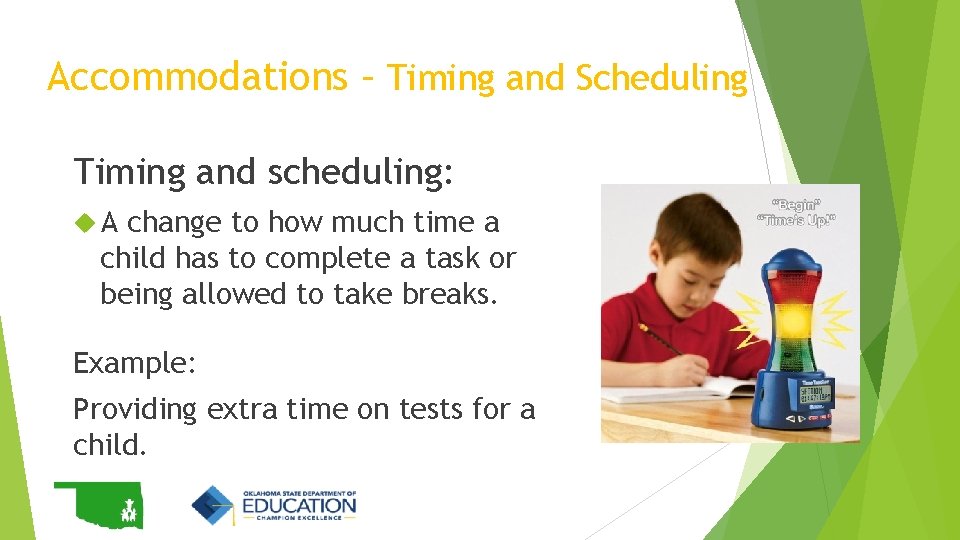
Accommodations – Timing and Scheduling Timing and scheduling: A change to how much time a child has to complete a task or being allowed to take breaks. Example: Providing extra time on tests for a child.
Accommodations DO NOT lower the expectations for what kids learn.
Accommodations – State/District Mandated Tests State/District Assessment Accommodation(s)
The use of accommodations is based on the individual needs of a student with a disability and may ONLY be provided when ALL of the following conditions have been met: The student has a disability that is documented in a current IEP. The student uses the accommodation routinely in the classroom. The accommodation is on the Assessment page of the IEP. The student requires the accommodation to participate in Oklahoma State Testing Program (OSTP). The accommodation is listed in accommodations manual (or the school received permission to use a unique accommodation not listed).
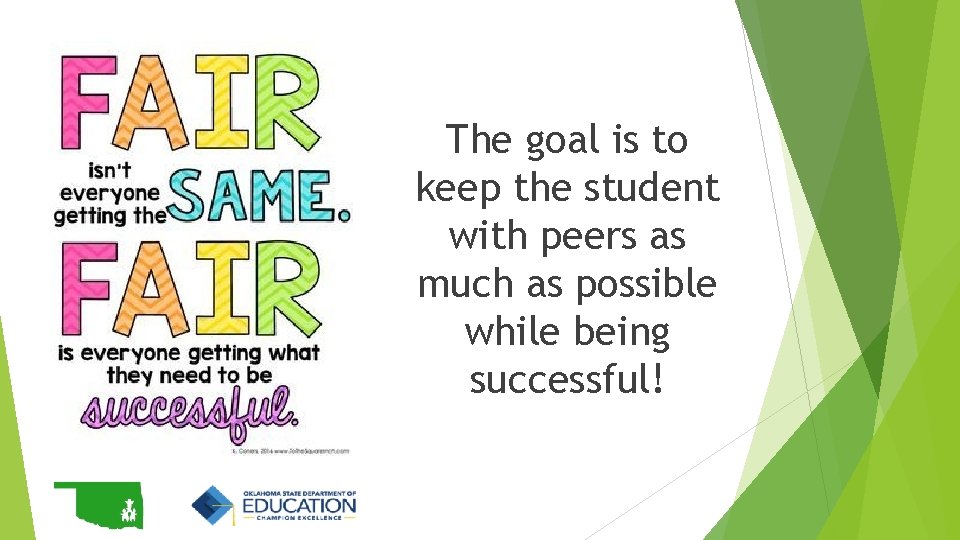
The goal is to keep the student with peers as much as possible while being successful!
Accommodations - Modifications A modification is an adjustment to an assignment or a test that changes what the assignment or test is supposed to measure (the standard).
Accommodation vs. modification what is the difference? Summary: Modifications and accommodations are not the same. Modifications change the learning expectation. Small percentage of the special education population require modifications. Be very selective when using modifications to ensure that the grade level content is not compromised.
Documentation of LRE Placement Considerations Regular Classes full-time or part-time Special Classes full-time or part-time Public/private separate day school facility Public/private residential facility Home instruction/hospital environment Correctional facility Parentally placed in private schools
Extended School Year - Definition Special education and related services that: Are provided to a child with a disability… Beyond the normal school year of the public agency (typically the school district); In accordance with a child’s IEP; At no cost to the parents of the child; and Meet the standards of the State Educational Agency.
Extended School Year Date ESY was/will be determined Student’s eligibility for ESY
Team Participant Signatures Position Team Participant Signature Date Agree Disagree
Team Participant Signatures Disagree Team members may submit separate statements as to why they disagree with the IEP as it is written.
Team Participant Signatures – Parents Who Did Not Attend If the parents did not attend, how else did they participant: Conference call Video conference Home visit
Informed Parental Consent Notice of Procedural Safeguards Parent Survey brochure Lindsey Nicole Henry Scholarship OSD/OSB Translation/Interpretation
Consent for Initial Placement Before initial services can begin, Parents must give consent. This consent is voluntary and can be revoked at any time.
Additional Meeting Attendees Signature Printed Date Purpose Name
How to contact us Oklahoma Parents Center, Inc. (OPC) P. O. Box 512 Holdenville, OK 74848 Phone: 877 -553 -4332 Email: info@oklahomaparentscenter. org
How to contact us - online Visit our Web Site: www. Oklahoma. Parents. Center. org Follow us on Facebook: www. facebook. com/Ok. Parents. Center/
How to contact us - personal Latisha Coats Director of Federal and State Programs Phone: 405 -712 -8050 Email: lcoats@oklahomaparentscenter. org
What’s Next – Keeping it All Together: Record Keeping Basics
Thank you for attending!