
Oklahoma Career Tech System CAREERTECH SYSTEM Oklahomas Career

- Slides: 23
Oklahoma Career. Tech System
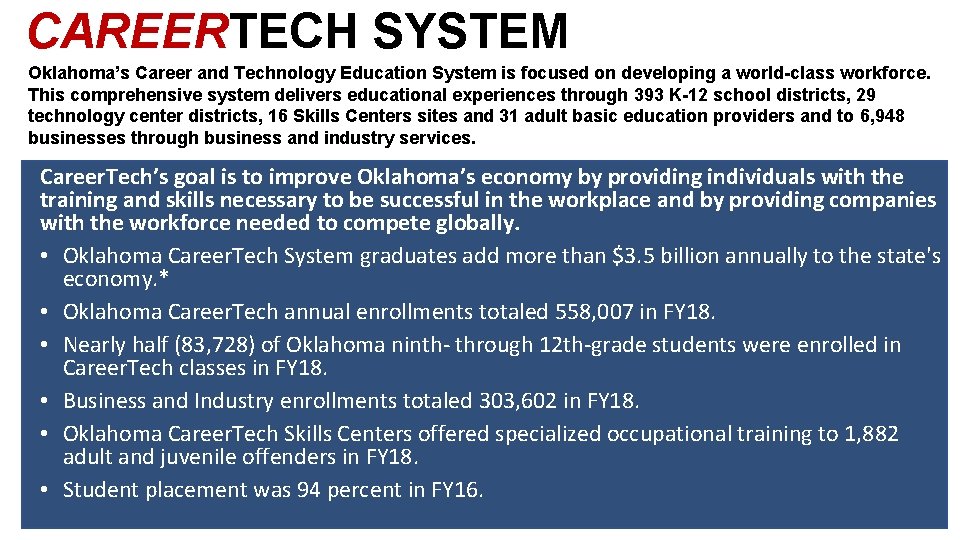
CAREERTECH SYSTEM Oklahoma’s Career and Technology Education System is focused on developing a world-class workforce. This comprehensive system delivers educational experiences through 393 K-12 school districts, 29 technology center districts, 16 Skills Centers sites and 31 adult basic education providers and to 6, 948 businesses through business and industry services. Career. Tech’s goal is to improve Oklahoma’s economy by providing individuals with the training and skills necessary to be successful in the workplace and by providing companies with the workforce needed to compete globally. • Oklahoma Career. Tech System graduates add more than $3. 5 billion annually to the state's economy. * • Oklahoma Career. Tech annual enrollments totaled 558, 007 in FY 18. • Nearly half (83, 728) of Oklahoma ninth- through 12 th-grade students were enrolled in Career. Tech classes in FY 18. • Business and Industry enrollments totaled 303, 602 in FY 18. • Oklahoma Career. Tech Skills Centers offered specialized occupational training to 1, 882 adult and juvenile offenders in FY 18. • Student placement was 94 percent in FY 16.
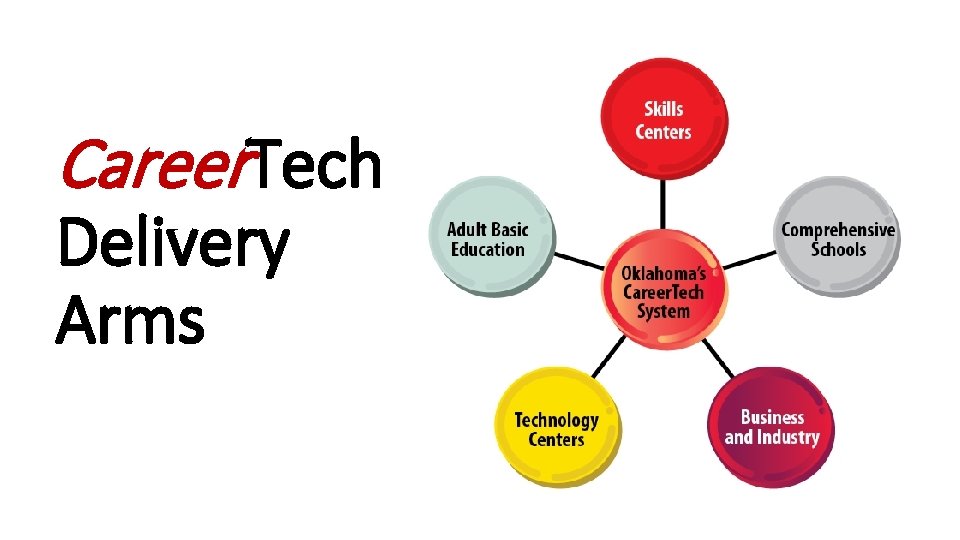
Career. Tech Delivery Arms
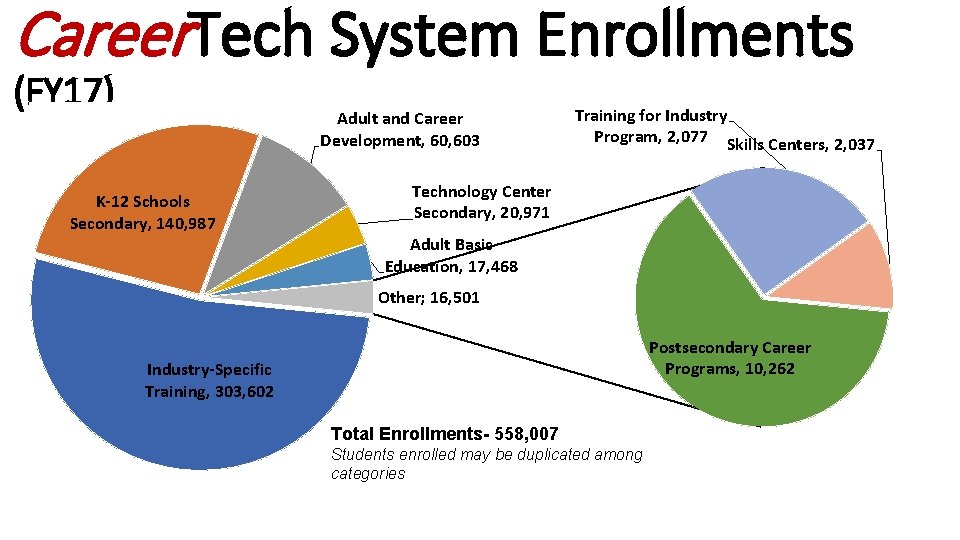
Career. Tech System Enrollments (FY 17) Adult and Career Development, 603 K-12 Schools Secondary, 140, 987 Training for Industry Program, 2, 077 Skills Centers, 2, 037 Technology Center Secondary, 20, 971 Adult Basic Education, 17, 468 Other; 16, 501 Postsecondary Career Programs, 10, 262 Industry-Specific Training, 303, 602 Total Enrollments- 558, 007 Students enrolled may be duplicated among categories
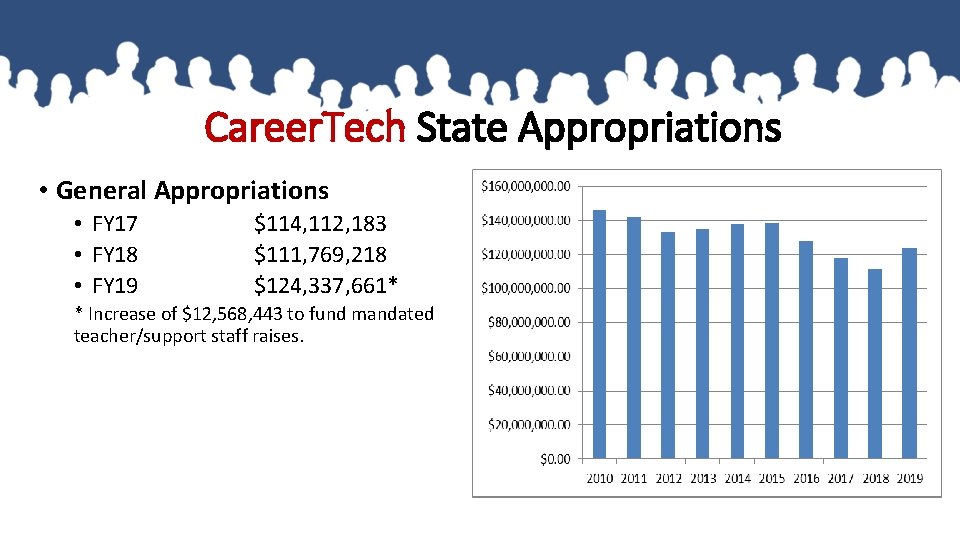
Career. Tech State Appropriations • General Appropriations • FY 17 • FY 18 • FY 19 $114, 112, 183 $111, 769, 218 $124, 337, 661* * Increase of $12, 568, 443 to fund mandated teacher/support staff raises.
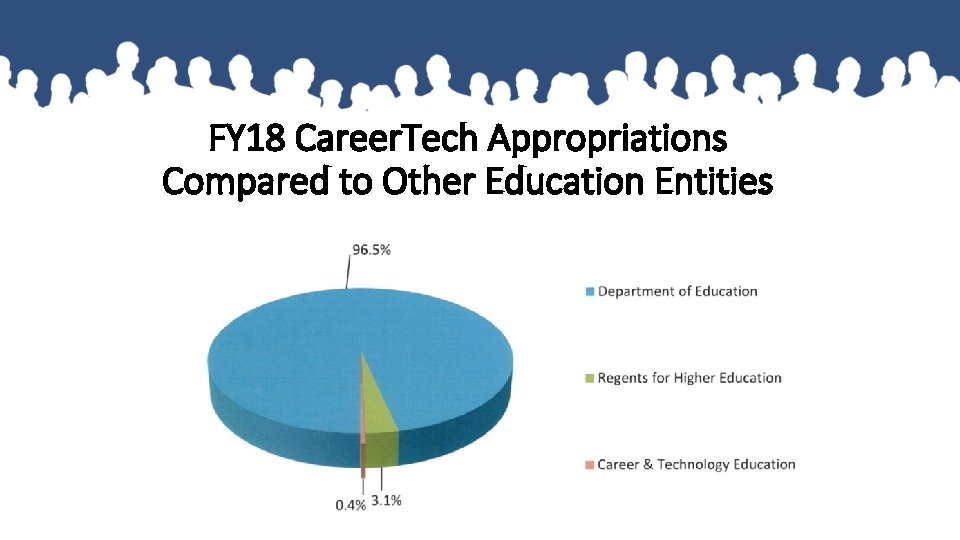
FY 18 Career. Tech Appropriations Compared to Other Education Entities
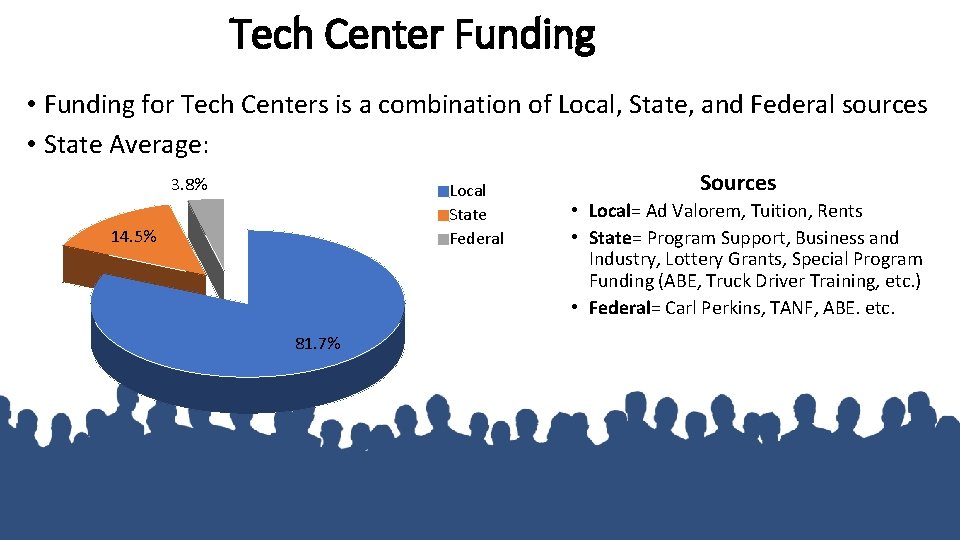
Tech Center Funding • Funding for Tech Centers is a combination of Local, State, and Federal sources • State Average: 3. 8% Local State Federal 14. 5% 81. 7% Sources • Local= Ad Valorem, Tuition, Rents • State= Program Support, Business and Industry, Lottery Grants, Special Program Funding (ABE, Truck Driver Training, etc. ) • Federal= Carl Perkins, TANF, ABE. etc.
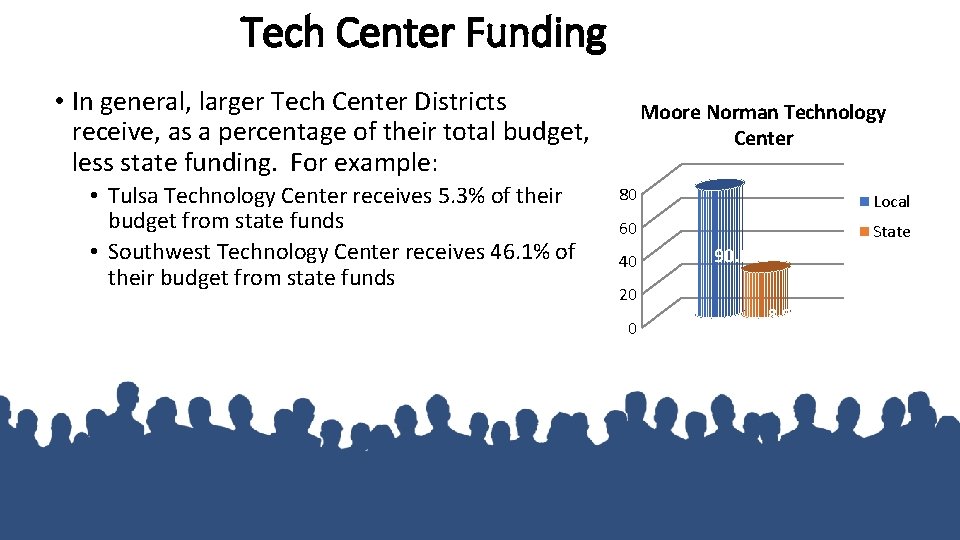
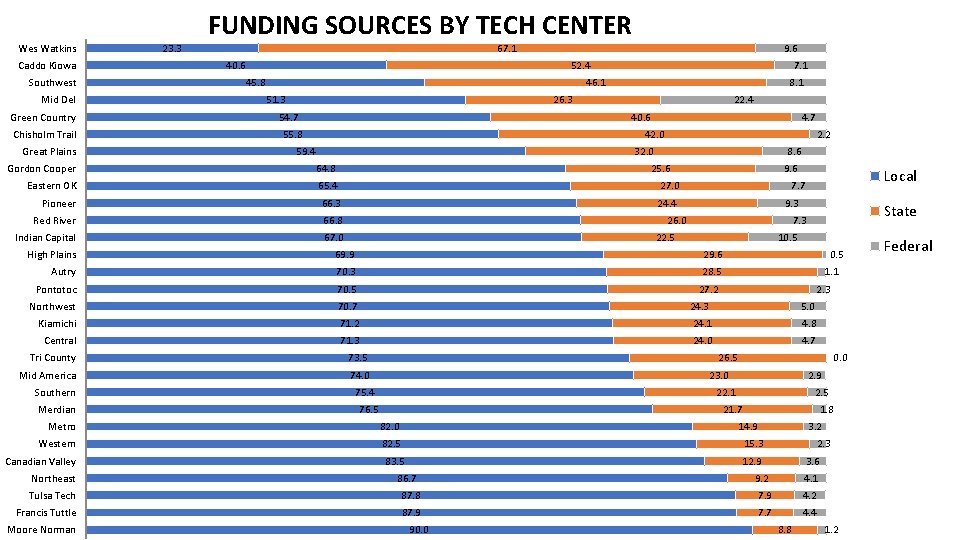
Tech Center Funding • In general, larger Tech Center Districts receive, as a percentage of their total budget, less state funding. For example: • Tulsa Technology Center receives 5. 3% of their budget from state funds • Southwest Technology Center receives 46. 1% of their budget from state funds Moore Norman Technology Center 80 Local 60 State 40 20 0 90. 0 8. 8
Wes Watkins Caddo Kiowa Southwest Mid Del Green Country Chisholm Trail Great Plains 23. 3 FUNDING SOURCES BY TECH CENTER 67. 1 40. 6 9. 6 52. 4 45. 8 7. 1 46. 1 51. 3 8. 1 26. 3 54. 7 22. 4 40. 6 55. 8 4. 7 42. 0 59. 4 2. 2 32. 0 Gordon Cooper 64. 8 Eastern OK 65. 4 8. 6 25. 6 9. 6 27. 0 Pioneer 66. 3 Red River 66. 8 Indian Capital 67. 0 Local 7. 7 24. 4 9. 3 26. 0 State 7. 3 22. 5 10. 5 High Plains 69. 9 29. 6 Autry 70. 3 28. 5 Pontotoc 70. 5 Northwest 70. 7 24. 3 5. 0 Kiamichi 71. 2 24. 1 4. 8 Central 71. 3 24. 0 4. 7 73. 5 Mid America 74. 0 Merdian 0. 0 23. 0 75. 4 2. 9 22. 1 76. 5 21. 7 82. 0 Western 82. 5 Northeast 2. 3 26. 5 Metro Canadian Valley 1. 1 27. 2 Tri County Southern 0. 5 1. 8 14. 9 3. 2 15. 3 83. 5 2. 3 12. 9 86. 7 3. 6 9. 2 4. 1 Tulsa Tech 87. 8 7. 9 4. 2 Francis Tuttle 87. 9 7. 7 4. 4 Moore Norman 90. 0 8. 8 1. 2 Federal
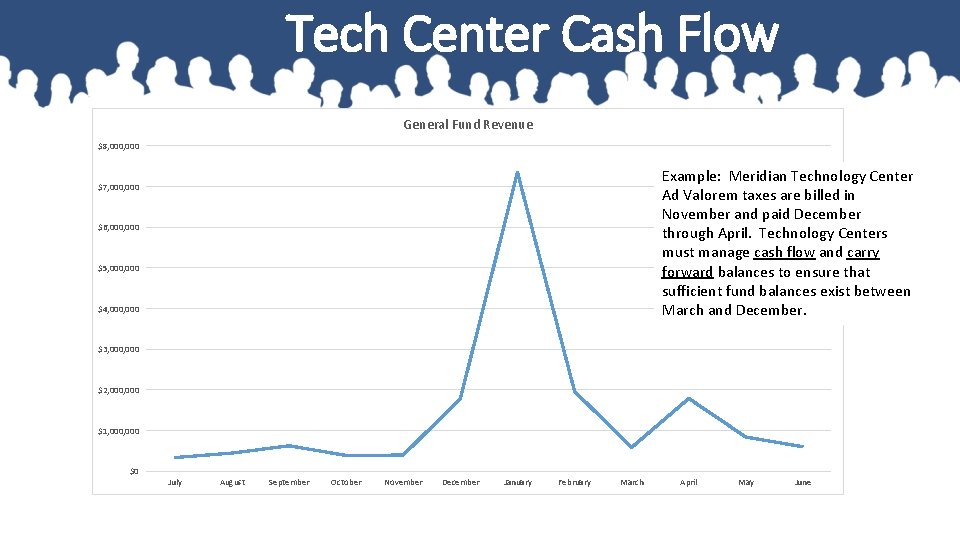
Tech Center Cash Flow General Fund Revenue $8, 000 Example: Meridian Technology Center Ad Valorem taxes are billed in November and paid December through April. Technology Centers must manage cash flow and carry forward balances to ensure that sufficient fund balances exist between March and December. $7, 000 $6, 000 Need Content $5, 000 $4, 000 $3, 000 $2, 000 $1, 000 $0 July August September October November December January February March April May June
Building Fund Expenditures Program equipment No State Funds are used for capital improvement or new construction Capital expenditures for Technology Centers. Capital expenditures are primarily paid for through local sources: Building Funds and/or Bond Issues. • In FY 17, only 3 Tech Centers had proceeds from sinking funds. Most Tech Centers accumulate required funds for building projects BEFORE the project is done. • More Tech Centers are now utilizing revenue lease financing in order to construct facilities, thus leveraging future known revenue, to avoid inflationary costs associated with the “save and build” method. • •
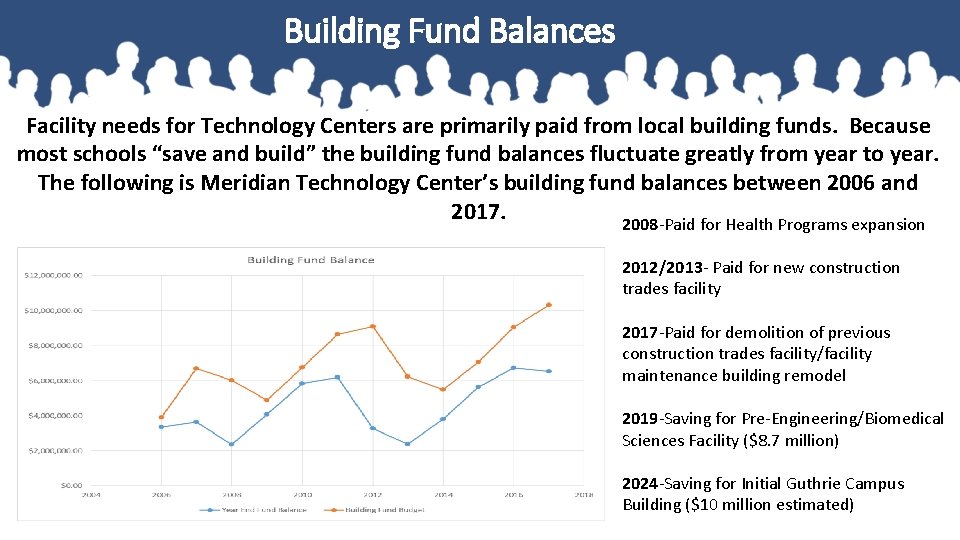
Building Fund Balances Facility needs for Technology Centers are primarily paid from local building funds. Because most schools “save and build” the building fund balances fluctuate greatly from year to year. The following is Meridian Technology Center’s building fund balances between 2006 and 2017. 2008 -Paid for Health Programs expansion 2012/2013 - Paid for new construction trades facility 2017 -Paid for demolition of previous construction trades facility/facility maintenance building remodel 2019 -Saving for Pre-Engineering/Biomedical Sciences Facility ($8. 7 million) 2024 -Saving for Initial Guthrie Campus Building ($10 million estimated)
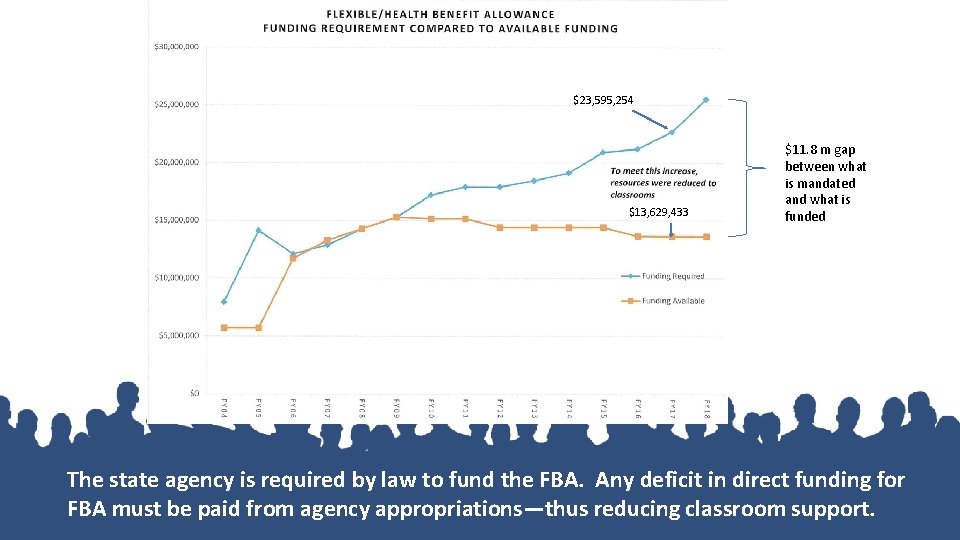
$23, 595, 254 $13, 629, 433 $11. 8 m gap between what is mandated and what is funded The state agency is required by law to fund the FBA. Any deficit in direct funding for FBA must be paid from agency appropriations—thus reducing classroom support.
Career. Tech Student Organizations (CTSO) 88, 000 students strong
Technology Centers 363, 439 Enrollments • Each Tech Center District was formed as a result of a vote of the people within the district they serve. • Affords all students access to a wider array of high quality Career. Tech programs • Tech Center funding is separate and apart from funding that goes to K-12 schools (not competing for tax dollars) • High school-age students living within the Tech Center’s district (including home-school and private school students) attend tuition free and transportation is provided. • Adult students living with in the Tech Center’s district pay tuition. • Many high school and adult students earn college credit through their Tech Center programs. • Programs offered at each Tech Center vary based upon local demographics and employer needs. • Tech Centers offer customized training for businesses and entrepreneurs located within their districts.
K-12 Career. Tech Programs 139, 598 Enrollments • Career. Tech programs at comprehensive schools (K-12) are primarily funded through the comprehensive schools funding stream. The Oklahoma Department of Career. Tech provides, from it’s state allocation, program support funds. These are intended to assist the comprehensive school districts with the additional costs associated with Career. Tech programs (equipment/facilities/instructional support). • The level of support to each type of CTE program (Ag/FFA, Family Consumer Sciences, Business/Marketing, etc) varies based upon program costs. For example, a funded agriculture education program currently receives $19, 055/year. • There a number of CTE programs currently being offered at comprehensive schools that are “approved” but not funded. • Teacher salaries for comprehensive school CTE programs are paid by the local school district and any state contributions (FBA, pay increases, etc. ) are included in the State Department of Education’s appropriations.
Skills Center Programs 1, 182 Enrollments 15 Locations • Skills Center Programs are administered through the Oklahoma Department of Career. Tech. • Funding comes from a combination of state allocations and contracts with the correctional facility. • Instructor-related costs are included in the State Department of Career. Tech’s appropriations.
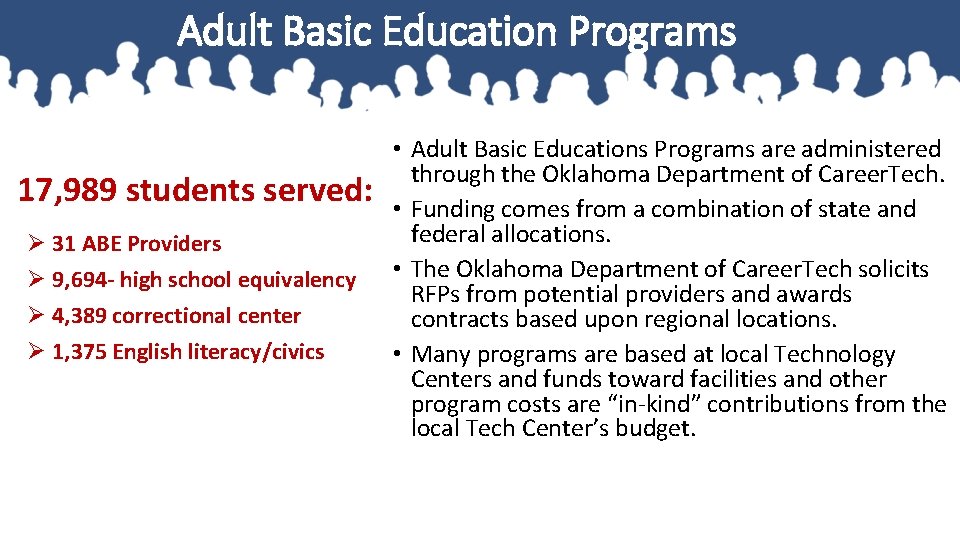
Adult Basic Education Programs 17, 989 students served: Ø 31 ABE Providers Ø 9, 694 - high school equivalency Ø 4, 389 correctional center Ø 1, 375 English literacy/civics • Adult Basic Educations Programs are administered through the Oklahoma Department of Career. Tech. • Funding comes from a combination of state and federal allocations. • The Oklahoma Department of Career. Tech solicits RFPs from potential providers and awards contracts based upon regional locations. • Many programs are based at local Technology Centers and funds toward facilities and other program costs are “in-kind” contributions from the local Tech Center’s budget.
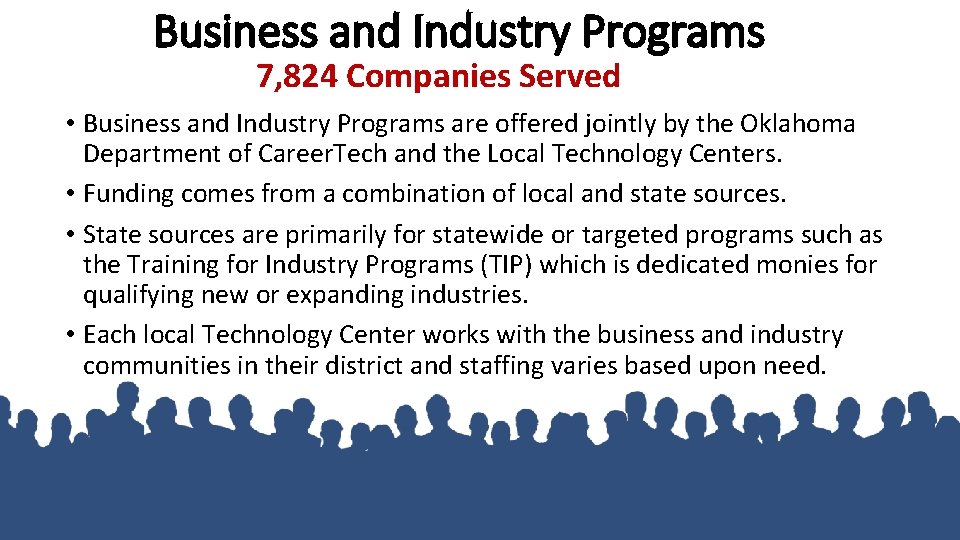
Business and Industry Programs 7, 824 Companies Served • Business and Industry Programs are offered jointly by the Oklahoma Department of Career. Tech and the Local Technology Centers. • Funding comes from a combination of local and state sources. • State sources are primarily for statewide or targeted programs such as the Training for Industry Programs (TIP) which is dedicated monies for qualifying new or expanding industries. • Each local Technology Center works with the business and industry communities in their district and staffing varies based upon need.
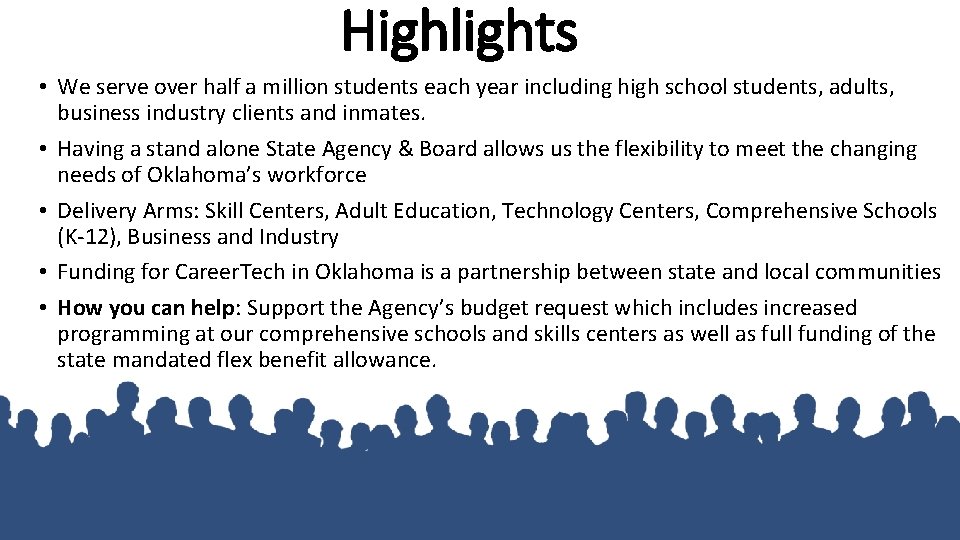
Highlights • We serve over half a million students each year including high school students, adults, business industry clients and inmates. • Having a stand alone State Agency & Board allows us the flexibility to meet the changing needs of Oklahoma’s workforce • Delivery Arms: Skill Centers, Adult Education, Technology Centers, Comprehensive Schools (K-12), Business and Industry • Funding for Career. Tech in Oklahoma is a partnership between state and local communities • How you can help: Support the Agency’s budget request which includes increased programming at our comprehensive schools and skills centers as well as full funding of the state mandated flex benefit allowance.
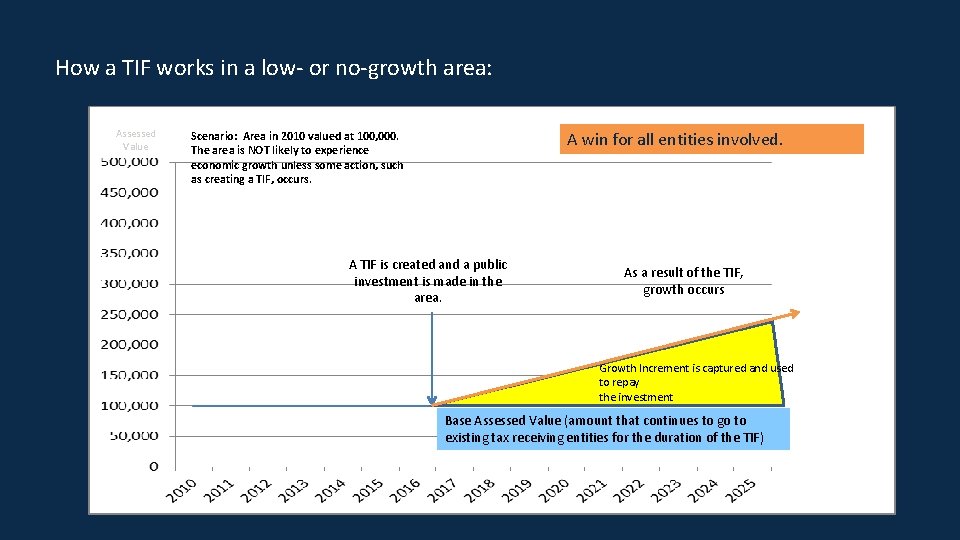
How a TIF works in a low- or no-growth area: Assessed Value A win for all entities involved. Scenario: Area in 2010 valued at 100, 000. The area is NOT likely to experience economic growth unless some action, such as creating a TIF, occurs. A TIF is created and a public investment is made in the area. As a result of the TIF, growth occurs Growth Increment is captured and used to repay the investment Base Assessed Value (amount that continues to go to existing tax receiving entities for the duration of the TIF)
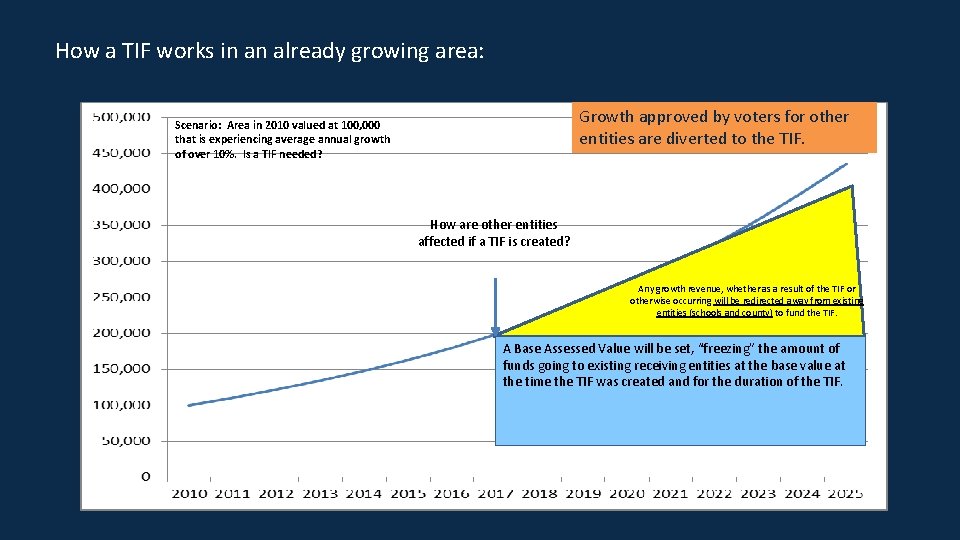
How a TIF works in an already growing area: Growth approved by voters for other entities are diverted to the TIF. Scenario: Area in 2010 valued at 100, 000 that is experiencing average annual growth of over 10%. Is a TIF needed? How are other entities affected if a TIF is created? Any growth revenue, whether as a result of the TIF or otherwise occurring will be redirected away from existing entities (schools and county) to fund the TIF. A Base Assessed Value will be set, “freezing” the amount of funds going to existing receiving entities at the base value at the time the TIF was created and for the duration of the TIF.
Thank you! We understand the important role you play and we appreciate your time and service.