Nk Queens Reflections Doug Chatham Morehead State University
- Slides: 23
N+k Queens Reflections Doug Chatham Morehead State University August 1, 2008
Acknowledgments n n This work is part of research partially supported by an NSF KY-EPSCo. R Research Enhancement Grant. This is part of joint work with Blankenship, Doyle, Fricke, Hufford, Miller, Skaggs, Ward, Wahle, et. al.
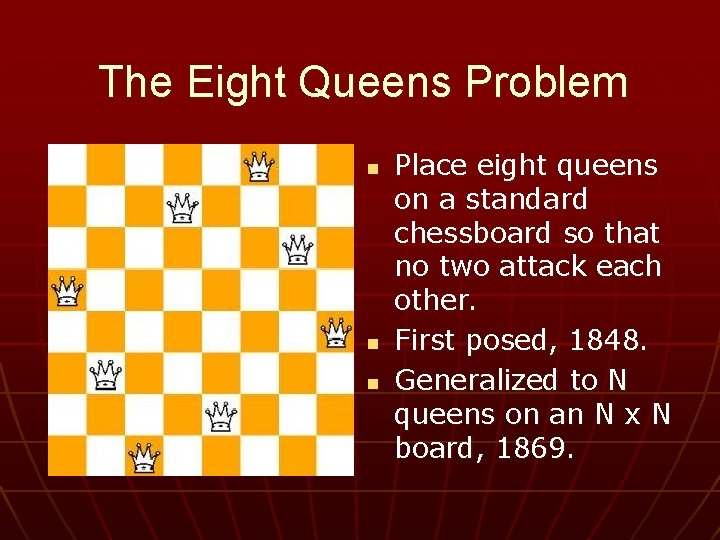
The Eight Queens Problem n n n Place eight queens on a standard chessboard so that no two attack each other. First posed, 1848. Generalized to N queens on an N x N board, 1869.
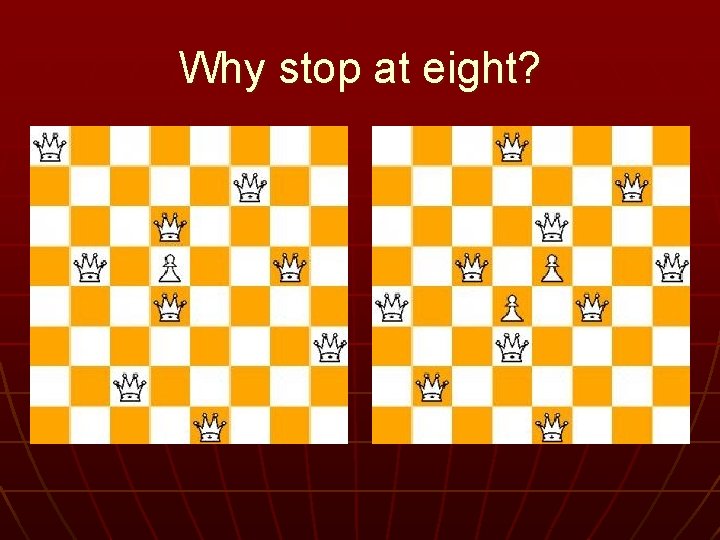
Why stop at eight?
N+k queens n Theorem: For each k, for large enough N we can place k pawns and N+k queens and an N-by-N board so that no two queens attack each other.
Symmetries of N-queens solutions n Kraitchik (1954) classified solutions to the n-queens problem into 3 types: • Ordinary • Centrosymmetric • Doubly centrosymmetric
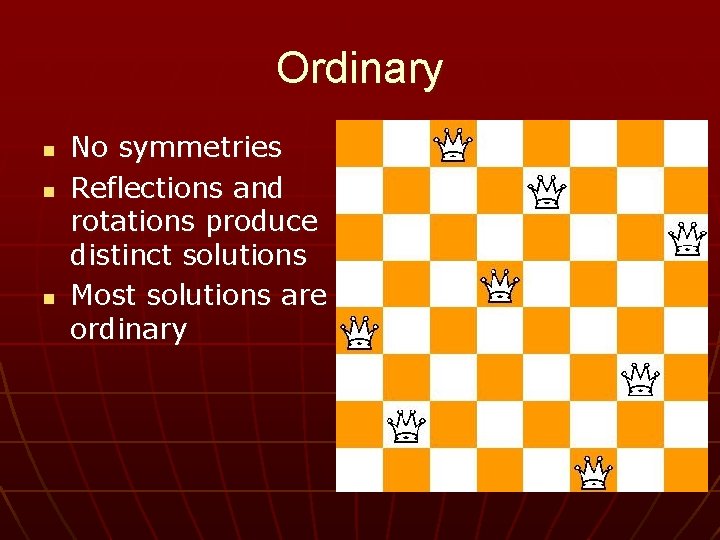
Ordinary n n n No symmetries Reflections and rotations produce distinct solutions Most solutions are ordinary
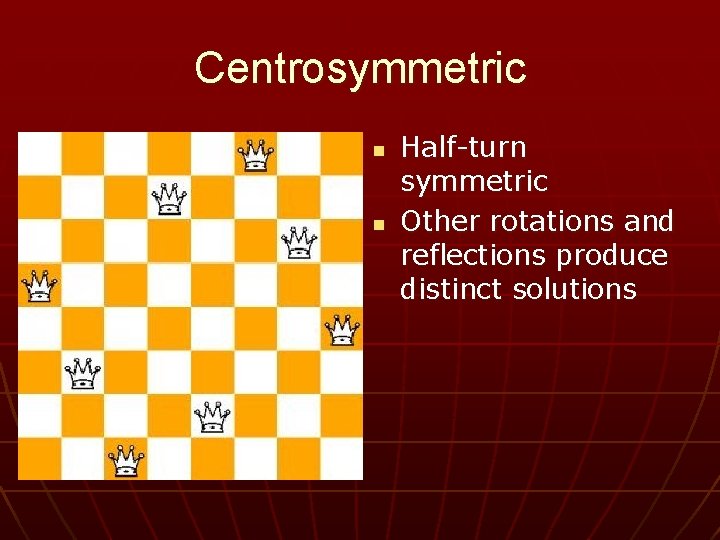
Centrosymmetric n n Half-turn symmetric Other rotations and reflections produce distinct solutions
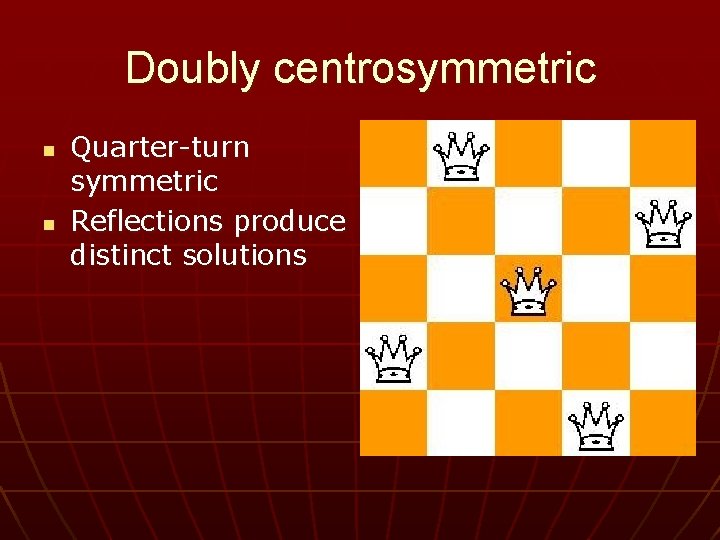
Doubly centrosymmetric n n Quarter-turn symmetric Reflections produce distinct solutions
What about N+k queens solutions? n n Reflections always produce distinct solutions (except for the trivial solution: N=1). All (nontrivial) solutions are either ordinary, centrosymmetric, or doubly centrosymmetric.
Alternating Lemma (AL) n Given a solution to the N+k queens problem: • The first and last piece in each row and column is a queen • Two pawns in the same row (column) have at least one queen between them • Two queens in the same row, column, or diagonal have at least one pawn between them
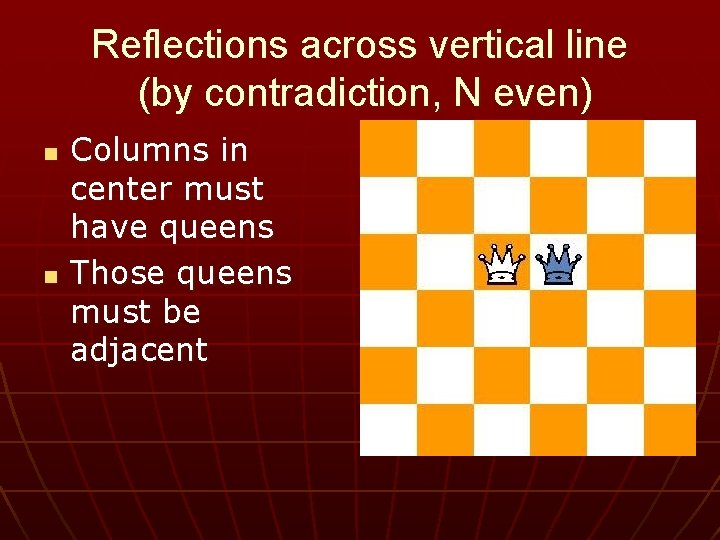
Reflections across vertical line (by contradiction, N even) n n Columns in center must have queens Those queens must be adjacent
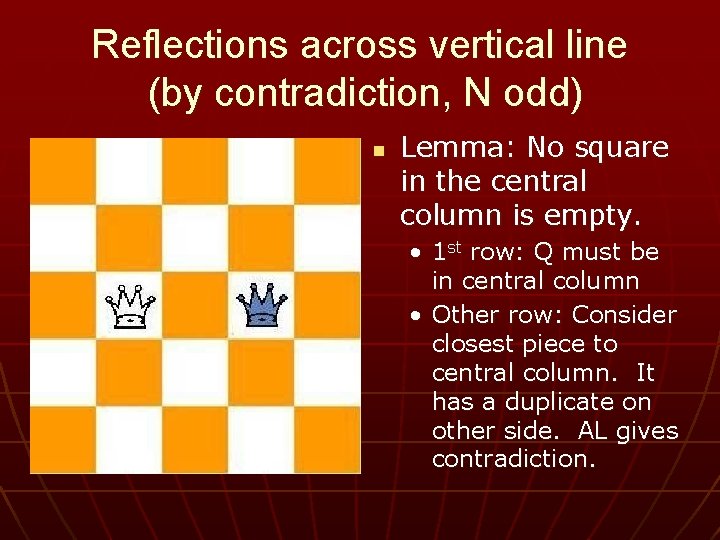
Reflections across vertical line (by contradiction, N odd) n Lemma: No square in the central column is empty. • 1 st row: Q must be in central column • Other row: Consider closest piece to central column. It has a duplicate on other side. AL gives contradiction.
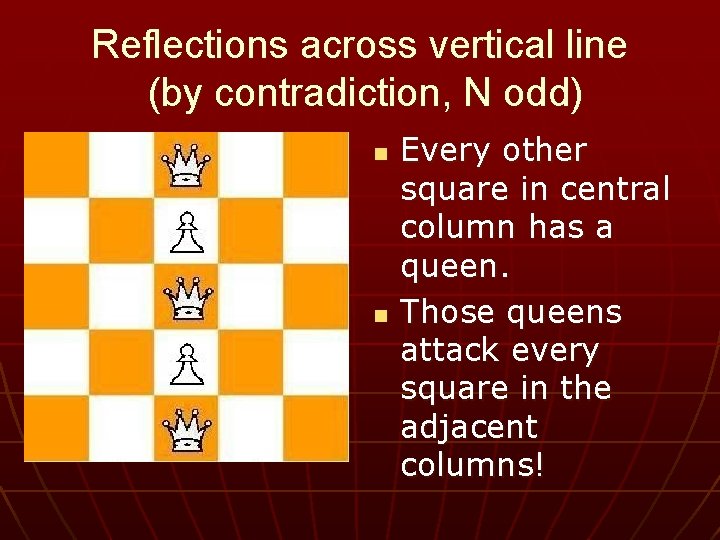
Reflections across vertical line (by contradiction, N odd) n n Every other square in central column has a queen. Those queens attack every square in the adjacent columns!
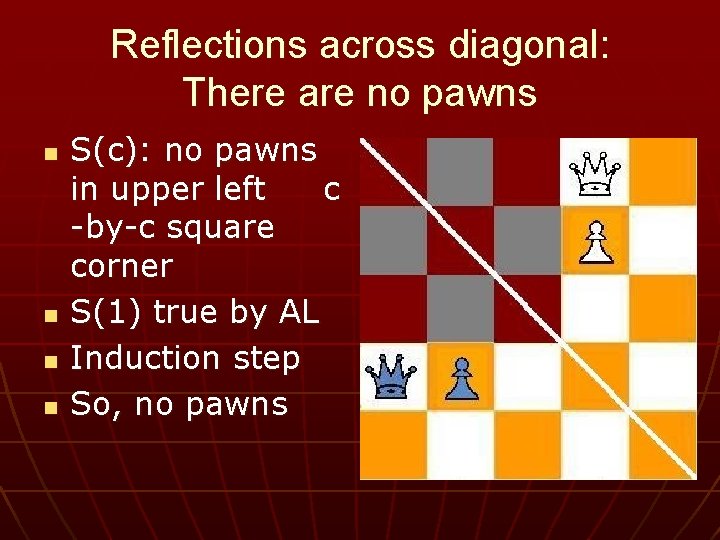
Reflections across diagonal: There are no pawns n n S(c): no pawns in upper left c -by-c square corner S(1) true by AL Induction step So, no pawns
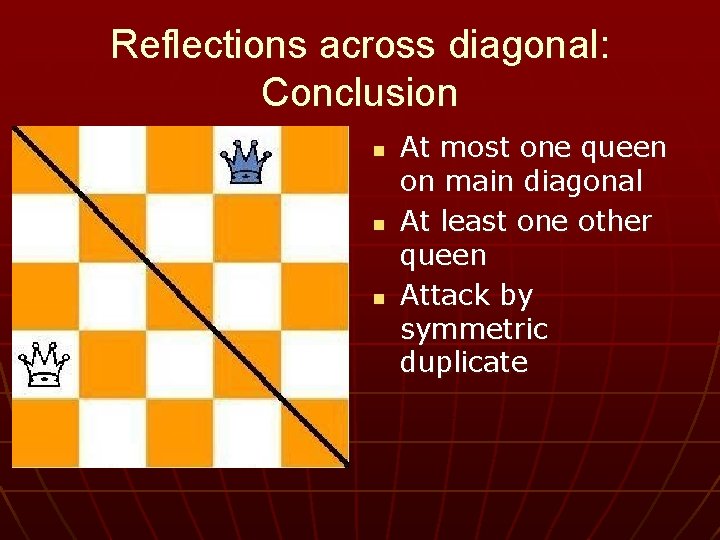
Reflections across diagonal: Conclusion n At most one queen on main diagonal At least one other queen Attack by symmetric duplicate
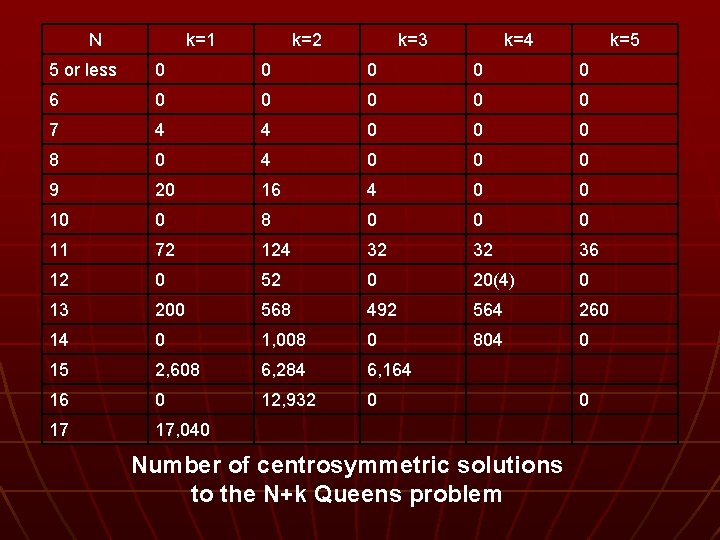
N k=1 k=2 k=3 k=4 k=5 5 or less 0 0 0 6 0 0 0 7 4 4 0 0 0 8 0 4 0 0 0 9 20 16 4 0 0 10 0 8 0 0 0 11 72 124 32 32 36 12 0 52 0 20(4) 0 13 200 568 492 564 260 14 0 1, 008 0 804 0 15 2, 608 6, 284 6, 164 16 0 12, 932 0 0 17 17, 040 Number of centrosymmetric solutions to the N+k Queens problem
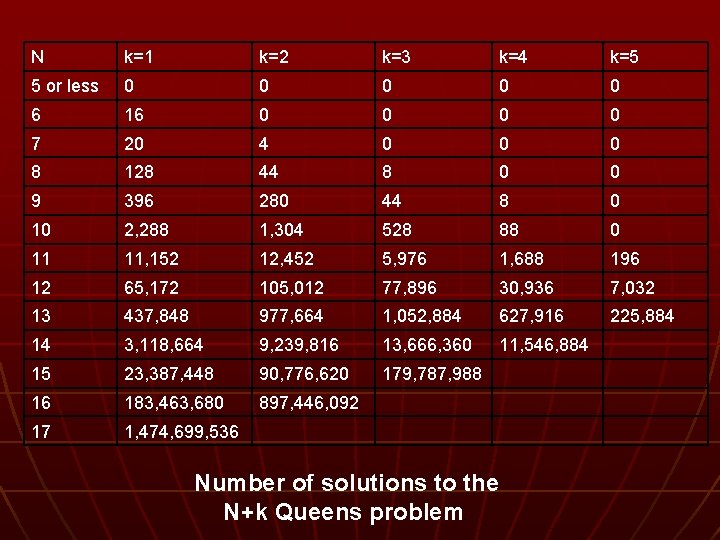
N k=1 k=2 k=3 k=4 k=5 5 or less 0 0 0 6 16 0 0 7 20 4 0 0 0 8 128 44 8 0 0 9 396 280 44 8 0 10 2, 288 1, 304 528 88 0 11 11, 152 12, 452 5, 976 1, 688 196 12 65, 172 105, 012 77, 896 30, 936 7, 032 13 437, 848 977, 664 1, 052, 884 627, 916 225, 884 14 3, 118, 664 9, 239, 816 13, 666, 360 11, 546, 884 15 23, 387, 448 90, 776, 620 179, 787, 988 16 183, 463, 680 897, 446, 092 17 1, 474, 699, 536 Number of solutions to the N+k Queens problem.
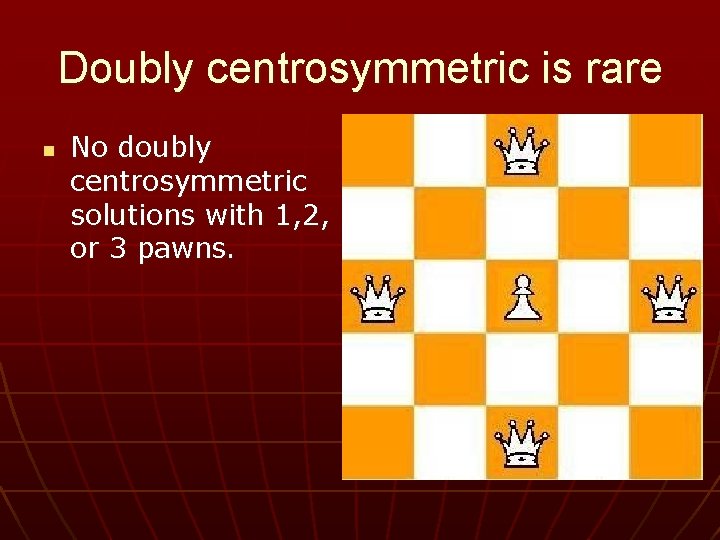
Doubly centrosymmetric is rare n No doubly centrosymmetric solutions with 1, 2, or 3 pawns.
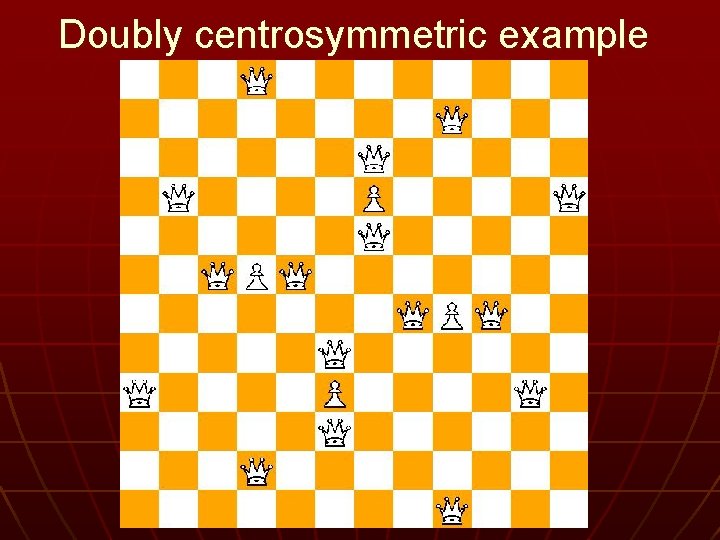
Doubly centrosymmetric example
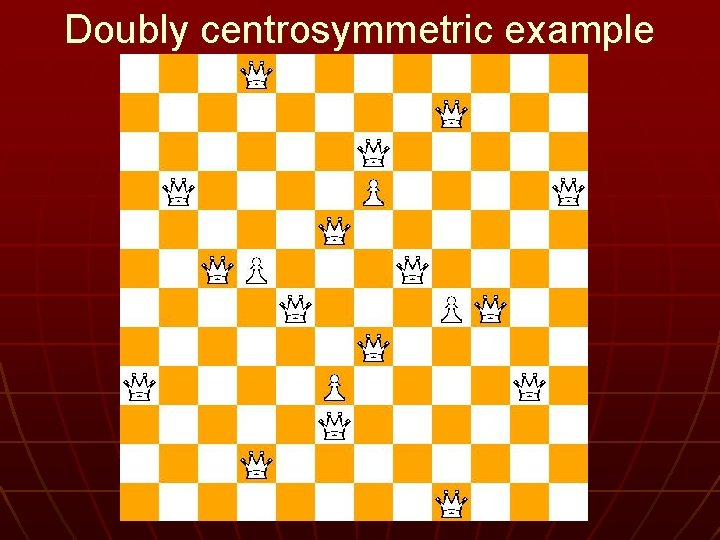
Doubly centrosymmetric example
References n n J. Bell, B. Stevens, A survey of known results and research areas for n-queens, Discrete Mathematics (2008), doi: 10. 1016/j. disc. 2007. 12. 043. G. Kuperberg, Symmetry classes of alternating-sign matrices under one roof, Annals of Mathematics (2) 156 (2002), no. 3, 835– 866. J. J. Watkins, Across the Board: The Mathematics of Chessboard Problems, Princeton University Press (2004). The N+k Queens Problem Page, http: //npluskqueens. info.
Your move! n Any questions?