
Morehead State University Waste Disposal Guidelines Hazardous Waste

- Slides: 78
Morehead State University Waste Disposal Guidelines & Hazardous Waste Management Office of Environmental Health & Safety BCB 113 ehs@moreheadstate. edu 606‐ 783‐ 2179 Effective November 2019
Purpose of Training • Understand history of hazardous waste disposal at MSU & how hazardous waste disposal will be handled going forward • Understand employee & university responsibilities when it comes to hazardous waste • Understand how to identify hazardous waste • Understand the required steps for hazardous waste disposal • Understand Emergency procedures & reporting requirements • Understand Universal and other wastes that have special disposal requirements
Basis & History • This training material is based on regulations enforced by the US Environmental Protection Agency and Kentucky Division of Waste Management. • MSU is permitted by the KY Department for Environmental Protection Division of Waste Management as a Large Quantity Generator (LQG) of hazardous waste in accordance with the Resource Conservation Recover Act (RCRA) and KRS Chapter 224. • Recently changed from SQG to LQG due to collection of old chemicals • Stockpiling and collecting old chemicals is prohibited – only order and keep what you need for the year
Responsibility • Responsibility for compliance with hazardous waste regulations begins with the individual researchers and employees who generate the waste material and continues through the transportation and disposal process. (Cradle to grave) • All MSU departments including faculty, staff and work study or graduate interns, must comply with this hazardous waste management manual or face disciplinary action, including possible suspension or dismissal from MSU and regulatory action from the KY Division of Waste Management and/or the US Environmental Protection Agency (USEPA). There is no exemption to these requirements for anyone at MSU.
What is a waste? • The first step in the management of hazardous waste is to determine whether a material is a waste. A waste is generally defined as a material which is discarded including materials that are either spent or intended to be thrown away. • Materials that are being used for their intended purpose or are otherwise still reusable are not considered waste. A waste can be a solid, liquid, semi‐solid or contained gaseous material.
What is a hazardous waste? • After determining if a material meets the definition of a waste, those responsible for generating the waste must determine if the waste is a hazardous waste. • A hazardous waste is a waste which falls into any of four specific listing descriptions (i. e. , “Listed”) and/or exhibits any of four hazardous waste characteristics (i. e. , “Characteristic”).
Listed Hazardous Waste • There are four different groups of listed hazardous waste which in total includes over 800 different substances: • F‐LISTED Waste originating from non‐specific sources. • P‐LISTED Waste that is acutely toxic. • K‐LISTED Waste originating from specific sources. • U‐LISTED Waste that is toxic.
Listed Hazardous Waste • P‐Listed waste is defined as acutely toxic and has significantly reduced accumulation thresholds (Refer to the discussion under Satellite Accumulation Area for limits). • The individual chemicals (and their corresponding Chemical Abstract Numbers) that comprise the “P and U” lists may be found at 40 CFR Part 261. 33. • In order to meet the criteria for a “P” or “U” listing, the waste material must not have ever been used for its intended purpose, for example, a common P or U listed waste consists of materials that have simply exceeded their expiration dates for usefulness.
Characteristic Hazardous Waste • Ignitable Hazardous Waste • Toxic Hazardous Wastes • Corrosive Hazardous Waste • Reactive Hazardous Waste • referred to in the regulations as “D” wastes • The complete definitions of characteristic wastes can be found in 40 CFR 261. 21‐ 261. 24 and 401 KAR 31: 030.
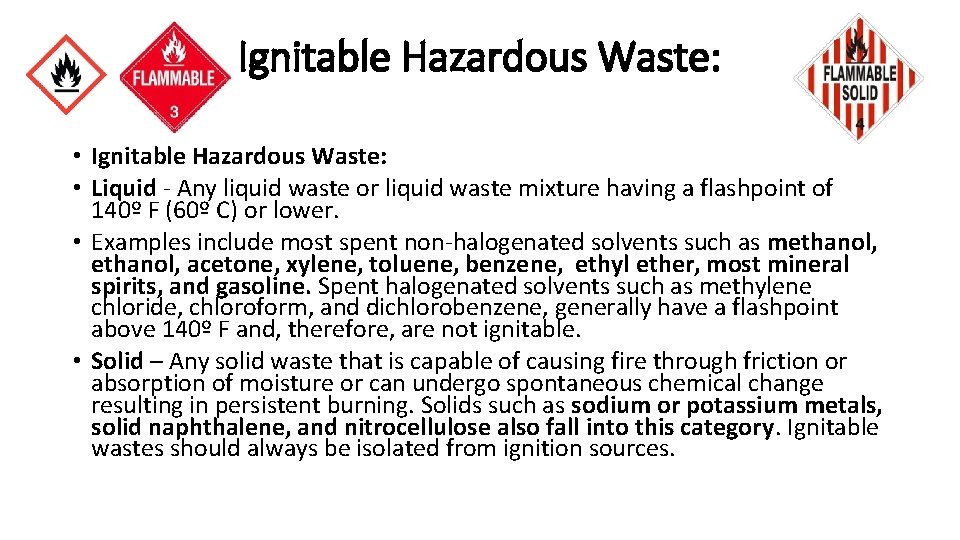
Ignitable Hazardous Waste: • Liquid ‐ Any liquid waste or liquid waste mixture having a flashpoint of 140º F (60º C) or lower. • Examples include most spent non‐halogenated solvents such as methanol, acetone, xylene, toluene, benzene, ethyl ether, most mineral spirits, and gasoline. Spent halogenated solvents such as methylene chloride, chloroform, and dichlorobenzene, generally have a flashpoint above 140º F and, therefore, are not ignitable. • Solid – Any solid waste that is capable of causing fire through friction or absorption of moisture or can undergo spontaneous chemical change resulting in persistent burning. Solids such as sodium or potassium metals, solid naphthalene, and nitrocellulose also fall into this category. Ignitable wastes should always be isolated from ignition sources.
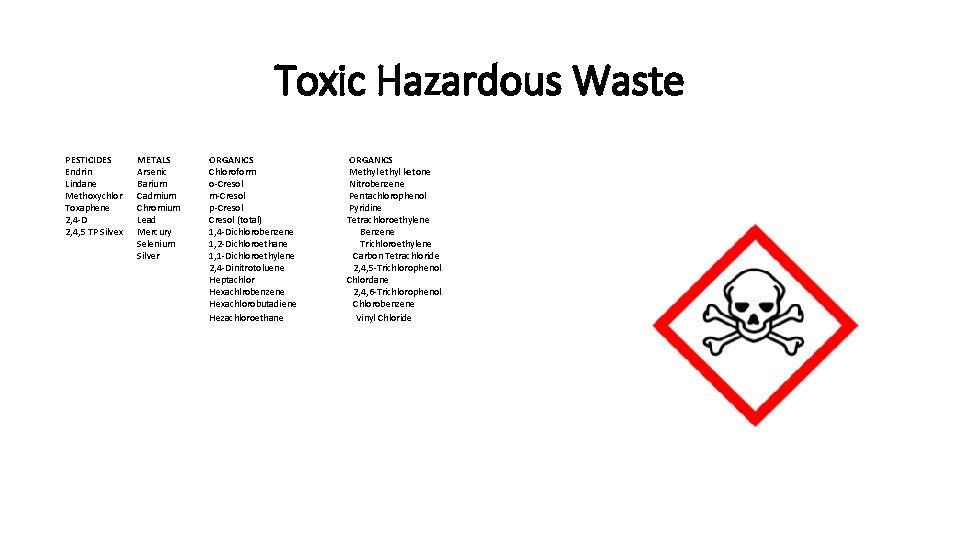
Toxic Hazardous Waste • The characteristic of toxicity refers to a waste from which harmful chemicals would leach if it were disposed of in a landfill. • A test, the Toxicity Characteristic Leachate Procedure (TCLP, pronounced T‐clip), is performed on the waste, and if the resulting leachate exceeds the allowable concentration of any one of 40 substances, the waste is a regulated hazardous waste. The list of these chemicals can be found in 40 CFR 261. 24 and 401 KAR 31: 030.
Toxic Hazardous Waste PESTICIDES Endrin Lindane Methoxychlor Toxaphene 2, 4‐D 2, 4, 5 TP Silvex METALS Arsenic Barium Cadmium Chromium Lead Mercury Selenium Silver ORGANICS ORGANICS Chloroform Methyl ketone o‐Cresol Nitrobenzene m‐Cresol Pentachlorophenol p‐Cresol Pyridine Cresol (total) Tetrachloroethylene 1, 4‐Dichlorobenzene Benzene 1, 2‐Dichloroethane Trichloroethylene 1, 1‐Dichloroethylene Carbon Tetrachloride 2, 4‐Dinitrotoluene 2, 4, 5‐Trichlorophenol Heptachlor Chlordane Hexachlrobenzene 2, 4, 6‐Trichlorophenol Hexachlorobutadiene Chlorobenzene Hezachloroethane Vinyl Chloride
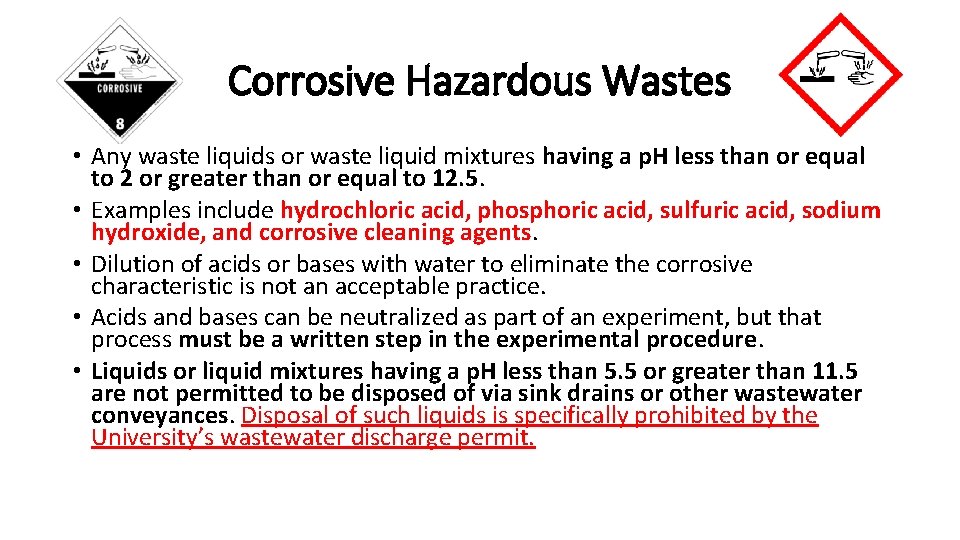
Corrosive Hazardous Wastes • Any waste liquids or waste liquid mixtures having a p. H less than or equal to 2 or greater than or equal to 12. 5. • Examples include hydrochloric acid, phosphoric acid, sulfuric acid, sodium hydroxide, and corrosive cleaning agents. • Dilution of acids or bases with water to eliminate the corrosive characteristic is not an acceptable practice. • Acids and bases can be neutralized as part of an experiment, but that process must be a written step in the experimental procedure. • Liquids or liquid mixtures having a p. H less than 5. 5 or greater than 11. 5 are not permitted to be disposed of via sink drains or other wastewater conveyances. Disposal of such liquids is specifically prohibited by the University’s wastewater discharge permit.
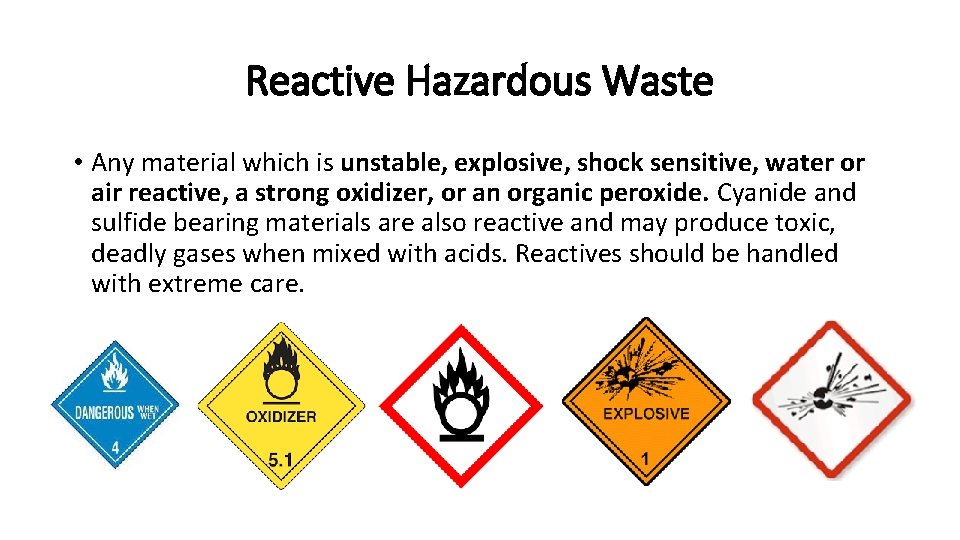
Reactive Hazardous Waste • Any material which is unstable, explosive, shock sensitive, water or air reactive, a strong oxidizer, or an organic peroxide. Cyanide and sulfide bearing materials are also reactive and may produce toxic, deadly gases when mixed with acids. Reactives should be handled with extreme care.
Hazardous Waste • If the waste falls into either the listed or characteristic categories it must be treated as a hazardous waste. • Hazardous waste cannot be disposed of by pouring down a drain or by throwing in the general trash. • There are significant fines and penalties involved when hazardous waste is disposed of illegally. $25, 000 per day! • In addition to the legal ramifications please realize that toxic wastes disposed down the sink or in the trash may cause environmental harm and can also create an unacceptable risk to human health.
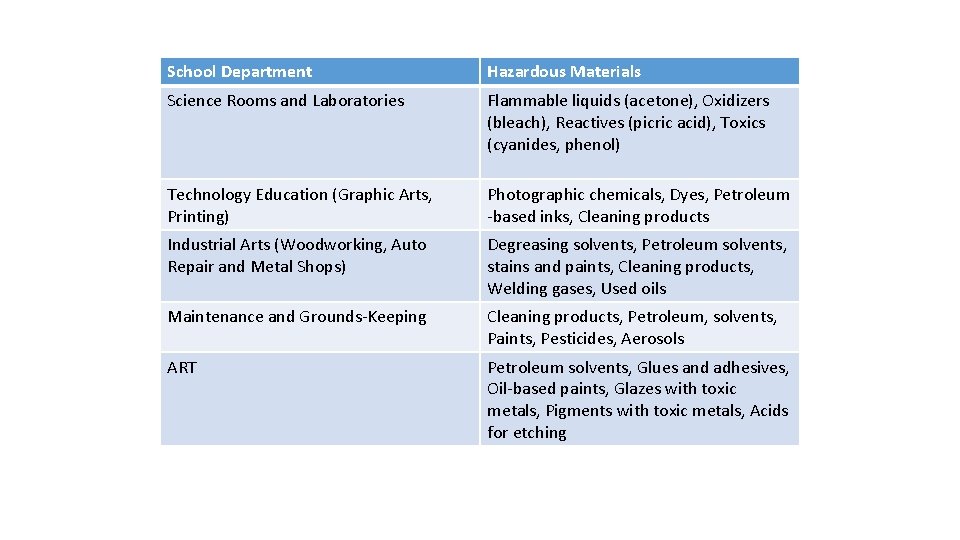
School Department Hazardous Materials Science Rooms and Laboratories Flammable liquids (acetone), Oxidizers (bleach), Reactives (picric acid), Toxics (cyanides, phenol) Technology Education (Graphic Arts, Printing) Photographic chemicals, Dyes, Petroleum ‐based inks, Cleaning products Industrial Arts (Woodworking, Auto Repair and Metal Shops) Degreasing solvents, Petroleum solvents, stains and paints, Cleaning products, Welding gases, Used oils Maintenance and Grounds‐Keeping Cleaning products, Petroleum, solvents, Paints, Pesticides, Aerosols ART Petroleum solvents, Glues and adhesives, Oil‐based paints, Glazes with toxic metals, Pigments with toxic metals, Acids for etching
Central Accumulation Area - CAA • The University’s Lappin Hall Chemical Storage Area is registered by the state to accumulate hazardous waste generated by the University. • The registered area receives all the hazardous waste generated on the main campus and some received from off‐campus University operations such as the Derrickson Agricultural Complex including the Veterinary programs and the Eagle Trace Golf Course. • This area is required to dispose of all hazardous waste by a permitted disposal company every 90 days as a LQG. • Hazardous waste pickup months for FY 20‐ 21 will be January, April, July, October.
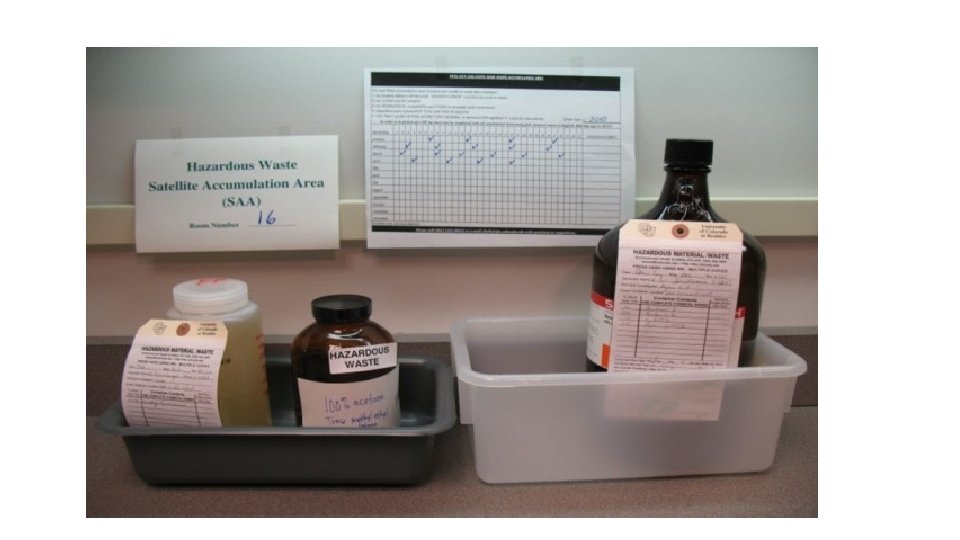
Satellite Accumulation Areas - SAA • Satellite Accumulation Areas (SAA) include individual research, clinical and teaching laboratories and classrooms. Departments are permitted to have SAA’s only if they meet the following provisions: 1) The area can be a storage area room, cabinet, shelf, closet, etc. but it must be at or near the point of generation and under the control of the generator. (secured &/or locked) 2) Personnel must notify EHS of the area and the area must be designated for the purpose of storing hazardous waste only. The area must be clearly marked with signage “Danger – Hazardous Waste accumulation area only. ” The signage should be displayed on the designated cabinet, door or shelf, not on the door to the room.
Satellite Accumulation Areas - SAA 3) SAA’s may not have over 55 gallons (1 Kg) of hazardous waste or 1 quart of acute hazardous waste (All P and some F listed waste codes). Any waste that is so dangerous it needs to be stored separately, must go directly to the CAA and cannot be stored in the SAA. Any full waste container or any amount in excess of the 55‐gallons or the 1 ‐quart limit for P listed wastes must be removed from the Satellite Accumulation Area within 3 calendar days. Submit a pickup request (Appendix D) to ehs@moreheadstate. edu. 4) All waste accumulation/storage areas described above are subject to routine audits and inspections by regulatory authorities who may conduct audits unannounced at any time they wish. • Appendix E has a printable sign suitable for designating SAA’s or you may design/order your own.
Waste Determination Requirement • All academic department personnel who generate wastes are responsible to provide an accurate written waste determination (Appendix D). The only exception to this rule will be for Facilities Management, in which EHS will make the determination for them. • The determination for each waste must be made • 1) at the point of waste generation, • 2) before any dilution, mixing, or other alteration of the waste occurs, • 3) and at any time in the course of its management that it has or may have changed its properties as a result of exposure to the environment or other • factors that may change the properties of the waste such that the RCRA classification of the waste may change.
Waste Determination Requirement • Acceptable generator knowledge that may be used in making an accurate determination as to whether the waste is hazardous include waste origin, composition, the process knowledge of products, by‐ products, and intermediates, chemical or physical characterization, testing that illustrates the properties of the waste; or other reliable and relevant information.
Waste Determination Requirement • Documentation must be kept with the waste until it is picked up for disposal by the contractor. Then it is to be kept with the shipping manifests in the Office of Environmental Health & Safety for a minimum of 3 years.
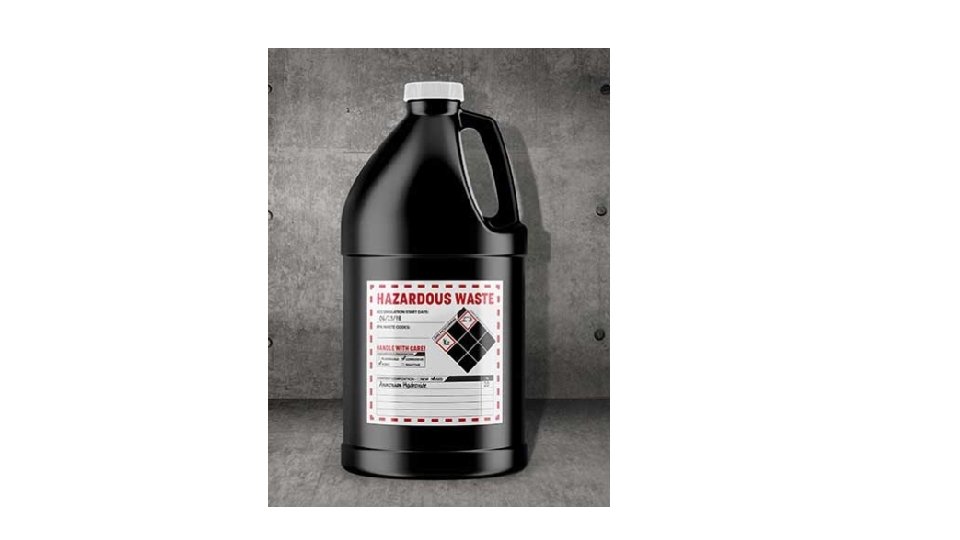
Labeling Requirements All hazardous waste must have a hazardous waste label with: 1) the contents of the container – when labeling the waste be specific (i. e. , “Xylene”, “Acetone”, “Toluene”, etc. ) instead of using generalities such as “Non‐Halogenated Solvents”. Do not use abbreviations, chemical formulas, or trade names. This information will assist in the event of emergency activities and it also will be needed when the waste manifest is prepared. Descriptions such as “Waste” or “Acetone Waste” in and of themselves are not acceptable but may be included as supplemental information. 2) and the hazard statements (GHS pictograms, NFPA diamond) clearly marked. 3) The container must say “Hazardous Waste”, when the first drop of waste is poured into the container. The contents and hazards must be legible, or it is in violation. 4) All hazardous waste containers must be dated once the container is full. 5) Generators must mark the containers with the applicable RCRA hazardous waste codes (D, F, K, P, U) 6) The generators initials and department abbreviation must be on the label.
Labeling Requirements • EHS can provide labels upon request or departments may order or create their own labels as long as they meet the label requirements listed above.
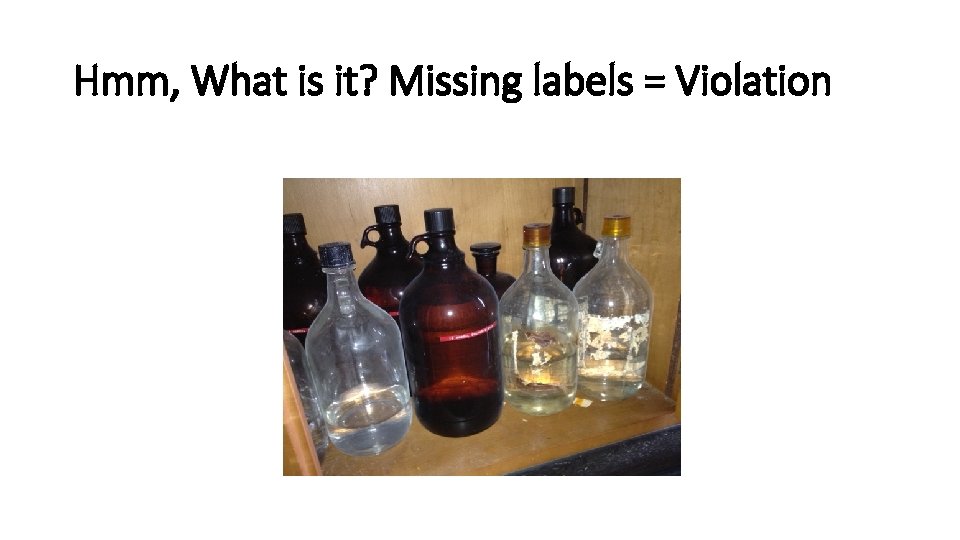
Hmm, What is it? Missing labels = Violation
Container Selection • Small containers for hazardous waste are more desirable than large containers and less costly to dispose of properly. • Please avoid using containers over 5‐gallon for liquids in satellite accumulation areas unless you have prior approval from EHS. • The best containers for hazardous waste are the original ones the materials came in. If the original container cannot be used then a compatible container in good condition is acceptable. • Containers with any residue left inside should be compatible with the new waste material.
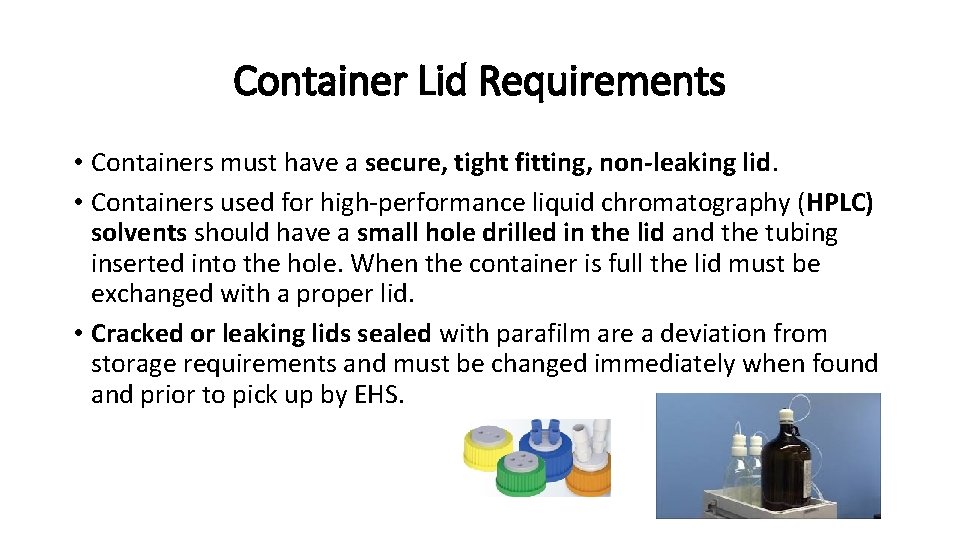
Container Lid Requirements • Containers must have a secure, tight fitting, non‐leaking lid. • Containers used for high‐performance liquid chromatography (HPLC) solvents should have a small hole drilled in the lid and the tubing inserted into the hole. When the container is full the lid must be exchanged with a proper lid. • Cracked or leaking lids sealed with parafilm are a deviation from storage requirements and must be changed immediately when found and prior to pick up by EHS.
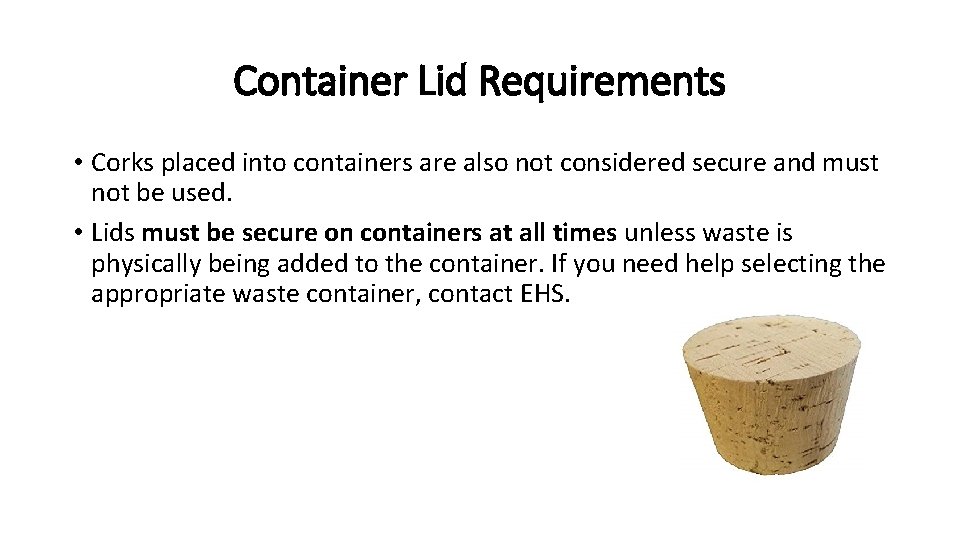
Container Lid Requirements • Corks placed into containers are also not considered secure and must not be used. • Lids must be secure on containers at all times unless waste is physically being added to the container. If you need help selecting the appropriate waste container, contact EHS.
STORAGE, COMPATIBILITY AND SAFETY • Hazardous waste should never be stored in or around drains or sinks. If it is unavoidable for the waste container to be near a drain, then a spill tray should be used. The best places to accumulate wastes are inside or under fume hoods or inside an appropriate safety cabinet. • For Satellite Accumulation Areas waste must be stored in a secure place, near the point of generation and always under the control of trained personnel. Waste must never be left in a hallway or any other area where it could endanger personnel or facility safety or the environment. • This area should be kept clean and inspected for spills daily.
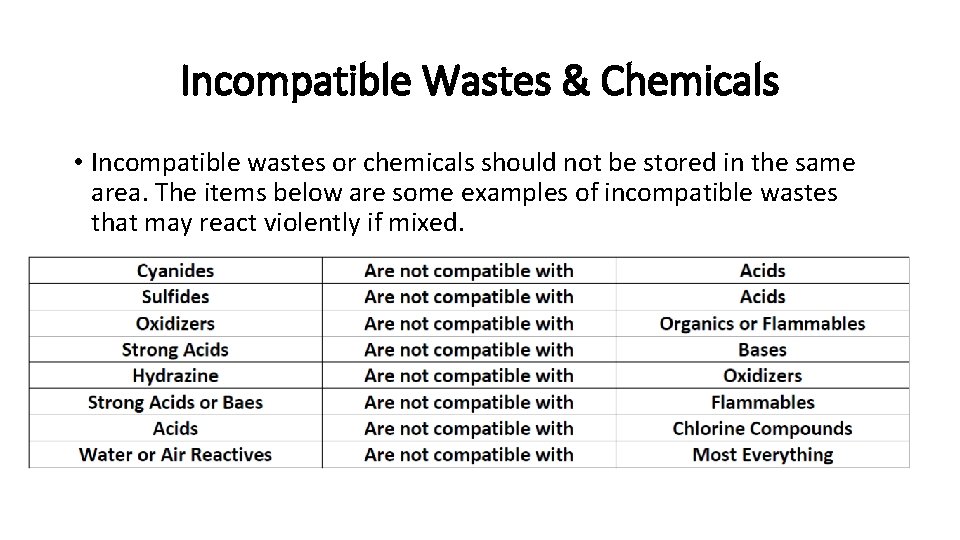
Incompatible Wastes & Chemicals • Incompatible wastes or chemicals should not be stored in the same area. The items below are some examples of incompatible wastes that may react violently if mixed.
Incompatible Wastes & Chemicals • These examples would apply if the chemicals were in pure form • In low concentrations the combinations may or may not present a safety hazard. • This list is by no means all‐inclusive so check with appropriate staff, SDSs, or other applicable literature before mixing. • Be aware of any heat generation or vapors released that may damage the container. These conditions would indicate incompatible mixing and must be avoided.
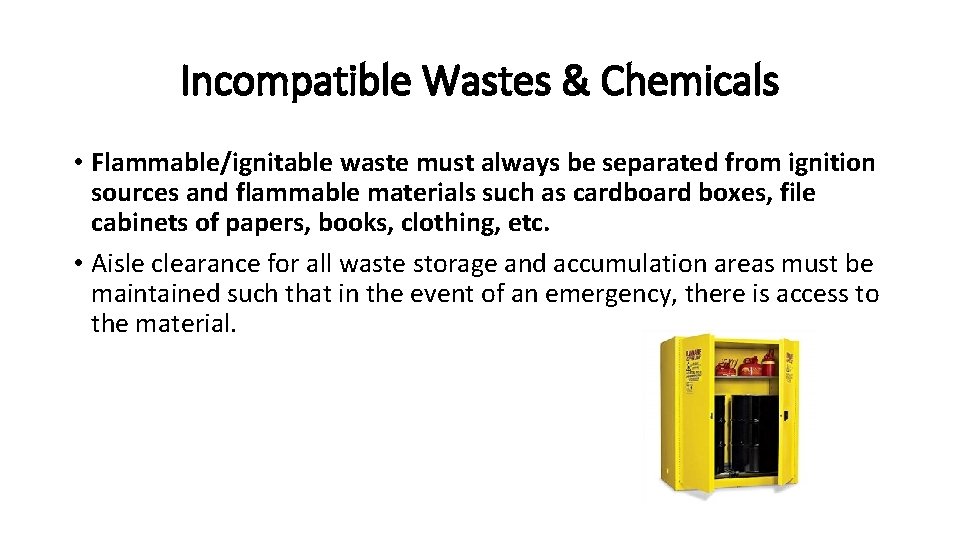
Incompatible Wastes & Chemicals • Flammable/ignitable waste must always be separated from ignition sources and flammable materials such as cardboard boxes, file cabinets of papers, books, clothing, etc. • Aisle clearance for all waste storage and accumulation areas must be maintained such that in the event of an emergency, there is access to the material.
Incompatible Wastes & Chemicals • Filled containers may only be moved from Satellite Accumulation Areas to Lappin Hall 141 storage area by trained personnel. In most campus locations this move is from the Satellite Accumulation Area to Lappin by EHS personnel. • For the Chemistry Department in Lappin Hall, the filled containers may be moved from the Satellite Accumulation Area to the designated storage area by trained personnel within the department. • A printable poster of the incompatibility information is included in Appendix B of the training manual and may be hung in the chemical storage and waste areas.
INSPECTIONS • While it is the policy of the University to routinely evaluate all waste storage and accumulation areas, documented weekly inspections are required. • Personnel working in Satellite Accumulation Areas should check the containers daily to insure they are properly closed, incompatible chemicals are kept apart, drains are properly protected, they are under control of the lab personnel, full containers have been properly dated and are in the process of being removed, and the thresholds of 55 gallons hazardous waste or 1 quart acute hazardous waste are not being reached.
INSPECTIONS • Documented weekly inspections of the storage areas should be conducted by all hazardous waste generators in the satellite areas unless there is no waste being produced or stored, as may be the case during summer or winter breaks. • These inspections must include: 1) the date and time of inspection, 2) the person performing the inspection, and 3) any deficiencies noted along with documentation of corrective actions taken. • An inspection form in Appendix C may be used or generators may create their own checklist form but it must contain the required information.
Preventing Spills • Maintain a neat and organized work area. • Store and transport chemicals in secondary containment trays or buckets. • Keep containers closed, except when adding or removing contents. • Avoid the purchase of chemicals in glass containers if possible. • Buy chemicals in the smallest size that is practical. Smaller containers produce smaller spills. • Check the condition of containers frequently.
CHEMICAL SPILL AND EMERGENCY PROCEDURES • All laboratories, chemical storage and hazardous waste areas must have the Environmental Health & Safety Emergency Procedures poster in Appendix A posted in a prominent location. • Students and new employees must be trained in emergency procedures before working in these areas. • When a spill occurs, personal safety should always come first. • Alert and clear everyone in the immediate area where the spill occurred
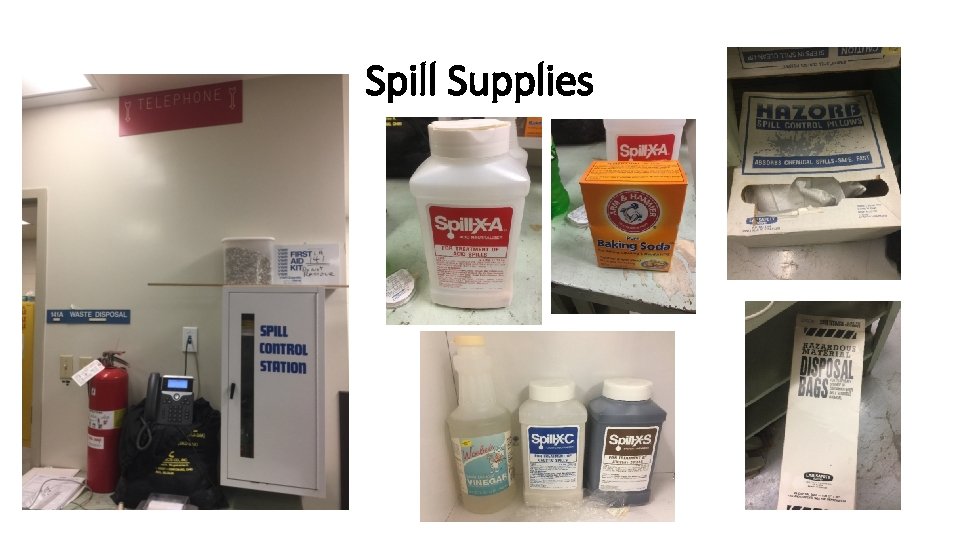
CHEMICAL SPILL AND EMERGENCY PROCEDURES • Trained personnel in laboratory or work areas should immediately clean up small spills of known materials. • Spill clean‐up debris should be placed in a compatible container, properly labeled and closed. • Spillows, spill pads, acid/base‐neutralizing kits, and granulated clay products (oil dry and/or kitty litter) are best for spill clean‐ups.
Spill Supplies
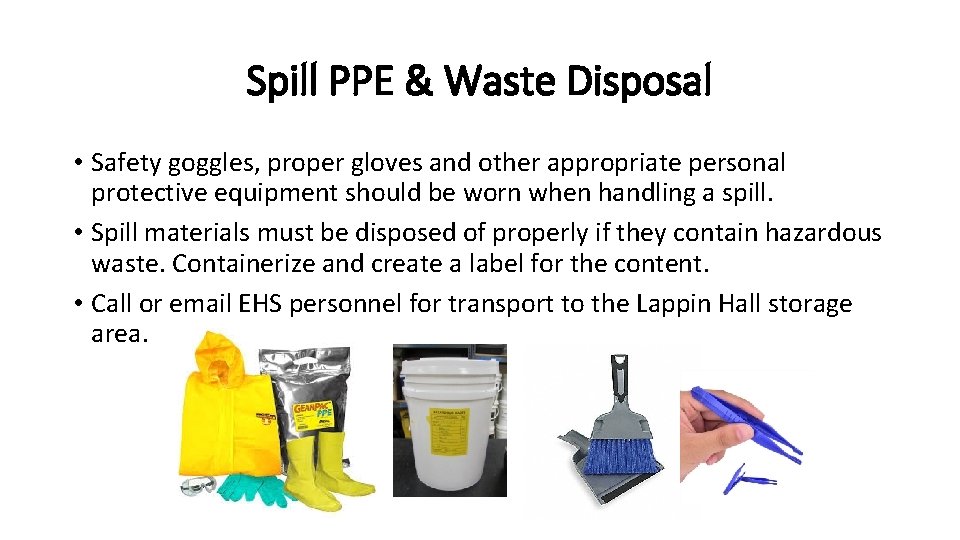
Spill PPE & Waste Disposal • Safety goggles, proper gloves and other appropriate personal protective equipment should be worn when handling a spill. • Spill materials must be disposed of properly if they contain hazardous waste. Containerize and create a label for the content. • Call or email EHS personnel for transport to the Lappin Hall storage area.
CHEMICAL SPILL AND EMERGENCY PROCEDURES All personnel should be knowledgeable in the specific departmental emergency procedures. These procedures must address: üPreventing spilled material from entering drain and water systems. üIdentification of appropriate personal protective equipment. üUnderstanding of how to activate emergency alarms. üEmergency evacuation procedures. üLocation of emergency equipment. üProcedures to summons emergency response personnel. üHow to turn off any automatic discharge systems if appropriate.
Large/IDLH Spills IDLH = Immediately dangerous to life and health IF THE SPILL OR RELEASE INVOLVES A DANGEROUS OR POTENTIALLY DANGEROUS MATERIAL 1) EVACUATE THE IMMEDIATE AREA, 2) SHUT ALL DOORS AND WINDOWS IF POSSIBLE AND 3) CALL 911. 4) STAY ON THE LINE WITH THE DISPATCHER UNTIL TOLD TO HANG UP. PERSONS INVOLVED WITH THE SPILL SHOULD REMAIN IN THE AREA AT A SAFE DISTANCE TO PROVIDE RESPONDERS WITH INFORMATION ON MATERIALS AND PROCESSES INVOLVED.
Reportable Quantities • The Emergency Response Branch (ERB) is trained to respond immediately to environmental emergencies where hazardous materials may have been spilled. • The ERB should be contacted when a release or spill meets or exceeds the reportable quantity as defined in KRS 224. 1‐ 400, the federal list of lists for hazardous materials, and the Clean Water Act. • It is the responsibility of the person responsible for the spill to report the spill immediately. Calling 911 does not fulfill the legal reporting requirement for release reporting. • TO REPORT AN ENVIRONMENTAL EMERGENCY, CALL: 502‐ 564‐ 2380 or 1‐ 800‐ 928‐ 2380 This line is open 24 hours a day, 7 days a week
Chemical Hygiene Plan - Laboratories • The MSU Chemical Hygiene Plan has a list of reportable quantities. • Know what you have before an accident happens and always minimize amount available in teaching labs and areas that can be accessed easily by the public. • EHS Website: • https: //www. moreheadstate. edu/ehs • Chemical and Laboratory Safety • Forms • Training
TRAINING • Facility personnel working in the 90‐day storage area and those engaged in hazardous waste management as Small or Large Quantity Generator are required by state and federal regulations to be trained annually. • Likewise, it is the policy of the University to require all persons operating Satellite Accumulation Areas to also complete initial and annual refresher training for hazardous waste management. • This hazardous waste training is available through scheduled classes or is available online under training on the MSU website. • Both initial and annual training will be required of all persons engaged in the management of hazardous waste and the use of hazardous chemicals.
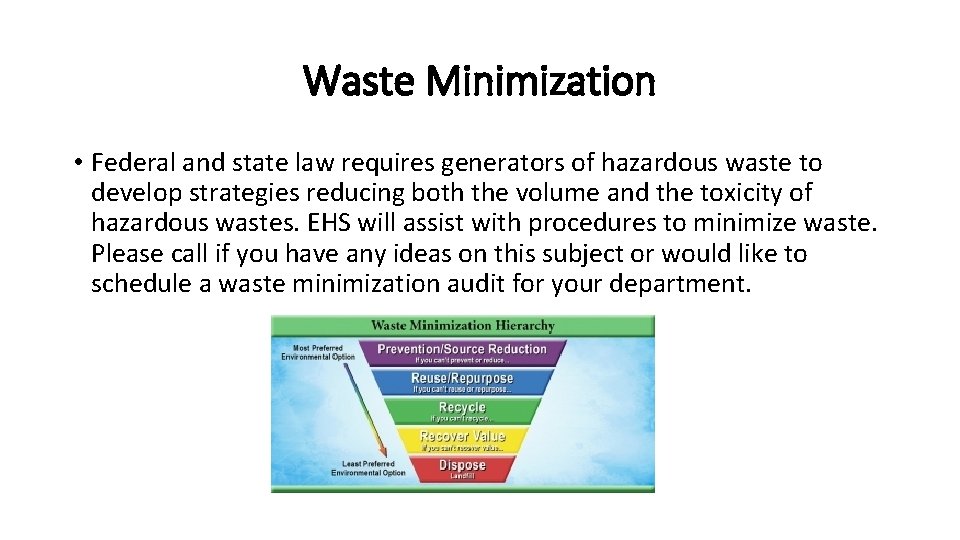
Waste Minimization • Federal and state law requires generators of hazardous waste to develop strategies reducing both the volume and the toxicity of hazardous wastes. EHS will assist with procedures to minimize waste. Please call if you have any ideas on this subject or would like to schedule a waste minimization audit for your department.
Some general examples of waste minimization techniques are: 1) Substitution – The best way to minimize hazardous waste is to replace toxic or other hazardous materials with less toxic or non‐hazardous substances. A an example of substitution includes using Alconox instead of sulfuric/chromic acid glass cleaner and replacing mercury thermometers with less hazardous alcohol thermometers or those with plastic coatings less likely to break when dropped. 2) Recycling/Redistribution – Chemicals that are like new or unopened can often be redistributed to other labs or works areas saving disposal costs for the University and new product costs for the recipient. 3) Ordering and Procurement Practices – Order only what you will need based on the shelf life of chemical and quantities required. A significant percentage of waste disposed by the University consists of old, unused reagent chemicals.
Waste Minimization Techniques 4) Micro. Chemistry – Use small‐scale chemistry instead of traditional methods to reduce the amount of chemicals used in laboratory experiments. 5) Redistilling – Reclaim solvents through distillation processes in laboratories using large quantities of solvents. This is a good way to cut lab costs and drastically reduce the cost of purchasing new solvents. Keep in mind that the residue generated from the re ‐ distillation process is hazardous waste.
Waste Minimization Techniques 6) In‐Laboratory Destruction – Some chemicals can be neutralized or made exempt from hazardous waste regulations by treatment or alteration in the laboratory. This must be done as part of the experiment and in accordance with published recognized methods. Contact EHS prior to performing in‐laboratory destruction to confirm the process is safe and meets regulatory requirements. An example would be neutralizing strong acids or bases as the last step in an experiment.
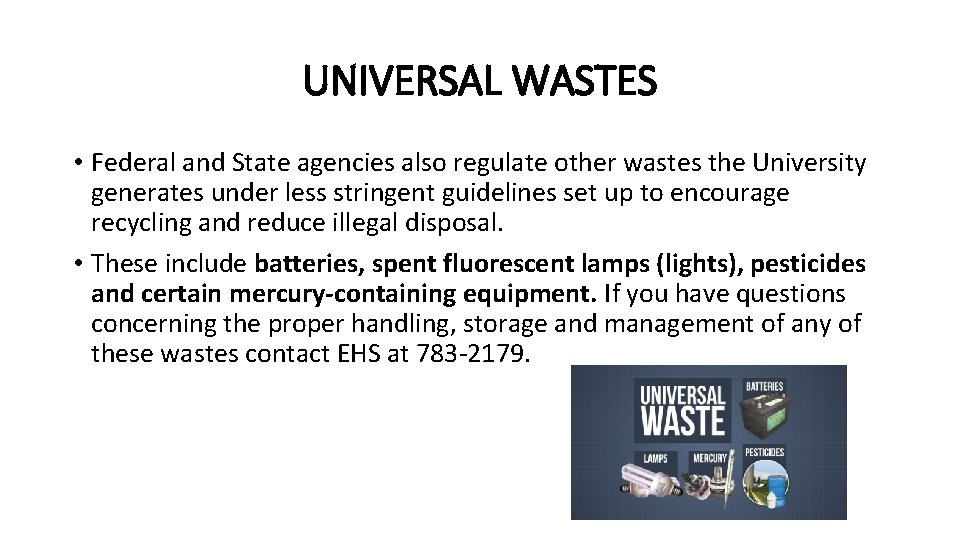
UNIVERSAL WASTES • Federal and State agencies also regulate other wastes the University generates under less stringent guidelines set up to encourage recycling and reduce illegal disposal. • These include batteries, spent fluorescent lamps (lights), pesticides and certain mercury‐containing equipment. If you have questions concerning the proper handling, storage and management of any of these wastes contact EHS at 783‐ 2179.
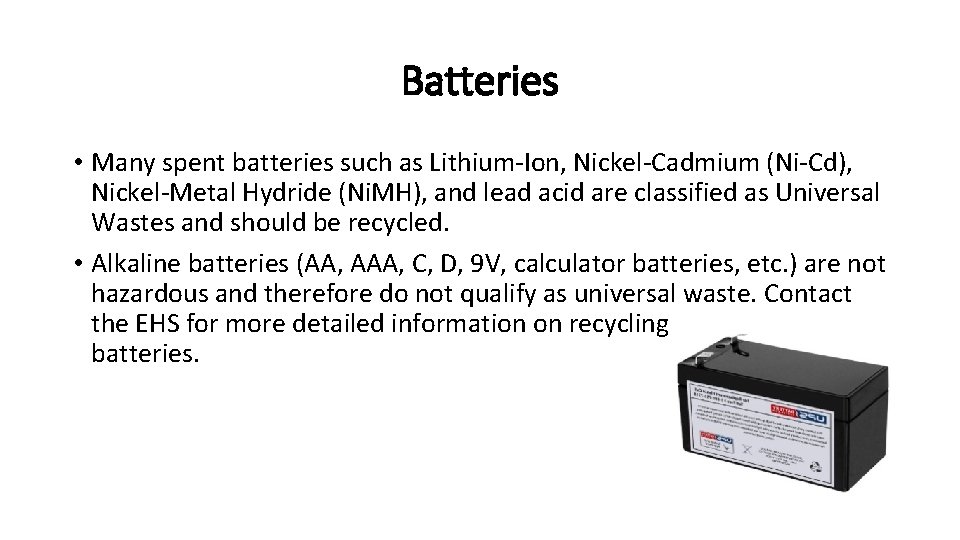
Batteries • Many spent batteries such as Lithium‐Ion, Nickel‐Cadmium (Ni‐Cd), Nickel‐Metal Hydride (Ni. MH), and lead acid are classified as Universal Wastes and should be recycled. • Alkaline batteries (AA, AAA, C, D, 9 V, calculator batteries, etc. ) are not hazardous and therefore do not qualify as universal waste. Contact the EHS for more detailed information on recycling universal waste batteries.
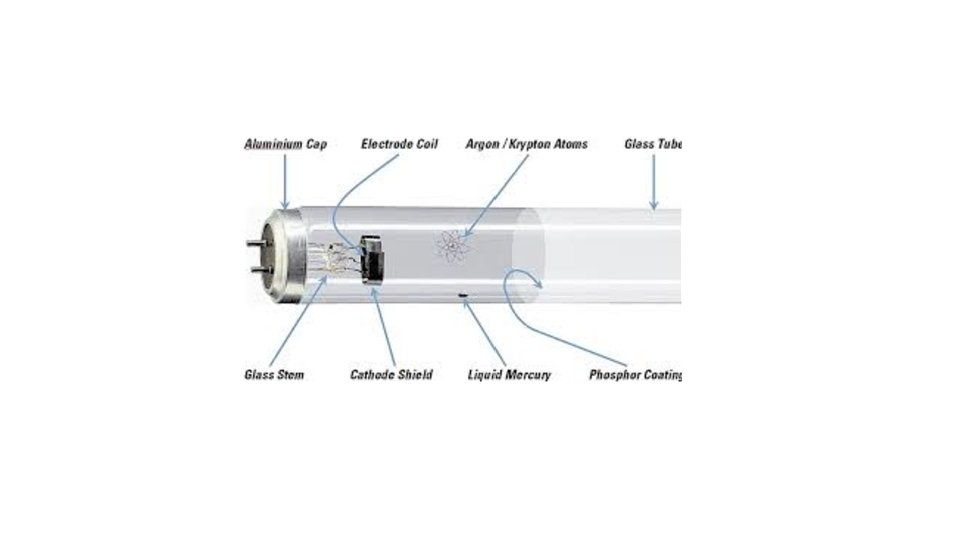
Fluorescent Lamps & Ballasts • Fluorescent Lamps: All spent fluorescent lamps, except some of those with green end caps, contain mercury in such amounts that they exhibit a hazardous waste toxicity characteristic. As with spent batteries, state and federal regulations allow them to be managed as a Universal Waste and must be recycled. • However, if the lamps are broken during removal they must be managed as hazardous waste and require labeling and containerization as appropriate. • In addition to the hazardous constituents in the fluorescent lamps, spent light ballasts also require special consideration because they may contain PCBs. Leaking ballast must be kept separate and containerized immediately.
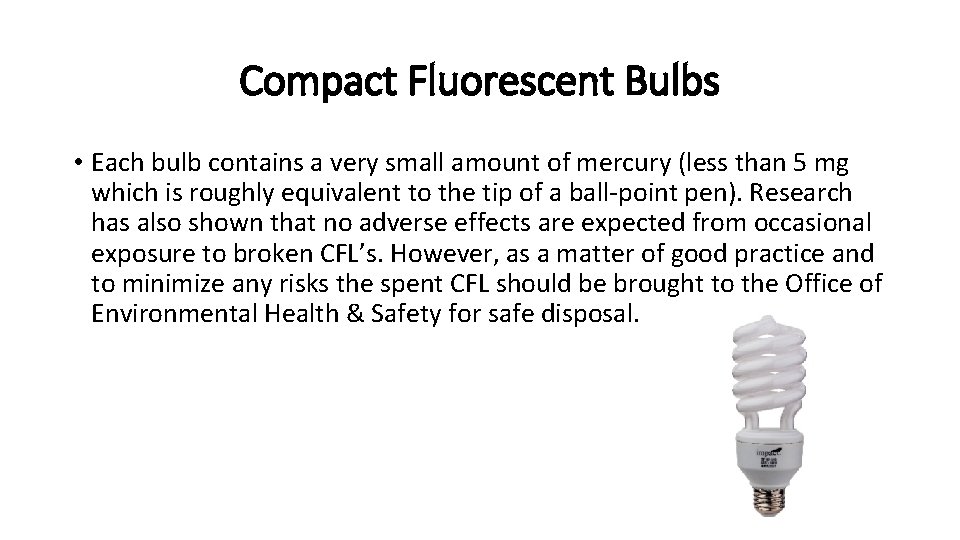
Compact Fluorescent Bulbs • Each bulb contains a very small amount of mercury (less than 5 mg which is roughly equivalent to the tip of a ball‐point pen). Research has also shown that no adverse effects are expected from occasional exposure to broken CFL’s. However, as a matter of good practice and to minimize any risks the spent CFL should be brought to the Office of Environmental Health & Safety for safe disposal.
Cleaning up a broken CFL bulb - EPA • https: //www. epa. gov/cfl/cleaning‐broken‐cfl
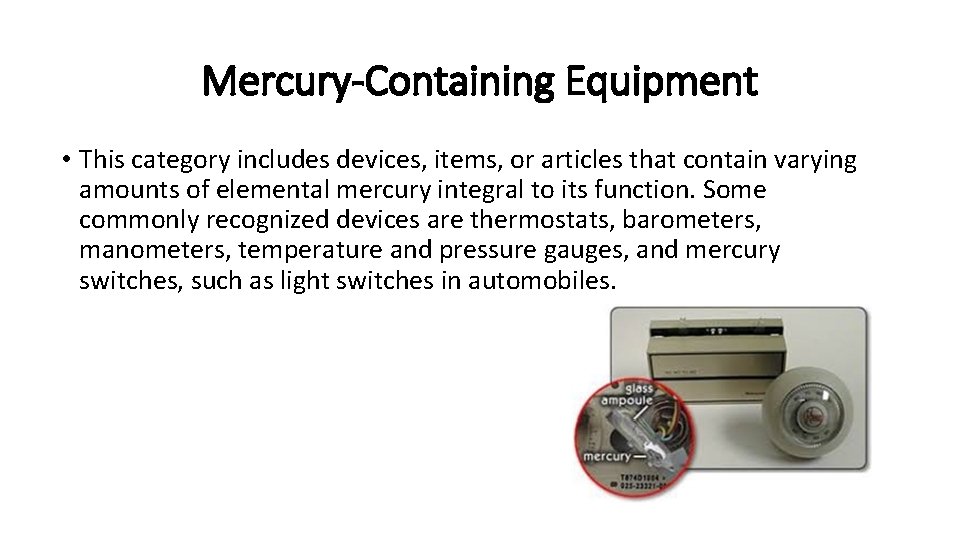
Mercury-Containing Equipment • This category includes devices, items, or articles that contain varying amounts of elemental mercury integral to its function. Some commonly recognized devices are thermostats, barometers, manometers, temperature and pressure gauges, and mercury switches, such as light switches in automobiles.
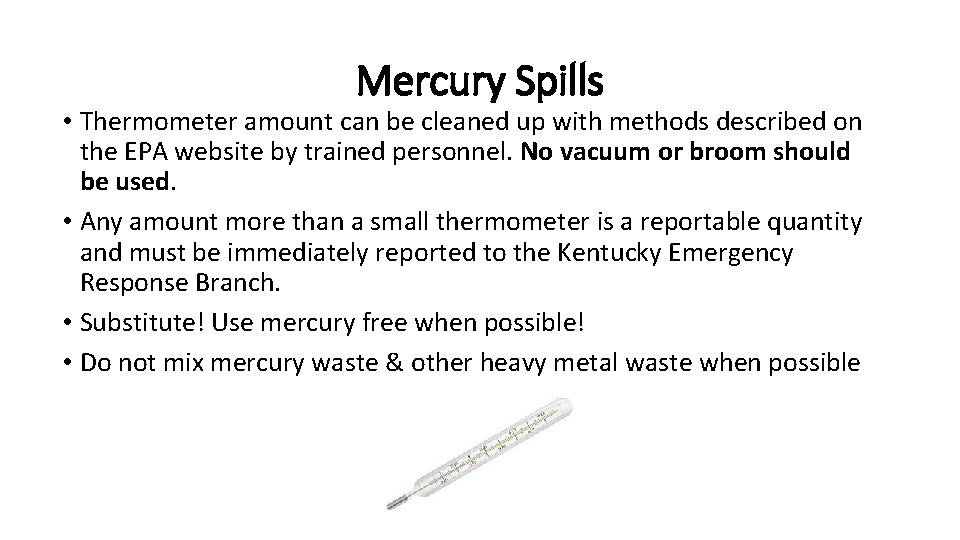
Mercury Spills • Thermometer amount can be cleaned up with methods described on the EPA website by trained personnel. No vacuum or broom should be used. • Any amount more than a small thermometer is a reportable quantity and must be immediately reported to the Kentucky Emergency Response Branch. • Substitute! Use mercury free when possible! • Do not mix mercury waste & other heavy metal waste when possible
What to do if a mercury thermometer breaks: • https: //www. epa. gov/mercury/what‐do‐if‐mercury‐thermometer‐ breaks
Pesticides • Waste pesticides can also qualify as Universal Wastes if they have been recalled or come from stocks of unused products gathered as part of a waste pesticide collection program. • You must be authorized by EHS and Facilities Management to use any type of pesticide or herbicide on MSU property. • In most all cases, a pesticide applicators license is required to apply these products to property other than a property you own. • Call EHS with any questions or concerns about pesticide usage at 3‐ 2179. Call Facilities Management at 3‐ 2066 for any pest related issues on campus property and grounds that need attention. • For more information about pesticides, integrated pest management and low risk products, refer to the National Pesticide Information Center.
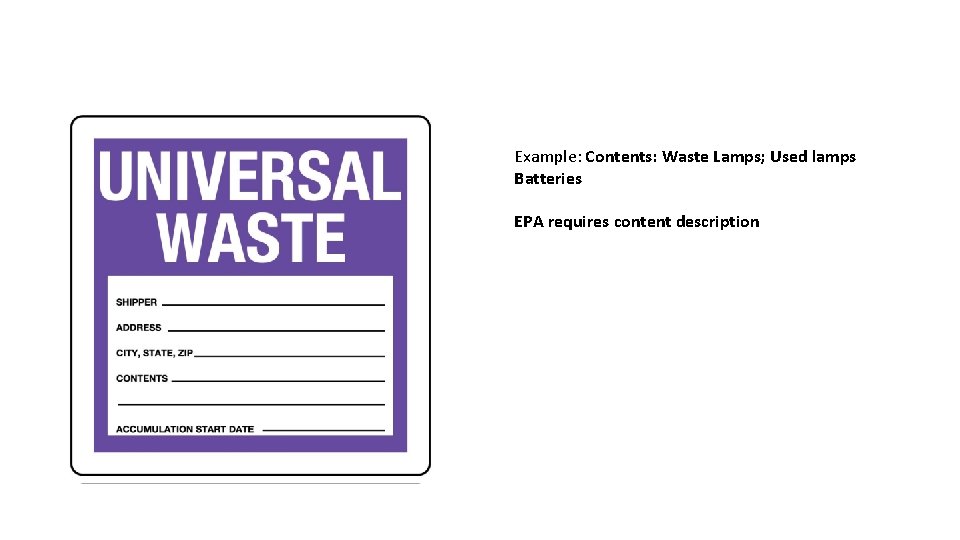
Universal Waste Labeling • All Universal Wastes must be labeled as such with a Universal Waste label (available from EHS) that has: 1) the description of the waste, 2) the container is dated when material is placed into it, and 3) may not be accumulated for longer than one year. When a container is filled, call EHS at 3‐ 2179 for a pick‐up request.
Example: Contents: Waste Lamps; Used lamps Batteries EPA requires content description
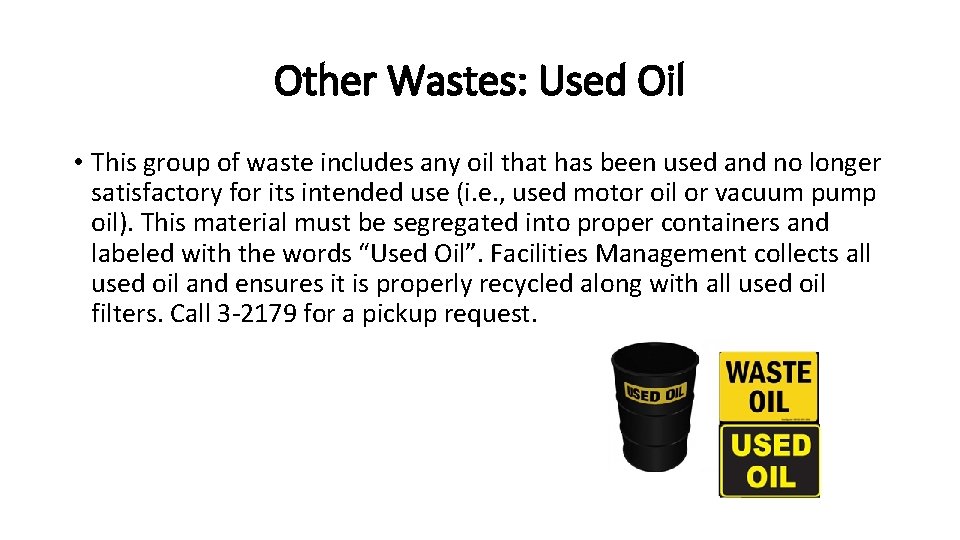
Other Wastes: Used Oil • This group of waste includes any oil that has been used and no longer satisfactory for its intended use (i. e. , used motor oil or vacuum pump oil). This material must be segregated into proper containers and labeled with the words “Used Oil”. Facilities Management collects all used oil and ensures it is properly recycled along with all used oil filters. Call 3‐ 2179 for a pickup request.
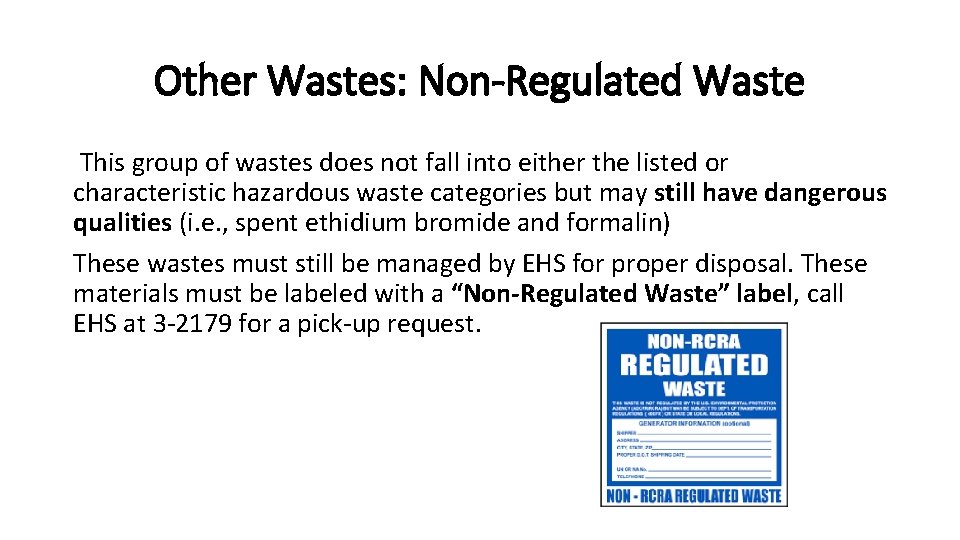
Other Wastes: Non-Regulated Waste This group of wastes does not fall into either the listed or characteristic hazardous waste categories but may still have dangerous qualities (i. e. , spent ethidium bromide and formalin) These wastes must still be managed by EHS for proper disposal. These materials must be labeled with a “Non‐Regulated Waste” label, call EHS at 3‐ 2179 for a pick‐up request.
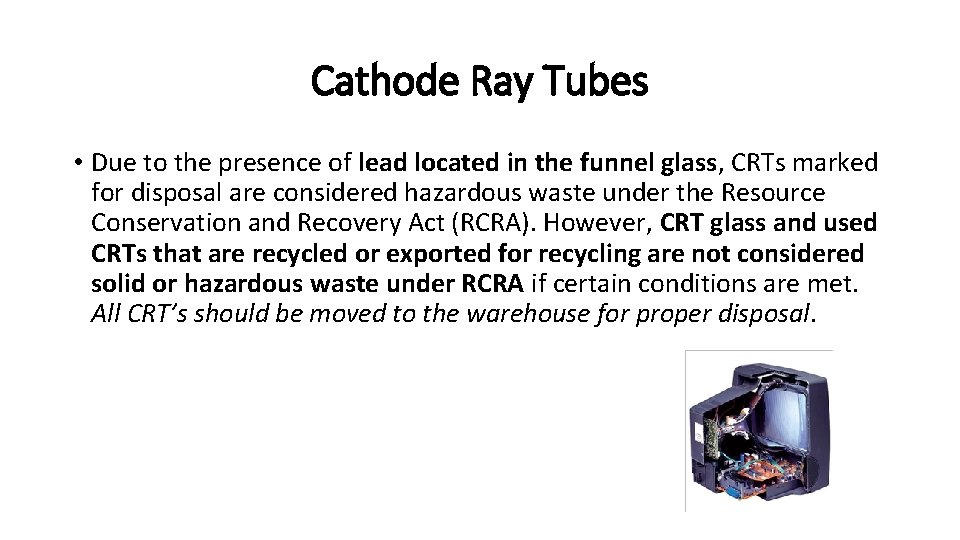
Cathode Ray Tubes • Due to the presence of lead located in the funnel glass, CRTs marked for disposal are considered hazardous waste under the Resource Conservation and Recovery Act (RCRA). However, CRT glass and used CRTs that are recycled or exported for recycling are not considered solid or hazardous waste under RCRA if certain conditions are met. All CRT’s should be moved to the warehouse for proper disposal.
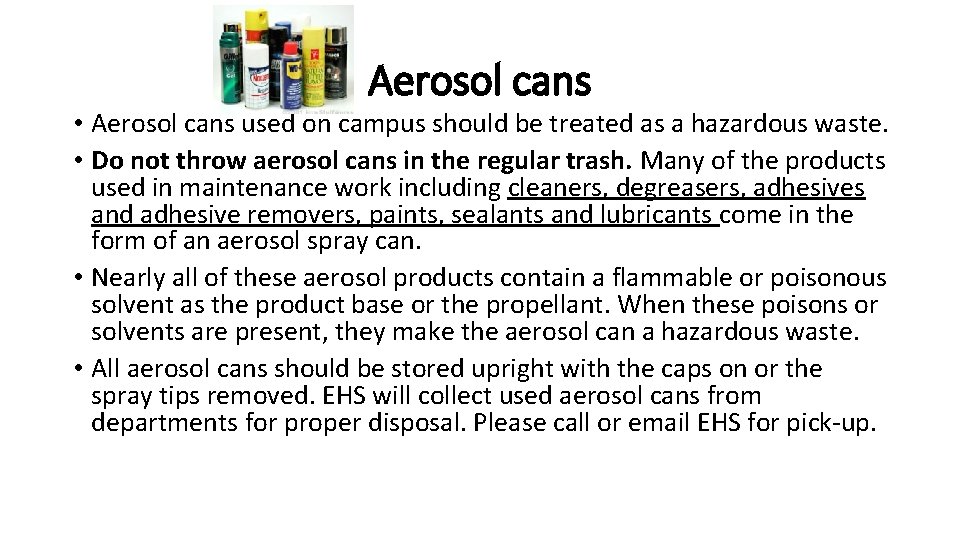
Aerosol cans • Aerosol cans used on campus should be treated as a hazardous waste. • Do not throw aerosol cans in the regular trash. Many of the products used in maintenance work including cleaners, degreasers, adhesives and adhesive removers, paints, sealants and lubricants come in the form of an aerosol spray can. • Nearly all of these aerosol products contain a flammable or poisonous solvent as the product base or the propellant. When these poisons or solvents are present, they make the aerosol can a hazardous waste. • All aerosol cans should be stored upright with the caps on or the spray tips removed. EHS will collect used aerosol cans from departments for proper disposal. Please call or email EHS for pick‐up.
Latex-based Paints • Latex‐based paints are not hazardous waste; however, liquid latex paint may not be disposed of in solid waste containers (i. e. dumpsters or trash cans) or in storm drains. • Old latex‐based paints may be consolidated into larger containers for disposal cost savings. Small quantities remaining in cans may be air dried before disposal. • If the paint in the can is completely dry, it may be disposed of in the trash. Dried rags and paintbrushes that are contaminated with latex‐based paints only may also be disposed of in the trash. • The rinsate water from the cleaning of rags and brushes contaminated with latex paints must be disposed of in a drain that goes directly to the wastewater treatment plant‐ no latex paint rinsate may go to the storm water drains or to the ground.
Solvent-based (or “oil based”) paints, enamels, varnishes, sealants, etc. • meet the definition of hazardous waste and unused portions must be disposed of by EHS. • Paint cans that once contained oil‐based paints must meet the EPA’s definition of empty before they can be placed in the trash. This is achieved by scraping the container to ensure that all pourable materials have been removed. • The pourable material must be collected for disposal by EHS. • Waste mixtures of solvent based paint and paint thinners/solvent must be collected in a closed, labeled container with the hazardous waste and flammable hazard clearly marked on the container.
Solvent-based (or “oil based”) paints, enamels, varnishes, sealants, etc. • Each container of solvent based paint/paint thinner waste must be closed after additions and the funnels should be cleaned out regularly. • No air drying of solvent‐based paint or paint waste is allowed. • Waste containers must be stored with secondary containment and protected from the weather. • Secondary containment must be kept clear of spills and debris.
Brushes and rags • Brushes and rags that have been contaminated with hazardous waste (non‐latex paints, cleaners, thinners, strippers, etc. ) and/or waste solvents cannot be placed in the trash and must be disposed of as hazardous waste through EHS. • Rollers, brushes, rags, and trays which are used for latex paints only may be disposed of as regular trash and placed in a dumpster or garbage can once the paint has been allowed to dry completely. • Paper towels, wipes, rags or absorbents that have been contaminated with paint/paint thinner waste or solvent waste must be collected as hazardous waste in a steel safety container and disposed of through EHS. To request a special container for this purpose, contact EHS.
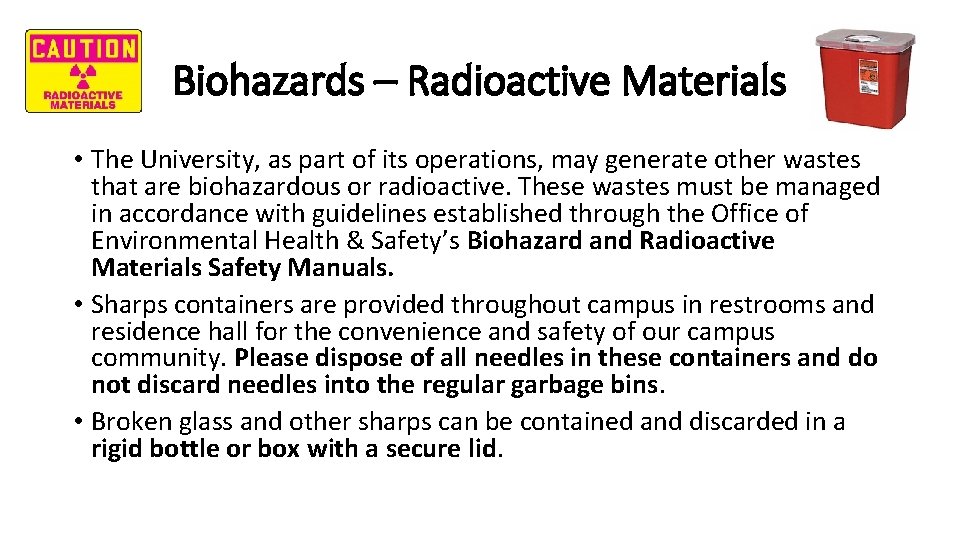
Biohazards – Radioactive Materials • The University, as part of its operations, may generate other wastes that are biohazardous or radioactive. These wastes must be managed in accordance with guidelines established through the Office of Environmental Health & Safety’s Biohazard and Radioactive Materials Safety Manuals. • Sharps containers are provided throughout campus in restrooms and residence hall for the convenience and safety of our campus community. Please dispose of all needles in these containers and do not discard needles into the regular garbage bins. • Broken glass and other sharps can be contained and discarded in a rigid bottle or box with a secure lid.
Organization & Documentation • Please keep the Disposal Guide and Hazardous Waste Management Training document with your other training materials for future reference. • No one may handle or prepare hazardous waste for disposal unless they have taken this training • Laboratories should keep a copy of the disposal guide, Chemical Hygiene Plan, weekly inspection logs and waste determinations in a binder or folder in the laboratory
Review üNever throw hazardous waste in the garbage or pour waste down drain. üAll hazardous waste must be labeled as such immediately upon generation. üKeep containers tightly sealed and never leave a funnel in an unattended container. üFilled containers must be dated and moved to the appropriate storage area on a timely basis. üKeep chemical, radioactive and biohazardous waste in separate containers. üDo not mix incompatible chemicals or wastes together. üKnow what to do in case of a chemical/waste spill. üRecycle or reduce the volume and toxicity of your wastes whenever possible. üTraining must be repeated annually
Training Manual Appendices’ – available online • Environmental Health & Safety Emergency Procedures Poster • Incompatible Materials Poster • Weekly Hazardous Waste Inspection Checklist • Waste Determination & Pickup Requests • Satellite Accumulation Area Signage • Faculty/Staff Hazardous Waste Manual Training Acknowledgement • EPA Hazardous Waste Codes
Questions? THANK YOU! • Your cooperation in helping the University comply with hazardous waste regulations is sincerely appreciated. • For any questions please contact: Office of Environmental Health & Safety Holly Niehoff, Director, EHS, Risk Management & Insurance BCB 113 783‐ 2179