
The Bauhinia Foundation Chatham House Conference on Financial
The Bauhinia Foundation – Chatham House Conference on Financial Centres in greater China: A Decade of Opportunity Hong Kong: The Pearl River Delta as a Financial Centre 13 June 2011 IPOs in Hong Kong: Strategic Needs and Selected Priorities by . . Jesús Seade. . Vice-President Sydney S. W. Leong Chair Professor of Economics and the International Financial Centres Research Team at . . Lingnan University 1
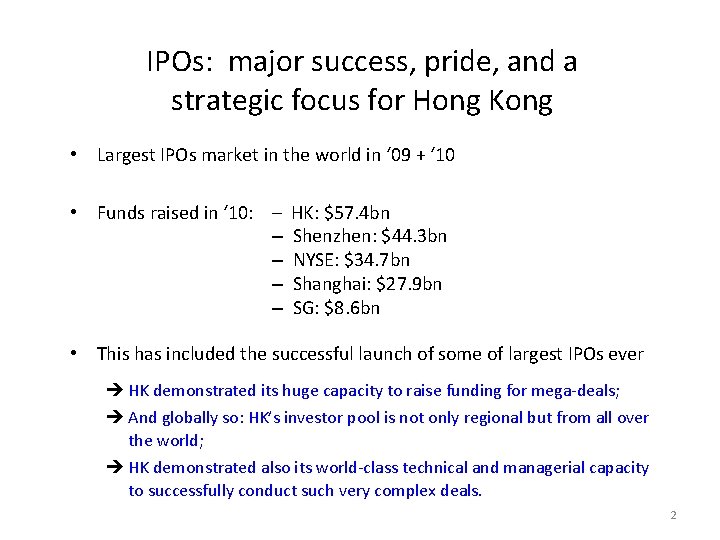
IPOs: major success, pride, and a strategic focus for Hong Kong • Largest IPOs market in the world in ‘ 09 + ‘ 10 • Funds raised in ‘ 10: – HK: $57. 4 bn – Shenzhen: $44. 3 bn – NYSE: $34. 7 bn – Shanghai: $27. 9 bn – SG: $8. 6 bn • This has included the successful launch of some of largest IPOs ever è HK demonstrated its huge capacity to raise funding for mega-deals; è And globally so: HK’s investor pool is not only regional but from all over the world; è HK demonstrated also its world-class technical and managerial capacity to successfully conduct such very complex deals. 2
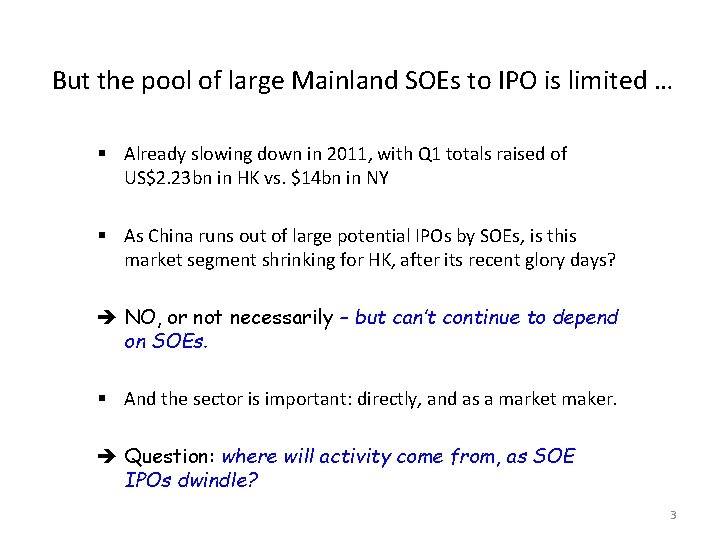
But the pool of large Mainland SOEs to IPO is limited … § Already slowing down in 2011, with Q 1 totals raised of US$2. 23 bn in HK vs. $14 bn in NY § As China runs out of large potential IPOs by SOEs, is this market segment shrinking for HK, after its recent glory days? è NO, or not necessarily – but can’t continue to depend on SOEs. § And the sector is important: directly, and as a market maker. è Question: where will activity come from, as SOE IPOs dwindle? 3
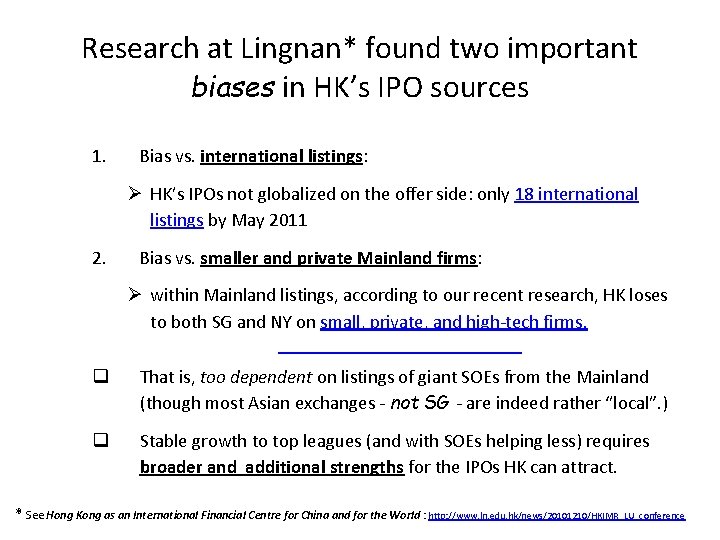
Research at Lingnan* found two important biases in HK’s IPO sources 1. Bias vs. international listings: Ø HK’s IPOs not globalized on the offer side: only 18 international listings by May 2011 2. Bias vs. smaller and private Mainland firms: Ø within Mainland listings, according to our recent research, HK loses to both SG and NY on small, private, and high-tech firms. ___________________________ q That is, too dependent on listings of giant SOEs from the Mainland (though most Asian exchanges - not SG - are indeed rather “local”. ) q Stable growth to top leagues (and with SOEs helping less) requires broader and additional strengths for the IPOs HK can attract. 4 * See Hong Kong as an International Financial Centre for China and for the World : http: //www. ln. edu. hk/news/20101210/HKIMR_LU_conference
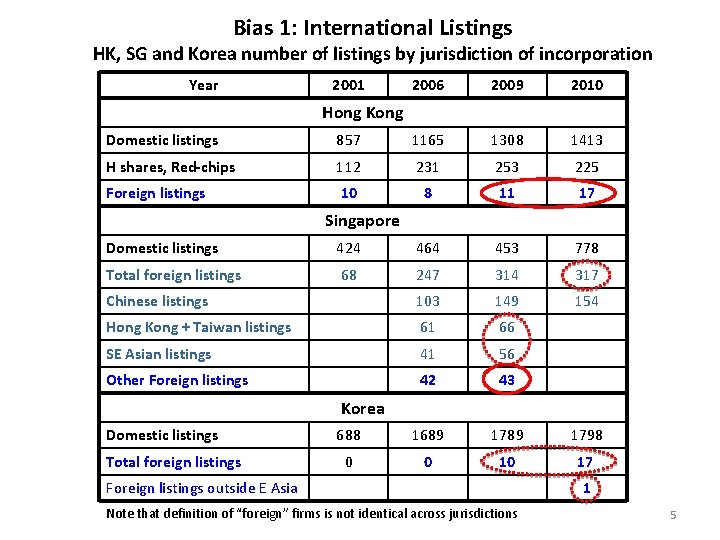
Bias 1: International Listings HK, SG and Korea number of listings by jurisdiction of incorporation Year 2001 2006 2009 2010 Hong Kong Domestic listings 857 1165 1308 1413 H shares, Red-chips 112 231 253 225 Foreign listings 10 8 11 17 Singapore Domestic listings 424 464 453 778 Total foreign listings 68 247 314 317 Chinese listings 103 149 154 Hong Kong + Taiwan listings 61 66 SE Asian listings 41 56 Other Foreign listings 42 43 688 1689 1798 0 0 10 17 Korea Domestic listings Total foreign listings Foreign listings outside E Asia Note that definition of “foreign” firms is not identical across jurisdictions 1 5
Bias 1: International Listings: is that a problem? § China naturally represents huge opportunities for financial HK, which of course must center on Mainland business. § But NYC too has a huge market it calls its own: its hinterland. Yet, they still have a very large number of foreign listings (495; and London has 613, as of 2009) § No market segment will be reserved for HK once China/Shanghai fully opens up, other than as a result of its own competitiveness. Not that “HK should be strong in everything” but: è Attracting international business is the acid test, and the way to underpin, that competitiveness; è Stable growth into the top leagues requires greater diversification – rule #1 for good risk management! 6
Bias 2: Mainland’s Smaller and Private Firms have not preferred HK for their IPOs q We conducted in-depth firm-level analysis of IPO location choices by Chinese firms 04 -08, compiling IPO Database on all domestic and overseas listings in that period. q Main findings: Ø Central government influence (measured through a range of indicators) is a main reason why many large SOEs came to HK. Ø More importantly, smaller, private and high-tech Chinese firms statistically prefer SG and NY to HK if going out at all. 7
Bias 2: Mainland’s Smaller and Private Firms have not preferred HK: Is that a problem? → The reserve of large SOE potential listings is running out; → SOEs now often urged to list in Shanghai; → Large HK-listed SOEs planning to "return home" or cross-list in Shanghai. But against that, Ø China’s future SME/company growth and FDI, plus huge room for financial deepening (current dependence on bank financing > 85%) ensure a constant, rich stream of IPOs and growth in equity markets. Ø Hong Kong is not tapping sufficiently that market. 8
Correction of some of these biases may now be underway already. New kinds of IPOs for HK: Impressive recent success by authorities and HKEx attracting IPOs in what could be two important emerging niches developing in HK: ¢ MINING SECTOR ¢ CONSUMER PRODUCTS SECTOR 9
Mining finance a niche market for HK • HK, the first in East Asia, in 2010 attracted some wholly new players: Russia’s UC Rusal; Canada’s South. Gobi Energy Resources; Mongolian Mining Co. • Other resources companies exploring listing in HK, from various CIS, Australia, Brazil, Africa. Markets expect HKEx to continue attracting cross-border listings in the sector. • Mining finance has in the past centred near producers. Toronto and Australia remain leaders (in new listings – surely also total listings or market capitalization). →But some important players are now coming near the market – China: is this a trend? →And they have chosen HGK: will the niche expand? 10
Another niche emerging? Consumer Products – huge potential for HK • China’s income rise has boosted demand for consumer and luxury goods. Trend will only increase with China’s growth and policies to increase consumption; • HK has been attracting a new kind of Chinese firm in these sectors: e. g. 7 new Chinese listings in Textiles and Clothing and 11 in Health and Personal Care in 2010 (plus notably France's L’Occitane), against only 6 + 6 new listings in 04 -08 in those sectors; • The trend continues in 2011, with HK-based luxury handbag chain Milan Station Holdings Ltd’s IPO in May; with Prada and Samsonite expected to float soon; and Ferragamo, Hermès, Coach and Baroque Japan actively exploring HK for IPOs 11
But rewind: why the “Biases”? Perhaps a common root to both weaknesses, on internationalisation and on Chinese SMEs and IT firms: HK’s strong focus on attracting the Mainland’s large SOE IPOs SG had to fight hard to attract a diversity of firms – and has done better with the kind of footloose company where choices are competitive: both Mainland SMEs and international listings. 12
Priority is overdue to update and modernise the often inconsistent and outdated listing rules § HK’s foreign listing rules were designed in ‘ 80 s to deal with re-domiciled HK firms – not revised as a whole ever since § Requirements stricter than London’s or New York’s only reflect HK’s weaker post -listing regime, compared with theirs. With weak rules once in the house, you must guard the front-door more carefully � less entry, less competition § More broadly, HK has higher listing and compliance costs e. g. than Singapore; § With rules aging and amendments added over time, inconsistencies occur, and the need for discretion in each decision increases. è High thresholds, high listing costs, old or unclear rules, more discretion: all these are more suited to listings by large Mainland SOEs that can better navigate and afford them, than for SMEs or foreign firms. 13
Is diversity of listings as such a priority? No. But: § The big and sustained IPO market that can be expected in the region will be: Ø Chinese SMEs being born / then getting big amidst China’s growth, and meeting their financing needs increasingly by listings (as China’s current 85+% dependence on bank financing is cut as financial deepening advances); and, Ø More foreign firms increasingly choosing to list in Asia to be closer to their market. § What matters is not diversity but to ensure HK is competitive to attract these firms. Past IPO success partially benefitted from a bias that private Chinese or foreign firms may not accord HK. è Necessary and important to revamp listing and post-listing rules, as a means to both better attract above business while retaining due control, and enhance entry and HK’s competitiveness as lead IPO centre for China and for the world. 14
- Slides: 14