
Journey of a TurnAround David Marchak Career Experience

- Slides: 31
Journey of a Turn-Around David Marchak
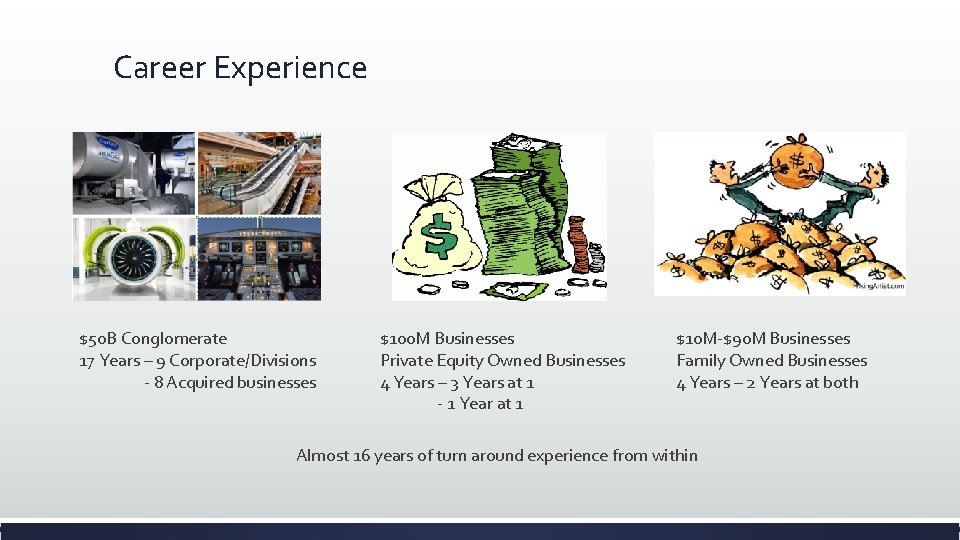
Career Experience $50 B Conglomerate 17 Years – 9 Corporate/Divisions - 8 Acquired businesses $100 M Businesses Private Equity Owned Businesses 4 Years – 3 Years at 1 - 1 Year at 1 $10 M-$90 M Businesses Family Owned Businesses 4 Years – 2 Years at both Almost 16 years of turn around experience from within
Turnaround According to Investopedia and to most “turnaround specialists”, a turnaround is the financial recovery of a company that has been performing poorly for an extended time. To effect a turnaround, a company must acknowledge and identify its problems, consider changes in management, and develop and implement a problem-solving strategy. Problem: This definition only focuses on the financial aspects.
Turnaround A turnaround is the financial, operational, psychological, and procedural journey of a business, operation, or function that has been performing below standard for an extended time and either desires to change or has been instructed it has to change its paradigm. To effect a turnaround, the leader(s) must acknowledge where they are, identify its problems, create buy-in with its constituents, and develop and implement a problem-solving strategy with specific deadlines and assigned tasks.
Operational & Procedural Journey Operations and Procedures (how actions are performed) are as a much, if not more, integral to a turnaround then the financial aspect • If we address the financial aspects of a turnaround and not the operational and procedural aspects of the business, the turnaround will not be successful. The flipside is also true. • Like Albert Einstein said, “Doing the same thing over and over again and expecting a different result is insanity” •
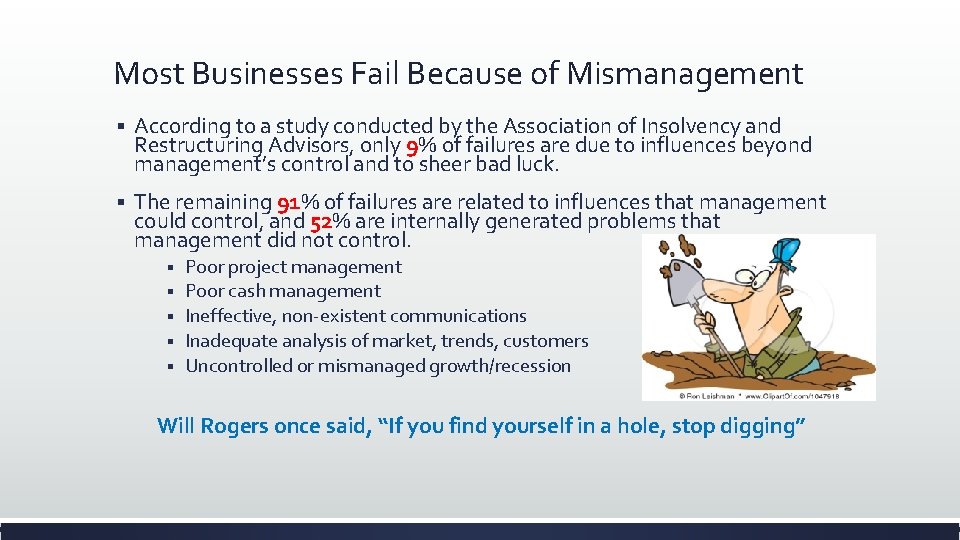
Most Businesses Fail Because of Mismanagement § According to a study conducted by the Association of Insolvency and Restructuring Advisors, only 9% of failures are due to influences beyond management’s control and to sheer bad luck. § The remaining 91% of failures are related to influences that management could control, and 52% are internally generated problems that management did not control. § § § Poor project management Poor cash management Ineffective, non-existent communications Inadequate analysis of market, trends, customers Uncontrolled or mismanaged growth/recession Will Rogers once said, “If you find yourself in a hole, stop digging”
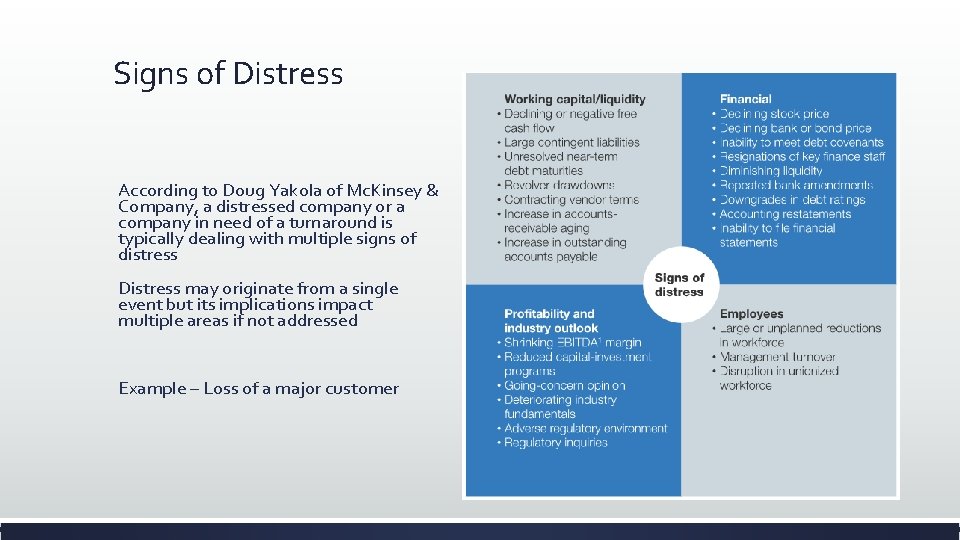
Signs of Distress According to Doug Yakola of Mc. Kinsey & Company, a distressed company or a company in need of a turnaround is typically dealing with multiple signs of distress Distress may originate from a single event but its implications impact multiple areas if not addressed Example – Loss of a major customer
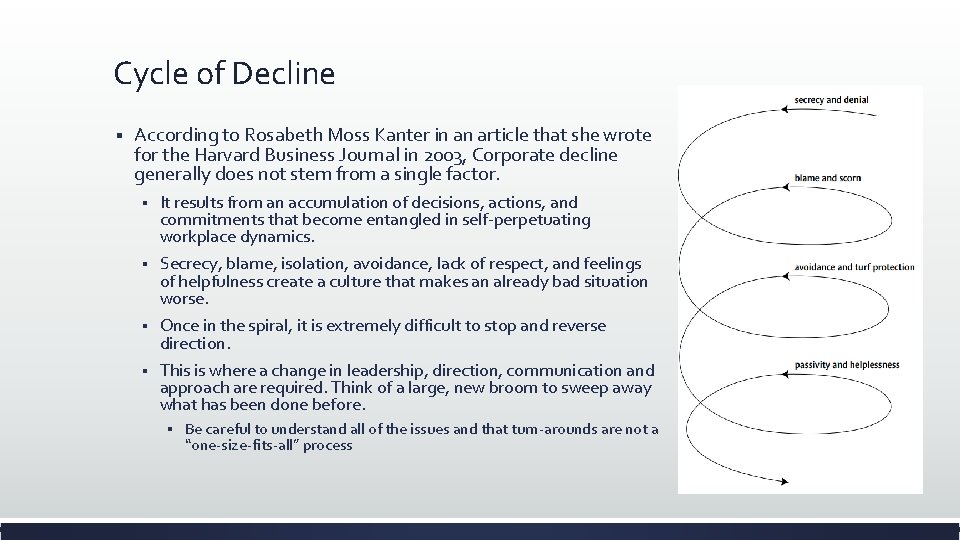
Cycle of Decline § According to Rosabeth Moss Kanter in an article that she wrote for the Harvard Business Journal in 2003, Corporate decline generally does not stem from a single factor. § It results from an accumulation of decisions, actions, and commitments that become entangled in self-perpetuating workplace dynamics. § Secrecy, blame, isolation, avoidance, lack of respect, and feelings of helpfulness create a culture that makes an already bad situation worse. § Once in the spiral, it is extremely difficult to stop and reverse direction. § This is where a change in leadership, direction, communication and approach are required. Think of a large, new broom to sweep away what has been done before. § Be careful to understand all of the issues and that turn-arounds are not a “one-size-fits-all” process
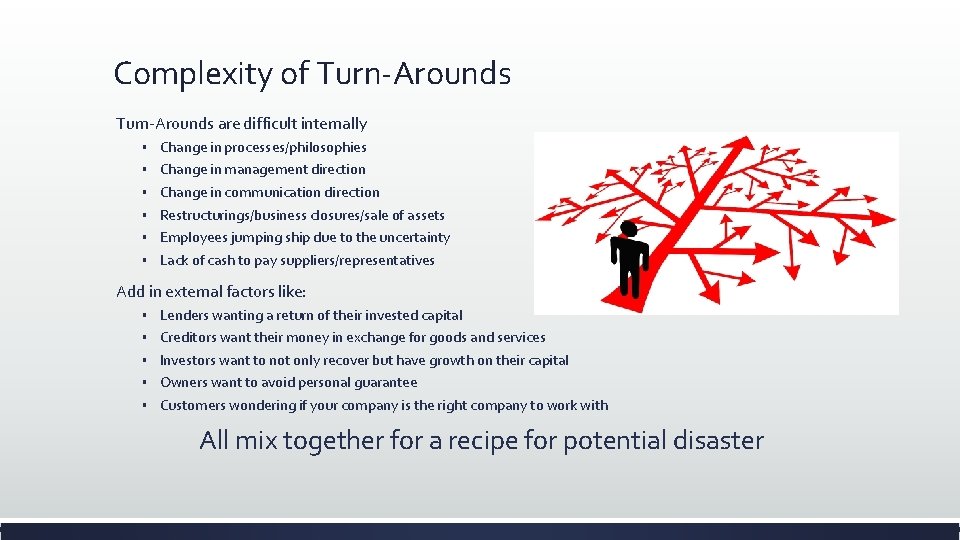
Complexity of Turn-Arounds are difficult internally § Change in processes/philosophies § Change in management direction § Change in communication direction § Restructurings/business closures/sale of assets § Employees jumping ship due to the uncertainty § Lack of cash to pay suppliers/representatives Add in external factors like: § Lenders wanting a return of their invested capital § Creditors want their money in exchange for goods and services § Investors want to not only recover but have growth on their capital § Owners want to avoid personal guarantee § Customers wondering if your company is the right company to work with All mix together for a recipe for potential disaster
Warning Signs that a Turnaround is Needed § Cash Shortfall – Business is living the “paycheck to paycheck” scenario – Delaying payments, using credit cards for extended terms, holding invoices, etc. § Physical Deterioration of Facilities or Equipment – Instead of having professionally licensed people fixing the equipment or facilities, “band-aides” are used to temporarily fix the situation. § Poor Financial Systems – Accounting and reporting systems are delinquent or inadequate – Doing more processes outside of the system vs. in the system. § High Concentration of Leases – Inability to secure traditional financing – “If you buy it, sales will come mentality…” § Management is in Denial of Current Situation – Defensive – “The issue is only temporary” or they are unwilling to learn from their competitors. § External Pressures – Lenders, Vendors, Creditors, Auditors § Poor Communication – Both internally and externally – Miscommunication or lack of communication
Warning Signs that a Turnaround is Needed – cont. § Ownership Distracted by Outside Activities – Lack of time for necessary oversight § Dishonest/Unethical Business Practices – Pushing the envelope or complete loss of ethical stewardship of the business § Pink Elephant Hunting – Looking for the next big score to fix all financial and operational problems – Lost sight of day to day business. § Inventory & Quality Issues – Slow moving items increasing or quality issues increasing § Departure of Key Employees – Inability to maintain an attractive work environment – Pay, challenges, environment § Unmotivated/Depressed Employees – General attitude of lower-level management and employees is negative
Stages of a Turnaround Depending on who you talk to, there are either 4 or 5 stages to a turnaround process § Management/Situation Analysis Stage – can be split into 2 stages or combined § Emergency Action Stage § Business Restructuring Stage § Return to Normal Stage Consultants/Specialists may be called in to manage the turnaround if current management team is unable to do so.
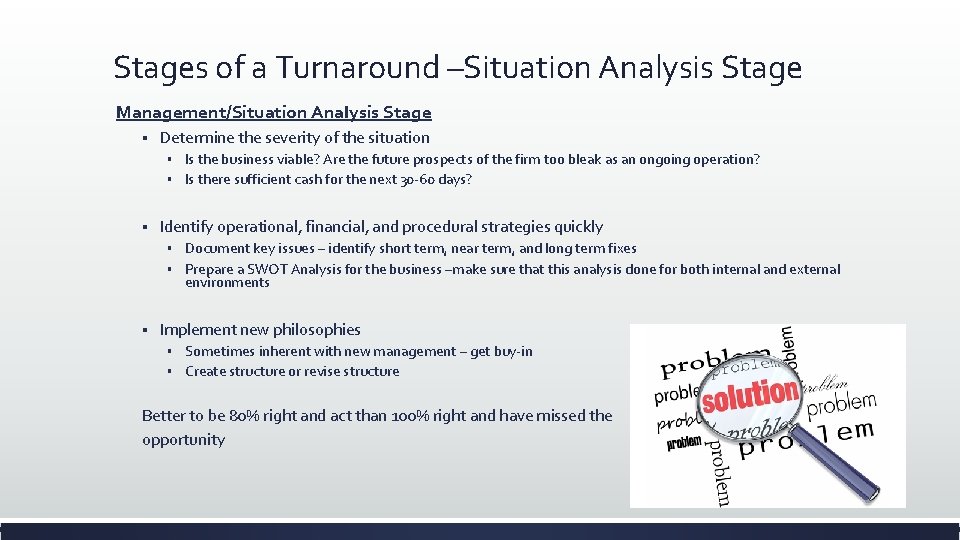
Stages of a Turnaround –Situation Analysis Stage Management/Situation Analysis Stage § Determine the severity of the situation Is the business viable? Are the future prospects of the firm too bleak as an ongoing operation? § Is there sufficient cash for the next 30 -60 days? § § Identify operational, financial, and procedural strategies quickly Document key issues – identify short term, near term, and long term fixes § Prepare a SWOT Analysis for the business –make sure that this analysis done for both internal and external environments § § Implement new philosophies Sometimes inherent with new management – get buy-in § Create structure or revise structure § Better to be 80% right and act than 100% right and have missed the opportunity
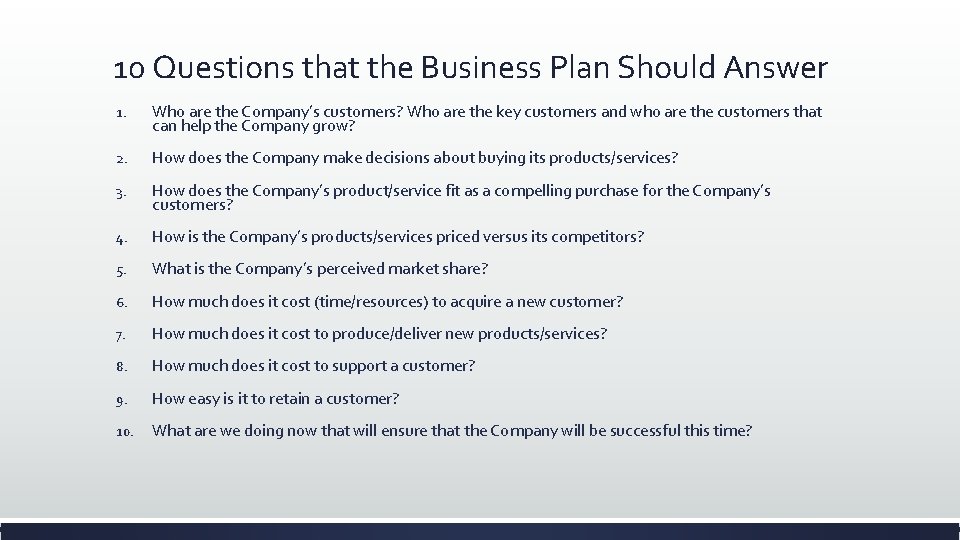
10 Questions that the Business Plan Should Answer 1. Who are the Company’s customers? Who are the key customers and who are the customers that can help the Company grow? 2. How does the Company make decisions about buying its products/services? 3. How does the Company’s product/service fit as a compelling purchase for the Company’s customers? 4. How is the Company’s products/services priced versus its competitors? 5. What is the Company’s perceived market share? 6. How much does it cost (time/resources) to acquire a new customer? 7. How much does it cost to produce/deliver new products/services? 8. How much does it cost to support a customer? 9. How easy is it to retain a customer? 10. What are we doing now that will ensure that the Company will be successful this time?
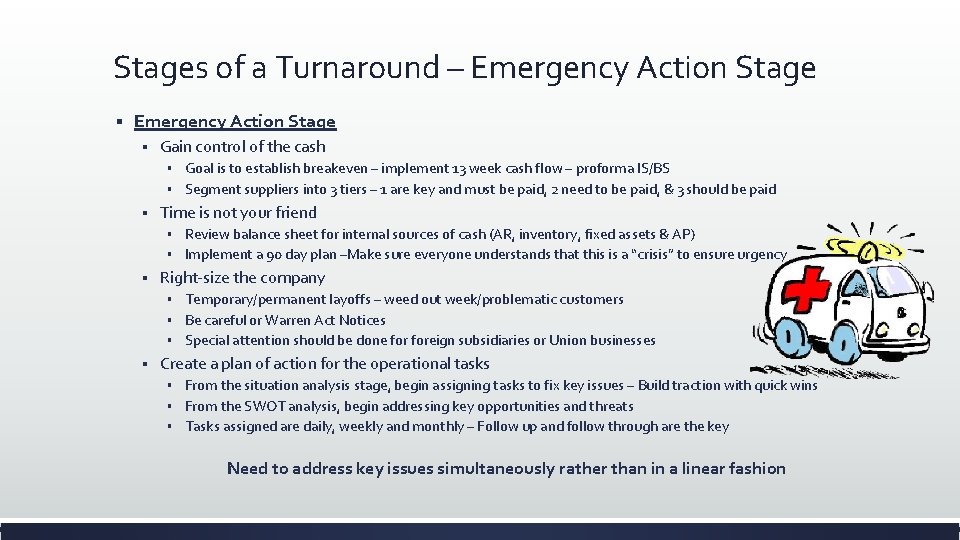
Stages of a Turnaround – Emergency Action Stage § Gain control of the cash Goal is to establish breakeven – implement 13 week cash flow – proforma IS/BS § Segment suppliers into 3 tiers – 1 are key and must be paid, 2 need to be paid, & 3 should be paid § § Time is not your friend Review balance sheet for internal sources of cash (AR, inventory, fixed assets & AP) § Implement a 90 day plan –Make sure everyone understands that this is a “crisis” to ensure urgency § § Right-size the company Temporary/permanent layoffs – weed out week/problematic customers § Be careful or Warren Act Notices § Special attention should be done foreign subsidiaries or Union businesses § § Create a plan of action for the operational tasks From the situation analysis stage, begin assigning tasks to fix key issues – Build traction with quick wins § From the SWOT analysis, begin addressing key opportunities and threats § Tasks assigned are daily, weekly and monthly – Follow up and follow through are the key § Need to address key issues simultaneously rather than in a linear fashion
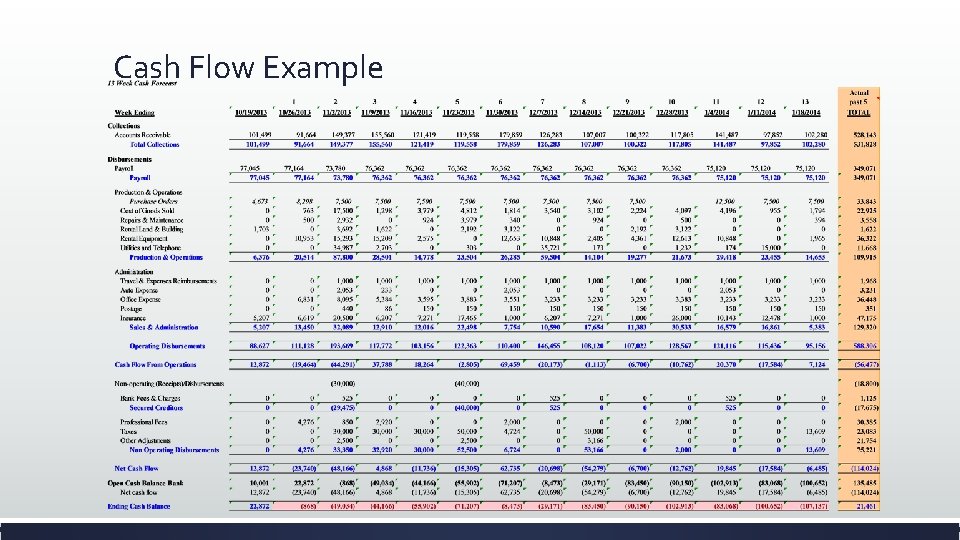
13 Week Cash Flow Model § Extremely important when dealing with a “cash strapped” situation § Focuses on the most near-term objectives § Use as a tool to provide direction as the company moves toward longer term stability § Indispensable means to gain creditability with lenders and other important constituencies § Helps measure where the company is versus its covenants and outstanding line of credit § Be realistic and measure against actual
Cash Flow Example
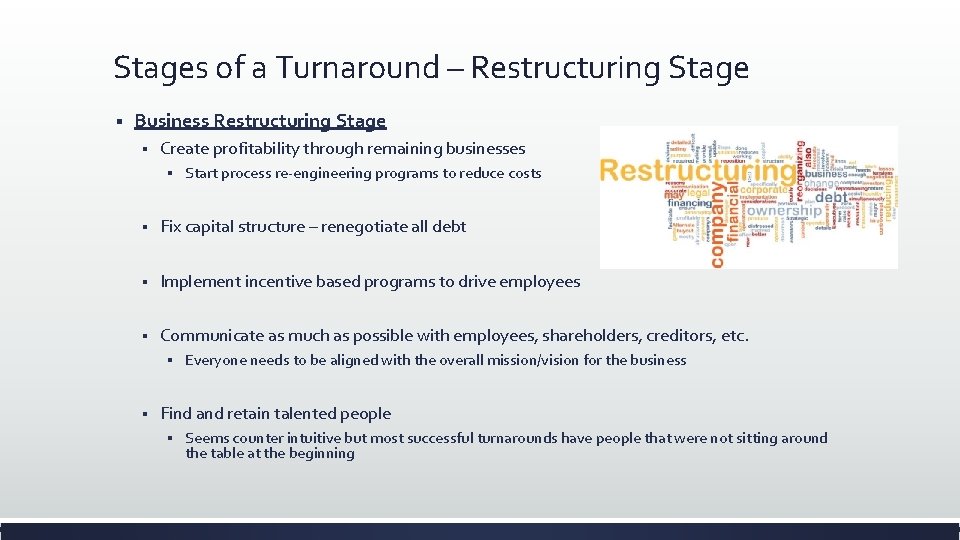
Stages of a Turnaround – Restructuring Stage § Business Restructuring Stage § Create profitability through remaining businesses § Start process re-engineering programs to reduce costs § Fix capital structure – renegotiate all debt § Implement incentive based programs to drive employees § Communicate as much as possible with employees, shareholders, creditors, etc. § § Everyone needs to be aligned with the overall mission/vision for the business Find and retain talented people § Seems counter intuitive but most successful turnarounds have people that were not sitting around the table at the beginning
Financial Restructuring § Financial restructuring usually involves changing the existing capital structure and/or raising additional equity § Involves communicating to major/main creditors the situation and plan to get the business back on track § § Should only be done by a member of the senior leadership team § Need to be open and honest – many companies have experienced similar issues Rescheduling existing bank and other third party debt § Look to pay interest only for 3 -6 months § Look to stop making payments for 3 months – tack at end of the term § Exploring the idea of taking out additional debt – consolidating all other debt § Raising new equity from existing shareholders or from outside investors
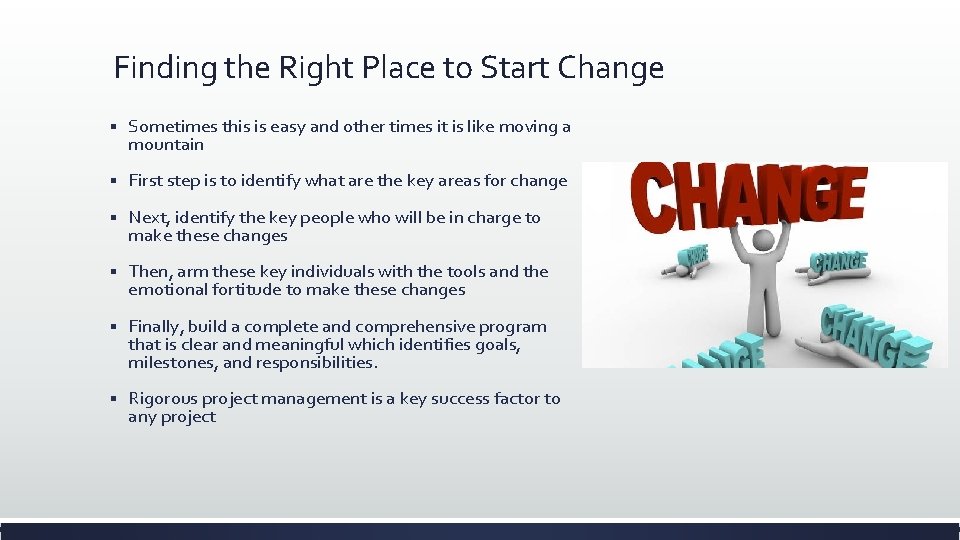
Finding the Right Place to Start Change § Sometimes this is easy and other times it is like moving a mountain § First step is to identify what are the key areas for change § Next, identify the key people who will be in charge to make these changes § Then, arm these key individuals with the tools and the emotional fortitude to make these changes § Finally, build a complete and comprehensive program that is clear and meaningful which identifies goals, milestones, and responsibilities. § Rigorous project management is a key success factor to any project
Project Scope for Change – Not a BPR § BPR – Business Process Re-Engineering Project § Describe the work to be accomplished § What’s the purpose or business need for this project? § Is there a relationship to other projects? § Who are the stakeholders? § What work is out of scope for this project? Must be sufficiently broad and deep to ensure that all mission critical issues are addressed. § The initial key is to focus on tackling the life threatening problems. § A more comprehensive business plan must also be developed to clearly state the long term goals for the business
Critical Process Improvements § Most turnaround businesses have issues with both their core and support processes § Processes are plagued with too high of cost (i. e. , inefficiency of people, systems or steps), poor quality or lack of attention to quality, and a lack of flexibility/responsiveness from the workforce. § Causes of these problems vary and have not been properly managed if addressed in the past § Inadequate machine repair – break fix vs. preventative maintenance § Outdated IT systems / Inadequate training from previous system implementation § Outdated organizational structures – still running under the typical “stove pipe” structure vs. being more fluid
Success in a Turnaround § You need to have clear-thinking to assess the current situation and determine the potential opportunities § Develop strategies that “no one has tried before”. Turnarounds require radical rather than incremental changes § Create a culture that treats the turnaround as a crisis § Begin implementing plans to restructure the company § Problems are rarely what management indicates they are § Do not focus on the symptoms – Need to find the underlying causes § Many times management is responsible for allowing these problems to exist and thus, they many not be equipped to manage the turn around
Key Ingredients for a Successful Turnaround 1. Leadership – Senior management changes 2. Stakeholder Management – Banks, lenders, investors, board, etc. 3. Crisis Stabilization – Stop the house from burning 4. Establish Focus on Strategy – Products, markets, outsourcing 5. Realign Organization – Build commitment – Improve communication 6. Implement Key Process Improvements – lower cost base 7. Get business to be cash neutral as quickly as possible. Establish new/key financial metrics. Look to reduce working capital and launch new cash generation strategies (liquidate surplus inventory, improving collections, sell unused equipment or divest business segments)
Books To Read § Below are some books that illustrate how some businesses turned around their businesses § American Icon, Alan Mulally and the Fight to Save Ford Motor Company § § Written by Bryce G. Hoffman From Worst to First: Behind the Scenes of Continental’s Remarkable Comeback § Written by Gordon Berthune
My Most Recent Journey – Setting the Stage § § § Company has been existence since the early 1960’s Had dramatic growth early and then leveled for more than 30 years – Top line changing by less than 5% for any given year Thought new equipment purchases would save the Company – No maintenance plan for older equipment – No changes in processes when new equipment was installed Owner/President started managing from a distance Two major programs which accounted for 20% of revenue came to end of life – no new programs where found to offset loss – no clear plan Owner/family still “kept up with the Joneses” on expenses and never ratcheted down on lower volumes Fraudulent billings input into the system to pump up sales and AR – were reversed over time Had promoted a staff accountant to CFO – never dealt with cash flow or internal controls - maxed out LOC and started defaulting on covenants Company had not upgraded its financial system in more than 15 years Outstanding AP was $2. 1 M – cash in bank was $124 K Turnover for the last 24 months was 18% Did not pay Federal 941 taxes for 1 st 2 quarters Company was in free fall
What Happened - The 1 st 30 days The son of the owner - just retired from the military took control of the Company in June 2013 2. I was hired as the CFO in July 2013 and immediately fired the former CFO and staff accountant and the previous accounting firm 3. Spent 42 hours straight and worked with the new president and VP of Operations to come up with a plan for the bank – meeting was three days after I was hired 4. Met with VP of Commercial Loans Workout Division of the Company’s bank – referred to as the “Undertaker” 1. a) b) c) Had every intention of pulling the plug on the business and putting locks on the doors Asked for 90 day freeze on all principal payments – interest only Presented a plan to increase cash flow – layoffs, sales of equipment, sale of former owner’s “toys” i. iii. Indicated that he and his team would be receiving weekly status updates and a 13 week cash flow Indicated that we would work with all other third party lenders to freeze at least principal payments for the next 90180 days – freeze all other capex items Illustrated plans to increase margins and look to grow sales – presented current backlog for orders after cleaning out dead orders Started meeting with all critical vendors and customers with the VP of Operations to get a better sense of the Company 6. Contacted every single third party creditor and negotiated either a complete freeze on payments or payments of interest only for the next 3 -6 months 7. New President and leadership team loaned the Company almost $500, 000 – no increase of LOC 5.
What Happened – Days 31 -90 - Strategy 1. After the layoff, sale of equipment and “toys”, had an all hands meeting with the employees a) b) c) 2. Told them the situation – openly and honestly – “a crisis and a call to action” Illustrated a plan to get the business moving forward – we created a change story that everyone understands Implemented a complete maintenance/training program for all machines Presented data on historical production processes a) b) c) d) On average, it was taking the team 30+ days to ship out product where the defined lead time was 10 days Many quality issues and missing steps in protocol were identified Presented margins by PL – Illustrated how the company was wrapping $100 bills to each product of a specific product line – change process or drop Presented a new operations diagram – how the flow of work will flow 3. Weekly calls with lenders, shareholders, other interested parties 4. Working with customers (new/existing) to drive additional business 5. Senior management rebuilt stakeholder confidence by demonstrating that we had “taken control” of the situation During this stage it is very important to not only be strategic but also tactical – no managing from 50, 000 ft.
What Happened – Days 91 -180 – Begin Stabilization 1. Built and illustrated predictability into the business a) Cashflow & revenue forecasts b) Constant communication with the stakeholders & employees c) Vendors and customers saw the difference 2. Brought in new sales team to address key targets/holes 3. Achieved 90% uptime on legacy machines after re-organizing plant layout and implementing maintenance program 4. Implemented upgraded ERP version and established quality controls 5. Increased on-time delivery to 88% 6. Re-aligned the business & its workforce to the new business direction 7. Worked with the State on various assistance programs a) DOL b) DECD c) SBA/Express Grant & Loan Program
What Happened – Days 181 -360 – Stabilization 1. Sought profitable growth a) Emphasized profits and returns b) Built competitive strengths c) Explored new markets 2. Developed rolling 90 day strategic plan 3. Restructured long term financing 4. Organized the business to succeed 5. a) Filled key position with talented people b) Did not compromise Institutionalized continuous management and employee training/development programs a) Implemented cross training programs and began apprenticeship program
What Happened – After 24 months…. Owner began falling into the same pattern as his father 2. Owner began ordering new machines on speculation of new orders 1. a) b) 3. 4. 5. 6. 7. 8. 9. Major new project order was pushed out 12 months Value dropped by 40% from original quote Owner increased his salary and bought a new vehicle as he thought he deserved it Owner stopped playing an active role in the day to day management of the business Owner started making decisions on his own without the consultation or discussion with the CFO and VP of Operations Owner began replacing people with people that he knew from his military days Revenues started to fall and quality issues began to increase Owner fired VP of Operations and blamed the down-fall on him Stakeholders started asking questions on direction and reasons for misses a) b) Told the CFO that he was forbidden from talking to the bank or other stakeholders CFO left Company was put back on workout with the bank Unless you are consistent and keep with plans/processes that got the Company out of a Turnaround, it is very likely that you will regress to old ways and end up in the same situation in 24 -36 months 10.