
If Time Marches on why is Time Constant

![[ (2 M 1 0 6 HS 0 V 0 + 10 [ t](https://slidetodoc.com/presentation_image/4d2b9263933672a0859850287af76697/image-5.jpg "[ (2 M 1 0 6 HS 0 V 0 + 10 [ t")
![[ (2 M 1 0 6 HS 5 0 + [ t , ,](https://slidetodoc.com/presentation_image/4d2b9263933672a0859850287af76697/image-6.jpg "[ (2 M 1 0 6 HS 5 0 + [ t , ,")

![[ (2 Natural (b) Response (a) + VR R [ t , , V](https://slidetodoc.com/presentation_image/4d2b9263933672a0859850287af76697/image-15.jpg "[ (2 Natural (b) Response (a) + VR R [ t , , V")

- Slides: 18
If Time Marches on why is Time Constant? [ t , , V 0 , I 1 , v(t) , R 1 , L 1 , XL ] (a) + V 0 (a) (b) V 3 v 0 - v. C(t) V 0 C 1 + V 1 V 2 V 1 R 1 (b) + V 0 R VR VC L AInc. G [ t , , V 1 , I 0 , i(t) , R 1 , C 1 , XC ]
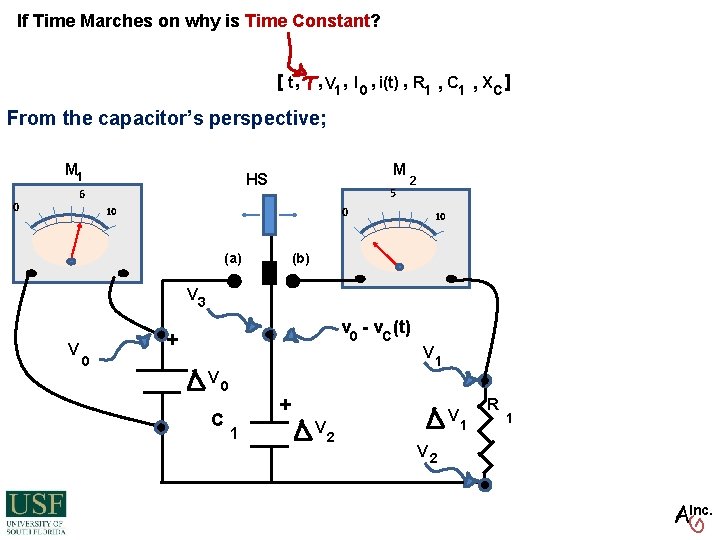
If Time Marches on why is Time Constant? [ t , , V 1 , I 0 , i(t) , R 1 , C 1 , XC ] From the capacitor’s perspective; M 1 6 0 M HS 5 2 0 10 (a) 10 (b) V 3 0 V 0 C V 1 + 1 V V 2 R 1 1 V 2 AInc. G V v 0 - v. C(t) +
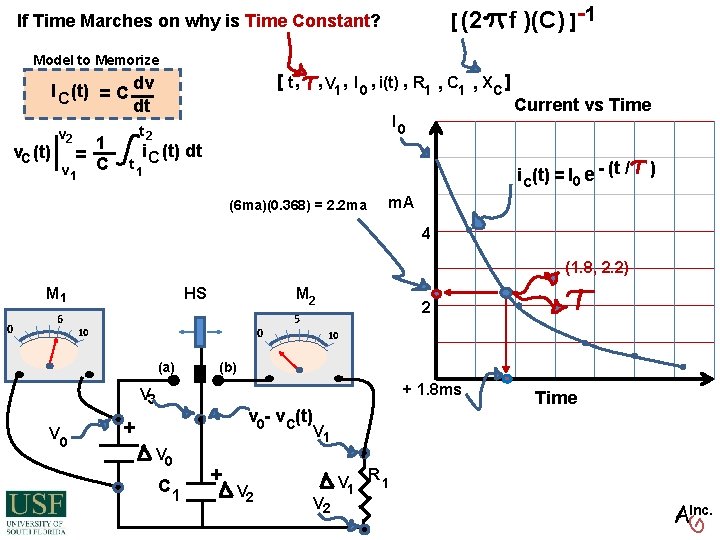
[ (2 If Time Marches on why is Time Constant? f )(C) ] -1 Model to Memorize [ t , , V 1 , I 0 , i(t) , R 1 , C 1 , XC ] I C (t) = C dv dt v. C (t) v 2 1 = v 1 C I 0 t 2 i (t) t 1 C dt Current vs Time i c(t) = I 0 e - (t / ) m. A (6 ma)(0. 368) = 2. 2 ma 4 (1. 8, 2. 2) 0 6 M 2 HS 0 10 (a) 10 (b) + 1. 8 ms V 3 V 0 2 5 v 0 - v C(t) + V 0 C 1 + V 2 Time V 1 V 2 V 1 R 1 AInc. G M 1
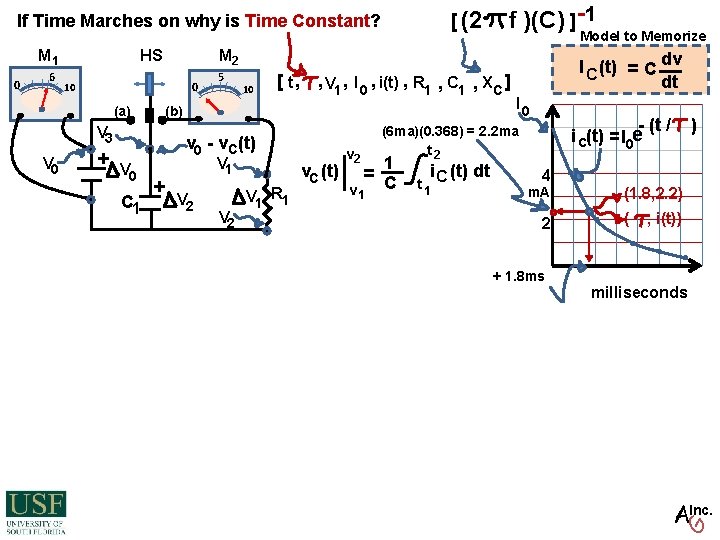
M 1 0 6 HS 0 V 0 + 5 10 [ t , , V 1 , I 0 , i(t) , R 1 , C 1 , XC ] (b) V 3 v 0 - v. C(t) V 0 C 1 + Model to Memorize M 2 10 (a) f )(C) ] -1 V 2 V 1 R 1 v. C (t) v 2 I C (t) = C dv dt I 0 - (t / i c(t) = I 0 e (6 ma)(0. 368) = 2. 2 ma t 2 1 = v 1 C i (t) t 1 C dt ) 4 m. A 2 + 1. 8 ms (1. 8, 2. 2) ( , i(t)) milliseconds AInc. G [ (2 If Time Marches on why is Time Constant?
[ (2 M 1 0 6 HS 0 V 0 + 10 [ t , , V 1 , I 0 , i(t) , R 1 , C 1 , XC ] v 0 - v. C(t) V 0 C 1 ic (t) = I 0 e 5 (b) V 3 - (t / + ) Model to Memorize M 2 10 (a) f )(C) ] -1 V 2 V 1 R 1 v. C (t) v 2 I C (t) = C dv dt I 0 - (t / i c(t) = I 0 e (6 ma)(0. 368) = 2. 2 ma t 2 1 i (t) t 1 C = v 1 C dt 4 m. A 2 V 2 = 1 C I (-1) 0 Discharging capacitor Energy balance [ V 2 ] in = (from resistor’s perspective) [ - (t / e V 1] out ) (1. 8, 2. 2) ( , i(t)) ) t 2 t 1 + 1. 8 ms 1 [ C 1 t 2 i C (t) dt t 1 2 4 6 milliseconds ] in = [ R 1 i(t) ] out AInc. G If Time Marches on why is Time Constant?
[ (2 M 1 0 6 HS 5 0 + [ t , , V 1 , I 0 , i(t) , R 1 , C 1 , XC ] v 0 - v. C(t) V 0 C 1 ic (t) = I 0 e 10 (b) V 3 V 0 - (t / + V 1 V 2 ) V 1 R 1 v. C (t) e- (t / V 2 = ) =0 I C (t) = C dv dt I 0 - (t / i c(t) = I 0 e (6 ma)(0. 368) = 2. 2 ma t 2 v 2 1 i (t) t 1 C = v 1 C dt 1 C - (t / e I (-1) 0 [ d i(t) + dt m. A (1. 8, 2. 2) ( 1 ]I R 1 C 1 0 , i(t)) ) t 2 t 1 + 1. 8 ms 1 [ C 1 V 1] out [ ) 4 2 Discharging capacitor Energy balance [ V 2 ] in = (from resistor’s perspective) 1 R 1 d i(t) + I dt C 1 0 Model to Memorize M 2 10 (a) f )(C) ] -1 e - (t / t 2 2 4 6 milliseconds i C (t) dt t 1 ) =0 ] in = [ R 1 i(t) ] out This is a first order differential equation If the time constant, R, and C are known, the Euler numerical method will produce i(t) vs. t plot above. AInc. G If Time Marches on why is Time Constant?
[ (2 If Time Marches on why is Time Constant? 0 6 HS M 2 + v 0 - v. C(t) V 0 C 1 ic (t) = I 0 e [ t , , V 1 , I 0 , i(t) , R 1 , C 1 , XC ] 10 (b) V 3 V 0 5 0 10 (a) - (t / + V 1 V 2 V 1 R 1 v. C (t) ) V 2 = e- (t / ) 1 C [ I 0 - (t / i c(t) = I 0 e (6 ma)(0. 368) = 2. 2 ma t 2 v 2 1 i (t) t 1 C = v 1 C dt R 1+ 1 [ I 0 e- (t / C 1 -(t / ) ] I 0 e e 0 4 m. A (1. 8, 2. 2) ( =0 t 1 + 1. 8 ms [ C 1 1 ]I R 1 C 1 0 ) + 1 t 2 1 V 1] out [ I 0 C 1 ) , i(t)) ) t 2 - (t / I (-1) d i(t) + dt =0 R 1 (-1) This is always zero when [ ] term below is zero. I C (t) = C dv dt 2 Discharging capacitor Energy balance [ V 2 ] in = (from resistor’s perspective) 1 R 1 d i(t) + I dt C 1 0 Model to Memorize e i C (t) dt t 1 - (t / ) e - (t / ) RC = R 1 C 1 2 4 6 milliseconds =0 = 0 ] in = [ R 1 i(t) ] out This is a first order differential equation If the time constant, R, and C are known, the Euler numerical method will produce i(t) vs. t plot above. AInc. G M 1 f )(C) ] -1
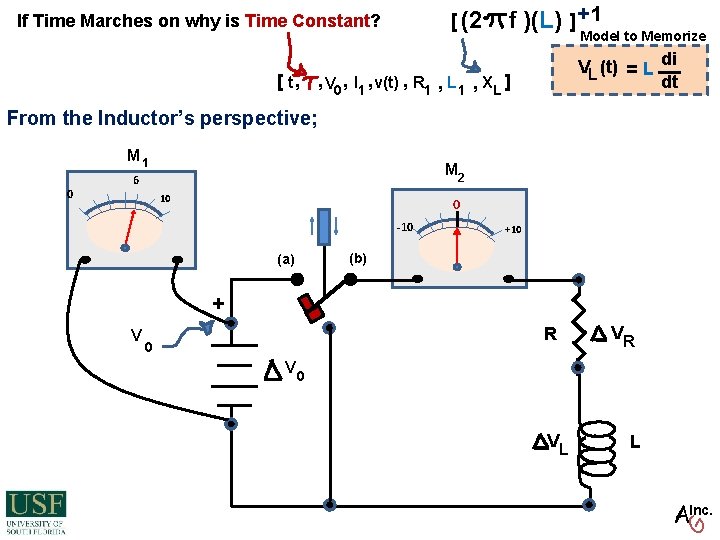
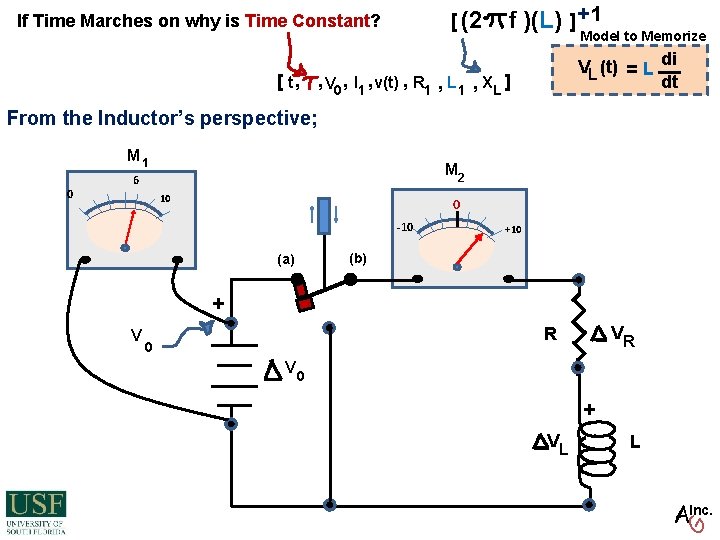
[ (2 If Time Marches on why is Time Constant? f )(L) ] +1 Model to Memorize VL (t) = L di dt [ t , , V 0 , I 1 , v(t) , R 1 , L 1 , XL ] From the Inductor’s perspective; M 1 10 0 -10 +10 (b) (a) + V R 0 V VR 0 VL L AInc. G 0 M 2 6
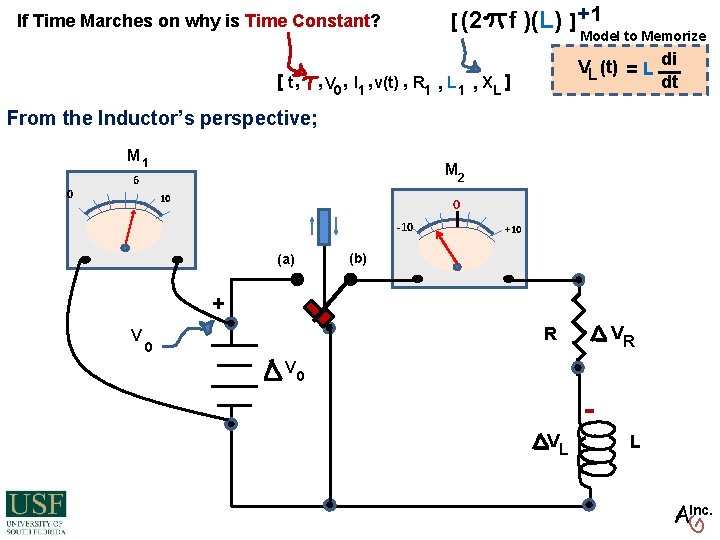
[ (2 If Time Marches on why is Time Constant? f )(L) ] +1 Model to Memorize VL (t) = L di dt [ t , , V 0 , I 1 , v(t) , R 1 , L 1 , XL ] From the Inductor’s perspective; M 1 10 0 -10 +10 (b) (a) + V VR R 0 V 0 + VL L AInc. G 0 M 2 6
[ (2 If Time Marches on why is Time Constant? f )(L) ] +1 Model to Memorize VL (t) = L di dt [ t , , V 0 , I 1 , v(t) , R 1 , L 1 , XL ] From the Inductor’s perspective; M 1 10 0 -10 +10 (b) (a) + V VR R 0 VL L AInc. G 0 M 2 6
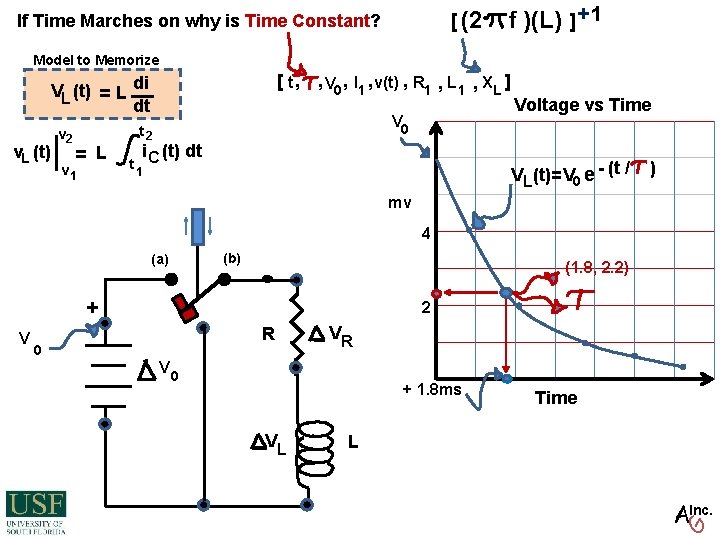
[ (2 If Time Marches on why is Time Constant? f )(L) ] +1 Model to Memorize [ t , , V 0 , I 1 , v(t) , R 1 , L 1 , XL ] VL (t) = L di dt v. L (t) v 2 V 0 t 2 = L v 1 i (t) t 1 C dt Voltage vs Time VL (t)= V 0 e - (t / ) mv 4 (b) (a) (1. 8, 2. 2) + R 0 V VR 0 + 1. 8 ms VL Time L AInc. G V 2
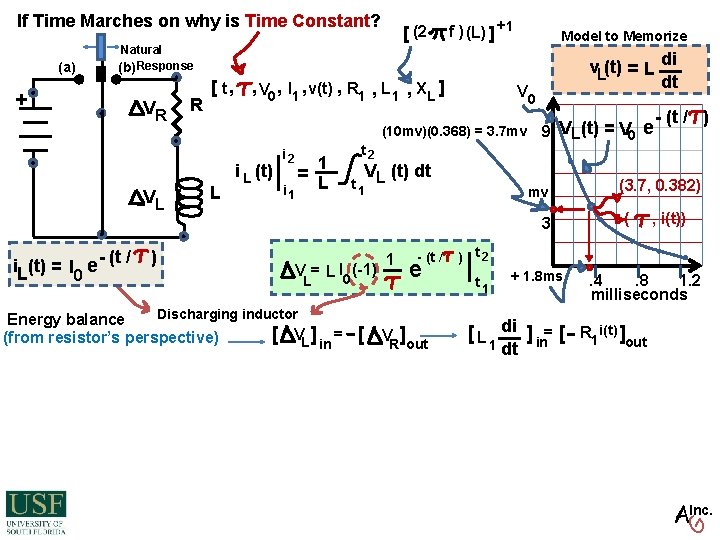
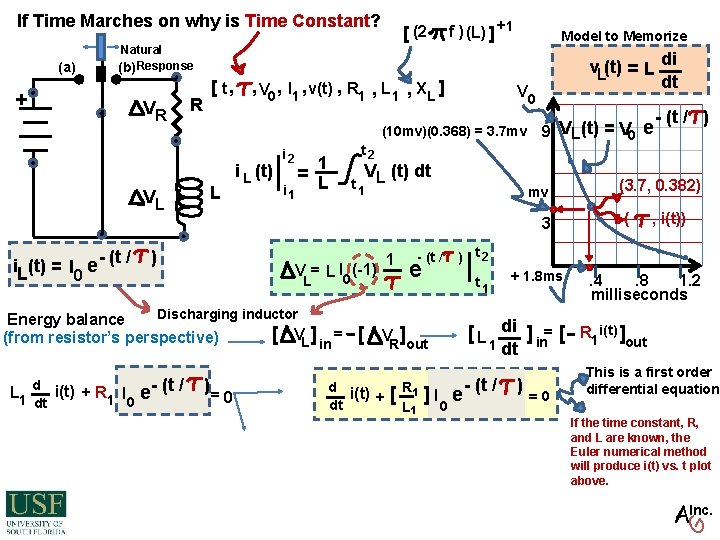
(a) [ (2 f ) (L) ] +1 Model to Memorize Natural (b) Response + VR VL R [ t , , V 0 , I 1 , v(t) , R 1 , L 1 , XL ] V 0 (10 mv)(0. 368) = 3. 7 mv L i L (t) i 2 1 = L i 1 t 2 V t 1 L v. L(t) = L di dt 9 VL(t) = V 0 e (t) dt mv 3 i. L(t) = I 0 e - (t / ) V = L I (-1) 0 L Discharging inductor Energy balance [ VL ] in = (from resistor’s perspective) [ 1 - (t / e VR]out - (t / ) (3. 7, 0. 382) ( , i(t)) ) t 2 t 1 + 1. 8 ms [ L di ] in= [ 1 dt . 4. 8 1. 2 milliseconds R 1 i(t) ] out AInc. G If Time Marches on why is Time Constant?
(a) [ (2 f ) (L) ] +1 Model to Memorize Natural (b) Response + VR VL [ t , , V 0 , I 1 , v(t) , R 1 , L 1 , XL ] R V 0 (10 mv)(0. 368) = 3. 7 mv L i L (t) i 2 1 = L i 1 t 2 V t 1 L v. L(t) = L di dt 9 VL(t) = V 0 e (t) dt mv 3 i. L(t) = I 0 e - (t / ) V = L I (-1) 0 L Discharging inductor Energy balance [ VL ] in = (from resistor’s perspective) L 1 d i(t) + R 1 I 0 dt e- (t / 1 ) =0 [ - (t / e [ R 1 ] I 0 e L 1 (3. 7, 0. 382) ( , i(t)) ) t 2 VR]out d i(t) + dt - (t / ) + 1. 8 ms t 1 [ L di ] in= [ 1 dt - (t / ) =0 . 4. 8 1. 2 milliseconds R 1 i(t) ] out This is a first order differential equation If the time constant, R, and L are known, the Euler numerical method will produce i(t) vs. t plot above. AInc. G If Time Marches on why is Time Constant?
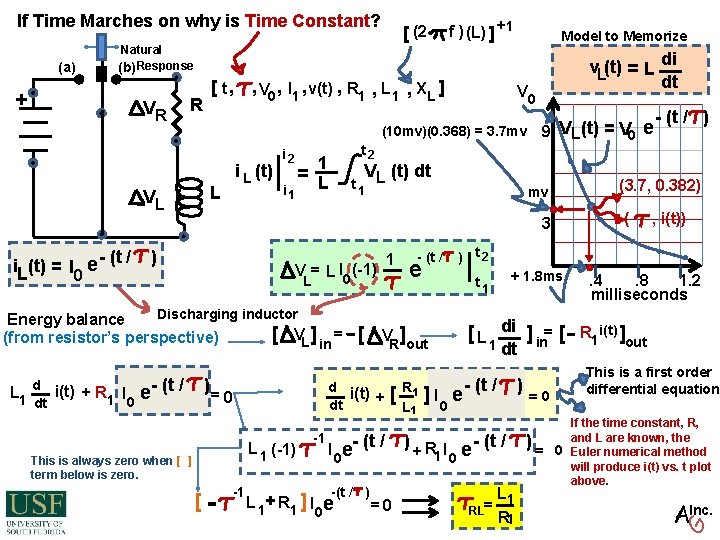
(a) [ (2 f ) (L) ] +1 Model to Memorize Natural (b) Response + VR [ t , , V 0 , I 1 , v(t) , R 1 , L 1 , XL ] R V 0 9 VL(t) = V 0 e (10 mv)(0. 368) = 3. 7 mv i L (t) L VL i 2 t 2 1 V t 1 L = L i 1 v. L(t) = L di dt (t) dt (3. 7, 0. 382) mv ( 3 i. L(t) = I 0 e - (t / ) V = L I (-1) 0 L Discharging inductor Energy balance [ VL ] in = (from resistor’s perspective) L 1 d i(t) + R 1 I 0 dt 1 e- (t / ) L 1 (-1) [ -1 -1 L 1+ R 1 ] I [ R 1 ] I 0 e I 0 e- (t / -(t / ) e 0 e =0 , i(t)) ) t 2 VR ]out d i(t) + dt =0 This is always zero when [ ] term below is zero. [ - (t / ) + 1. 8 ms t 1 [ L di ] in= [ 1 dt - (t / L 1 ) R I e - (t / + 1 0 L 1 = RL R 1 ) =0 ) = . 4. 8 1. 2 milliseconds R 1 i(t) ] out This is a first order differential equation If the time constant, R, and L are known, the 0 Euler numerical method will produce i(t) vs. t plot above. AInc. G If Time Marches on why is Time Constant?
[ (2 Natural (b) Response (a) + VR R [ t , , V 0 , I 1 , v(t) , R 1 , L 1 , XL ] L VL i L (t) i 1 1 = L t 2 V t 1 L (t) dt v L(t) t 2 i t 1 L = L v 1 (t) dt V 3 + V 0 Model to Memorize (b) v 0 - v. C(t) V 0 C 1 + V 1 V 2 V 1 R 1 v. C (t) v 2 1 = C v 1 t 2 i (t) t 1 C dt I C (t) = C dv dt IC (t) i 2 i 1 =C I 0 V (t) dt t 1 C - (t / ) ( , i(t)) . 4. 8 1. 2 milliseconds - (t / i c(t) = I 0 e (6 ma)(0. 368) = 2. 2 ma 4 m. A 2 + 1. 8 ms t 2 e (3. 7, 0. 382) mv + 1. 8 ms [ t , , V 1 , I 0 , i(t) , R 1 , C 1 , XC ] (a) 9 VL(t) = V 0 3 VL (t) = L di dt v 2 V 0 (10 mv)(0. 368) = 3. 7 mv Model to Memorize i 2 f ) (L) ] +1 ) (1. 8, 2. 2) ( , i(t)) 2 4 6 milliseconds AInc. G Summary - Time Constant
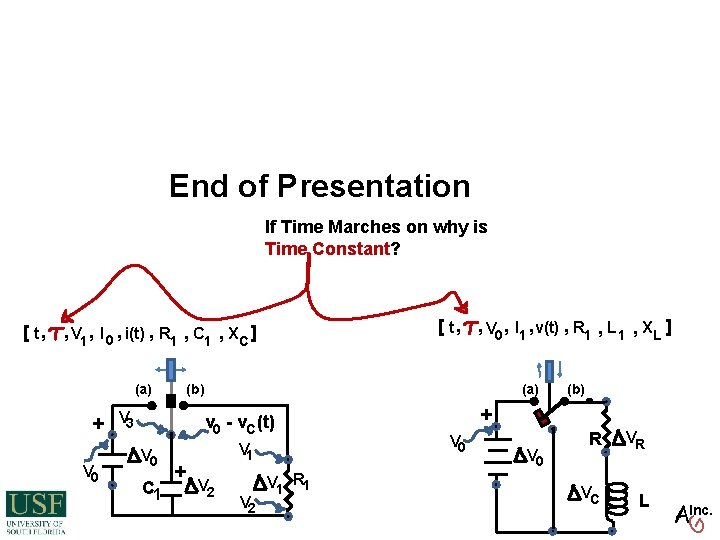
End of Presentation If Time Marches on why is Time Constant? [ t , , V 0 , I 1 , v(t) , R 1 , L 1 , XL ] (a) + V 0 (b) V 3 (a) v 0 - v. C(t) V 0 C 1 + V 1 V 2 V 1 R 1 (b) + V 0 R VR VC L AInc. G [ t , , V 1 , I 0 , i(t) , R 1 , C 1 , XC ]
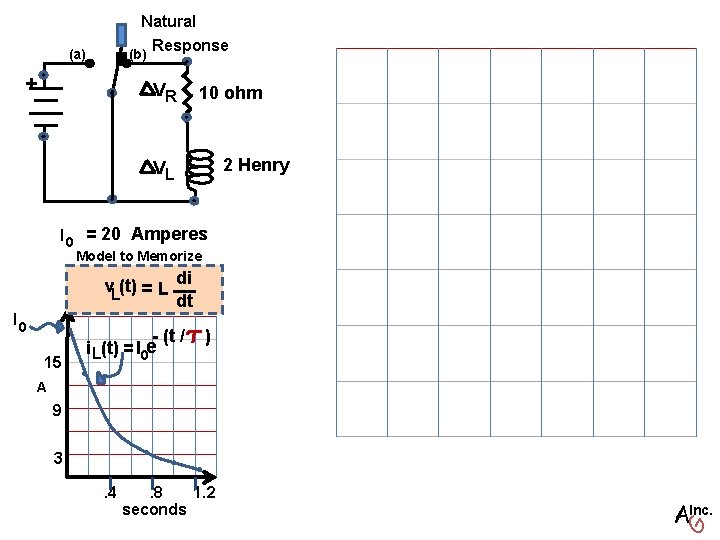
Natural Response (a) (b) + VR 10 ohm 2 Henry VL I 0 = 20 Amperes Model to Memorize v. L(t) = L di dt I 0 15 - (t / i L(t) = I 0 e ) A 9 3. 8 1. 2 seconds AInc. G . 4