Modularity Professor Jennifer Rexford http www cs princeton

- Slides: 48
Modularity Professor Jennifer Rexford http: //www. cs. princeton. edu/~jrex The material for this lecture is drawn, in part, from The Practice of Programming (Kernighan & Pike) Chapter 4 1
Goals of this Lecture • Help you learn how to: • Create high quality modules in C • Why? • Abstraction is a powerful (only? ) technique available for understanding large, complex systems • A power programmer knows how to find the abstractions in a large program • A power programmer knows how to convey a large program’s abstractions via its modularity 2
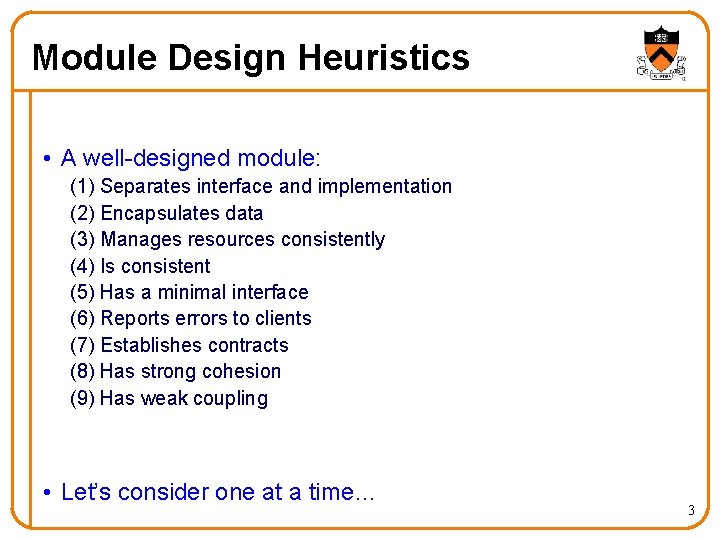
Module Design Heuristics • A well-designed module: (1) Separates interface and implementation (2) Encapsulates data (3) Manages resources consistently (4) Is consistent (5) Has a minimal interface (6) Reports errors to clients (7) Establishes contracts (8) Has strong cohesion (9) Has weak coupling • Let’s consider one at a time… 3
Interfaces (1) A well-designed module separates interface and implementation • Why? • Hides implementation details from clients • Thus facilitating abstraction • Also allows separate compilation of each implementation • Thus facilitating partial builds 4
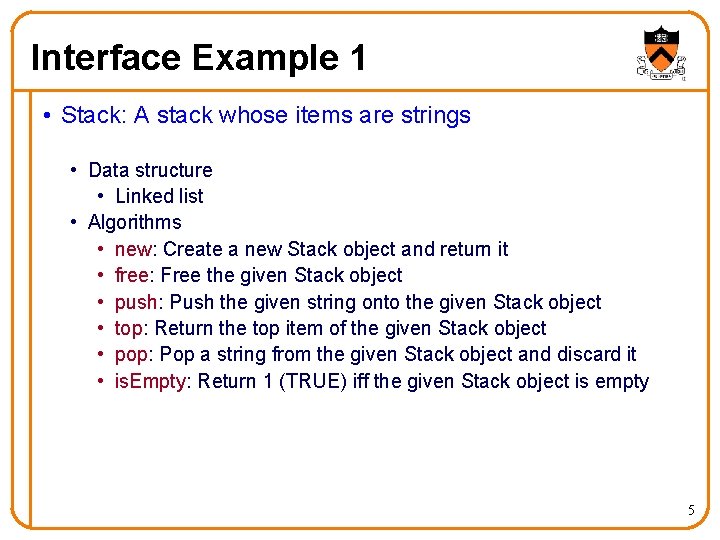
Interface Example 1 • Stack: A stack whose items are strings • Data structure • Linked list • Algorithms • new: Create a new Stack object and return it • free: Free the given Stack object • push: Push the given string onto the given Stack object • top: Return the top item of the given Stack object • pop: Pop a string from the given Stack object and discard it • is. Empty: Return 1 (TRUE) iff the given Stack object is empty 5
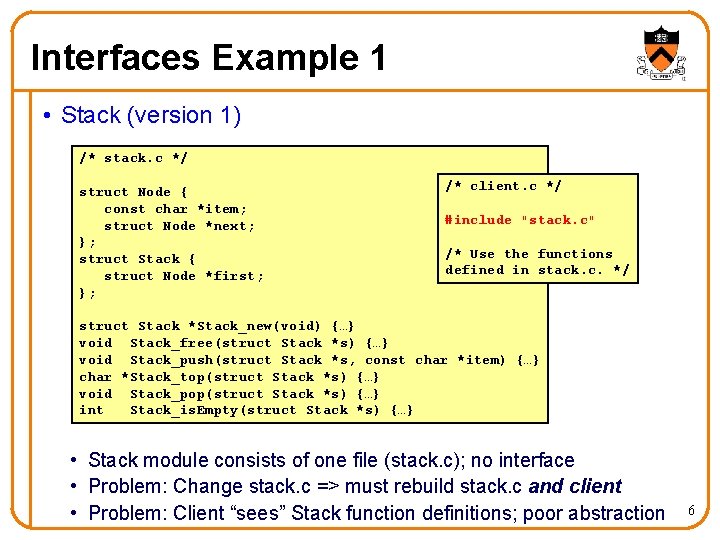
Interfaces Example 1 • Stack (version 1) /* stack. c */ struct Node { const char *item; struct Node *next; }; struct Stack { struct Node *first; }; /* client. c */ #include "stack. c" /* Use the functions defined in stack. c. */ struct Stack *Stack_new(void) {…} void Stack_free(struct Stack *s) {…} void Stack_push(struct Stack *s, const char *item) {…} char *Stack_top(struct Stack *s) {…} void Stack_pop(struct Stack *s) {…} int Stack_is. Empty(struct Stack *s) {…} • Stack module consists of one file (stack. c); no interface • Problem: Change stack. c => must rebuild stack. c and client • Problem: Client “sees” Stack function definitions; poor abstraction 6
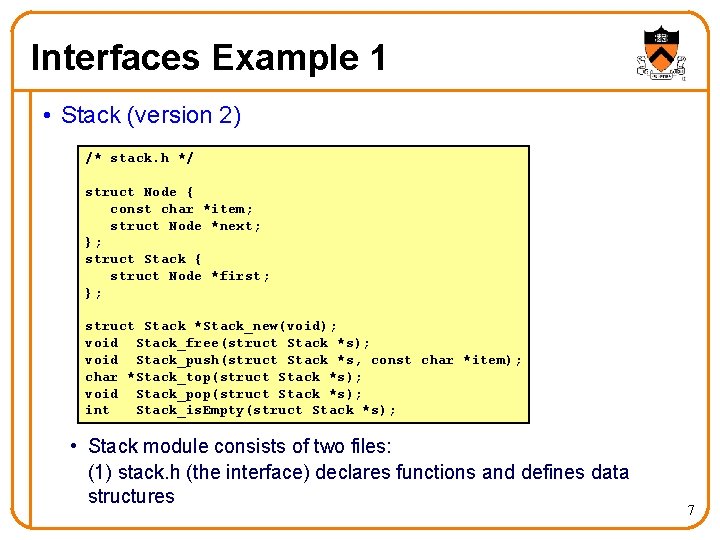
Interfaces Example 1 • Stack (version 2) /* stack. h */ struct Node { const char *item; struct Node *next; }; struct Stack { struct Node *first; }; struct Stack *Stack_new(void); void Stack_free(struct Stack *s); void Stack_push(struct Stack *s, const char *item); char *Stack_top(struct Stack *s); void Stack_pop(struct Stack *s); int Stack_is. Empty(struct Stack *s); • Stack module consists of two files: (1) stack. h (the interface) declares functions and defines data structures 7
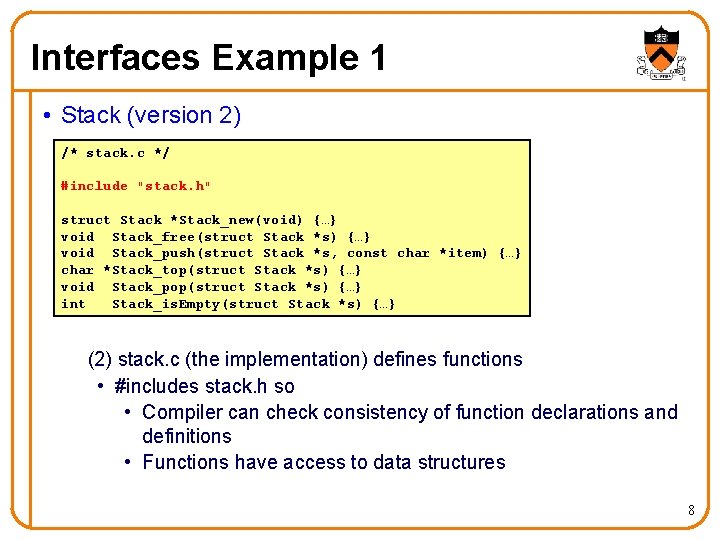
Interfaces Example 1 • Stack (version 2) /* stack. c */ #include "stack. h" struct Stack *Stack_new(void) {…} void Stack_free(struct Stack *s) {…} void Stack_push(struct Stack *s, const char *item) {…} char *Stack_top(struct Stack *s) {…} void Stack_pop(struct Stack *s) {…} int Stack_is. Empty(struct Stack *s) {…} (2) stack. c (the implementation) defines functions • #includes stack. h so • Compiler can check consistency of function declarations and definitions • Functions have access to data structures 8
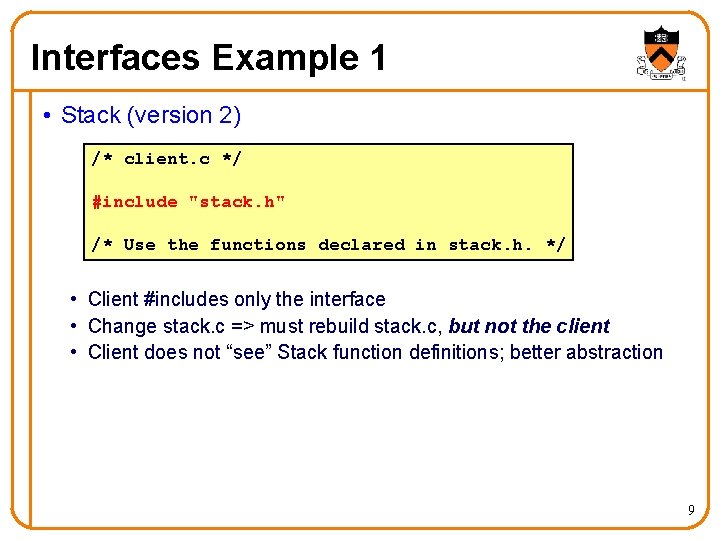
Interfaces Example 1 • Stack (version 2) /* client. c */ #include "stack. h" /* Use the functions declared in stack. h. */ • Client #includes only the interface • Change stack. c => must rebuild stack. c, but not the client • Client does not “see” Stack function definitions; better abstraction 9
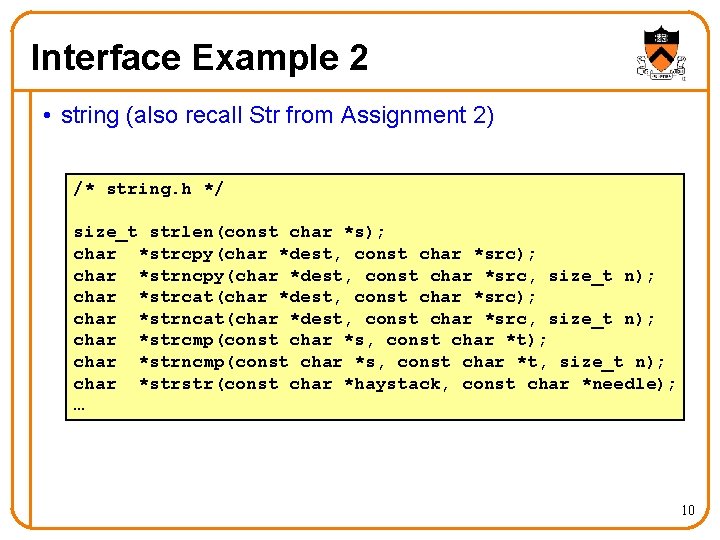
Interface Example 2 • string (also recall Str from Assignment 2) /* string. h */ size_t strlen(const char *s); char *strcpy(char *dest, const char *src); char *strncpy(char *dest, const char *src, size_t n); char *strcat(char *dest, const char *src); char *strncat(char *dest, const char *src, size_t n); char *strcmp(const char *s, const char *t); char *strncmp(const char *s, const char *t, size_t n); char *strstr(const char *haystack, const char *needle); … 10
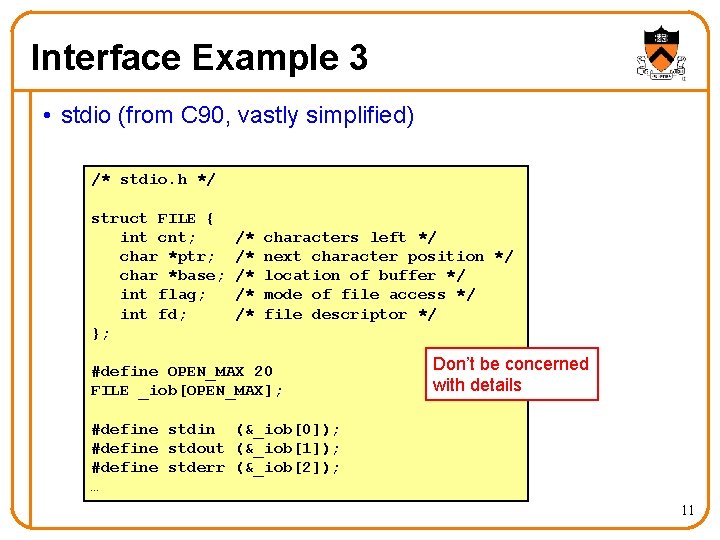
Interface Example 3 • stdio (from C 90, vastly simplified) /* stdio. h */ struct FILE { int cnt; char *ptr; char *base; int flag; int fd; }; /* /* /* characters left */ next character position */ location of buffer */ mode of file access */ file descriptor */ #define OPEN_MAX 20 FILE _iob[OPEN_MAX]; Don’t be concerned with details #define stdin (&_iob[0]); #define stdout (&_iob[1]); #define stderr (&_iob[2]); … 11
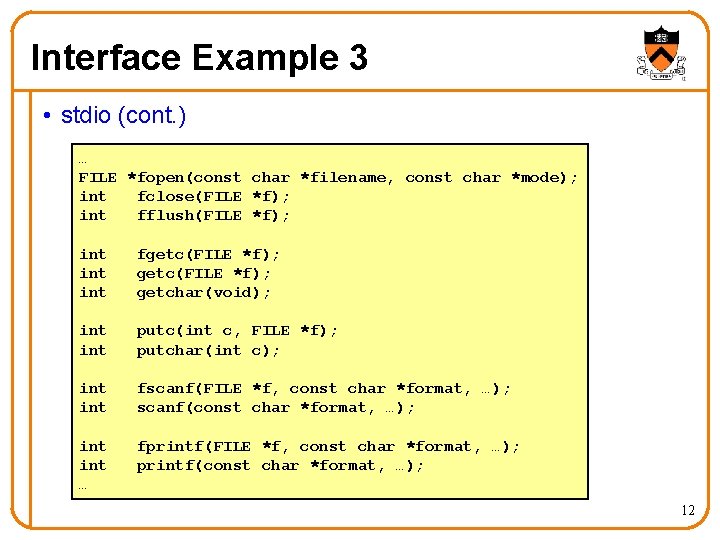
Interface Example 3 • stdio (cont. ) … FILE *fopen(const char *filename, const char *mode); int fclose(FILE *f); int fflush(FILE *f); int int fgetc(FILE *f); getchar(void); int putc(int c, FILE *f); putchar(int c); int fscanf(FILE *f, const char *format, …); scanf(const char *format, …); int … fprintf(FILE *f, const char *format, …); printf(const char *format, …); 12
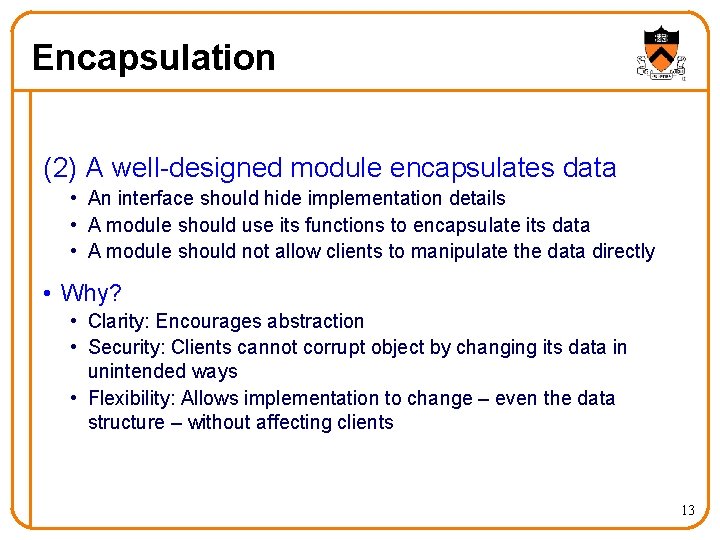
Encapsulation (2) A well-designed module encapsulates data • An interface should hide implementation details • A module should use its functions to encapsulate its data • A module should not allow clients to manipulate the data directly • Why? • Clarity: Encourages abstraction • Security: Clients cannot corrupt object by changing its data in unintended ways • Flexibility: Allows implementation to change – even the data structure – without affecting clients 13
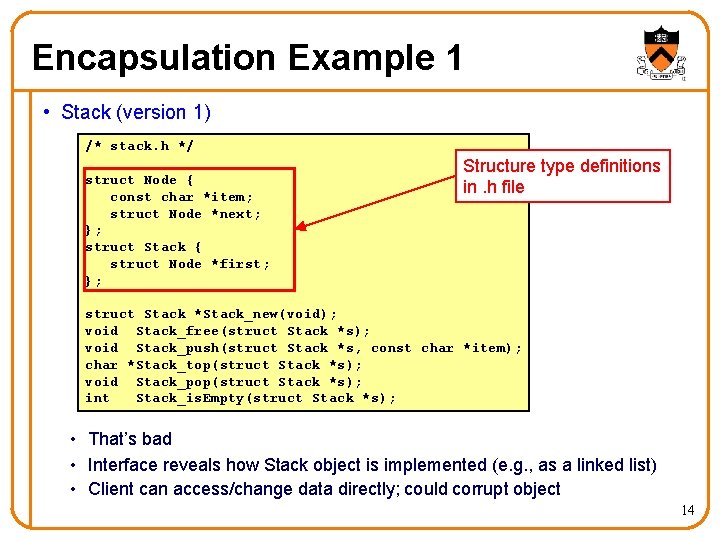
Encapsulation Example 1 • Stack (version 1) /* stack. h */ struct Node { const char *item; struct Node *next; }; struct Stack { struct Node *first; }; Structure type definitions in. h file struct Stack *Stack_new(void); void Stack_free(struct Stack *s); void Stack_push(struct Stack *s, const char *item); char *Stack_top(struct Stack *s); void Stack_pop(struct Stack *s); int Stack_is. Empty(struct Stack *s); • That’s bad • Interface reveals how Stack object is implemented (e. g. , as a linked list) • Client can access/change data directly; could corrupt object 14
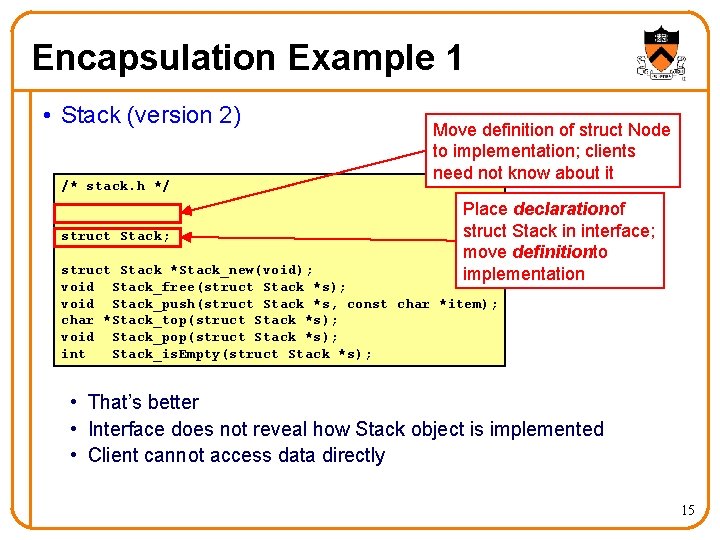
Encapsulation Example 1 • Stack (version 2) /* stack. h */ struct Stack; Move definition of struct Node to implementation; clients need not know about it Place declaration of struct Stack in interface; move definitionto implementation struct Stack *Stack_new(void); void Stack_free(struct Stack *s); void Stack_push(struct Stack *s, const char *item); char *Stack_top(struct Stack *s); void Stack_pop(struct Stack *s); int Stack_is. Empty(struct Stack *s); • That’s better • Interface does not reveal how Stack object is implemented • Client cannot access data directly 15
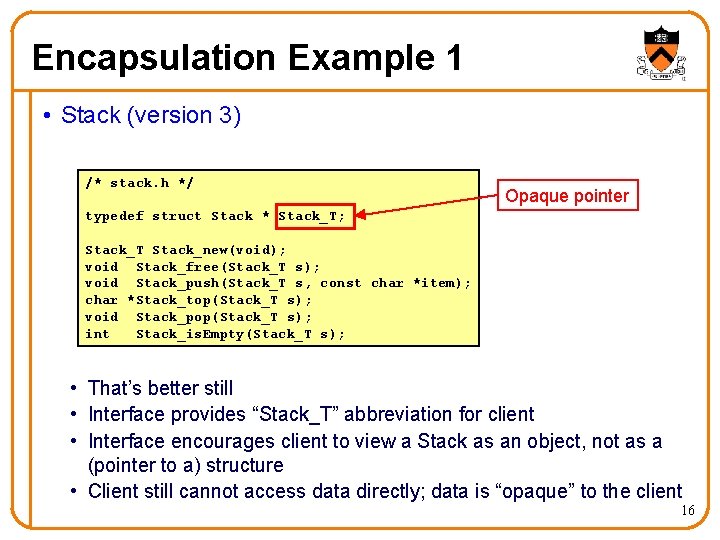
Encapsulation Example 1 • Stack (version 3) /* stack. h */ Opaque pointer typedef struct Stack * Stack_T; Stack_T Stack_new(void); void Stack_free(Stack_T s); void Stack_push(Stack_T s, const char *item); char *Stack_top(Stack_T s); void Stack_pop(Stack_T s); int Stack_is. Empty(Stack_T s); • That’s better still • Interface provides “Stack_T” abbreviation for client • Interface encourages client to view a Stack as an object, not as a (pointer to a) structure • Client still cannot access data directly; data is “opaque” to the client 16
Encapsulation Example 2 • string • “Stateless” module • Has no state to encapsulate! 17
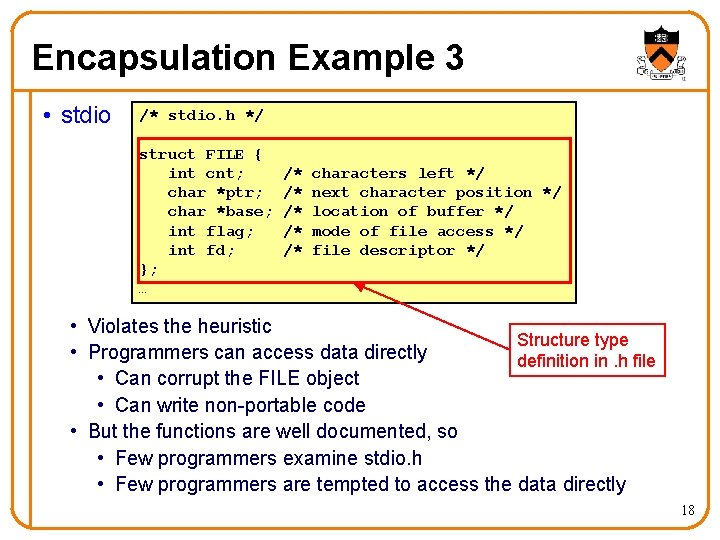
Encapsulation Example 3 • stdio /* stdio. h */ struct FILE { int cnt; char *ptr; char *base; int flag; int fd; }; … /* /* /* characters left */ next character position */ location of buffer */ mode of file access */ file descriptor */ • Violates the heuristic Structure type • Programmers can access data directly definition in. h file • Can corrupt the FILE object • Can write non-portable code • But the functions are well documented, so • Few programmers examine stdio. h • Few programmers are tempted to access the data directly 18
Resources (3) A well-designed module manages resources consistently • A module should free a resource if and only if the module has allocated that resource • Examples • Object allocates memory <=> object frees memory • Object opens file <=> object closes file • Why? • Allocating and freeing resources at different levels is error-prone • Forget to free memory => memory leak • Forget to allocate memory => dangling pointer, seg fault • Forget to close file => inefficient use of a limited resource • Forget to open file => dangling pointer, seg fault 19
Resources Example 1 • Stack: Who allocates and frees the strings? • Reasonable options: (1) Client allocates and frees strings • Stack_push() does not create copy of given string • Stack_pop() does not free the popped string • Stack_free() does not free remaining strings (2) Stack object allocates and frees strings • Stack_push() creates copy of given string • Stack_pop() frees the popped string • Stack_free() frees all remaining strings • Our choice: (1), but debatable • Unreasonable options: • Client allocates strings, Stack object frees strings • Stack object allocates strings, client frees strings 20
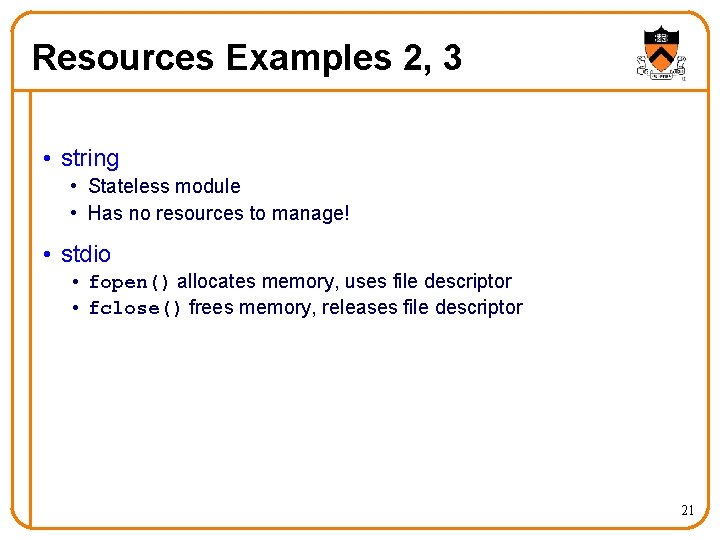
Resources Examples 2, 3 • string • Stateless module • Has no resources to manage! • stdio • fopen() allocates memory, uses file descriptor • fclose() frees memory, releases file descriptor 21
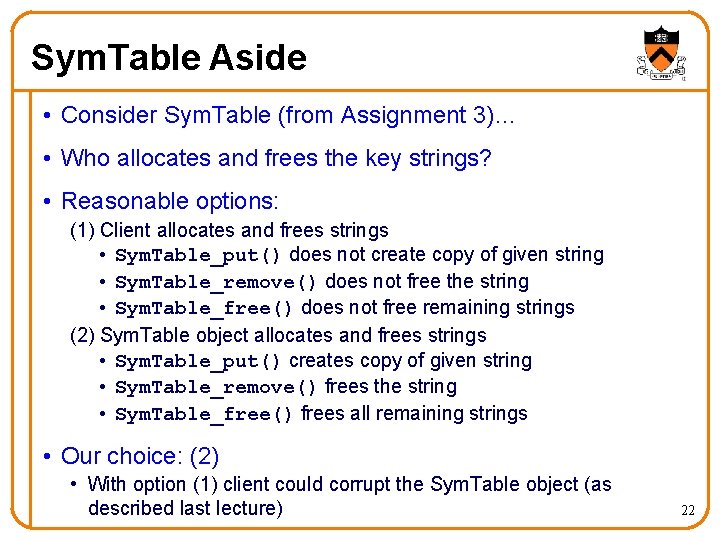
Sym. Table Aside • Consider Sym. Table (from Assignment 3)… • Who allocates and frees the key strings? • Reasonable options: (1) Client allocates and frees strings • Sym. Table_put() does not create copy of given string • Sym. Table_remove() does not free the string • Sym. Table_free() does not free remaining strings (2) Sym. Table object allocates and frees strings • Sym. Table_put() creates copy of given string • Sym. Table_remove() frees the string • Sym. Table_free() frees all remaining strings • Our choice: (2) • With option (1) client could corrupt the Sym. Table object (as described last lecture) 22
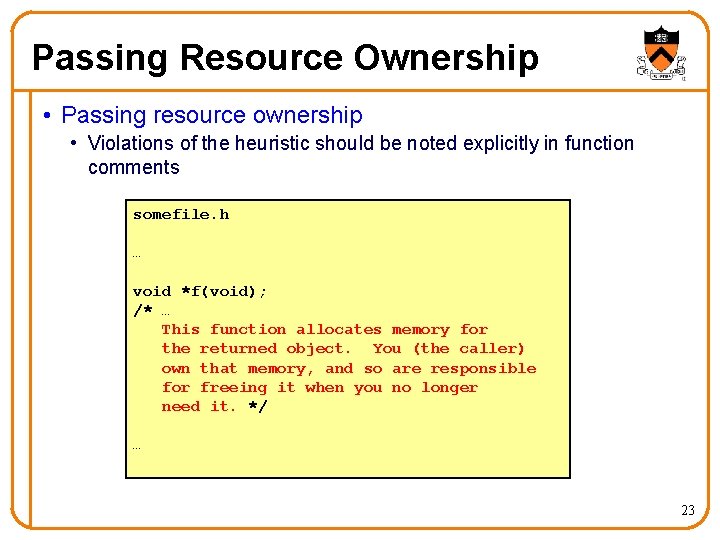
Passing Resource Ownership • Passing resource ownership • Violations of the heuristic should be noted explicitly in function comments somefile. h … void *f(void); /* … This function allocates memory for the returned object. You (the caller) own that memory, and so are responsible for freeing it when you no longer need it. */ … 23
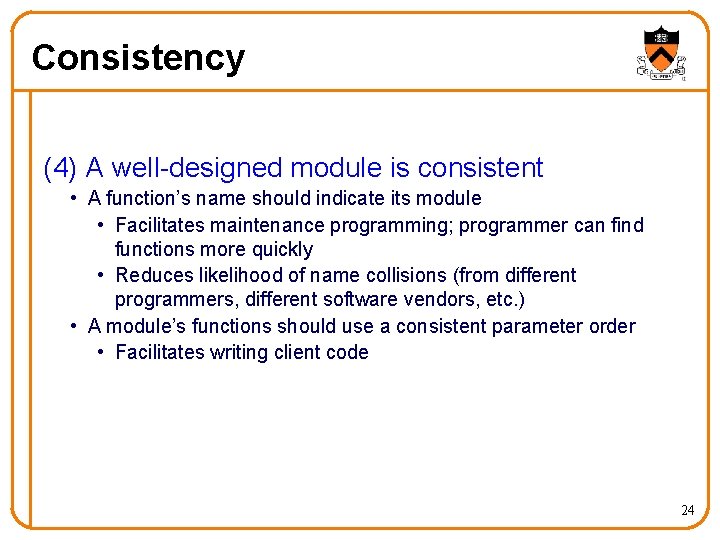
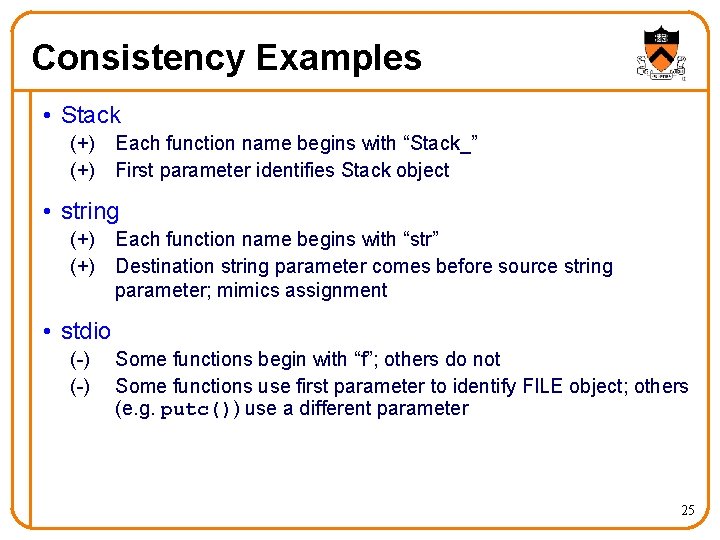
Consistency (4) A well-designed module is consistent • A function’s name should indicate its module • Facilitates maintenance programming; programmer can find functions more quickly • Reduces likelihood of name collisions (from different programmers, different software vendors, etc. ) • A module’s functions should use a consistent parameter order • Facilitates writing client code 24
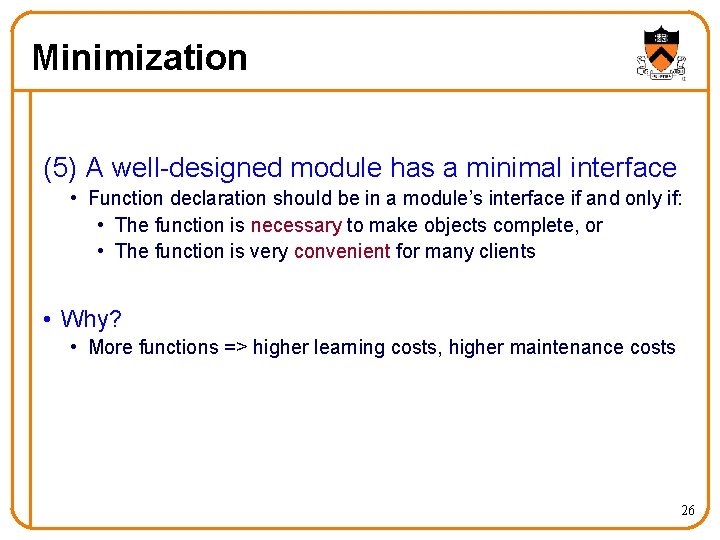
Consistency Examples • Stack (+) Each function name begins with “Stack_” First parameter identifies Stack object • string (+) Each function name begins with “str” Destination string parameter comes before source string parameter; mimics assignment • stdio (-) Some functions begin with “f”; others do not Some functions use first parameter to identify FILE object; others (e. g. putc()) use a different parameter 25
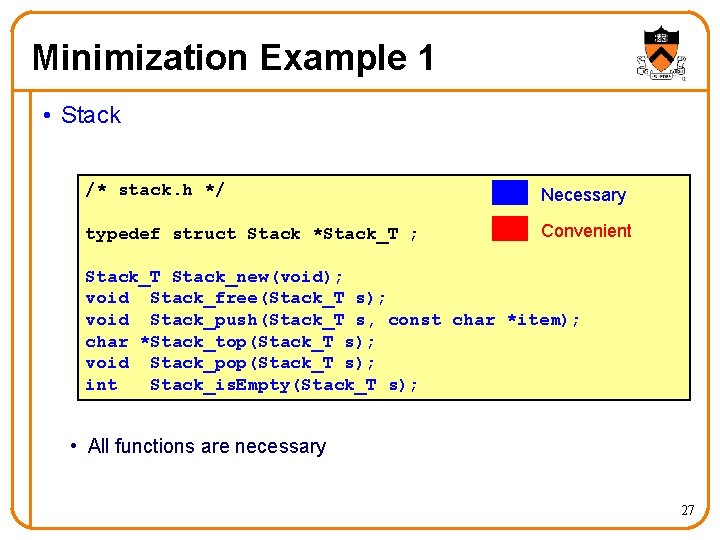
Minimization (5) A well-designed module has a minimal interface • Function declaration should be in a module’s interface if and only if: • The function is necessary to make objects complete, or • The function is very convenient for many clients • Why? • More functions => higher learning costs, higher maintenance costs 26
Minimization Example 1 • Stack /* stack. h */ Necessary typedef struct Stack *Stack_T ; Convenient Stack_T Stack_new(void); void Stack_free(Stack_T s); void Stack_push(Stack_T s, const char *item); char *Stack_top(Stack_T s); void Stack_pop(Stack_T s); int Stack_is. Empty(Stack_T s); • All functions are necessary 27
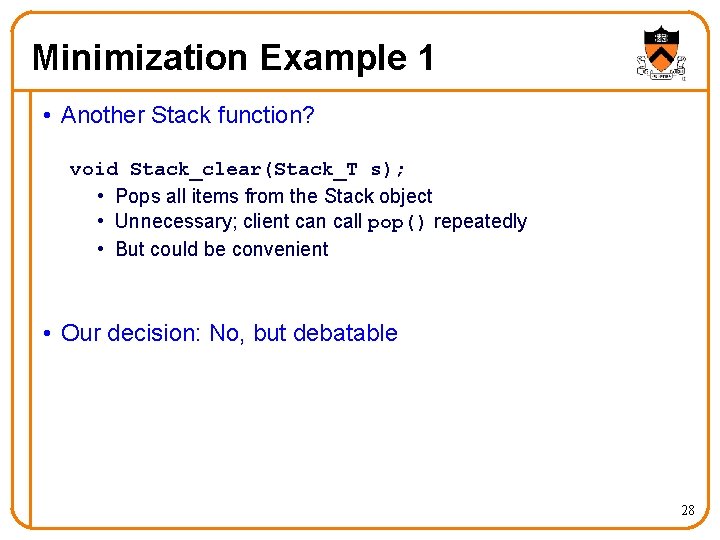
Minimization Example 1 • Another Stack function? void Stack_clear(Stack_T s); • Pops all items from the Stack object • Unnecessary; client can call pop() repeatedly • But could be convenient • Our decision: No, but debatable 28
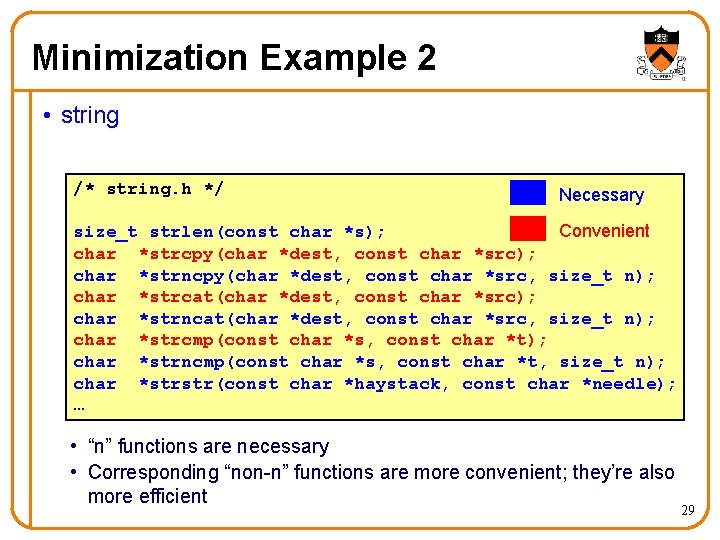
Minimization Example 2 • string /* string. h */ Necessary Convenient size_t strlen(const char *s); char *strcpy(char *dest, const char *src); char *strncpy(char *dest, const char *src, size_t n); char *strcat(char *dest, const char *src); char *strncat(char *dest, const char *src, size_t n); char *strcmp(const char *s, const char *t); char *strncmp(const char *s, const char *t, size_t n); char *strstr(const char *haystack, const char *needle); … • “n” functions are necessary • Corresponding “non-n” functions are more convenient; they’re also more efficient 29
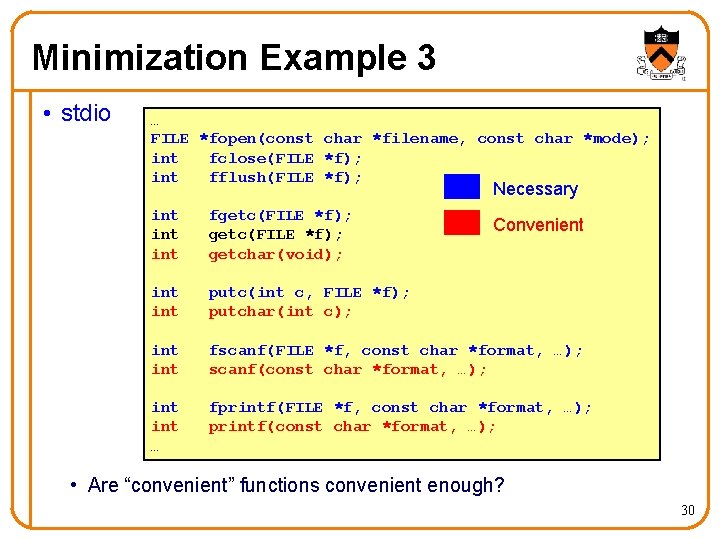
Minimization Example 3 • stdio … FILE *fopen(const char *filename, const char *mode); int fclose(FILE *f); int fflush(FILE *f); Necessary int int fgetc(FILE *f); getchar(void); int putc(int c, FILE *f); putchar(int c); int fscanf(FILE *f, const char *format, …); scanf(const char *format, …); int … fprintf(FILE *f, const char *format, …); printf(const char *format, …); Convenient • Are “convenient” functions convenient enough? 30
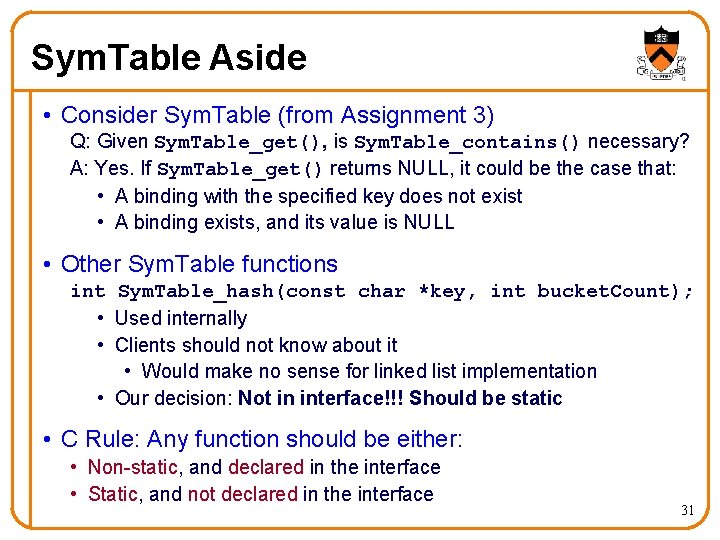
Sym. Table Aside • Consider Sym. Table (from Assignment 3) Q: Given Sym. Table_get(), is Sym. Table_contains() necessary? A: Yes. If Sym. Table_get() returns NULL, it could be the case that: • A binding with the specified key does not exist • A binding exists, and its value is NULL • Other Sym. Table functions int Sym. Table_hash(const char *key, int bucket. Count); • Used internally • Clients should not know about it • Would make no sense for linked list implementation • Our decision: Not in interface!!! Should be static • C Rule: Any function should be either: • Non-static, and declared in the interface • Static, and not declared in the interface 31
Reporting Errors (6) A well-designed module reports errors to clients • A module should detect errors, but allow clients to handle them • (But it should do so with some moderation) • Why? • Handling errors in the client provides the most flexibility • Module should not assume what error-handling action clients prefer 32
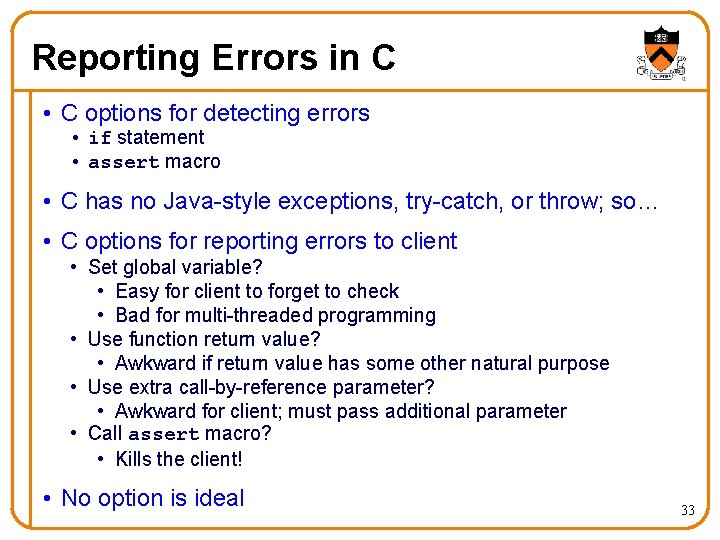
Reporting Errors in C • C options for detecting errors • if statement • assert macro • C has no Java-style exceptions, try-catch, or throw; so… • C options for reporting errors to client • Set global variable? • Easy for client to forget to check • Bad for multi-threaded programming • Use function return value? • Awkward if return value has some other natural purpose • Use extra call-by-reference parameter? • Awkward for client; must pass additional parameter • Call assert macro? • Kills the client! • No option is ideal 33
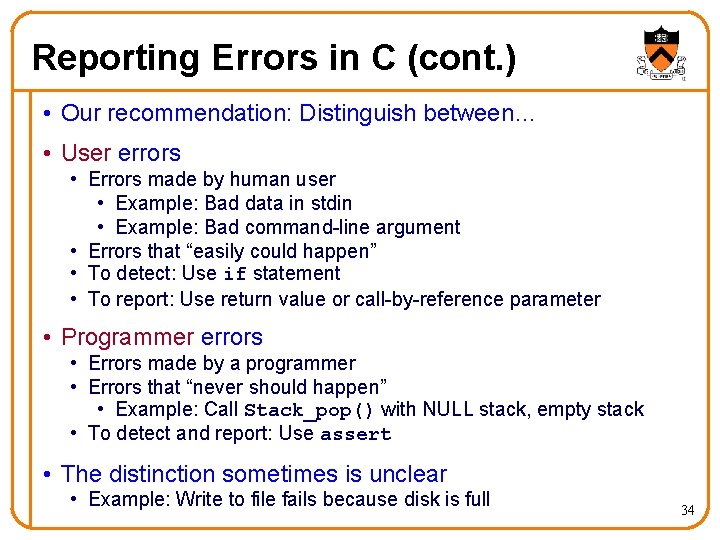
Reporting Errors in C (cont. ) • Our recommendation: Distinguish between… • User errors • Errors made by human user • Example: Bad data in stdin • Example: Bad command-line argument • Errors that “easily could happen” • To detect: Use if statement • To report: Use return value or call-by-reference parameter • Programmer errors • Errors made by a programmer • Errors that “never should happen” • Example: Call Stack_pop() with NULL stack, empty stack • To detect and report: Use assert • The distinction sometimes is unclear • Example: Write to file fails because disk is full 34
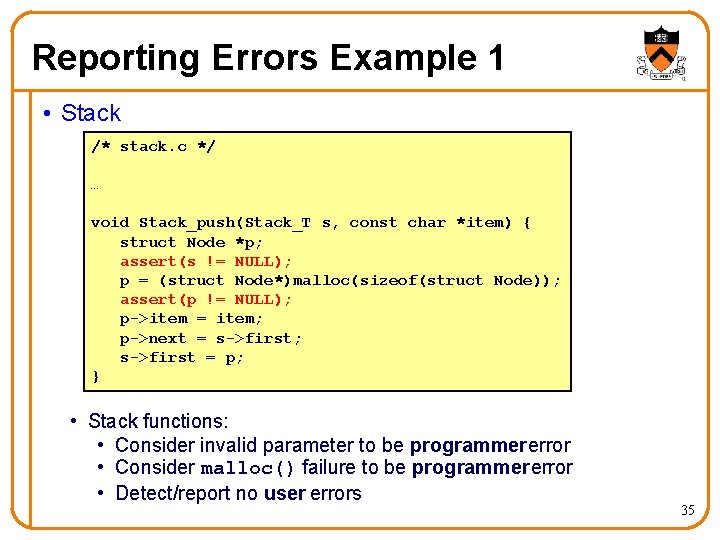
Reporting Errors Example 1 • Stack /* stack. c */ … void Stack_push(Stack_T s, const char *item) { struct Node *p; assert(s != NULL); p = (struct Node*)malloc(sizeof(struct Node)); assert(p != NULL); p->item = item; p->next = s->first; s->first = p; } • Stack functions: • Consider invalid parameter to be programmer error • Consider malloc() failure to be programmer error • Detect/report no user errors 35
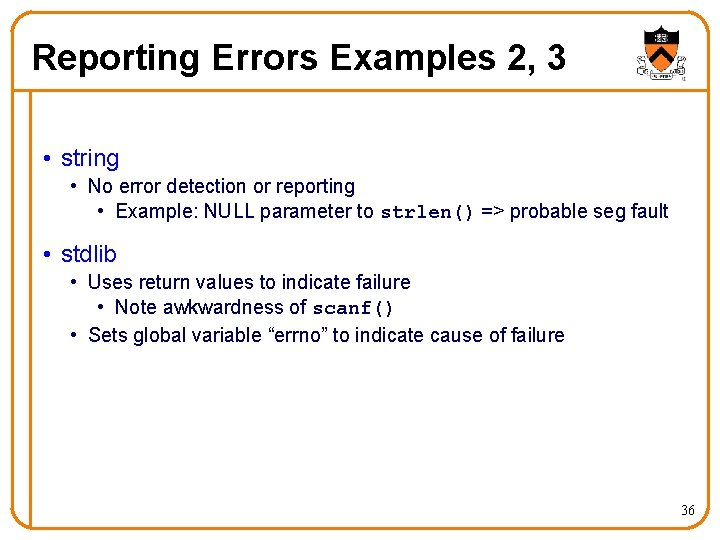
Reporting Errors Examples 2, 3 • string • No error detection or reporting • Example: NULL parameter to strlen() => probable seg fault • stdlib • Uses return values to indicate failure • Note awkwardness of scanf() • Sets global variable “errno” to indicate cause of failure 36
Establishing Contracts (7) A well-designed module establishes contracts • A module should establish contracts with its clients • Contracts should describe what each function does, esp: • Meanings of parameters • Valid/invalid parameter values • Meaning of return value • Side effects • Why? • Establishing contracts facilitates cooperation between multiple programmers on a team • Establishing contracts assigns blame to violators • Catch errors at the door! • Better that the boss yells at the programmer who is your client rather than at you!!! 37
Establishing Contracts in C • Our recommendation… • In C, establish contracts via comments in module interface • A module’s implementation then should enforce the contracts 38
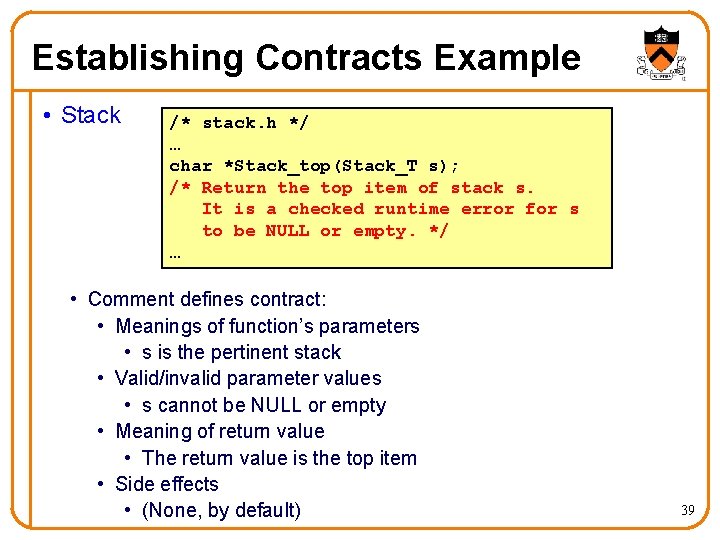
Establishing Contracts Example • Stack /* stack. h */ … char *Stack_top(Stack_T s); /* Return the top item of stack s. It is a checked runtime error for s to be NULL or empty. */ … • Comment defines contract: • Meanings of function’s parameters • s is the pertinent stack • Valid/invalid parameter values • s cannot be NULL or empty • Meaning of return value • The return value is the top item • Side effects • (None, by default) 39
Strong Cohesion (8) A well-designed module has strong cohesion • A module’s functions should be strongly related to each other • Why? • Strong cohesion facilitates abstraction 40
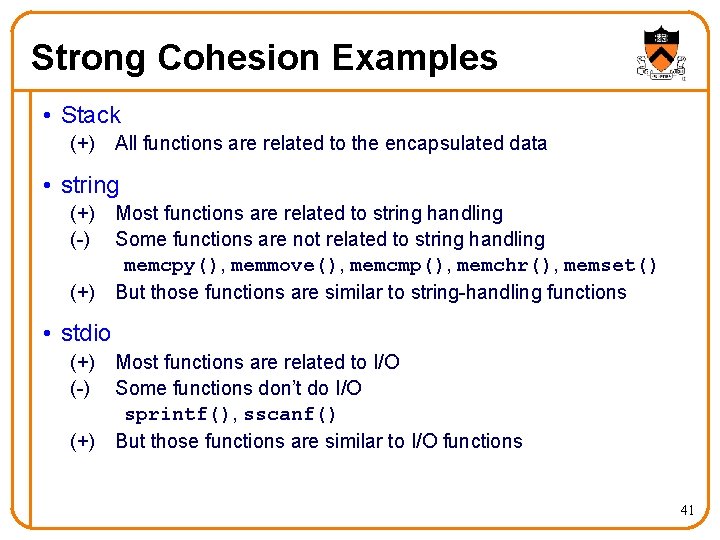
Strong Cohesion Examples • Stack (+) All functions are related to the encapsulated data • string (+) (-) (+) Most functions are related to string handling Some functions are not related to string handling memcpy(), memmove(), memcmp(), memchr(), memset() But those functions are similar to string-handling functions • stdio (+) (-) (+) Most functions are related to I/O Some functions don’t do I/O sprintf(), sscanf() But those functions are similar to I/O functions 41
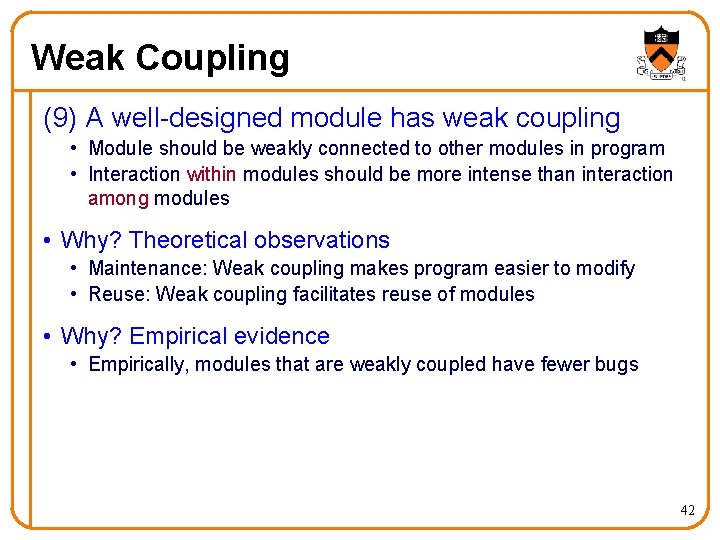
Weak Coupling (9) A well-designed module has weak coupling • Module should be weakly connected to other modules in program • Interaction within modules should be more intense than interaction among modules • Why? Theoretical observations • Maintenance: Weak coupling makes program easier to modify • Reuse: Weak coupling facilitates reuse of modules • Why? Empirical evidence • Empirically, modules that are weakly coupled have fewer bugs 42
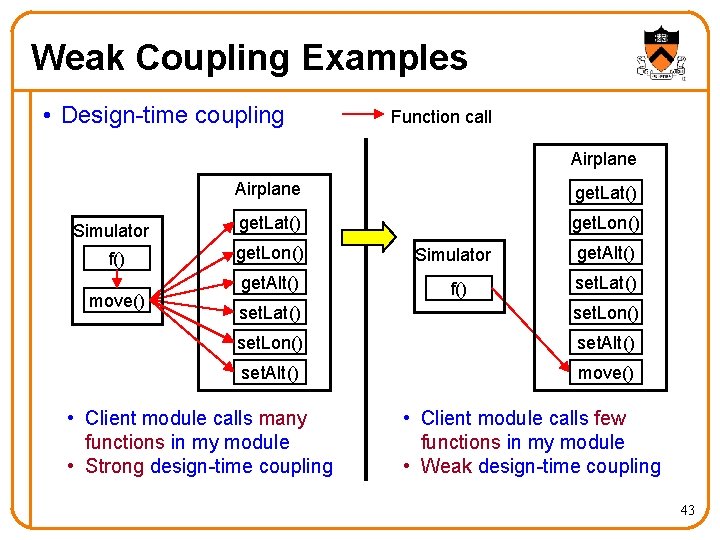
Weak Coupling Examples • Design-time coupling Function call Airplane Simulator f() move() Airplane get. Lat() get. Lon() get. Alt() Simulator f() get. Alt() set. Lat() set. Lon() set. Alt() move() • Client module calls many functions in my module • Strong design-time coupling • Client module calls few functions in my module • Weak design-time coupling 43
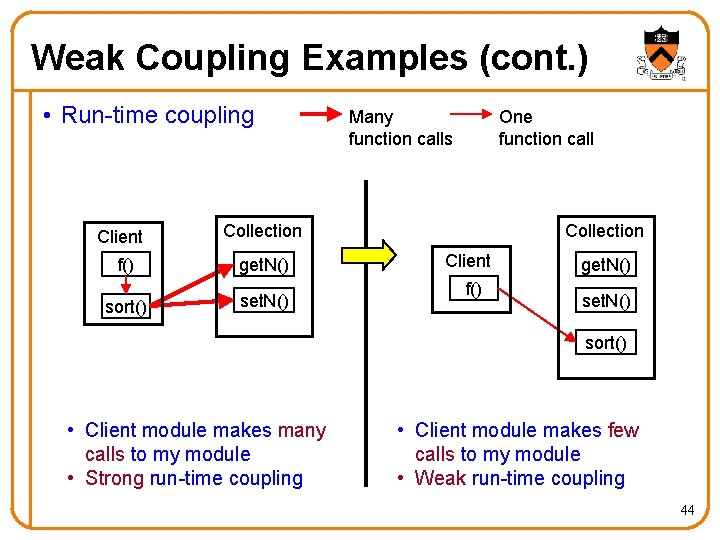
Weak Coupling Examples (cont. ) • Run-time coupling Client Many function calls One function call Collection f() get. N() sort() set. N() Collection Client f() get. N() sort() • Client module makes many calls to my module • Strong run-time coupling • Client module makes few calls to my module • Weak run-time coupling 44
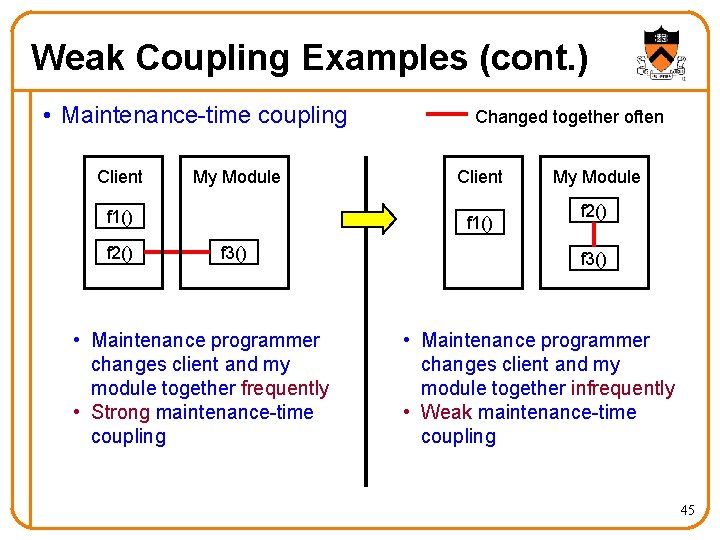
Weak Coupling Examples (cont. ) • Maintenance-time coupling Client My Module f 1() f 2() Changed together often Client f 1() f 3() • Maintenance programmer changes client and my module together frequently • Strong maintenance-time coupling My Module f 2() f 3() • Maintenance programmer changes client and my module together infrequently • Weak maintenance-time coupling 45
Achieving Weak Coupling • Achieving weak coupling could involve: • Moving code from clients to my module (shown) • Moving code from my module to clients (not shown) • Moving code from clients and my module to a new module (not shown) 46
Summary • A well-designed module: (1) Separates interface and implementation (2) Encapsulates data (3) Manages resources consistently (4) Is consistent (5) Has a minimal interface (6) Reports errors to clients (7) Establishes contracts (8) Has strong cohesion (9) Has weak coupling 47
The Rest of This Week • Reading • Recommended: K&P chapter 4 • Assignment #3 • Due Sunday at 9 pm • Midterm exam • Class time on Wednesday March 11 (i. e. , 10: 00 -10: 50 am) • In CS large lecture hall (room CS 104), not the normal room • Open book, open notes, open lecture slides, but no computers • Midterm exam preparation • Practice exams online • http: //www. cs. princeton. edu/courses/archive/spring 09/cos 217/exam 1 prep/ • See especially Spring 2008 and Fall 2005 (i. e. , my exams!) • Review session in lecture on Monday March 9 48