Comparisons of ECH Plasmas with and without Symmetry

- Slides: 31
Comparisons of ECH Plasmas with and without Symmetry in the Helically Symmetric Experiment* S. P. Gerhardt, A. Abdou, A. F. Almagri, D. T. Anderson, F. S. B. Anderson, D. Brower 1, J. Canik, C. Deng 1, W. A. Guttenfelder, K. Likin, P. H. Probert, S. Oh, J. Tabora, V. Sakaguchi, J. Schmitt, J. N. Talmadge, and K. Zhai. The HSX Plasma Laboratory, University of Wisconsin-Madison, USA 1 Electrical Engineering Department, University of California, Los Angeles, USA *This work supported by DOE grant #DE-F 602 -93 ER 54222 ICC Meeting, Seattle, 2003
Outline • Overview of the Device. • Studies of ECH Absorption. • Studies of Stored Energy and Central Te vs. Launched Power and Machine Configuration. • Studies of Ion Flow Damping. • Evidence of Direct Loss Orbits and Impurity Flow with Broken Symmetry. ICC Meeting, Seattle, 2003
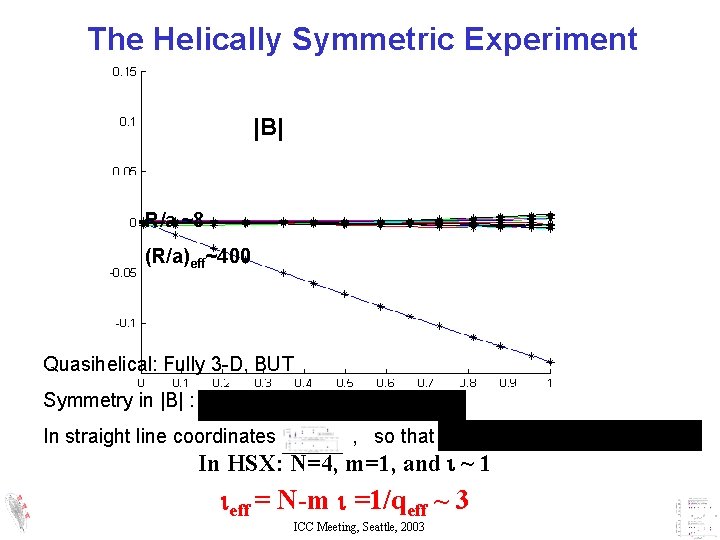
The Helically Symmetric Experiment |B| R/a ~8 (R/a)eff~400 Quasihelical: Fully 3 -D, BUT Symmetry in |B| : In straight line coordinates , so that In HSX: N=4, m=1, and i ~ 1 ieff = N-m i =1/qeff ~ 3 ICC Meeting, Seattle, 2003
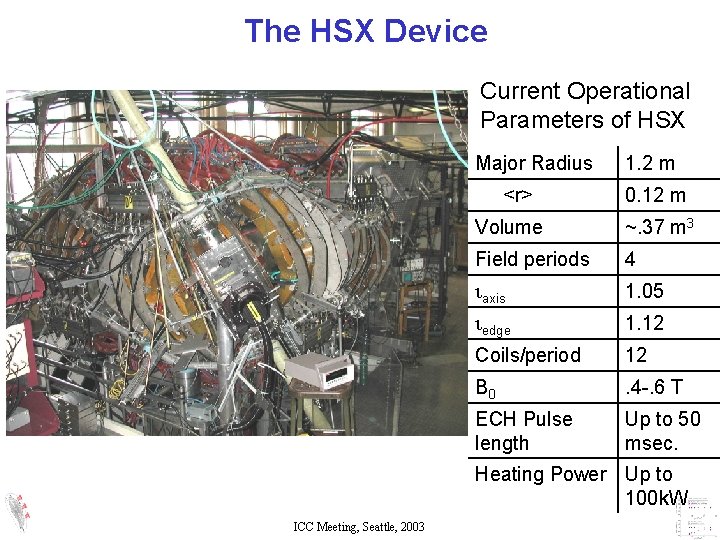
The HSX Device Current Operational Parameters of HSX Major Radius 1. 2 m <r> 0. 12 m Volume ~. 37 m 3 Field periods 4 axis 1. 05 edge 1. 12 Coils/period 12 B 0 . 4 -. 6 T ECH Pulse length Up to 50 msec. Heating Power Up to 100 k. W ICC Meeting, Seattle, 2003
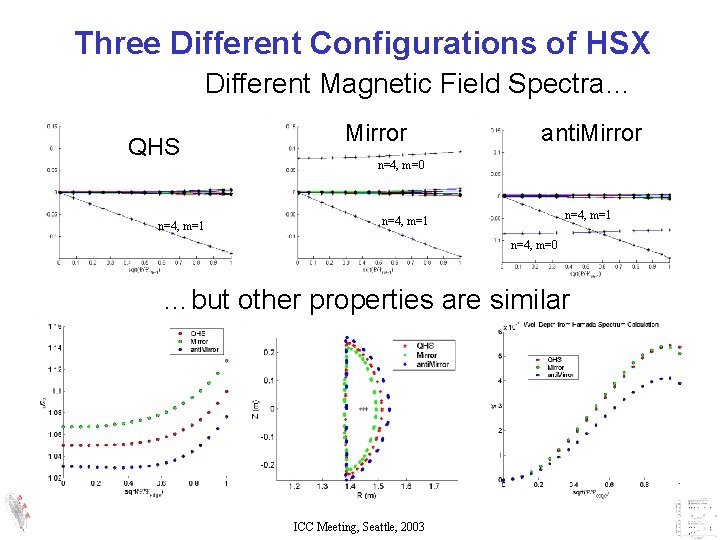
Three Different Configurations of HSX Different Magnetic Field Spectra… QHS n=4, m=1 Mirror anti. Mirror n=4, m=0 n=4, m=1 n=4, m=0 …but other properties are similar ICC Meeting, Seattle, 2003
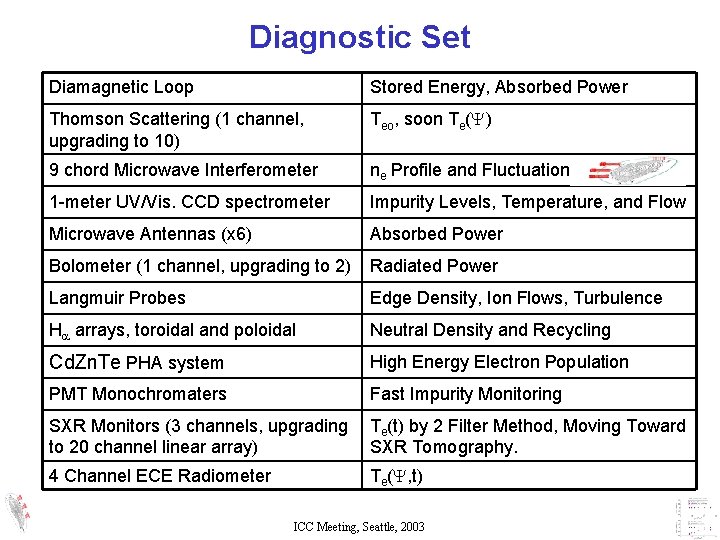
Diagnostic Set Diamagnetic Loop Stored Energy, Absorbed Power Thomson Scattering (1 channel, upgrading to 10) Teo, soon Te( ) 9 chord Microwave Interferometer ne Profile and Fluctuations 1 -meter UV/Vis. CCD spectrometer Impurity Levels, Temperature, and Flow Microwave Antennas (x 6) Absorbed Power Bolometer (1 channel, upgrading to 2) Radiated Power Langmuir Probes Edge Density, Ion Flows, Turbulence H arrays, toroidal and poloidal Neutral Density and Recycling Cd. Zn. Te PHA system High Energy Electron Population PMT Monochromaters Fast Impurity Monitoring SXR Monitors (3 channels, upgrading Te(t) by 2 Filter Method, Moving Toward to 20 channel linear array) SXR Tomography. 4 Channel ECE Radiometer Te( , t) ICC Meeting, Seattle, 2003
Excellent Absorption of ECH Power in HSX Plasmas ICC Meeting, Seattle, 2003
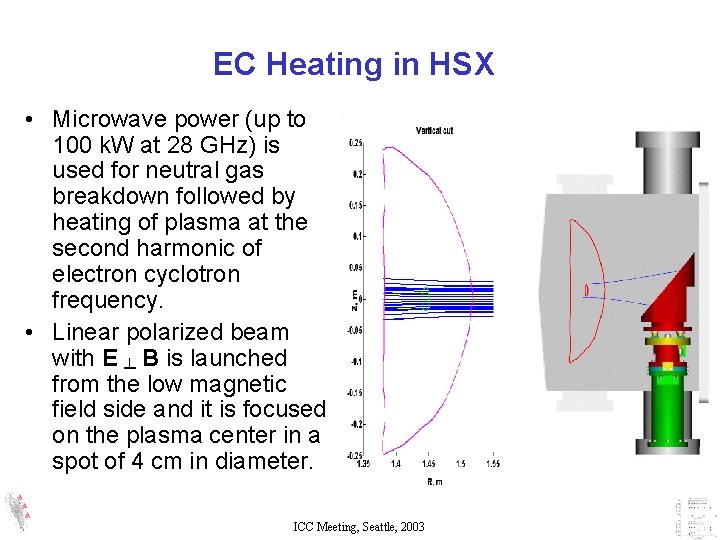
EC Heating in HSX • Microwave power (up to 100 k. W at 28 GHz) is used for neutral gas breakdown followed by heating of plasma at the second harmonic of electron cyclotron frequency. • Linear polarized beam with E ┴ B is launched from the low magnetic field side and it is focused on the plasma center in a spot of 4 cm in diameter. ICC Meeting, Seattle, 2003
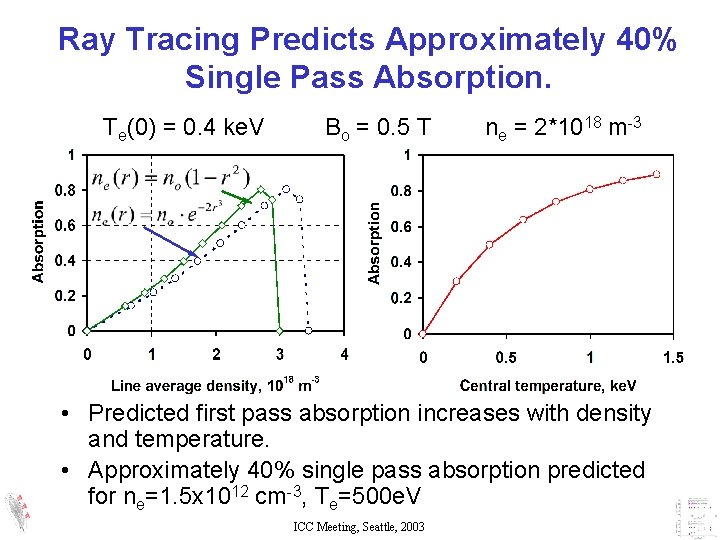
Ray Tracing Predicts Approximately 40% Single Pass Absorption. Te(0) = 0. 4 ke. V Bo = 0. 5 T ne = 2*1018 m-3 • Predicted first pass absorption increases with density and temperature. • Approximately 40% single pass absorption predicted for ne=1. 5 x 1012 cm-3, Te=500 e. V ICC Meeting, Seattle, 2003
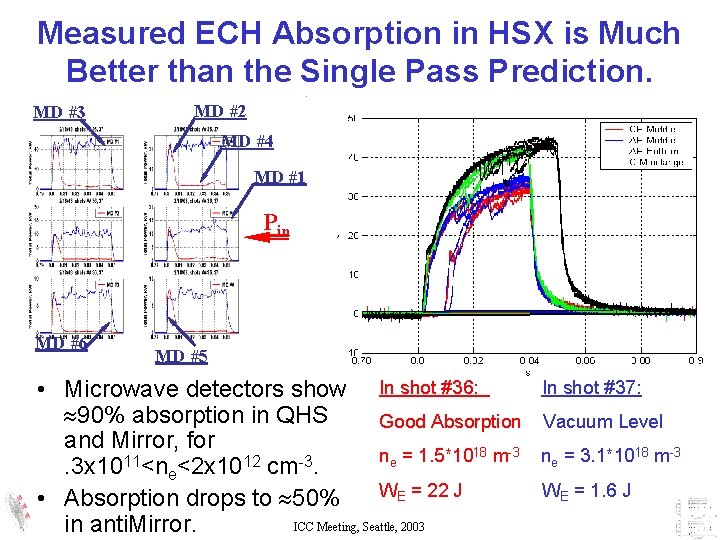
Measured ECH Absorption in HSX is Much Better than the Single Pass Prediction. MD #3 MD #2 MD #4 MD #1 Pin MD #6 MD #5 • Microwave detectors show In shot #36: In shot #37: 90% absorption in QHS Good Absorption Vacuum Level and Mirror, for ne = 1. 5*1018 m-3 ne = 3. 1*1018 m-3 11 12 -3. 3 x 10 <ne<2 x 10 cm. • Absorption drops to 50% WE = 22 J WE = 1. 6 J ICC Meeting, Seattle, 2003 in anti. Mirror.
HSX Meets ISS-95 Scaling at 90 k. W Launched Power, with Electron Temperatures in Excess of 600 e. V. ICC Meeting, Seattle, 2003
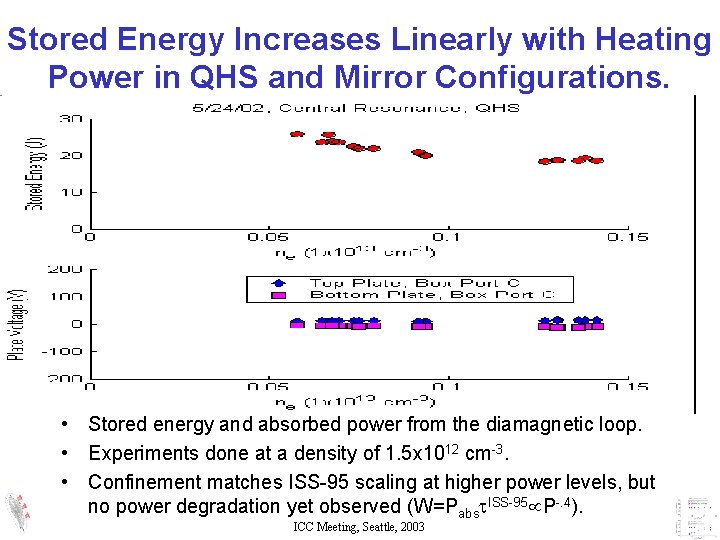
Stored Energy Increases Linearly with Heating Power in QHS and Mirror Configurations. • Stored energy and absorbed power from the diamagnetic loop. • Experiments done at a density of 1. 5 x 1012 cm-3. • Confinement matches ISS-95 scaling at higher power levels, but no power degradation yet observed (W=Pabs ISS-95 P-. 4). ICC Meeting, Seattle, 2003
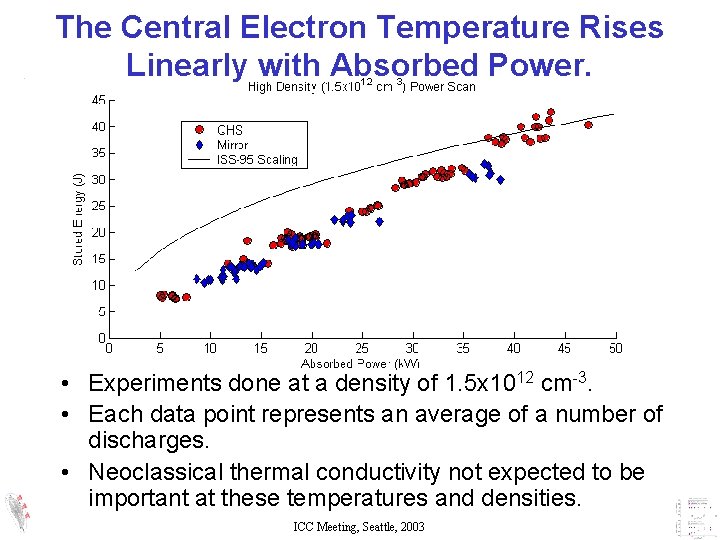
The Central Electron Temperature Rises Linearly with Absorbed Power. • Experiments done at a density of 1. 5 x 1012 cm-3. • Each data point represents an average of a number of discharges. • Neoclassical thermal conductivity not expected to be important at these temperatures and densities. ICC Meeting, Seattle, 2003
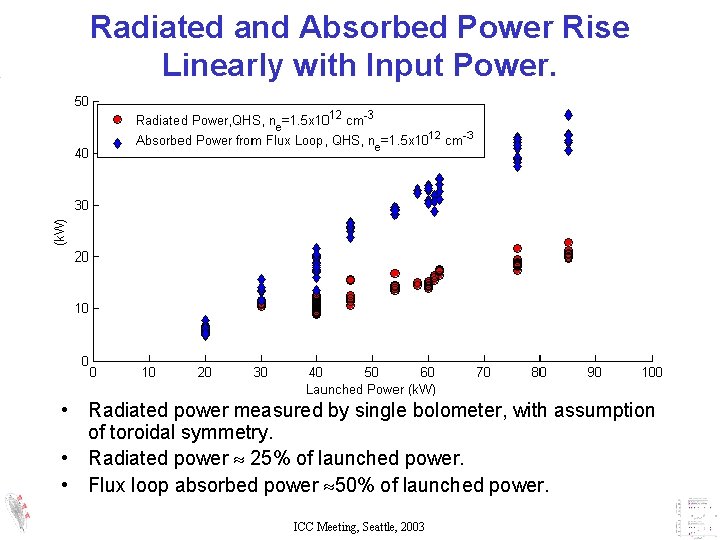
Radiated and Absorbed Power Rise Linearly with Input Power. • Radiated power measured by single bolometer, with assumption of toroidal symmetry. • Radiated power 25% of launched power. • Flux loop absorbed power 50% of launched power. ICC Meeting, Seattle, 2003
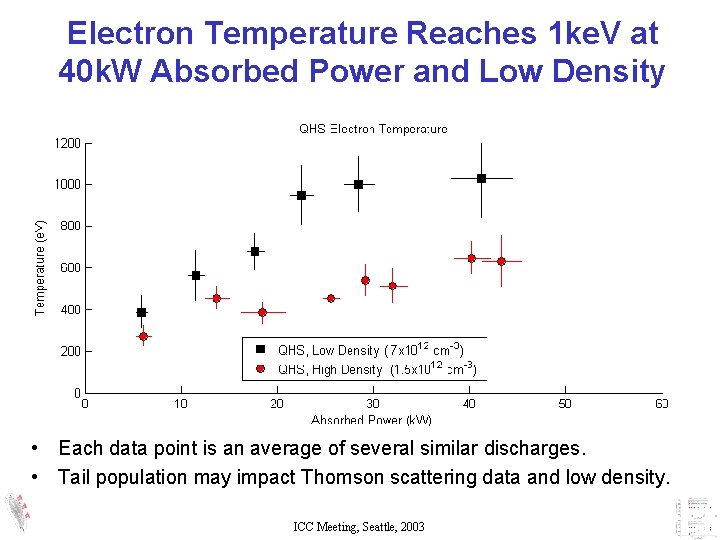
Electron Temperature Reaches 1 ke. V at 40 k. W Absorbed Power and Low Density • Each data point is an average of several similar discharges. • Tail population may impact Thomson scattering data and low density. ICC Meeting, Seattle, 2003
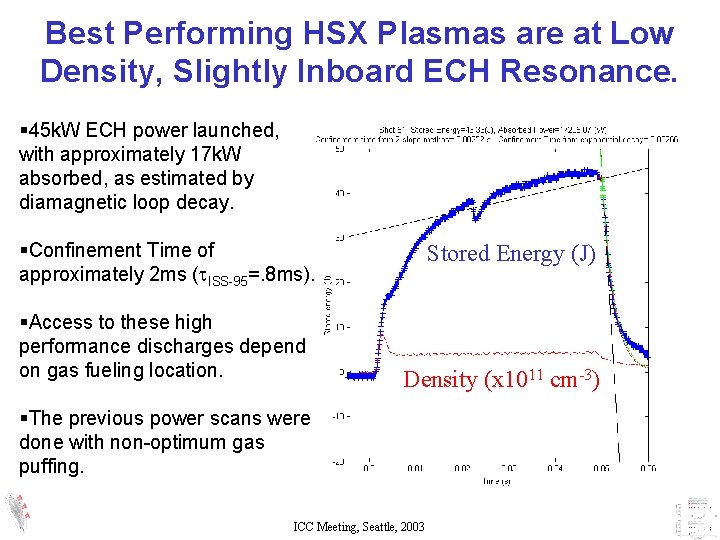
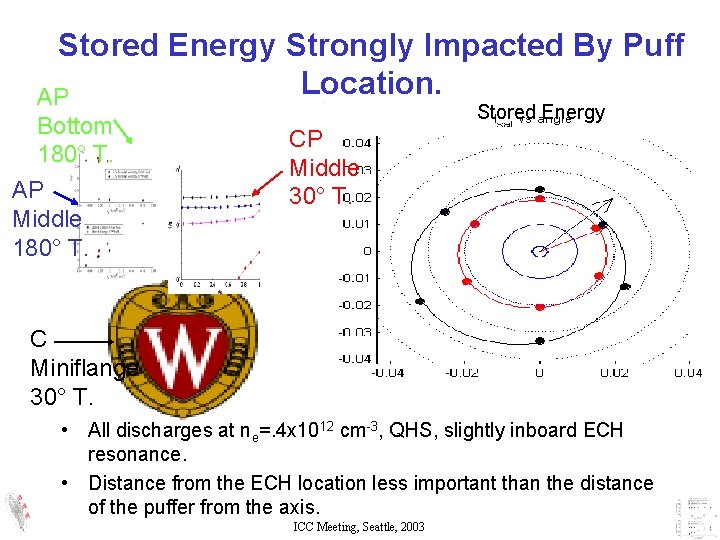
Best Performing HSX Plasmas are at Low Density, Slightly Inboard ECH Resonance. § 45 k. W ECH power launched, with approximately 17 k. W absorbed, as estimated by diamagnetic loop decay. §Confinement Time of approximately 2 ms ( ISS-95=. 8 ms). §Access to these high performance discharges depend on gas fueling location. Stored Energy (J) Density (x 1011 cm-3) §The previous power scans were done with non-optimum gas puffing. ICC Meeting, Seattle, 2003
Stored Energy Strongly Impacted By Puff Location. AP Bottom 180° T. AP Middle 180° T. Stored Energy CP Middle 30° T. C Miniflange 30° T. • All discharges at ne=. 4 x 1012 cm-3, QHS, slightly inboard ECH resonance. • Distance from the ECH location less important than the distance of the puffer from the axis. ICC Meeting, Seattle, 2003
Reduction of Viscous Damping with Symmetry ICC Meeting, Seattle, 2003
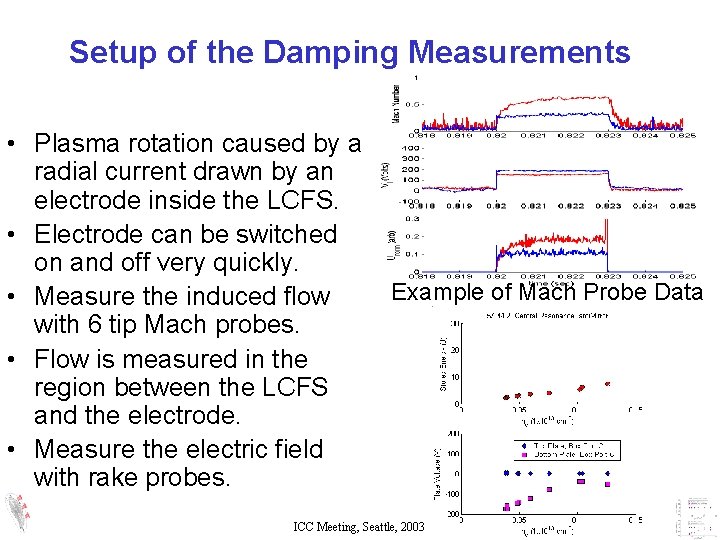
Setup of the Damping Measurements • Plasma rotation caused by a radial current drawn by an electrode inside the LCFS. • Electrode can be switched on and off very quickly. Example of Mach Probe Data • Measure the induced flow with 6 tip Mach probes. • Flow is measured in the region between the LCFS and the electrode. • Measure the electric field with rake probes. ICC Meeting, Seattle, 2003
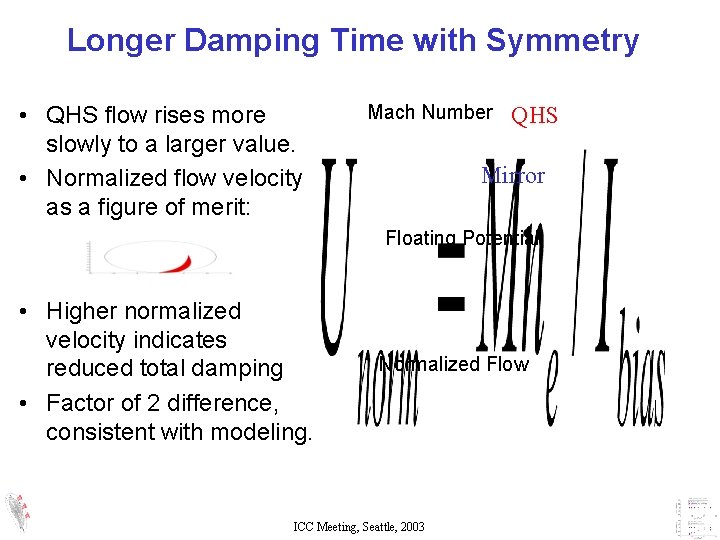
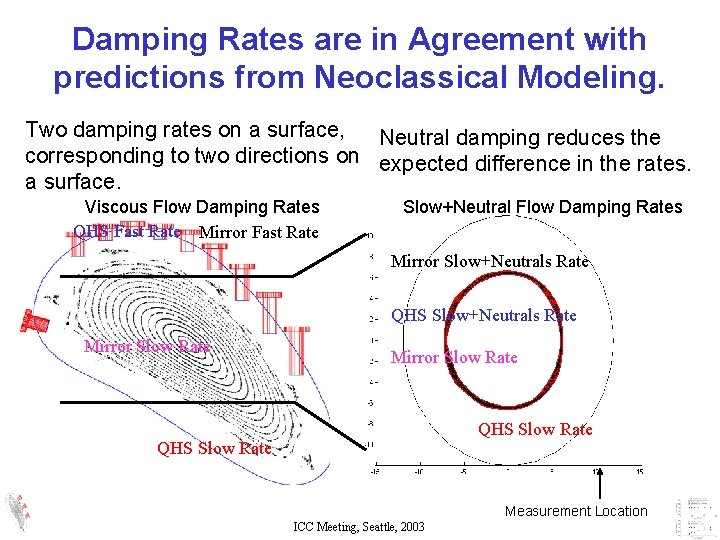
Longer Damping Time with Symmetry • QHS flow rises more slowly to a larger value. • Normalized flow velocity as a figure of merit: Mach Number QHS Mirror Floating Potential • Higher normalized velocity indicates reduced total damping • Factor of 2 difference, consistent with modeling. Normalized Flow ICC Meeting, Seattle, 2003
Damping Rates are in Agreement with predictions from Neoclassical Modeling. Two damping rates on a surface, Neutral damping reduces the corresponding to two directions on expected difference in the rates. a surface. Viscous Flow Damping Rates QHS Fast Rate Mirror Fast Rate Slow+Neutral Flow Damping Rates Mirror Slow+Neutrals Rate QHS Slow+Neutrals Rate Mirror Slow Rate QHS Slow Rate Measurement Location ICC Meeting, Seattle, 2003
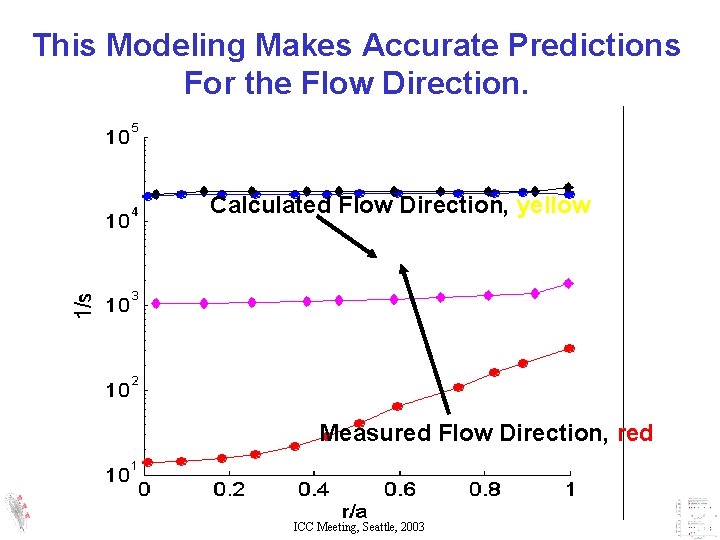
This Modeling Makes Accurate Predictions For the Flow Direction. Calculated Flow Direction, yellow Measured Flow Direction, red ICC Meeting, Seattle, 2003
Evidence of Direct Loss Orbits With Broken Symmetry ICC Meeting, Seattle, 2003
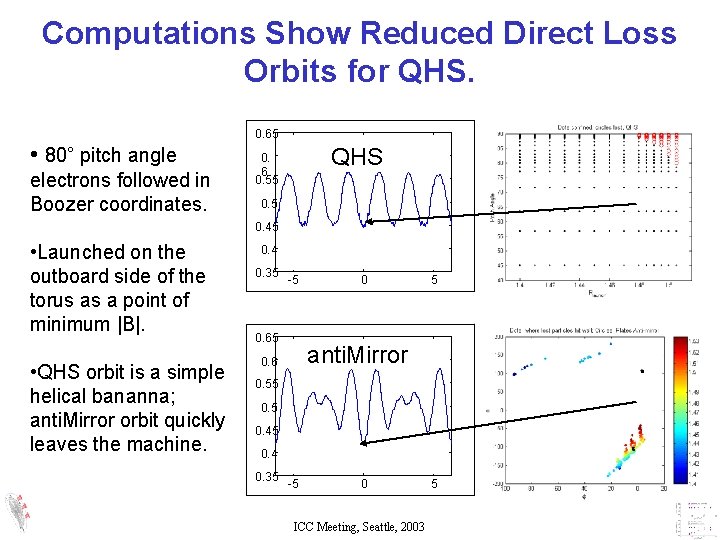
Computations Show Reduced Direct Loss Orbits for QHS. • 80° pitch angle electrons followed in Boozer coordinates. 0. 65 QHS 0. 6 0. 55 0. 45 • Launched on the outboard side of the torus as a point of minimum |B|. • QHS orbit is a simple helical bananna; anti. Mirror orbit quickly leaves the machine. 0. 4 0. 35 -5 0. 65 0 5 anti. Mirror 0. 6 0. 55 0. 45 0. 4 0. 35 -5 0 ICC Meeting, Seattle, 2003 5
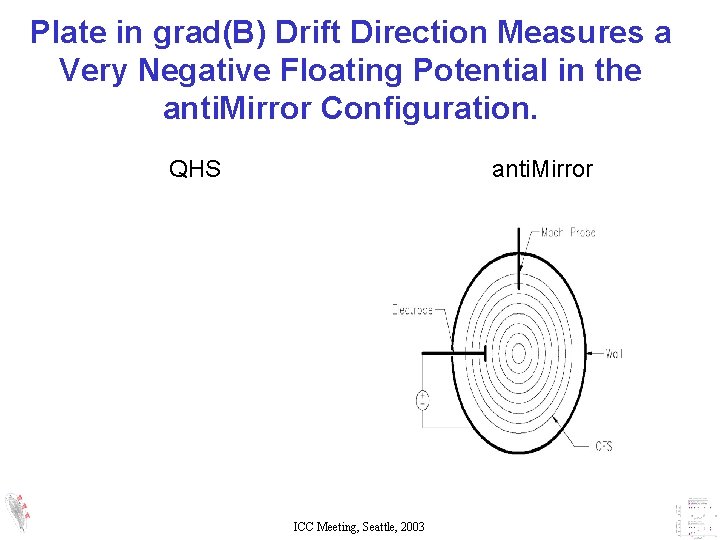
Plate in grad(B) Drift Direction Measures a Very Negative Floating Potential in the anti. Mirror Configuration. QHS anti. Mirror ICC Meeting, Seattle, 2003
Plates Near the ECH Antenna Behave Differently than Those 180 Degrees Away Plates 180° toroidally displaced show very little signal, no asymmetry. Plates at the location of the antenna show the up/down asymmetry. The phenomenon appears to be due to direct loss orbits. ICC Meeting, Seattle, 2003
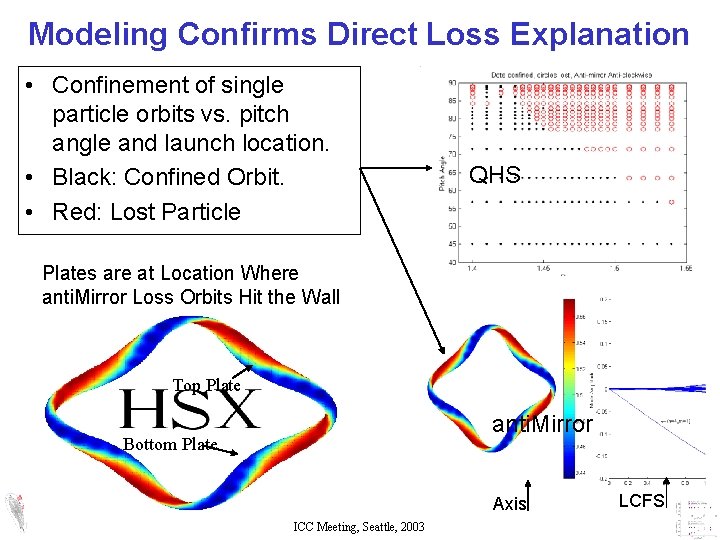
Modeling Confirms Direct Loss Explanation • Confinement of single particle orbits vs. pitch angle and launch location. • Black: Confined Orbit. • Red: Lost Particle QHS Plates are at Location Where anti. Mirror Loss Orbits Hit the Wall Top Plate anti. Mirror Bottom Plate Axis ICC Meeting, Seattle, 2003 LCFS
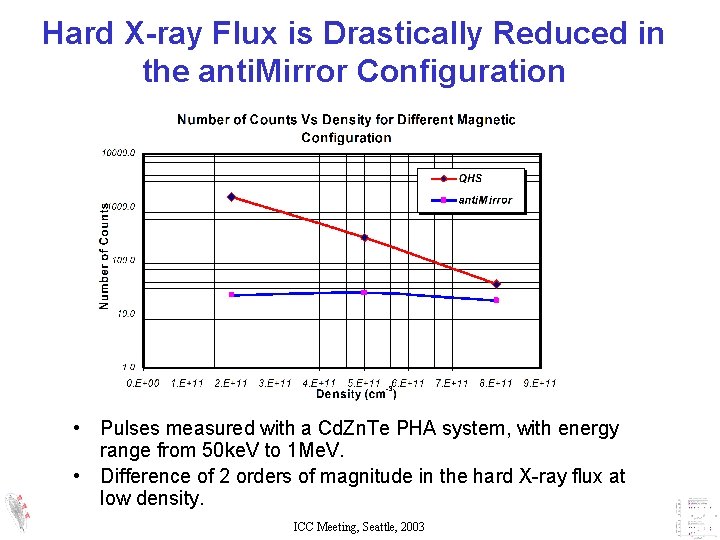
Hard X-ray Flux is Drastically Reduced in the anti. Mirror Configuration • Pulses measured with a Cd. Zn. Te PHA system, with energy range from 50 ke. V to 1 Me. V. • Difference of 2 orders of magnitude in the hard X-ray flux at low density. ICC Meeting, Seattle, 2003
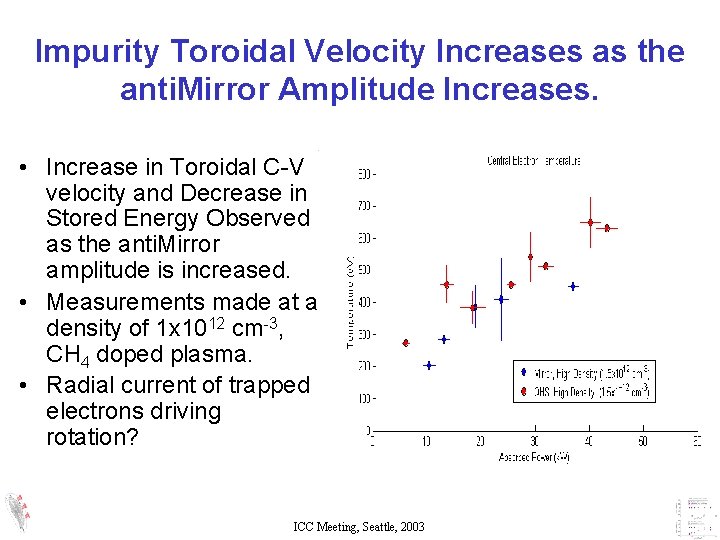
Impurity Toroidal Velocity Increases as the anti. Mirror Amplitude Increases. • Increase in Toroidal C-V velocity and Decrease in Stored Energy Observed as the anti. Mirror amplitude is increased. • Measurements made at a density of 1 x 1012 cm-3, CH 4 doped plasma. • Radial current of trapped electrons driving rotation? ICC Meeting, Seattle, 2003
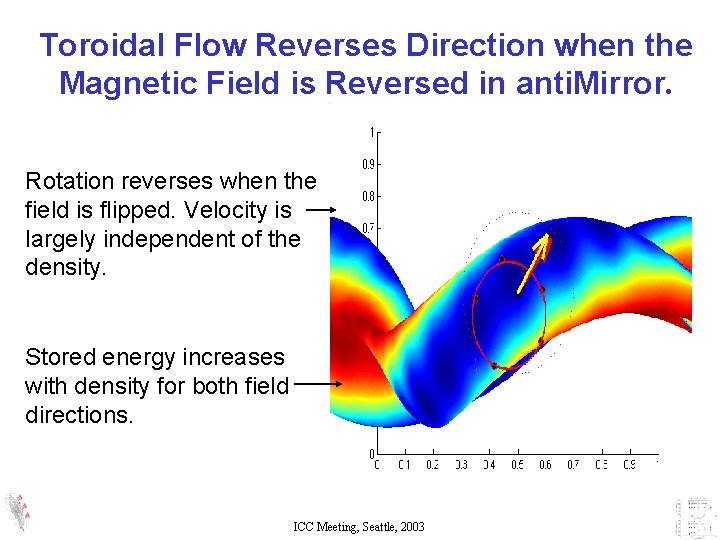
Toroidal Flow Reverses Direction when the Magnetic Field is Reversed in anti. Mirror. Rotation reverses when the field is flipped. Velocity is largely independent of the density. Stored energy increases with density for both field directions. ICC Meeting, Seattle, 2003
Conclusions • Plasmas in HSX are heated with high ECH absorption efficiency to temperatures in excess of 600 e. V. • The plasma is able to rotate more easily in the QHS configuration. • Direct loss orbits are detected in configurations where symmetry is broken and deep minimum in |B| is at the ECH resonance location. This direct loss current may be driving rotation. Presentation will be posted at hsxa. ece. wisc. edu. ICC Meeting, Seattle, 2003