
Memory Definiteness and Information Losslessness of Finite Automata
- Slides: 35
Memory, Definiteness, and Information Losslessness of Finite Automata Zvi Kohavi and Niraj K. Jha 1
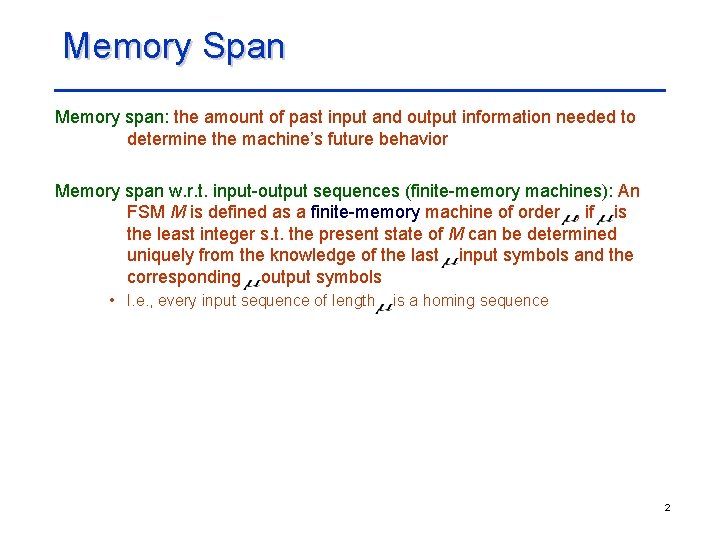
Memory Span Memory span: the amount of past input and output information needed to determine the machine’s future behavior Memory span w. r. t. input-output sequences (finite-memory machines): An FSM M is defined as a finite-memory machine of order , if is the least integer s. t. the present state of M can be determined uniquely from the knowledge of the last input symbols and the corresponding output symbols • I. e. , every input sequence of length is a homing sequence 2
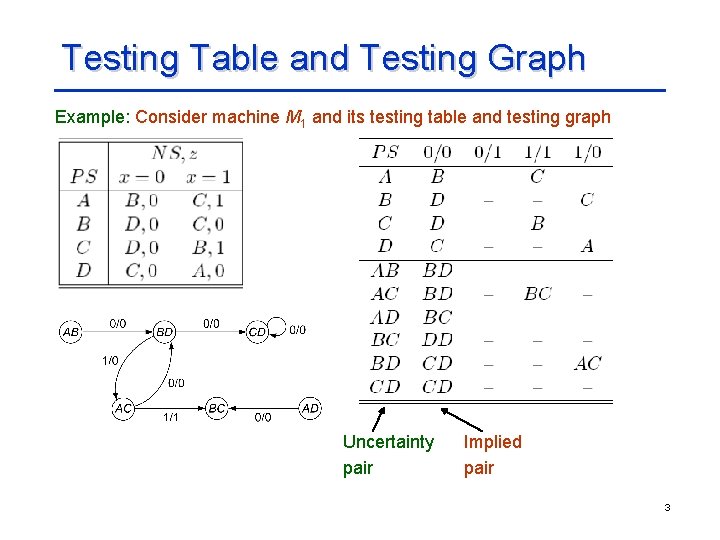
Testing Table and Testing Graph Example: Consider machine M 1 and its testing table and testing graph Uncertainty pair Implied pair 3
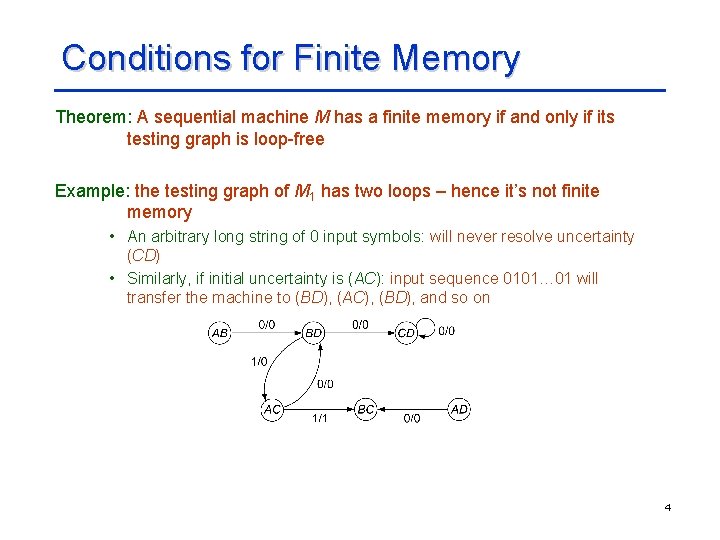
Conditions for Finite Memory Theorem: A sequential machine M has a finite memory if and only if its testing graph is loop-free Example: the testing graph of M 1 has two loops – hence it’s not finite memory • An arbitrary long string of 0 input symbols: will never resolve uncertainty (CD) • Similarly, if initial uncertainty is (AC): input sequence 0101… 01 will transfer the machine to (BD), (AC), (BD), and so on 4
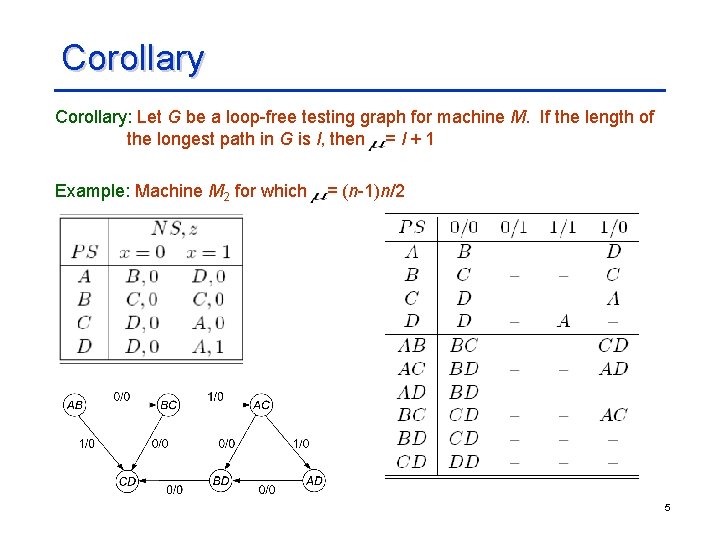
Corollary: Let G be a loop-free testing graph for machine M. If the length of the longest path in G is l, then = l + 1 Example: Machine M 2 for which = (n-1)n/2 5
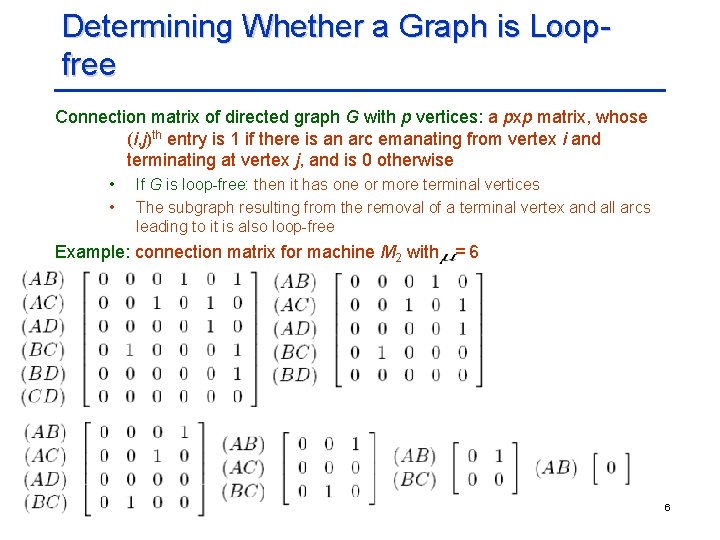
Determining Whether a Graph is Loopfree Connection matrix of directed graph G with p vertices: a pxp matrix, whose (i, j)th entry is 1 if there is an arc emanating from vertex i and terminating at vertex j, and is 0 otherwise • • If G is loop-free: then it has one or more terminal vertices The subgraph resulting from the removal of a terminal vertex and all arcs leading to it is also loop-free Example: connection matrix for machine M 2 with = 6 6
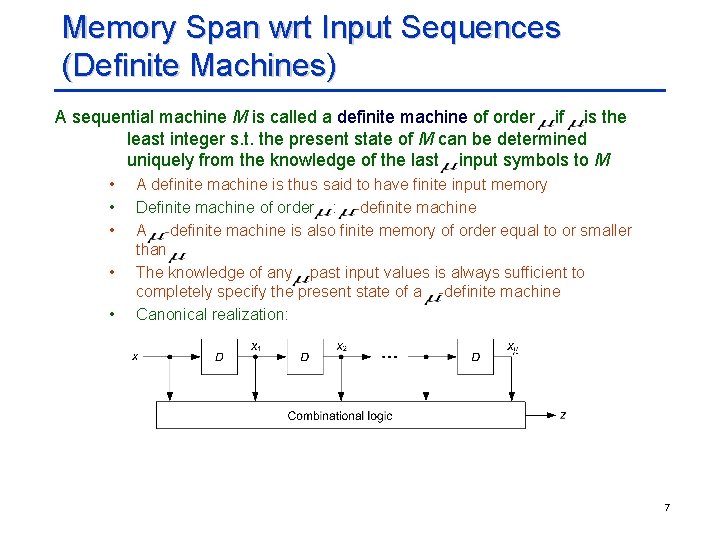
Memory Span wrt Input Sequences (Definite Machines) A sequential machine M is called a definite machine of order if is the least integer s. t. the present state of M can be determined uniquely from the knowledge of the last input symbols to M • • • A definite machine is thus said to have finite input memory Definite machine of order : -definite machine A -definite machine is also finite memory of order equal to or smaller than The knowledge of any past input values is always sufficient to completely specify the present state of a -definite machine Canonical realization: 7
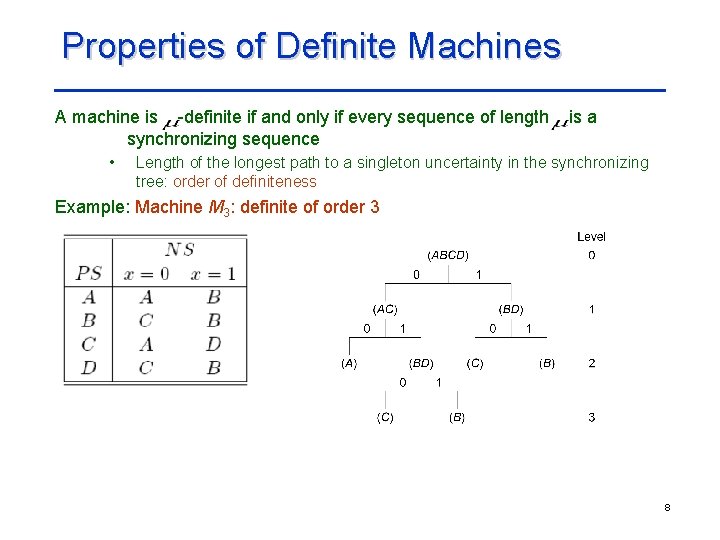
Properties of Definite Machines A machine is -definite if and only if every sequence of length synchronizing sequence • is a Length of the longest path to a singleton uncertainty in the synchronizing tree: order of definiteness Example: Machine M 3: definite of order 3 8
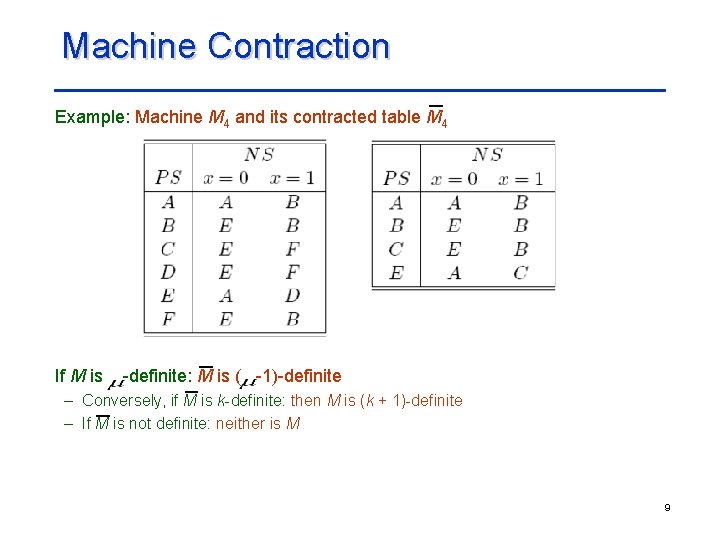
Machine Contraction Example: Machine M 4 and its contracted table M 4 If M is -definite: M is ( -1)-definite – Conversely, if M is k-definite: then M is (k + 1)-definite – If M is not definite: neither is M 9
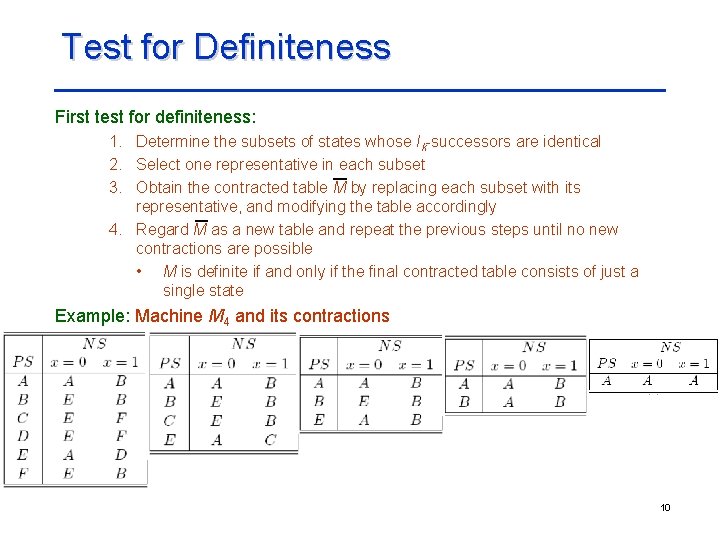
Test for Definiteness First test for definiteness: 1. Determine the subsets of states whose Ik-successors are identical 2. Select one representative in each subset 3. Obtain the contracted table M by replacing each subset with its representative, and modifying the table accordingly 4. Regard M as a new table and repeat the previous steps until no new contractions are possible • M is definite if and only if the final contracted table consists of just a single state Example: Machine M 4 and its contractions 10
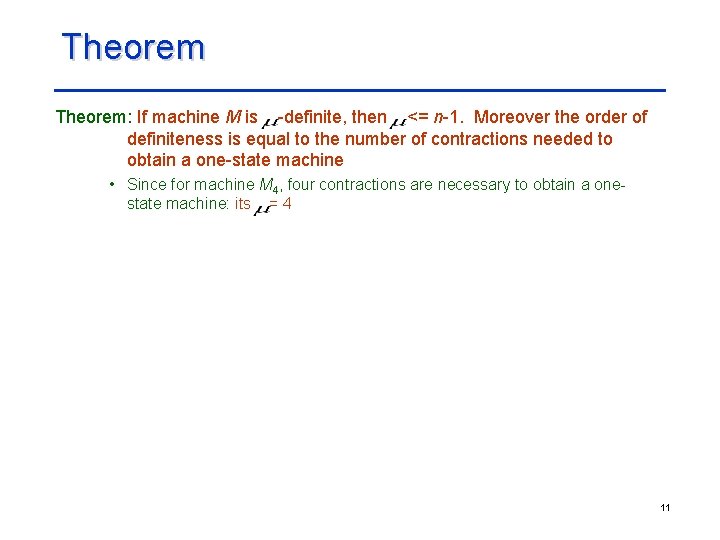
Theorem: If machine M is -definite, then <= n-1. Moreover the order of definiteness is equal to the number of contractions needed to obtain a one-state machine • Since for machine M 4, four contractions are necessary to obtain a onestate machine: its = 4 11
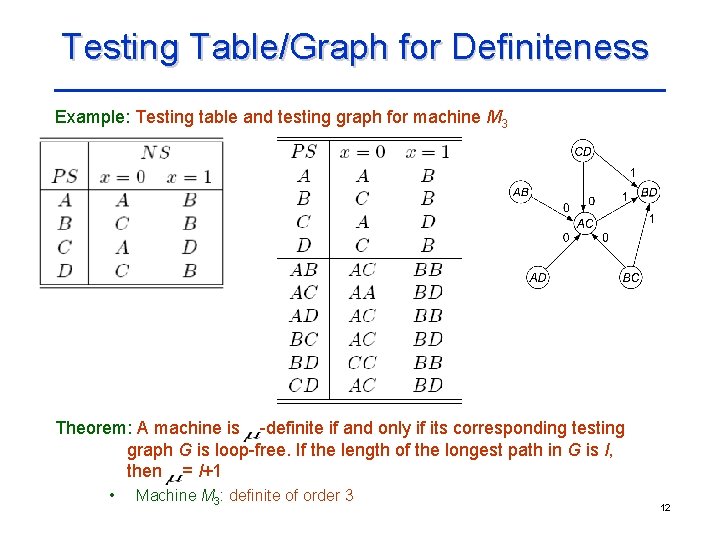
Testing Table/Graph for Definiteness Example: Testing table and testing graph for machine M 3 Theorem: A machine is -definite if and only if its corresponding testing graph G is loop-free. If the length of the longest path in G is l, then = l+1 • Machine M 3: definite of order 3 12
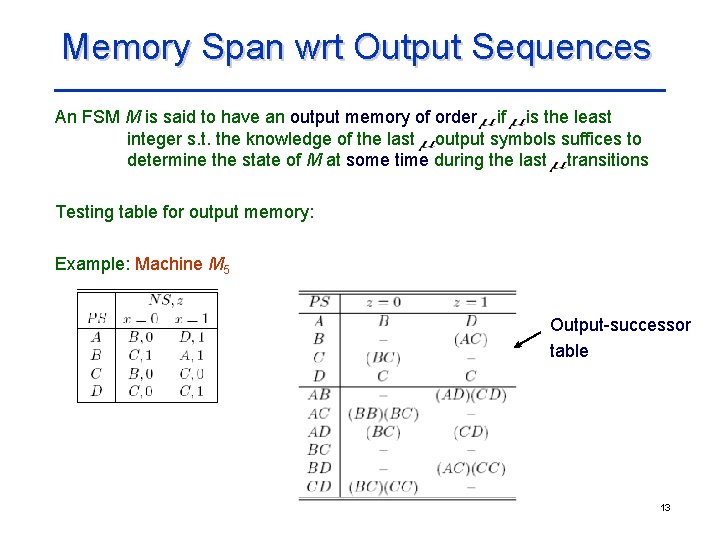
Memory Span wrt Output Sequences An FSM M is said to have an output memory of order if is the least integer s. t. the knowledge of the last output symbols suffices to determine the state of M at some time during the last transitions Testing table for output memory: Example: Machine M 5 Output-successor table 13
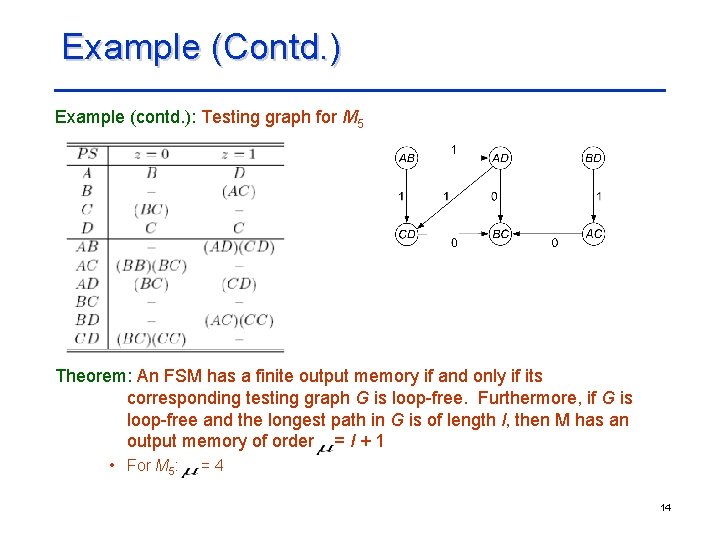
Example (Contd. ) Example (contd. ): Testing graph for M 5 Theorem: An FSM has a finite output memory if and only if its corresponding testing graph G is loop-free. Furthermore, if G is loop-free and the longest path in G is of length l, then M has an output memory of order = I + 1 • For M 5: =4 14
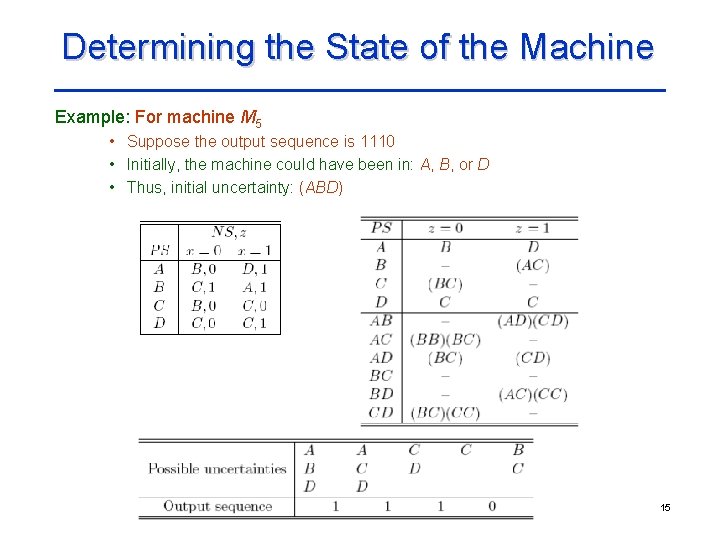
Determining the State of the Machine Example: For machine M 5 • Suppose the output sequence is 1110 • Initially, the machine could have been in: A, B, or D • Thus, initial uncertainty: (ABD) 15
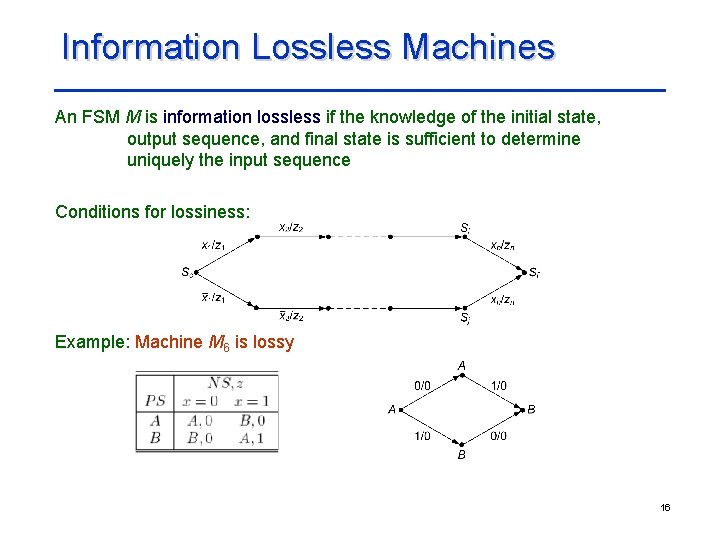
Information Lossless Machines An FSM M is information lossless if the knowledge of the initial state, output sequence, and final state is sufficient to determine uniquely the input sequence Conditions for lossiness: Example: Machine M 6 is lossy 16
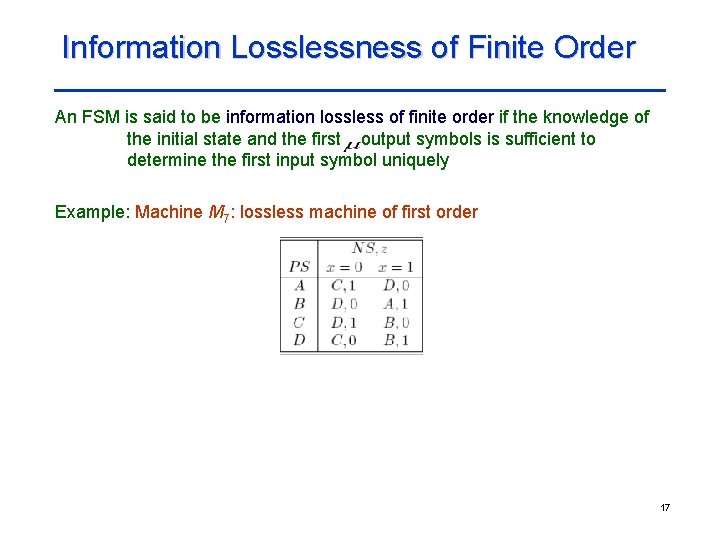
Information Losslessness of Finite Order An FSM is said to be information lossless of finite order if the knowledge of the initial state and the first output symbols is sufficient to determine the first input symbol uniquely Example: Machine M 7: lossless machine of first order 17
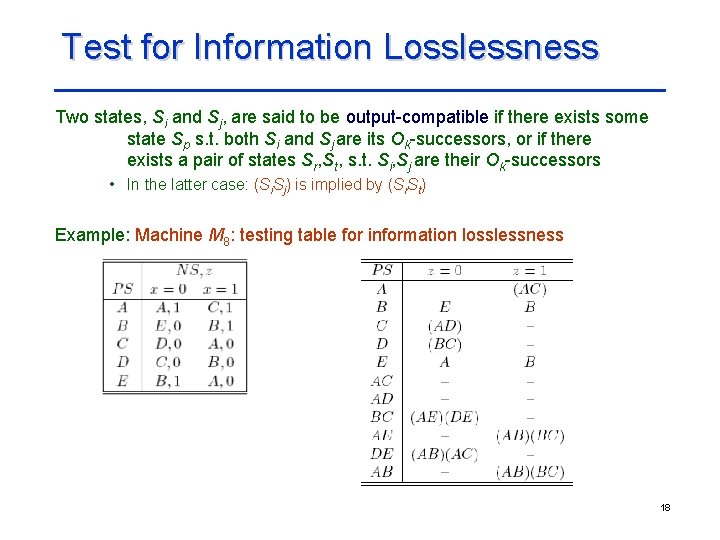
Test for Information Losslessness Two states, Si and Sj, are said to be output-compatible if there exists some state Sp s. t. both Si and Sj are its Ok-successors, or if there exists a pair of states Sr, St, s. t. Si, Sj are their Ok-successors • In the latter case: (Si. Sj) is implied by (Sr. St) Example: Machine M 8: testing table for information losslessness 18
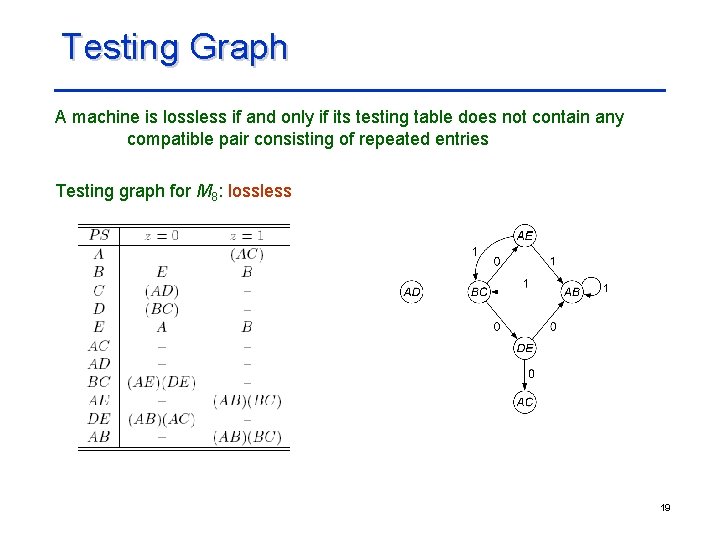
Testing Graph A machine is lossless if and only if its testing table does not contain any compatible pair consisting of repeated entries Testing graph for M 8: lossless 19
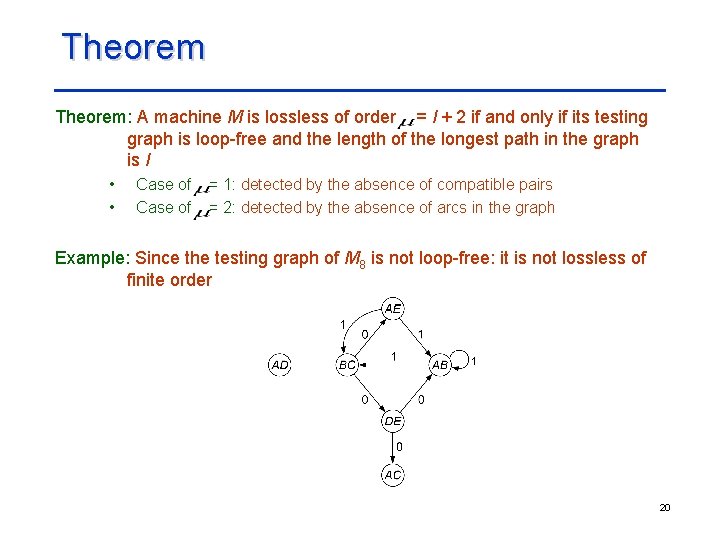
Theorem: A machine M is lossless of order = l + 2 if and only if its testing graph is loop-free and the length of the longest path in the graph is l • • Case of = 1: detected by the absence of compatible pairs = 2: detected by the absence of arcs in the graph Example: Since the testing graph of M 8 is not loop-free: it is not lossless of finite order 20
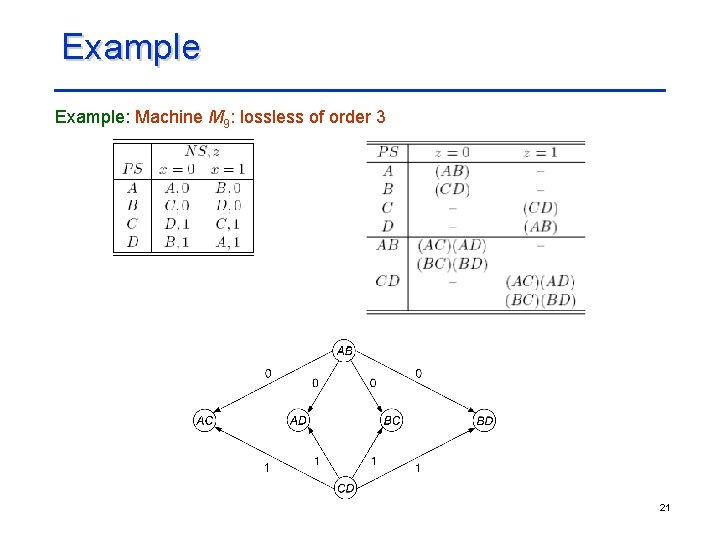
Example: Machine M 9: lossless of order 3 21
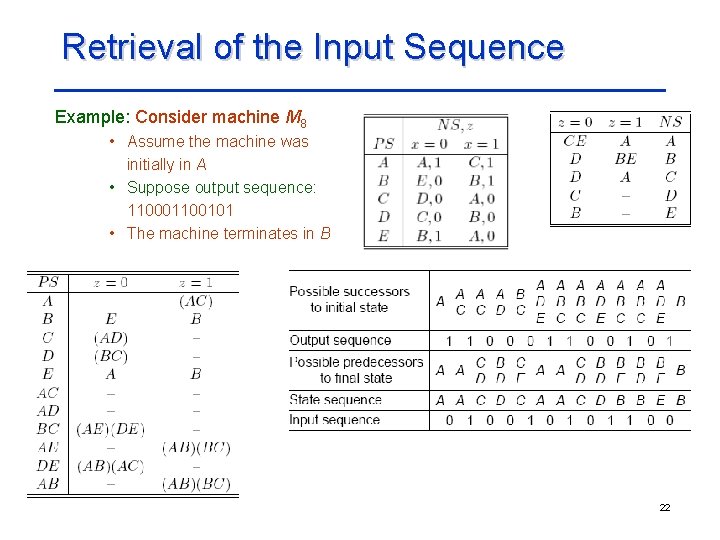
Retrieval of the Input Sequence Example: Consider machine M 8 • Assume the machine was initially in A • Suppose output sequence: 110001100101 • The machine terminates in B 22
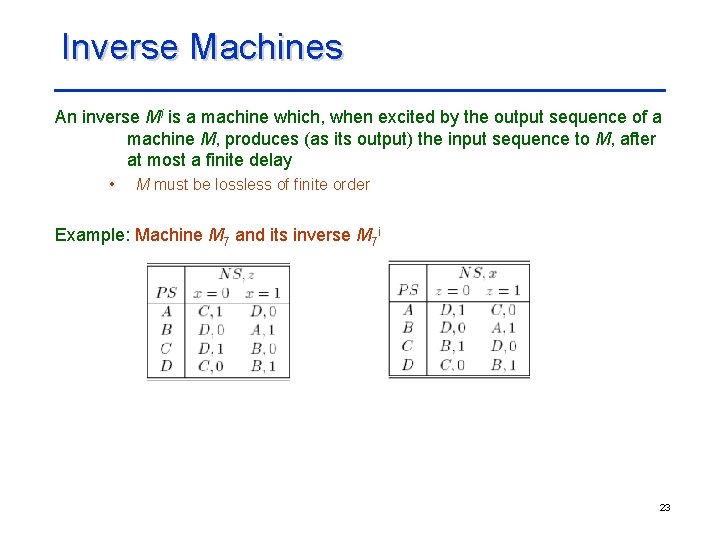
Inverse Machines An inverse Mi is a machine which, when excited by the output sequence of a machine M, produces (as its output) the input sequence to M, after at most a finite delay • M must be lossless of finite order Example: Machine M 7 and its inverse M 7 i 23
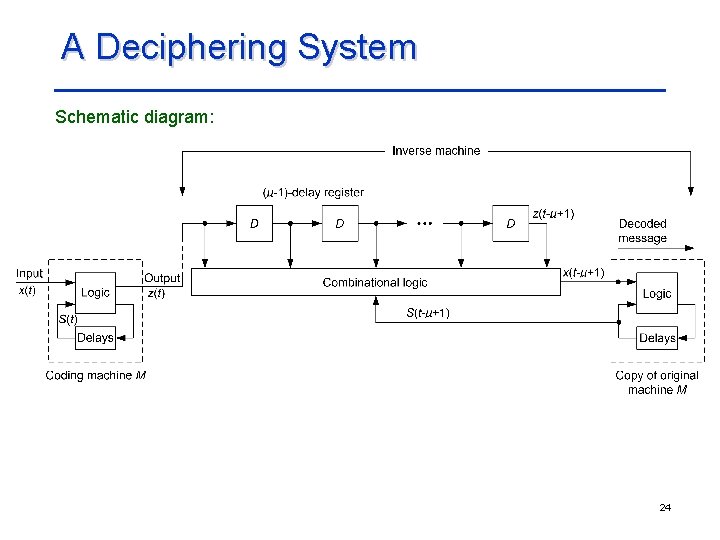
A Deciphering System Schematic diagram: 24
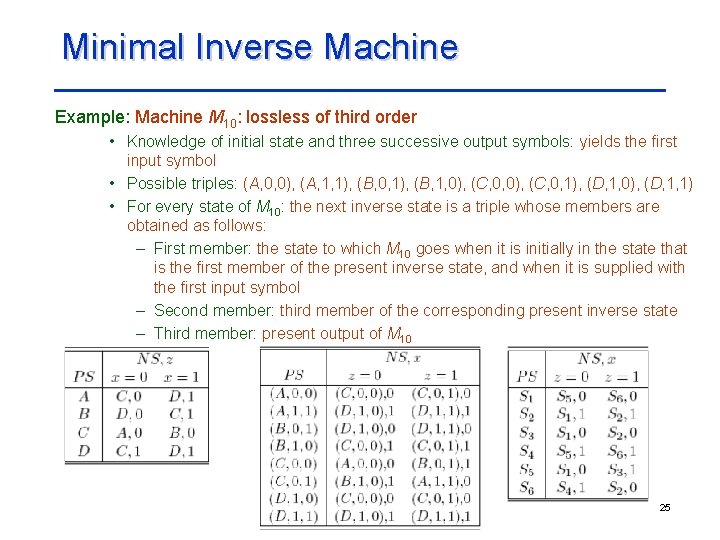
Minimal Inverse Machine Example: Machine M 10: lossless of third order • Knowledge of initial state and three successive output symbols: yields the first input symbol • Possible triples: (A, 0, 0), (A, 1, 1), (B, 0, 1), (B, 1, 0), (C, 0, 1), (D, 1, 0), (D, 1, 1) • For every state of M 10: the next inverse state is a triple whose members are obtained as follows: – First member: the state to which M 10 goes when it is initially in the state that is the first member of the present inverse state, and when it is supplied with the first input symbol – Second member: third member of the corresponding present inverse state – Third member: present output of M 10 25
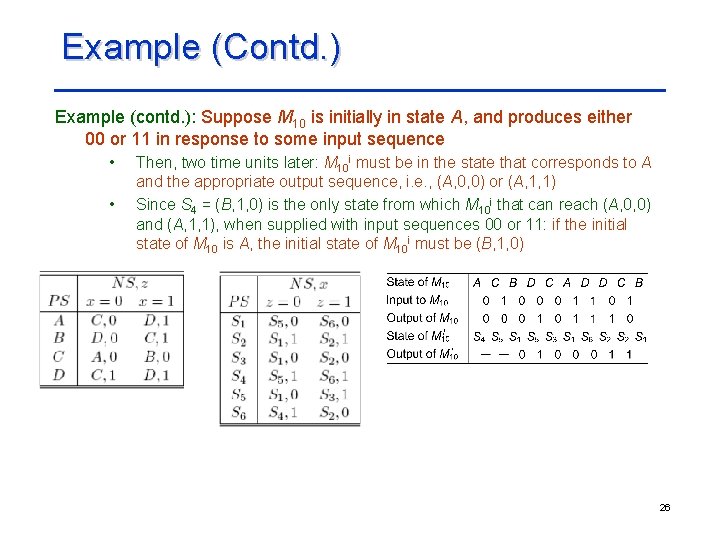
Example (Contd. ) Example (contd. ): Suppose M 10 is initially in state A, and produces either 00 or 11 in response to some input sequence • • Then, two time units later: M 10 i must be in the state that corresponds to A and the appropriate output sequence, i. e. , (A, 0, 0) or (A, 1, 1) Since S 4 = (B, 1, 0) is the only state from which M 10 i that can reach (A, 0, 0) and (A, 1, 1), when supplied with input sequences 00 or 11: if the initial state of M 10 is A, the initial state of M 10 i must be (B, 1, 0) 26
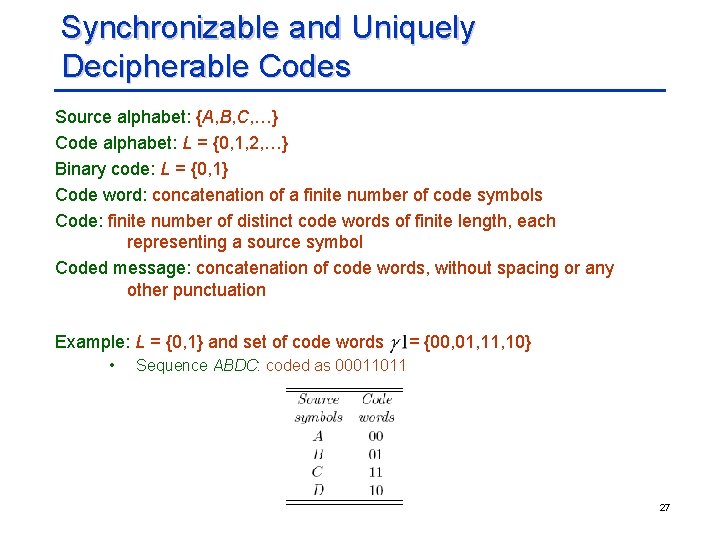
Synchronizable and Uniquely Decipherable Codes Source alphabet: {A, B, C, …} Code alphabet: L = {0, 1, 2, …} Binary code: L = {0, 1} Code word: concatenation of a finite number of code symbols Code: finite number of distinct code words of finite length, each representing a source symbol Coded message: concatenation of code words, without spacing or any other punctuation Example: L = {0, 1} and set of code words • = {00, 01, 10} Sequence ABDC: coded as 00011011 27
Uniquely Decipherable Code Example: Not in every case can we work backwards to find a unique sequence of source symbols for a given binary sequence • If = {0, 01} represents {A, B, C}: then 0001 may be decoded as AAC or BC Uniquely decipherable code: if and only if every coded message can be decomposed into a sequence of code words in only one way • is uniquely decipherable, is not • Whenever the number of code symbols is not the same for all code words: the code is not necessarily uniquely decipherable • On the other hand: = {1, 001, 0001} is uniquely decipherable since symbol 1 actually serves as a separator between successive code words – Such a separator is called a comma – Such a code is called a comma code • Block code: in which all code words contain the same number of symbols • Variable-length code: in which the number of symbols representing code words is not the same 28
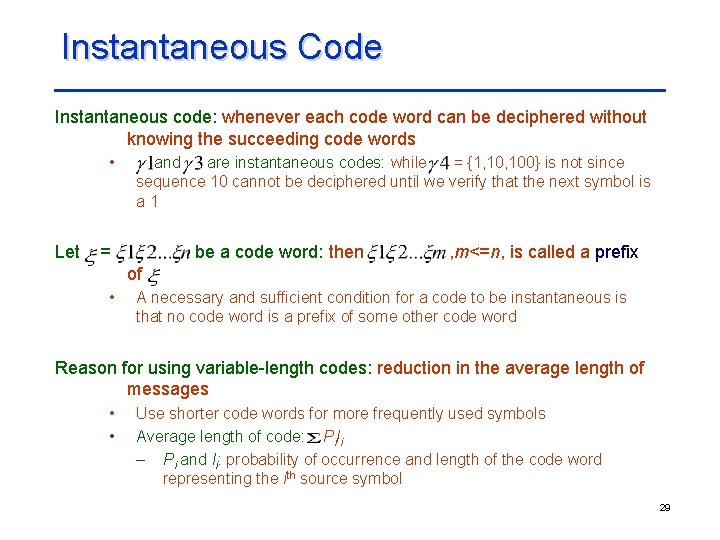
Instantaneous Code Instantaneous code: whenever each code word can be deciphered without knowing the succeeding code words • Let and are instantaneous codes: while = {1, 100} is not since sequence 10 cannot be deciphered until we verify that the next symbol is a 1 = be a code word: then , m<=n, is called a prefix of • A necessary and sufficient condition for a code to be instantaneous is that no code word is a prefix of some other code word Reason for using variable-length codes: reduction in the average length of messages • • Use shorter code words for more frequently used symbols Average length of code: Pili – Pi and li: probability of occurrence and length of the code word representing the ith source symbol 29
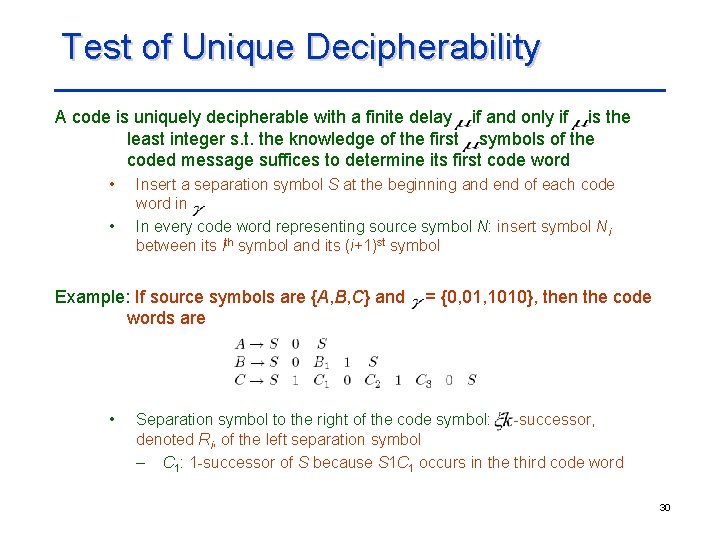
Test of Unique Decipherability A code is uniquely decipherable with a finite delay if and only if is the least integer s. t. the knowledge of the first symbols of the coded message suffices to determine its first code word • • Insert a separation symbol S at the beginning and end of each code word in In every code word representing source symbol N: insert symbol Ni between its ith symbol and its (i+1)st symbol Example: If source symbols are {A, B, C} and words are • = {0, 01, 1010}, then the code Separation symbol to the right of the code symbol: -successor, denoted Ri, of the left separation symbol – C 1: 1 -successor of S because S 1 C 1 occurs in the third code word 30
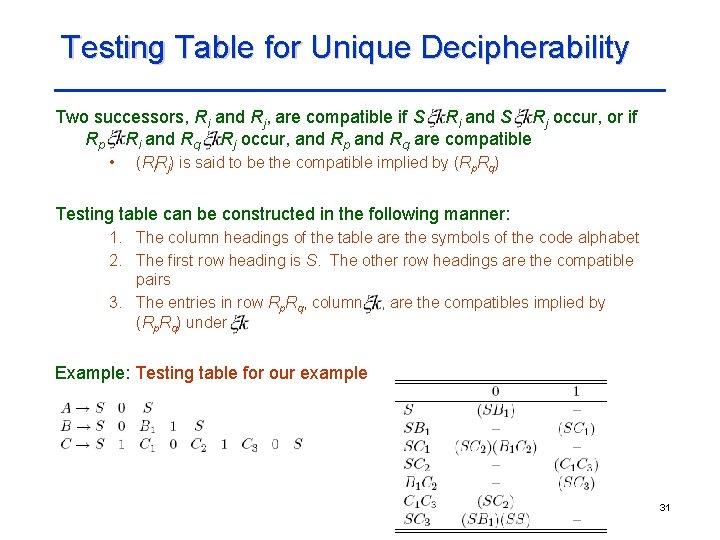
Testing Table for Unique Decipherability Two successors, Ri and Rj, are compatible if S Ri and S Rj occur, or if Rp Ri and Rq Rj occur, and Rp and Rq are compatible • (Ri. Rj) is said to be the compatible implied by (Rp. Rq) Testing table can be constructed in the following manner: 1. The column headings of the table are the symbols of the code alphabet 2. The first row heading is S. The other row headings are the compatible pairs 3. The entries in row Rp. Rq, column , are the compatibles implied by (Rp. Rq) under Example: Testing table for our example 31
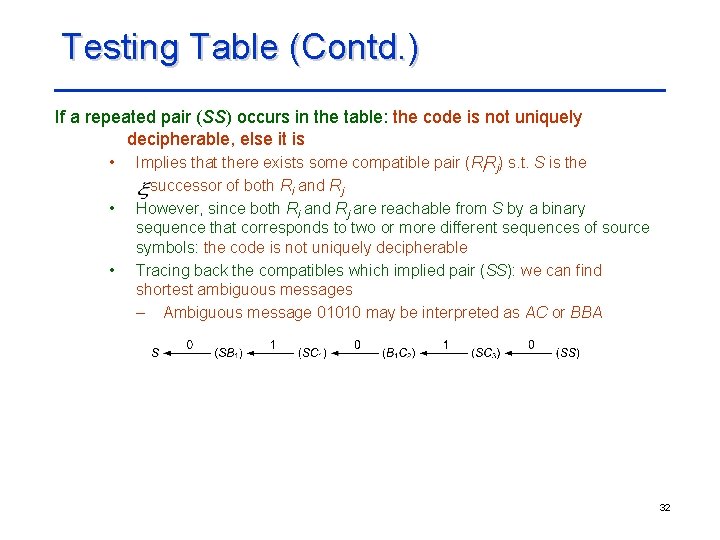
Testing Table (Contd. ) If a repeated pair (SS) occurs in the table: the code is not uniquely decipherable, else it is • • • Implies that there exists some compatible pair (Ri. Rj) s. t. S is the -successor of both Ri and Rj However, since both Ri and Rj are reachable from S by a binary sequence that corresponds to two or more different sequences of source symbols: the code is not uniquely decipherable Tracing back the compatibles which implied pair (SS): we can find shortest ambiguous messages – Ambiguous message 01010 may be interpreted as AC or BBA 32
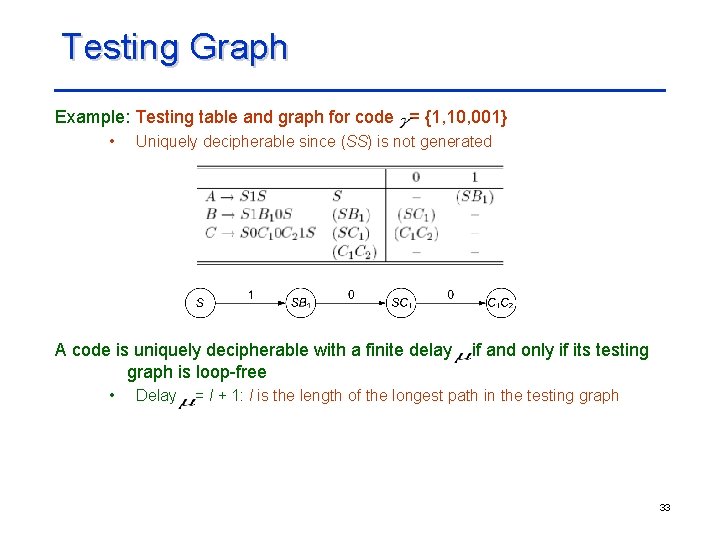
Testing Graph Example: Testing table and graph for code = {1, 10, 001} • Uniquely decipherable since (SS) is not generated A code is uniquely decipherable with a finite delay graph is loop-free • Delay if and only if its testing = I + 1: l is the length of the longest path in the testing graph 33
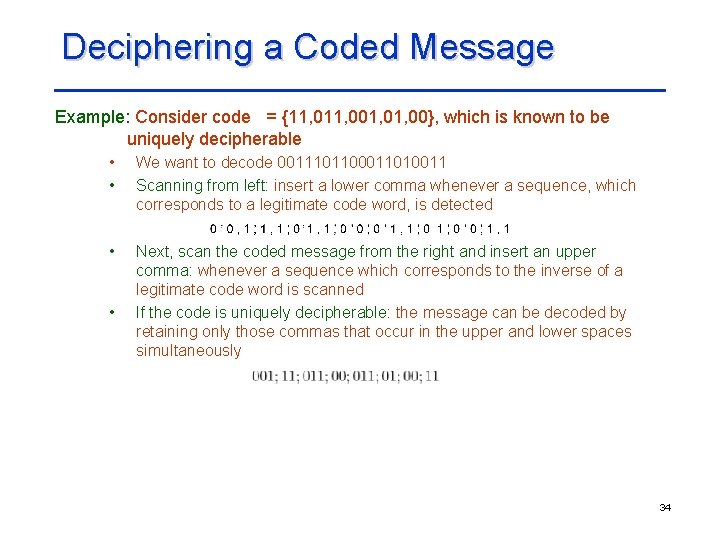
Deciphering a Coded Message Example: Consider code = {11, 001, 00}, which is known to be uniquely decipherable • • We want to decode 0011101100011010011 Scanning from left: insert a lower comma whenever a sequence, which corresponds to a legitimate code word, is detected • Next, scan the coded message from the right and insert an upper comma: whenever a sequence which corresponds to the inverse of a legitimate code word is scanned If the code is uniquely decipherable: the message can be decoded by retaining only those commas that occur in the upper and lower spaces simultaneously • 34
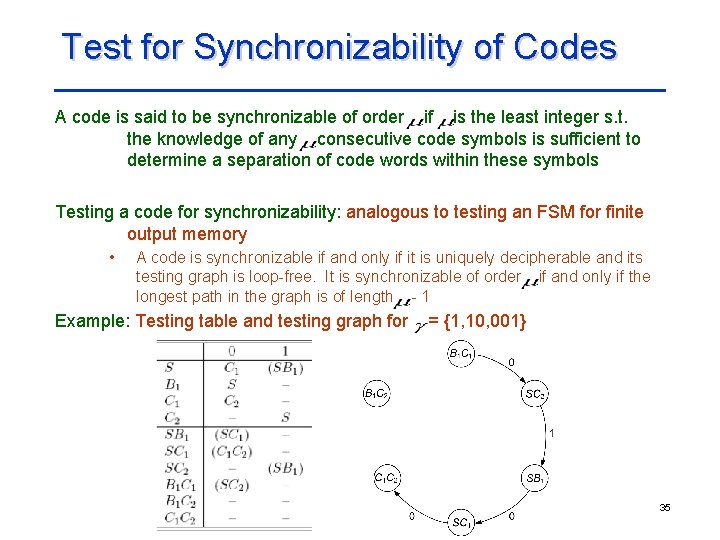
Test for Synchronizability of Codes A code is said to be synchronizable of order if is the least integer s. t. the knowledge of any consecutive code symbols is sufficient to determine a separation of code words within these symbols Testing a code for synchronizability: analogous to testing an FSM for finite output memory • A code is synchronizable if and only if it is uniquely decipherable and its testing graph is loop-free. It is synchronizable of order if and only if the longest path in the graph is of length - 1 Example: Testing table and testing graph for = {1, 10, 001} 35