MEDICOLEGAL CASES CORE ELEMENTS DARRYL S C GOON




- Slides: 66
MEDICO-LEGAL CASES: CORE ELEMENTS DARRYL S C GOON 1 ST MARCH 2019
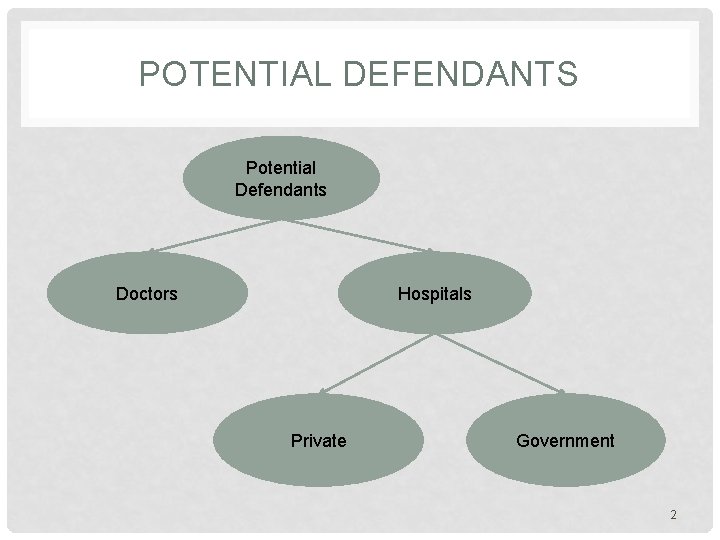
POTENTIAL DEFENDANTS Potential Defendants Doctors Hospitals Private Government 2
DOCTORS COMMON LAW BASES FOR LIABILITY 3
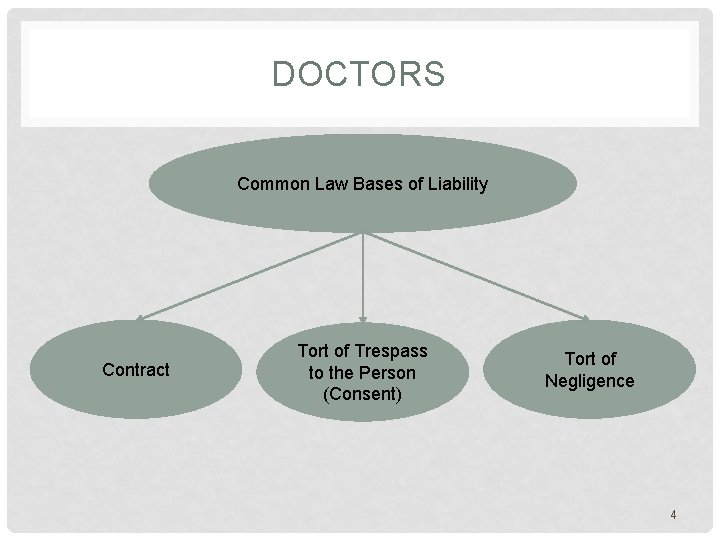
DOCTORS Common Law Bases of Liability Contract Tort of Trespass to the Person (Consent) Tort of Negligence 4
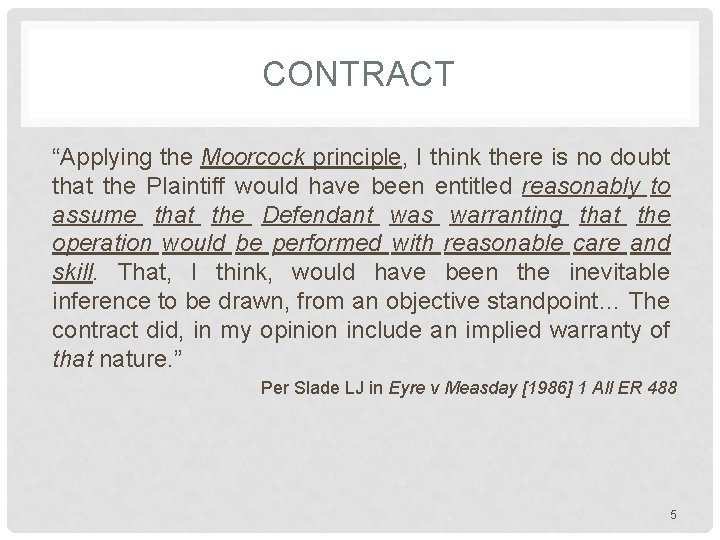
CONTRACT “Applying the Moorcock principle, I think there is no doubt that the Plaintiff would have been entitled reasonably to assume that the Defendant was warranting that the operation would be performed with reasonable care and skill. That, I think, would have been the inevitable inference to be drawn, from an objective standpoint… The contract did, in my opinion include an implied warranty of that nature. ” Per Slade LJ in Eyre v Measday [1986] 1 All ER 488 5
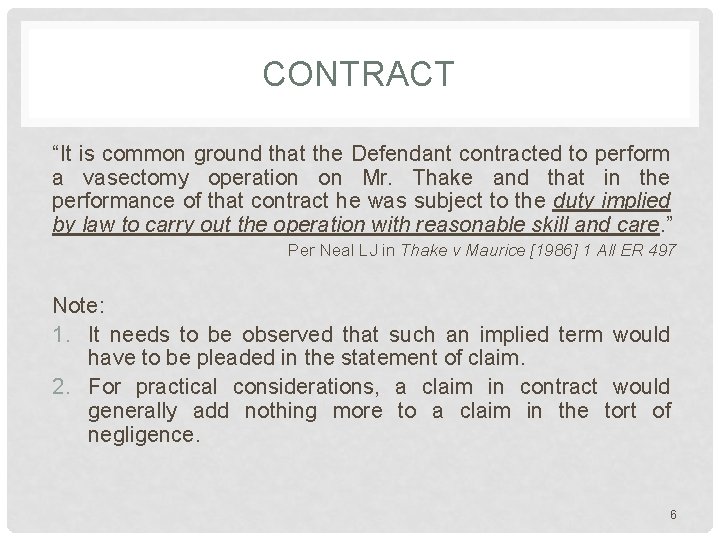
CONTRACT “It is common ground that the Defendant contracted to perform a vasectomy operation on Mr. Thake and that in the performance of that contract he was subject to the duty implied by law to carry out the operation with reasonable skill and care. ” Per Neal LJ in Thake v Maurice [1986] 1 All ER 497 Note: 1. It needs to be observed that such an implied term would have to be pleaded in the statement of claim. 2. For practical considerations, a claim in contract would generally add nothing more to a claim in the tort of negligence. 6
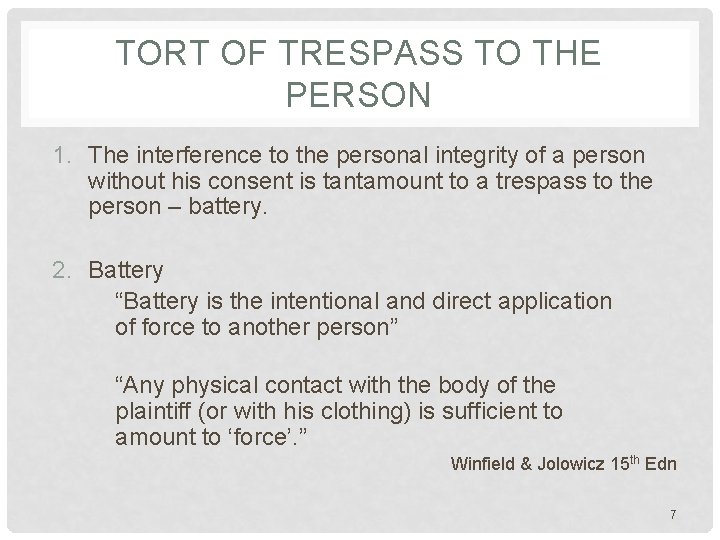
TORT OF TRESPASS TO THE PERSON 1. The interference to the personal integrity of a person without his consent is tantamount to a trespass to the person – battery. 2. Battery “Battery is the intentional and direct application of force to another person” “Any physical contact with the body of the plaintiff (or with his clothing) is sufficient to amount to ‘force’. ” Winfield & Jolowicz 15 th Edn 7
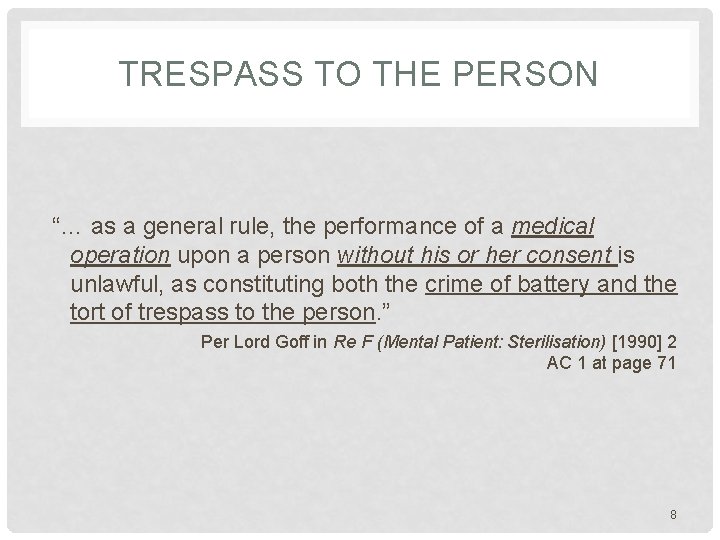
TRESPASS TO THE PERSON “… as a general rule, the performance of a medical operation upon a person without his or her consent is unlawful, as constituting both the crime of battery and the tort of trespass to the person. ” Per Lord Goff in Re F (Mental Patient: Sterilisation) [1990] 2 AC 1 at page 71 8
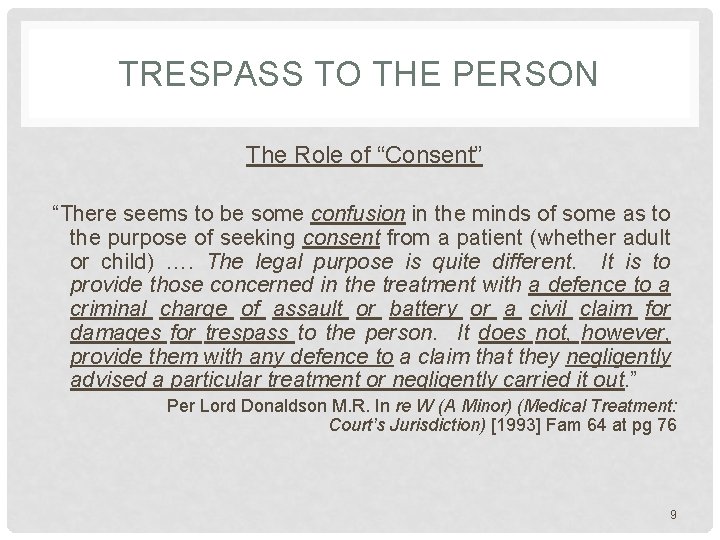
TRESPASS TO THE PERSON The Role of “Consent” “There seems to be some confusion in the minds of some as to the purpose of seeking consent from a patient (whether adult or child) …. The legal purpose is quite different. It is to provide those concerned in the treatment with a defence to a criminal charge of assault or battery or a civil claim for damages for trespass to the person. It does not, however, provide them with any defence to a claim that they negligently advised a particular treatment or negligently carried it out. ” Per Lord Donaldson M. R. In re W (A Minor) (Medical Treatment: Court’s Jurisdiction) [1993] Fam 64 at pg 76 9
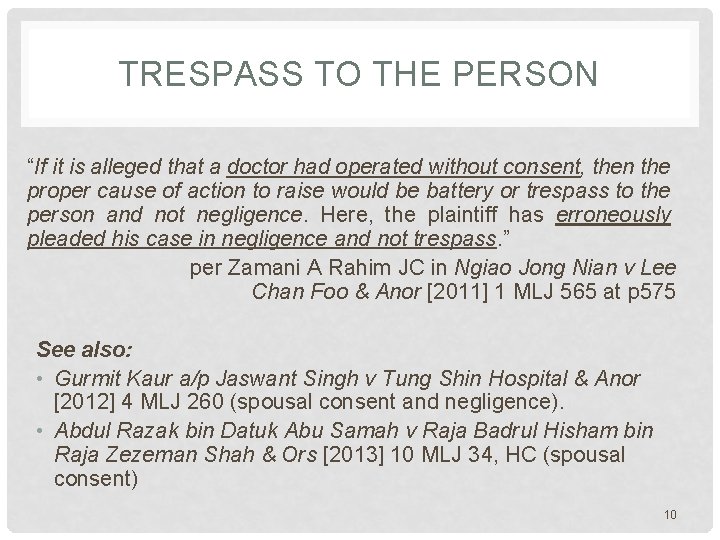
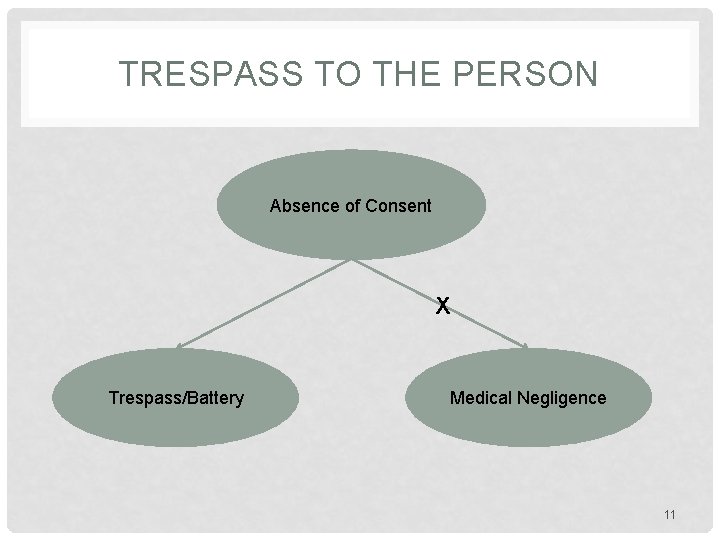
TRESPASS TO THE PERSON “If it is alleged that a doctor had operated without consent, then the proper cause of action to raise would be battery or trespass to the person and not negligence. Here, the plaintiff has erroneously pleaded his case in negligence and not trespass. ” per Zamani A Rahim JC in Ngiao Jong Nian v Lee Chan Foo & Anor [2011] 1 MLJ 565 at p 575 See also: • Gurmit Kaur a/p Jaswant Singh v Tung Shin Hospital & Anor [2012] 4 MLJ 260 (spousal consent and negligence). • Abdul Razak bin Datuk Abu Samah v Raja Badrul Hisham bin Raja Zezeman Shah & Ors [2013] 10 MLJ 34, HC (spousal consent) 10
TRESPASS TO THE PERSON Absence of Consent X Trespass/Battery Medical Negligence 11
TRESPASS TO THE PERSON How much explanation for a valid consent? “I am wholly satisfied that as a matter of English law a consent is not vitiated by a failure on the part of the doctor to give the patient sufficient information before the consent is given. ” Per Donaldson MR in Sidaway v Bethlem Royal Hospital Governors [1984] 1 All ER 1018, at 1026 and 1029 12
TRESPASS TO THE PERSON How much explanation for a valid consent? “In my judgment what the court has to do in each case is to look at all the circumstances and say, “Was there a real consent? ’… … In my judgment once the patient is informed in broad terms of the nature of the procedure which is intended, and gives her consent, that consent, is real, and the cause of the action on which to base a claim for failure to go into risks and implications is negligence, not trespass. ” Per Bristow J in Chatterton v Gerson [1981] 1 All ER 257 at 265 13
TRESPASS TO THE PERSON How much explanation for a valid consent? “Anglo-Australian law has rightly taken the view that an allegation that the risks inherent in a medical procedure have not been disclosed to the patient can only found an action in negligence and not in trespass; the consent necessary to negative the offence of battery is satisfied by the patient being advised in broad terms of the nature of the procedure to be performed. ” Per Mason CJ, Brennan, Dawson, Toohey and Mc. Hugh JJ said in Rogers v Whitaker (1992) 175 CLR 479 at 490. 14
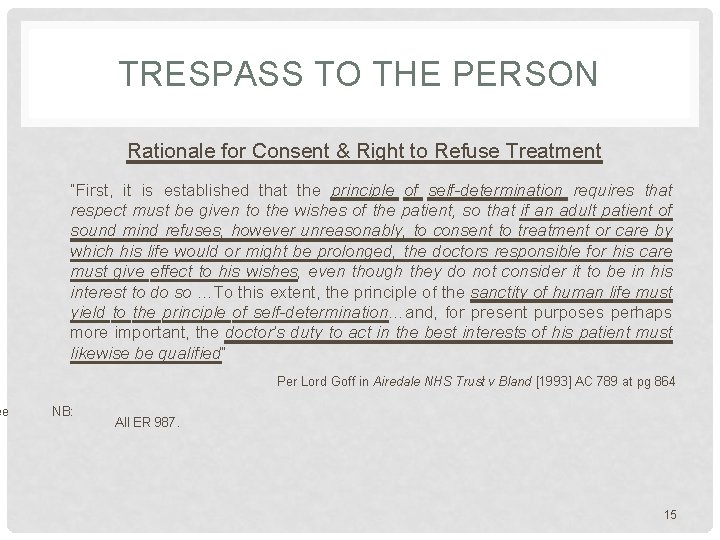
ee TRESPASS TO THE PERSON Rationale for Consent & Right to Refuse Treatment “First, it is established that the principle of self-determination requires that respect must be given to the wishes of the patient, so that if an adult patient of sound mind refuses, however unreasonably, to consent to treatment or care by which his life would or might be prolonged, the doctors responsible for his care must give effect to his wishes, even though they do not consider it to be in his interest to do so …To this extent, the principle of the sanctity of human life must yield to the principle of self-determination…and, for present purposes perhaps more important, the doctor’s duty to act in the best interests of his patient must likewise be qualified” Per Lord Goff in Airedale NHS Trust v Bland [1993] AC 789 at pg 864 NB: All ER 987. 15
CONSENT : STATUTORY REQUIREMENT Private Healthcare Facilities & Services (Private Hospitals and Other Private Healthcare Facilities) Regulations 2006 : Regulation 47 § A written “valid consent” must be obtained “…before any procedure or surgery is carried out on the patient. ” § For patients under 18 and unmarried, consent must be obtained from the parent or guardian § Contravention of Regulation 47 is an offence punishable by a maximum fine of RM 10 K and/or a maximum of 3 months imprisonment. NB: 1. Does not apply to government hospitals 2. See also Guardianship of Infants Act 1961, Age of Majority Act 1971 and Child Act 2001 16
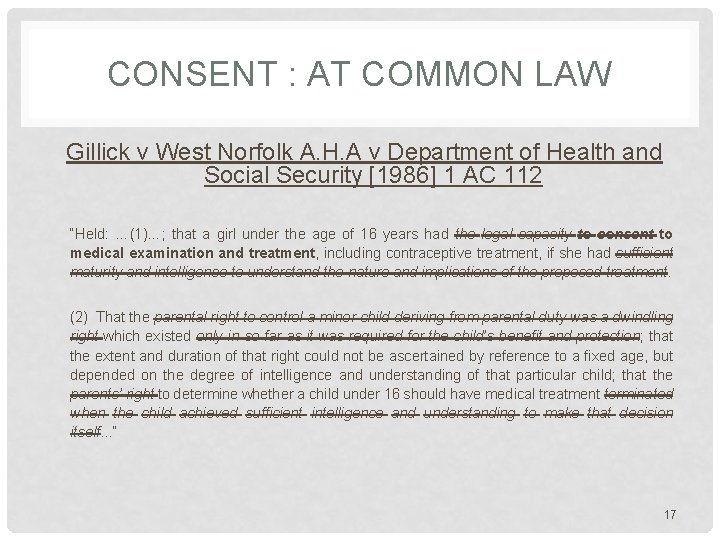
CONSENT : AT COMMON LAW Gillick v West Norfolk A. H. A v Department of Health and Social Security [1986] 1 AC 112 “Held: …(1)…; that a girl under the age of 16 years had the legal capacity to consent to medical examination and treatment, including contraceptive treatment, if she had sufficient maturity and intelligence to understand the nature and implications of the proposed treatment. (2) That the parental right to control a minor child deriving from parental duty was a dwindling right which existed only in so far as it was required for the child’s benefit and protection; that the extent and duration of that right could not be ascertained by reference to a fixed age, but depended on the degree of intelligence and understanding of that particular child; that the parents’ right to determine whether a child under 16 should have medical treatment terminated when the child achieved sufficient intelligence and understanding to make that decision itself. . . ” 17
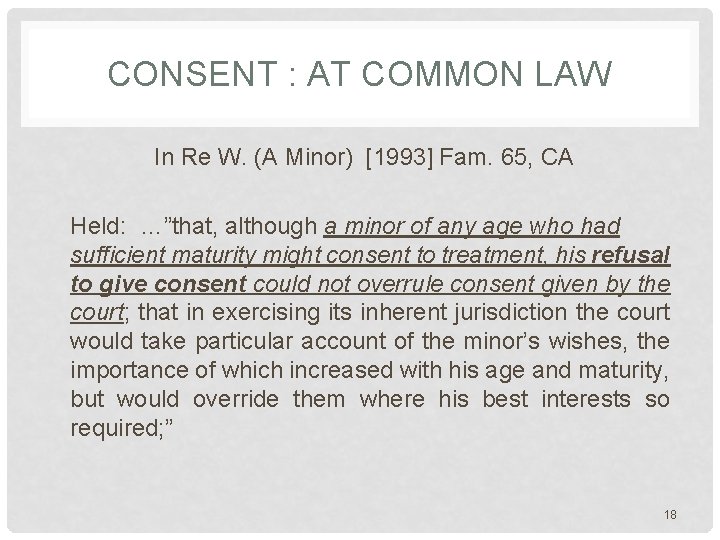
CONSENT : AT COMMON LAW In Re W. (A Minor) [1993] Fam. 65, CA Held: …”that, although a minor of any age who had sufficient maturity might consent to treatment, his refusal to give consent could not overrule consent given by the court; that in exercising its inherent jurisdiction the court would take particular account of the minor’s wishes, the importance of which increased with his age and maturity, but would override them where his best interests so required; ” 18
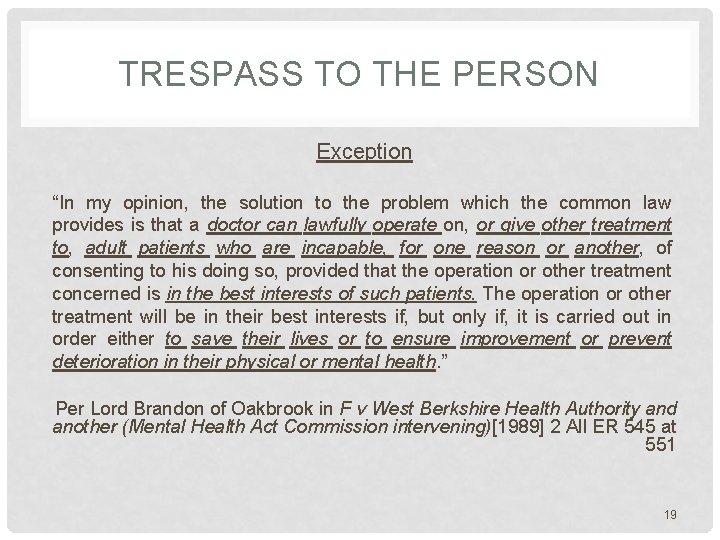
TRESPASS TO THE PERSON Exception “In my opinion, the solution to the problem which the common law provides is that a doctor can lawfully operate on, or give other treatment to, adult patients who are incapable, for one reason or another, of consenting to his doing so, provided that the operation or other treatment concerned is in the best interests of such patients. The operation or other treatment will be in their best interests if, but only if, it is carried out in order either to save their lives or to ensure improvement or prevent deterioration in their physical or mental health. ” Per Lord Brandon of Oakbrook in F v West Berkshire Health Authority and another (Mental Health Act Commission intervening)[1989] 2 All ER 545 at 551 19
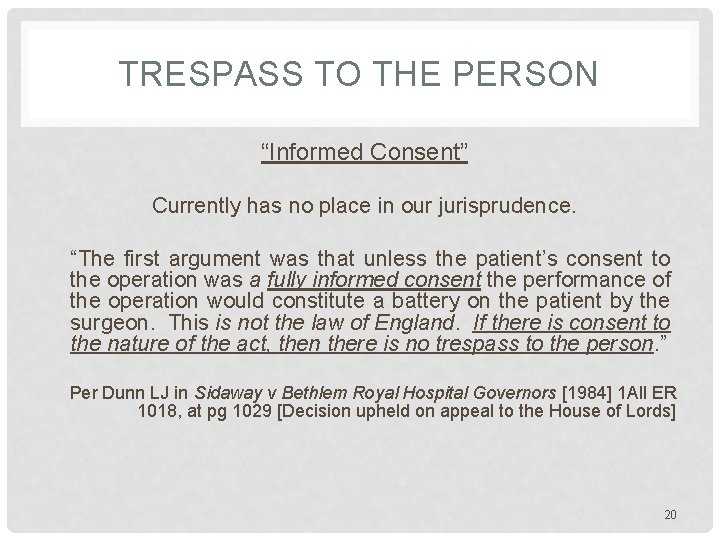
TRESPASS TO THE PERSON “Informed Consent” Currently has no place in our jurisprudence. “The first argument was that unless the patient’s consent to the operation was a fully informed consent the performance of the operation would constitute a battery on the patient by the surgeon. This is not the law of England. If there is consent to the nature of the act, then there is no trespass to the person. ” Per Dunn LJ in Sidaway v Bethlem Royal Hospital Governors [1984] 1 All ER 1018, at pg 1029 [Decision upheld on appeal to the House of Lords] 20
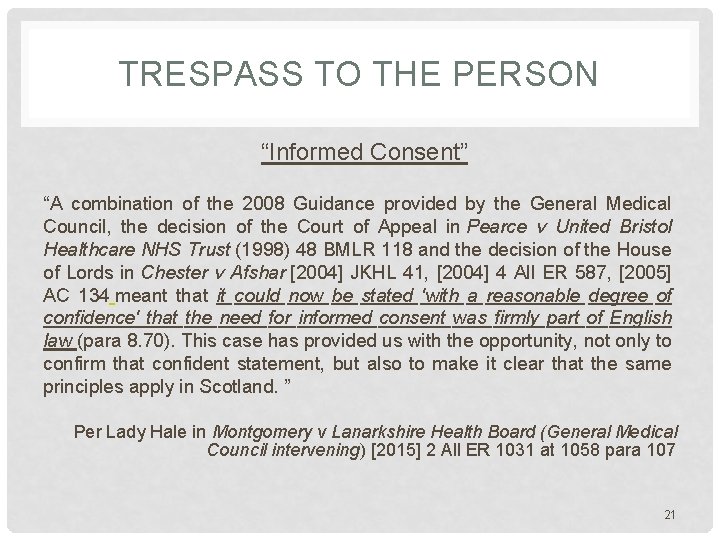
TRESPASS TO THE PERSON “Informed Consent” “A combination of the 2008 Guidance provided by the General Medical Council, the decision of the Court of Appeal in Pearce v United Bristol Healthcare NHS Trust (1998) 48 BMLR 118 and the decision of the House of Lords in Chester v Afshar [2004] JKHL 41, [2004] 4 All ER 587, [2005] AC 134 meant that it could now be stated 'with a reasonable degree of confidence' that the need for informed consent was firmly part of English law (para 8. 70). This case has provided us with the opportunity, not only to confirm that confident statement, but also to make it clear that the same principles apply in Scotland. ” Per Lady Hale in Montgomery v Lanarkshire Health Board (General Medical Council intervening) [2015] 2 All ER 1031 at 1058 para 107 21
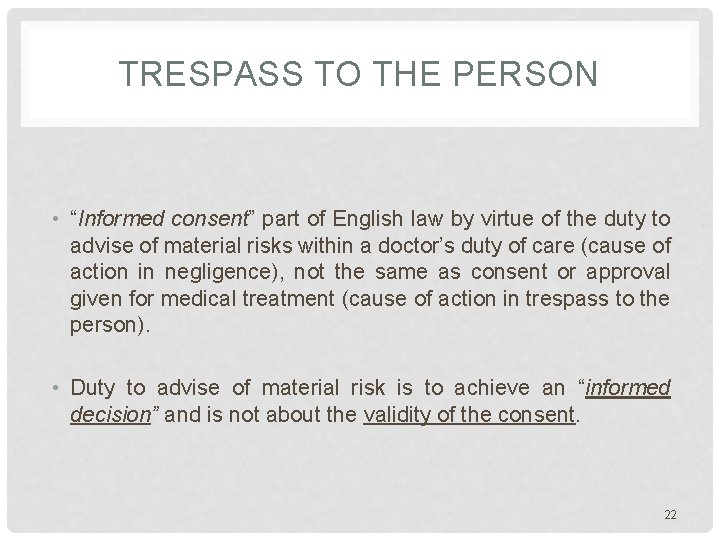
TRESPASS TO THE PERSON • “Informed consent” part of English law by virtue of the duty to advise of material risks within a doctor’s duty of care (cause of action in negligence), not the same as consent or approval given for medical treatment (cause of action in trespass to the person). • Duty to advise of material risk is to achieve an “informed decision” and is not about the validity of the consent. 22
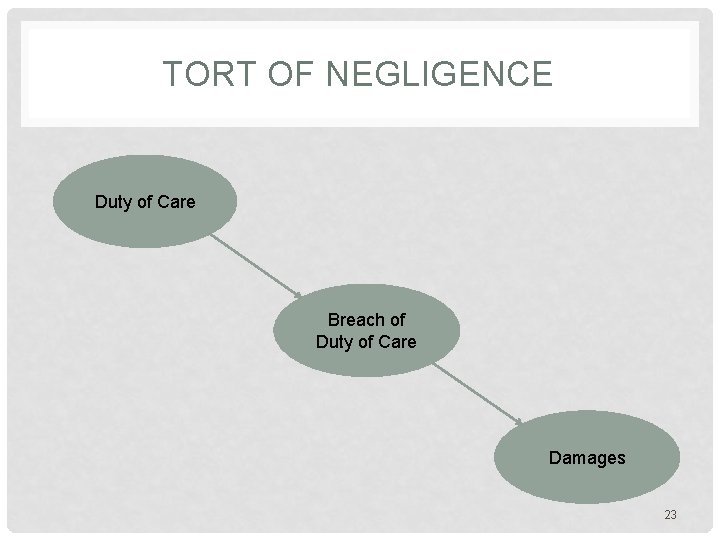
TORT OF NEGLIGENCE Duty of Care Breach of Duty of Care Damages 23
NEGLIGENCE : DUTY OF CARE It is beyond contestation that a medical doctor owes his patient a duty of care. 24
NEGLIGENCE : DUTY OF CARE Doctor’s Duty of Care Diagnosis (Misdiagnosis and Wrong Diagnosis) Advice Treatment (Removal of wrong limb, damaging other organs in the course of a surgery, etc…) 25
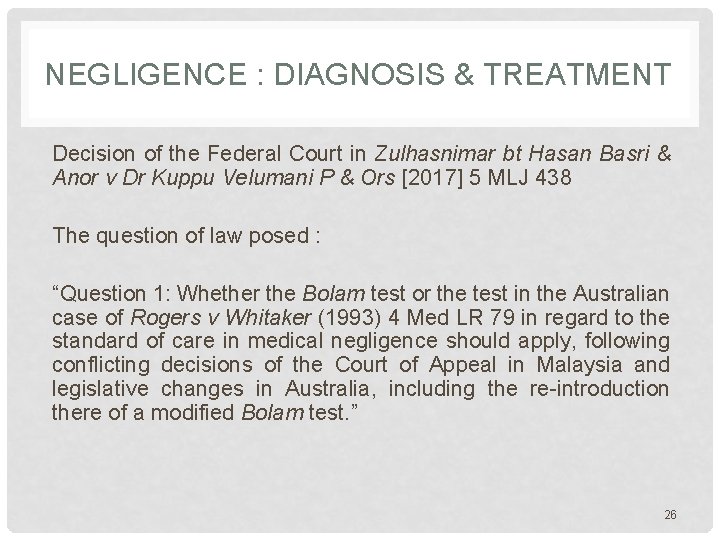
NEGLIGENCE : DIAGNOSIS & TREATMENT Decision of the Federal Court in Zulhasnimar bt Hasan Basri & Anor v Dr Kuppu Velumani P & Ors [2017] 5 MLJ 438 The question of law posed : “Question 1: Whether the Bolam test or the test in the Australian case of Rogers v Whitaker (1993) 4 Med LR 79 in regard to the standard of care in medical negligence should apply, following conflicting decisions of the Court of Appeal in Malaysia and legislative changes in Australia, including the re-introduction there of a modified Bolam test. ” 26
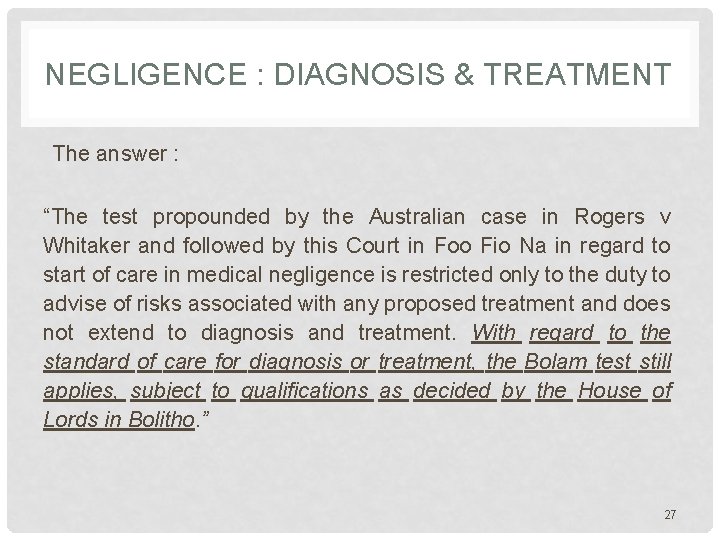
NEGLIGENCE : DIAGNOSIS & TREATMENT The answer : “The test propounded by the Australian case in Rogers v Whitaker and followed by this Court in Foo Fio Na in regard to start of care in medical negligence is restricted only to the duty to advise of risks associated with any proposed treatment and does not extend to diagnosis and treatment. With regard to the standard of care for diagnosis or treatment, the Bolam test still applies, subject to qualifications as decided by the House of Lords in Bolitho. ” 27
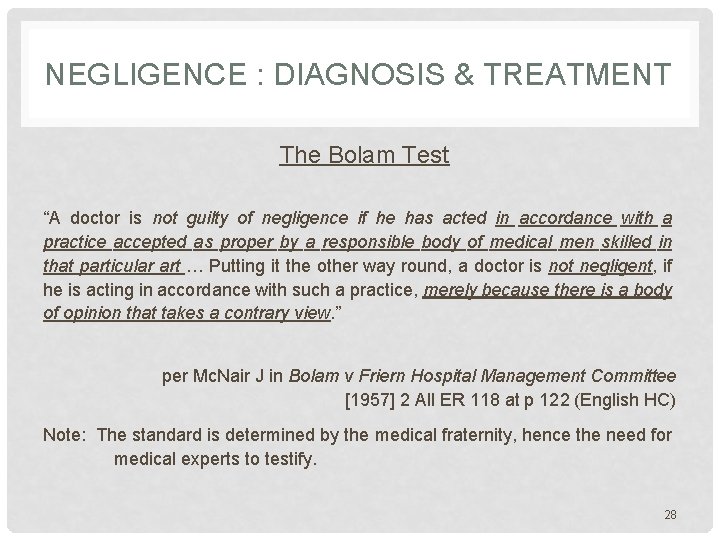
NEGLIGENCE : DIAGNOSIS & TREATMENT The Bolam Test “A doctor is not guilty of negligence if he has acted in accordance with a practice accepted as proper by a responsible body of medical men skilled in that particular art … Putting it the other way round, a doctor is not negligent, if he is acting in accordance with such a practice, merely because there is a body of opinion that takes a contrary view. ” per Mc. Nair J in Bolam v Friern Hospital Management Committee [1957] 2 All ER 118 at p 122 (English HC) Note: The standard is determined by the medical fraternity, hence the need for medical experts to testify. 28
NEGLIGENCE : DIAGNOSIS & TREATMENT The Bolitho Qualification “…But if, in a rare case, it can be demonstrated that the professional opinion is not capable of withstanding logical analysis, the judge is entitled to hold that the body of opinion is not reasonable or responsible. I emphasise that in my view it will very seldom be right for a judge to reach the conclusion that views genuinely held by a competent medical expert are unreasonable. ” per Lord Browne-Wilkinson in Bolitho v City and Hackney Health Authority [1998] AC 232 at p 243 C-D (English HL) 29
NEGLIGENCE : DUTY TO ADVISE Decision of the Federal Court in Foo Fio Na v Dr Soo Fook Mun & Anor [2007] 1 MLJ 593 at p 611 (FC) “… we are of the opinion that the Bolam Test has no relevance to the duty and standard of care of a medical practitioner in providing advice to a patient on the inherent and material risks of the proposed treatment. ” “…we are of the view that the Rogers v Whitaker test would be a more appropriate and a viable test of this millennium then the Bolam Test. ” 30
NEGLIGENCE : DUTY TO ADVISE Decision of the High Court of Australia in Rogers v Whitaker (1992) 175 CLR 479 at p 490 (Australian HC) "The law should recognise that a doctor has a duty to warn a patient of a material risk inherent in the proposed treatment; a risk is material if, in the circumstances of the particular case, a reasonable person in the patient's position, if warned of the risk, would be likely to attach significance to it or if the medical practitioner is or should reasonably be aware that the particular patient, if warned of the risk, would be likely to attach significance to it. This duty is subject to therapeutic privilege. “ 31
NEGLIGENCE : DUTY TO ADVISE What is “Material Risk”? A risk is “material” if: 1. in the circumstances of the case, a reasonable person in the patient’s position, if warned of the risk, would be likely to attach significance to it or 2. if the medical practitioner is or should reasonably be aware that the particular patient, if warned of the risk, would be likely to attach significance to it. NB: “Significance” not a matter of percentage or likelihood of occurrence. 32
NEGLIGENCE : DUTY TO ADVISE Recent Development: The decision of the Supreme Court in Montgomery v Lanarkshire Health Board[2015] 2 All ER 1031 “The doctor is therefore under a duty to take reasonable care to ensure that the patient is aware of any material risks involved in any recommended treatment, and of any reasonable alternative or variant treatment. The test of materiality was whether, in the circumstances of a particular case, a reasonable person in the patient’s position would be likely to attach significance to the risk, or the doctor is or should reasonably be aware that the particular patient would be likely to attach significance to it. The doctor is however entitled to withhold from the patient information as to a risk if he reasonably considered that its disclosure would be seriously detrimental to the patient's health. The doctor is also excused from conferring with the patient in circumstances of necessity…” 33
NEGLIGENCE : DUTY TO ADVISE Additional observations made in Montgomery 1. Whether a risk is material is not resolved by reference to percentages – fact sensitive. Substantial risk ≠ Attach significance to the risk 2. Doctors’ advisory role involves dialogue Aim of dialogue – to ensure that patient understands seriousness of condition, anticipated benefits and risks of proposed treatment, reasonable alternatives: Necessary for an “informed decision”. 3. Therapeutic exception should not be abused. 34
NEGLIGENCE : DUTY TO ADVISE Additional observations made in Montgomery 4. Necessary to impose legal obligations – “…so that even those doctors who have less skill or inclination for communication, or who are more hurried, are obliged to pause and engage in the discussion of what the law requires. ” 5. An approach “. . which results in patients being aware that the outcome of treatment is uncertain and potentially dangerous and in their taking the ultimate choice to undergo that treatment, may be less likely to 35
NEGLIGENCE : DUTY TO ADVISE Juristic basis of the approach in Montgomery It, “…is an approach to the law which, instead of treating patients as placing themselves in the hands of their doctors (and then being prone to sue their doctors in the event of a disappointing outcome), treats them so far as possible as adults who are capable of understanding that medical treatment is uncertain of success and may involve risks, accepting responsibility for the taking of the risks affecting their own lives, and living with the consequences of their choices. ” Per Lord Kerr & Lord Reed in Montgomery v Lanarkshire Health Board[2015] 2 All ER 1031 at p 1052 36
NEGLIGENCE : CAUSATION “…it would seem obvious in principle that the pursuer or plaintiff must prove not only negligence or breach of duty but also that such fault caused, or materially contributed to, his injury and there is ample authority for that proposition… both in Scotland in England. ” Per Lord Reid in Bonnington Castings Ltd v Wardlaw [1956] 1 All ER 615 at p 617 -618 See also : Williams v Bermuda Hospital Board [2016] AC 888; Nicholson v Atlas Steel Foundry & Engineering Co Ltd [1957] 1 All ER 776, Mc. Ghee v National Coal Board [1972] 3 All ER 108 and Wilsher v Essex Area Health Authority [1988] 1 All ER 871, Dr. Soo Fook Mun v Foo Fio Na & Anor and Another Appeal [2001] 2 CLJ 457, Hasan Datolah v Kerajaan Malaysia [2010] 5 CLJ 764 37
NEGLIGENCE : CAUSATION In Elizabeth Chin Yew Kim & Anor v Dato’ Ng Gim Huat & Other Appeals [2017] 2 CLJ 274, the Court of Appeal cited with approval a passage on causation from the judgment of the Supreme Court of Canada in Clements v Clements [2012] 2 SCC 32 at para 14 : “To recap, the basic rule of recovery for negligence is that the plaintiff must establish on a balance of probabilities that the defendant caused the plaintiff's injury on the "but for" test. This is a factual determination. Exceptionally, however, courts have accepted that a plaintiff may be able to recover on the basis of "material contribution to risk of injury", without showing factual "but for" causation. ” 38
NEGLIGENCE : CAUSATION In Fairchild v Glenhaven Funeral Services Ltd [2003] 1 AC 32, the House of Lords approved of a modified approach to causation where employees contracted Mesothelioma after working for a series of employers dealing with asbestos. Applying the “but for” test, no single employer can be said to have caused the risk of the disease. “…by proving that the defendants individually materially increased the risk that the men would develop Mesothelioma due to inhaling asbestos fiber's, the claimants are taken in law to have proved that the defendants materially contributed to their illness. ” Per Lord Rodger of Earlsferry in Fairchild v Glenhaven Funeral Services Ltd [2003] 1 AC 32 at 383 para 168 Note: See also the difficult case of Chester v Afshar [2005] 1 AC 134 39
NEGLIGENCE : CAUSATION Causation in failure to advise of risks: In Rosenberg v Percival [2001] 205 CLR 434, the High Court of Australia held as follows: “… causation, in the present kind of case, requires satisfaction of two criteria. The first criterion is a breach of the duty to warn of a material risk, that risk having eventuated and caused, in the physical sense, injury to the patient. The second criterion is that, had the warning been given, the injury would have been averted, in the sense that the relevant ‘patient’ would not have had the treatment in question. ” (Emphasis added) Per Gummow J in Rosenberg v Percival [2001] 205 CLR 434 at p 461. See also Montgomery v Lanarkshire Health Board (General Medical Council intervning) [2015] 2 All ER 1031, Bolam v Friern Management Committee [1957] 2 All. ER 118 at 112 H-I, Wallace v Kam [2013] HCA 19 40
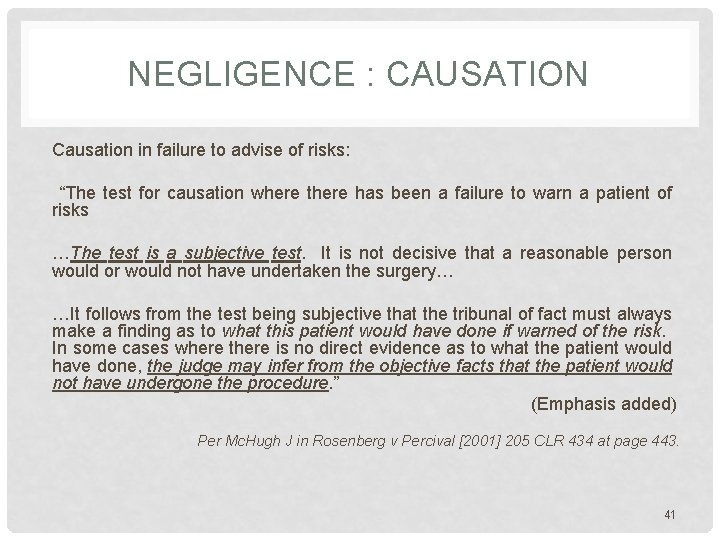
NEGLIGENCE : CAUSATION Causation in failure to advise of risks: “The test for causation where there has been a failure to warn a patient of risks …The test is a subjective test. It is not decisive that a reasonable person would or would not have undertaken the surgery… …It follows from the test being subjective that the tribunal of fact must always make a finding as to what this patient would have done if warned of the risk. In some cases where there is no direct evidence as to what the patient would have done, the judge may infer from the objective facts that the patient would not have undergone the procedure. ” (Emphasis added) Per Mc. Hugh J in Rosenberg v Percival [2001] 205 CLR 434 at page 443. 41
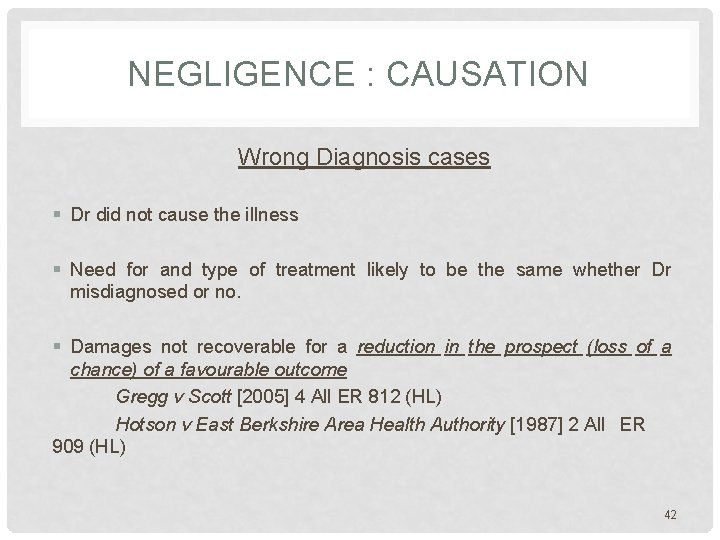
NEGLIGENCE : CAUSATION Wrong Diagnosis cases § Dr did not cause the illness § Need for and type of treatment likely to be the same whether Dr misdiagnosed or no. § Damages not recoverable for a reduction in the prospect (loss of a chance) of a favourable outcome Gregg v Scott [2005] 4 All ER 812 (HL) Hotson v East Berkshire Area Health Authority [1987] 2 All ER 909 (HL) 42
HOSPITALS COMMON LAW BASES FOR LIABILITY 43
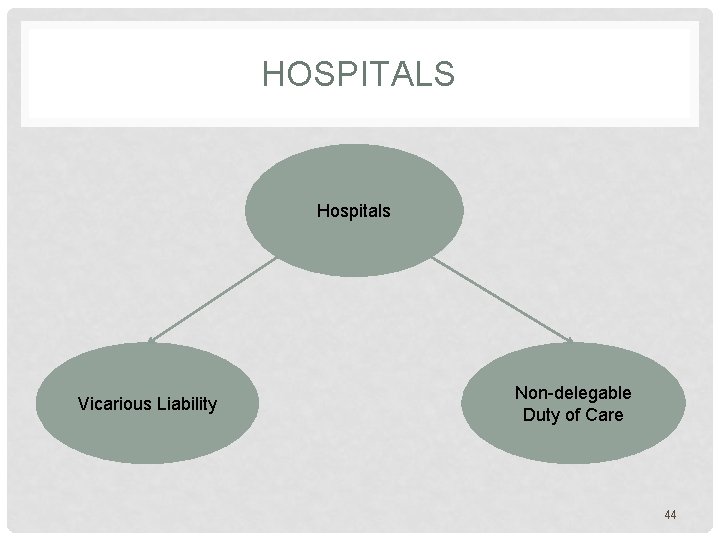
HOSPITALS Hospitals Vicarious Liability Non-delegable Duty of Care 44
VICARIOUS LIABILITY 1. Hospitals would almost invariably have to act through the agency of their servants and/or agents. 2. However, note the case of private clinics operated by sole proprietorships or partnerships where there are both principals and agents. 45
VICARIOUS LIABILITY The decision of the Federal Court in Dr Kok Choong Seng & Anor v Soo Cheng & another appeal [2018] 1 MLJ 685 One of the questions of law posed was: “Question 3: Whether the criteria for imposing vicarious liability set out by Lord Phillips in the decision of the Supreme Court of UK in Various Claimants v Catholic Child Welfare Society and others [2013] 2 AC 1 and as further explained and elaborated by the Supreme Court in Cox v Ministry of Justice [2016] AC 660 and Mohamud v WM Morrison Supermarkets plc [2016] AC 677 applies in Malaysia? ” 46
VICARIOUS LIABILITY The answer: “With these modifications, we would adopt the stage 1 test in Various Claimants as elaborated upon in Cox and answer the third question in the affirmative in that respect. ” per Raus Sharif, CJ in Dr Kok Choong Seng & Anor v Soo Cheng & another appeal [2018] 1 MLJ 685 at para 90 47
VICARIOUS LIABILITY The Various Claimants Test per Lord Phillips in Various Claimants v Catholic Child Welfare Society [2012] UKSC 56 at para 35 Stage 1 Assesses the elements of the relationship between the wrongdoer and the defendant to determine if it is an employment or relationship “akin” to employment. Stage 2 Assesses the connection between the tortious act and the relationship. 48
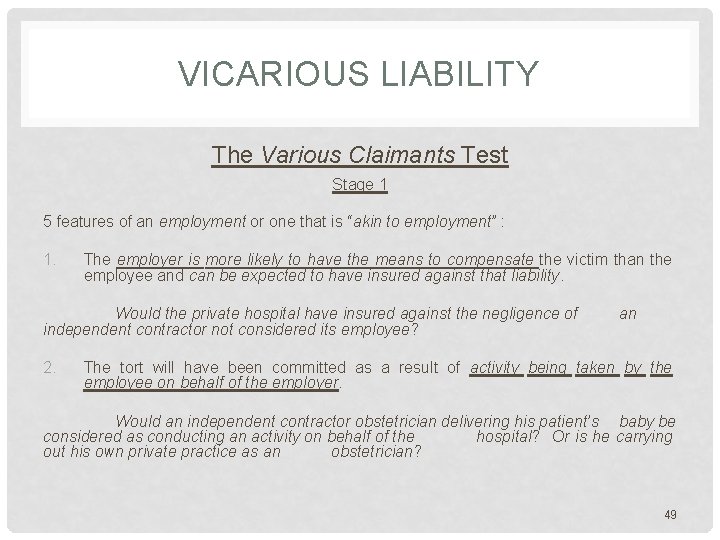
VICARIOUS LIABILITY The Various Claimants Test Stage 1 5 features of an employment or one that is “akin to employment” : 1. The employer is more likely to have the means to compensate the victim than the employee and can be expected to have insured against that liability. Would the private hospital have insured against the negligence of an independent contractor not considered its employee? 2. The tort will have been committed as a result of activity being taken by the employee on behalf of the employer. Would an independent contractor obstetrician delivering his patient’s baby be considered as conducting an activity on behalf of the hospital? Or is he carrying out his own private practice as an obstetrician? 49
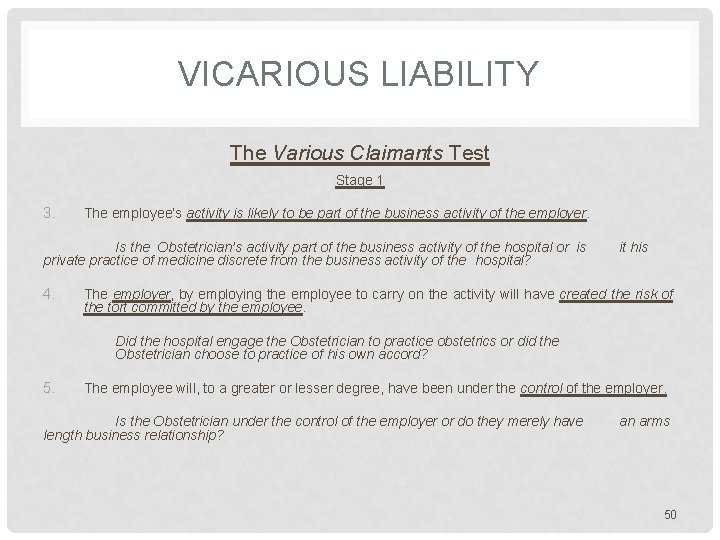
VICARIOUS LIABILITY The Various Claimants Test Stage 1 3. The employee’s activity is likely to be part of the business activity of the employer. Is the Obstetrician’s activity part of the business activity of the hospital or is private practice of medicine discrete from the business activity of the hospital? 4. it his The employer, by employing the employee to carry on the activity will have created the risk of the tort committed by the employee. Did the hospital engage the Obstetrician to practice obstetrics or did the Obstetrician choose to practice of his own accord? 5. The employee will, to a greater or lesser degree, have been under the control of the employer. Is the Obstetrician under the control of the employer or do they merely have length business relationship? an arms 50
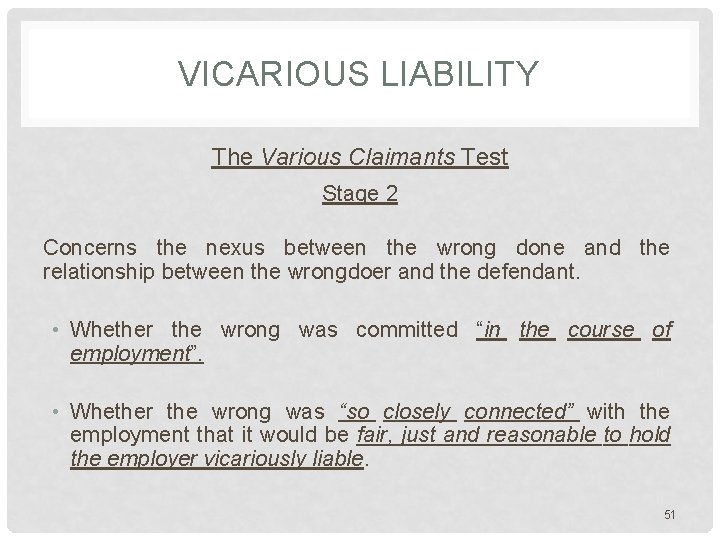
VICARIOUS LIABILITY The Various Claimants Test Stage 2 Concerns the nexus between the wrong done and the relationship between the wrongdoer and the defendant. • Whether the wrong was committed “in the course of employment”. • Whether the wrong was “so closely connected” with the employment that it would be fair, just and reasonable to hold the employer vicariously liable. 51
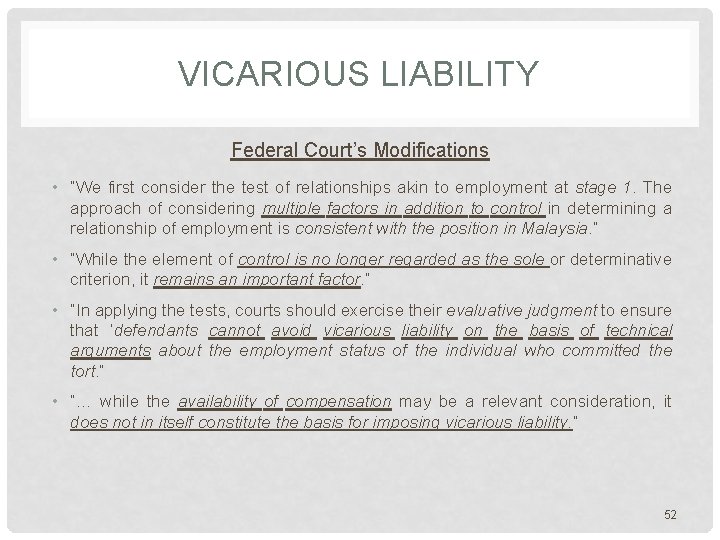
VICARIOUS LIABILITY Federal Court’s Modifications • “We first consider the test of relationships akin to employment at stage 1. The approach of considering multiple factors in addition to control in determining a relationship of employment is consistent with the position in Malaysia. ” • “While the element of control is no longer regarded as the sole or determinative criterion, it remains an important factor. ” • “In applying the tests, courts should exercise their evaluative judgment to ensure that ‘defendants cannot avoid vicarious liability on the basis of technical arguments about the employment status of the individual who committed the tort. ” • “… while the availability of compensation may be a relevant consideration, it does not in itself constitute the basis for imposing vicarious liability. ” 52
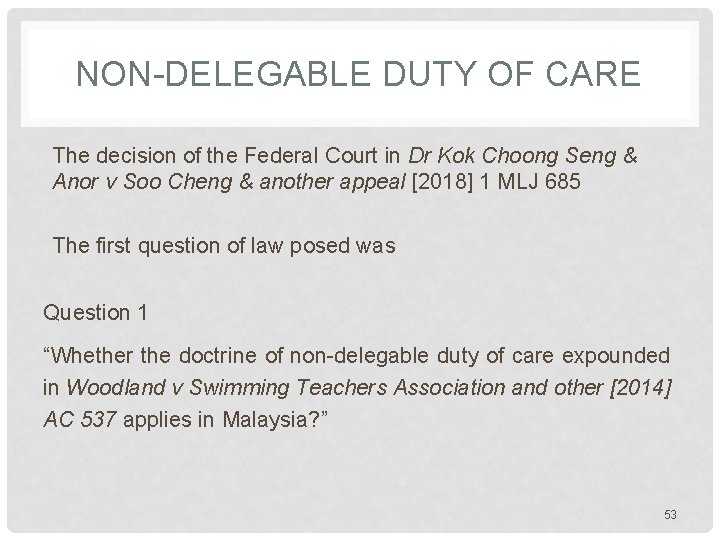
NON-DELEGABLE DUTY OF CARE The decision of the Federal Court in Dr Kok Choong Seng & Anor v Soo Cheng & another appeal [2018] 1 MLJ 685 The first question of law posed was Question 1 “Whether the doctrine of non-delegable duty of care expounded in Woodland v Swimming Teachers Association and other [2014] AC 537 applies in Malaysia? ” 53
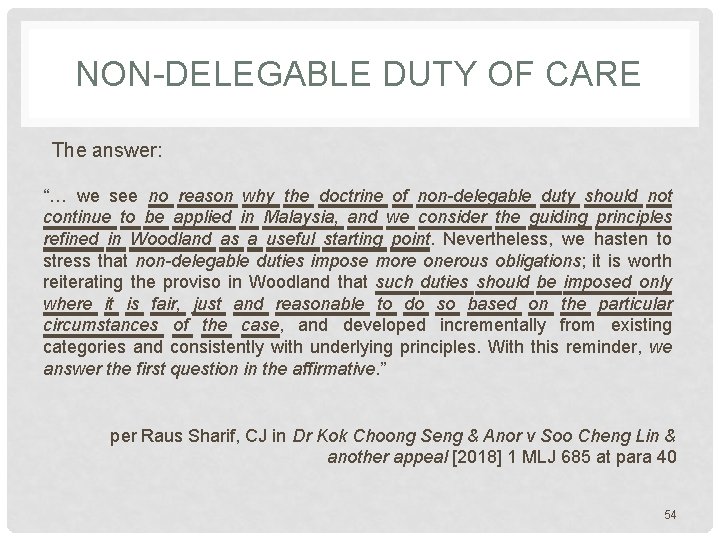
NON-DELEGABLE DUTY OF CARE The answer: “… we see no reason why the doctrine of non-delegable duty should not continue to be applied in Malaysia, and we consider the guiding principles refined in Woodland as a useful starting point. Nevertheless, we hasten to stress that non-delegable duties impose more onerous obligations; it is worth reiterating the proviso in Woodland that such duties should be imposed only where it is fair, just and reasonable to do so based on the particular circumstances of the case, and developed incrementally from existing categories and consistently with underlying principles. With this reminder, we answer the first question in the affirmative. ” per Raus Sharif, CJ in Dr Kok Choong Seng & Anor v Soo Cheng Lin & another appeal [2018] 1 MLJ 685 at para 40 54
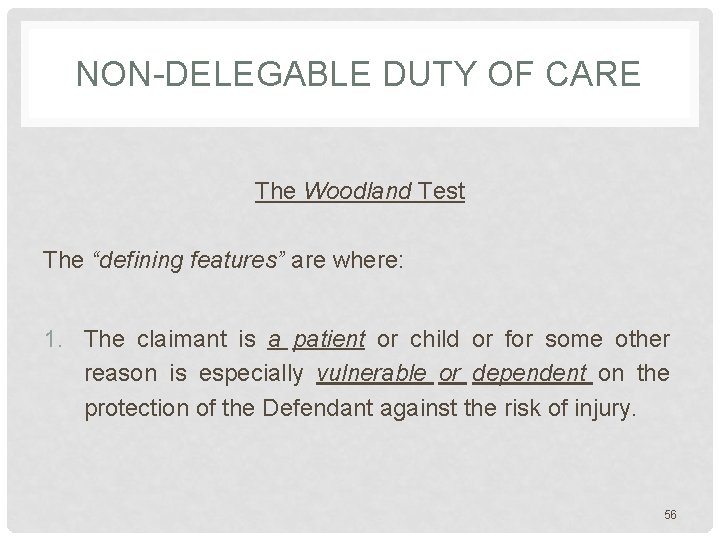
NON-DELEGABLE DUTY OF CARE The Woodland Test The “defining features” of a non-delegable duty of care were identified by Lord Sumption in Woodland v Swimming Teachers’ Association and others [2014] 3 AC 537 at p 583 55
NON-DELEGABLE DUTY OF CARE The Woodland Test The “defining features” are where: 1. The claimant is a patient or child or for some other reason is especially vulnerable or dependent on the protection of the Defendant against the risk of injury. 56
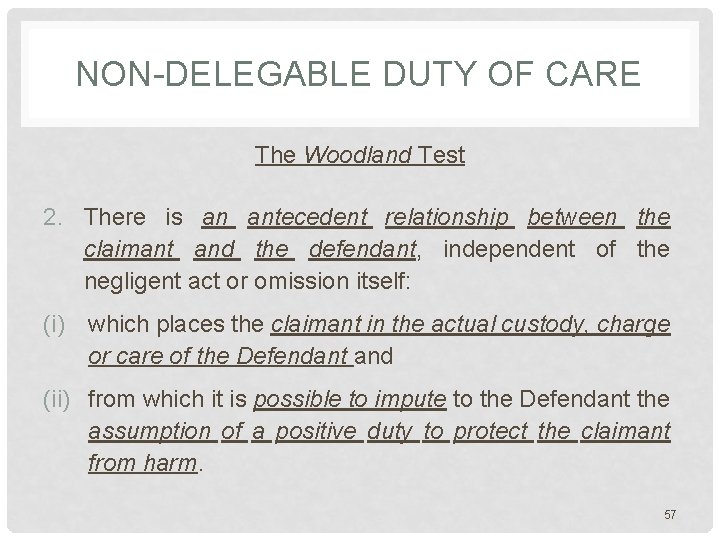
NON-DELEGABLE DUTY OF CARE The Woodland Test 2. There is an antecedent relationship between the claimant and the defendant, independent of the negligent act or omission itself: (i) which places the claimant in the actual custody, charge or care of the Defendant and (ii) from which it is possible to impute to the Defendant the assumption of a positive duty to protect the claimant from harm. 57
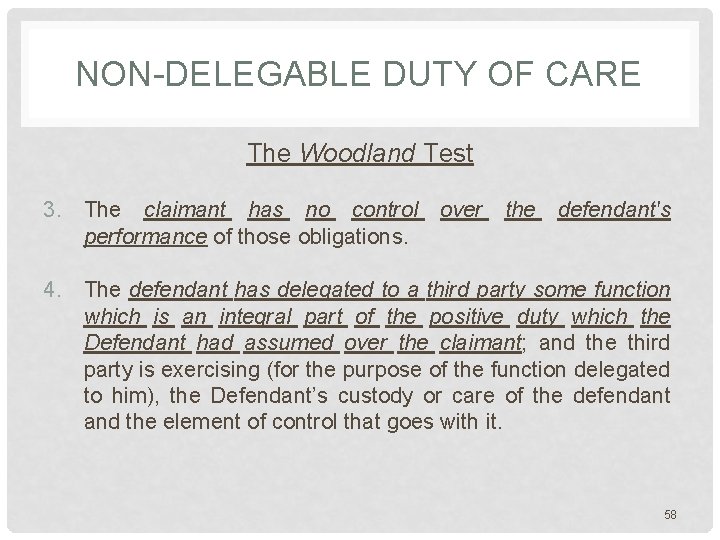
NON-DELEGABLE DUTY OF CARE The Woodland Test 3. The claimant has no control over the defendant's performance of those obligations. 4. The defendant has delegated to a third party some function which is an integral part of the positive duty which the Defendant had assumed over the claimant; and the third party is exercising (for the purpose of the function delegated to him), the Defendant’s custody or care of the defendant and the element of control that goes with it. 58
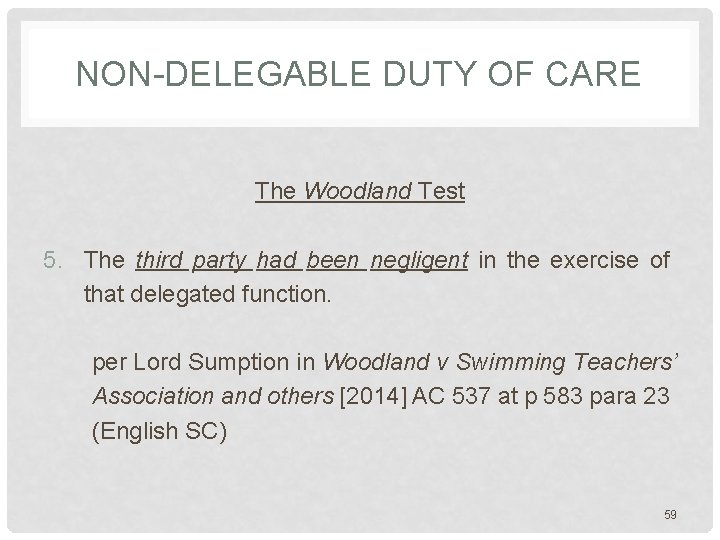
NON-DELEGABLE DUTY OF CARE The Woodland Test 5. The third party had been negligent in the exercise of that delegated function. per Lord Sumption in Woodland v Swimming Teachers’ Association and others [2014] AC 537 at p 583 para 23 (English SC) 59
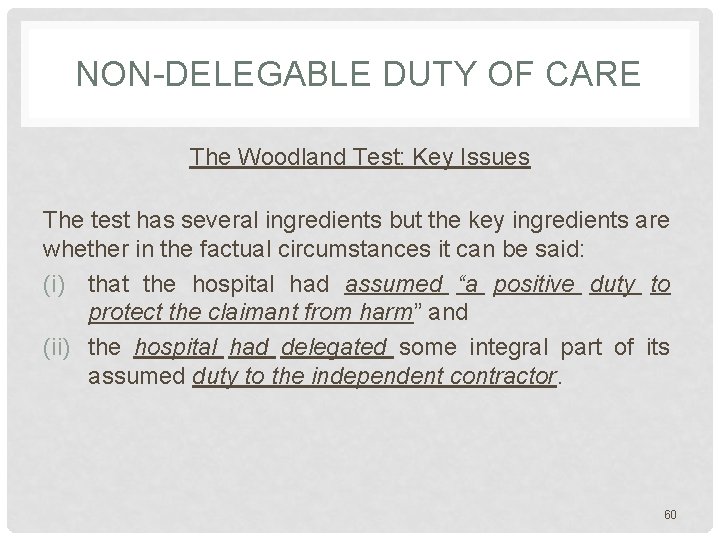
NON-DELEGABLE DUTY OF CARE The Woodland Test: Key Issues The test has several ingredients but the key ingredients are whether in the factual circumstances it can be said: (i) that the hospital had assumed “a positive duty to protect the claimant from harm” and (ii) the hospital had delegated some integral part of its assumed duty to the independent contractor. 60
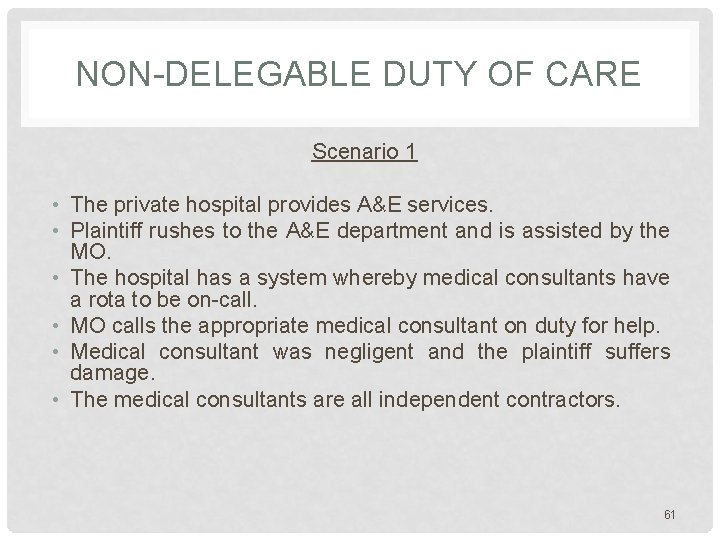
NON-DELEGABLE DUTY OF CARE Scenario 1 • The private hospital provides A&E services. • Plaintiff rushes to the A&E department and is assisted by the MO. • The hospital has a system whereby medical consultants have a rota to be on-call. • MO calls the appropriate medical consultant on duty for help. • Medical consultant was negligent and the plaintiff suffers damage. • The medical consultants are all independent contractors. 61
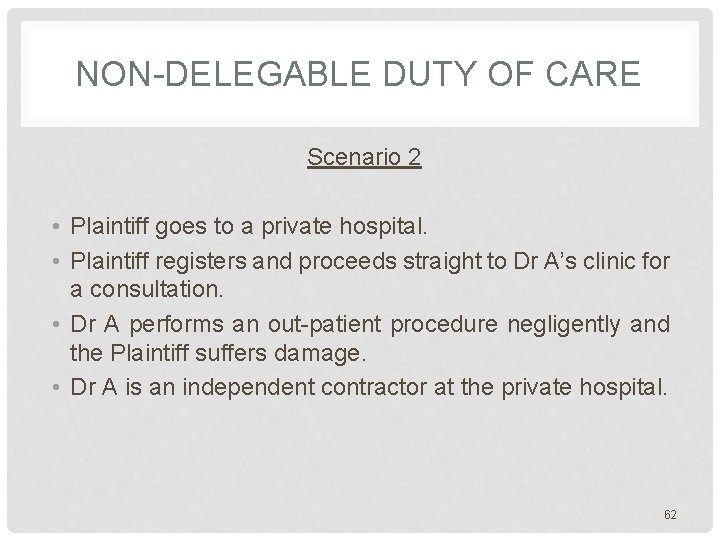
NON-DELEGABLE DUTY OF CARE Scenario 2 • Plaintiff goes to a private hospital. • Plaintiff registers and proceeds straight to Dr A’s clinic for a consultation. • Dr A performs an out-patient procedure negligently and the Plaintiff suffers damage. • Dr A is an independent contractor at the private hospital. 62
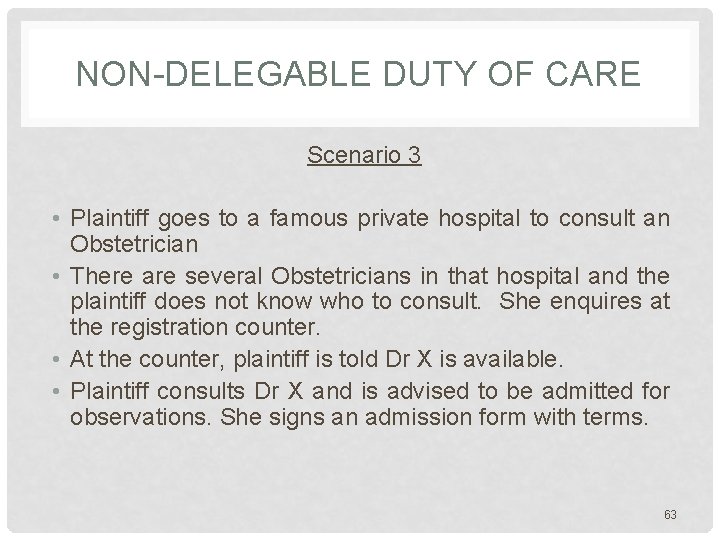
NON-DELEGABLE DUTY OF CARE Scenario 3 • Plaintiff goes to a famous private hospital to consult an Obstetrician • There are several Obstetricians in that hospital and the plaintiff does not know who to consult. She enquires at the registration counter. • At the counter, plaintiff is told Dr X is available. • Plaintiff consults Dr X and is advised to be admitted for observations. She signs an admission form with terms. 63
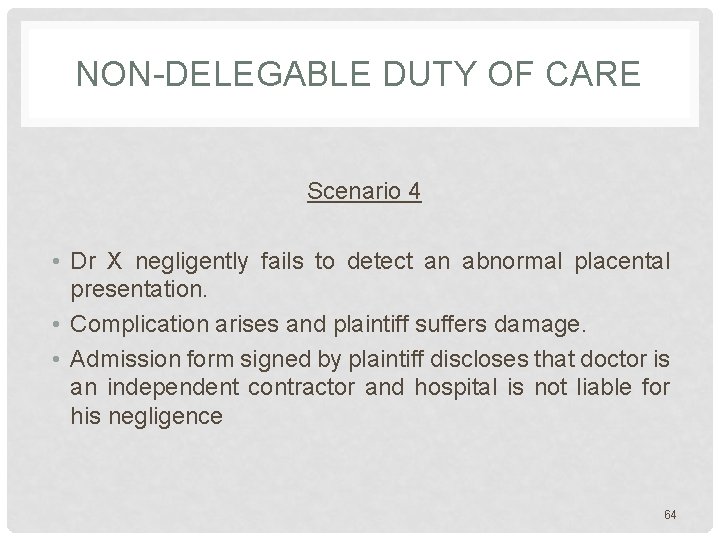
NON-DELEGABLE DUTY OF CARE Scenario 4 • Dr X negligently fails to detect an abnormal placental presentation. • Complication arises and plaintiff suffers damage. • Admission form signed by plaintiff discloses that doctor is an independent contractor and hospital is not liable for his negligence 64
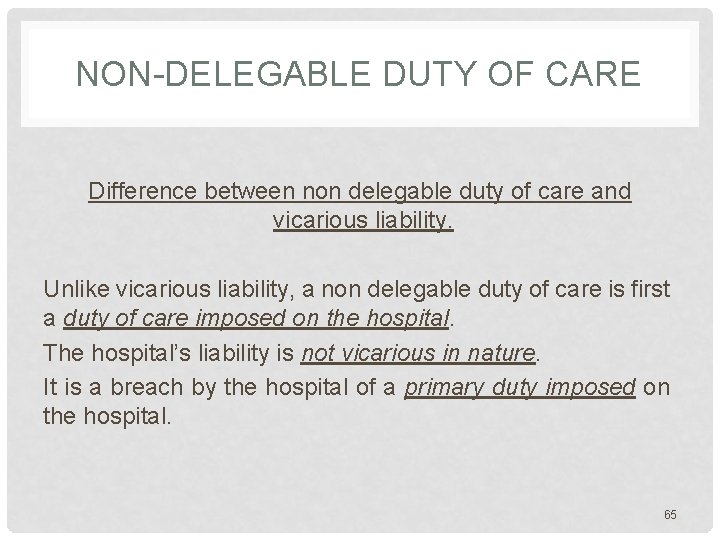
NON-DELEGABLE DUTY OF CARE Difference between non delegable duty of care and vicarious liability. Unlike vicarious liability, a non delegable duty of care is first a duty of care imposed on the hospital. The hospital’s liability is not vicarious in nature. It is a breach by the hospital of a primary duty imposed on the hospital. 65
THANK YOU