Medical Arthropodology Department of Parasitology XiangYa School of
- Slides: 64
Medical Arthropodology Department of Parasitology Xiang-Ya School of Medicine
I Concepts q Arthropod species , about a few hundred million, accounting for dynamic 87% of the total number of material types, hazard to human health is only a tiny minority. q Medical arthropods (mainly medical insects) refer to those arthropods with medical importance; q Parasitic arthropods are those being able to either directly impair to human health by their toxic substances or indirectly harm through spread of pathogens.
I Concepts q Medical arthropodology or Medical entomology is to research on: morphological characters, classification, life cycle, ecology, geographical distribution, pathogenesis, regularity of disease transmission and control strategies of medical pests
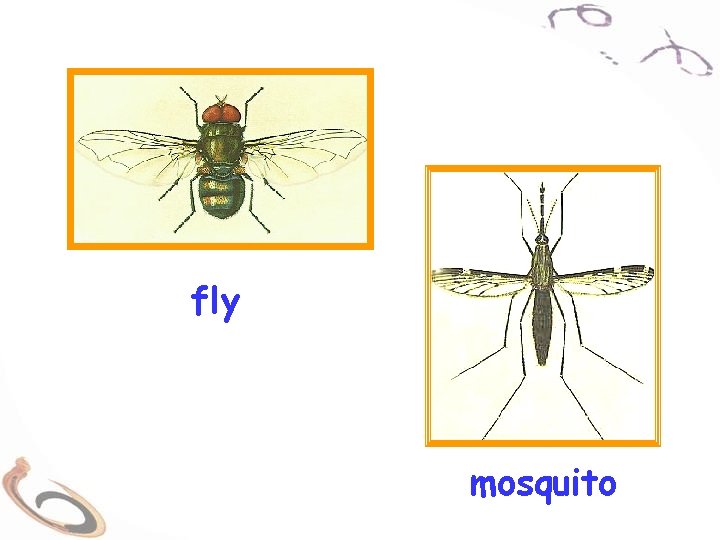
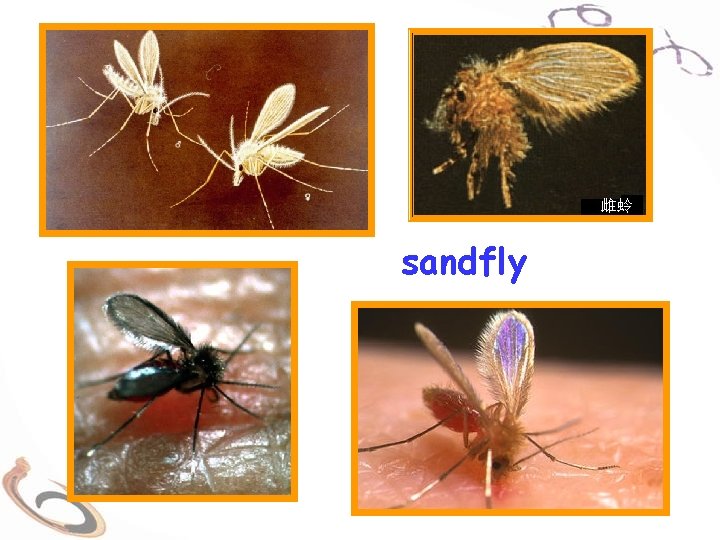
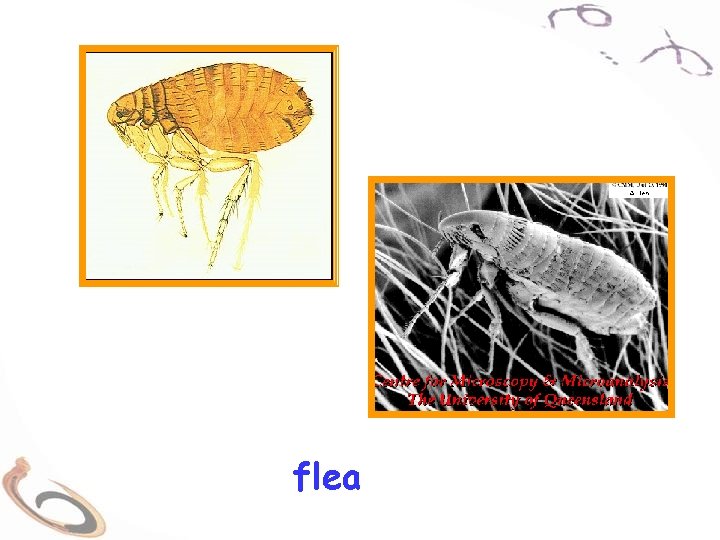
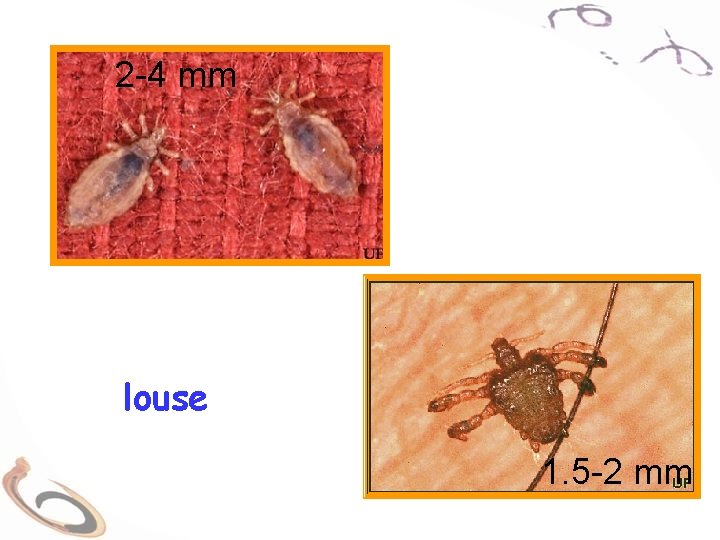
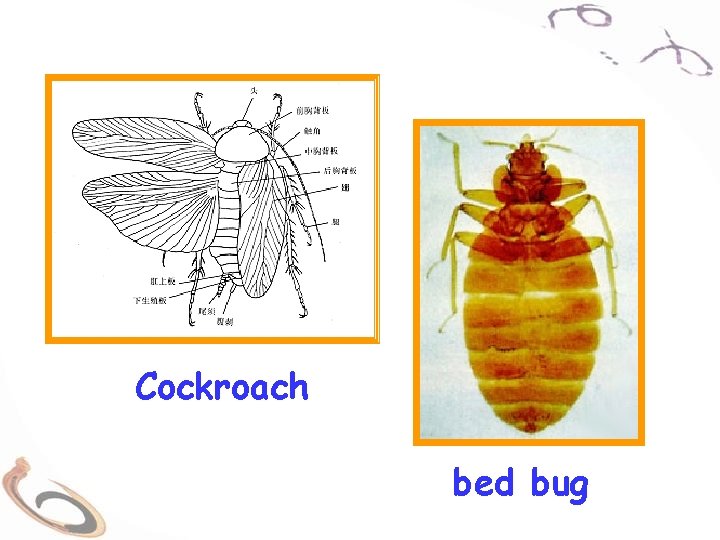
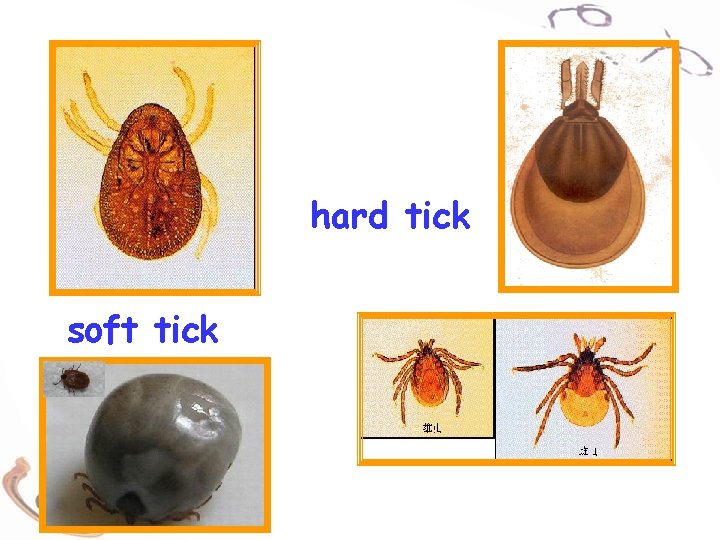
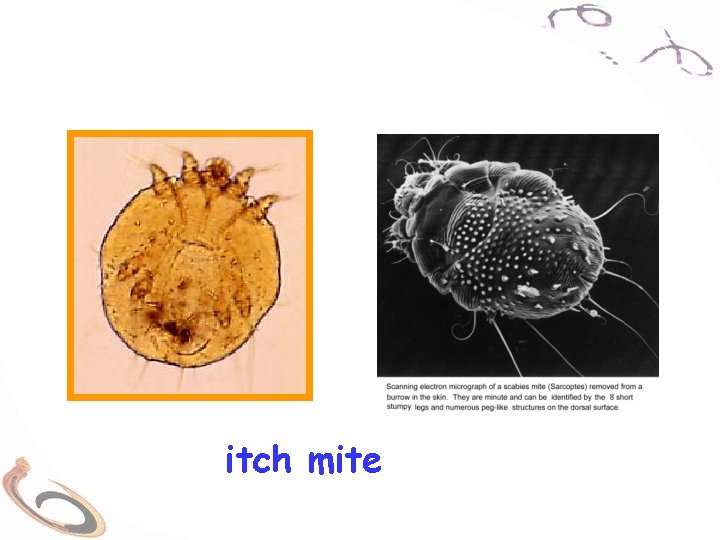
I Concepts Medical arthropods closely related with human life include: mosquito, fly, sandfly, flea, louse, cockroach, bed bug, hard tick, soft tick, gamasid mite, itch mite, follicle mite, etc. The most harmful pests in China are mosquito, fly and cockroach.
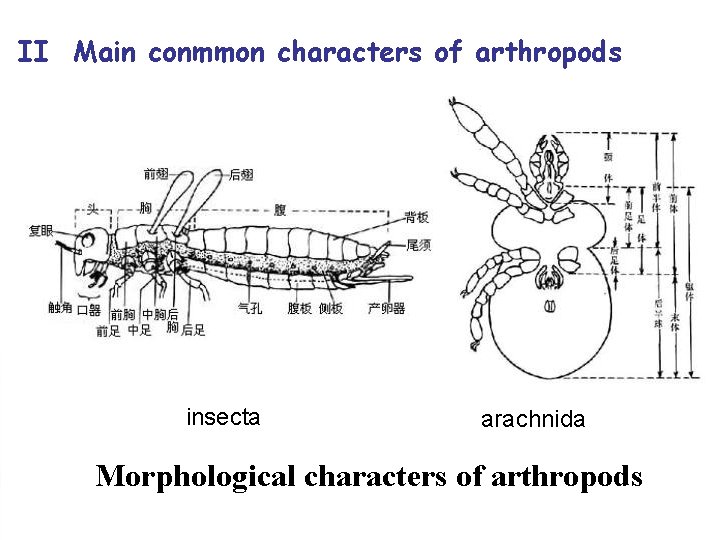
II Main conmmon characters of arthropods insecta arachnida Morphological characters of arthropods
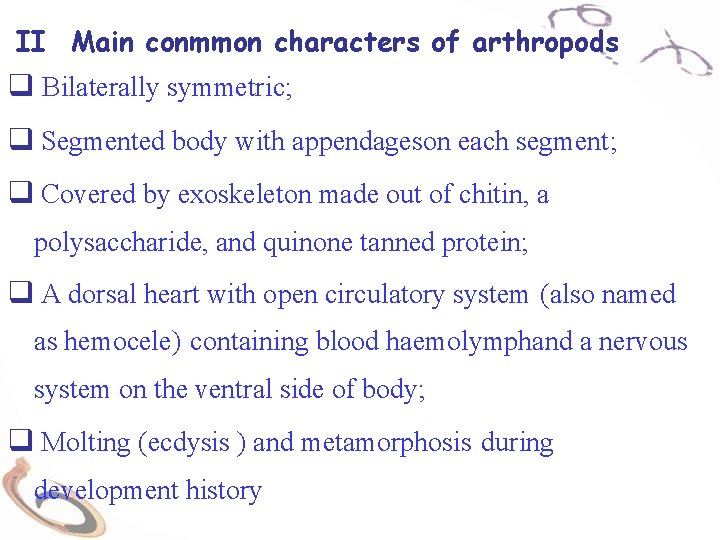
II Main conmmon characters of arthropods q Bilaterally symmetric; q Segmented body with appendageson each segment; q Covered by exoskeleton made out of chitin, a polysaccharide, and quinone tanned protein; q A dorsal heart with open circulatory system (also named as hemocele) containing blood haemolymphand a nervous system on the ventral side of body; q Molting (ecdysis ) and metamorphosis during development history
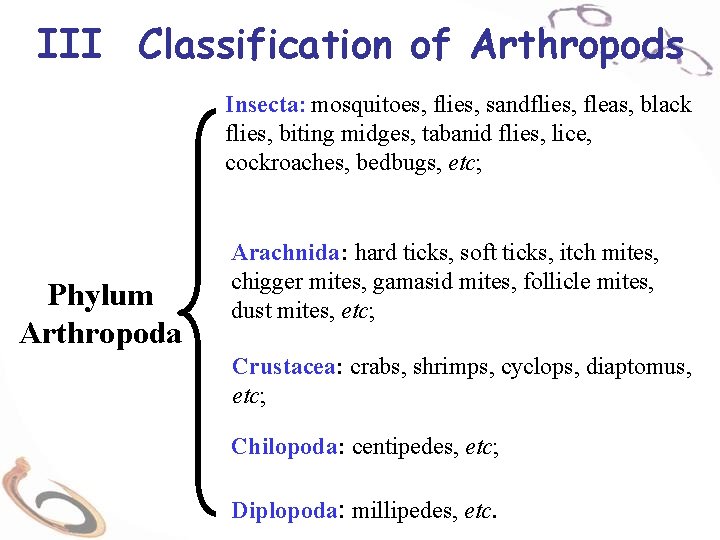
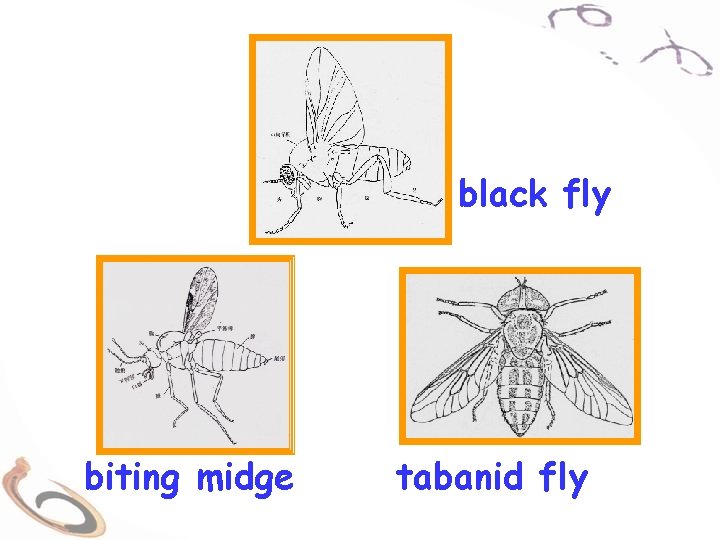
III Classification of Arthropods Insecta: mosquitoes, flies, sandflies, fleas, black flies, biting midges, tabanid flies, lice, cockroaches, bedbugs, etc; Phylum Arthropoda Arachnida: hard ticks, soft ticks, itch mites, chigger mites, gamasid mites, follicle mites, dust mites, etc; Crustacea: crabs, shrimps, cyclops, diaptomus, etc; Chilopoda: centipedes, etc; Diplopoda: millipedes, etc.
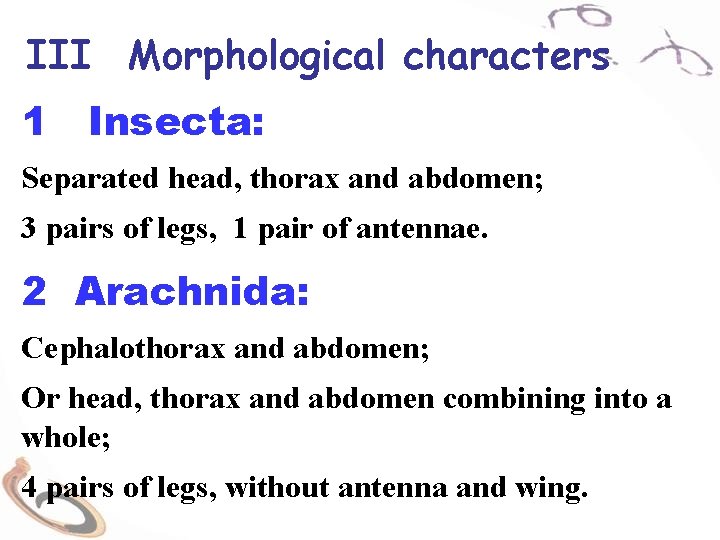
III Morphological characters 1 Insecta: Separated head, thorax and abdomen; 3 pairs of legs, 1 pair of antennae. 2 Arachnida: Cephalothorax and abdomen; Or head, thorax and abdomen combining into a whole; 4 pairs of legs, without antenna and wing.
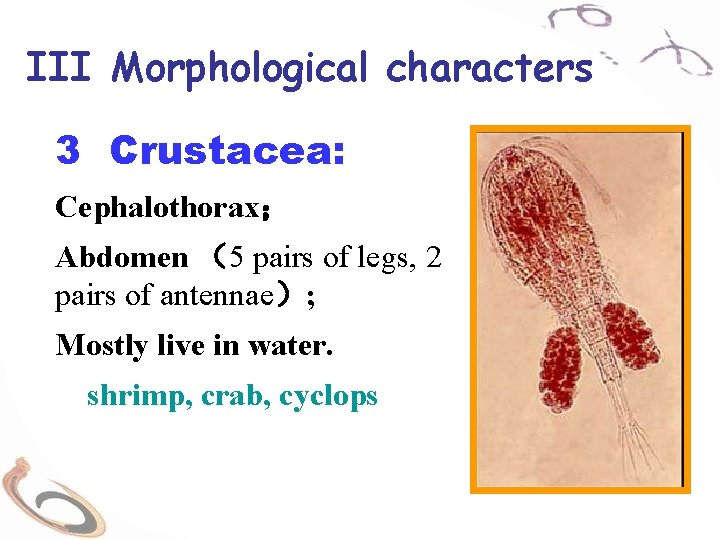
III Morphological characters 3 Crustacea: Cephalothorax; Abdomen (5 pairs of legs, 2 pairs of antennae); Mostly live in water. shrimp, crab, cyclops
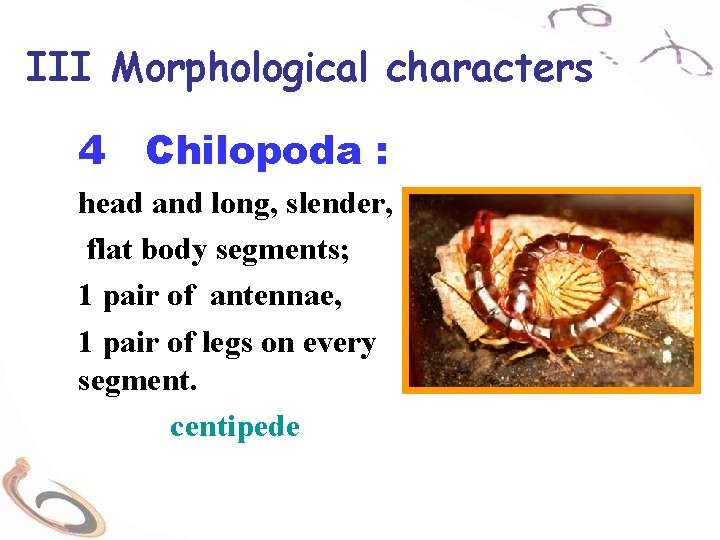
III Morphological characters 4 Chilopoda : head and long, slender, flat body segments; 1 pair of antennae, 1 pair of legs on every segment. centipede
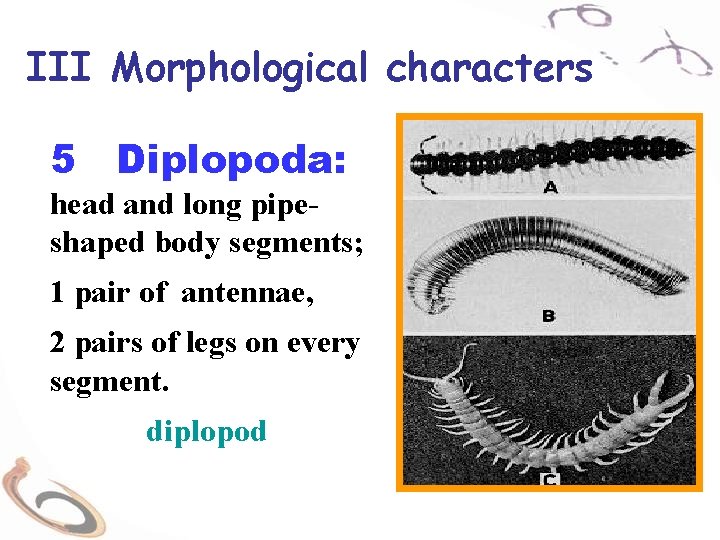
III Morphological characters 5 Diplopoda: head and long pipeshaped body segments; 1 pair of antennae, 2 pairs of legs on every segment. diplopod
fly mosquito
sandfly
flea
black fly biting midge tabanid fly
2 -4 mm louse 1. 5 -2 mm
Cockroach bed bug
hard tick soft tick
itch mite
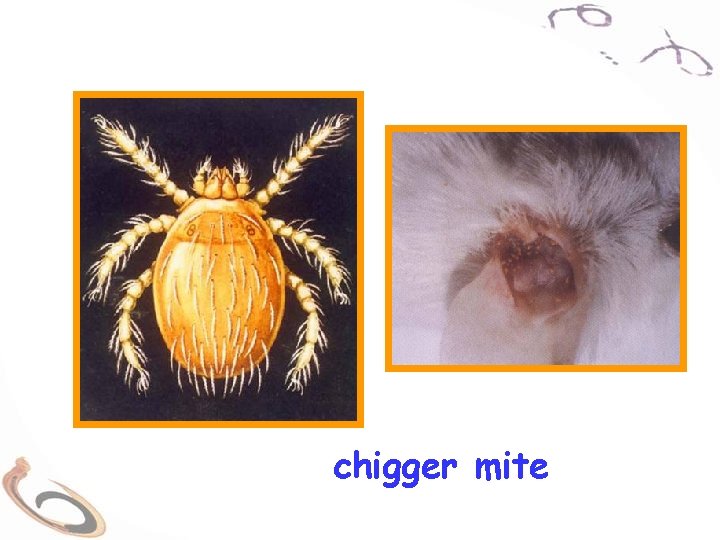
chigger mite
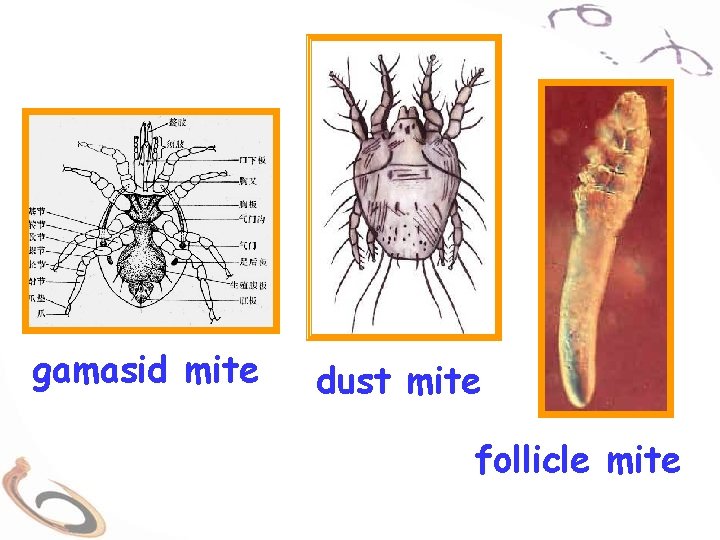
gamasid mite dust mite follicle mite
IV Metamorphosis: A series of changes on external morphological characters, structures, physiological functions, life habit, behaviour and instinct during the development of an insect from egg to adult.
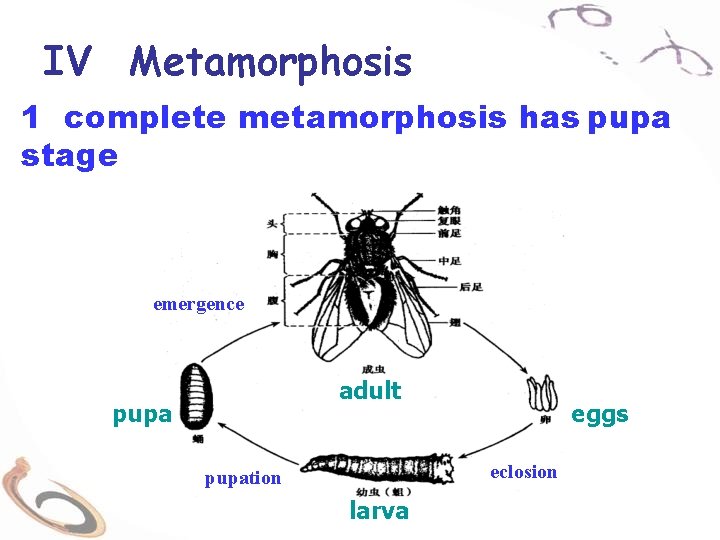
IV Metamorphosis 1 complete metamorphosis has pupa stage emergence adult pupa eggs eclosion pupation larva
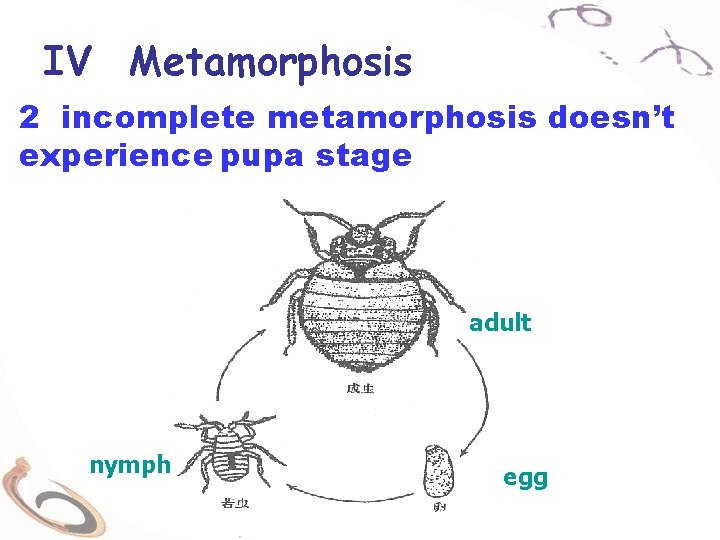
IV Metamorphosis 2 incomplete metamorphosis doesn’t experience pupa stage adult nymph egg
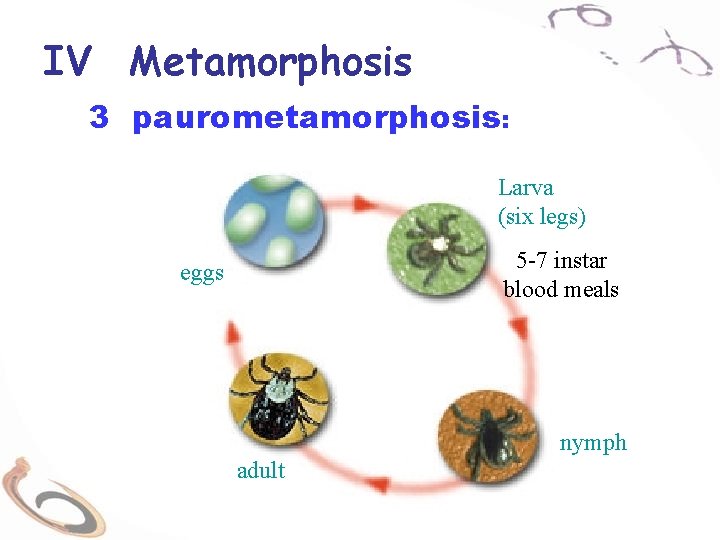
IV Metamorphosis 3 paurometamorphosis: Larva (six legs) 5 -7 instar blood meals eggs nymph adult
V Harmful effects on human 1 Direct harmful effects : q Annoyance resulted from sting and bites q Envenomization and damage by toxic substance
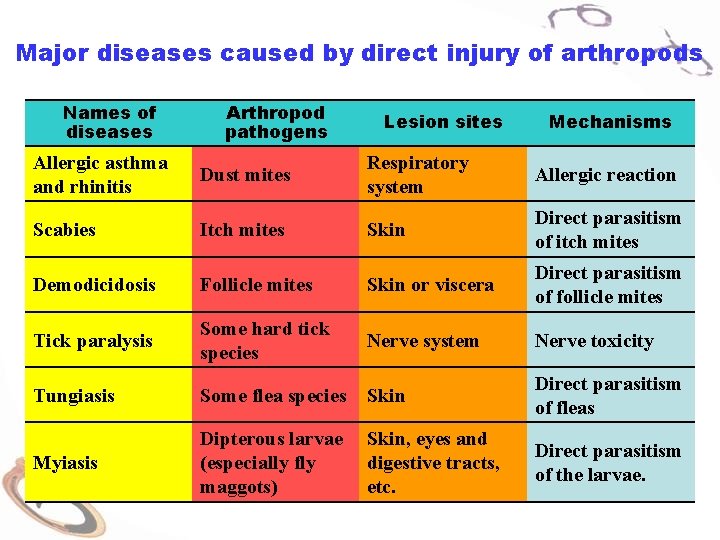
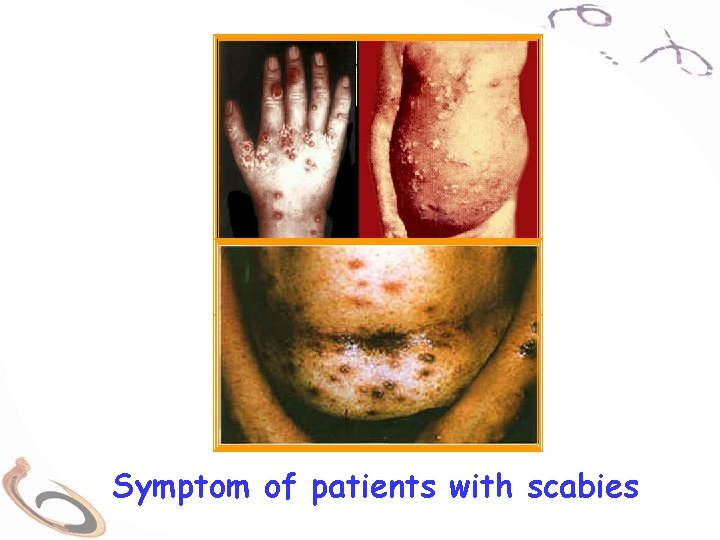
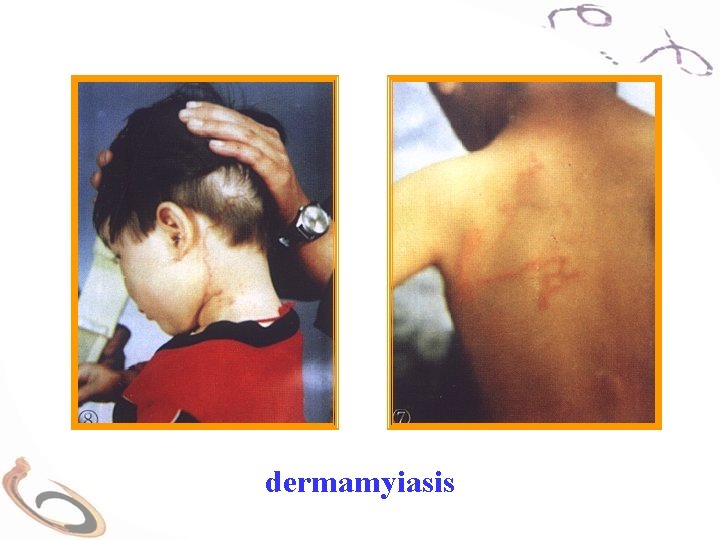
V Harmful effects on human 1 Direct harmful effects : q Allergic reaction : resulted from heterogeneous proteins, just as saliva, secretions , excretions , and hull, etc. from arthropods q Direct parasitism : myiasis: caused by larval flies parasiting in human body); tungiasis: caused by tunga; scabies: caused by itch mites; demodicidosis: caused by follicle mite
Major diseases caused by direct injury of arthropods Names of diseases Arthropod pathogens Lesion sites Mechanisms Allergic asthma and rhinitis Dust mites Respiratory system Allergic reaction Scabies Itch mites Skin Direct parasitism of itch mites Demodicidosis Follicle mites Skin or viscera Direct parasitism of follicle mites Tick paralysis Some hard tick species Nerve system Nerve toxicity Tungiasis Some flea species Skin Direct parasitism of fleas Myiasis Dipterous larvae (especially fly maggots) Skin, eyes and digestive tracts, etc. Direct parasitism of the larvae.
Symptom of patients with scabies
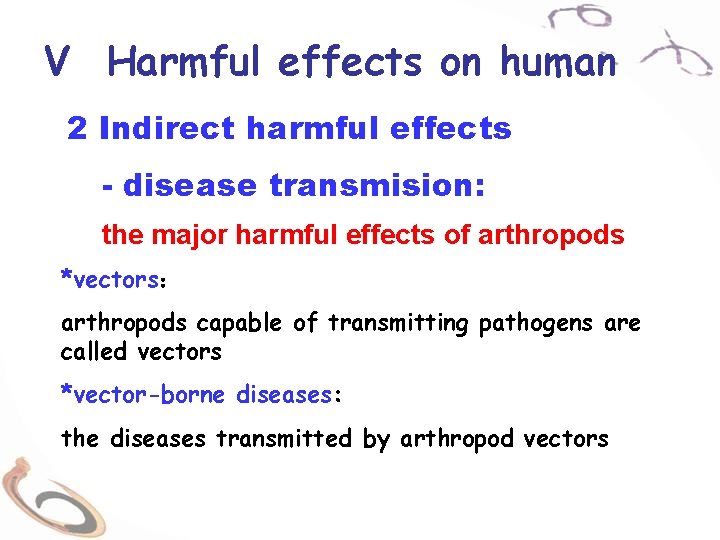
V Harmful effects on human 2 Indirect harmful effects - disease transmision: the major harmful effects of arthropods *vectors: arthropods capable of transmitting pathogens are called vectors *vector-borne diseases: the diseases transmitted by arthropod vectors
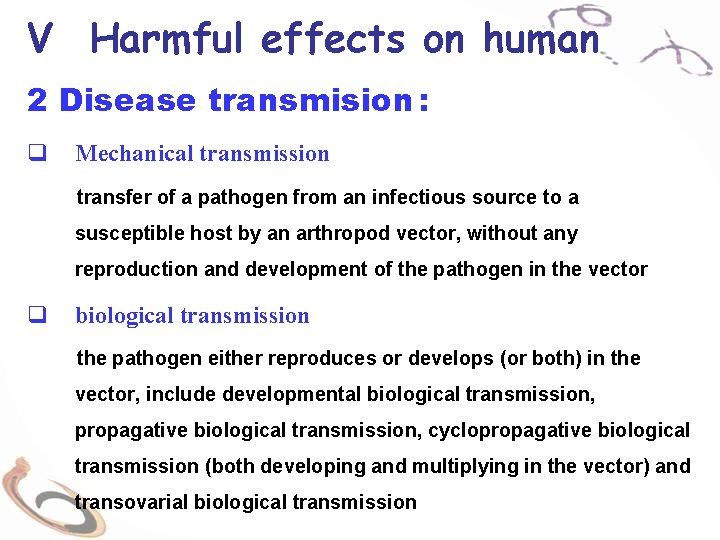
V Harmful effects on human 2 Disease transmision : q Mechanical transmission transfer of a pathogen from an infectious source to a susceptible host by an arthropod vector, without any reproduction and development of the pathogen in the vector q biological transmission the pathogen either reproduces or develops (or both) in the vector, include developmental biological transmission, propagative biological transmission, cyclopropagative biological transmission (both developing and multiplying in the vector) and transovarial biological transmission
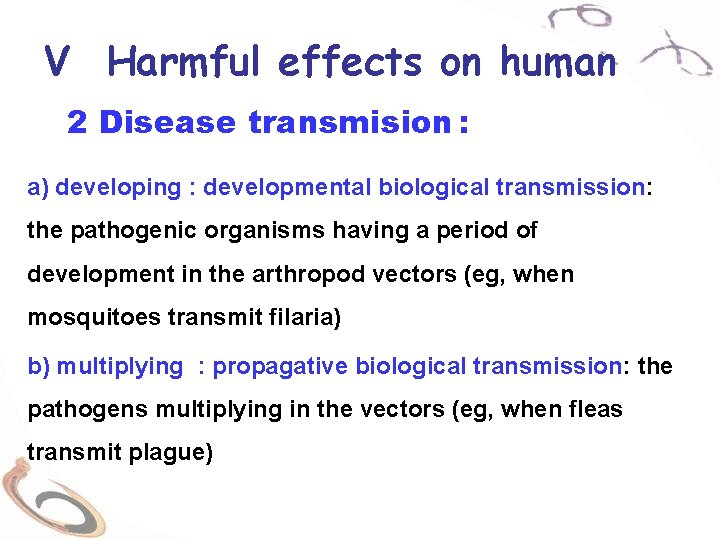
V Harmful effects on human 2 Disease transmision : a) developing : developmental biological transmission: the pathogenic organisms having a period of development in the arthropod vectors (eg, when mosquitoes transmit filaria) b) multiplying : propagative biological transmission: the pathogens multiplying in the vectors (eg, when fleas transmit plague)
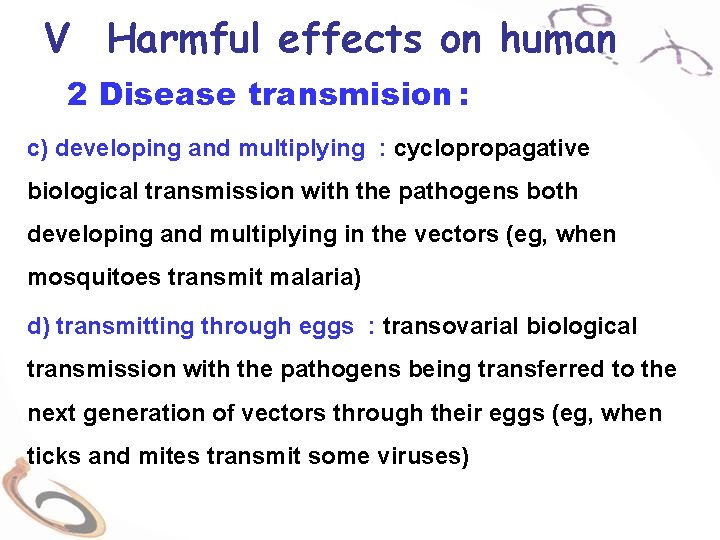
V Harmful effects on human 2 Disease transmision : c) developing and multiplying : cyclopropagative biological transmission with the pathogens both developing and multiplying in the vectors (eg, when mosquitoes transmit malaria) d) transmitting through eggs : transovarial biological transmission with the pathogens being transferred to the next generation of vectors through their eggs (eg, when ticks and mites transmit some viruses)
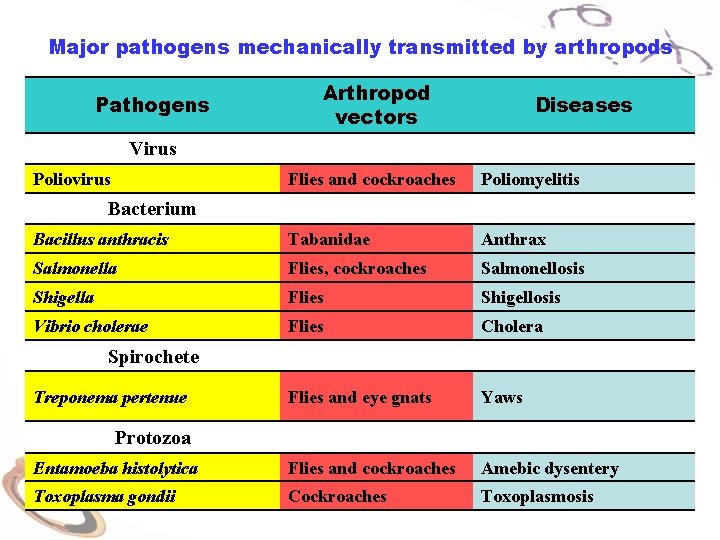
Major pathogens mechanically transmitted by arthropods Pathogens Arthropod vectors Diseases Virus Poliovirus Flies and cockroaches Poliomyelitis Bacillus anthracis Tabanidae Anthrax Salmonella Flies, cockroaches Salmonellosis Shigella Flies Shigellosis Vibrio cholerae Flies Cholera Flies and eye gnats Yaws Entamoeba histolytica Flies and cockroaches Amebic dysentery Toxoplasma gondii Cockroaches Toxoplasmosis Bacterium Spirochete Treponema pertenue Protozoa
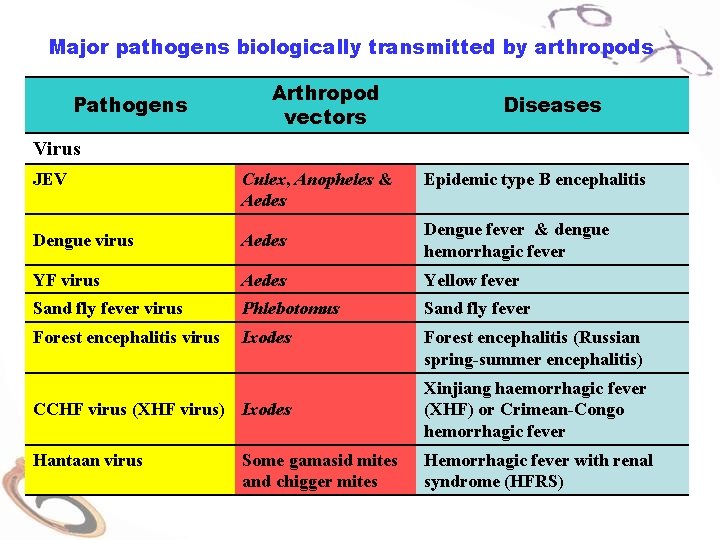
Major pathogens biologically transmitted by arthropods Pathogens Arthropod vectors Diseases Virus JEV Culex, Anopheles & Aedes Dengue virus Aedes Dengue fever & dengue hemorrhagic fever YF virus Aedes Yellow fever Sand fly fever virus Phlebotomus Sand fly fever Forest encephalitis virus Ixodes Forest encephalitis (Russian spring-summer encephalitis) CCHF virus (XHF virus) Ixodes Hantaan virus Some gamasid mites and chigger mites Epidemic type B encephalitis Xinjiang haemorrhagic fever (XHF) or Crimean-Congo hemorrhagic fever Hemorrhagic fever with renal syndrome (HFRS)
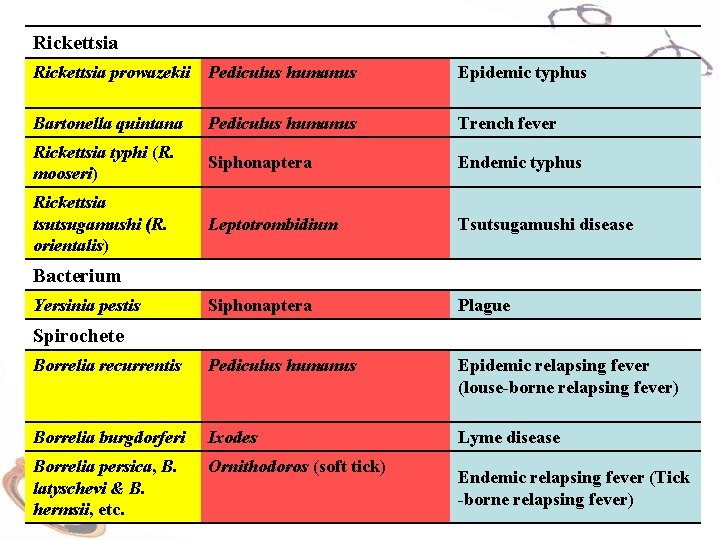
Rickettsia prowazekii Pediculus humanus Epidemic typhus Bartonella quintana Pediculus humanus Trench fever Rickettsia typhi (R. mooseri) Siphonaptera Endemic typhus Rickettsia tsutsugamushi (R. orientalis) Leptotrombidium Tsutsugamushi disease Siphonaptera Plague Borrelia recurrentis Pediculus humanus Epidemic relapsing fever (louse-borne relapsing fever) Borrelia burgdorferi Ixodes Lyme disease Borrelia persica, B. latyschevi & B. hermsii, etc. Ornithodoros (soft tick) Bacterium Yersinia pestis Spirochete Endemic relapsing fever (Tick -borne relapsing fever)
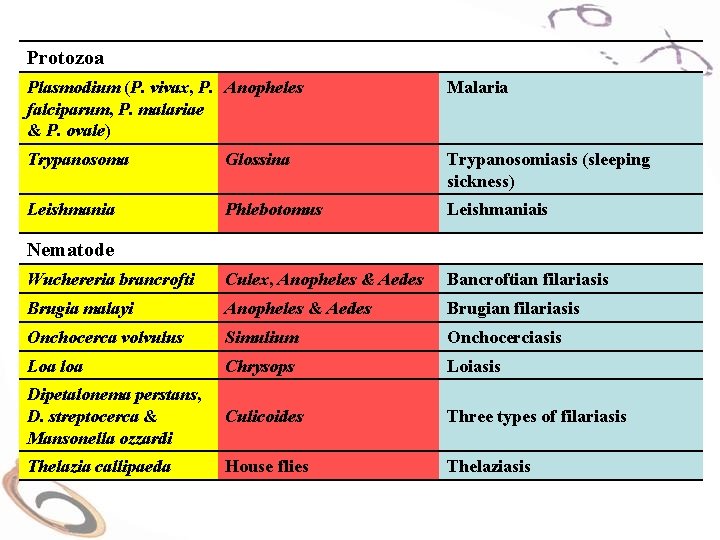
Protozoa Plasmodium (P. vivax, P. Anopheles falciparum, P. malariae & P. ovale) Malaria Trypanosoma Glossina Trypanosomiasis (sleeping sickness) Leishmania Phlebotomus Leishmaniais Wuchereria brancrofti Culex, Anopheles & Aedes Bancroftian filariasis Brugia malayi Anopheles & Aedes Brugian filariasis Onchocerca volvulus Simulium Onchocerciasis Loa loa Chrysops Loiasis Dipetalonema perstans, D. streptocerca & Mansonella ozzardi Culicoides Three types of filariasis Thelazia callipaeda House flies Thelaziasis Nematode
Section 1 Culicidae / mosquito
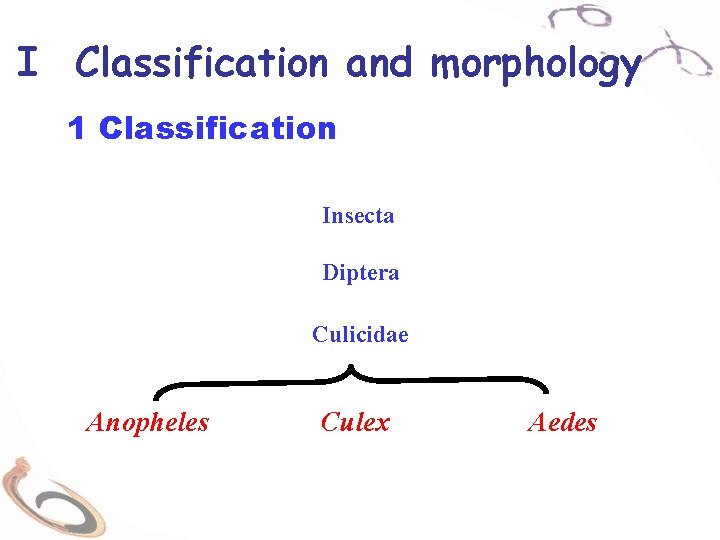
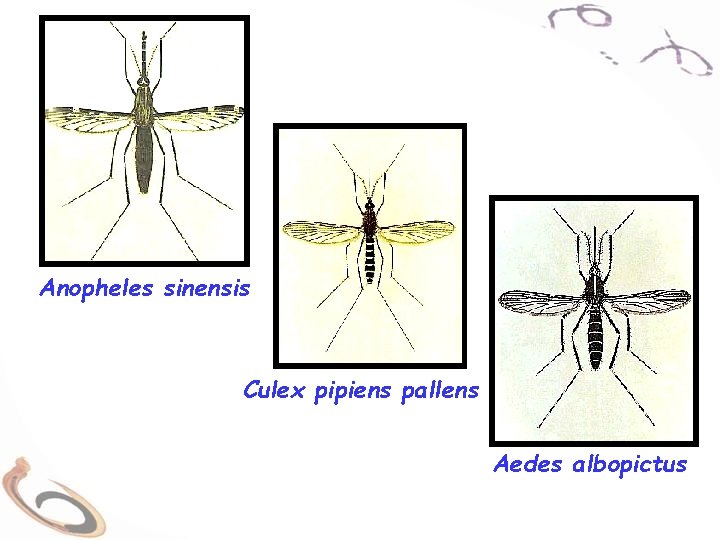
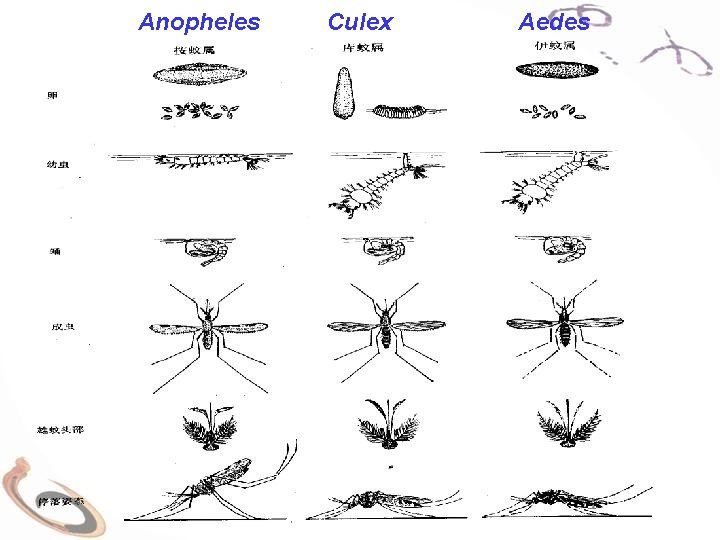
I Classification and morphology 1 Classification Insecta Diptera Culicidae Anopheles Culex Aedes
Anopheles sinensis Culex pipiens pallens Aedes albopictus
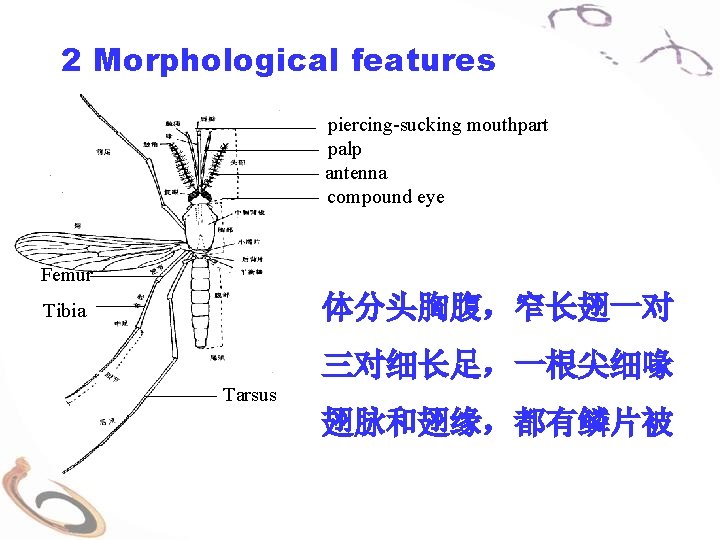
2 Morphological features piercing-sucking mouthpart palp antenna compound eye Femur 体分头胸腹,窄长翅一对 Tibia 三对细长足,一根尖细喙 Tarsus 翅脉和翅缘,都有鳞片被
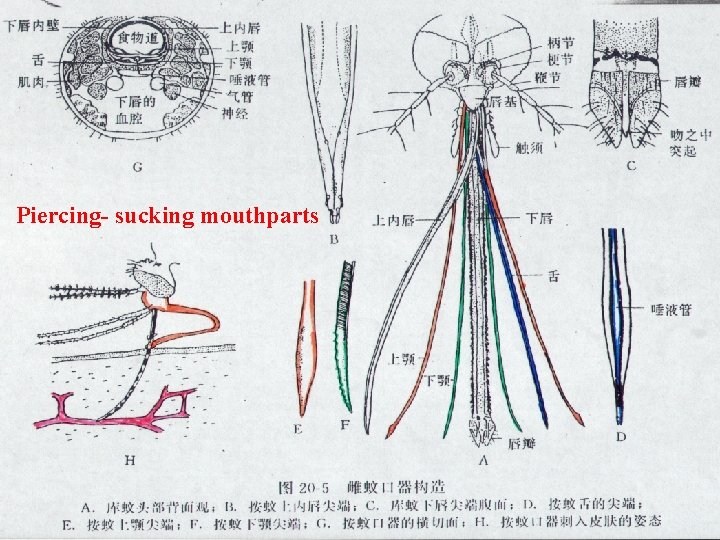
Piercing- sucking mouthparts
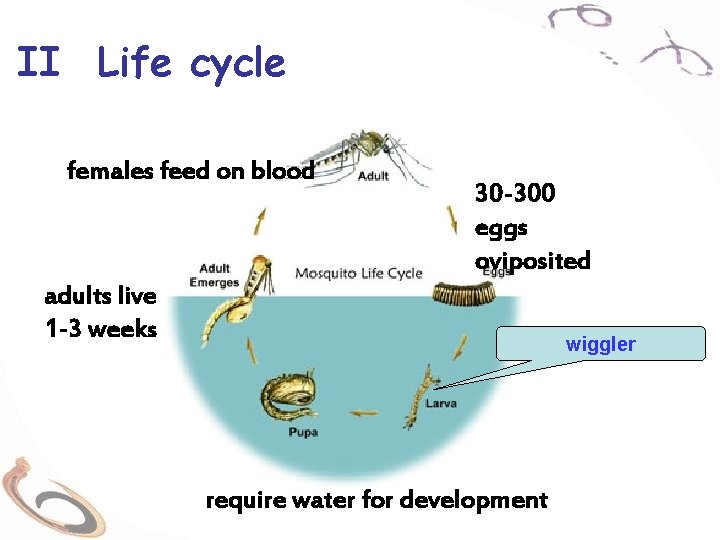
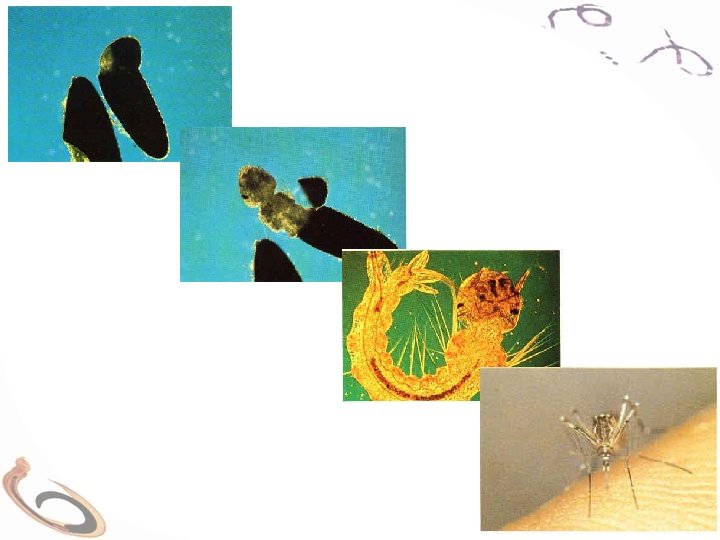
II Life cycle females feed on blood 30 -300 eggs oviposited adults live 1 -3 weeks wiggler require water for development
Anopheles Culex Aedes
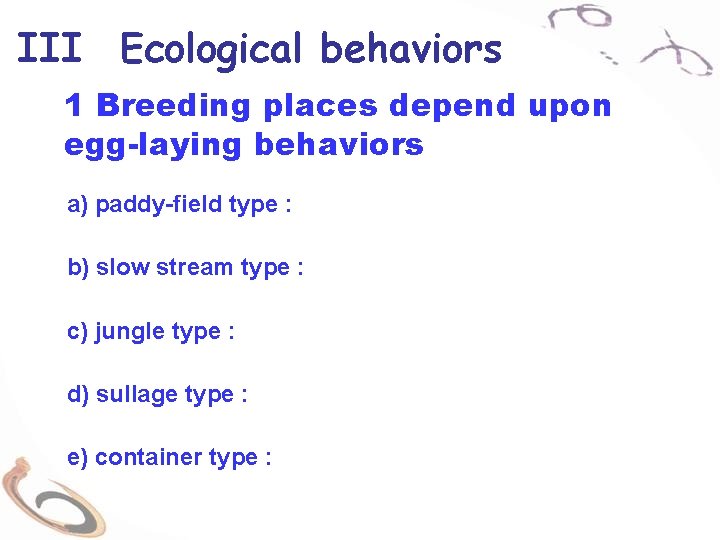
III Ecological behaviors 1 Breeding places depend upon egg-laying behaviors a) paddy-field type : b) slow stream type : c) jungle type : d) sullage type : e) container type :
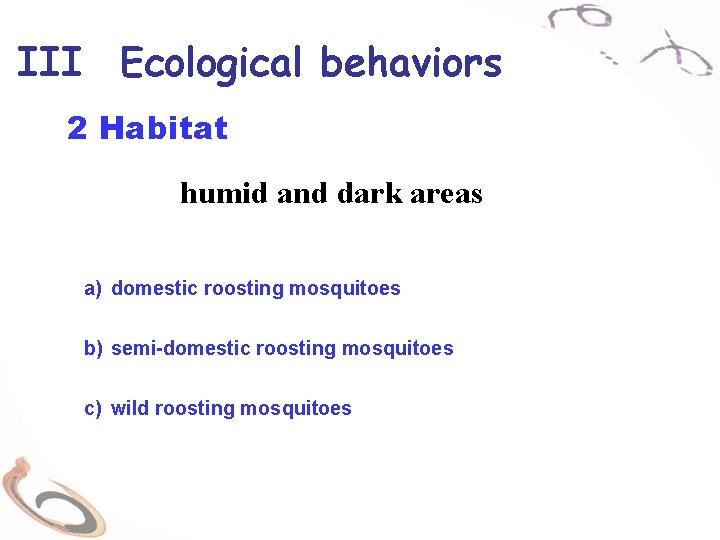
III Ecological behaviors 2 Habitat humid and dark areas a) domestic roosting mosquitoes b) semi-domestic roosting mosquitoes c) wild roosting mosquitoes
III Ecological behaviors 3 Host preference female mosquitoes: blood meal male mosquitoes : feed on the nectar of flowers or other suitable sugar source human blood domestic animal blood
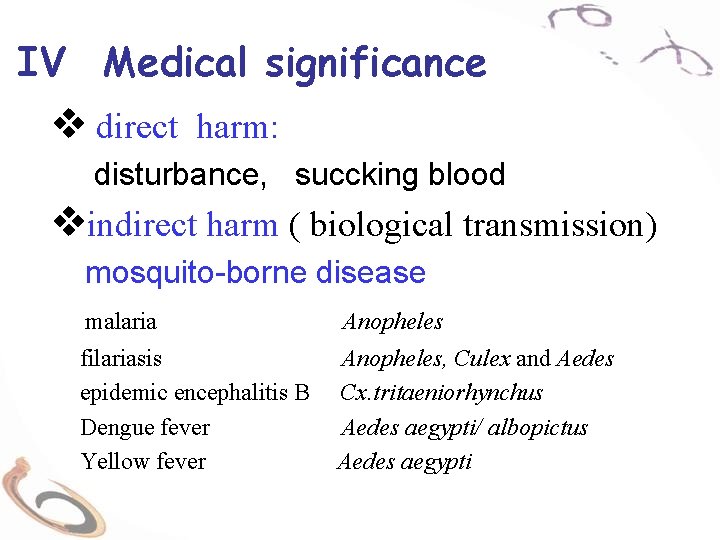
IV Medical significance v direct harm: disturbance, succking blood vindirect harm ( biological transmission) mosquito-borne disease malaria Anopheles filariasis epidemic encephalitis B Dengue fever Yellow fever Anopheles, Culex and Aedes Cx. tritaeniorhynchus Aedes aegypti/ albopictus Aedes aegypti
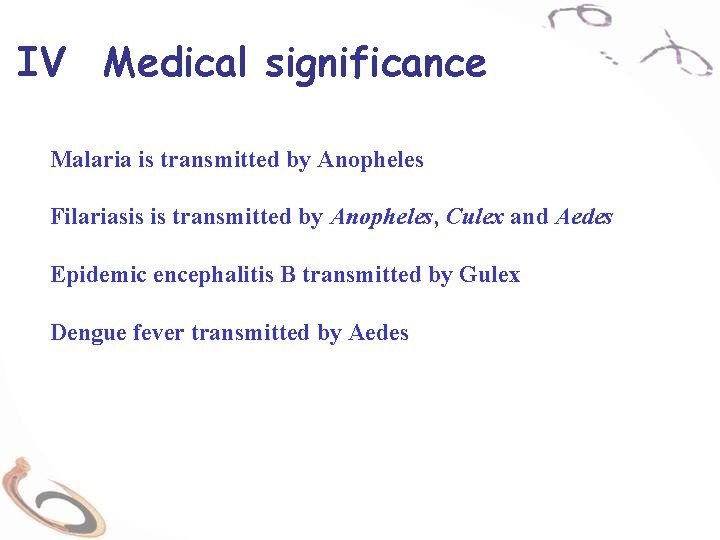
IV Medical significance Malaria is transmitted by Anopheles Filariasis is transmitted by Anopheles, Culex and Aedes Epidemic encephalitis B transmitted by Gulex Dengue fever transmitted by Aedes
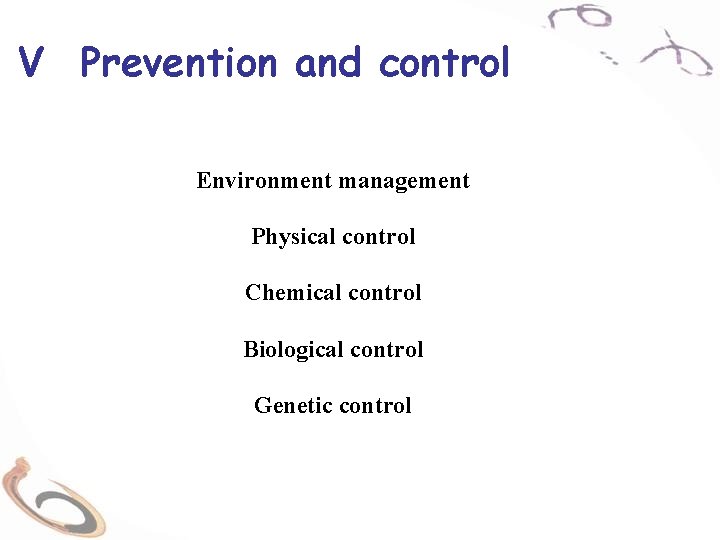
V Prevention and control Environment management Physical control Chemical control Biological control Genetic control
Fly
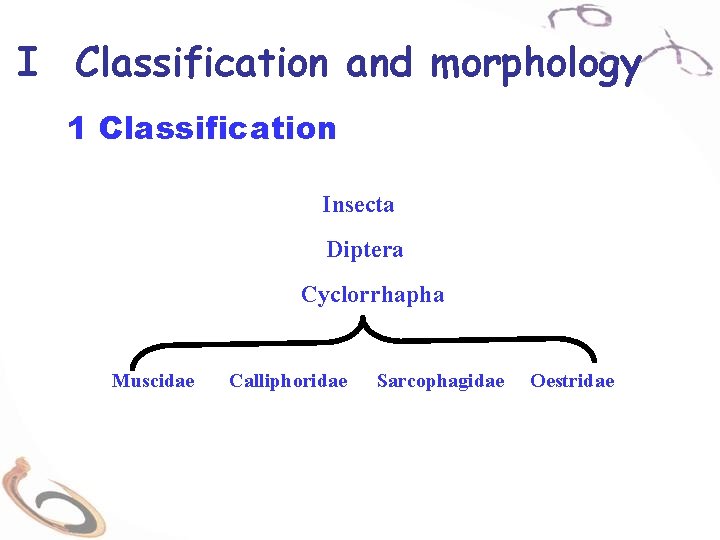
I Classification and morphology 1 Classification Insecta Diptera Cyclorrhapha Muscidae Calliphoridae Sarcophagidae Oestridae
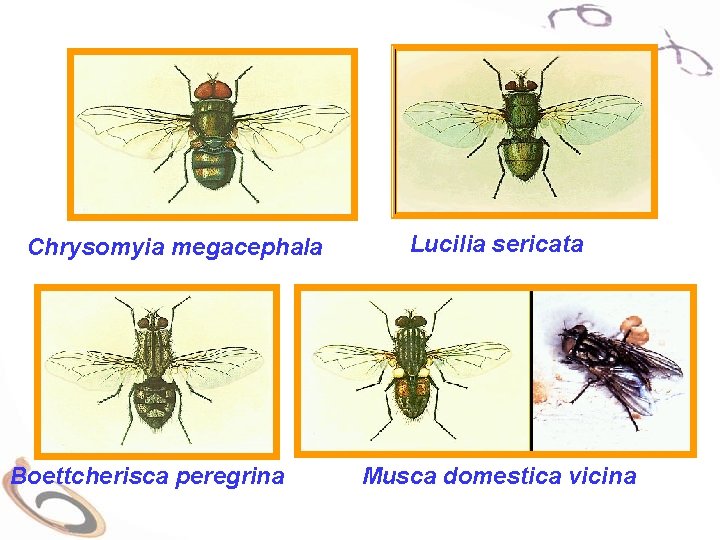
Chrysomyia megacephala Boettcherisca peregrina Lucilia sericata Musca domestica vicina
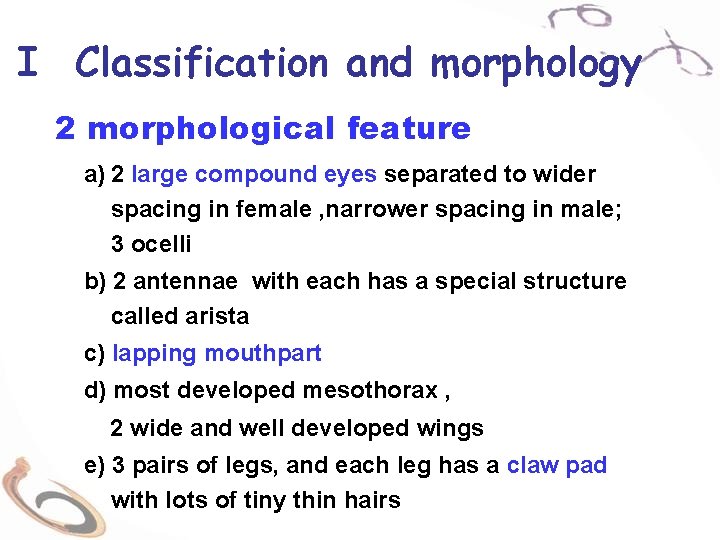
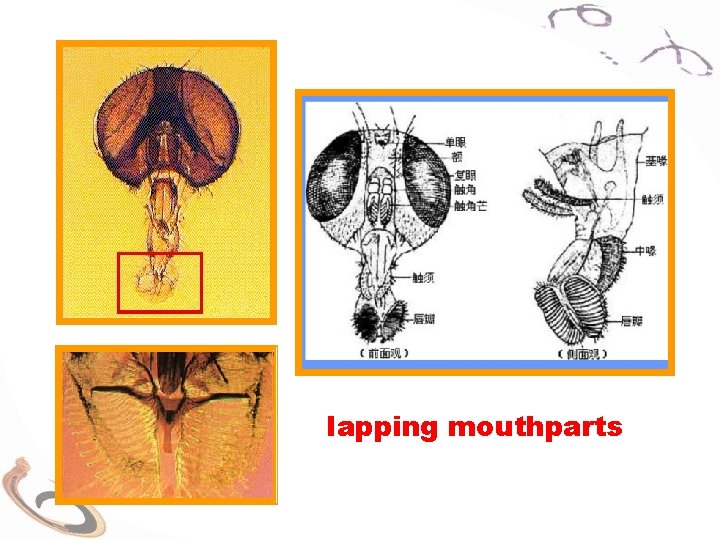
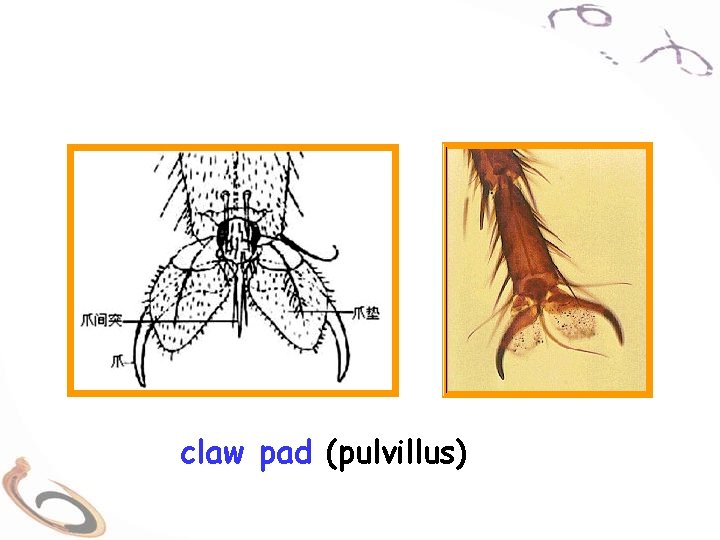
I Classification and morphology 2 morphological feature a) 2 large compound eyes separated to wider spacing in female , narrower spacing in male; 3 ocelli b) 2 antennae with each has a special structure called arista c) lapping mouthpart d) most developed mesothorax , 2 wide and well developed wings e) 3 pairs of legs, and each leg has a claw pad with lots of tiny thin hairs
lapping mouthparts
claw pad (pulvillus)
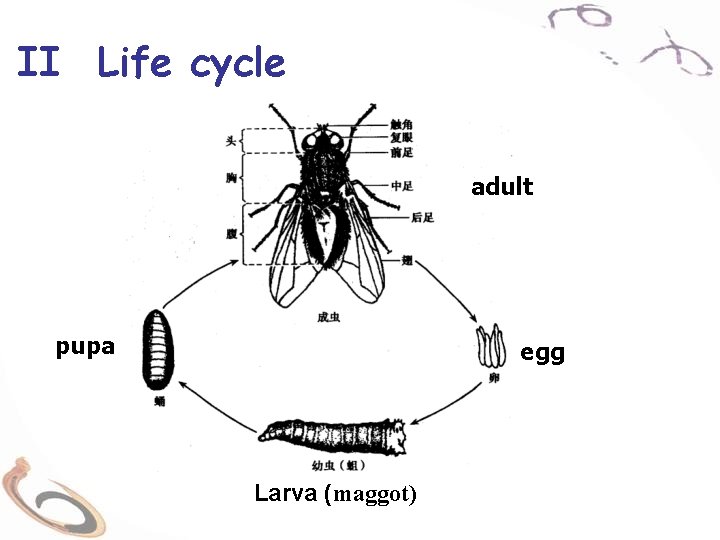
II Life cycle adult pupa egg Larva (maggot)
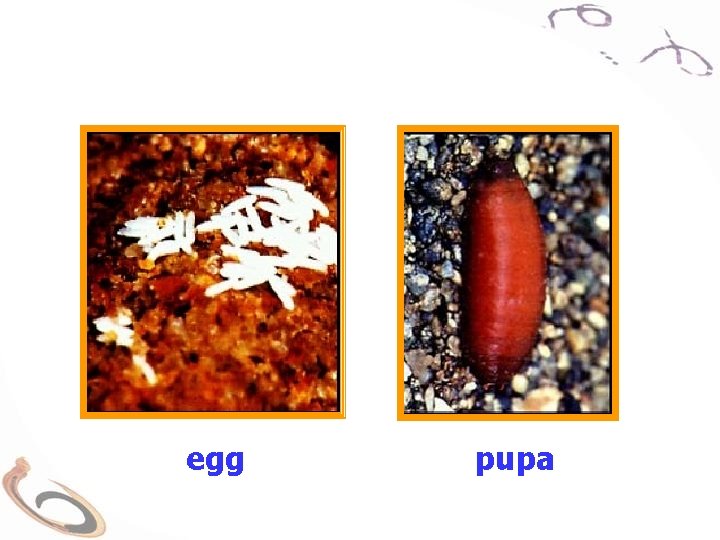
egg pupa
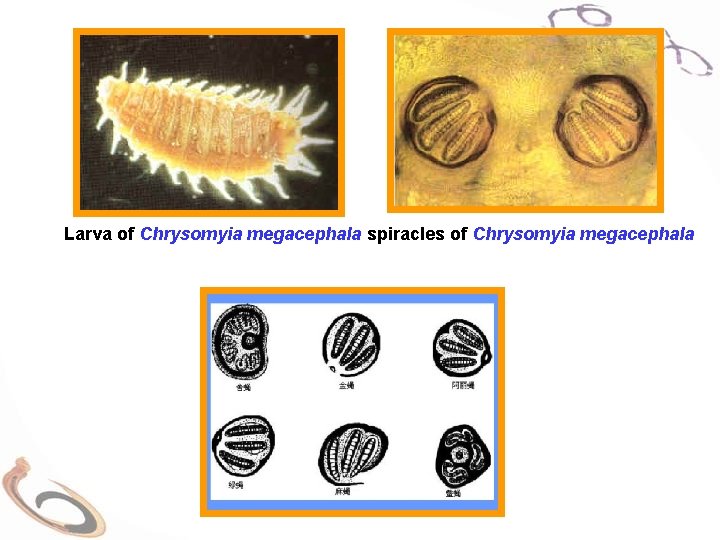
Larva of Chrysomyia megacephala spiracles of Chrysomyia megacephala
III Ecological behaviors 1 Breeding place The larvae of most flies feed on organic substance, and usually select the following sites as their breeding places : feces, garbage, putrid plants and decaying flesh , etc.
III Ecological behaviors 2 Feeding habit a) unable to feed themselves: Oestridae b) sucking blood: Stomoxys calcitrans,tsetsefly c) omnivorous: most flies with lapping mouthparts are feeding on a variety of food, including feces, decaying animals or plants, excretory substance and humans’ food, etc. vomit / excrete while eating
IV Medical significance vmechanical transmission: vbiological transmission: vtissue invasion and parasitism: Myiasis
dermamyiasis