Introduction to Medical Parasitology History Definitions Classification and


- Slides: 30
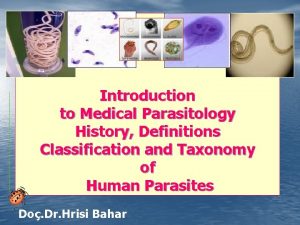
Introduction to Medical Parasitology History, Definitions Classification and Taxonomy of Human Parasites Doç. Dr. Hrisi Bahar
Parasitology • Parasitology – science about parasitic animals and relationships with their hosts. • Para + situ + logos = conversation about those living nearby us = parasitology.
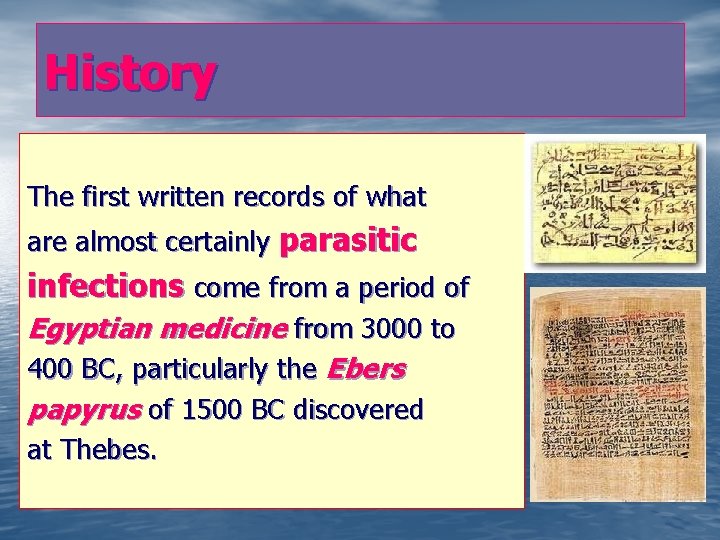
History The first written records of what are almost certainly parasitic infections come from a period of Egyptian medicine from 3000 to 400 BC, particularly the Ebers papyrus of 1500 BC discovered at Thebes.
A. lumbricoides eggs have been found in human coprolites from Peru dating from 2277 BC. Larval nematodes, possibly hook worms, have been found in fecal samples dated to about 200 BC from the Colorado Plateau In 1910, Marc Armand Ruffer found S. haematobium eggs in two Egyptian mummies dating from the, 1250 to 1000 BC
A parasite, is an organism that lives on or inside another organism to the detriment of the host organism. The parasite grows, feeds, or uses shelter of the host organism (including the host itself) contributing negatively to the relationship.
• Parasitism: A symbiotic relationship in which the symbiont (parasite) benefits at the expense of the host by living either within the host (endoparasite) or outside the host (ectoparasite).
Types of parasitism Obligate parasites: All or most of their life cycle are parasitic. Temporary parasites: parasitic for limited period for either feeding or reproduction.
Facultative parasites: organisms are not parasitic but can live parasitic for a limited period. Accidental parasites: normally free living organisms can survive within a host when they are accidentally taken.
What is a Parasite Host? The host is the organism that the parasite lives in. *A definitive host * An intermediate host *A paratenic host *A reservoir host
A definitive host is an organism that the adult, or sexually reproductive stage of the parasite lives in. Ex: When a human has an adult beef tapeworm in the intestine producing eggs, he or she is a “definitive host”
• An intermediate host is an organism that hosts an immature parasitic stage, or a stage that reproduces asexually Ex: Human are “intermediate hosts” to malariae parasites which multiply in human liver and blood cells.
• Reservoir hosts, with respect to human parasites, are hosts that are infected with a parasite and keep it alive even if the parasite is wiped out in humans. “Reservoir hosts can spread the parasite and reintroduce it to human populations”.
●A paratenic host is an organism that is infected with a parasite and can pass it on to another host, but in which the parasite does not develop further.
SYMBIOSIS A biological relationship in which (usually) two species live in close proximity to each other and interact regularly in such a way as to benefit one or both of the organisms. *Symbiosis may exist between two or more individuals of the same species as well as between two or more individuals representing two different species
The three principal varieties of symbiosis are *mutualism, *commensalism, * parasitism.
MUTUALISM Mutualism is any relationship between two species of organisms that benefits both species COMMENSALISM A symbiotic relationship in which one organism, the commensal, benefits without causing any detriment to the other organism which is the host. PARASITISM A symbiotic relationship in which one organism, the parasite, benefit at the expense of the other organism, which is the host.
Other Parasitology Definitions *A cyst is a stage of many protozoan parasites that survives well in the environment. Cysts of human parasites are infective to humans. *A trophozoite is a moving, feeding, and multiplying stage of protozoan life cycles. There are not male and female trophozoites: they multiply asexually.
Other Parasitology Definitions • Infective (=invasive) stage The stage of the parasite that invades the host. • Vector: An Arthropod which is carrying and transferring parasites from one host to an other (Egg-larval stages-adult parasite-eggs)
Other Parasitology Definitions • Reservoir= Non-human “host” where the parasite can live. This term is only applied when the parasite can infect humans. • Life Cycle= Stages of development of a parasite
Essential features of the parasitism *Parasite is smaller then the host *Parasite has a shorter life span than it’s host *Parasite has a greater reproductive potential than it’s host
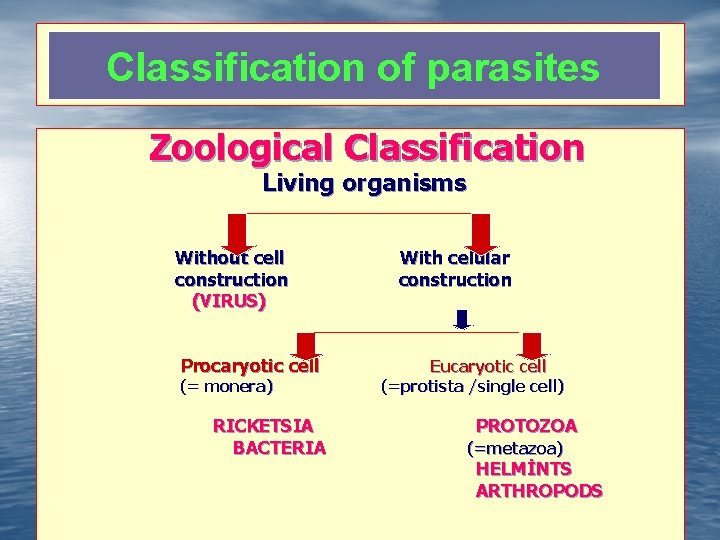
Classification of parasites Zoological Classification Living organisms Without cell construction (VIRUS) Procaryotic cell (= monera) RICKETSIA BACTERIA With celular construction Eucaryotic cell (=protista /single cell) PROTOZOA (=metazoa) HELMİNTS ARTHROPODS
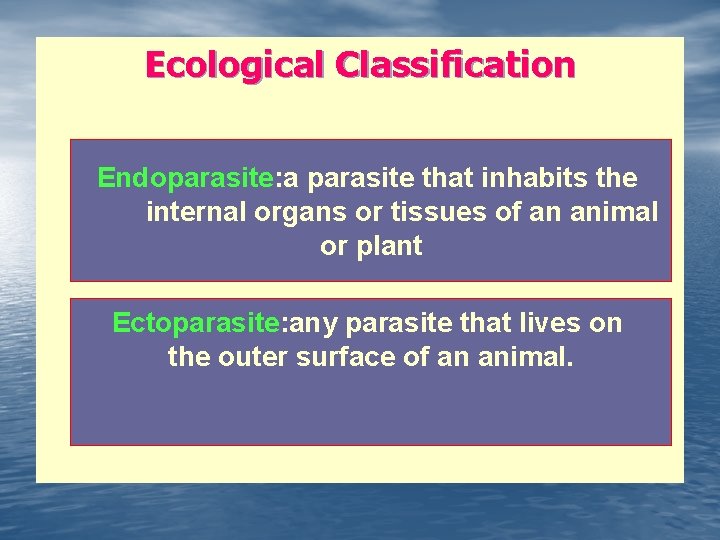
Ecological Classification Endoparasite: a parasite that inhabits the internal organs or tissues of an animal or plant Ectoparasite: any parasite that lives on the outer surface of an animal.
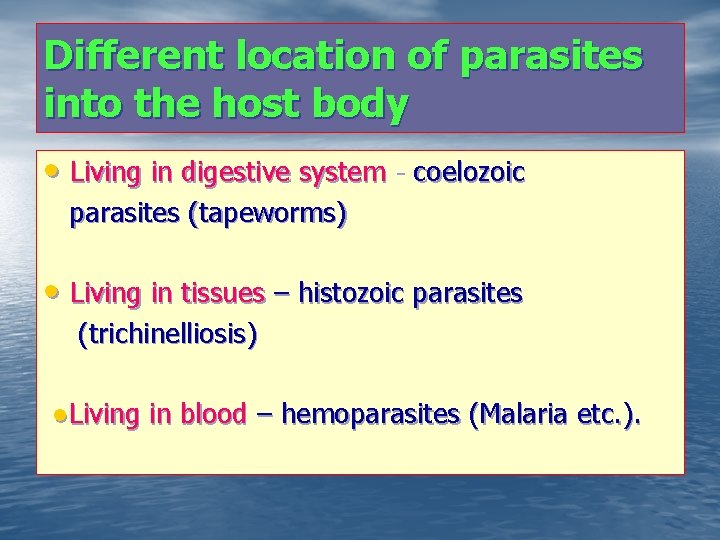
Different location of parasites into the host body • Living in digestive system - coelozoic parasites (tapeworms) • Living in tissues – histozoic parasites (trichinelliosis) ●Living in blood – hemoparasites (Malaria etc. ).
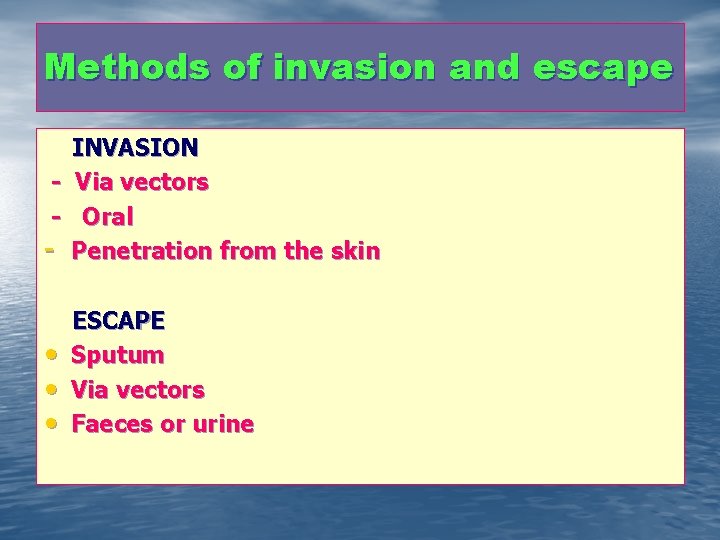
Methods of invasion and escape INVASION - Via vectors - Oral - Penetration from the skin • • • ESCAPE Sputum Via vectors Faeces or urine
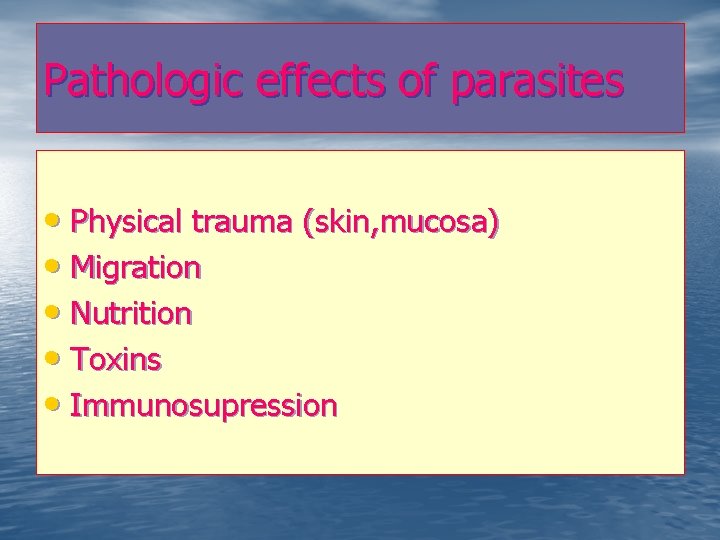
Pathologic effects of parasites • Physical trauma (skin, mucosa) • Migration • Nutrition • Toxins • Immunosupression
Diagnosis of Parasitic Infections: • 1. Clinical diagnosis • 2. Laboratory diagnosis
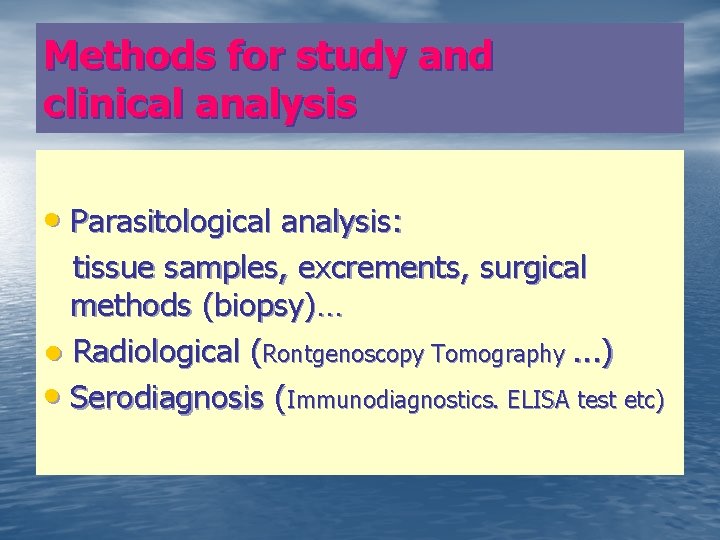
Methods for study and clinical analysis • Parasitological analysis: tissue samples, excrements, surgical methods (biopsy)… ● Radiological (Rontgenoscopy Tomography. . . ) • Serodiagnosis (Immunodiagnostics. ELISA test etc)
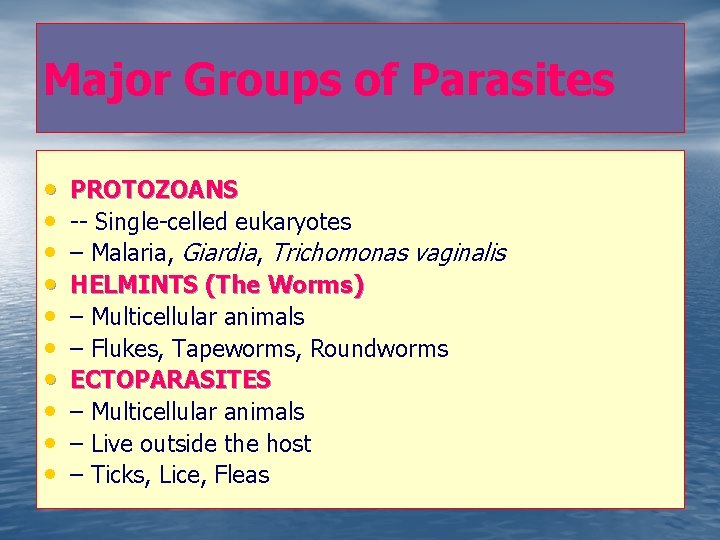
Major Groups of Parasites • • • PROTOZOANS -- Single-celled eukaryotes – Malaria, Giardia, Trichomonas vaginalis HELMINTS (The Worms) – Multicellular animals – Flukes, Tapeworms, Roundworms ECTOPARASITES – Multicellular animals – Live outside the host – Ticks, Lice, Fleas
Treatment of Parasitic Infections: • 1. Medical and surgical • 2. Chemotherapy • 3. Adequate nutrition
Prevention and Control: • 1. Reduction in sources • 2. Education • 3. Destruction and/or control of reservoir hosts and vector