Lecture 3 CS 473 COMPILER DESIGN 1 creating
- Slides: 31
Lecture 3 CS 473: COMPILER DESIGN 1
creating an abstract representation of program syntax PARSING 2
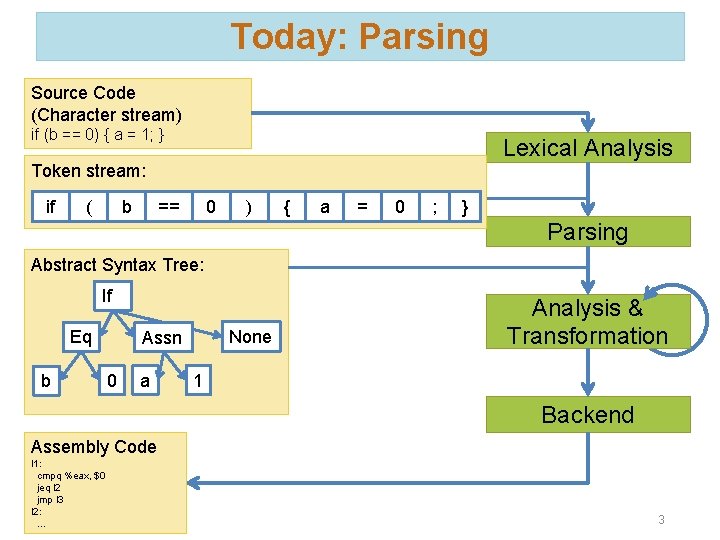
Today: Parsing Source Code (Character stream) if (b == 0) { a = 1; } Lexical Analysis Token stream: if ( b == 0 ) { a = 0 ; } Parsing Abstract Syntax Tree: If Eq b None Assn 0 a Analysis & Transformation 1 Backend Assembly Code l 1: cmpq %eax, $0 jeq l 2 jmp l 3 l 2: … 3
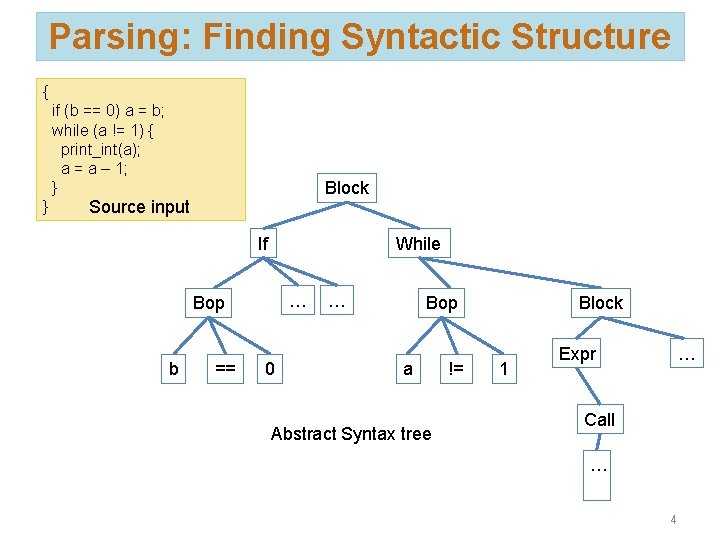
Parsing: Finding Syntactic Structure { if (b == 0) a = b; while (a != 1) { print_int(a); a = a – 1; } } Block Source input If While … Bop b == 0 … Block Bop a Abstract Syntax tree != 1 Expr … Call … 4
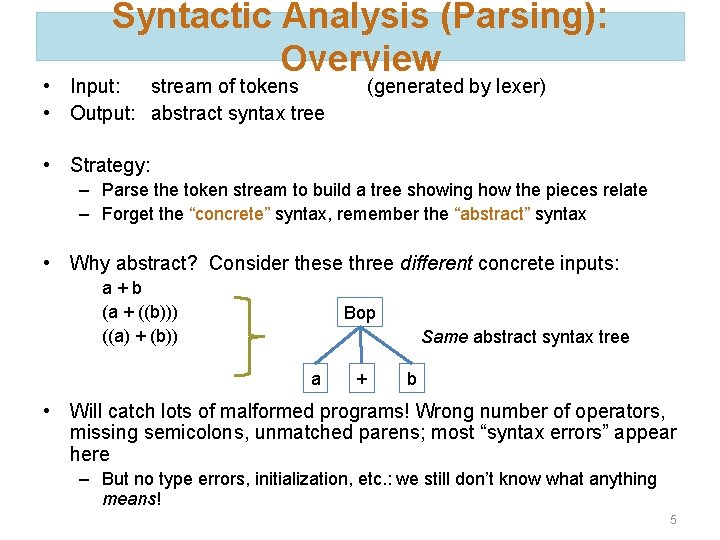
Syntactic Analysis (Parsing): Overview • Input: stream of tokens • Output: abstract syntax tree (generated by lexer) • Strategy: – Parse the token stream to build a tree showing how the pieces relate – Forget the “concrete” syntax, remember the “abstract” syntax • Why abstract? Consider these three different concrete inputs: a+b (a + ((b))) ((a) + (b)) Bop Same abstract syntax tree a + b • Will catch lots of malformed programs! Wrong number of operators, missing semicolons, unmatched parens; most “syntax errors” appear here – But no type errors, initialization, etc. : we still don’t know what anything means! 5
Specifying Language Syntax • First question: how to describe language syntax precisely and conveniently? • Last time: we described tokens using regular expressions – Easy to implement, efficient DFA representation – Why not use regular expressions on tokens to specify programming language syntax? • Limits of regular expressions: – DFAs have only finite # of states – So DFAs can’t “count” – For example, consider the language of all strings that contain balanced parentheses – easier than most programming languages, but not regular. • We need more expressive power than DFAs! 6
CONTEXT-FREE GRAMMARS 7
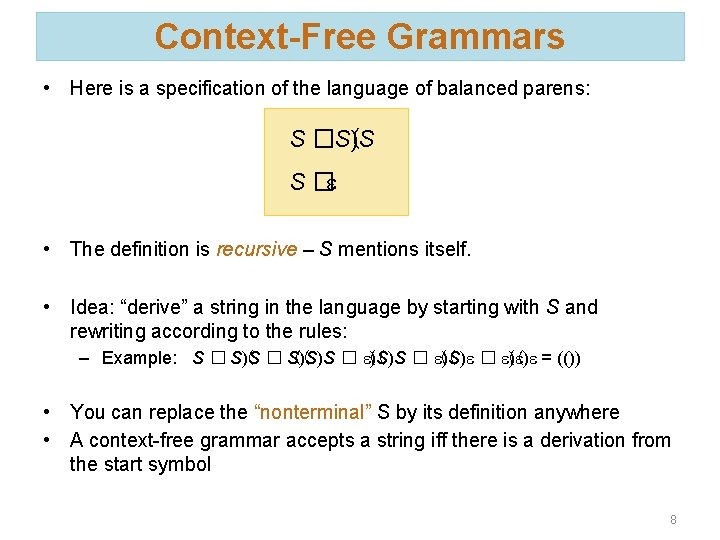
Context-Free Grammars • Here is a specification of the language of balanced parens: S �S)S ( S �e • The definition is recursive – S mentions itself. • Idea: “derive” a string in the language by starting with S and rewriting according to the rules: – Example: S � S)S ( � S)S)S (( � e)S)e (( � e)e)e (( = (()) • You can replace the “nonterminal” S by its definition anywhere • A context-free grammar accepts a string iff there is a derivation from the start symbol 8
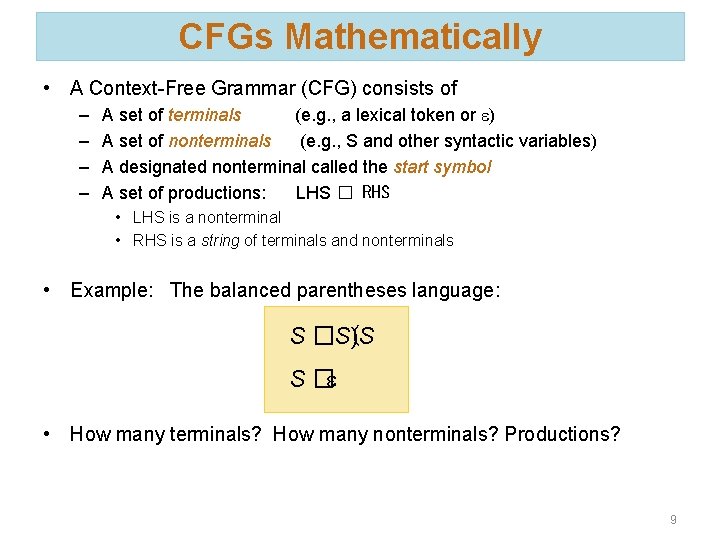
CFGs Mathematically • A Context-Free Grammar (CFG) consists of – – A set of terminals (e. g. , a lexical token or e) A set of nonterminals (e. g. , S and other syntactic variables) A designated nonterminal called the start symbol A set of productions: LHS � RHS • LHS is a nonterminal • RHS is a string of terminals and nonterminals • Example: The balanced parentheses language: S �S)S ( S �e • How many terminals? How many nonterminals? Productions? 9
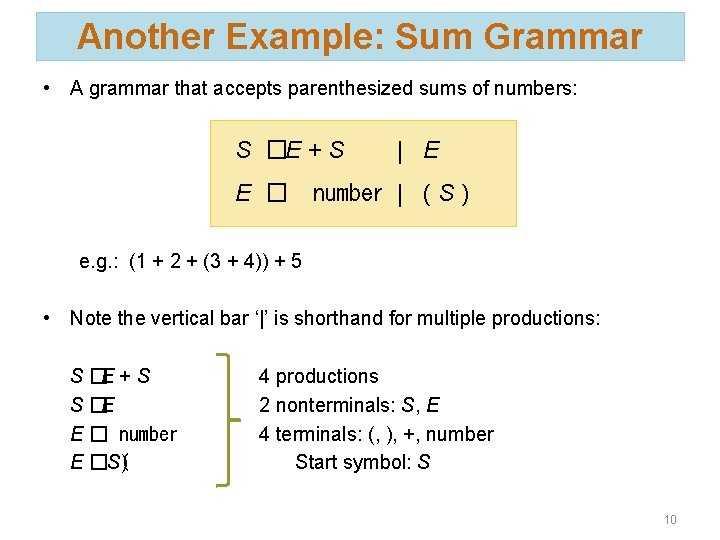
Another Example: Sum Grammar • A grammar that accepts parenthesized sums of numbers: S �E + S E � | E number | ( S ) e. g. : (1 + 2 + (3 + 4)) + 5 • Note the vertical bar ‘|’ is shorthand for multiple productions: S �E + S S �E E � number E �S)( 4 productions 2 nonterminals: S, E 4 terminals: (, ), +, number Start symbol: S 10
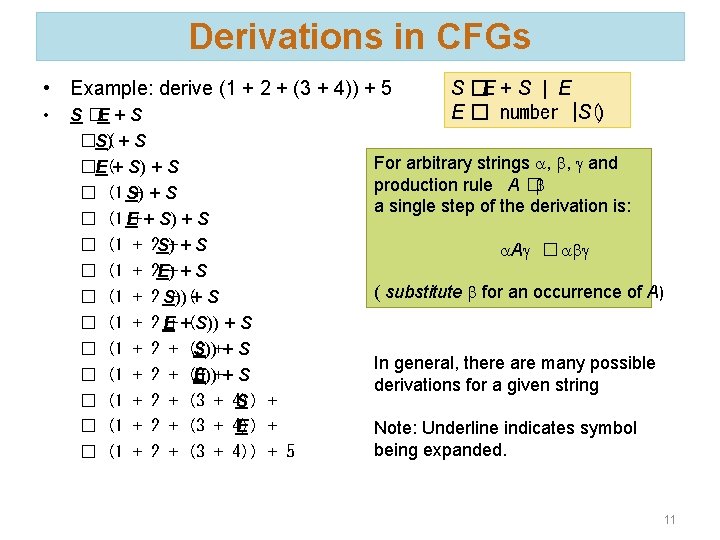
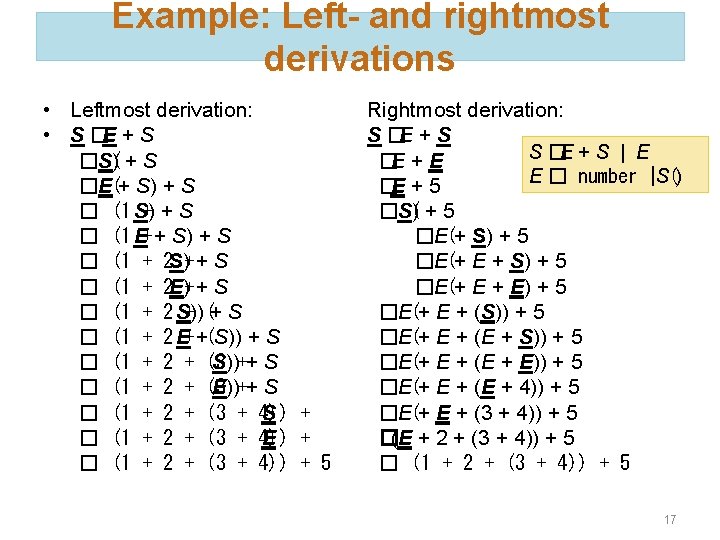
Derivations in CFGs • Example: derive (1 + 2 + (3 + 4)) + 5 • S �E + S �S)( + S �E(+ S) + S � (1 S) + +S � (1 E+ + S) + S � (1 + 2 S)+ + S � (1 + 2 E)+ + S � (1 + 2 S)) + (+ S � (1 + 2 E+ +(S)) + S � (1 + 2 + (3 S))++ S � (1 + 2 + (3 E))++ S � (1 + 2 + (3 + 4)) S + � (1 + 2 + (3 + 4)) E + � (1 + 2 + (3 + 4)) + 5 S �E + S | E E � number |S() For arbitrary strings a, b, g and production rule A �b a single step of the derivation is: a. Ag � abg ( substitute b for an occurrence of A) In general, there are many possible derivations for a given string Note: Underline indicates symbol being expanded. 11
12
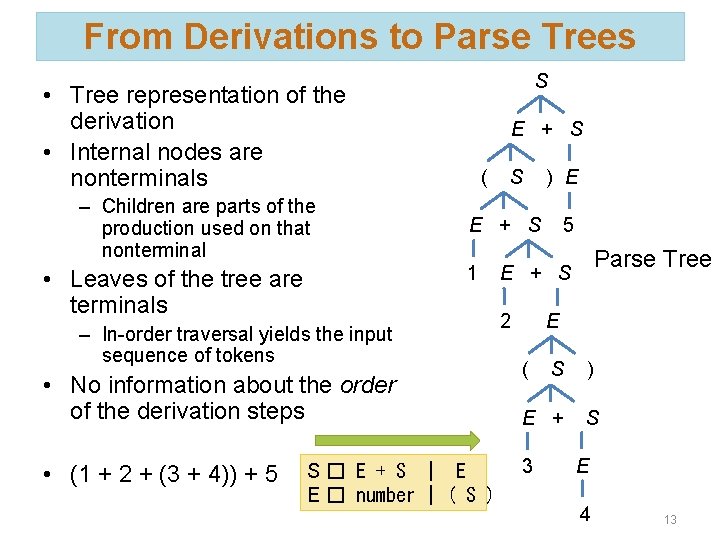
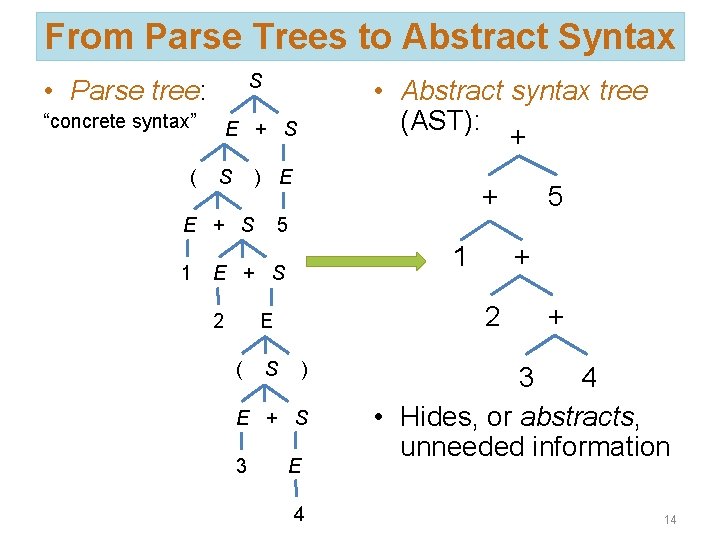
From Derivations to Parse Trees S • Tree representation of the derivation • Internal nodes are nonterminals – Children are parts of the production used on that nonterminal E + S ( – In-order traversal yields the input sequence of tokens • No information about the order of the derivation steps • (1 + 2 + (3 + 4)) + 5 ) E E + S 1 • Leaves of the tree are terminals S S� E + S | E E � number | ( S ) 5 Parse Tree E + S 2 E ( S E + 3 ) S E 4 13
From Parse Trees to Abstract Syntax • Parse tree: S “concrete syntax” E + S ( S ) E E + S 1 • Abstract syntax tree (AST): + 5 1 E + S 2 S ) E + S 3 + 2 E ( 5 + E 4 + 3 4 • Hides, or abstracts, unneeded information 14
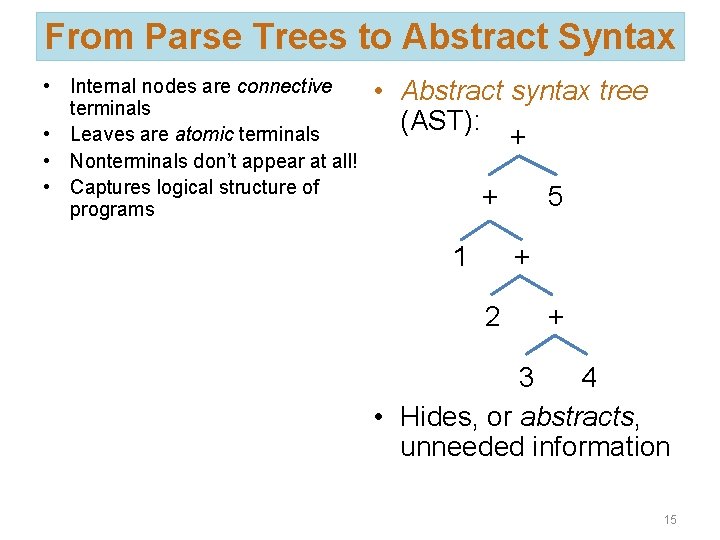
From Parse Trees to Abstract Syntax • Internal nodes are connective terminals • Leaves are atomic terminals • Nonterminals don’t appear at all! • Captures logical structure of programs • Abstract syntax tree (AST): + 5 + 1 + 2 + 3 4 • Hides, or abstracts, unneeded information 15
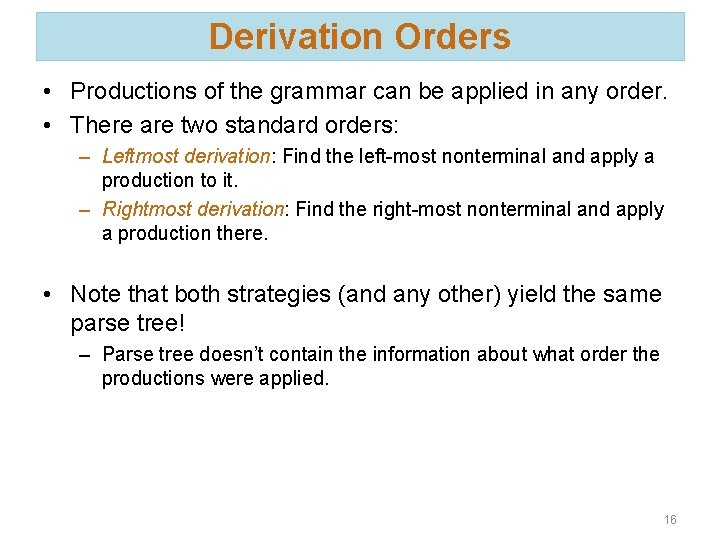
Derivation Orders • Productions of the grammar can be applied in any order. • There are two standard orders: – Leftmost derivation: Find the left-most nonterminal and apply a production to it. – Rightmost derivation: Find the right-most nonterminal and apply a production there. • Note that both strategies (and any other) yield the same parse tree! – Parse tree doesn’t contain the information about what order the productions were applied. 16
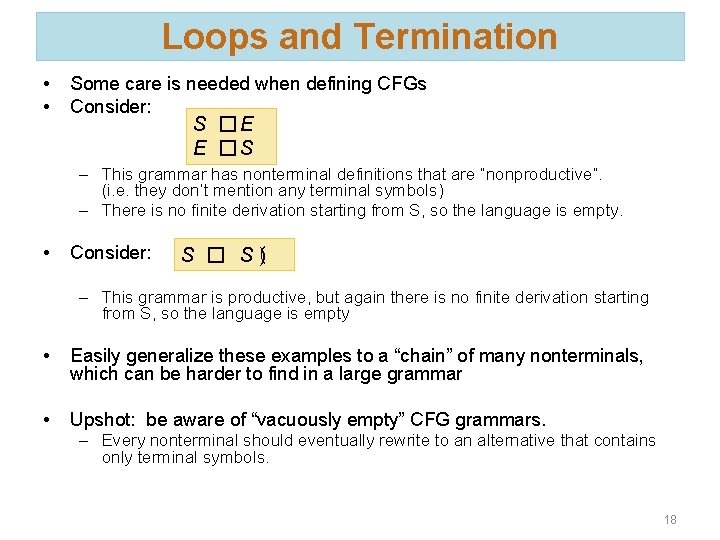
Loops and Termination • • Some care is needed when defining CFGs Consider: S �E E �S – This grammar has nonterminal definitions that are “nonproductive”. (i. e. they don’t mention any terminal symbols) – There is no finite derivation starting from S, so the language is empty. • Consider: S � S () – This grammar is productive, but again there is no finite derivation starting from S, so the language is empty • Easily generalize these examples to a “chain” of many nonterminals, which can be harder to find in a large grammar • Upshot: be aware of “vacuously empty” CFG grammars. – Every nonterminal should eventually rewrite to an alternative that contains only terminal symbols. 18
19
20
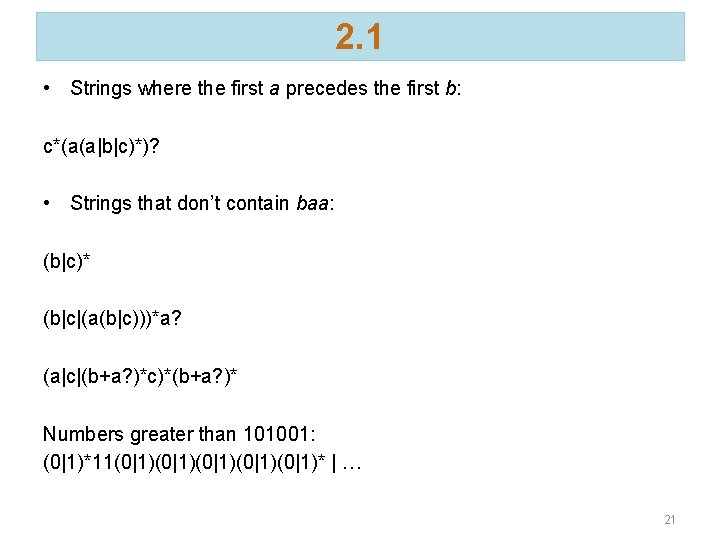
2. 1 • Strings where the first a precedes the first b: c*(a(a|b|c)*)? • Strings that don’t contain baa: (b|c)* (b|c|(a(b|c)))*a? (a|c|(b+a? )*c)*(b+a? )* Numbers greater than 101001: (0|1)*11(0|1)(0|1)(0|1)* | … 21
associativity, ambiguity, and precedence GRAMMARS FOR PROGRAMMING LANGUAGES 22
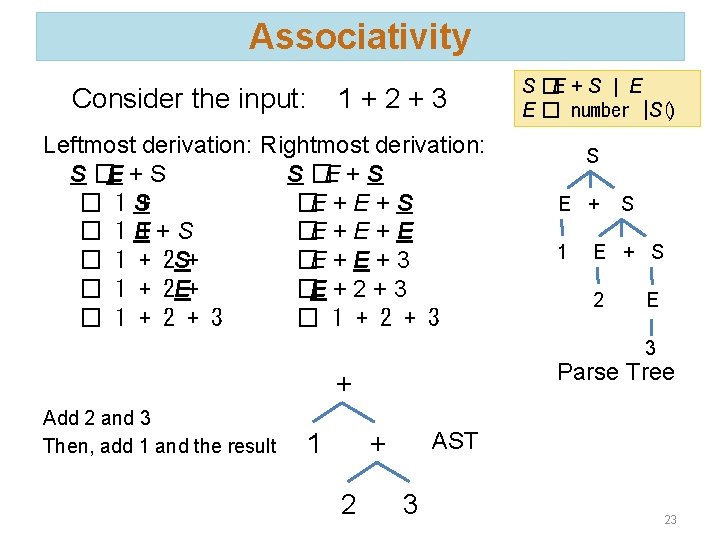
Associativity Consider the input: 1+2+3 Leftmost derivation: Rightmost derivation: S �E + S � 1 S+ �E + S � 1 E+ + S �E + E � 1 + 2 S+ �E + 3 � 1 + 2 E+ �E + 2 + 3 � 1 + 2 + 3 S �E + S | E E � number |S() S E + 1 S E + S 2 E 3 Parse Tree + Add 2 and 3 Then, add 1 and the result 1 AST + 2 3 23
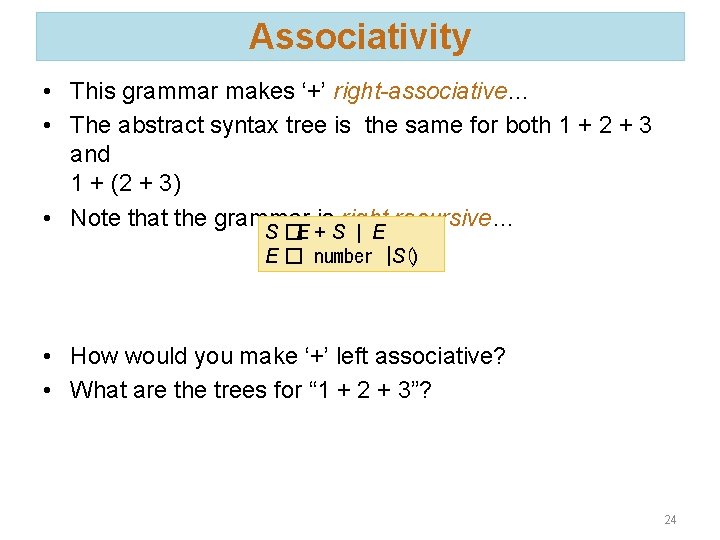
Associativity • This grammar makes ‘+’ right-associative… • The abstract syntax tree is the same for both 1 + 2 + 3 and 1 + (2 + 3) • Note that the grammar is right recursive… S �E + S | E E � number |S() • How would you make ‘+’ left associative? • What are the trees for “ 1 + 2 + 3”? 24
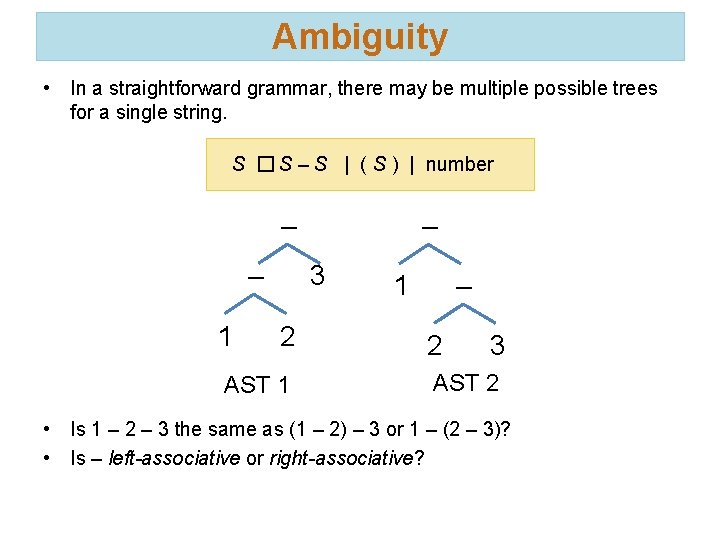
Ambiguity • In a straightforward grammar, there may be multiple possible trees for a single string. S � S – S | ( S ) | number – – 1 – 3 2 AST 1 1 – 2 3 AST 2 • Is 1 – 2 – 3 the same as (1 – 2) – 3 or 1 – (2 – 3)? • Is – left-associative or right-associative?
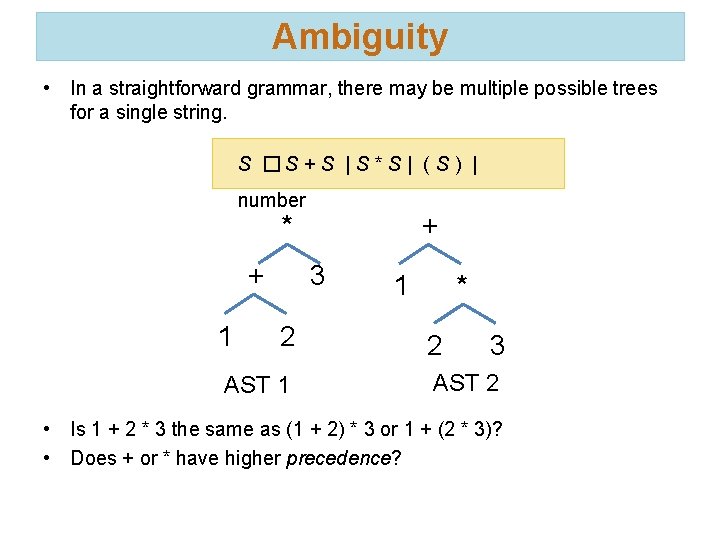
Ambiguity • In a straightforward grammar, there may be multiple possible trees for a single string. S �S + S | S * S | ( S ) | number * + 1 + 3 2 AST 1 1 * 2 3 AST 2 • Is 1 + 2 * 3 the same as (1 + 2) * 3 or 1 + (2 * 3)? • Does + or * have higher precedence?
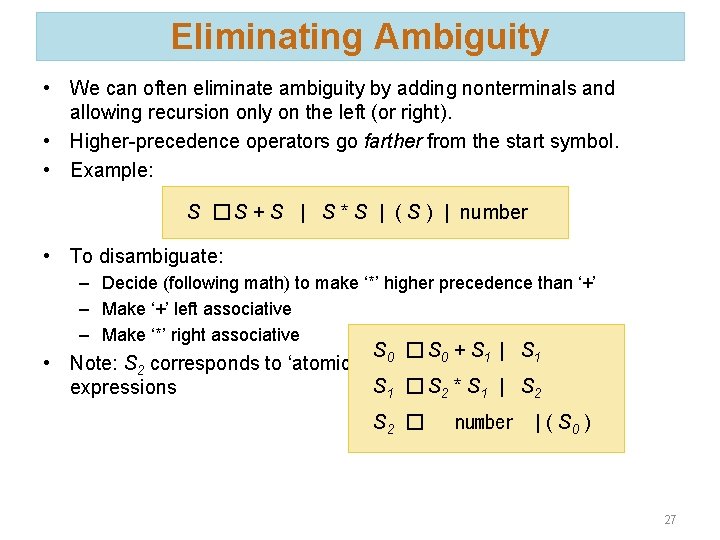
Eliminating Ambiguity • We can often eliminate ambiguity by adding nonterminals and allowing recursion only on the left (or right). • Higher-precedence operators go farther from the start symbol. • Example: S � S + S | S * S | ( S ) | number • To disambiguate: – Decide (following math) to make ‘*’ higher precedence than ‘+’ – Make ‘+’ left associative – Make ‘*’ right associative S 0 � S 0 + S 1 | S 1 • Note: S 2 corresponds to ‘atomic’ S 1 � S 2 * S 1 | S 2 expressions S 2 � number | ( S 0 ) 27
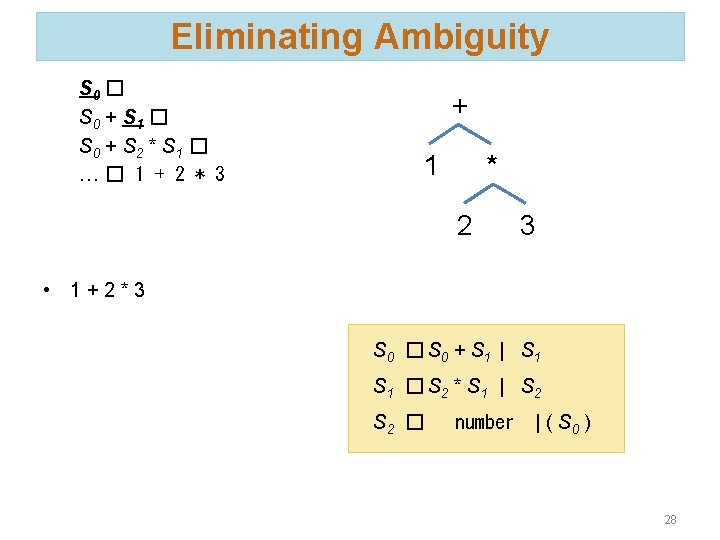
Eliminating Ambiguity S 0 � S 0 + S 1 � S 0 + S 2 * S 1 � …� 1 + 2 * 3 + 1 * 2 3 • 1+2*3 S 0 � S 0 + S 1 | S 1 � S 2 * S 1 | S 2 � number | ( S 0 ) 28
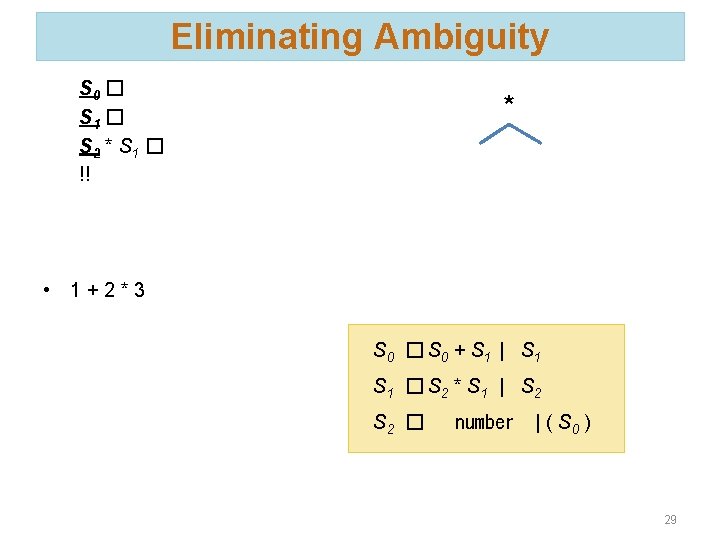
Eliminating Ambiguity S 0 � S 1 � S 2 * S 1 � !! * • 1+2*3 S 0 � S 0 + S 1 | S 1 � S 2 * S 1 | S 2 � number | ( S 0 ) 29
Context Free Grammars: Summary • Context-free grammars allow concise specifications of programming languages. – Can apply rules to convert token stream to parse tree/AST – Ambiguity can often be removed by encoding precedence and associativity in the grammar. • Even with an unambiguous CFG, there may be more than one derivation – But all derivations correspond to the same abstract syntax tree. • Next up: finding a derivation automatically (parsing!) 30
31