
CS 473 Algorithms I Other Dynamic Programming Problems
CS 473 - Algorithms I Other Dynamic Programming Problems View in slide-show mode CS 473 – DP Examples Cevdet Aykanat and Mustafa Ozdal Computer Engineering Department, Bilkent University 1
CS 473 - Algorithms I Problem 1 Subset Sum CS 473 – DP Examples Cevdet Aykanat and Mustafa Ozdal Computer Engineering Department, Bilkent University 2
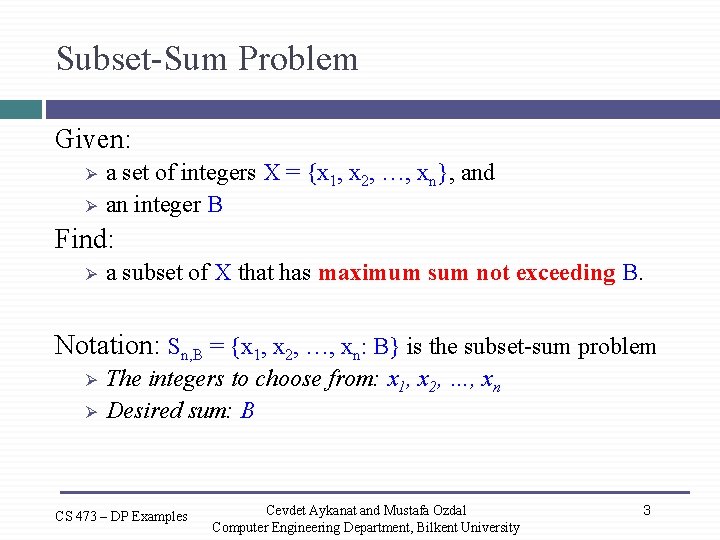
Subset-Sum Problem Given: Ø Ø a set of integers X = {x 1, x 2, …, xn}, and an integer B Find: Ø a subset of X that has maximum sum not exceeding B. Notation: Sn, B = {x 1, x 2, …, xn: B} is the subset-sum problem Ø Ø The integers to choose from: x 1, x 2, …, xn Desired sum: B CS 473 – DP Examples Cevdet Aykanat and Mustafa Ozdal Computer Engineering Department, Bilkent University 3
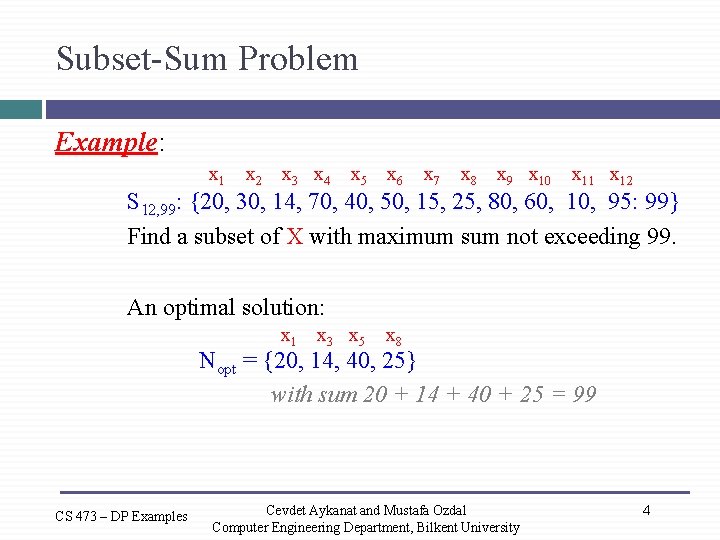
Subset-Sum Problem Example: x 1 x 2 x 3 x 4 x 5 x 6 x 7 x 8 x 9 x 10 x 11 x 12 S 12, 99: {20, 30, 14, 70, 40, 50, 15, 25, 80, 60, 10, 95: 99} Find a subset of X with maximum sum not exceeding 99. An optimal solution: x 1 x 3 x 5 x 8 Nopt = {20, 14, 40, 25} with sum 20 + 14 + 40 + 25 = 99 CS 473 – DP Examples Cevdet Aykanat and Mustafa Ozdal Computer Engineering Department, Bilkent University 4

Optimal Substructure Property Consider the solution as a sequence of n decisions: ith decision: whether we pick number xi or not Let Nopt be an optimal solution for Sn, B Let xk be the highest-indexed number in Nopt (optimal for Sn, B) xk Nʹopt = Nopt – {xk} CS 473 – DP Examples Cevdet Aykanat and Mustafa Ozdal Computer Engineering Department, Bilkent University 5
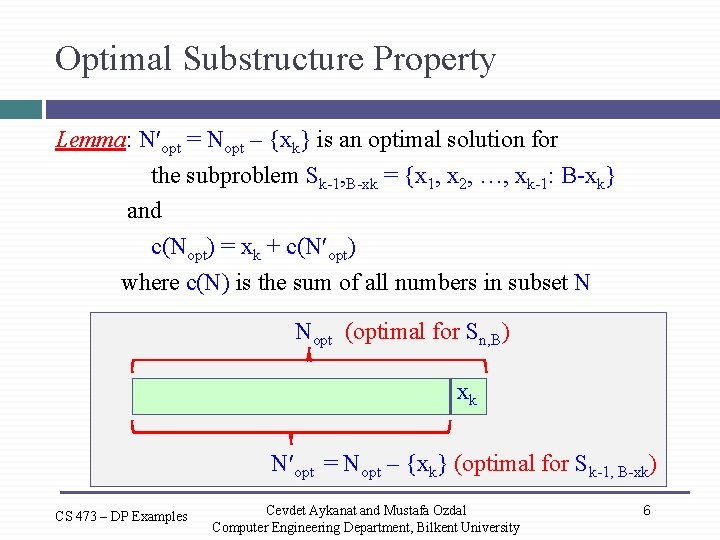
Optimal Substructure Property Lemma: Nʹopt = Nopt – {xk} is an optimal solution for the subproblem Sk-1, B-xk = {x 1, x 2, …, xk-1: B-xk} and c(Nopt) = xk + c(Nʹopt) where c(N) is the sum of all numbers in subset N Nopt (optimal for Sn, B) xk Nʹopt = Nopt – {xk} (optimal for Sk-1, B-xk) CS 473 – DP Examples Cevdet Aykanat and Mustafa Ozdal Computer Engineering Department, Bilkent University 6
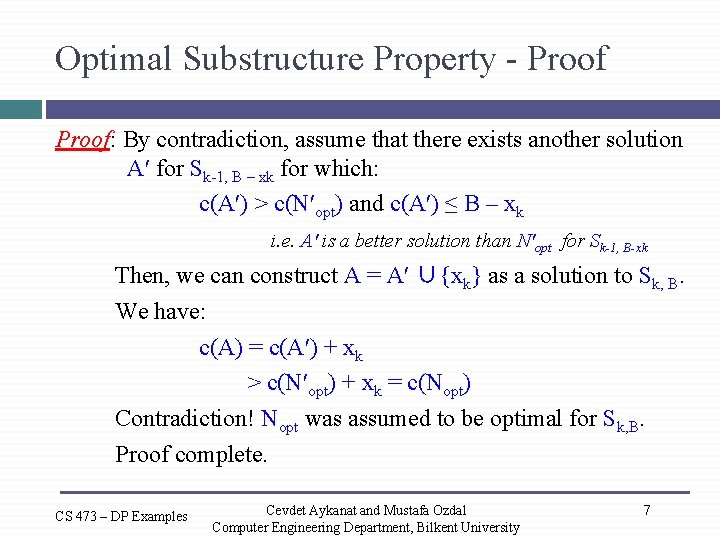
Optimal Substructure Property - Proof: By contradiction, assume that there exists another solution Aʹ for Sk-1, B – xk for which: c(Aʹ) > c(Nʹopt) and c(Aʹ) ≤ B – xk i. e. Aʹ is a better solution than Nʹopt for Sk-1, B-xk Then, we can construct A = Aʹ ∪{xk} as a solution to Sk, B. We have: c(A) = c(Aʹ) + xk > c(Nʹopt) + xk = c(Nopt) Contradiction! Nopt was assumed to be optimal for Sk, B. Proof complete. CS 473 – DP Examples Cevdet Aykanat and Mustafa Ozdal Computer Engineering Department, Bilkent University 7
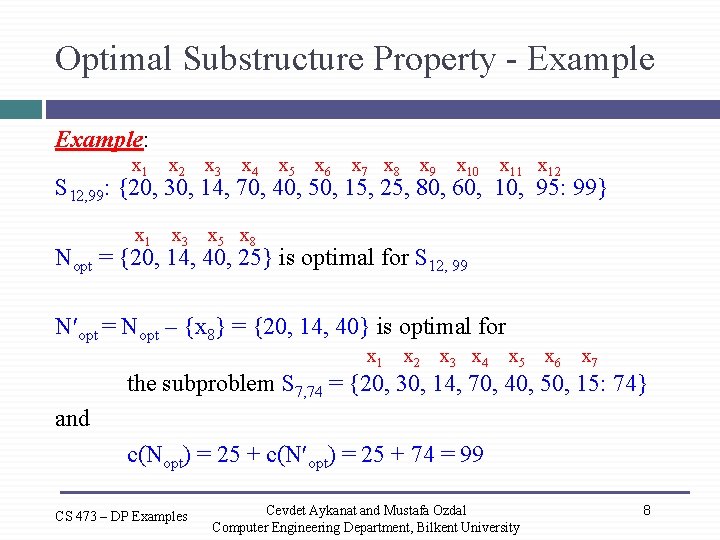
Optimal Substructure Property - Example: x 1 x 2 x 3 x 4 x 1 x 3 x 5 x 8 x 5 x 6 x 7 x 8 x 9 x 10 x 11 x 12 S 12, 99: {20, 30, 14, 70, 40, 50, 15, 25, 80, 60, 10, 95: 99} Nopt = {20, 14, 40, 25} is optimal for S 12, 99 Nʹopt = Nopt – {x 8} = {20, 14, 40} is optimal for x 1 x 2 x 3 x 4 x 5 x 6 x 7 the subproblem S 7, 74 = {20, 30, 14, 70, 40, 50, 15: 74} and c(Nopt) = 25 + c(Nʹopt) = 25 + 74 = 99 CS 473 – DP Examples Cevdet Aykanat and Mustafa Ozdal Computer Engineering Department, Bilkent University 8
![Recursive Definition an Optimal Solution c[i, b]: the value of an optimal solution for](http://slidetodoc.com/presentation_image_h2/49d73e315e6bacf023769cc8aa13ef0c/image-9.jpg "Recursive Definition an Optimal Solution c[i, b]: the value of an optimal solution for")
Recursive Definition an Optimal Solution c[i, b]: the value of an optimal solution for Si, b = {x 1, …, xi: b} According to this recurrence, an optimal solution Ni, b for Si, b: Ø either contains xi �c(Ni, b) = xi + c(Ni-1, b-xi) Ø or does not contain xi � c(Ni, b) = c(Ni-1, b) CS 473 – DP Examples Cevdet Aykanat and Mustafa Ozdal Computer Engineering Department, Bilkent University 9
![1 1 b-xi b n i-1 i c[i, b] Need to process: c[i, b]](http://slidetodoc.com/presentation_image_h2/49d73e315e6bacf023769cc8aa13ef0c/image-10.jpg "1 1 b-xi b n i-1 i c[i, b] Need to process: c[i, b]")
1 1 b-xi b n i-1 i c[i, b] Need to process: c[i, b] after computing: c[i-1, b], c[i-1, b-xi] n CS 473 – DP Examples Cevdet Aykanat and Mustafa Ozdal Computer Engineering Department, Bilkent University 10
![1 1 b-xi b n i-1 i c[i, b] for i � 1 to](http://slidetodoc.com/presentation_image_h2/49d73e315e6bacf023769cc8aa13ef0c/image-11.jpg "1 1 b-xi b n i-1 i c[i, b] for i � 1 to")
1 1 b-xi b n i-1 i c[i, b] for i � 1 to m for b � 1 to n …. …. c[i, b] = m CS 473 – DP Examples Cevdet Aykanat and Mustafa Ozdal Computer Engineering Department, Bilkent University 11
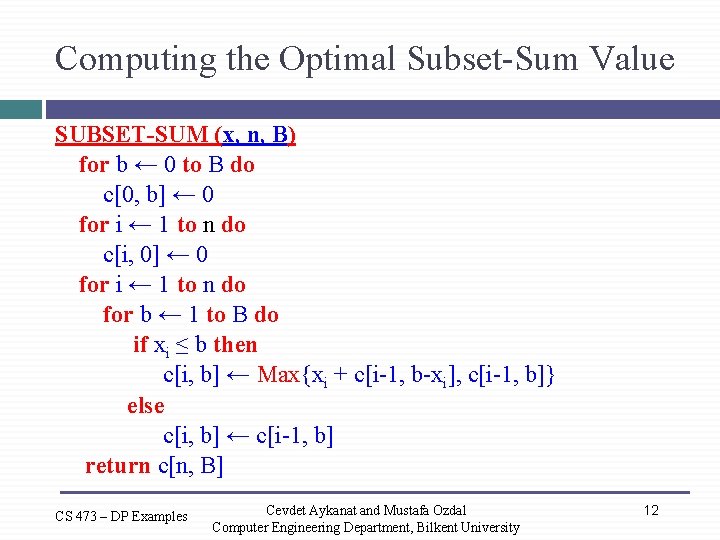
Computing the Optimal Subset-Sum Value SUBSET-SUM (x, n, B) for b ← 0 to B do c[0, b] ← 0 for i ← 1 to n do c[i, 0] ← 0 for i ← 1 to n do for b ← 1 to B do if xi ≤ b then c[i, b] ← Max{xi + c[i-1, b-xi], c[i-1, b]} else c[i, b] ← c[i-1, b] return c[n, B] CS 473 – DP Examples Cevdet Aykanat and Mustafa Ozdal Computer Engineering Department, Bilkent University 12
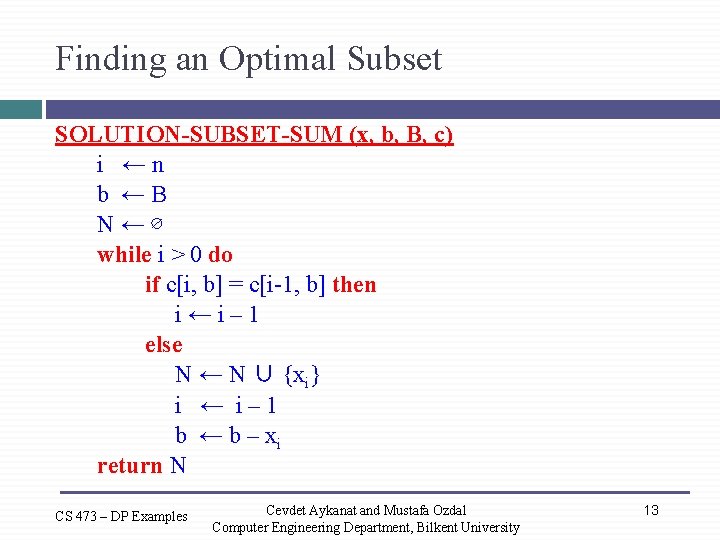
Finding an Optimal Subset SOLUTION-SUBSET-SUM (x, b, B, c) i ←n b ←B N←∅ while i > 0 do if c[i, b] = c[i-1, b] then i←i– 1 else N ← N ∪ {xi} i ← i– 1 b ← b – xi return N CS 473 – DP Examples Cevdet Aykanat and Mustafa Ozdal Computer Engineering Department, Bilkent University 13
CS 473 - Algorithms I Problem 2 Optimal Binary Search Tree CS 473 – DP Examples Cevdet Aykanat and Mustafa Ozdal Computer Engineering Department, Bilkent University 14
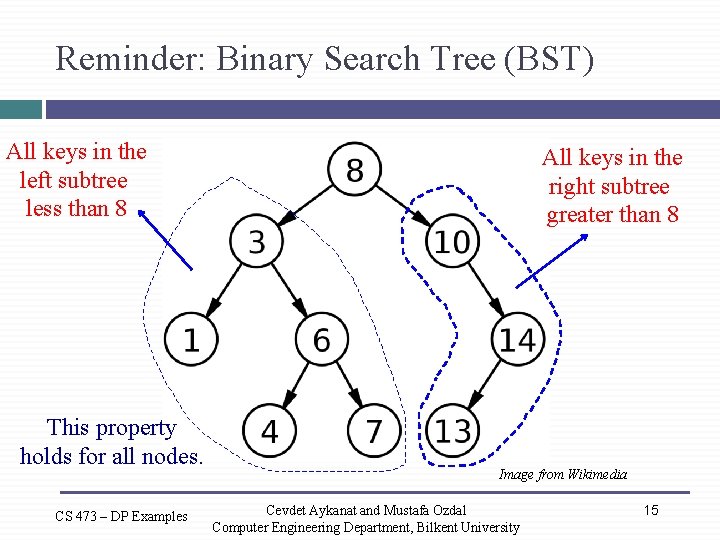
Reminder: Binary Search Tree (BST) All keys in the left subtree less than 8 This property holds for all nodes. CS 473 – DP Examples All keys in the right subtree greater than 8 Image from Wikimedia Cevdet Aykanat and Mustafa Ozdal Computer Engineering Department, Bilkent University 15
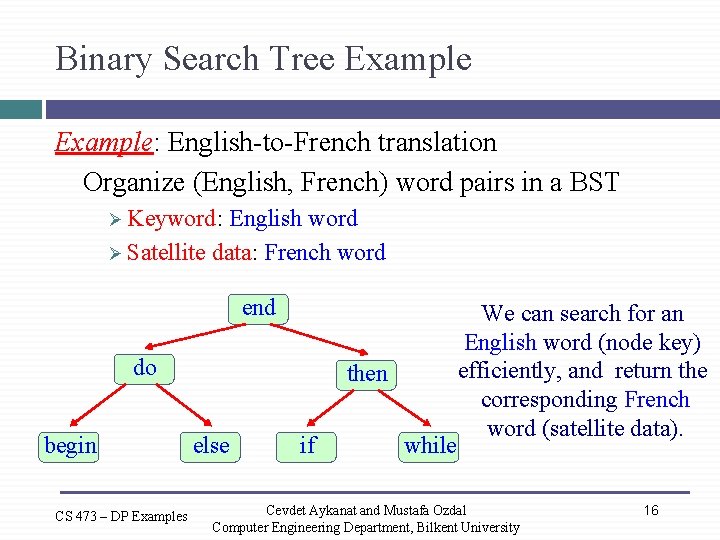
Binary Search Tree Example: English-to-French translation Organize (English, French) word pairs in a BST Ø Keyword: English word Ø Satellite data: French word end do begin CS 473 – DP Examples then else if while We can search for an English word (node key) efficiently, and return the corresponding French word (satellite data). Cevdet Aykanat and Mustafa Ozdal Computer Engineering Department, Bilkent University 16
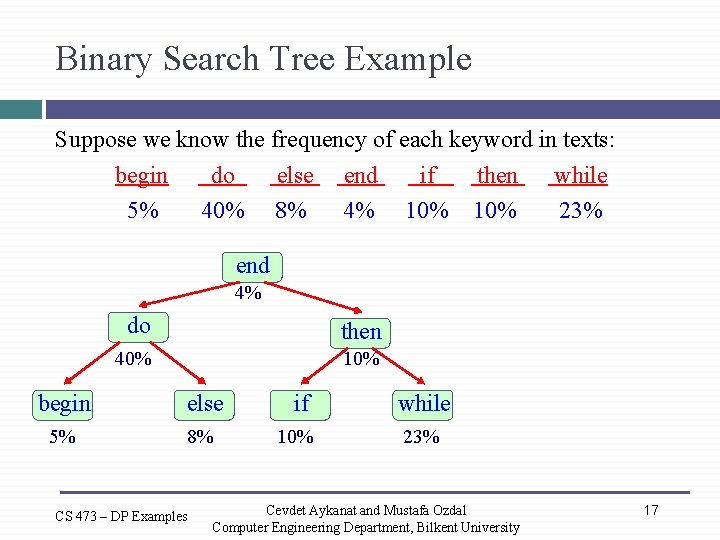
Binary Search Tree Example Suppose we know the frequency of each keyword in texts: begin do else end if then while 5% 40% 8% 4% 10% 23% end 4% do then 40% 10% begin else if while 5% 8% 10% 23% CS 473 – DP Examples Cevdet Aykanat and Mustafa Ozdal Computer Engineering Department, Bilkent University 17
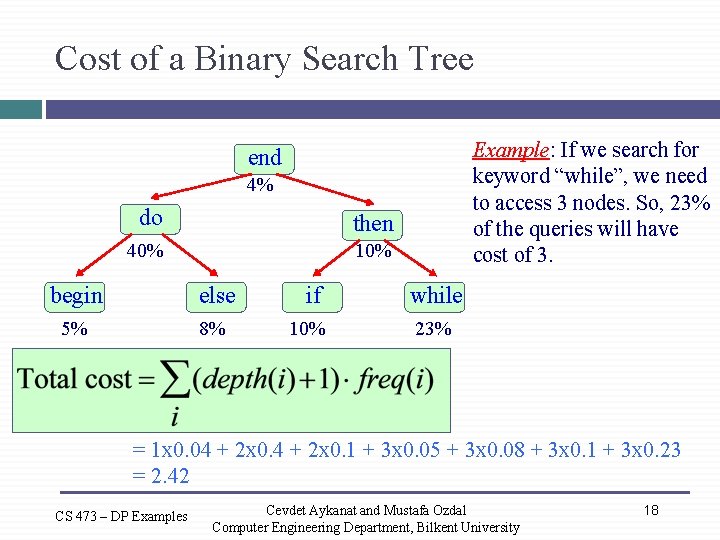
Cost of a Binary Search Tree Example: If we search for keyword “while”, we need to access 3 nodes. So, 23% of the queries will have cost of 3. end 4% do then 40% 10% begin else if while 5% 8% 10% 23% = 1 x 0. 04 + 2 x 0. 1 + 3 x 0. 05 + 3 x 0. 08 + 3 x 0. 1 + 3 x 0. 23 = 2. 42 CS 473 – DP Examples Cevdet Aykanat and Mustafa Ozdal Computer Engineering Department, Bilkent University 18
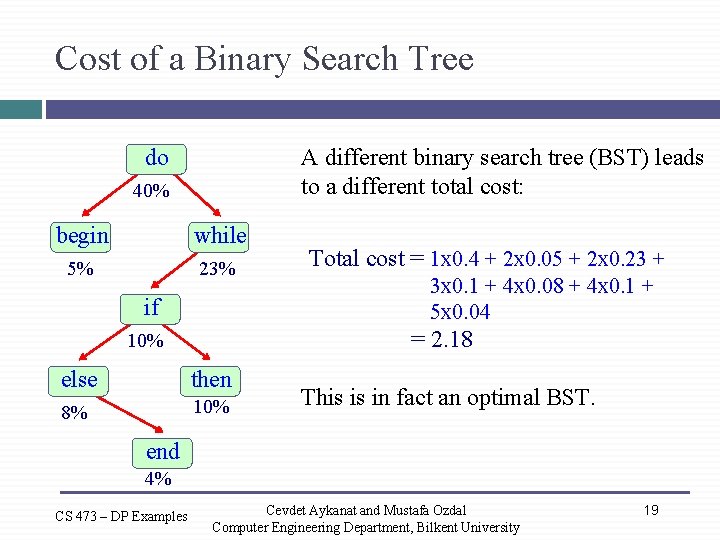
Cost of a Binary Search Tree do A different binary search tree (BST) leads to a different total cost: 40% begin while 5% 23% if Total cost = 1 x 0. 4 + 2 x 0. 05 + 2 x 0. 23 + 3 x 0. 1 + 4 x 0. 08 + 4 x 0. 1 + 5 x 0. 04 = 2. 18 10% else then 8% 10% This is in fact an optimal BST. end 4% CS 473 – DP Examples Cevdet Aykanat and Mustafa Ozdal Computer Engineering Department, Bilkent University 19
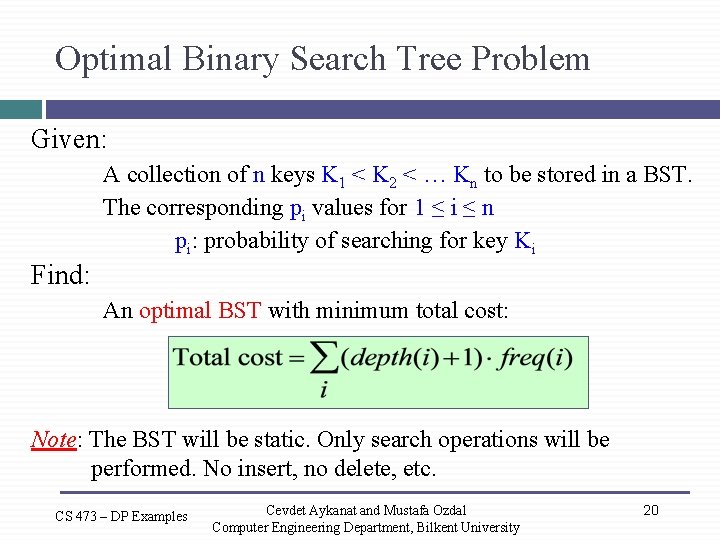
Optimal Binary Search Tree Problem Given: A collection of n keys K 1 < K 2 < … Kn to be stored in a BST. The corresponding pi values for 1 ≤ i ≤ n pi: probability of searching for key Ki Find: An optimal BST with minimum total cost: Note: The BST will be static. Only search operations will be performed. No insert, no delete, etc. CS 473 – DP Examples Cevdet Aykanat and Mustafa Ozdal Computer Engineering Department, Bilkent University 20
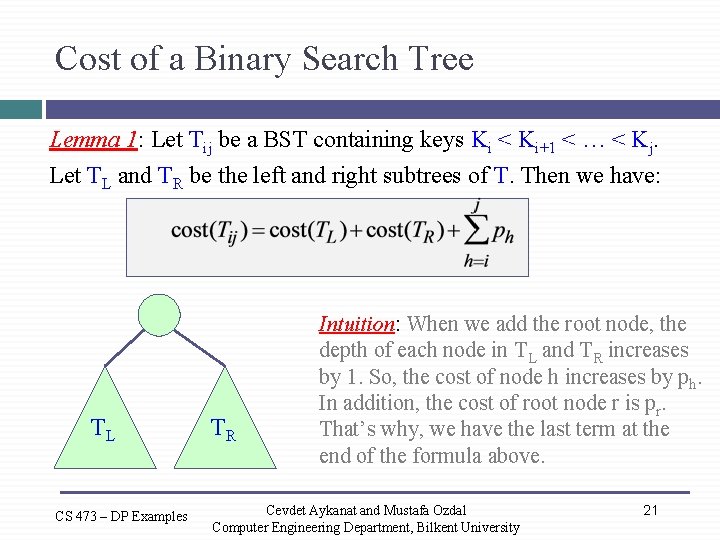
Cost of a Binary Search Tree Lemma 1: Let Tij be a BST containing keys Ki < Ki+1 < … < Kj. Let TL and TR be the left and right subtrees of T. Then we have: TL CS 473 – DP Examples TR Intuition: When we add the root node, the depth of each node in TL and TR increases by 1. So, the cost of node h increases by ph. In addition, the cost of root node r is pr. That’s why, we have the last term at the end of the formula above. Cevdet Aykanat and Mustafa Ozdal Computer Engineering Department, Bilkent University 21
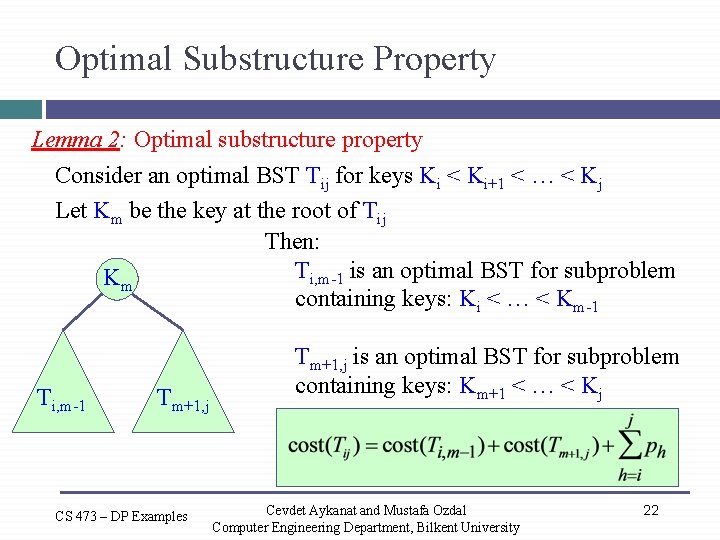
Optimal Substructure Property Lemma 2: Optimal substructure property Consider an optimal BST Tij for keys Ki < Ki+1 < … < Kj Let Km be the key at the root of Tij Then: Ti, m-1 is an optimal BST for subproblem Km containing keys: Ki < … < Km-1 Ti, m-1 Tm+1, j CS 473 – DP Examples Tm+1, j is an optimal BST for subproblem containing keys: Km+1 < … < Kj Cevdet Aykanat and Mustafa Ozdal Computer Engineering Department, Bilkent University 22
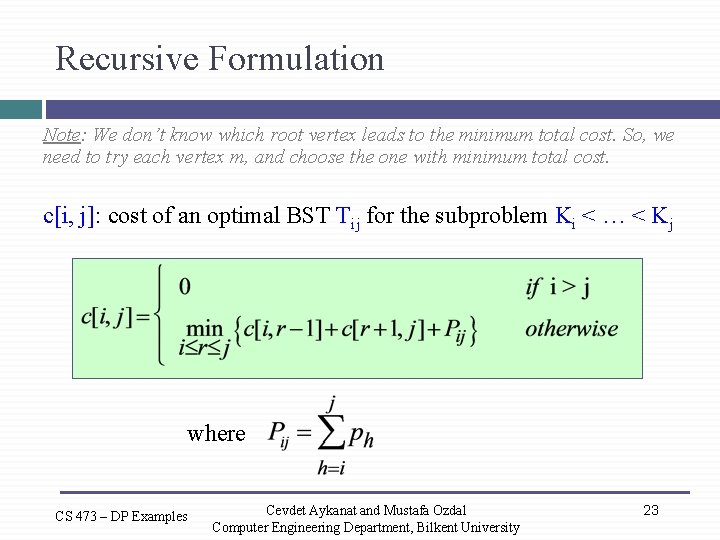
Recursive Formulation Note: We don’t know which root vertex leads to the minimum total cost. So, we need to try each vertex m, and choose the one with minimum total cost. c[i, j]: cost of an optimal BST Tij for the subproblem Ki < … < Kj where CS 473 – DP Examples Cevdet Aykanat and Mustafa Ozdal Computer Engineering Department, Bilkent University 23
![Bottom-up computation How to choose the order in which we process c[i, j] values?](http://slidetodoc.com/presentation_image_h2/49d73e315e6bacf023769cc8aa13ef0c/image-24.jpg "Bottom-up computation How to choose the order in which we process c[i, j] values?")
Bottom-up computation How to choose the order in which we process c[i, j] values? Before computing c[i, j], we have to make sure that the values for c[i, r-1] and c[r+1, j] have been computed for all r. CS 473 – DP Examples Cevdet Aykanat and Mustafa Ozdal Computer Engineering Department, Bilkent University 24
![1 i 1 j n r c[i, r-1] i r c[i, j] must be](http://slidetodoc.com/presentation_image_h2/49d73e315e6bacf023769cc8aa13ef0c/image-25.jpg "1 i 1 j n r c[i, r-1] i r c[i, j] must be")
1 i 1 j n r c[i, r-1] i r c[i, j] must be processed after c[i, r-1] and c[r+1, j] j n CS 473 – DP Examples Cevdet Aykanat and Mustafa Ozdal Computer Engineering Department, Bilkent University 25
![1 i j n 1 i c[i, j] If the entries c[i, j] are](http://slidetodoc.com/presentation_image_h2/49d73e315e6bacf023769cc8aa13ef0c/image-26.jpg "1 i j n 1 i c[i, j] If the entries c[i, j] are")
1 i j n 1 i c[i, j] If the entries c[i, j] are computed in the shown order, then c[i, r-1] and c[r+1, j] values are guaranteed to be computed before c[i, j]. j n CS 473 – DP Examples Cevdet Aykanat and Mustafa Ozdal Computer Engineering Department, Bilkent University 26
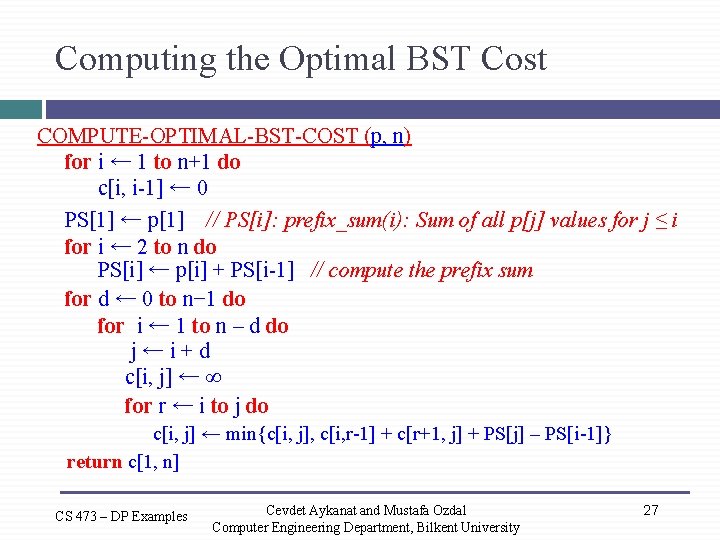
Computing the Optimal BST Cost COMPUTE-OPTIMAL-BST-COST (p, n) for i ← 1 to n+1 do c[i, i-1] ← 0 PS[1] ← p[1] // PS[i]: prefix_sum(i): Sum of all p[j] values for j ≤ i for i ← 2 to n do PS[i] ← p[i] + PS[i-1] // compute the prefix sum for d ← 0 to n− 1 do for i ← 1 to n – d do j←i+d c[i, j] ← ∞ for r ← i to j do c[i, j] ← min{c[i, j], c[i, r-1] + c[r+1, j] + PS[j] – PS[i-1]} return c[1, n] CS 473 – DP Examples Cevdet Aykanat and Mustafa Ozdal Computer Engineering Department, Bilkent University 27
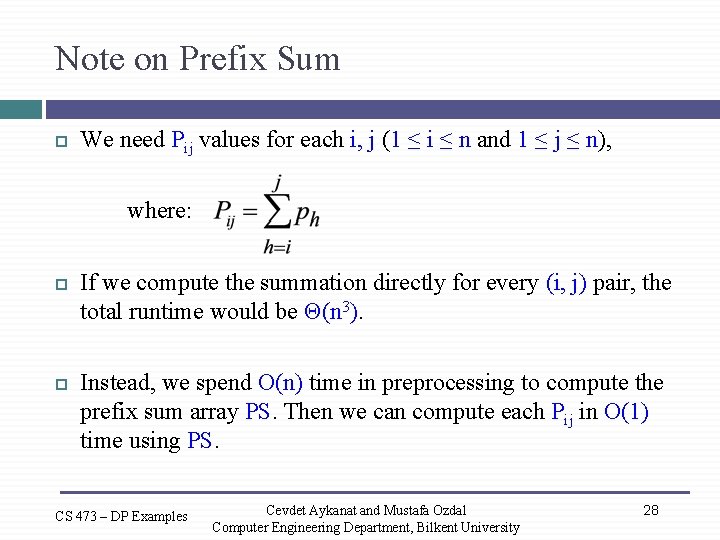
Note on Prefix Sum We need Pij values for each i, j (1 ≤ i ≤ n and 1 ≤ j ≤ n), where: If we compute the summation directly for every (i, j) pair, the total runtime would be Θ(n 3). Instead, we spend O(n) time in preprocessing to compute the prefix sum array PS. Then we can compute each Pij in O(1) time using PS. CS 473 – DP Examples Cevdet Aykanat and Mustafa Ozdal Computer Engineering Department, Bilkent University 28
![Note on Prefix Sum In preprocessing, compute for each i: PS[i]: the sum of](http://slidetodoc.com/presentation_image_h2/49d73e315e6bacf023769cc8aa13ef0c/image-29.jpg "Note on Prefix Sum In preprocessing, compute for each i: PS[i]: the sum of")
Note on Prefix Sum In preprocessing, compute for each i: PS[i]: the sum of p[j] values for 1 ≤ j ≤ i Then, we can compute Pij in O(1) time as follows: Pij = PS[i] – PS[j-1] Example: 1 2 3 4 5 6 7 8 p: 0. 05 0. 02 0. 06 0. 07 0. 20 0. 05 0. 08 0. 02 PS: 0. 05 0. 07 0. 13 0. 20 0. 45 0. 53 0. 55 P 27 = PS[7] – PS[1] = 0. 53 – 0. 05 = 0. 48 P 36 = PS[6] – PS[2] = 0. 45 – 0. 07 = 0. 38 CS 473 – DP Examples Cevdet Aykanat and Mustafa Ozdal Computer Engineering Department, Bilkent University 29
- Slides: 29