
Heuristics CSE 473 University of Washington Daniel S
- Slides: 16
Heuristics CSE 473 University of Washington © Daniel S. Weld
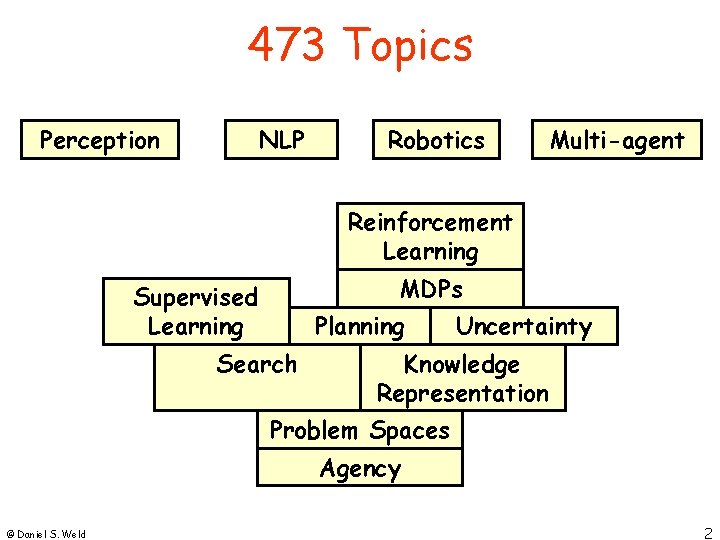
473 Topics Perception NLP Robotics Multi-agent Reinforcement Learning MDPs Supervised Learning Planning Search Uncertainty Knowledge Representation Problem Spaces Agency © Daniel S. Weld 2
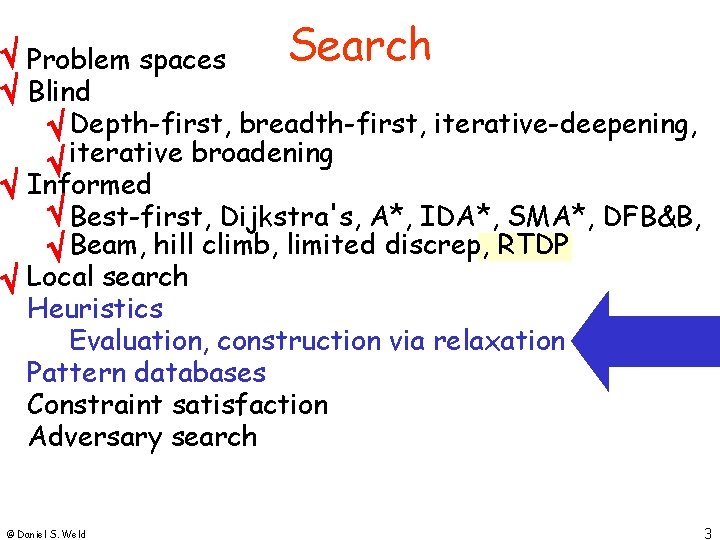
Search Problem spaces Blind Depth-first, breadth-first, iterative-deepening, iterative broadening Informed Best-first, Dijkstra's, A*, IDA*, SMA*, DFB&B, Beam, hill climb, limited discrep, RTDP Local search Heuristics Evaluation, construction via relaxation Pattern databases Constraint satisfaction Adversary search © Daniel S. Weld 3
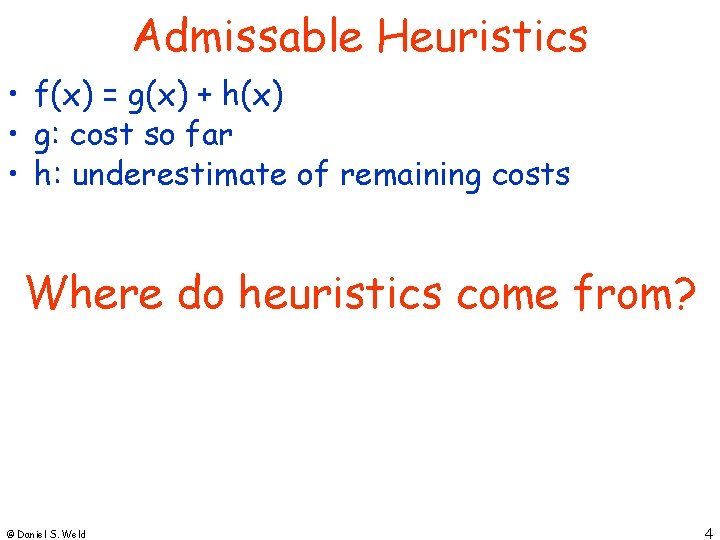
Admissable Heuristics • f(x) = g(x) + h(x) • g: cost so far • h: underestimate of remaining costs Where do heuristics come from? © Daniel S. Weld 4
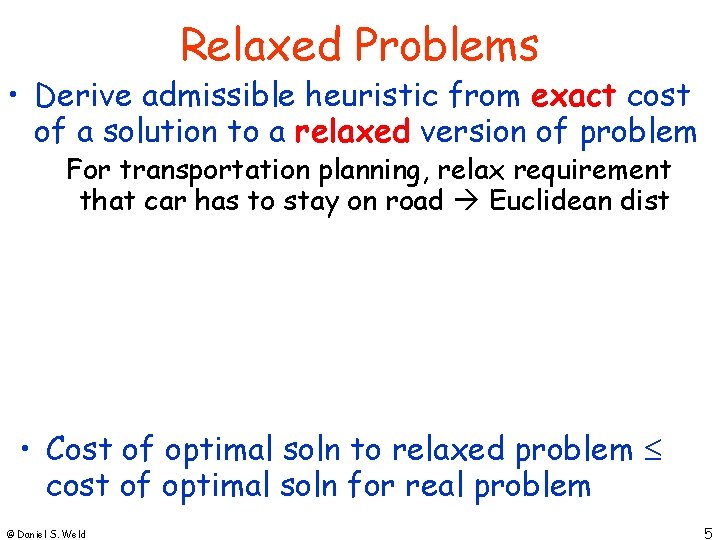
Relaxed Problems • Derive admissible heuristic from exact cost of a solution to a relaxed version of problem For transportation planning, relax requirement that car has to stay on road Euclidean dist For blocks world, distance = # move operations heuristic = number of misplaced blocks What is relaxed problem? # out of place = 2, true distance to goal = 3 • Cost of optimal soln to relaxed problem cost of optimal soln for real problem © Daniel S. Weld 5
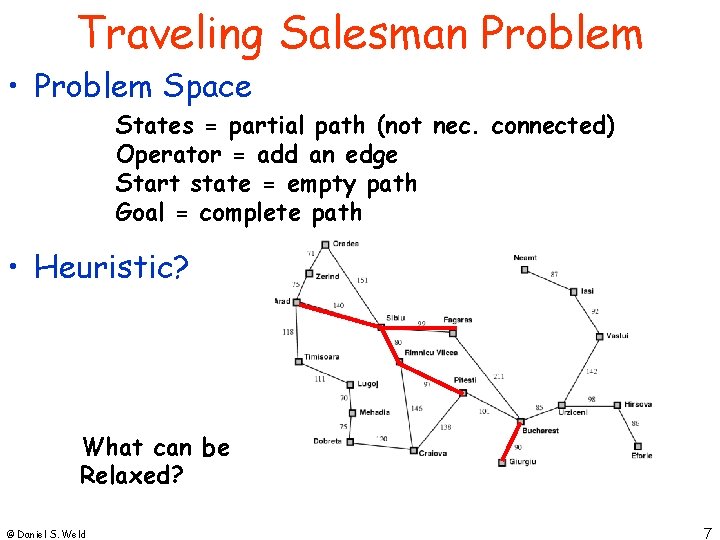
Traveling Salesman Problem • Problem Space States = partial path (not nec. connected) Operator = add an edge Start state = empty path Goal = complete path • Heuristic? What can be Relaxed? © Daniel S. Weld 7
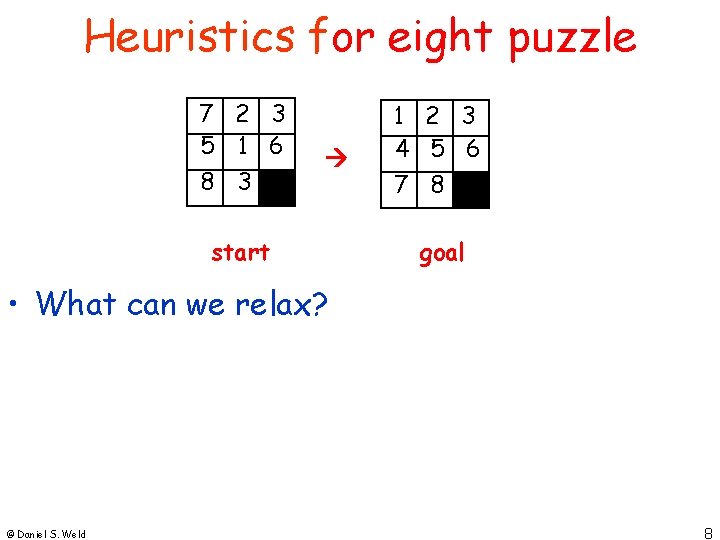
Heuristics for eight puzzle 7 2 3 5 1 6 8 3 start 1 2 3 4 5 6 7 8 goal • What can we relax? © Daniel S. Weld 8
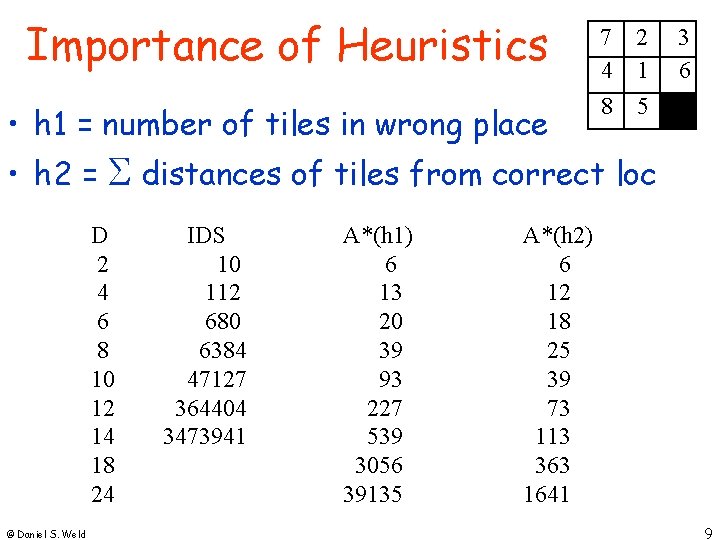
Importance of Heuristics • h 1 = number of tiles in wrong place 7 2 4 1 8 5 3 6 • h 2 = distances of tiles from correct loc D 2 4 6 8 10 12 14 18 24 © Daniel S. Weld IDS 10 112 680 6384 47127 364404 3473941 A*(h 1) 6 13 20 39 93 227 539 3056 39135 A*(h 2) 6 12 18 25 39 73 113 363 1641 9
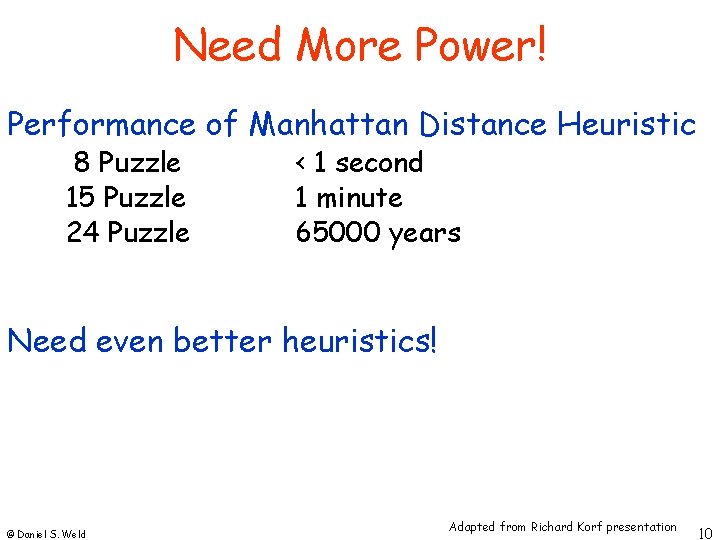
Need More Power! Performance of Manhattan Distance Heuristic 8 Puzzle 15 Puzzle 24 Puzzle < 1 second 1 minute 65000 years Need even better heuristics! © Daniel S. Weld Adapted from Richard Korf presentation 10
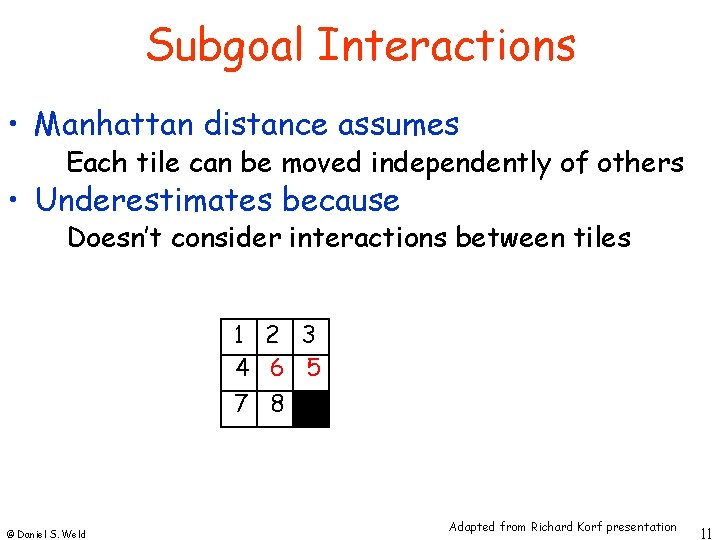
Subgoal Interactions • Manhattan distance assumes Each tile can be moved independently of others • Underestimates because Doesn’t consider interactions between tiles 1 2 3 4 6 5 7 8 © Daniel S. Weld Adapted from Richard Korf presentation 11
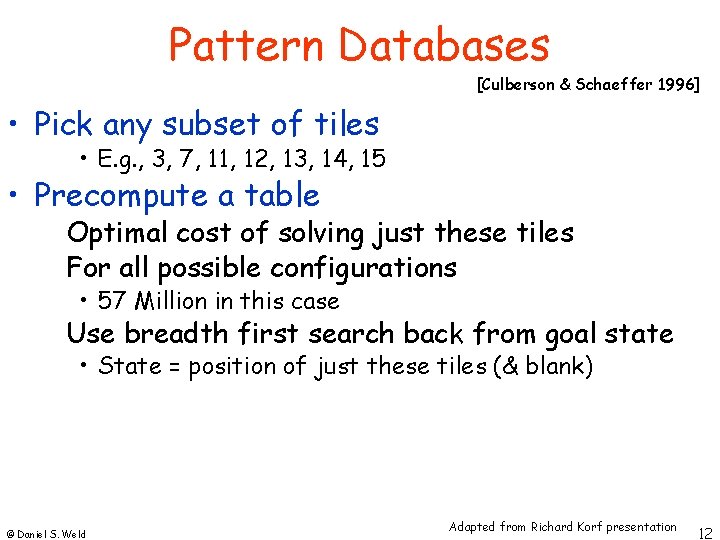
Pattern Databases [Culberson & Schaeffer 1996] • Pick any subset of tiles • E. g. , 3, 7, 11, 12, 13, 14, 15 • Precompute a table Optimal cost of solving just these tiles For all possible configurations • 57 Million in this case Use breadth first search back from goal state • State = position of just these tiles (& blank) © Daniel S. Weld Adapted from Richard Korf presentation 12
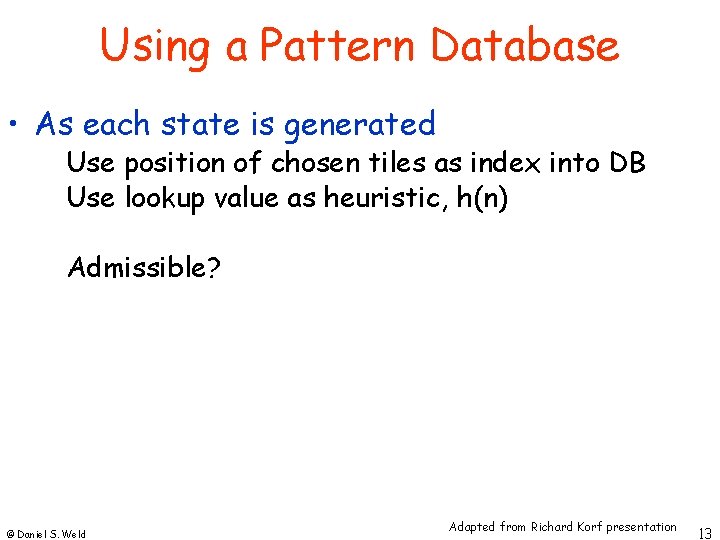
Using a Pattern Database • As each state is generated Use position of chosen tiles as index into DB Use lookup value as heuristic, h(n) Admissible? © Daniel S. Weld Adapted from Richard Korf presentation 13
Combining Multiple Databases • Can choose another set of tiles Precompute multiple tables • How combine table values? • E. g. Optimal solutions to Rubik’s cube First found w/ IDA* using pattern DB heuristics Multiple DBs were used (dif subsets of cubies) Most problems solved optimally in 1 day Compare with 574, 000 years for IDDFS © Daniel S. Weld Adapted from Richard Korf presentation 14
Drawbacks of Standard Pattern DBs • Since we can only take max Diminishing returns on additional DBs • Would like to be able to add values © Daniel S. Weld Adapted from Richard Korf presentation 15
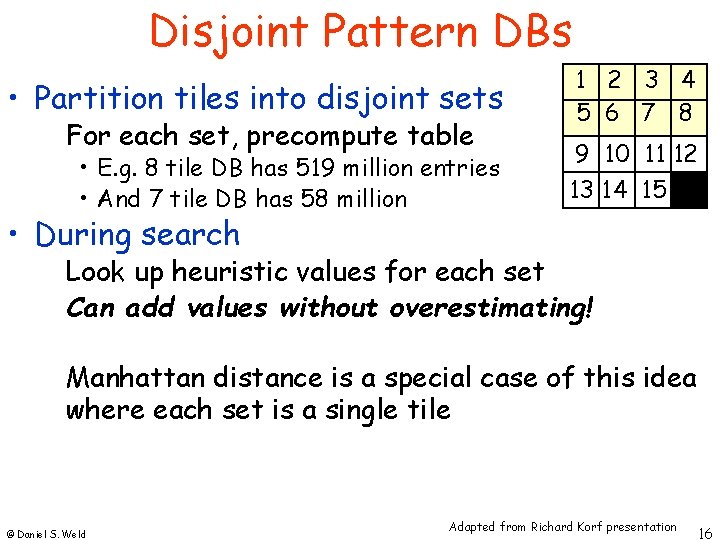
Disjoint Pattern DBs • Partition tiles into disjoint sets For each set, precompute table • E. g. 8 tile DB has 519 million entries • And 7 tile DB has 58 million 1 2 3 4 5 6 7 8 9 10 11 12 13 14 15 • During search Look up heuristic values for each set Can add values without overestimating! Manhattan distance is a special case of this idea where each set is a single tile © Daniel S. Weld Adapted from Richard Korf presentation 16
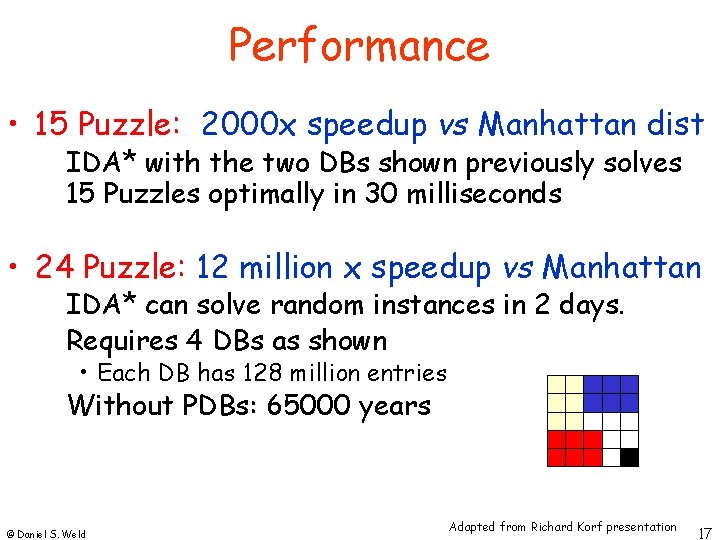
Performance • 15 Puzzle: 2000 x speedup vs Manhattan dist IDA* with the two DBs shown previously solves 15 Puzzles optimally in 30 milliseconds • 24 Puzzle: 12 million x speedup vs Manhattan IDA* can solve random instances in 2 days. Requires 4 DBs as shown • Each DB has 128 million entries Without PDBs: 65000 years © Daniel S. Weld Adapted from Richard Korf presentation 17