Lauri Naukkarinen Tatu Kosonen KariMatti Kangas LUTSaimia Cap
- Slides: 25
Lauri Naukkarinen Tatu Kosonen Kari-Matti Kangas LUT/Saimia Cap. Gemini Code Camp 17. 10. 2012 Java EE Technologies
Objectives � What is Java EE � Why use Java EE � Examples
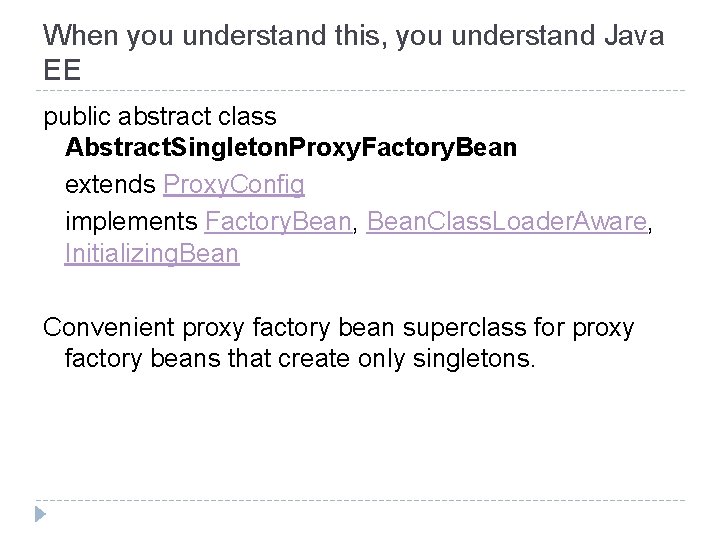
When you understand this, you understand Java EE public abstract class Abstract. Singleton. Proxy. Factory. Bean extends Proxy. Config implements Factory. Bean, Bean. Class. Loader. Aware, Initializing. Bean Convenient proxy factory bean superclass for proxy factory beans that create only singletons.
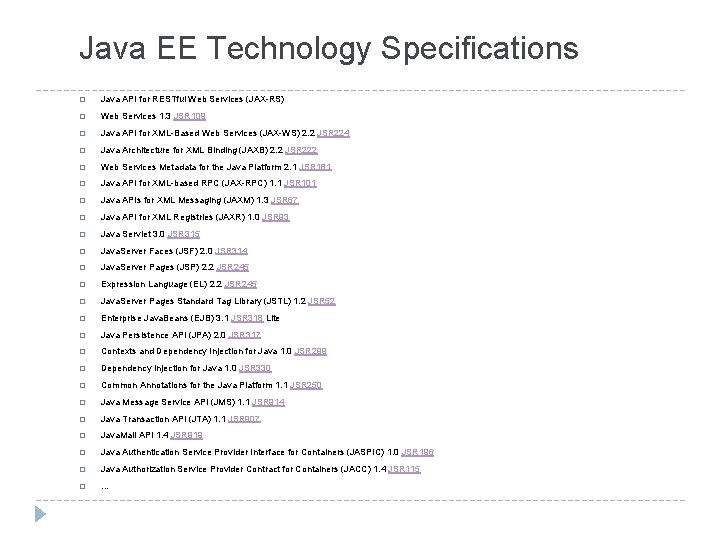
Java EE Technology Specifications � Java API for RESTful Web Services (JAX-RS) � Web Services 1. 3 JSR 109 � Java API for XML-Based Web Services (JAX-WS) 2. 2 JSR 224 � Java Architecture for XML Binding (JAXB) 2. 2 JSR 222 � Web Services Metadata for the Java Platform 2. 1 JSR 181 � Java API for XML-based RPC (JAX-RPC) 1. 1 JSR 101 � Java APIs for XML Messaging (JAXM) 1. 3 JSR 67 � Java API for XML Registries (JAXR) 1. 0 JSR 93 � Java Servlet 3. 0 JSR 315 � Java. Server Faces (JSF) 2. 0 JSR 314 � Java. Server Pages (JSP) 2. 2 JSR 245 � Expression Language (EL) 2. 2 JSR 245 � Java. Server Pages Standard Tag Library (JSTL) 1. 2 JSR 52 � Enterprise Java. Beans (EJB) 3. 1 JSR 318 Lite � Java Persistence API (JPA) 2. 0 JSR 317 � Contexts and Dependency Injection for Java 1. 0 JSR 299 � Dependency Injection for Java 1. 0 JSR 330 � Common Annotations for the Java Platform 1. 1 JSR 250 � Java Message Service API (JMS) 1. 1 JSR 914 � Java Transaction API (JTA) 1. 1 JSR 907 � Java. Mail API 1. 4 JSR 919 � Java Authentication Service Provider Interface for Containers (JASPIC) 1. 0 JSR 196 � Java Authorization Service Provider Contract for Containers (JACC) 1. 4 JSR 115 � …
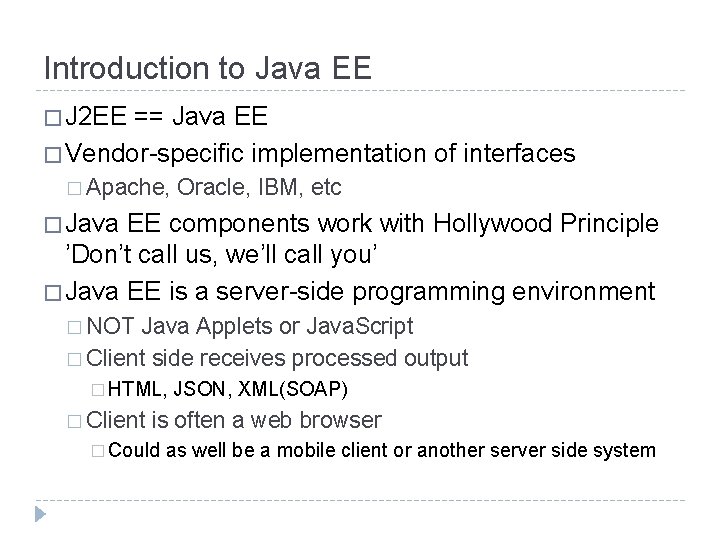
Introduction to Java EE � J 2 EE == Java EE � Vendor-specific implementation of interfaces � Apache, Oracle, IBM, etc � Java EE components work with Hollywood Principle ’Don’t call us, we’ll call you’ � Java EE is a server-side programming environment � NOT Java Applets or Java. Script � Client side receives processed output � HTML, � Client JSON, XML(SOAP) is often a web browser � Could as well be a mobile client or another server side system
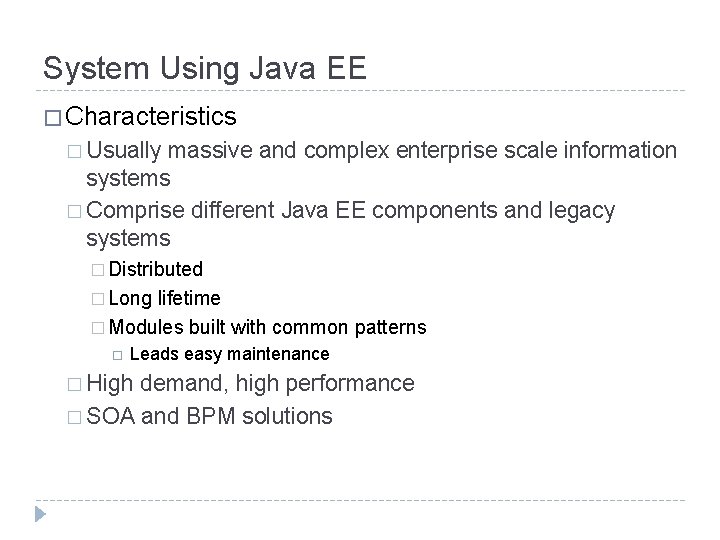
System Using Java EE � Characteristics � Usually massive and complex enterprise scale information systems � Comprise different Java EE components and legacy systems � Distributed � Long lifetime � Modules built with common patterns Leads easy maintenance � High demand, high performance � SOA and BPM solutions
Traditional Java EE Users � Examples of use � Insurance companies � Online banks � Manufacturing industries � Public sector ’Cobol of the 21 st century’
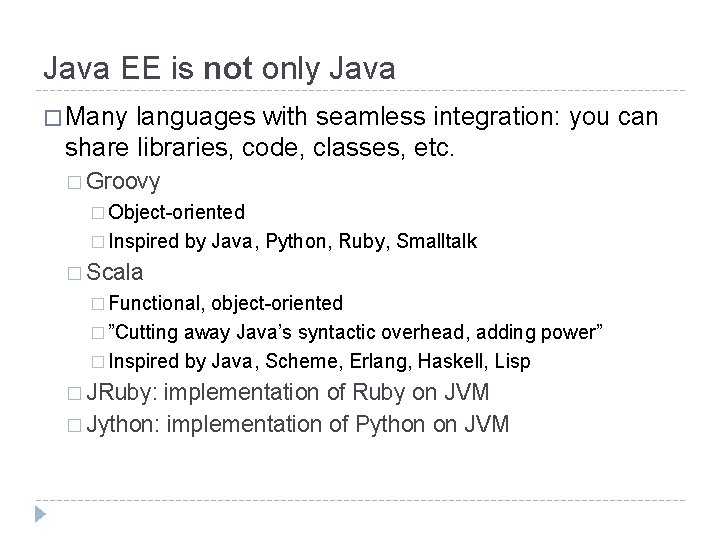
Java EE is not only Java � Many languages with seamless integration: you can share libraries, code, classes, etc. � Groovy � Object-oriented � Inspired by Java, Python, Ruby, Smalltalk � Scala � Functional, object-oriented � ”Cutting away Java’s syntactic overhead, adding power” � Inspired by Java, Scheme, Erlang, Haskell, Lisp � JRuby: implementation of Ruby on JVM � Jython: implementation of Python on JVM
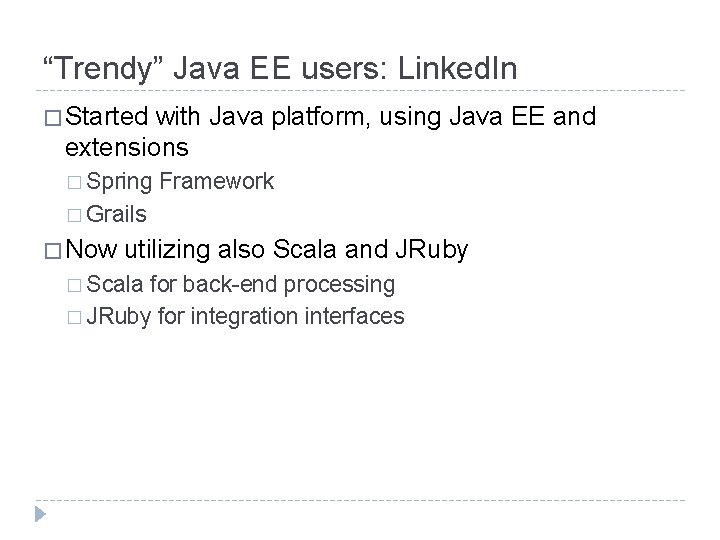
“Trendy” Java EE users: Linked. In � Started with Java platform, using Java EE and extensions � Spring Framework � Grails � Now utilizing also Scala and JRuby � Scala for back-end processing � JRuby for integration interfaces
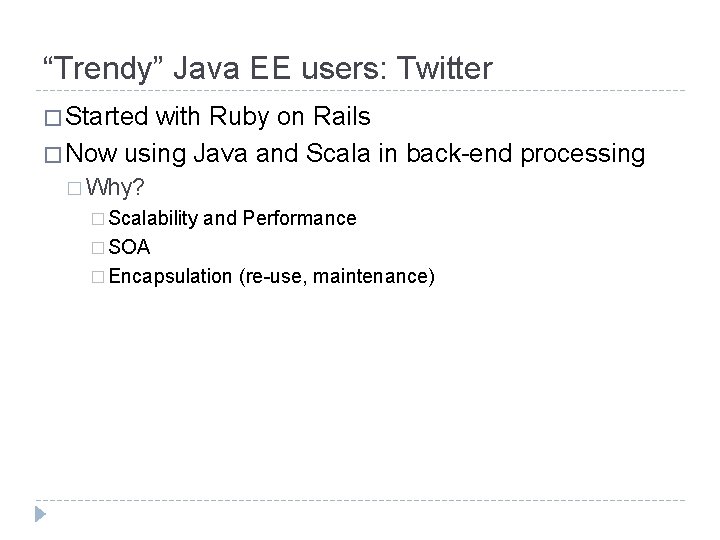
“Trendy” Java EE users: Twitter � Started with Ruby on Rails � Now using Java and Scala in back-end processing � Why? � Scalability and Performance � SOA � Encapsulation (re-use, maintenance)
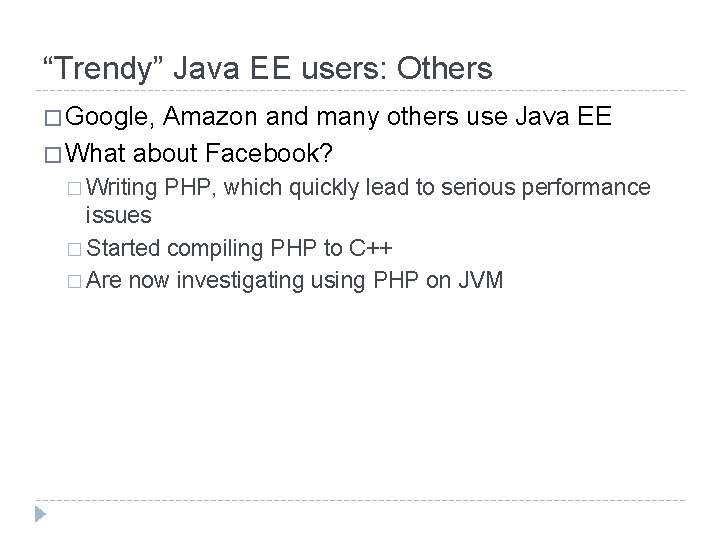
“Trendy” Java EE users: Others � Google, Amazon and many others use Java EE � What about Facebook? � Writing PHP, which quickly lead to serious performance issues � Started compiling PHP to C++ � Are now investigating using PHP on JVM
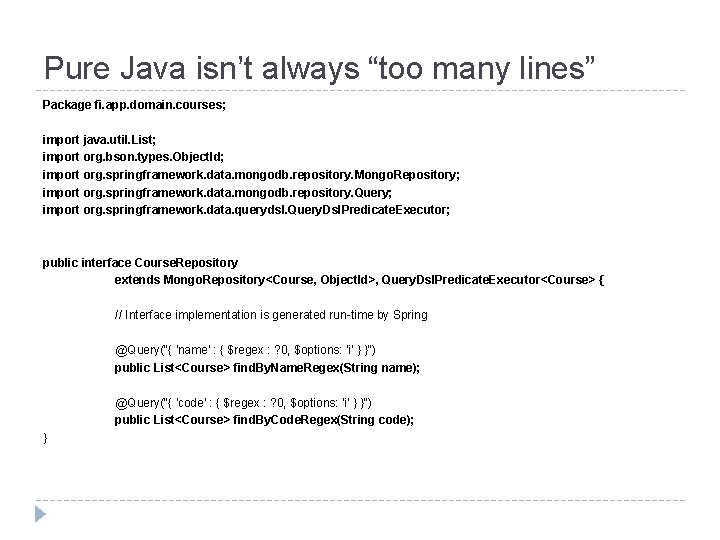
Pure Java isn’t always “too many lines” Package fi. app. domain. courses; import java. util. List; import org. bson. types. Object. Id; import org. springframework. data. mongodb. repository. Mongo. Repository; import org. springframework. data. mongodb. repository. Query; import org. springframework. data. querydsl. Query. Dsl. Predicate. Executor; public interface Course. Repository extends Mongo. Repository<Course, Object. Id>, Query. Dsl. Predicate. Executor<Course> { // Interface implementation is generated run-time by Spring @Query("{ 'name' : { $regex : ? 0, $options: 'i' } }") public List<Course> find. By. Name. Regex(String name); @Query("{ 'code' : { $regex : ? 0, $options: 'i' } }") public List<Course> find. By. Code. Regex(String code); }
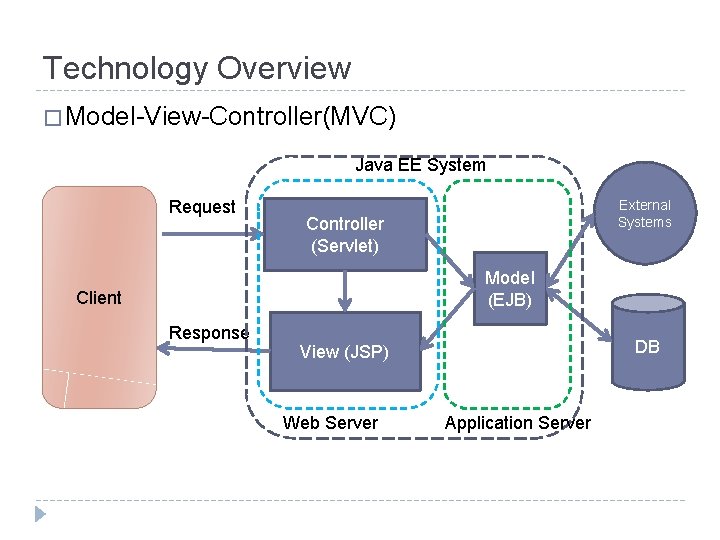
Technology Overview � Model-View-Controller(MVC) Java EE System Request External Systems Controller (Servlet) bv Client Response Model (EJB) DB View (JSP) Web Server Application Server
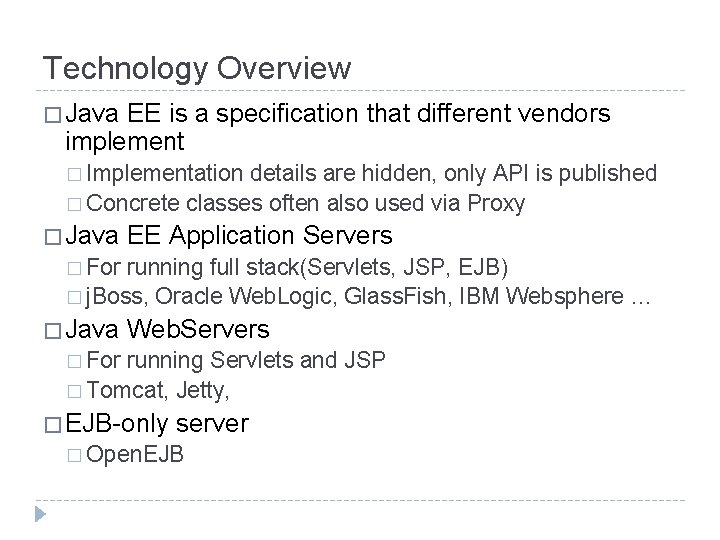
Technology Overview � Java EE is a specification that different vendors implement � Implementation details are hidden, only API is published � Concrete classes often also used via Proxy � Java EE Application Servers � For running full stack(Servlets, JSP, EJB) � j. Boss, Oracle Web. Logic, Glass. Fish, IBM Websphere … � Java Web. Servers � For running Servlets and JSP � Tomcat, Jetty, � EJB-only server � Open. EJB
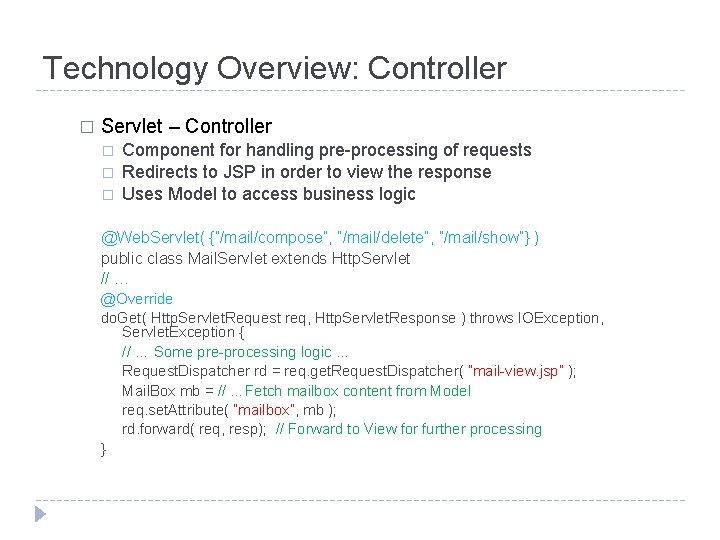
Technology Overview: Controller � Servlet – Controller � � � Component for handling pre-processing of requests Redirects to JSP in order to view the response Uses Model to access business logic @Web. Servlet( {”/mail/compose”, ”/mail/delete”, ”/mail/show”} ) public class Mail. Servlet extends Http. Servlet // … @Override do. Get( Http. Servlet. Request req, Http. Servlet. Response ) throws IOException, Servlet. Exception { // … Some pre-processing logic … Request. Dispatcher rd = req. get. Request. Dispatcher( ”mail-view. jsp” ); Mail. Box mb = // …Fetch mailbox content from Model req. set. Attribute( ”mailbox”, mb ); rd. forward( req, resp); // Forward to View for further processing }
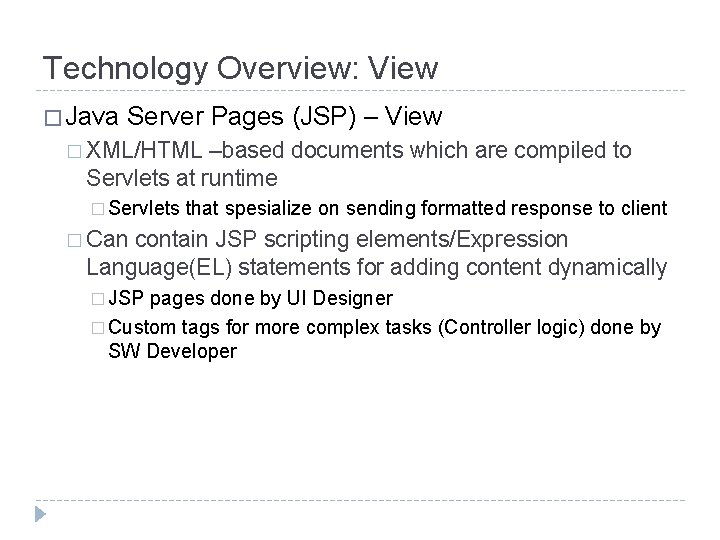
Technology Overview: View � Java Server Pages (JSP) – View � XML/HTML –based documents which are compiled to Servlets at runtime � Servlets that spesialize on sending formatted response to client � Can contain JSP scripting elements/Expression Language(EL) statements for adding content dynamically � JSP pages done by UI Designer � Custom tags for more complex tasks (Controller logic) done by SW Developer
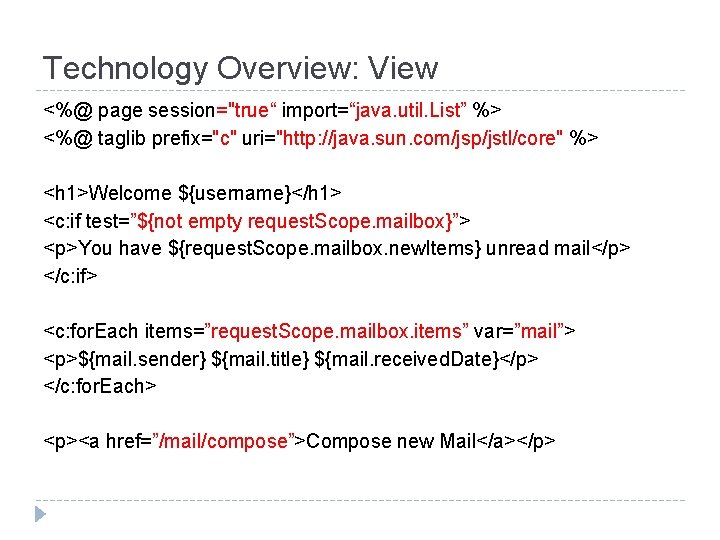
Technology Overview: View <%@ page session="true“ import=“java. util. List” %> <%@ taglib prefix="c" uri="http: //java. sun. com/jsp/jstl/core" %> <h 1>Welcome ${username}</h 1> <c: if test=”${not empty request. Scope. mailbox}”> <p>You have ${request. Scope. mailbox. new. Items} unread mail</p> </c: if> <c: for. Each items=”request. Scope. mailbox. items” var=”mail”> <p>${mail. sender} ${mail. title} ${mail. received. Date}</p> </c: for. Each> <p><a href=”/mail/compose”>Compose new Mail</a></p>
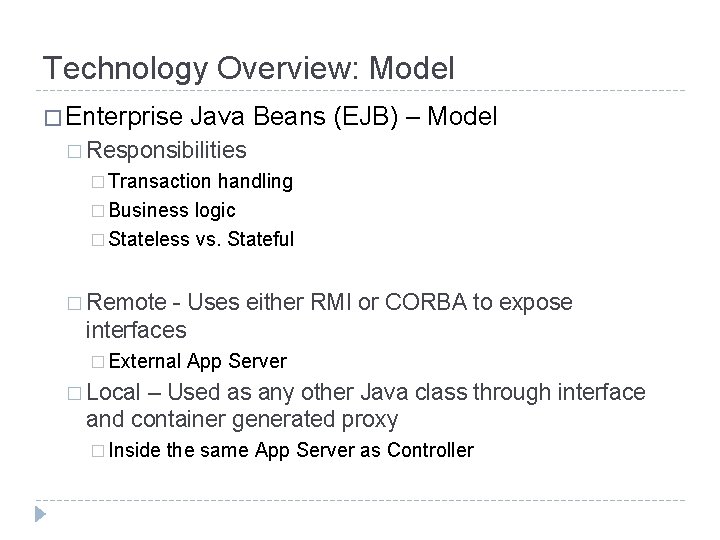
Technology Overview: Model � Enterprise Java Beans (EJB) – Model � Responsibilities � Transaction handling � Business logic � Stateless vs. Stateful � Remote - Uses either RMI or CORBA to expose interfaces � External App Server � Local – Used as any other Java class through interface and container generated proxy � Inside the same App Server as Controller
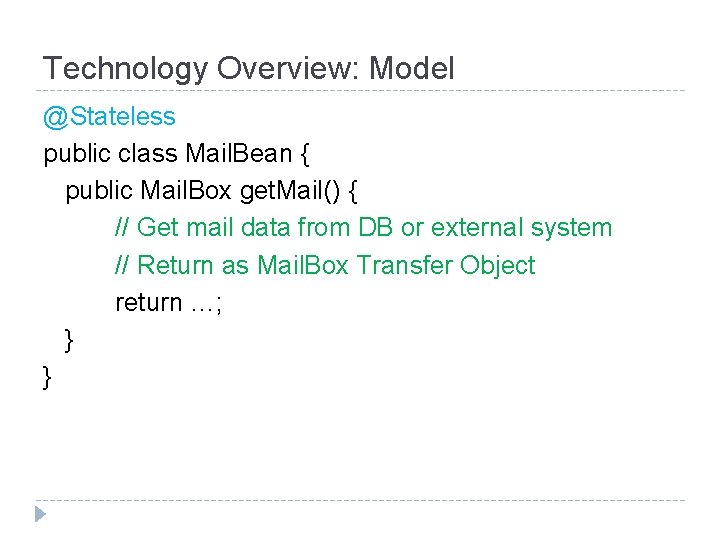
Technology Overview: Model @Stateless public class Mail. Bean { public Mail. Box get. Mail() { // Get mail data from DB or external system // Return as Mail. Box Transfer Object return …; } }
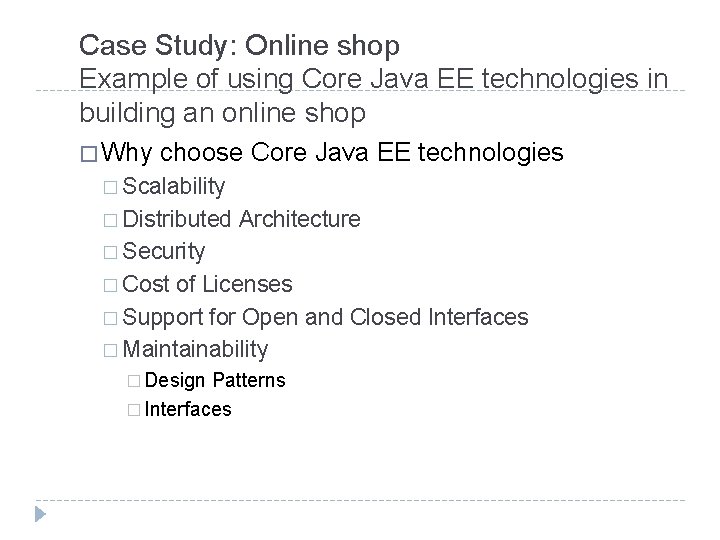
Case Study: Online shop Example of using Core Java EE technologies in building an online shop � Why choose Core Java EE technologies � Scalability � Distributed Architecture � Security � Cost of Licenses � Support for Open and Closed Interfaces � Maintainability � Design Patterns � Interfaces
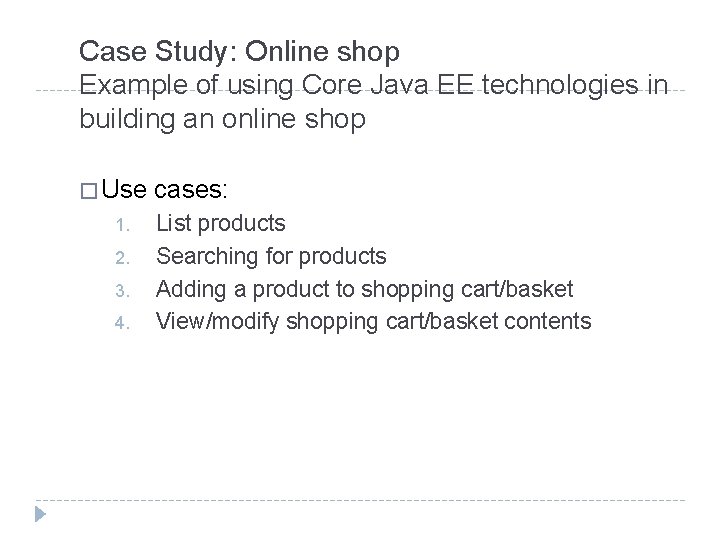
Case Study: Online shop Example of using Core Java EE technologies in building an online shop � Use 1. 2. 3. 4. cases: List products Searching for products Adding a product to shopping cart/basket View/modify shopping cart/basket contents
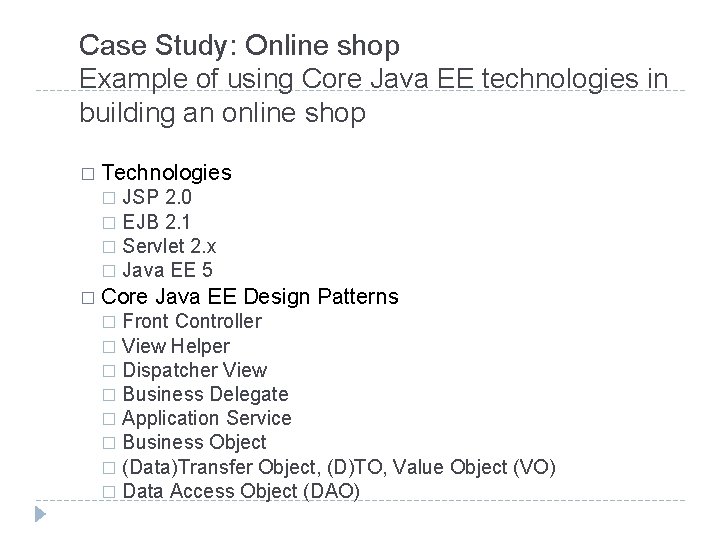
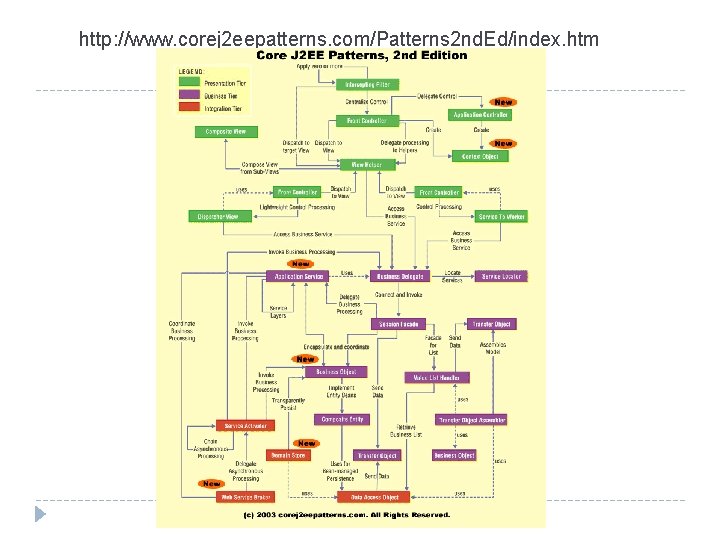
Case Study: Online shop Example of using Core Java EE technologies in building an online shop � Technologies JSP 2. 0 � EJB 2. 1 � Servlet 2. x � Java EE 5 � � Core Java EE Design Patterns Front Controller � View Helper � Dispatcher View � Business Delegate � Application Service � Business Object � (Data)Transfer Object, (D)TO, Value Object (VO) � Data Access Object (DAO) �
http: //www. corej 2 eepatterns. com/Patterns 2 nd. Ed/index. htm
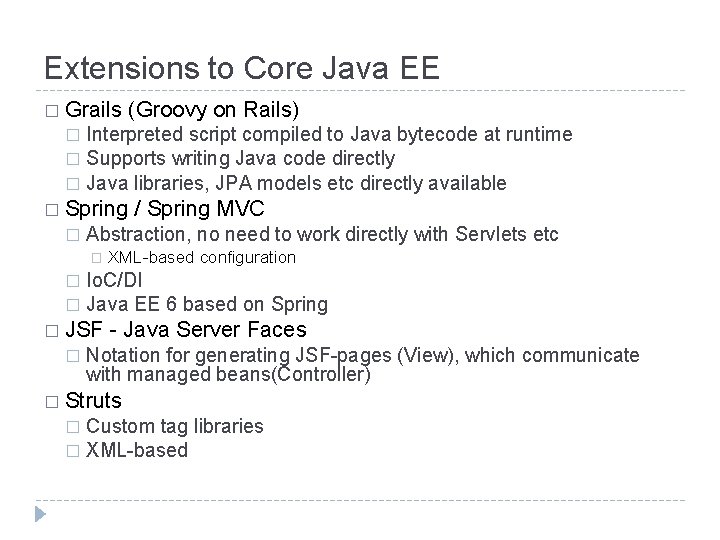
Extensions to Core Java EE � Grails (Groovy on Rails) Interpreted script compiled to Java bytecode at runtime � Supports writing Java code directly � Java libraries, JPA models etc directly available � � Spring � / Spring MVC Abstraction, no need to work directly with Servlets etc � XML-based configuration Io. C/DI � Java EE 6 based on Spring � � JSF � - Java Server Faces Notation for generating JSF-pages (View), which communicate with managed beans(Controller) � Struts Custom tag libraries � XML-based �
Questions / Comments ? Thank you!