KaiMin Chung Academia Sinica joint work with Zhenming




- Slides: 34
Kai-Min Chung (Academia Sinica) joint work with Zhenming Liu (Princeton) and Rafael Pass (Cornell NY Tech)
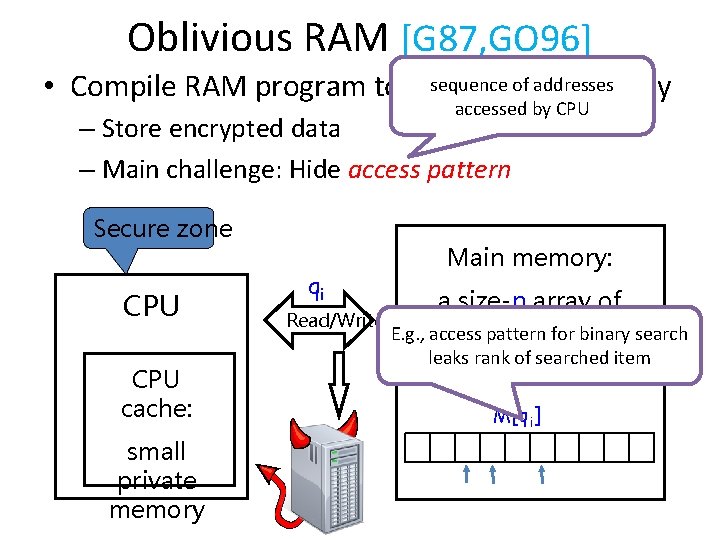
Oblivious RAM [G 87, GO 96] sequence of addresses • Compile RAM program to protect data privacy accessed by CPU – Store encrypted data – Main challenge: Hide access pattern Secure zone CPU cache: small private memory qi Main memory: a size-n array of Read/Write memory cells E. g. , access pattern for binary search leaks rank of searched item (words) M[qi]
Cloud Storage Scenario Access data from the cloud Encrypt the data Alice Hide the access pattern Bob is curious
Oblivious RAM—hide access pattern • Design an oblivious data structure implements – a big array of n memory cells with – Read(addr) & Write(addr, val) functionality • Goal: hide access pattern
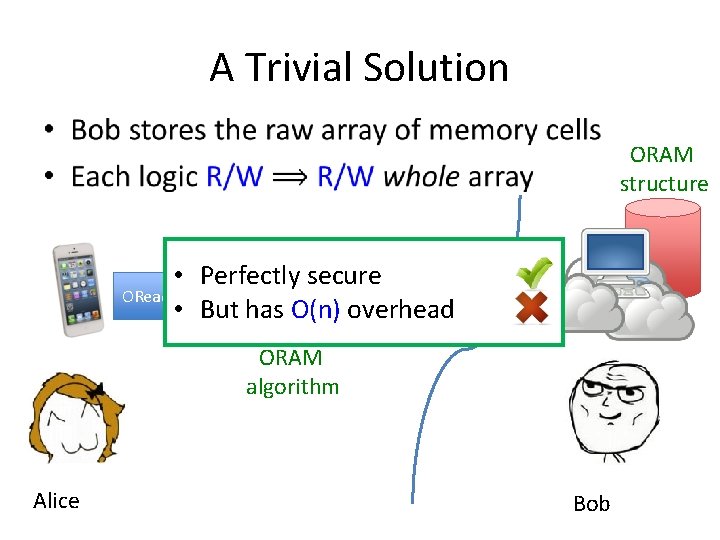
Illustration • ORAM structure Multiple Read/Write ORead/OWrite ORAM algorithm Alice Bob
Oblivious RAM—hide access pattern • Design an oblivious data structure implements – a big array of n memory cells with – Read(addr) & Write(addr, val) functionality • Goal: hide access pattern – For any two sequences of Read/Write operations Q 1, Q 2 of equal length, the access patterns are statistically / computationally indistinguishable
A Trivial Solution • ORAM structure • Perfectly secure. Multiple ORead/OWrite Read/Write • But has O(n) overhead ORAM algorithm Alice Bob
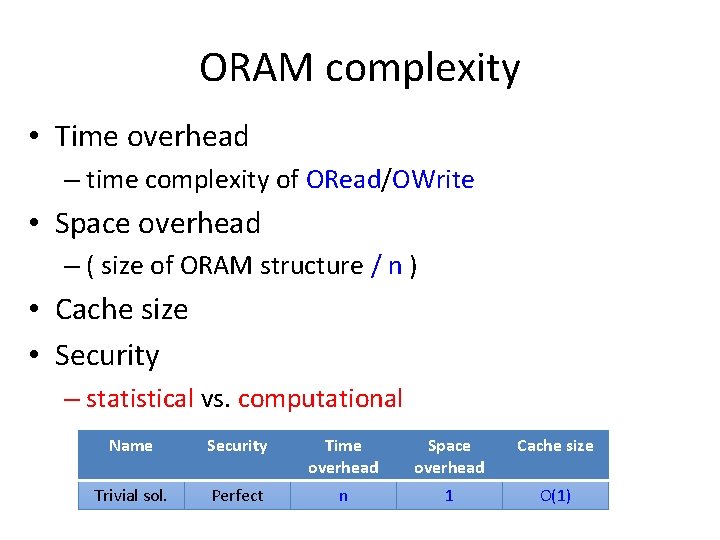
ORAM complexity • Time overhead – time complexity of ORead/OWrite • Space overhead – ( size of ORAM structure / n ) • Cache size • Security – statistical vs. computational Name Security Time overhead Space overhead Cache size Trivial sol. Perfect n 1 O(1)
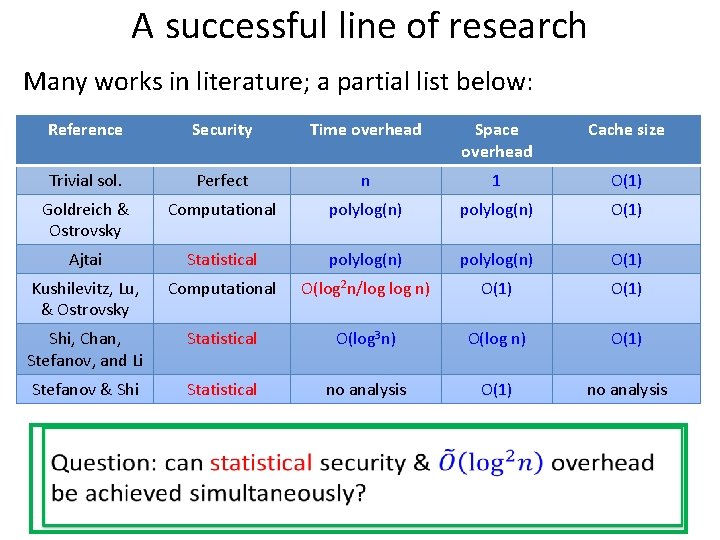
A successful line of research Many works in literature; a partial list below: Reference Security Time overhead Space overhead Cache size Trivial sol. Perfect n 1 O(1) Goldreich & Ostrovsky Computational polylog(n) O(1) Ajtai Statistical polylog(n) O(1) Kushilevitz, Lu, & Ostrovsky Computational O(log 2 n/log n) O(1) Shi, Chan, Stefanov, and Li Statistical O(log 3 n) O(log n) O(1) Stefanov & Shi Statistical no analysis O(1) no analysis
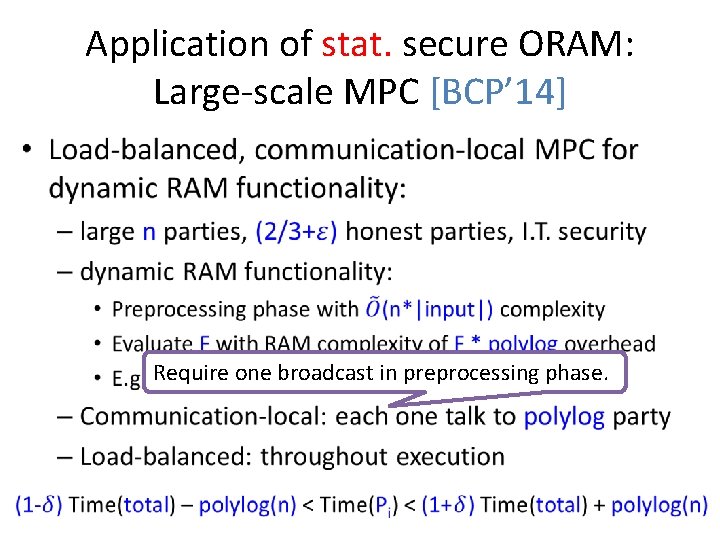
Why statistical security? • We need to encrypt data, which is only computationally secure anyway. So, why statistical security? • Ans 1: Why not? It provides stronger guarantee, which is better. • Ans 2: It enables new applications! – Large scale MPC with several new features [BCP 14] • emulate ORAM w/ secret sharing as I. T. -secure encryption • require stat. secure ORAM to achieve I. T. -secure MPC
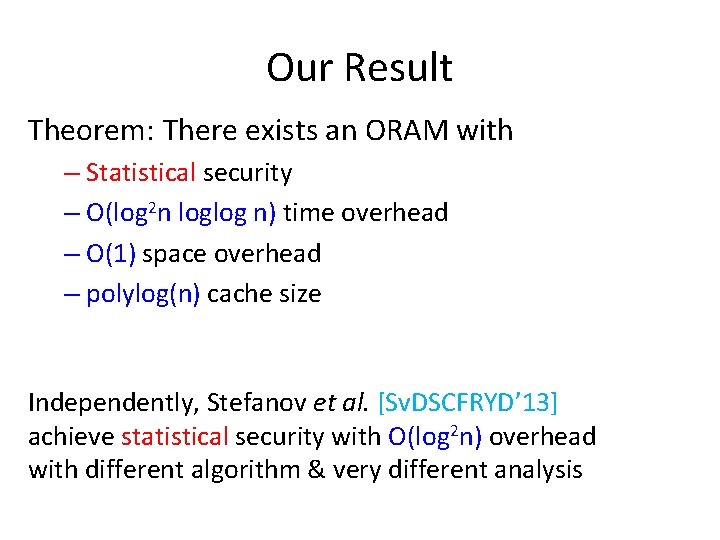
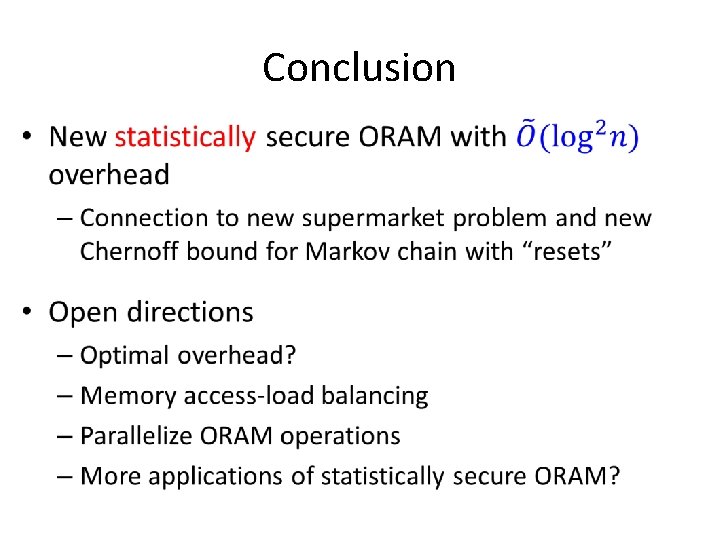
Our Result Theorem: There exists an ORAM with – Statistical security – O(log 2 n loglog n) time overhead – O(1) space overhead – polylog(n) cache size Independently, Stefanov et al. [Sv. DSCFRYD’ 13] achieve statistical security with O(log 2 n) overhead with different algorithm & very different analysis
Tree-base ORAM framework of [SCSL’ 10]
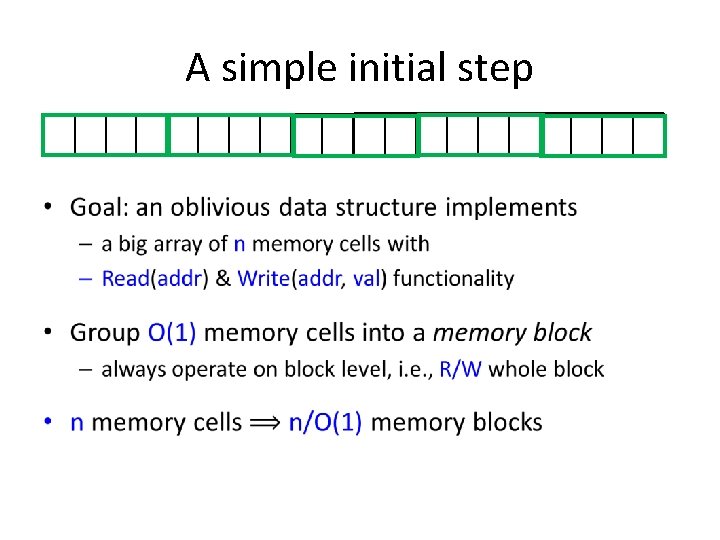
A simple initial step •
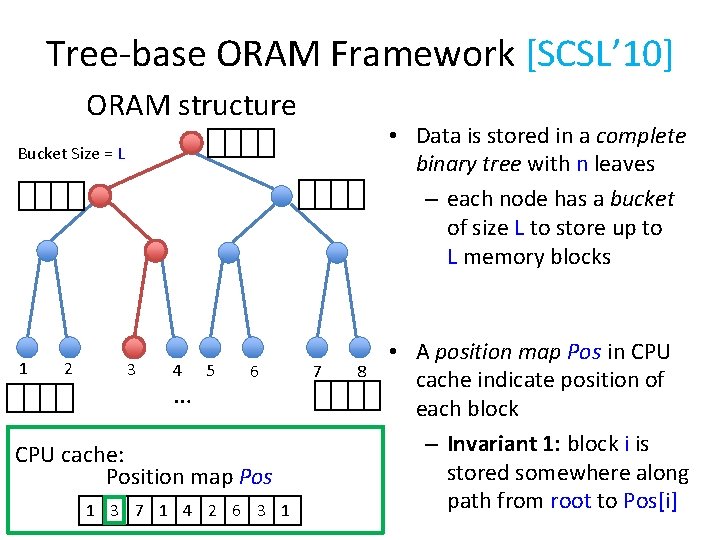
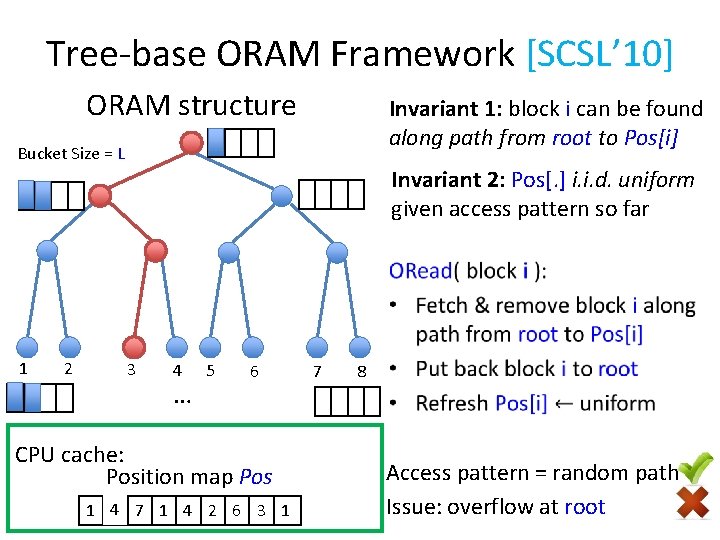
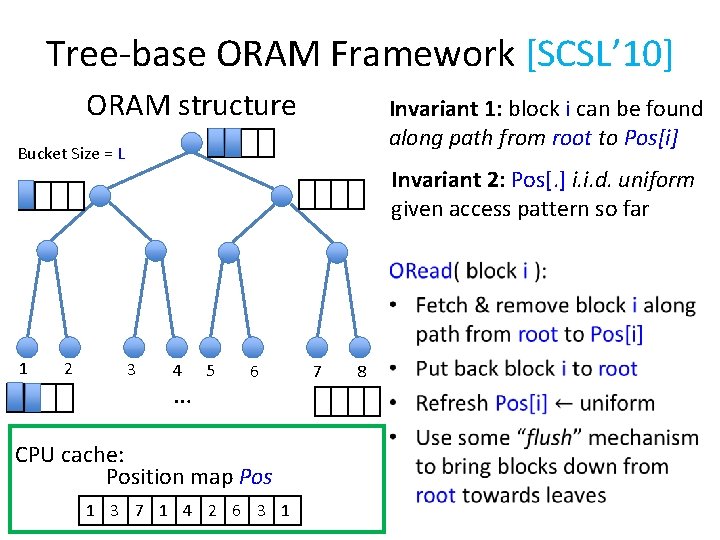
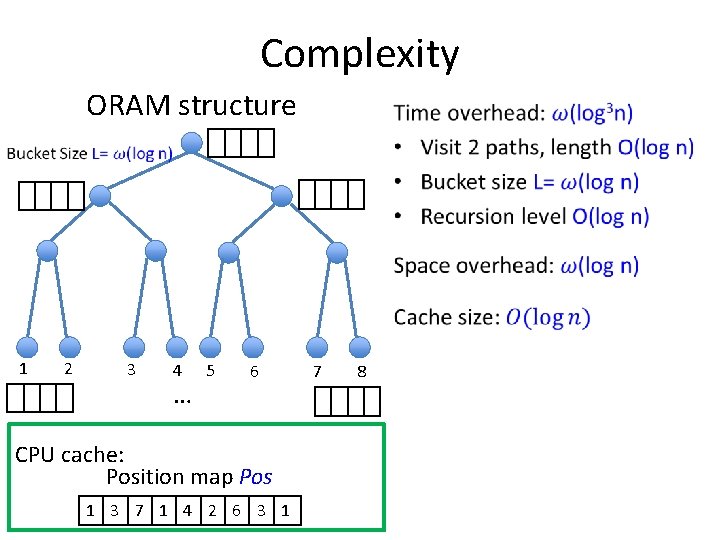
Tree-base ORAM Framework [SCSL’ 10] ORAM structure • Data is stored in a complete binary tree with n leaves – each node has a bucket of size L to store up to L memory blocks Bucket Size = L 1 2 3 4 … 5 6 CPU cache: Position map Pos 1 3 7 1 4 2 6 3 1 7 8 • A position map Pos in CPU cache indicate position of each block – Invariant 1: block i is stored somewhere along path from root to Pos[i]
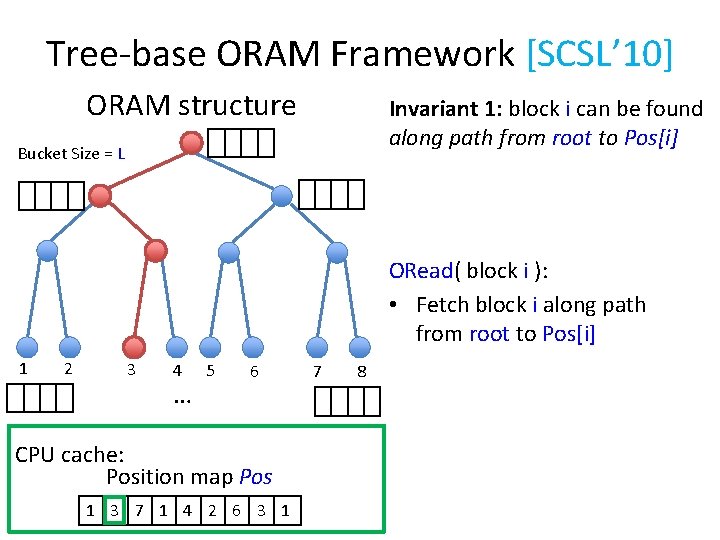
Tree-base ORAM Framework [SCSL’ 10] ORAM structure Invariant 1: block i can be found along path from root to Pos[i] Bucket Size = L ORead( block i ): • Fetch block i along path from root to Pos[i] 1 2 3 4 … 5 6 CPU cache: Position map Pos 1 3 7 1 4 2 6 3 1 7 8
Tree-base ORAM Framework [SCSL’ 10] ORAM structure Invariant 1: block i can be found along path from root to Pos[i] Bucket Size = L Invariant 2: Pos[. ] i. i. d. uniform given access pattern so far • 1 2 3 4 … 5 6 CPU cache: Position map Pos 1 4 3 7 1 4 2 6 3 1 7 8 Access pattern = random path Issue: overflow at root
Tree-base ORAM Framework [SCSL’ 10] ORAM structure Invariant 1: block i can be found along path from root to Pos[i] Bucket Size = L Invariant 2: Pos[. ] i. i. d. uniform given access pattern so far • 1 2 3 4 … 5 6 CPU cache: Position map Pos 1 3 7 1 4 2 6 3 1 7 8
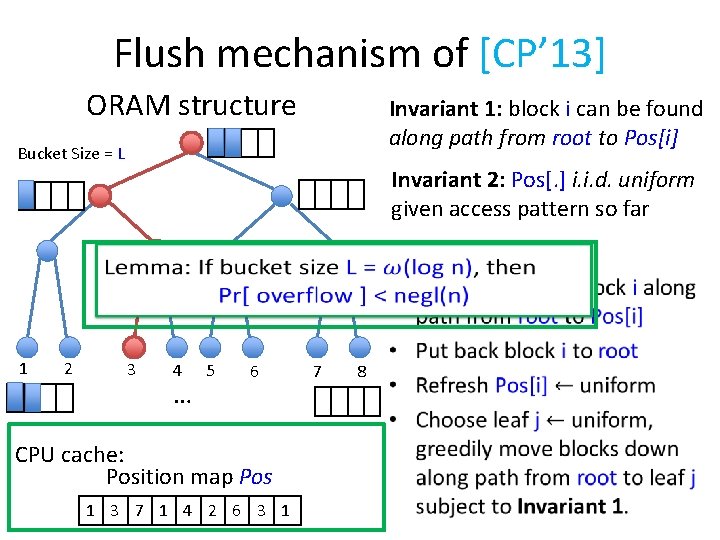
Flush mechanism of [CP’ 13] ORAM structure Invariant 1: block i can be found along path from root to Pos[i] Bucket Size = L Invariant 2: Pos[. ] i. i. d. uniform given access pattern so far • 1 2 3 4 … 5 6 CPU cache: Position map Pos 1 3 7 1 4 2 6 3 1 7 8
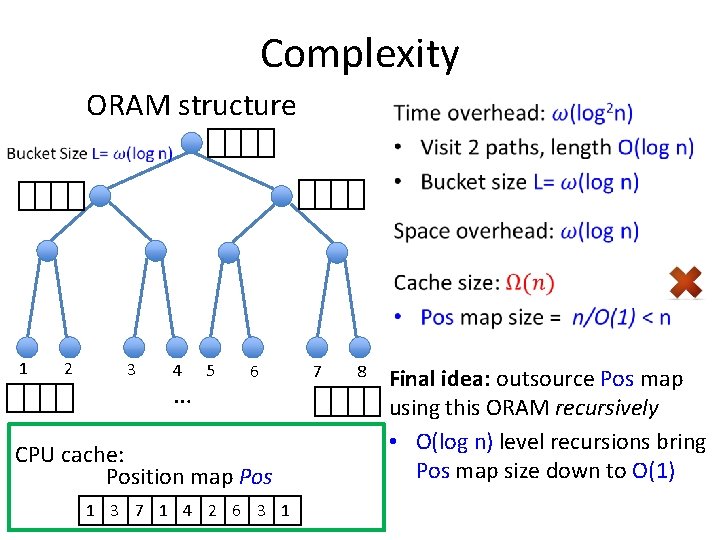
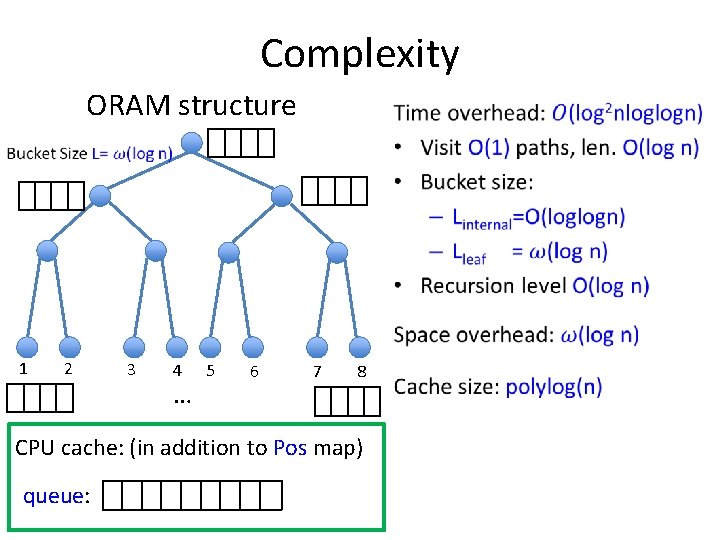
Complexity ORAM structure 1 2 3 4 … 5 6 CPU cache: Position map Pos 1 3 7 1 4 2 6 3 1 • 7 8 Final idea: outsource Pos map using this ORAM recursively • O(log n) level recursions bring Pos map size down to O(1)
Complexity ORAM structure 1 2 3 4 … 5 6 CPU cache: Position map Pos 1 3 7 1 4 2 6 3 1 • 7 8
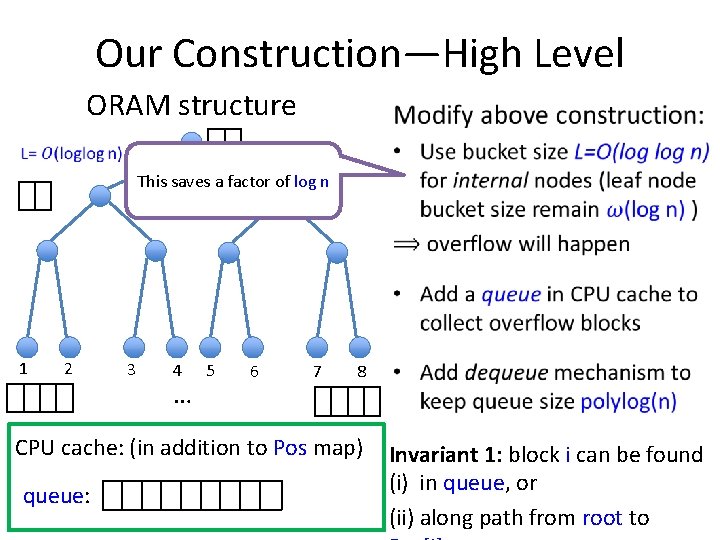
Our Construction—High Level ORAM structure • This saves a factor of log n 1 2 3 4 … 5 6 7 8 CPU cache: (in addition to Pos map) queue: Invariant 1: block i can be found (i) in queue, or (ii) along path from root to
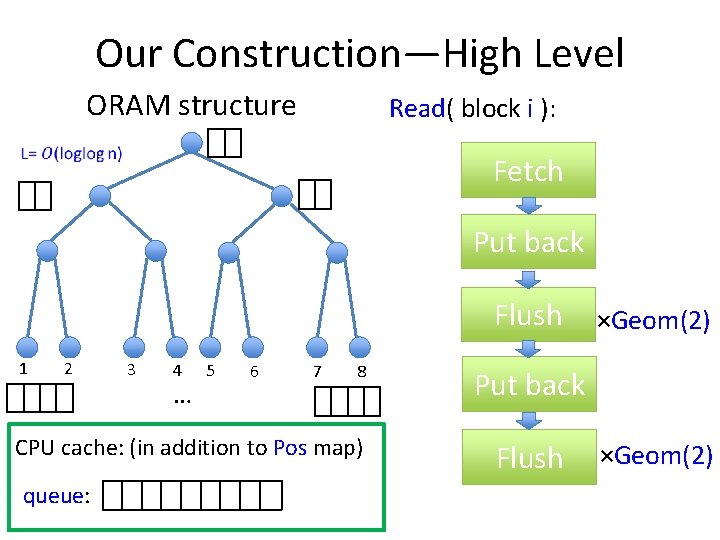
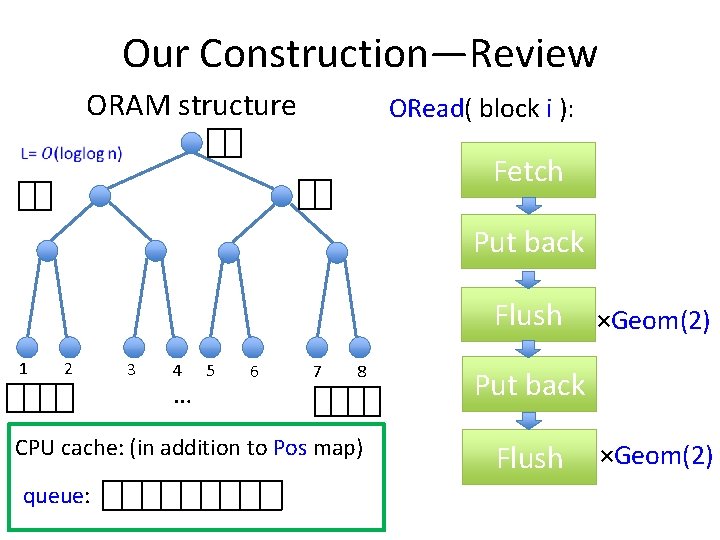
Our Construction—High Level ORAM structure Read( block i ): Fetch Put back Flush 1 2 3 4 … 5 6 7 8 CPU cache: (in addition to Pos map) queue: ×Geom(2) Put back Flush ×Geom(2)
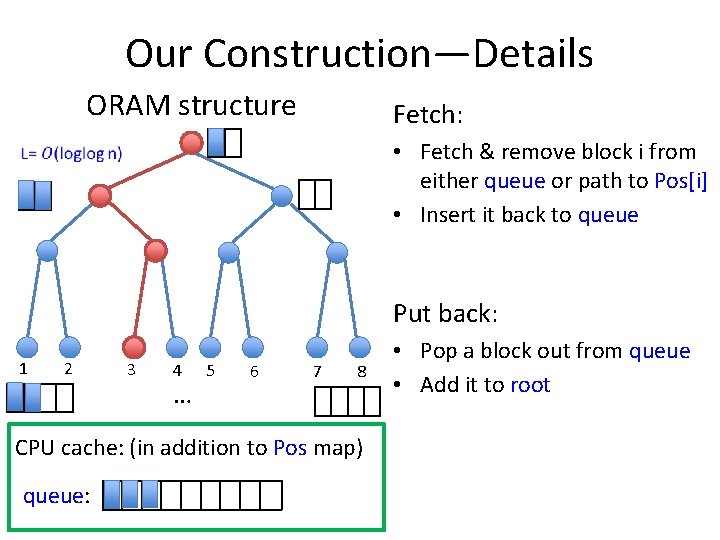
Our Construction—Details ORAM structure Fetch: • Fetch & remove block i from either queue or path to Pos[i] • Insert it back to queue Put back: 1 2 3 4 … 5 6 7 8 CPU cache: (in addition to Pos map) queue: • Pop a block out from queue • Add it to root
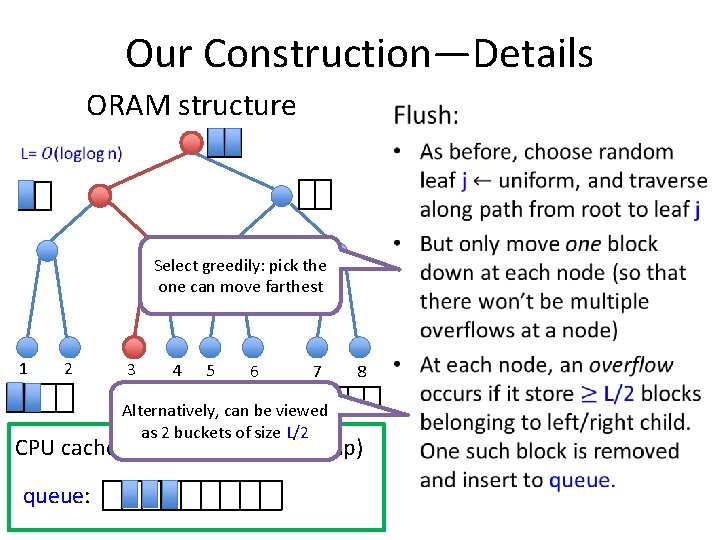
Our Construction—Details ORAM structure • Select greedily: pick the one can move farthest 1 2 3 4 5 6 7 … Alternatively, can be viewed as 2 buckets of size L/2 8 CPU cache: (in addition to Pos map) queue:
Our Construction—Review ORAM structure ORead( block i ): Fetch Put back Flush 1 2 3 4 … 5 6 7 8 CPU cache: (in addition to Pos map) queue: ×Geom(2) Put back Flush ×Geom(2)
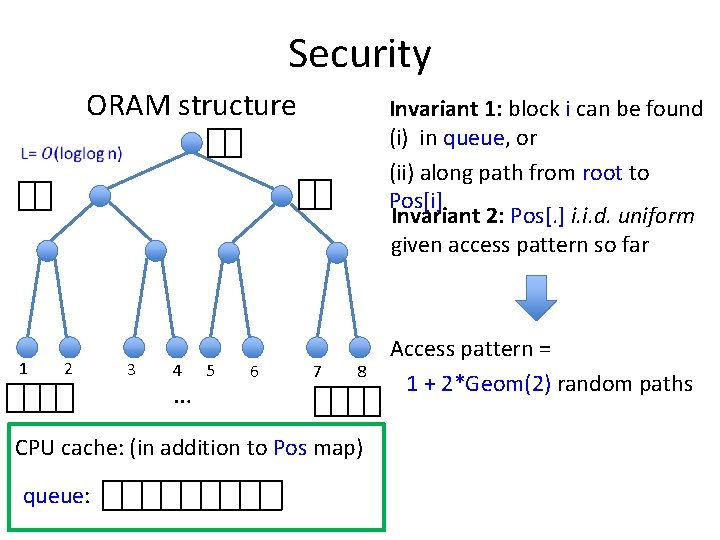
Security ORAM structure 1 2 3 4 … 5 6 Invariant 1: block i can be found (i) in queue, or (ii) along path from root to Pos[i] Invariant 2: Pos[. ] i. i. d. uniform given access pattern so far 7 8 CPU cache: (in addition to Pos map) queue: Access pattern = 1 + 2*Geom(2) random paths
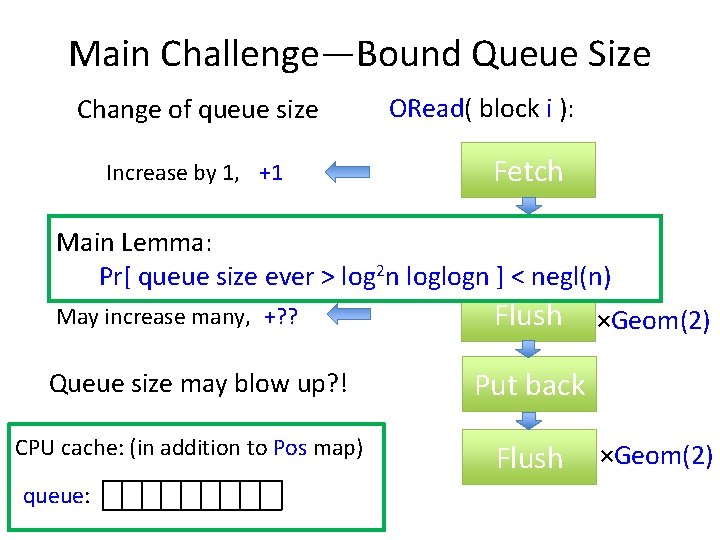
Main Challenge—Bound Queue Size Change of queue size Increase by 1, +1 ORead( block i ): Fetch Main. Decrease Lemma: by 1, -1 Put back Pr[ queue size ever > log 2 n loglogn ] < negl(n) May increase many, +? ? Queue size may blow up? ! CPU cache: (in addition to Pos map) queue: Flush ×Geom(2) Put back Flush ×Geom(2)
Complexity ORAM structure 1 2 3 4 … 5 6 • 7 8 CPU cache: (in addition to Pos map) queue:
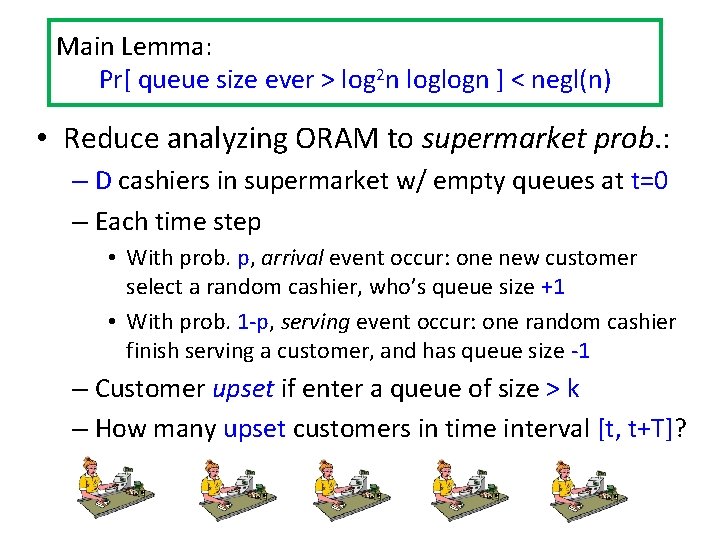
Main Lemma: Pr[ queue size ever > log 2 n loglogn ] < negl(n) • Reduce analyzing ORAM to supermarket prob. : – D cashiers in supermarket w/ empty queues at t=0 – Each time step • With prob. p, arrival event occur: one new customer select a random cashier, who’s queue size +1 • With prob. 1 -p, serving event occur: one random cashier finish serving a customer, and has queue size -1 – Customer upset if enter a queue of size > k – How many upset customers in time interval [t, t+T]?
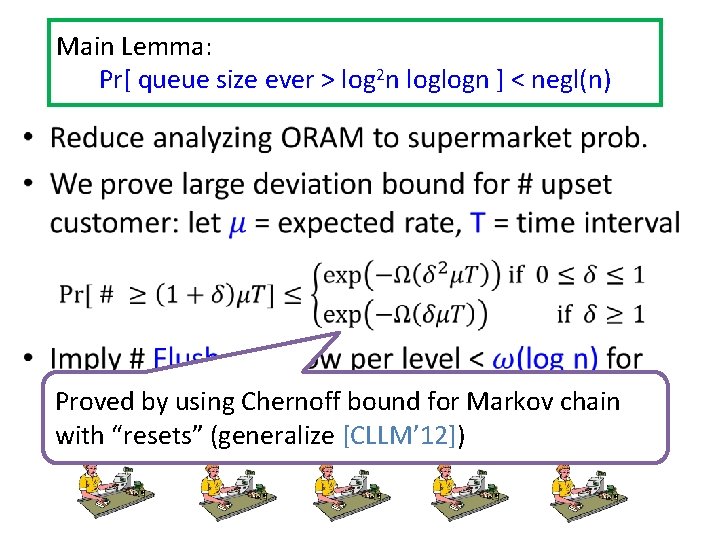
Main Lemma: Pr[ queue size ever > log 2 n loglogn ] < negl(n) • Proved by using Chernoff bound for Markov chain with “resets” (generalize [CLLM’ 12])
Application of stat. secure ORAM: Large-scale MPC [BCP’ 14] • Require one broadcast in preprocessing phase.
Conclusion •
Thank you! Questions?