
Transitioning from Academia to Industry Myths and Truths
- Slides: 35
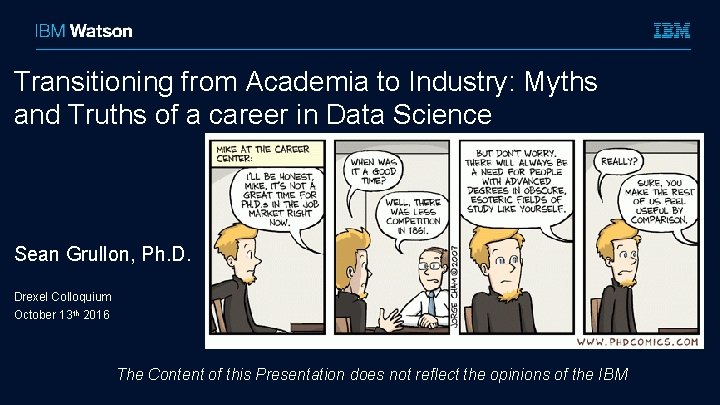
Transitioning from Academia to Industry: Myths and Truths of a career in Data Science Sean Grullon, Ph. D. Drexel Colloquium October 13 th 2016 The Content of this Presentation does not reflect the opinions of the IBM
Outline • What is Data Science? • Common Myths in Data Science • Data Science with IBM Watson • Transitioning from Academia to Data Science - Lessons learned • Discussion 2
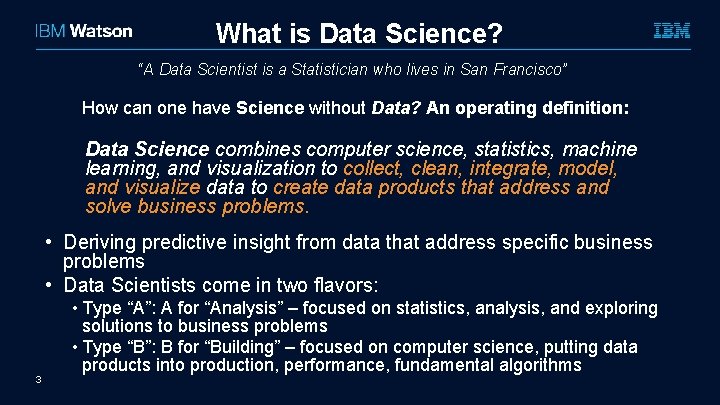
What is Data Science? “A Data Scientist is a Statistician who lives in San Francisco” How can one have Science without Data? An operating definition: Data Science combines computer science, statistics, machine learning, and visualization to collect, clean, integrate, model, and visualize data to create data products that address and solve business problems. • Deriving predictive insight from data that address specific business problems • Data Scientists come in two flavors: 3 • Type “A”: A for “Analysis” – focused on statistics, analysis, and exploring solutions to business problems • Type “B”: B for “Building” – focused on computer science, putting data products into production, performance, fundamental algorithms
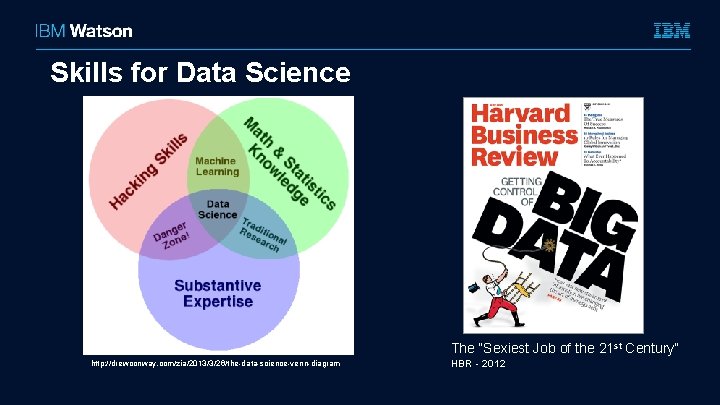
Skills for Data Science The “Sexiest Job of the 21 st Century” http: //drewconway. com/zia/2013/3/26/the-data-science-venn-diagram HBR - 2012
Data Science “Bread & Butter”: Advertising • Sponsored Search (Google Adwords and Adsense) is how Google cornered the search engine market. Google revenue around $50 bn/year from marketing, 97% of Google’s revenue. • Sponsored search uses an auction – a pure competition for marketers trying to win access to consumers, who make ~30 billion search requests/month. • In other words, a competition for models of consumers – their likelihood of responding to the ad – and of determining the right bid for the item.
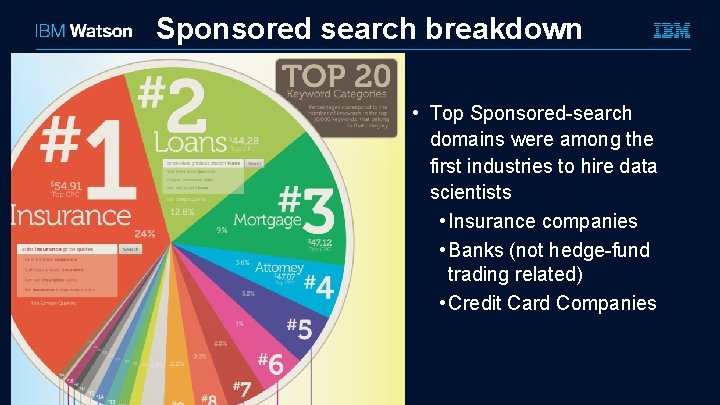
Sponsored search breakdown • Top Sponsored-search domains were among the first industries to hire data scientists • Insurance companies • Banks (not hedge-fund trading related) • Credit Card Companies
Myth 1: “I don’t want to work in advertising…”
Other Data Science Areas – Called “Domains” • Quantitative Finance –high frequency trading jobs. (not classically considered Data Science) • e. Commerce – Marketing, Recommender Systems (think Net. Flix and Amazon), Customer Segmentation • Software Improvement & Intelligent Software Products – improving Microsoft Office, Microsoft Cortana, etc. • Customer Relations - Social Media Data, Product Reviews, Consumer Satisfaction (Facebook, Twitter, Linked. In) • Internet of Things - Wireless Sensor Data, Smart Home, Real-time Monitoring, “Connected Devices” • Healthcare & Life Sciences – Genomic data, Pharmaceutical R&D, Medical Records, medical claims. • Internet Security and operational reliability - Software Log Data, privacy, security. • Media – Comcast, Netflix, “Data-driven journalism” (Five. Thirty. Eight, New York Times, etc. ) • Education & Academia. (Academic programs, technology transfer, Machine Learning Research, curriculum improvement, Khan Academy) • Other – many more!
Myth 2: “I want to make a positive impact – making money for a company seems like a conflict of interest” • Microloans to developing (premise. com) • Government Agencies. (Largely Healthcare & Defense) • Local governments increasingly using data science (city of Philadelphia, “opendataphilly. org”) • Healthcare, hospital operations. (Healthcare companies, consulting, local hospitals. ) • Education • White House’s “AI roadmap”: https: //www. whitehouse. gov/sites/default/files/whitehouse_files/ microsites/ostp/NSTC/preparing_for_the_future_of_ai. pdf
Myth 3: “I like the freedom of Academia. I won’t fit in a corporate-structured environment ” • In Academia - you have the freedom to pursue only what your grant says you can pursue • Corporate Culture varies wildly, even in big companies – it can depend on your team in a place like Microsoft, Linked. In, Facebook. • Startups have an “elastic” culture/environment you can help shape.
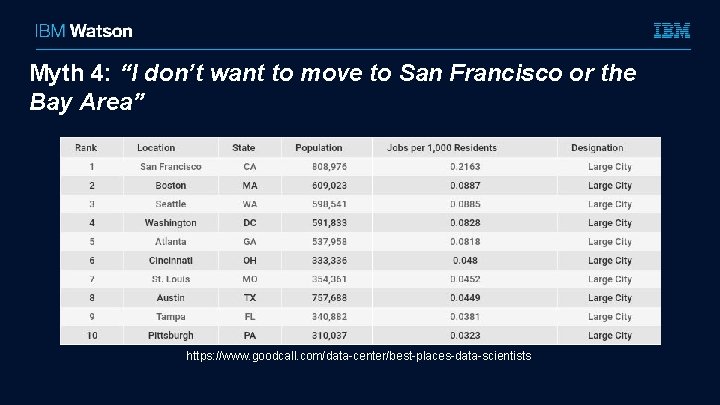
Myth 4: “I don’t want to move to San Francisco or the Bay Area” https: //www. goodcall. com/data-center/best-places-data-scientists
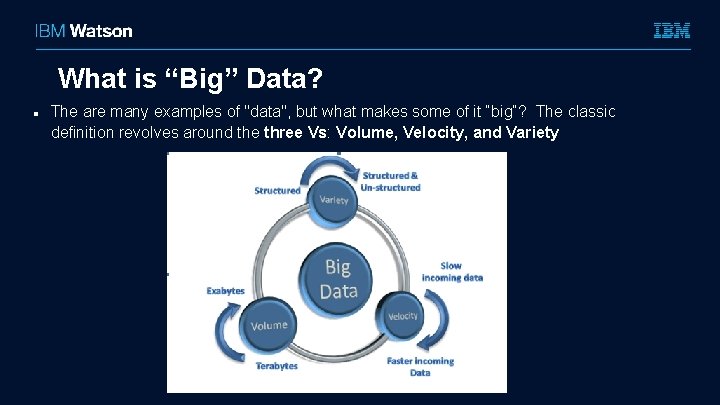
What is “Big” Data? The are many examples of "data", but what makes some of it “big”? The classic definition revolves around the three Vs: Volume, Velocity, and Variety
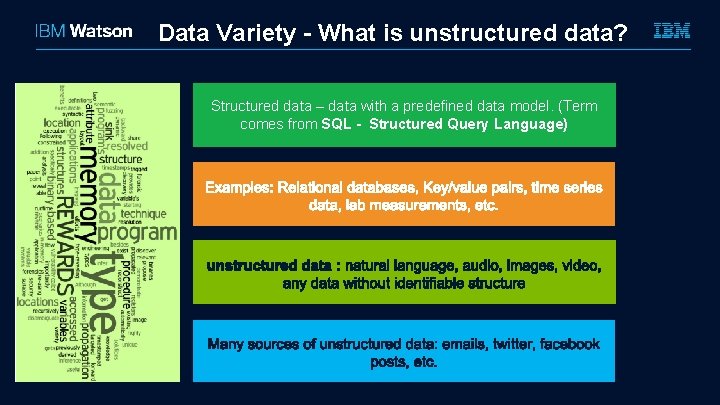
Data Variety - What is unstructured data? Structured data – data with a predefined data model. (Term comes from SQL - Structured Query Language)
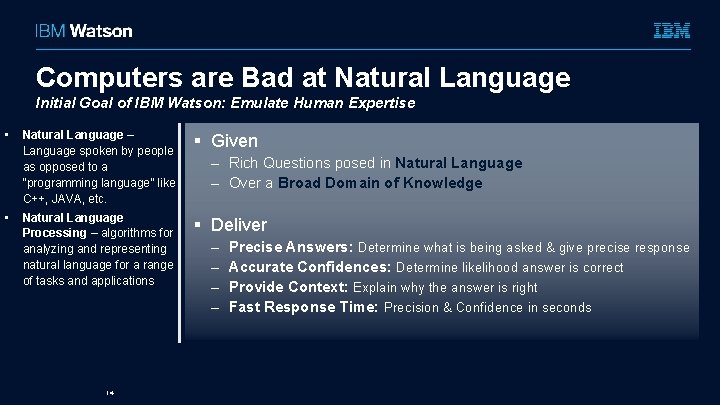
Computers are Bad at Natural Language Initial Goal of IBM Watson: Emulate Human Expertise • • Natural Language – Language spoken by people as opposed to a “programming language” like C++, JAVA, etc. § Given Natural Language Processing – algorithms for analyzing and representing natural language for a range of tasks and applications § Deliver 14 – Rich Questions posed in Natural Language – Over a Broad Domain of Knowledge – – Precise Answers: Determine what is being asked & give precise response Accurate Confidences: Determine likelihood answer is correct Provide Context: Explain why the answer is right Fast Response Time: Precision & Confidence in seconds
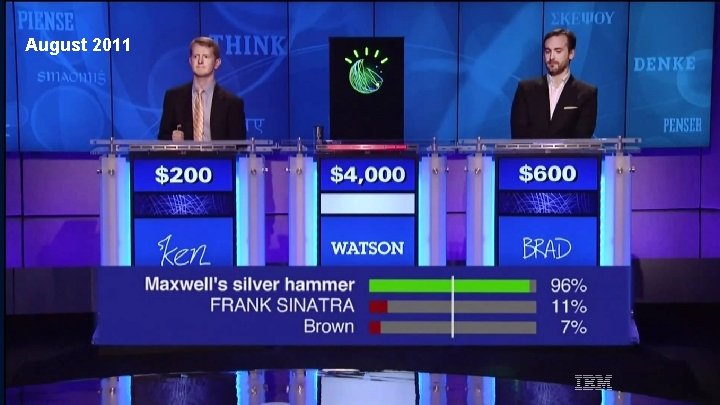
August 2011
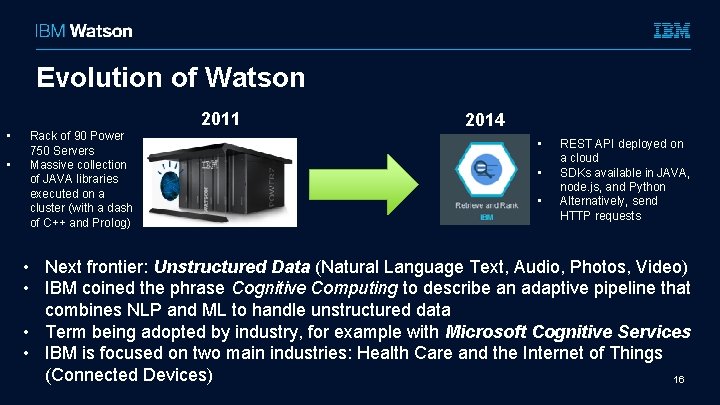
Evolution of Watson 2011 • • Rack of 90 Power 750 Servers Massive collection of JAVA libraries executed on a cluster (with a dash of C++ and Prolog) 2014 • • • REST API deployed on a cloud SDKs available in JAVA, node. js, and Python Alternatively, send HTTP requests • Next frontier: Unstructured Data (Natural Language Text, Audio, Photos, Video) • IBM coined the phrase Cognitive Computing to describe an adaptive pipeline that combines NLP and ML to handle unstructured data • Term being adopted by industry, for example with Microsoft Cognitive Services • IBM is focused on two main industries: Health Care and the Internet of Things (Connected Devices) 16
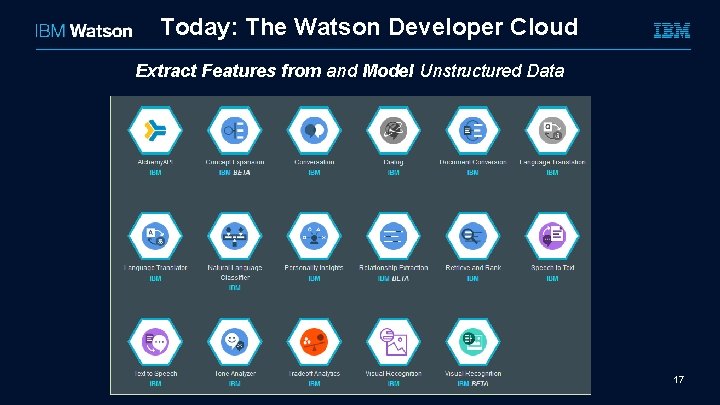
Today: The Watson Developer Cloud Extract Features from and Model Unstructured Data 17
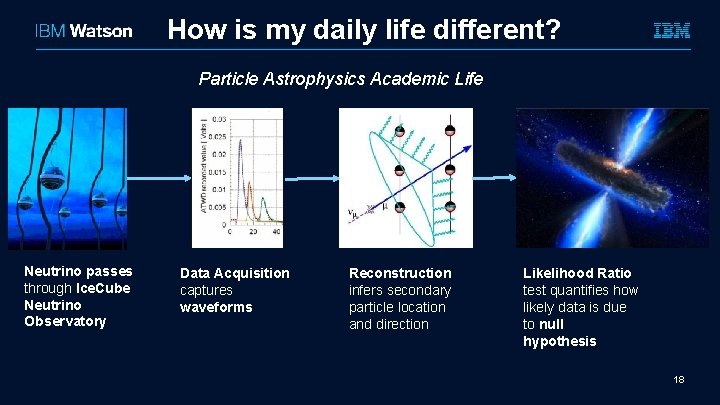
How is my daily life different? Particle Astrophysics Academic Life Neutrino passes through Ice. Cube Neutrino Observatory Data Acquisition captures waveforms Reconstruction infers secondary particle location and direction Likelihood Ratio test quantifies how likely data is due to null hypothesis 18
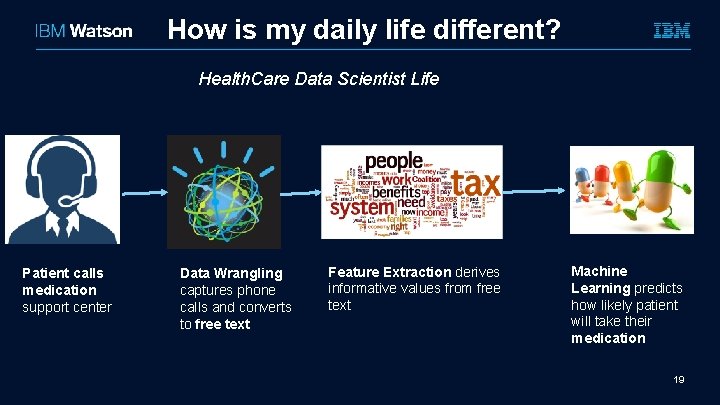
How is my daily life different? Health. Care Data Scientist Life Patient calls medication support center Data Wrangling captures phone calls and converts to free text Feature Extraction derives informative values from free text Machine Learning predicts how likely patient will take their medication 19
Lessons learned from my industry job search 20
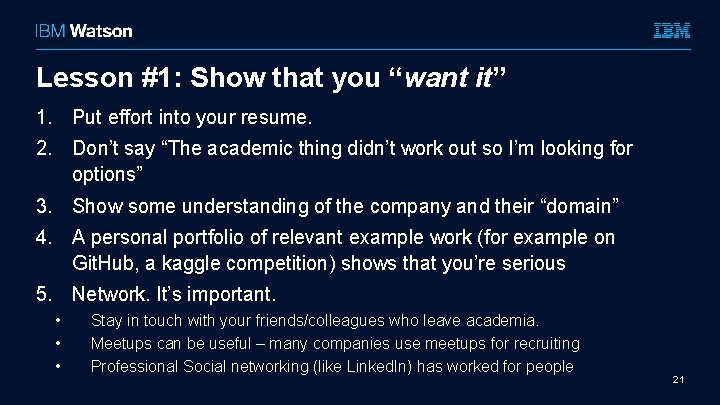
Lesson #1: Show that you “want it” 1. Put effort into your resume. 2. Don’t say “The academic thing didn’t work out so I’m looking for options” 3. Show some understanding of the company and their “domain” 4. A personal portfolio of relevant example work (for example on Git. Hub, a kaggle competition) shows that you’re serious 5. Network. It’s important. • • • Stay in touch with your friends/colleagues who leave academia. Meetups can be useful – many companies use meetups for recruiting Professional Social networking (like Linked. In) has worked for people 21
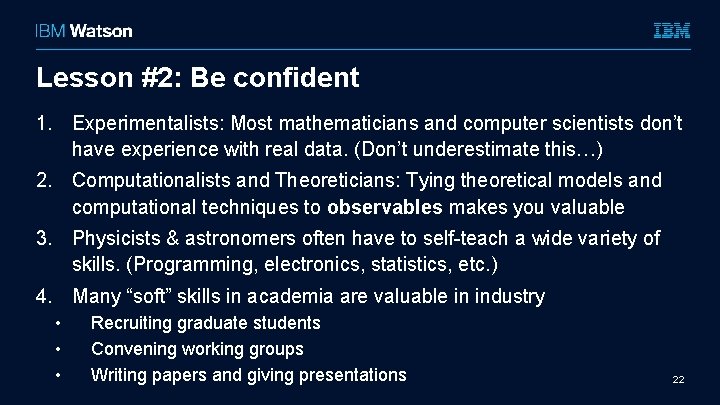
Lesson #2: Be confident 1. Experimentalists: Most mathematicians and computer scientists don’t have experience with real data. (Don’t underestimate this…) 2. Computationalists and Theoreticians: Tying theoretical models and computational techniques to observables makes you valuable 3. Physicists & astronomers often have to self-teach a wide variety of skills. (Programming, electronics, statistics, etc. ) 4. Many “soft” skills in academia are valuable in industry • • • Recruiting graduate students Convening working groups Writing papers and giving presentations 22
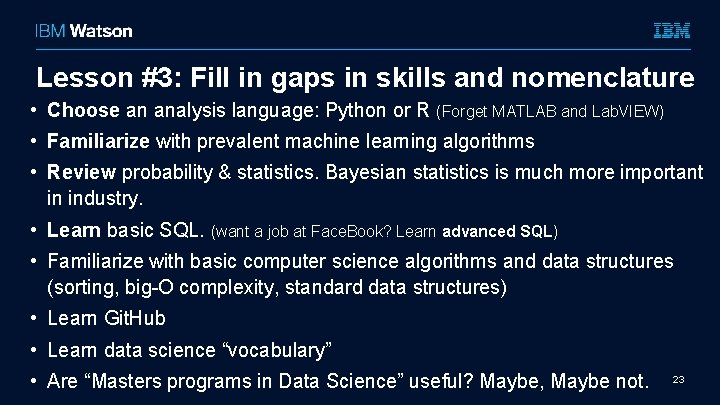
Lesson #3: Fill in gaps in skills and nomenclature • Choose an analysis language: Python or R (Forget MATLAB and Lab. VIEW) • Familiarize with prevalent machine learning algorithms • Review probability & statistics. Bayesian statistics is much more important in industry. • Learn basic SQL. (want a job at Face. Book? Learn advanced SQL) • Familiarize with basic computer science algorithms and data structures (sorting, big-O complexity, standard data structures) • Learn Git. Hub • Learn data science “vocabulary” • Are “Masters programs in Data Science” useful? Maybe, Maybe not. 23
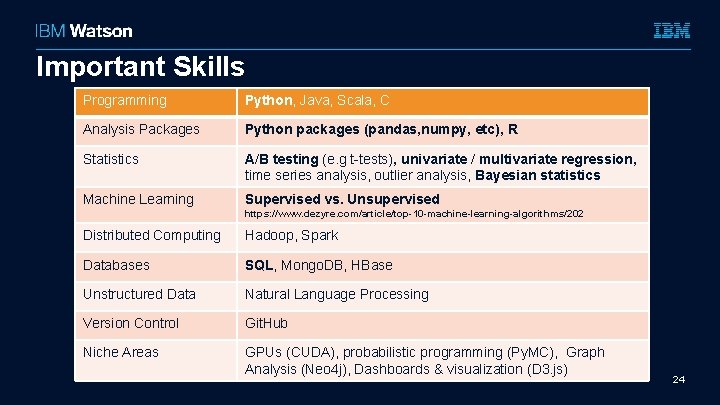
Important Skills Programming Python, Java, Scala, C Analysis Packages Python packages (pandas, numpy, etc), R Statistics A/B testing (e. g t-tests), univariate / multivariate regression, time series analysis, outlier analysis, Bayesian statistics Machine Learning Supervised vs. Unsupervised https: //www. dezyre. com/article/top-10 -machine-learning-algorithms/202 Distributed Computing Hadoop, Spark Databases SQL, Mongo. DB, HBase Unstructured Data Natural Language Processing Version Control Git. Hub Niche Areas GPUs (CUDA), probabilistic programming (Py. MC), Graph Analysis (Neo 4 j), Dashboards & visualization (D 3. js) 24
Some resources • 21 questions every data scientist should know http: //www. kdnuggets. com/2016/02/21 -data-science-interview-questions-answers. html • Blogs: • http: //www. kdnuggets. com/ • http: //blog. kaggle. com/ • https: //www. opendatascience. com/ • Training • https: //www. coursera. org/specializations/jhu-data-science • http: //work. caltech. edu/telecourse. html • Fellowships: • Insight http: //insightdatascience. com/ • The data incubator https: //www. thedataincubator. com/ 25
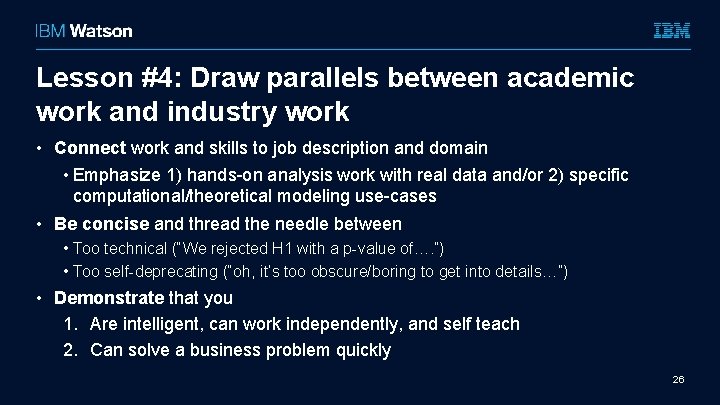
Lesson #4: Draw parallels between academic work and industry work • Connect work and skills to job description and domain • Emphasize 1) hands-on analysis work with real data and/or 2) specific computational/theoretical modeling use-cases • Be concise and thread the needle between • Too technical (“We rejected H 1 with a p-value of…. ”) • Too self-deprecating (“oh, it’s too obscure/boring to get into details…”) • Demonstrate that you 1. Are intelligent, can work independently, and self teach 2. Can solve a business problem quickly 26
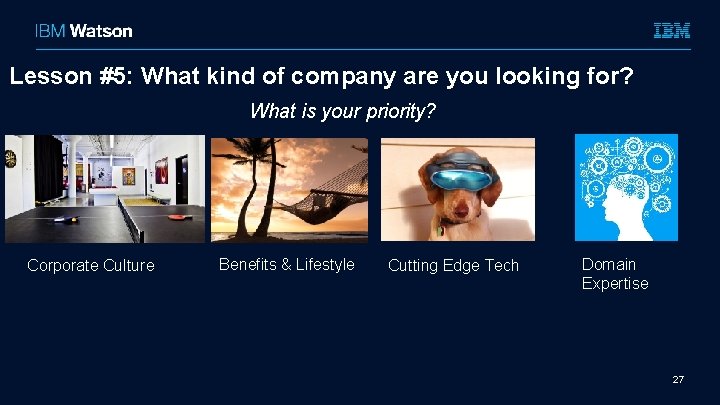
Lesson #5: What kind of company are you looking for? What is your priority? Corporate Culture Benefits & Lifestyle Cutting Edge Tech Domain Expertise 27
Lesson #6: Beware of pitfalls • Be careful with headhunters • Data Science has become a corporate catchphrase. Many jobs are labeled “Data Science” that have nothing to do with data science • Beware of “Data Science Boggle” • Beware of skill validation questions that are either • Too academic • Not technical at all • The “Goldilocks” level should be similar to http: //www. kdnuggets. com/2016/02/21 -data-science-interviewquestions-answers. html 28
Thank You! 29
Appendix Watson / Presentation Title / Date 30
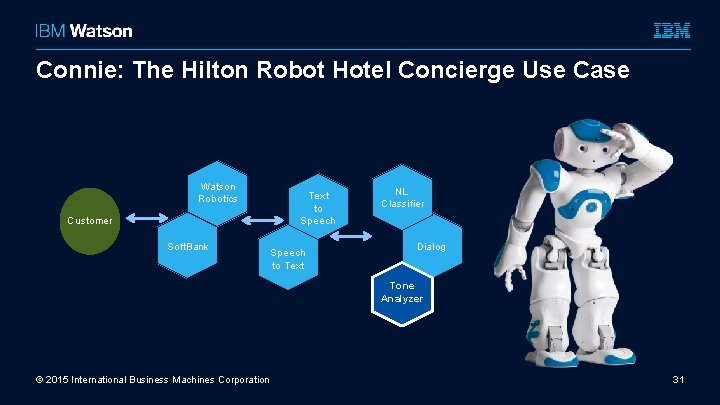
Connie: The Hilton Robot Hotel Concierge Use Case Watson Robotics Customer Soft. Bank Text to Speech to Text NL Classifier Dialog Tone Analyzer © 2015 International Business Machines Corporation 31
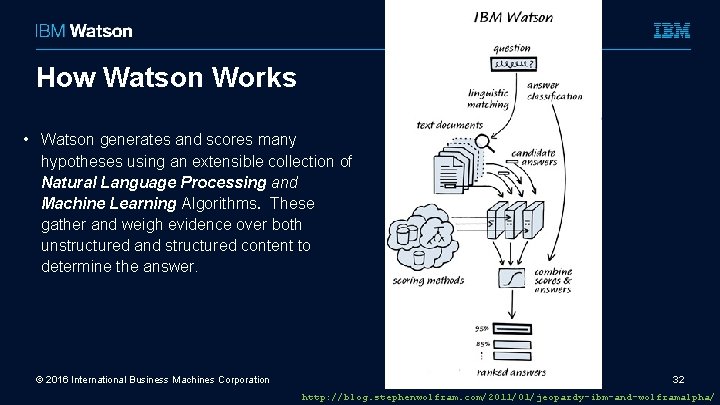
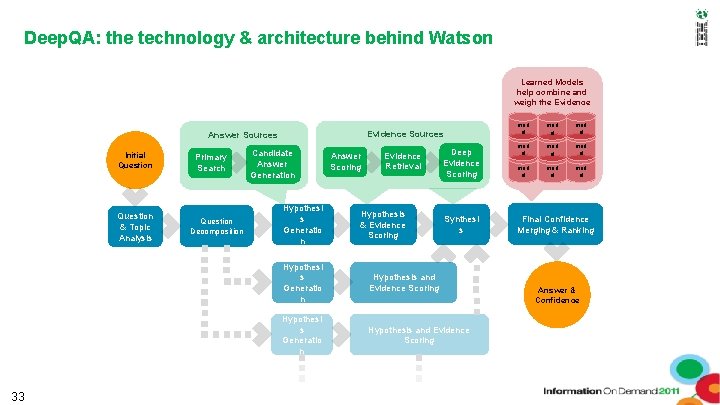
How Watson Works • Watson generates and scores many hypotheses using an extensible collection of Natural Language Processing and Machine Learning Algorithms. These gather and weigh evidence over both unstructured and structured content to determine the answer. © 2016 International Business Machines Corporation 32 http: //blog. stephenwolfram. com/2011/01/jeopardy-ibm-and-wolframalpha/
Deep. QA: the technology & architecture behind Watson Learned Models help combine and weigh the Evidence Sources Answer Sources Initial Question & Topic Analysis 33 Primary Search Question Decomposition Candidate Answer Generation Hypothesi s Generatio n Answer Scoring Evidence Retrieval Hypothesis & Evidence Scoring Deep Evidence Scoring Synthesi s Hypothesi s Generatio n Hypothesis and Evidence Scoring mod el mod el mod el Final Confidence Merging & Ranking Answer & Confidence
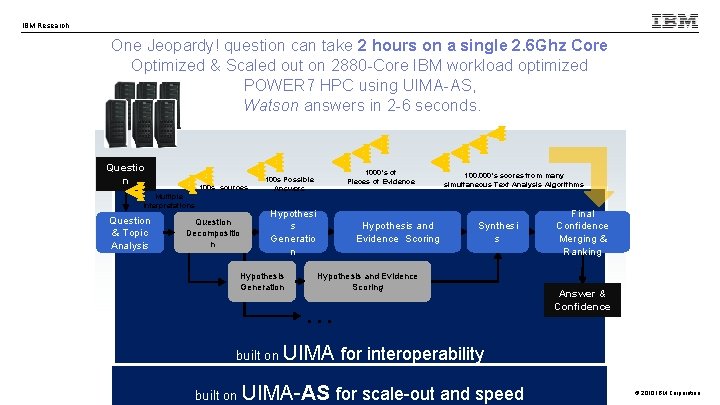
IBM Research One Jeopardy! question can take 2 hours on a single 2. 6 Ghz Core Optimized & Scaled out on 2880 -Core IBM workload optimized POWER 7 HPC using UIMA-AS, Watson answers in 2 -6 seconds. Questio n 100 s sources Multiple Interpretations Question & Topic Analysis Question Decompositio n 1000’s of Pieces of Evidence 100 s Possible Answers Hypothesi s Generatio n Hypothesis Generation Hypothesis and Evidence Scoring 100, 000’s scores from many simultaneous Text Analysis Algorithms Synthesi s Hypothesis and Evidence Scoring . . . built on UIMA-AS Final Confidence Merging & Ranking Answer & Confidence for interoperability for scale-out and speed © 2010 IBM Corporation
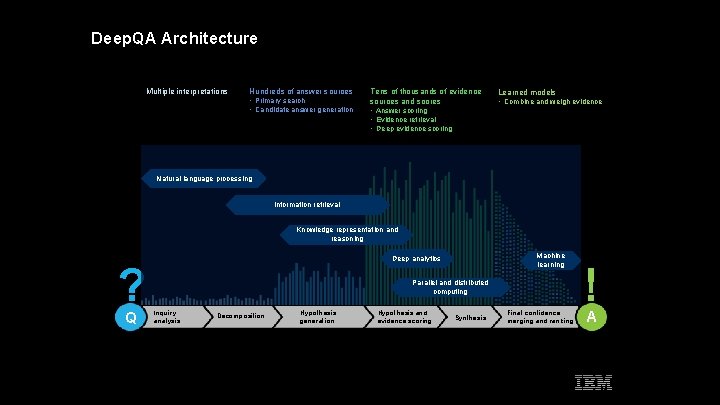
Deep. QA Architecture Multiple interpretations Hundreds of answer sources • Primary search • Candidate answer generation Tens of thousands of evidence sources and scores • Answer scoring • Evidence retrieval • Deep evidence scoring Learned models • Combine and weigh evidence Natural language processing Information retrieval Knowledge representation and reasoning ? Q Machine learning Deep analytics Parallel and distributed computing Inquiry analysis Decomposition Hypothesis generation Hypothesis and evidence scoring Synthesis Final confidence merging and ranking ! A