International Telecommunication Union Regional Symposium on Egovernment and
- Slides: 34
International Telecommunication Union Regional Symposium on E-government and IP Dubai (UAE), 22 -25 November 2004 Next Generation Networks and IP issues: Exploiting advanced visions to optimize network services and applications, INTERNET EXCHANGE, Wi. Fi and Wi. Max Désiré KARYABWITE IP Coordinator, E-Strategy Unit, Email: desire. karyabwite@itu. int Tel: +41 22 730 5009 Fax: +41 22 730 5484 The views expressed in this paper are those of the author and may not necessarily reflect the opinions of the ITU or its membership. .
International Telecommunication Union Table of Contents 1. Introduction 2. Challenges of Change: NGN, Internet Interconnections and IXPs 3. Wireless Access Systems (WAS) ITU Standards, Wi-Fi and Wi. Max 4. Conclusion 2
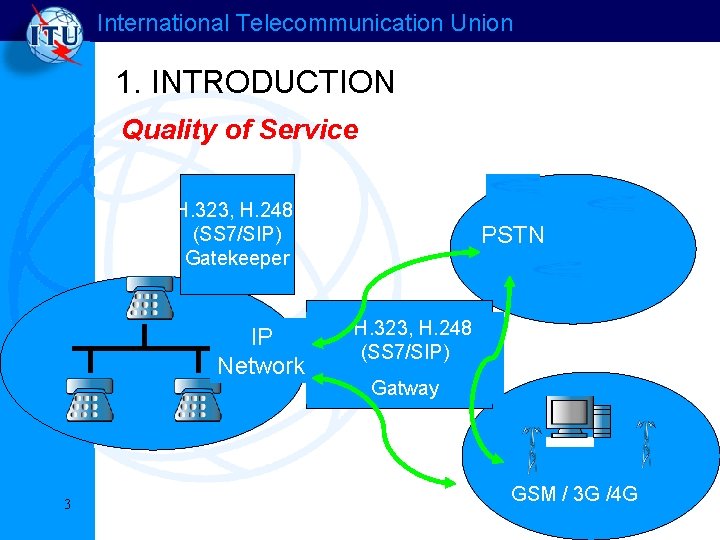
International Telecommunication Union 1. INTRODUCTION Quality of Service H. 323, H. 248 (SS 7/SIP) Gatekeeper IP Network 3 PSTN H. 323, H. 248 (SS 7/SIP) Gatway GSM / 3 G /4 G
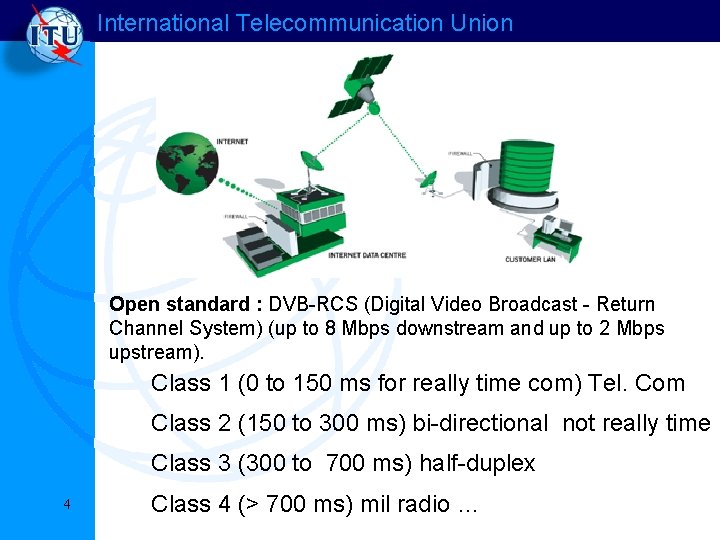
International Telecommunication Union Open standard : DVB-RCS (Digital Video Broadcast - Return Channel System) (up to 8 Mbps downstream and up to 2 Mbps upstream). Class 1 (0 to 150 ms for really time com) Tel. Com Class 2 (150 to 300 ms) bi-directional not really time Class 3 (300 to 700 ms) half-duplex 4 Class 4 (> 700 ms) mil radio …
International Telecommunication Union 2. Challenges of Change: NGN, Internet Interconnections and IXPs 2. 1 Definition of Next Generation Network A Next Generation Network (NGN) is a packet-based network able to provide services including Telecommunication Services and able to make use of multiple broadband, Qo. S-enabled transport technologies and in which service-related functions are independent from underlying transport-related technologies. It offers unrestricted access by users to different service providers. It supports generalized mobility which will allow consistent and ubiquitous provision of services to users. The NGN is characterized by the following fundamental aspects: • Packet-based transfer • Separation of control functions among bearer capabilities, call/session, and application/ service • Decoupling of service provision from network, and provision of open interfaces 5
International Telecommunication Union • Support for a wide range of services, applications and mechanisms based on service building blocks (including real time/ streaming/ nonreal time services and multi-media) • Broadband capabilities with end-to-end Qo. S and transparency • Interworking with legacy networks via open interfaces • Generalized mobility • Unrestricted access by users to different service providers • A variety of identification schemes which can be resolved to IP addresses for the purposes of routing in IP networks • Unified service characteristics for the same service as perceived by the user • Converged services between Fixed/Mobile • Independence of service-related functions from underlying transport technologies • Compliant with all Regulatory requirements, for example concerning emergency communications and security/privacy, etc 6
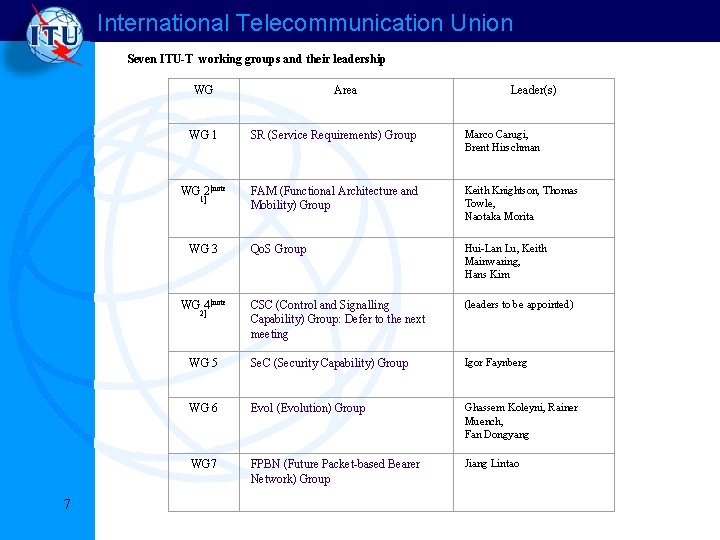
International Telecommunication Union Seven ITU-T working groups and their leadership WG Leader(s) WG 1 SR (Service Requirements) Group Marco Carugi, Brent Hirschman WG 2[note FAM (Functional Architecture and Mobility) Group Keith Knightson, Thomas Towle, Naotaka Morita Qo. S Group Hui-Lan Lu, Keith Mainwaring, Hans Kim CSC (Control and Signalling Capability) Group: Defer to the next meeting (leaders to be appointed) WG 5 Se. C (Security Capability) Group Igor Faynberg WG 6 Evol (Evolution) Group Ghassem Koleyni, Rainer Muench, Fan Dongyang WG 7 FPBN (Future Packet-based Bearer Network) Group Jiang Lintao 1] WG 3 WG 4[note 2] 7 Area
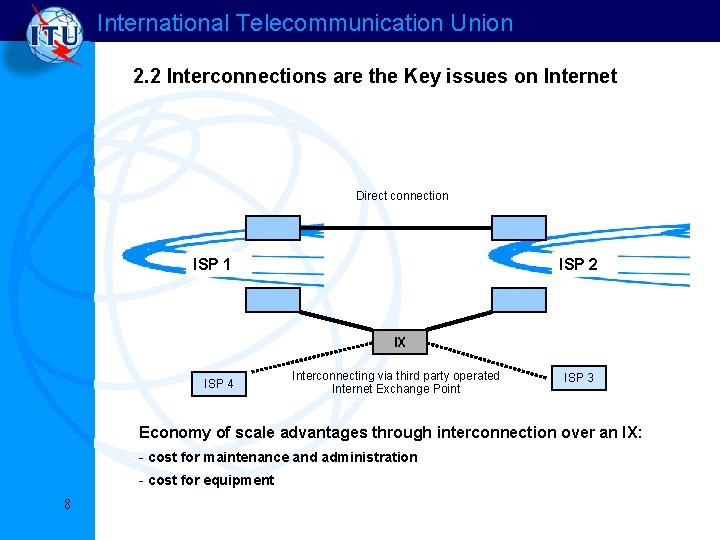
International Telecommunication Union 2. 2 Interconnections are the Key issues on Internet Direct connection ISP 1 ISP 2 IX ISP 4 Interconnecting via third party operated Internet Exchange Point ISP 3 Economy of scale advantages through interconnection over an IX: - cost for maintenance and administration - cost for equipment 8
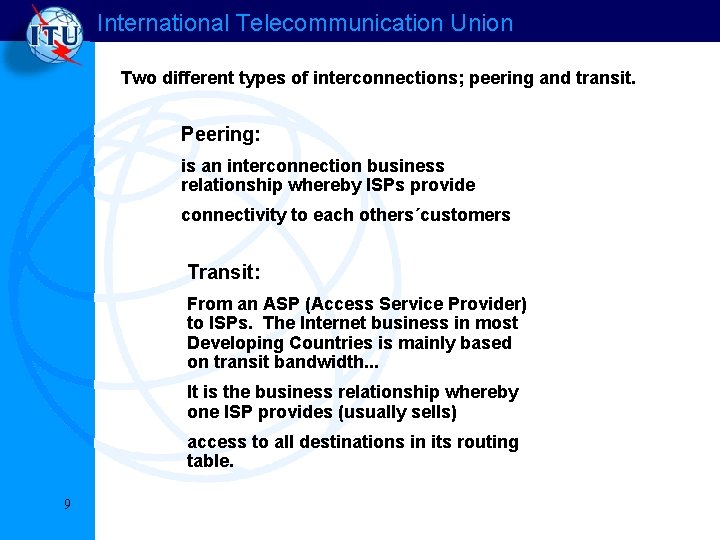
International Telecommunication Union Two different types of interconnections; peering and transit. Peering: is an interconnection business relationship whereby ISPs provide connectivity to each others´customers Transit: From an ASP (Access Service Provider) to ISPs. The Internet business in most Developing Countries is mainly based on transit bandwidth. . . It is the business relationship whereby one ISP provides (usually sells) access to all destinations in its routing table. 9
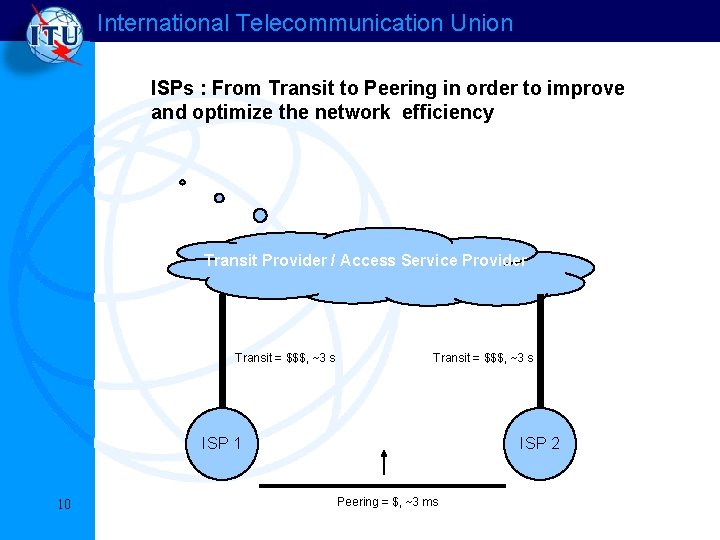
International Telecommunication Union ISPs : From Transit to Peering in order to improve and optimize the network efficiency Transit Provider / Access Service Provider Transit = $$$, ~3 s ISP 1 10 ISP 2 Peering = $, ~3 ms
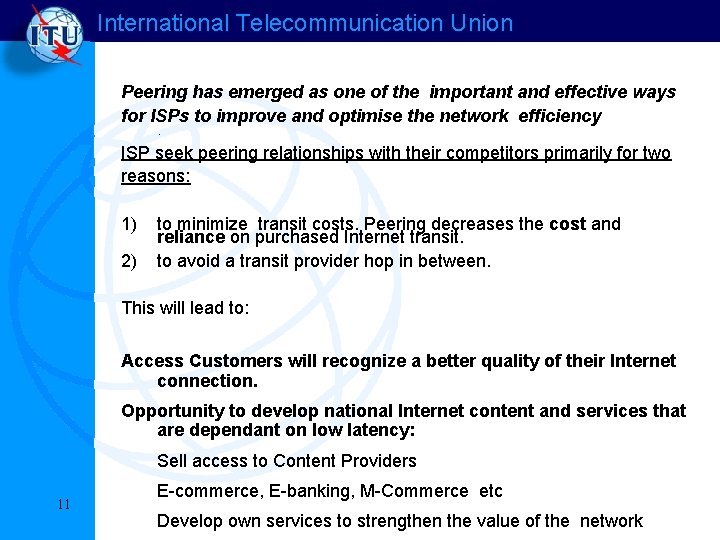
International Telecommunication Union Peering has emerged as one of the important and effective ways for ISPs to improve and optimise the network efficiency. ISP seek peering relationships with their competitors primarily for two reasons: 1) 2) to minimize transit costs. Peering decreases the cost and reliance on purchased Internet transit. to avoid a transit provider hop in between. This will lead to: Access Customers will recognize a better quality of their Internet connection. Opportunity to develop national Internet content and services that are dependant on low latency: Sell access to Content Providers 11 E-commerce, E-banking, M-Commerce etc Develop own services to strengthen the value of the network
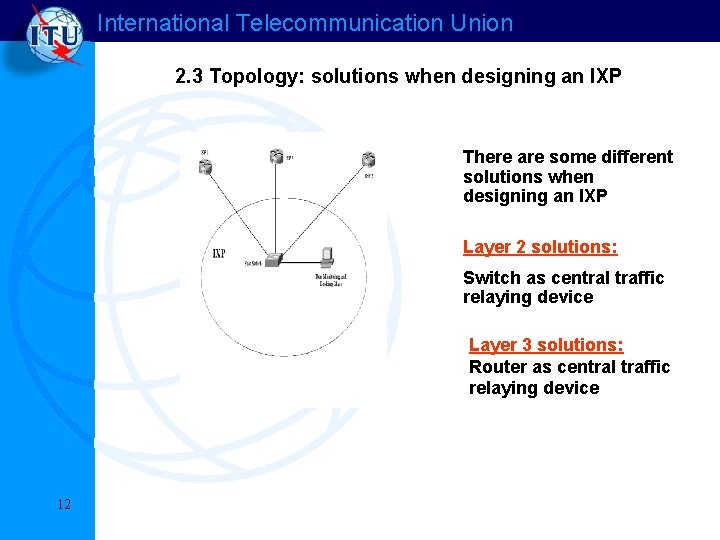
International Telecommunication Union 2. 3 Topology: solutions when designing an IXP There are some different solutions when designing an IXP Layer 2 solutions: Switch as central traffic relaying device Layer 3 solutions: Router as central traffic relaying device 12
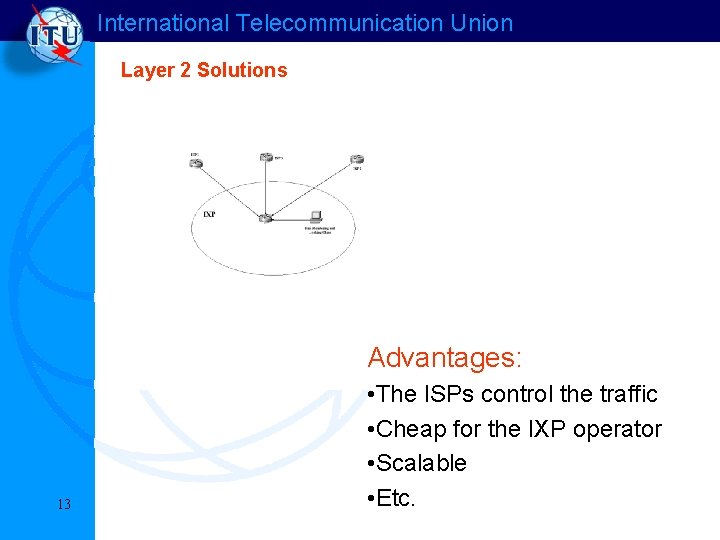
International Telecommunication Union Layer 2 Solutions Advantages: 13 • The ISPs control the traffic • Cheap for the IXP operator • Scalable • Etc.
International Telecommunication Union Layer 3 Solutions Advantages: • The ISPs control the traffic • Cheap for the ISPs • Etc 14
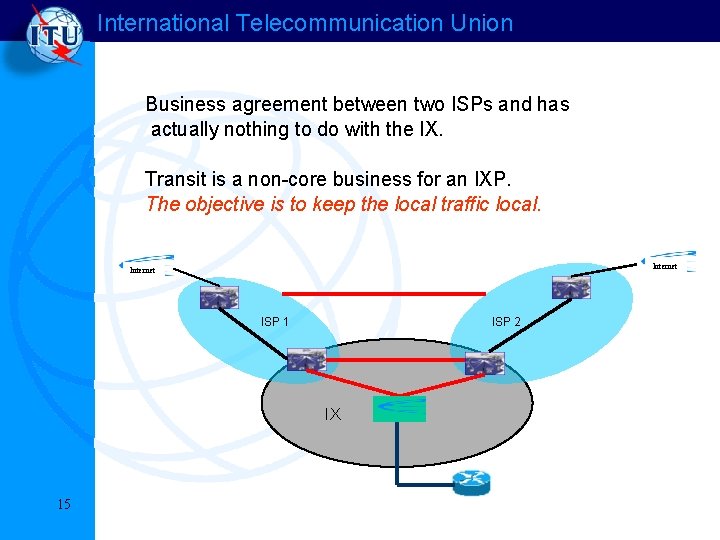
International Telecommunication Union Business agreement between two ISPs and has actually nothing to do with the IX. Transit is a non-core business for an IXP. The objective is to keep the local traffic local. Internet ISP 1 ISP 2 IX 15
International Telecommunication Union 2. 4 Policy and Administration of IXP The decision to be made is on having Bi-lateral or Multi-lateral peering agreements to rule over the traffic exchange over the IX: 1. Multi-lateral peering agreement implies that all connected ISPs must peer with all other ISPs connected to the IX, on the same conditions. 2. Bi-lateral leaves it to the ISP to decide with whom to peer and on what conditions, but they must have peering agreements with at least two if they want to use the IX. 16 Documents Procedures Ø Policy of IXP Ø Joining Ø Connection agreement Ø Termination Ø Service definition Ø Payment of fees
International Telecommunication Union 3. Wireless Access Systems (WAS) ITU Standards, Wi-Fi and Wi. Max 17
International Telecommunication Union Advances in technology and competitive access are driving the revolution towards wireless access infrastructure for the provision of basic telephone service and IPbased applications. 18 ITU-BDT (Telecommunication Development Bureau) is advising and promoting Wireless Access Systems in developing countries where there is a a lack of infrastructure for data/telecom but still in the same time have a great demand for broadband connections. (Convergence issue).
International Telecommunication Union 3. 1 ITU Studies can be categorised as follows: 1. Preferred frequency bands, spectrum requirements and frequency channelling plan. 2. Suitable technology for WAS. 3. System characteristics and operational requirements including interface to switched networks. 4. Performance and availability objectives. 5. Frequency sharing criteria, interference effects and service area boundary. 6. Radio local area networks (RLANs). 19
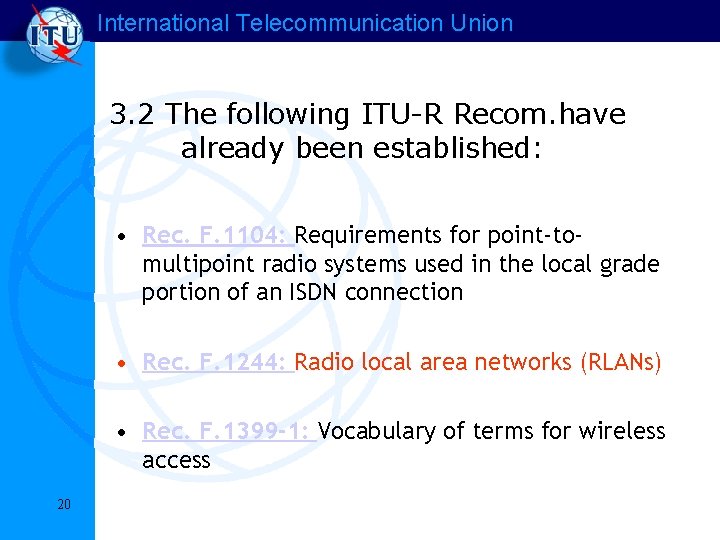
International Telecommunication Union 3. 2 The following ITU-R Recom. have already been established: • Rec. F. 1104: Requirements for point-tomultipoint radio systems used in the local grade portion of an ISDN connection • Rec. F. 1244: Radio local area networks (RLANs) • Rec. F. 1399 -1: Vocabulary of terms for wireless access 20
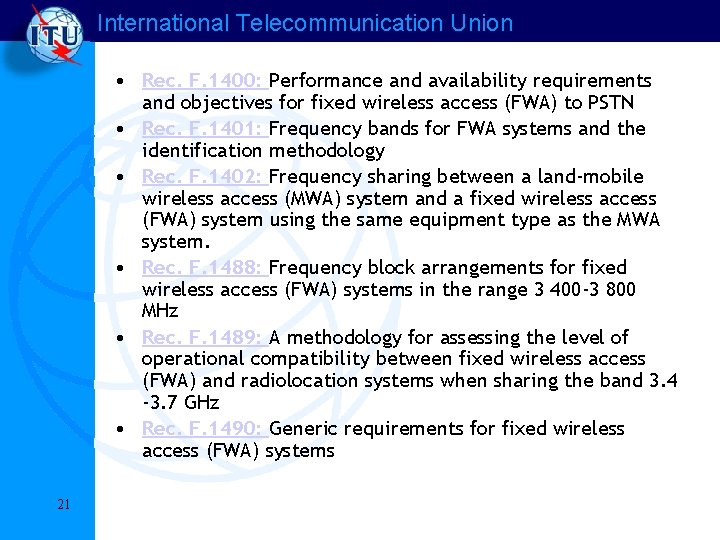
International Telecommunication Union • Rec. F. 1400: Performance and availability requirements and objectives for fixed wireless access (FWA) to PSTN • Rec. F. 1401: Frequency bands for FWA systems and the identification methodology • Rec. F. 1402: Frequency sharing between a land-mobile wireless access (MWA) system and a fixed wireless access (FWA) system using the same equipment type as the MWA system. • Rec. F. 1488: Frequency block arrangements for fixed wireless access (FWA) systems in the range 3 400 -3 800 MHz • Rec. F. 1489: A methodology for assessing the level of operational compatibility between fixed wireless access (FWA) and radiolocation systems when sharing the band 3. 4 -3. 7 GHz • Rec. F. 1490: Generic requirements for fixed wireless access (FWA) systems 21
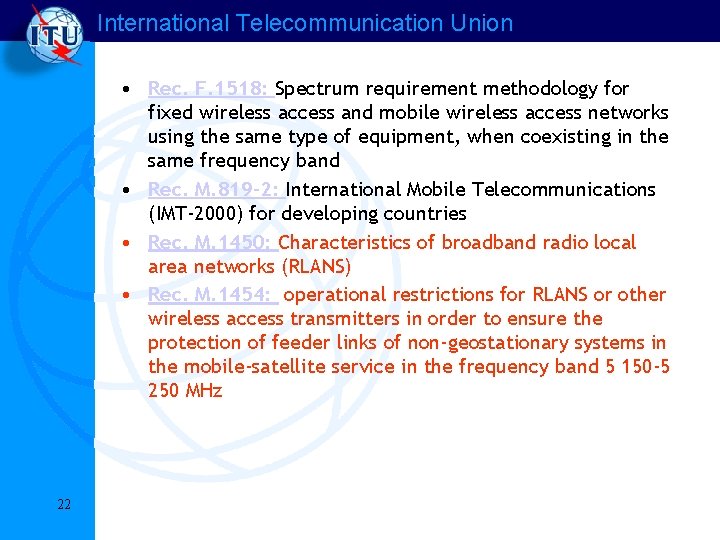
International Telecommunication Union • Rec. F. 1518: Spectrum requirement methodology for fixed wireless access and mobile wireless access networks using the same type of equipment, when coexisting in the same frequency band • Rec. M. 819 -2: International Mobile Telecommunications (IMT-2000) for developing countries • Rec. M. 1450: Characteristics of broadband radio local area networks (RLANS) • Rec. M. 1454: operational restrictions for RLANS or other wireless access transmitters in order to ensure the protection of feeder links of non-geostationary systems in the mobile-satellite service in the frequency band 5 150 -5 250 MHz 22
International Telecommunication Union Radio local area networks (RLANs / WLANs) control modules (CM) and user modules (UM). 23
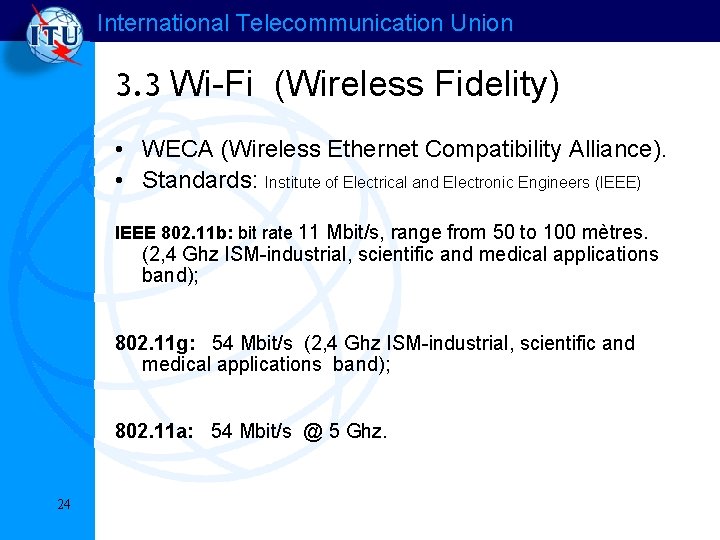
International Telecommunication Union 3. 3 Wi-Fi (Wireless Fidelity) • WECA (Wireless Ethernet Compatibility Alliance). • Standards: Institute of Electrical and Electronic Engineers (IEEE) IEEE 802. 11 b: bit rate 11 Mbit/s, range from 50 to 100 mètres. (2, 4 Ghz ISM-industrial, scientific and medical applications band); 802. 11 g: 54 Mbit/s (2, 4 Ghz ISM-industrial, scientific and medical applications band); 802. 11 a: 54 Mbit/s @ 5 Ghz. 24
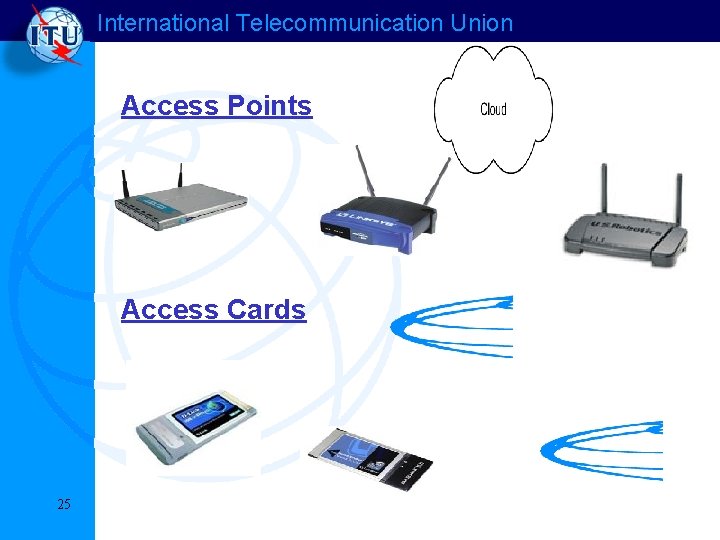
International Telecommunication Union Access Points Access Cards 25
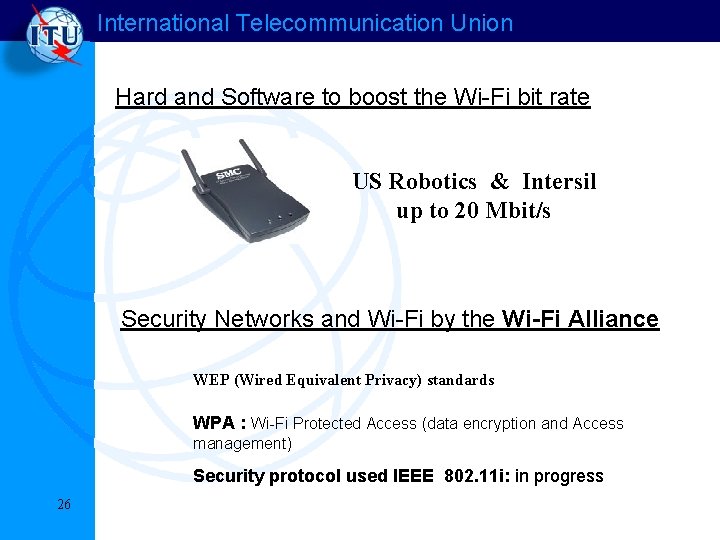
International Telecommunication Union Hard and Software to boost the Wi-Fi bit rate US Robotics & Intersil up to 20 Mbit/s Security Networks and Wi-Fi by the Wi-Fi Alliance WEP (Wired Equivalent Privacy) standards WPA : Wi-Fi Protected Access (data encryption and Access management) Security protocol used IEEE 802. 11 i: in progress 26
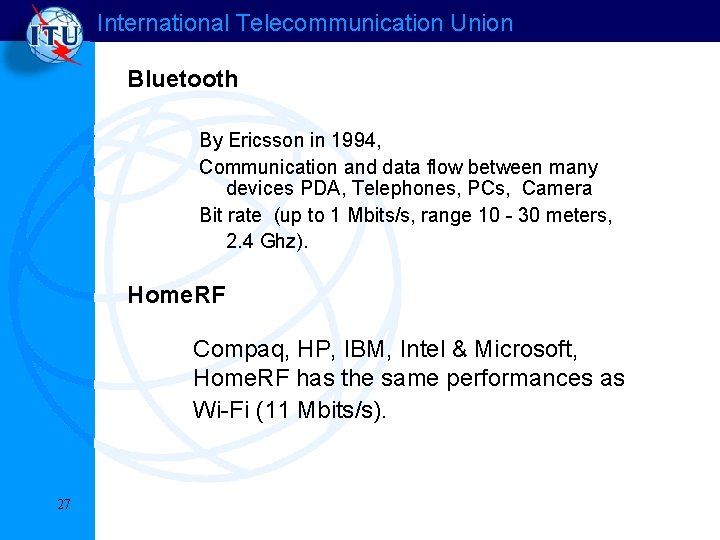
International Telecommunication Union Bluetooth By Ericsson in 1994, Communication and data flow between many devices PDA, Telephones, PCs, Camera Bit rate (up to 1 Mbits/s, range 10 - 30 meters, 2. 4 Ghz). Home. RF Compaq, HP, IBM, Intel & Microsoft, Home. RF has the same performances as Wi-Fi (11 Mbits/s). 27
International Telecommunication Union Hiper. Lan 1 & 2 • By ETSI (European Telecommunications Standards Institute) • Hiperlan is exclusively European standard. • Hiperlan 1 (20 Mbit/s) • Hiperlan 2 (54 Mbit/s) as Wi-Fi and Home. RF (up to 100 meters). • 5 Ghz 28
International Telecommunication Union convergence/interoperability (802. 11 a et d'Hiperlan 2) 54 Mbit/s technologies 29
International Telecommunication Union 3. 4 Wi. Max (Worldwide Interoperability for Microwave Access ) The Interoperability Challenge • IEEE 802. 16 Air Interface Specification is a very large specification. It was designed to cover the fixed broadband wireless access needs of a variety of different situations. • In order to ensure interoperability between vendors competing in the same market, the Wi. MAX technical working groups were created by the leaders in IEEE 802. 16 technology • Began in 2001 in Antibes-France • Founding Companies: - Ensemble - Nokia - Harris - Cross. Span 30
International Telecommunication Union • The initial version of IEEE 802. 16 was developed with the goal of meeting the requirements of a vast array of deployment scenarios for BWA systems operating between 10 and 66 GHz. • An amendment is almost finished to do the same for systems operating between 2 and 11 GHz. • Abstract Test Suite specifications according to the ISO/IEC 9464 series are equivalent to ITU-T x. 290 series of conformance testing standards. • ITU guidelines (See ITU-T X. 29 x series) 31
International Telecommunication Union 4. Conclusion Data traffic is growing more (10 times) compared to the voice traffic and as a consequence, the past concept of telephone networks, which also carry data might be replaced by the concept of data networks that also carry voice. 32 In this regard, seam-less interworking between IP-based networks and PSTN and the interoperability of their respective applications or services is essential in meeting the business requirements placed on modern communication networks.
International Telecommunication Union • • • 33 Best practices for DNS and IP addresses Management Governing Law and Dispute Resolution Clear responsibilities IXP/ Member Responsibilites Clear Membership policy and Connection to IXP Fees
International Telecommunication Union Thank you for your Attention For more details: www. itu. int/itu-d Désiré KARYABWITE IP Coordinator, E-Strategy Unit, Email: desire. karyabwite@itu. int Tel: +41 22 730 5009 Fax: +41 22 730 5484 34