Introduction to the Professional Development Series Jennifer Coffey



- Slides: 26
Introduction to the Professional Development Series Jennifer Coffey, OSEP
Webinar Schedule Regional Meetings – Evidence Based Professional Development February 3 - Washington, DC - Speaker: Michelle Duda, SISEP February 8 - New Orleans, LA - Speaker: Melissa Van. Dyke, SISEP February 15 - Portland, OR - Speaker: Chris Borgmeier, Oregon PBIS Leadership Network Innovation Fluency Date: March 24, 3: 00 -4: 30 pm ET Speaker: Karen Blasé, SISEP Professional Development for Administrators Date: April 19, 3: 00 -4: 30 pm ET Speakers: Elaine Mulligan, NIUSI Leadscape & Rich Barbacane, Nat’l Association of Elementary School Principals Steve Goodman, Michigan SPDG Using Technology for Professional Development Date: May 18, 2: 00 -3: 30 pm ET Speaker: Chris Dede, Ph. D. , Learning Technologies, Harvard 2
Professional Development Defined According to thesaurus of the Educational Resources Information Center (ERIC) database, professional development refers to "activities to enhance professional career growth. " Such activities may include individual development, continuing education, and inservice education, as well as curriculum writing, peer collaboration, study groups, and peer coaching or mentoring. Fullan (1991) expands the definition to include "the sum total of formal and informal learning experiences throughout one's career from preservice teacher education to retirement" (p. 326). North Central Regional Education Lab (NCREL)
"Professional development. . . goes beyond the term 'training' with its implications of learning skills, and encompasses a definition that includes formal and informal means of helping teachers not only learn new skills but also develop new insights into pedagogy and their own practice, and explore new or advanced understandings of content and resources. [This] definition of professional development includes support for teachers as they encounter the challenges that come with putting into practice their evolving understandings about the use of technology to support inquiry-based learning. . Current technologies offer resources to meet these challenges and provide teachers with a cluster of supports that help them continue to grow in their professional skills, understandings, and interests. “ – Grant (nd)
PD Models and Evaluation Evidence base/best practice Models • Carol Trivette and Carl Dunst - PALS • NIRN – Implementation Drivers • Guskey Preview to the presentation at the Regional Meeting and the PD Series SPDG/OSEP Program Measures 5
Our Presenters Today Julie Morrison, Ohio SPDG Evaluator • Models of Professional Development Li Walter and Alan Wood, California SPDG Evaluators
“No intervention practice, no matter what its evidence base, is likely to be learned and adopted if the methods and strategies used to teach or train students, practitioners, parents, or others are not themselves effective. ” "Let's Be Pals: An Evidence-based Approach to Professional Development. " Dunst & Trivette, 2009
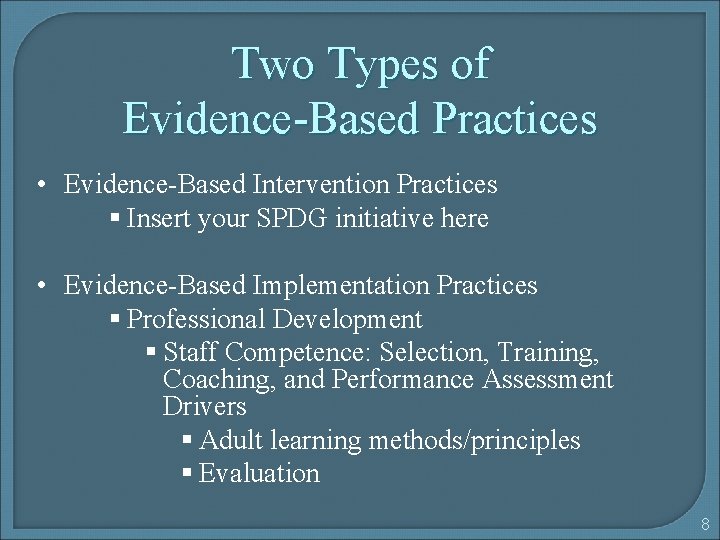
Two Types of Evidence-Based Practices • Evidence-Based Intervention Practices § Insert your SPDG initiative here • Evidence-Based Implementation Practices § Professional Development § Staff Competence: Selection, Training, Coaching, and Performance Assessment Drivers § Adult learning methods/principles § Evaluation 8
“Adult learning refers to a collection of theories, methods, and approaches for describing the characteristics of and conditions under which the process of learning is optimized. ”
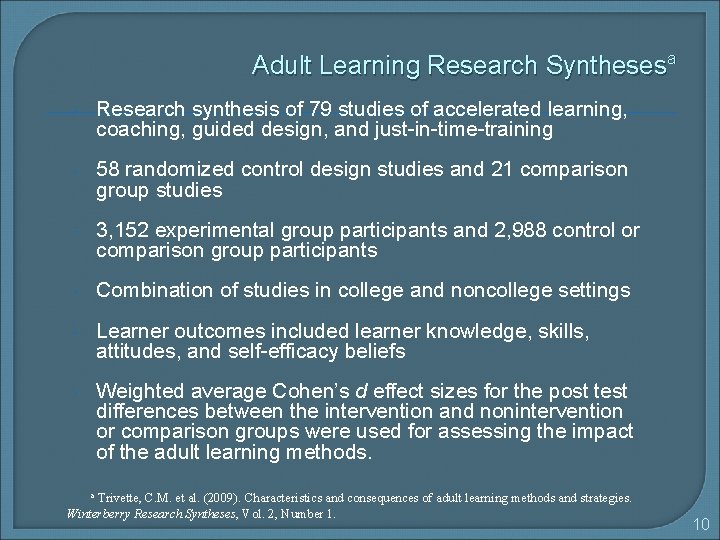
Adult Learning Research Synthesesa Research synthesis of 79 studies of accelerated learning, coaching, guided design, and just-in-time-training 58 randomized control design studies and 21 comparison group studies 3, 152 experimental group participants and 2, 988 control or comparison group participants Combination of studies in college and noncollege settings Learner outcomes included learner knowledge, skills, attitudes, and self-efficacy beliefs Weighted average Cohen’s d effect sizes for the post test differences between the intervention and nonintervention or comparison groups were used for assessing the impact of the adult learning methods. Trivette, C. M. et al. (2009). Characteristics and consequences of adult learning methods and strategies. Winterberry Research Syntheses, Vol. 2, Number 1. a 10
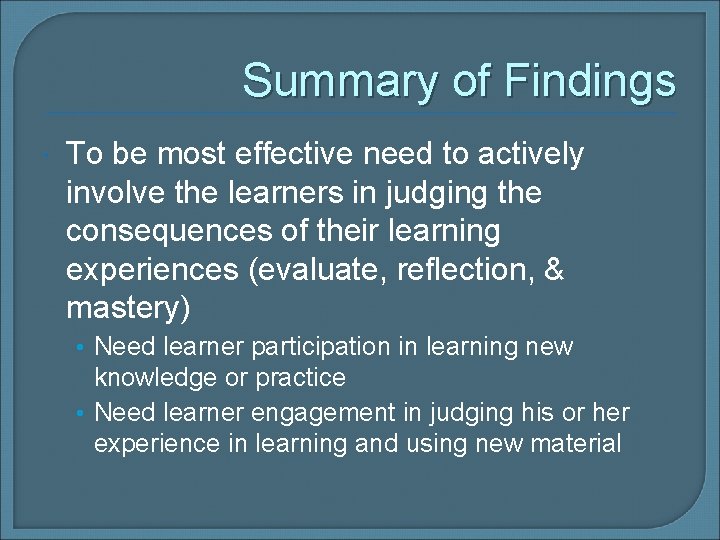
Summary of Findings To be most effective need to actively involve the learners in judging the consequences of their learning experiences (evaluate, reflection, & mastery) • Need learner participation in learning new knowledge or practice • Need learner engagement in judging his or her experience in learning and using new material
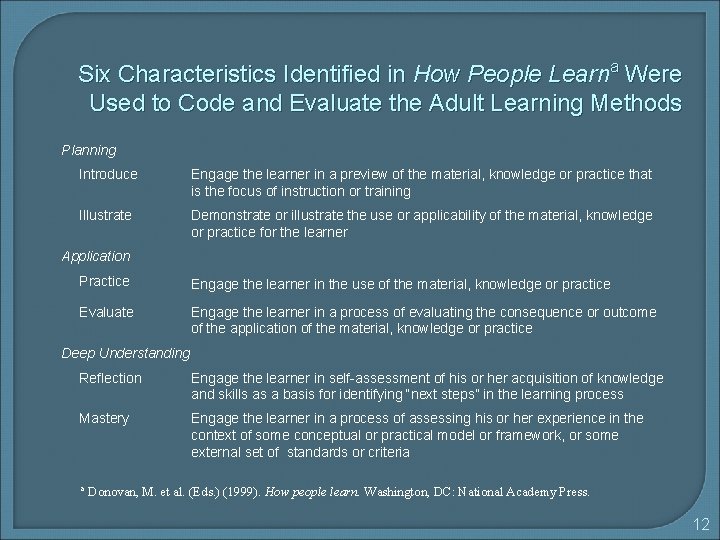
Six Characteristics Identified in How People Learna Were Used to Code and Evaluate the Adult Learning Methods Planning Introduce Engage the learner in a preview of the material, knowledge or practice that is the focus of instruction or training Illustrate Demonstrate or illustrate the use or applicability of the material, knowledge or practice for the learner Application Practice Engage the learner in the use of the material, knowledge or practice Evaluate Engage the learner in a process of evaluating the consequence or outcome of the application of the material, knowledge or practice Deep Understanding Reflection Engage the learner in self-assessment of his or her acquisition of knowledge and skills as a basis for identifying “next steps” in the learning process Mastery Engage the learner in a process of assessing his or her experience in the context of some conceptual or practical model or framework, or some external set of standards or criteria a Donovan, M. et al. (Eds. ) (1999). How people learn. Washington, DC: National Academy Press. 12
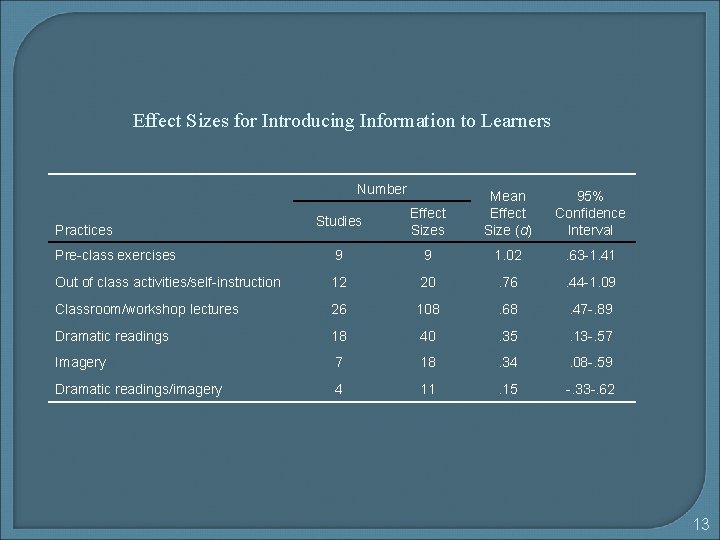
Effect Sizes for Introducing Information to Learners Number Studies Effect Sizes Mean Effect Size (d) Pre-class exercises 9 9 1. 02 . 63 -1. 41 Out of class activities/self-instruction 12 20 . 76 . 44 -1. 09 Classroom/workshop lectures 26 108 . 68 . 47 -. 89 Dramatic readings 18 40 . 35 . 13 -. 57 Imagery 7 18 . 34 . 08 -. 59 Dramatic readings/imagery 4 11 . 15 -. 33 -. 62 Practices 95% Confidence Interval 13
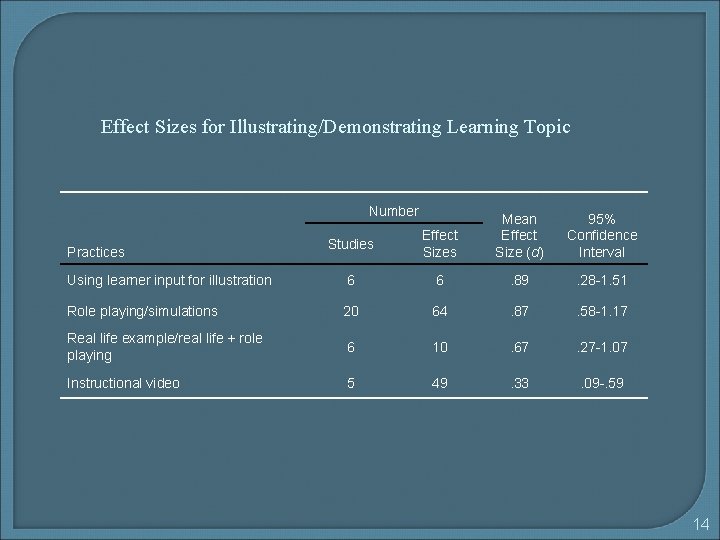
Effect Sizes for Illustrating/Demonstrating Learning Topic Number Studies Effect Sizes Mean Effect Size (d) Using learner input for illustration 6 6 . 89 . 28 -1. 51 Role playing/simulations 20 64 . 87 . 58 -1. 17 Real life example/real life + role playing 6 10 . 67 . 27 -1. 07 Instructional video 5 49 . 33 . 09 -. 59 Practices 95% Confidence Interval 14
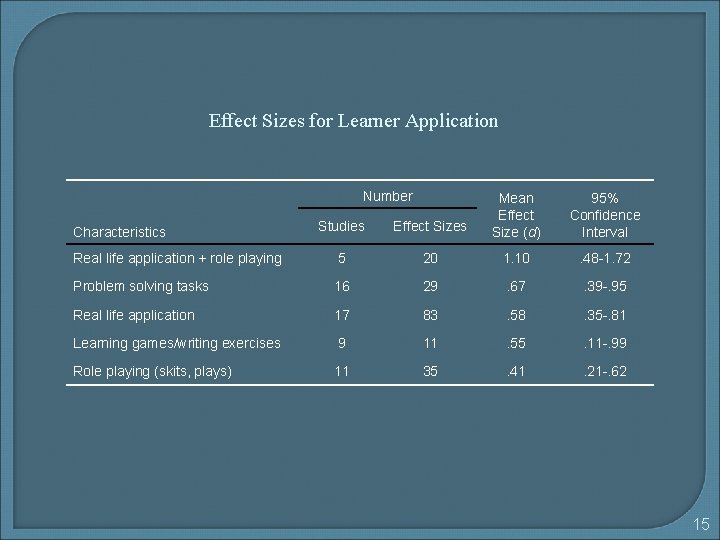
Effect Sizes for Learner Application Number Studies Effect Sizes Mean Effect Size (d) Real life application + role playing 5 20 1. 10 . 48 -1. 72 Problem solving tasks 16 29 . 67 . 39 -. 95 Real life application 17 83 . 58 . 35 -. 81 Learning games/writing exercises 9 11 . 55 . 11 -. 99 Role playing (skits, plays) 11 35 . 41 . 21 -. 62 Characteristics 95% Confidence Interval 15
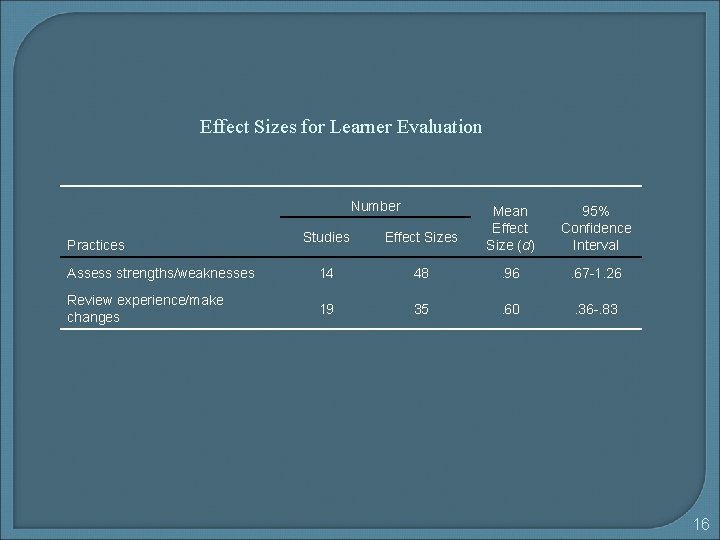
Effect Sizes for Learner Evaluation Number Mean Effect Size (d) 95% Confidence Interval Studies Effect Sizes Assess strengths/weaknesses 14 48 . 96 . 67 -1. 26 Review experience/make changes 19 35 . 60 . 36 -. 83 Practices 16
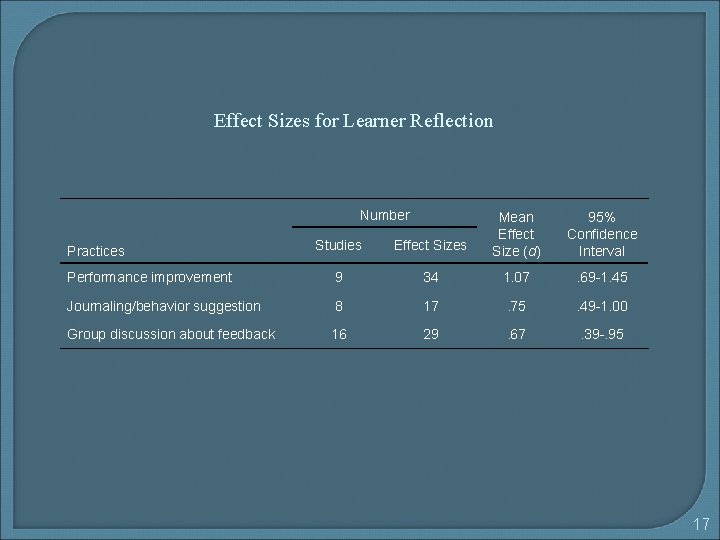
Effect Sizes for Learner Reflection Number Studies Effect Sizes Mean Effect Size (d) Performance improvement 9 34 1. 07 . 69 -1. 45 Journaling/behavior suggestion 8 17 . 75 . 49 -1. 00 Group discussion about feedback 16 29 . 67 . 39 -. 95 Practices 95% Confidence Interval 17
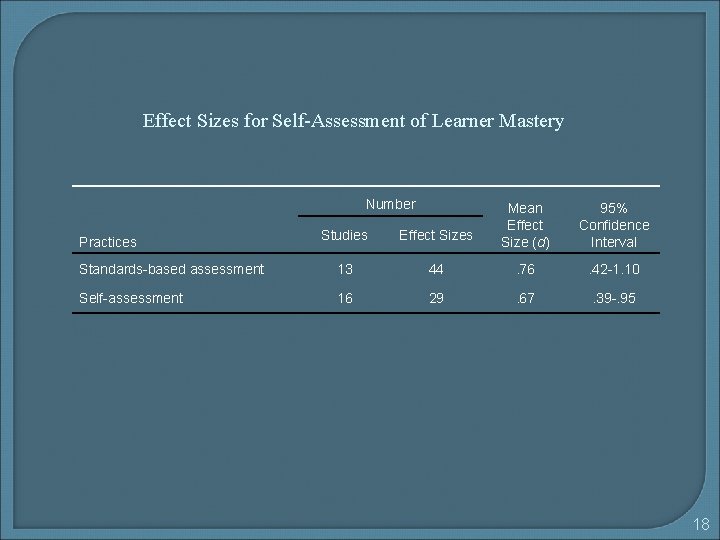
Effect Sizes for Self-Assessment of Learner Mastery Number Studies Effect Sizes Mean Effect Size (d) Standards-based assessment 13 44 . 76 . 42 -1. 10 Self-assessment 16 29 . 67 . 39 -. 95 Practices 95% Confidence Interval 18
Engaging learners in a process of selfassessment of their performance using some type of conceptual or operational framework proved to be a practice that resulted in the largest effect “Learners are not likely to become experts without instructors engaging them in a process of evaluating their experiences in the context of some framework, model, or operationally defined performance standards or expectations. ”
“The more opportunities a learner has to acquire and use new knowledge or practice, the more frequently those opportunities occur, and the more the learner is engaged in reflection on those opportunities using some external set of standards, the greater the likelihood of optimal benefits. ”
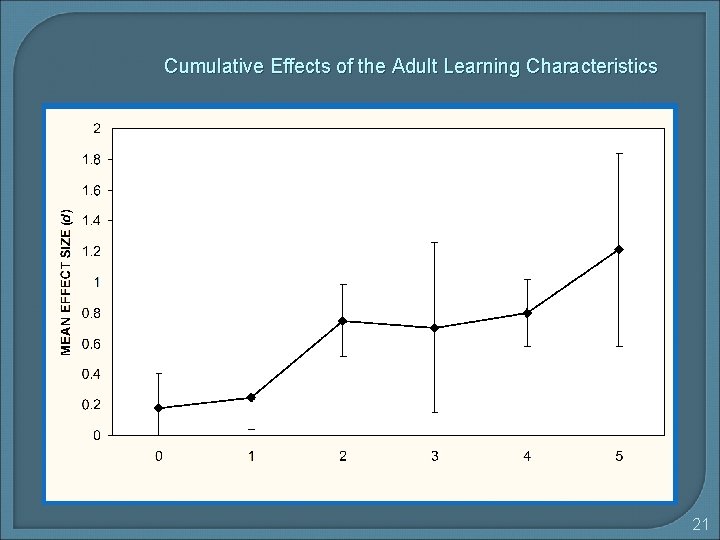
Cumulative Effects of the Adult Learning Characteristics 21
Additional Translational Synthesis Findings The smaller the number of persons participating in a training (<20), the larger the effect sizes for the study outcomes. The more hours of training over an extended number of sessions, the better the study outcomes. The practices are similarly effective when used in different settings with different types of learners. 22
Trainers neither direct learning nor encourage only self-directed learning, but rather guide learning based on observations of learners’ experiences and evaluation of the use of the practice and learner self-assessment against standards.
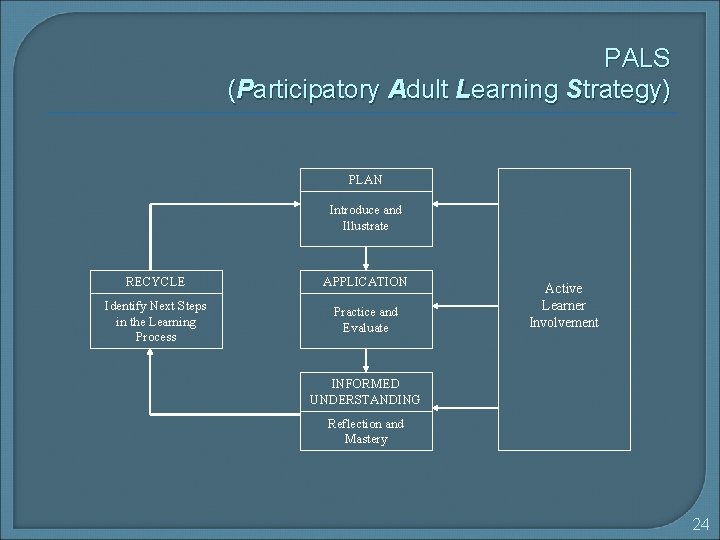
PALS (Participatory Adult Learning Strategy) PLAN Introduce and Illustrate RECYCLE APPLICATION Identify Next Steps in the Learning Process Practice and Evaluate Active Learner Involvement INFORMED UNDERSTANDING Reflection and Mastery 24
“The use of PALS practices has been found to be associated with improved learner knowledge use, and mastery of different types of intervention practices. ”
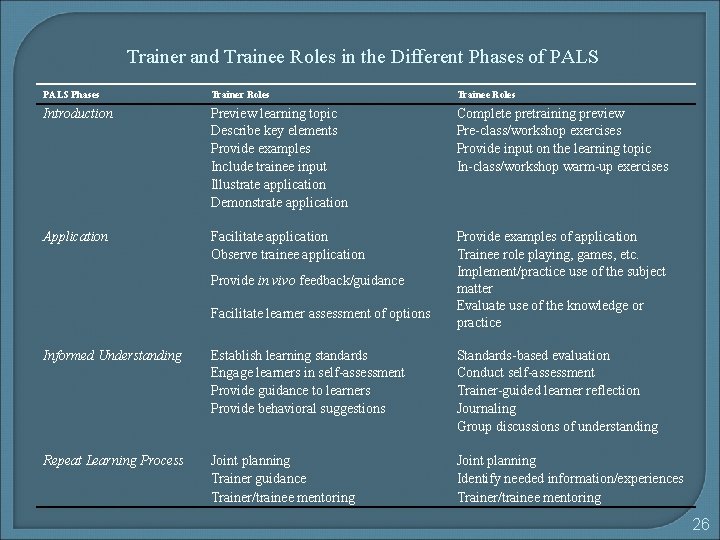
Trainer and Trainee Roles in the Different Phases of PALS Phases Trainer Roles Trainee Roles Introduction Preview learning topic Describe key elements Provide examples Include trainee input Illustrate application Demonstrate application Complete pretraining preview Pre-class/workshop exercises Provide input on the learning topic In-class/workshop warm-up exercises Application Facilitate application Observe trainee application Provide examples of application Trainee role playing, games, etc. Implement/practice use of the subject matter Evaluate use of the knowledge or practice Provide in vivo feedback/guidance Facilitate learner assessment of options Informed Understanding Establish learning standards Engage learners in self-assessment Provide guidance to learners Provide behavioral suggestions Standards-based evaluation Conduct self-assessment Trainer-guided learner reflection Journaling Group discussions of understanding Repeat Learning Process Joint planning Trainer guidance Trainer/trainee mentoring Joint planning Identify needed information/experiences Trainer/trainee mentoring 26