Instructions Language of the Machine More primitive than




- Slides: 31
Instructions: • • Language of the Machine More primitive than higher level languages e. g. , no sophisticated control flow Very restrictive e. g. , MIPS Arithmetic Instructions We’ll be working with the MIPS instruction set architecture – similar to other architectures developed since the 1980's – used by NEC, Nintendo, Silicon Graphics, Sony Design goals: maximize performance and minimize cost, reduce design time 1
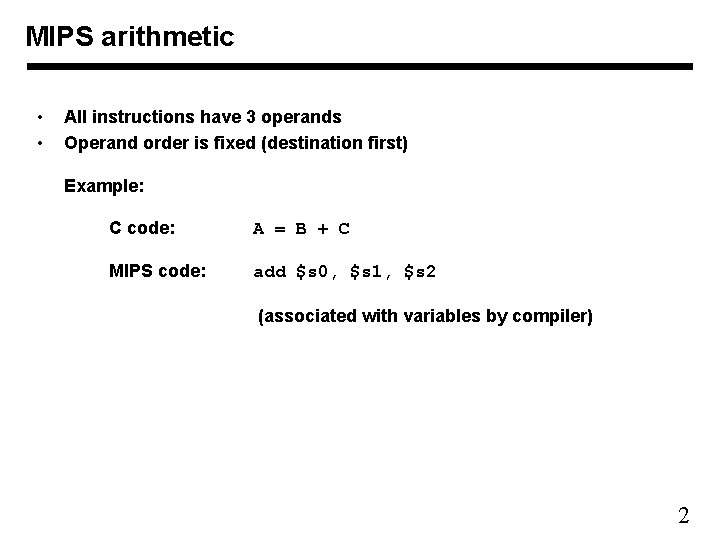
MIPS arithmetic • • All instructions have 3 operands Operand order is fixed (destination first) Example: C code: A = B + C MIPS code: add $s 0, $s 1, $s 2 (associated with variables by compiler) 2
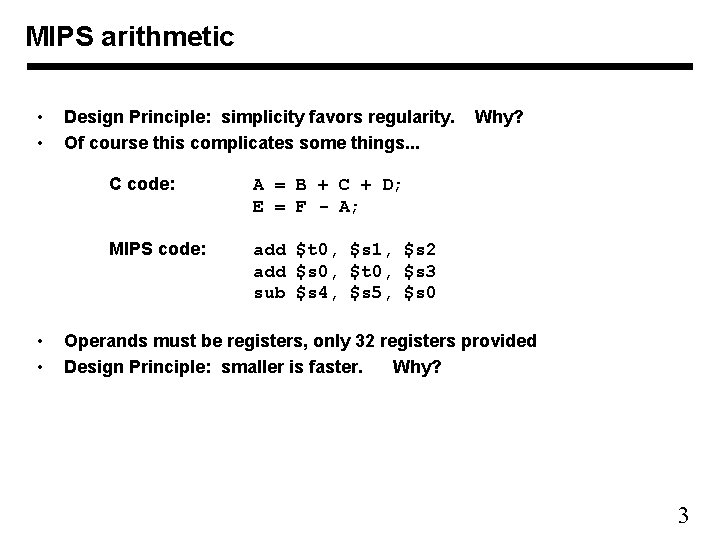
MIPS arithmetic • • Design Principle: simplicity favors regularity. Of course this complicates some things. . . C code: A = B + C + D; E = F - A; MIPS code: add $t 0, $s 1, $s 2 add $s 0, $t 0, $s 3 sub $s 4, $s 5, $s 0 Why? Operands must be registers, only 32 registers provided Design Principle: smaller is faster. Why? 3
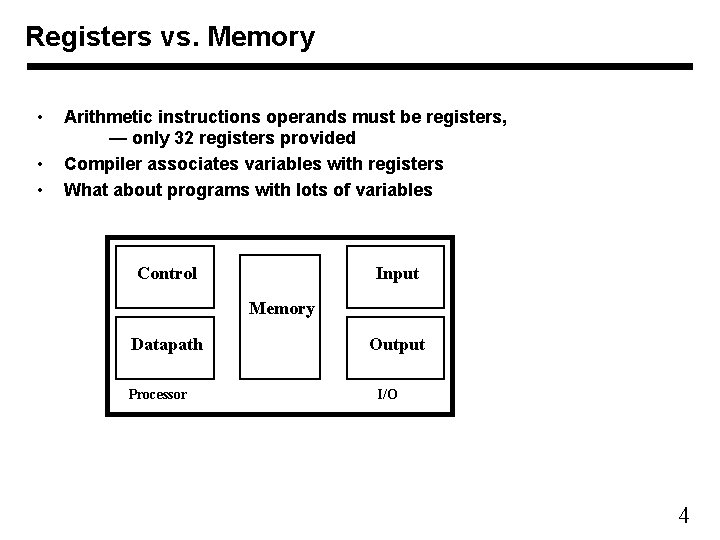
Registers vs. Memory • • • Arithmetic instructions operands must be registers, — only 32 registers provided Compiler associates variables with registers What about programs with lots of variables Control Input Memory Datapath Processor Output I/O 4
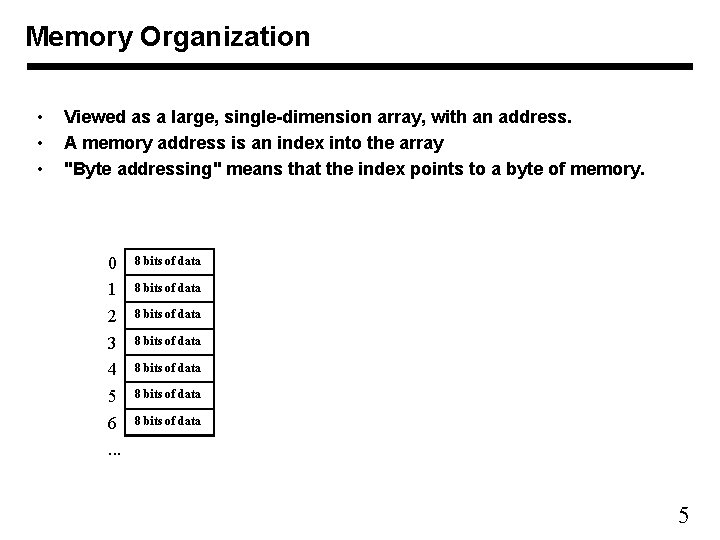
Memory Organization • • • Viewed as a large, single-dimension array, with an address. A memory address is an index into the array "Byte addressing" means that the index points to a byte of memory. 0 1 2 3 4 5 6. . . 8 bits of data 8 bits of data 5
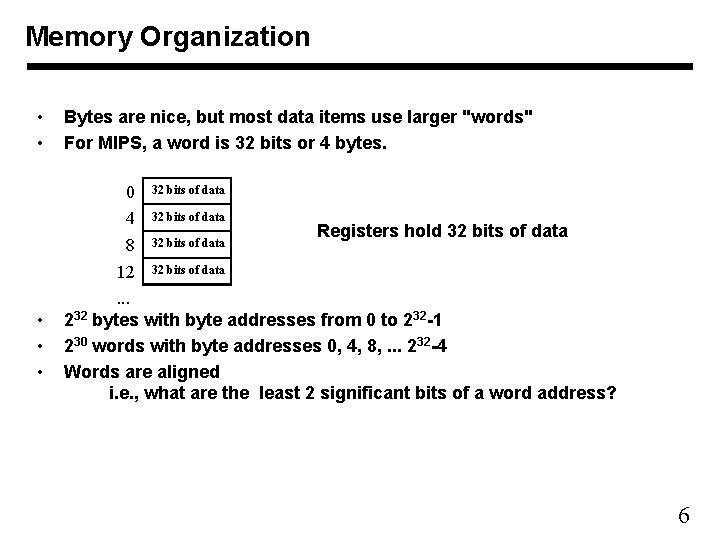
Memory Organization • • • Bytes are nice, but most data items use larger "words" For MIPS, a word is 32 bits or 4 bytes. 0 32 bits of data 4 32 bits of data Registers hold 32 bits of data 8 32 bits of data 12 32 bits of data. . . 232 bytes with byte addresses from 0 to 232 -1 230 words with byte addresses 0, 4, 8, . . . 232 -4 Words are aligned i. e. , what are the least 2 significant bits of a word address? 6
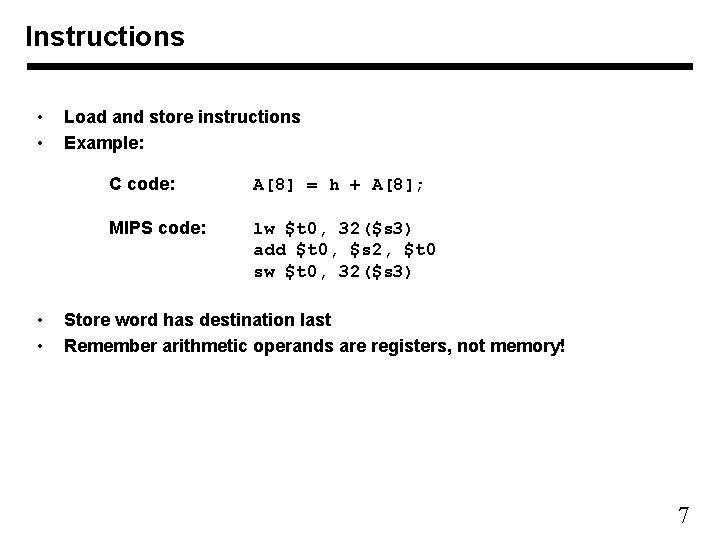
Instructions • • Load and store instructions Example: C code: A[8] = h + A[8]; MIPS code: lw $t 0, 32($s 3) add $t 0, $s 2, $t 0 sw $t 0, 32($s 3) Store word has destination last Remember arithmetic operands are registers, not memory! 7
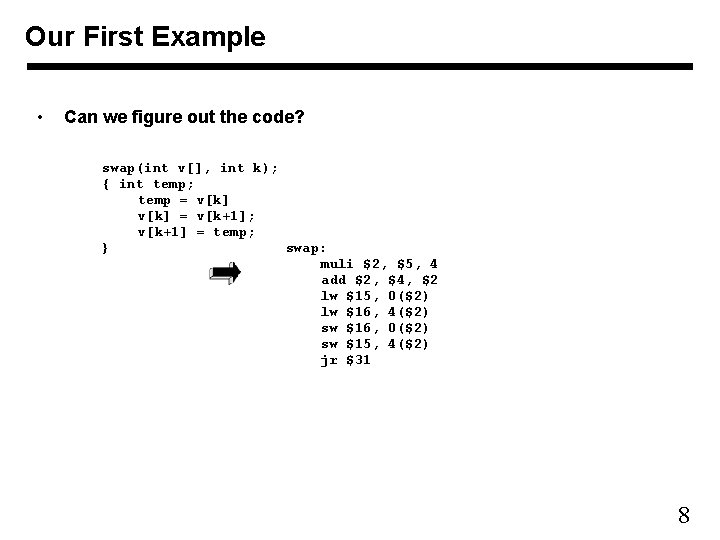
Our First Example • Can we figure out the code? swap(int v[], int k); { int temp; temp = v[k] = v[k+1]; v[k+1] = temp; swap: } muli $2, $5, 4 add $2, $4, $2 lw $15, 0($2) lw $16, 4($2) sw $16, 0($2) sw $15, 4($2) jr $31 8
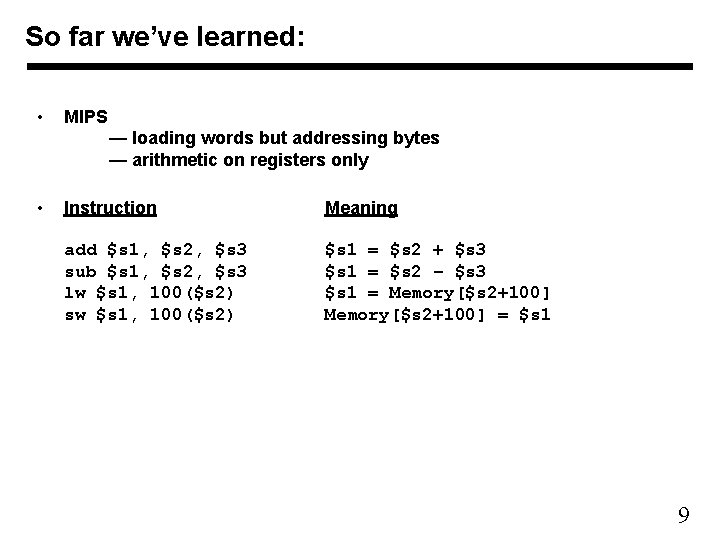
So far we’ve learned: • MIPS — loading words but addressing bytes — arithmetic on registers only • Instruction Meaning add $s 1, $s 2, $s 3 sub $s 1, $s 2, $s 3 lw $s 1, 100($s 2) sw $s 1, 100($s 2) $s 1 = $s 2 + $s 3 $s 1 = $s 2 – $s 3 $s 1 = Memory[$s 2+100] = $s 1 9
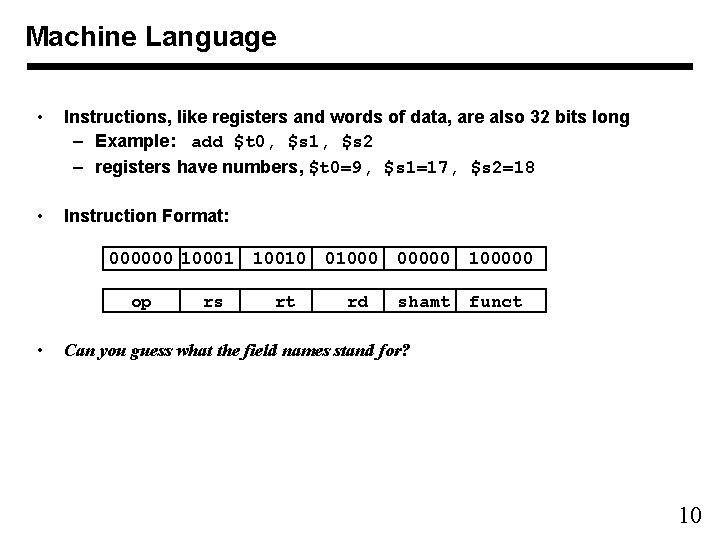
Machine Language • Instructions, like registers and words of data, are also 32 bits long – Example: add $t 0, $s 1, $s 2 – registers have numbers, $t 0=9, $s 1=17, $s 2=18 • Instruction Format: 000000 10001 10010 01000 00000 100000 op • rs rt rd shamt funct Can you guess what the field names stand for? 10
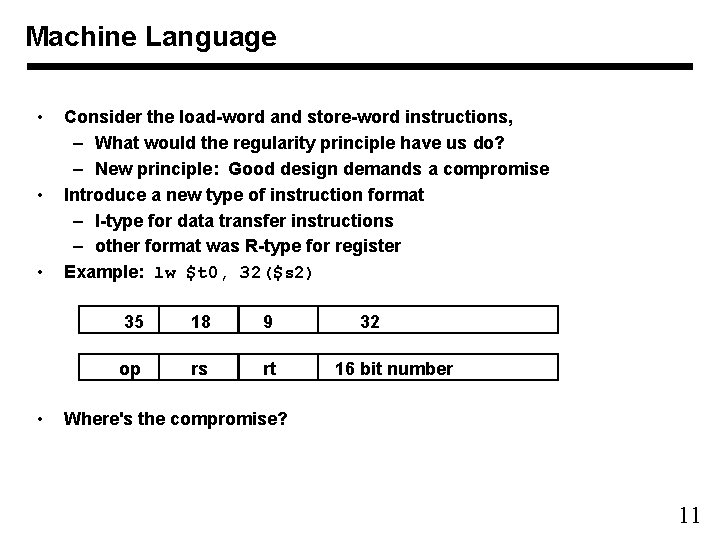
Machine Language • • Consider the load-word and store-word instructions, – What would the regularity principle have us do? – New principle: Good design demands a compromise Introduce a new type of instruction format – I-type for data transfer instructions – other format was R-type for register Example: lw $t 0, 32($s 2) 35 18 9 op rs rt 32 16 bit number Where's the compromise? 11
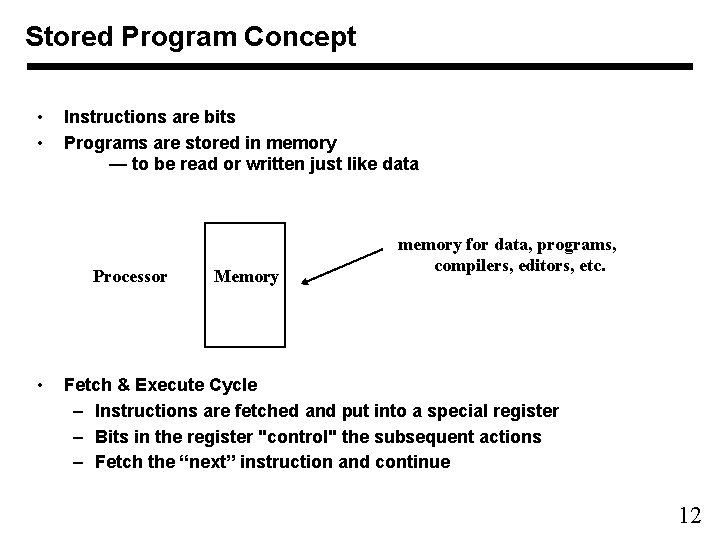
Stored Program Concept • • Instructions are bits Programs are stored in memory — to be read or written just like data Processor • Memory memory for data, programs, compilers, editors, etc. Fetch & Execute Cycle – Instructions are fetched and put into a special register – Bits in the register "control" the subsequent actions – Fetch the “next” instruction and continue 12
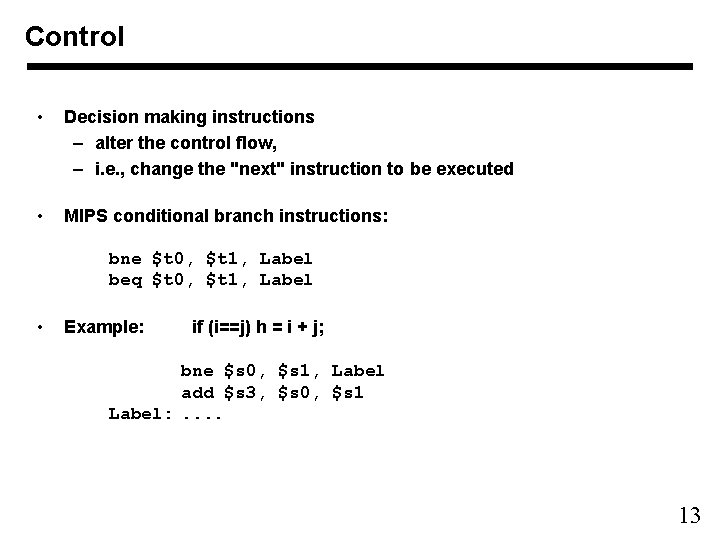
Control • Decision making instructions – alter the control flow, – i. e. , change the "next" instruction to be executed • MIPS conditional branch instructions: bne $t 0, $t 1, Label beq $t 0, $t 1, Label • Example: if (i==j) h = i + j; bne $s 0, $s 1, Label add $s 3, $s 0, $s 1 Label: . . 13
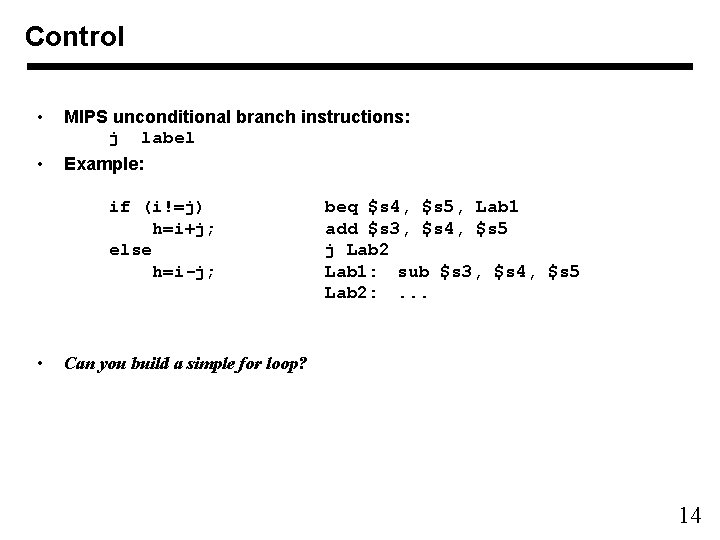
Control • MIPS unconditional branch instructions: j label • Example: if (i!=j) h=i+j; else h=i-j; • beq $s 4, $s 5, Lab 1 add $s 3, $s 4, $s 5 j Lab 2 Lab 1: sub $s 3, $s 4, $s 5 Lab 2: . . . Can you build a simple for loop? 14
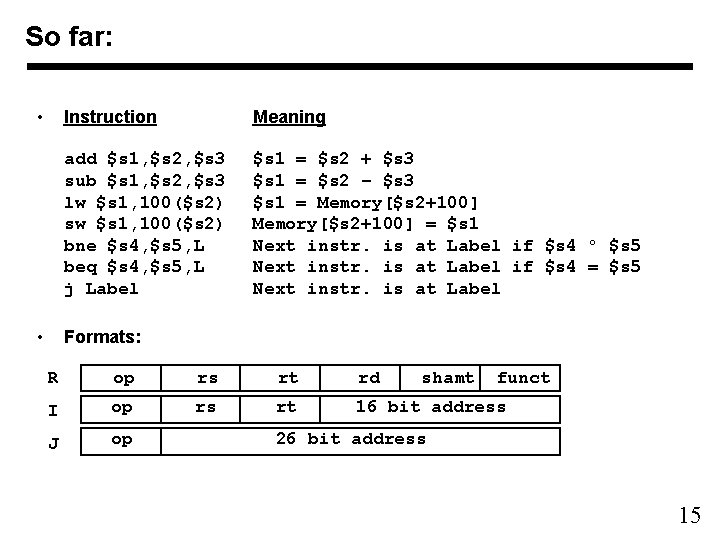
So far: • • Instruction Meaning add $s 1, $s 2, $s 3 sub $s 1, $s 2, $s 3 lw $s 1, 100($s 2) sw $s 1, 100($s 2) bne $s 4, $s 5, L beq $s 4, $s 5, L j Label $s 1 = $s 2 + $s 3 $s 1 = $s 2 – $s 3 $s 1 = Memory[$s 2+100] = $s 1 Next instr. is at Label if $s 4 ° $s 5 Next instr. is at Label if $s 4 = $s 5 Next instr. is at Label Formats: R op rs rt rd I op rs rt 16 bit address J op shamt funct 26 bit address 15
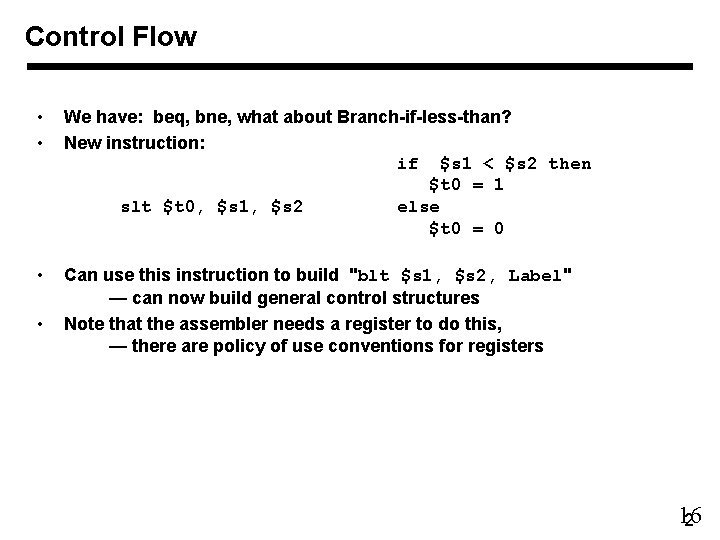
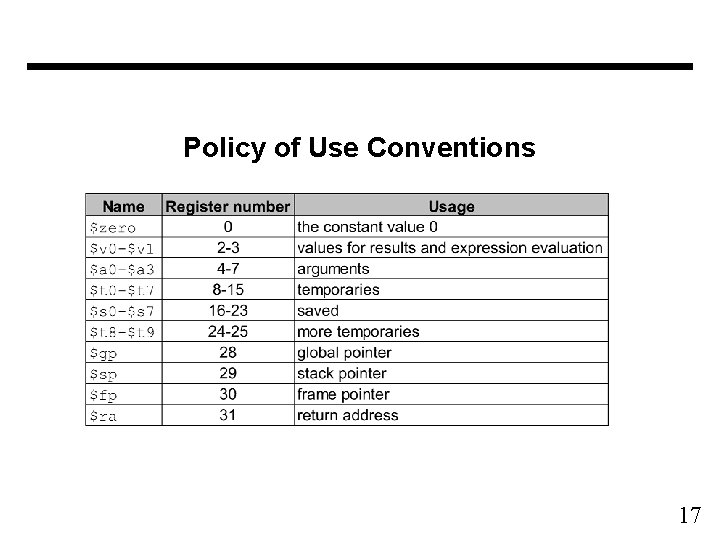
Control Flow • • We have: beq, bne, what about Branch-if-less-than? New instruction: if $s 1 < $s 2 then $t 0 = 1 slt $t 0, $s 1, $s 2 else $t 0 = 0 • Can use this instruction to build "blt $s 1, $s 2, Label" — can now build general control structures Note that the assembler needs a register to do this, — there are policy of use conventions for registers • 16 2
Policy of Use Conventions 17
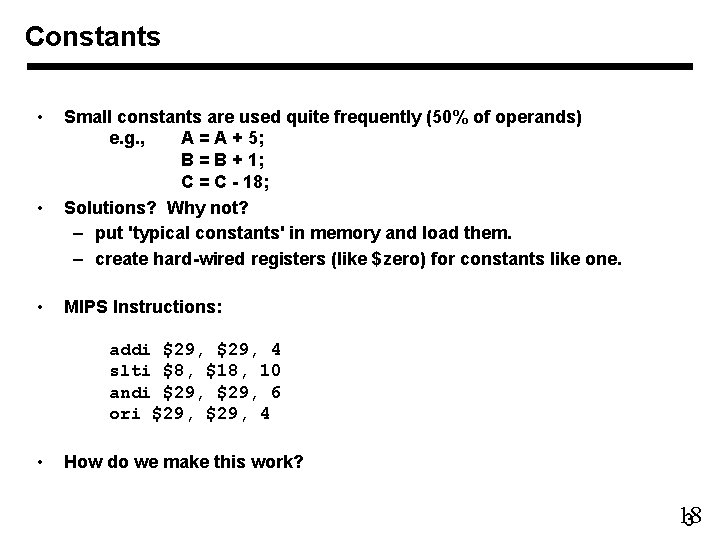
Constants • • • Small constants are used quite frequently (50% of operands) e. g. , A = A + 5; B = B + 1; C = C - 18; Solutions? Why not? – put 'typical constants' in memory and load them. – create hard-wired registers (like $zero) for constants like one. MIPS Instructions: addi $29, 4 slti $8, $18, 10 andi $29, 6 ori $29, 4 • How do we make this work? 18 3
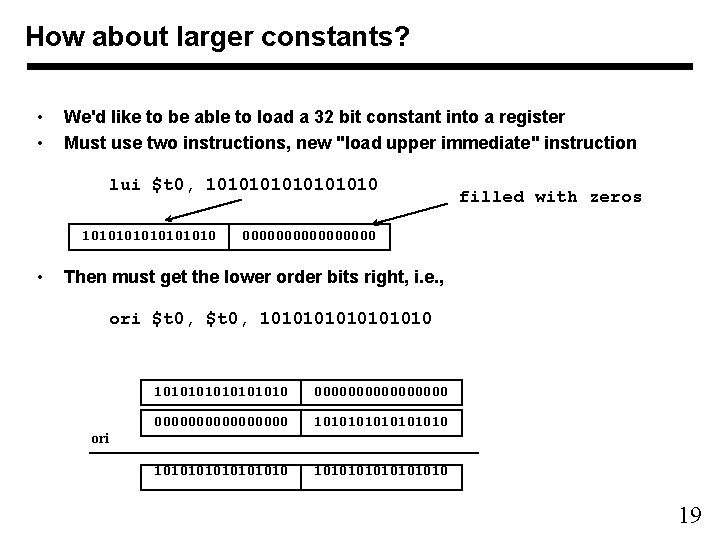
How about larger constants? • • We'd like to be able to load a 32 bit constant into a register Must use two instructions, new "load upper immediate" instruction lui $t 0, 1010101010101010 • filled with zeros 00000000 Then must get the lower order bits right, i. e. , ori $t 0, 10101010 ori 10101010 0000000000000000 1010101010101010 19
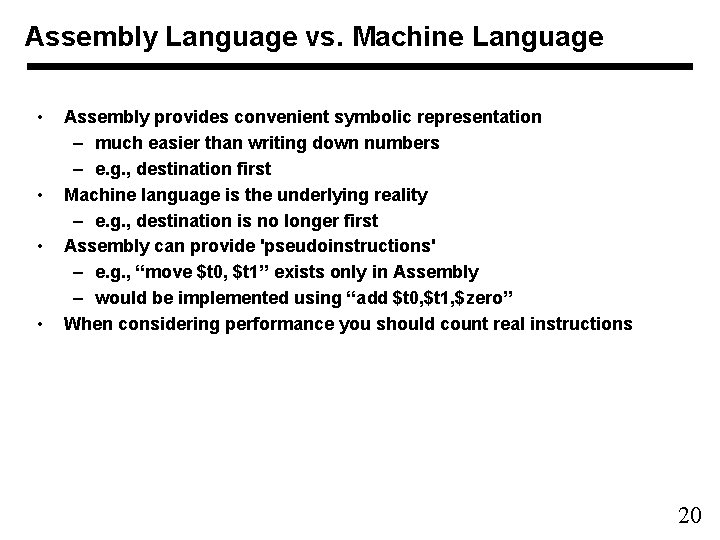
Assembly Language vs. Machine Language • • Assembly provides convenient symbolic representation – much easier than writing down numbers – e. g. , destination first Machine language is the underlying reality – e. g. , destination is no longer first Assembly can provide 'pseudoinstructions' – e. g. , “move $t 0, $t 1” exists only in Assembly – would be implemented using “add $t 0, $t 1, $zero” When considering performance you should count real instructions 20
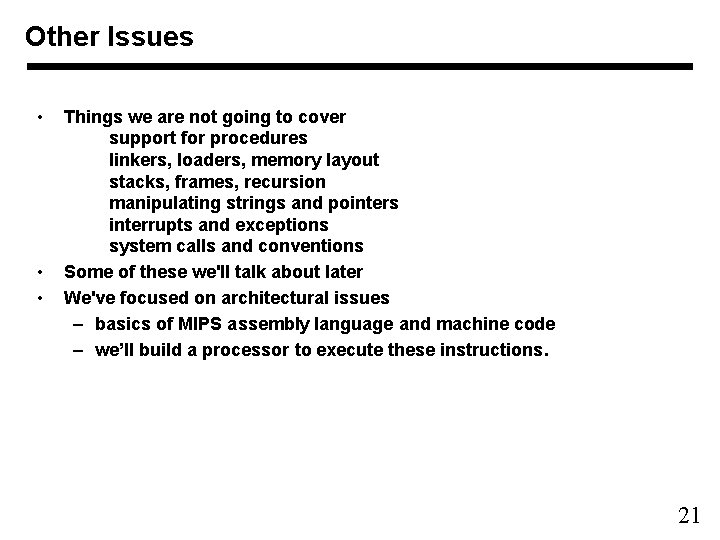
Other Issues • • • Things we are not going to cover support for procedures linkers, loaders, memory layout stacks, frames, recursion manipulating strings and pointers interrupts and exceptions system calls and conventions Some of these we'll talk about later We've focused on architectural issues – basics of MIPS assembly language and machine code – we’ll build a processor to execute these instructions. 21
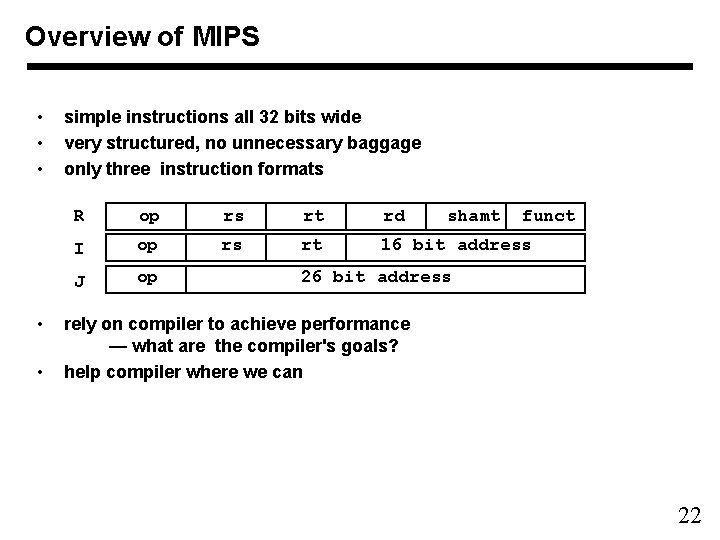
Overview of MIPS • • • simple instructions all 32 bits wide very structured, no unnecessary baggage only three instruction formats R op rs rt rd I op rs rt 16 bit address J op shamt funct 26 bit address rely on compiler to achieve performance — what are the compiler's goals? help compiler where we can 22
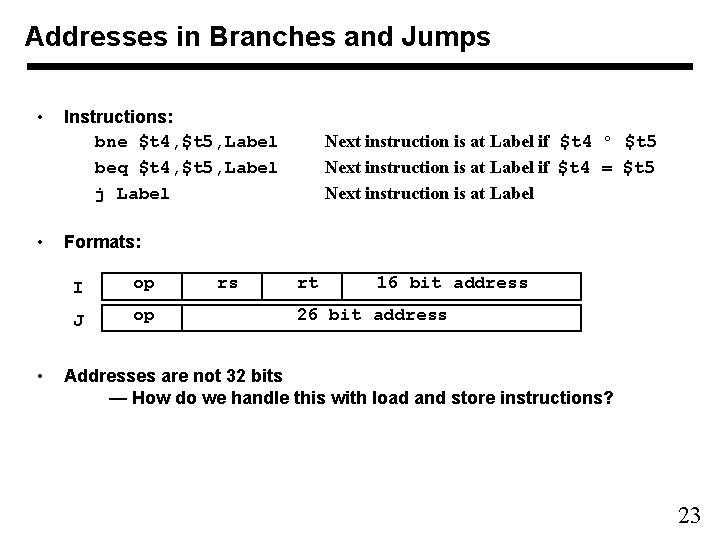
Addresses in Branches and Jumps • • • Instructions: bne $t 4, $t 5, Label beq $t 4, $t 5, Label j Label Next instruction is at Label if $t 4 ° $t 5 Next instruction is at Label if $t 4 = $t 5 Next instruction is at Label Formats: I op J op rs rt 16 bit address 26 bit address Addresses are not 32 bits — How do we handle this with load and store instructions? 23
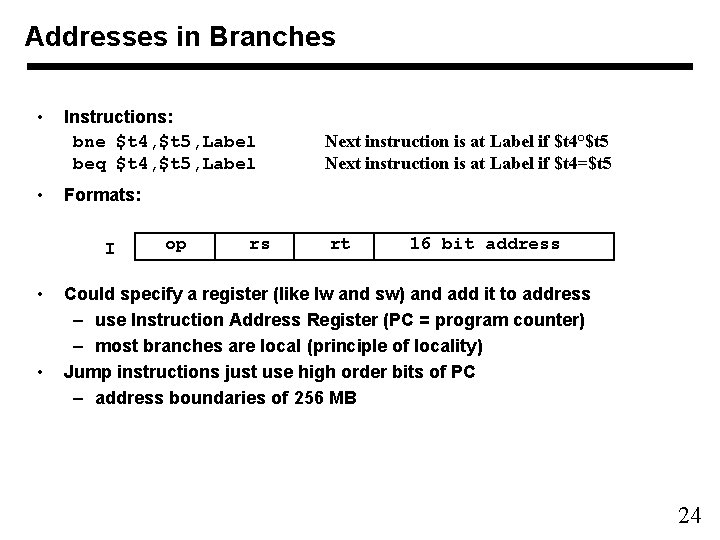
Addresses in Branches • • Instructions: bne $t 4, $t 5, Label beq $t 4, $t 5, Label Formats: I • • Next instruction is at Label if $t 4°$t 5 Next instruction is at Label if $t 4=$t 5 op rs rt 16 bit address Could specify a register (like lw and sw) and add it to address – use Instruction Address Register (PC = program counter) – most branches are local (principle of locality) Jump instructions just use high order bits of PC – address boundaries of 256 MB 24
To summarize: 25
26
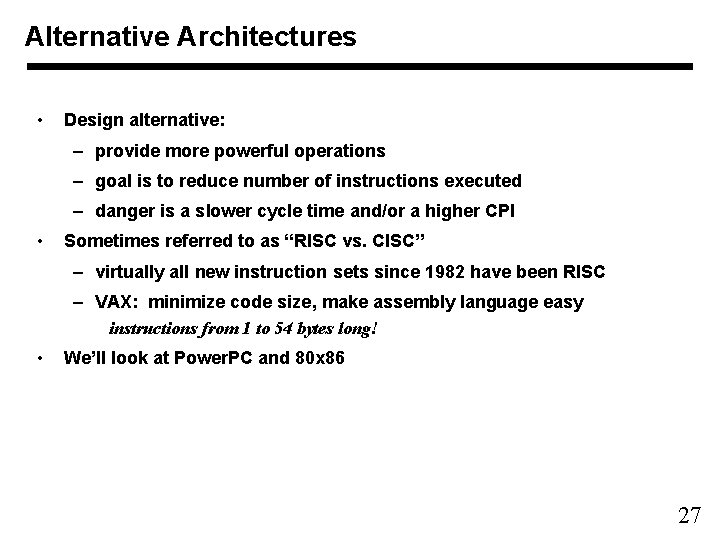
Alternative Architectures • Design alternative: – provide more powerful operations – goal is to reduce number of instructions executed – danger is a slower cycle time and/or a higher CPI • Sometimes referred to as “RISC vs. CISC” – virtually all new instruction sets since 1982 have been RISC – VAX: minimize code size, make assembly language easy instructions from 1 to 54 bytes long! • We’ll look at Power. PC and 80 x 86 27
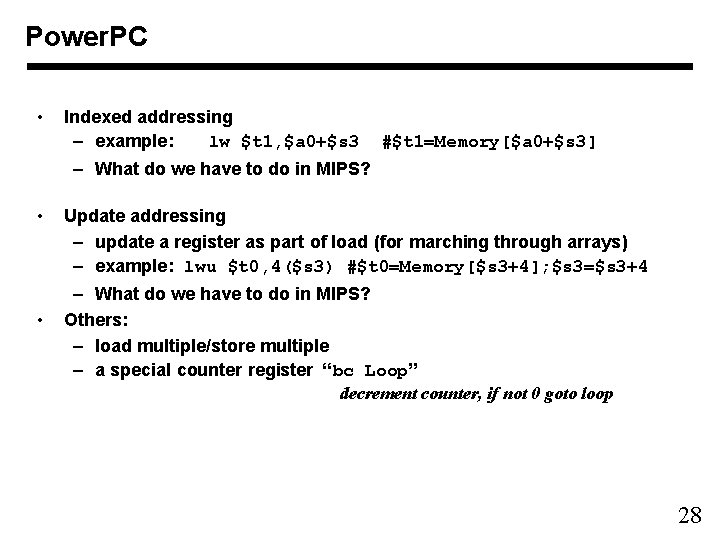
Power. PC • Indexed addressing – example: lw $t 1, $a 0+$s 3 #$t 1=Memory[$a 0+$s 3] – What do we have to do in MIPS? • • Update addressing – update a register as part of load (for marching through arrays) – example: lwu $t 0, 4($s 3) #$t 0=Memory[$s 3+4]; $s 3=$s 3+4 – What do we have to do in MIPS? Others: – load multiple/store multiple – a special counter register “bc Loop” decrement counter, if not 0 goto loop 28
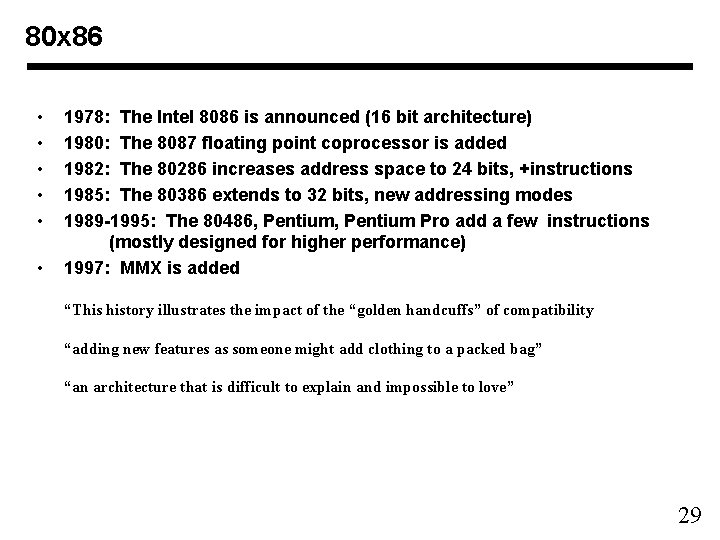
80 x 86 • • • 1978: The Intel 8086 is announced (16 bit architecture) 1980: The 8087 floating point coprocessor is added 1982: The 80286 increases address space to 24 bits, +instructions 1985: The 80386 extends to 32 bits, new addressing modes 1989 -1995: The 80486, Pentium Pro add a few instructions (mostly designed for higher performance) 1997: MMX is added “This history illustrates the impact of the “golden handcuffs” of compatibility “adding new features as someone might add clothing to a packed bag” “an architecture that is difficult to explain and impossible to love” 29
A dominant architecture: 80 x 86 • • • See your textbook for a more detailed description Complexity: – Instructions from 1 to 17 bytes long – one operand must act as both a source and destination – one operand can come from memory – complex addressing modes e. g. , “base or scaled index with 8 or 32 bit displacement” Saving grace: – the most frequently used instructions are not too difficult to build – compilers avoid the portions of the architecture that are slow “what the 80 x 86 lacks in style is made up in quantity, making it beautiful from the right perspective” 30
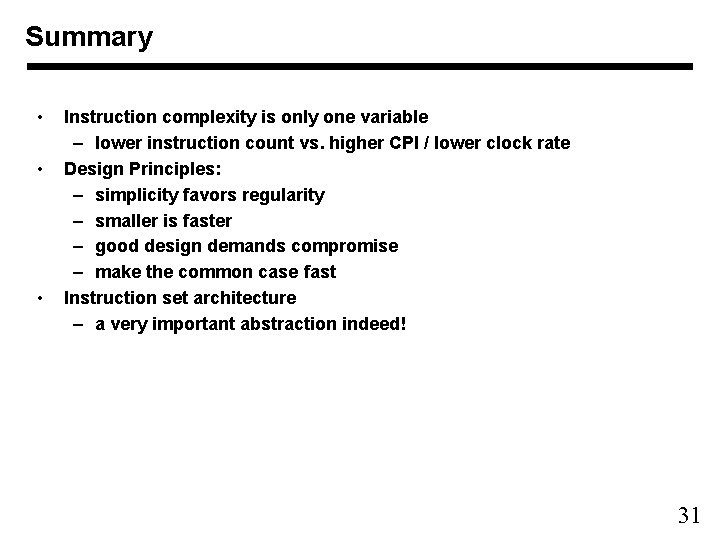
Summary • • • Instruction complexity is only one variable – lower instruction count vs. higher CPI / lower clock rate Design Principles: – simplicity favors regularity – smaller is faster – good design demands compromise – make the common case fast Instruction set architecture – a very important abstraction indeed! 31