Institute of High Energy Physics Triangle singularity and

- Slides: 48
Institute of High Energy Physics Triangle singularity and threshold phenomena – a long story about the pseudoscalar glueball Qiang Zhao Institute of High Energy Physics, CAS and Theoretical Physics Center for Science Facilities (TPCSF), CAS zhaoq@ihep. ac. cn The International Workshop on Partial Wave Analyses and Advanced Tools for Hadron Physics, July 16 -20, 2018, Beijing
Outline 1. Exotic hadrons and observable effects produced by leading kinematic singularities, “triangle singularity” 2. Controversial issues in the study of pseudoscalar glueball 3. Reconsile the dynamical model calculations with LQCD simulations 4. 5. Observables sensitive to the underlying dynamics Brief summary
1. Exotic hadrons and observable effects produced by leading kinematic singularities, “triangle singularity”
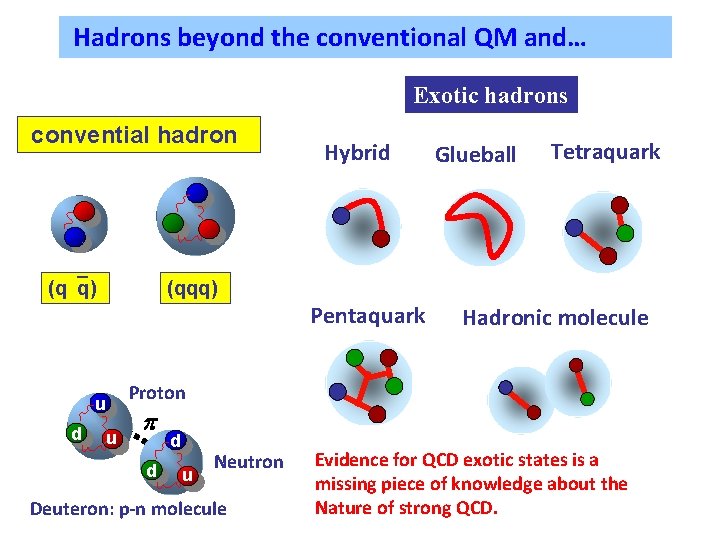
Hadrons beyond the conventional QM and… Exotic hadrons convential hadron (q q) Hybrid Tetraquark (qqq) Pentaquark Hadronic molecule Proton u d Glueball u d d u Neutron Deuteron: p-n molecule Evidence for QCD exotic states is a missing piece of knowledge about the Nature of strong QCD.
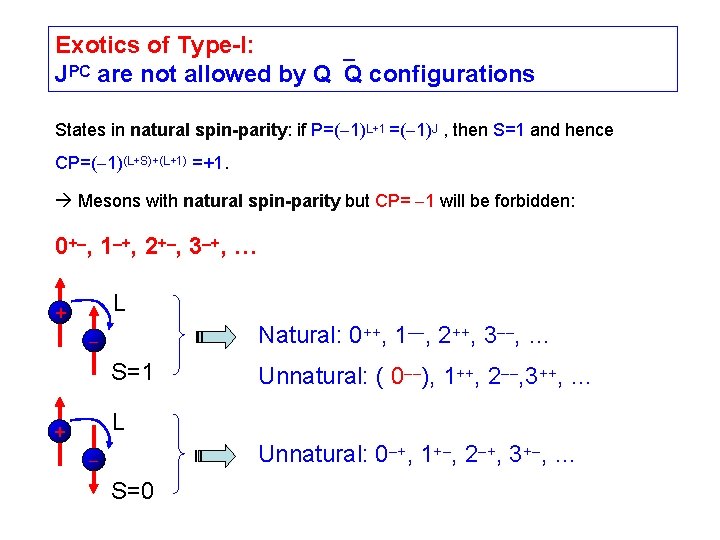
Exotics of Type-I: JPC are not allowed by Q Q configurations States in natural spin-parity: if P=( 1)L+1 =( 1)J , then S=1 and hence CP=( 1)(L+S)+(L+1) =+1. Mesons with natural spin-parity but CP= 1 will be forbidden: 0+ , 1 +, 2+ , 3 +, … L + Natural: 0++, 1 , 2++, 3 , … S=1 Unnatural: ( 0 ), 1++, 2 , 3++, … L + Unnatural: 0 +, 1+ , 2 +, 3+ , … S=0
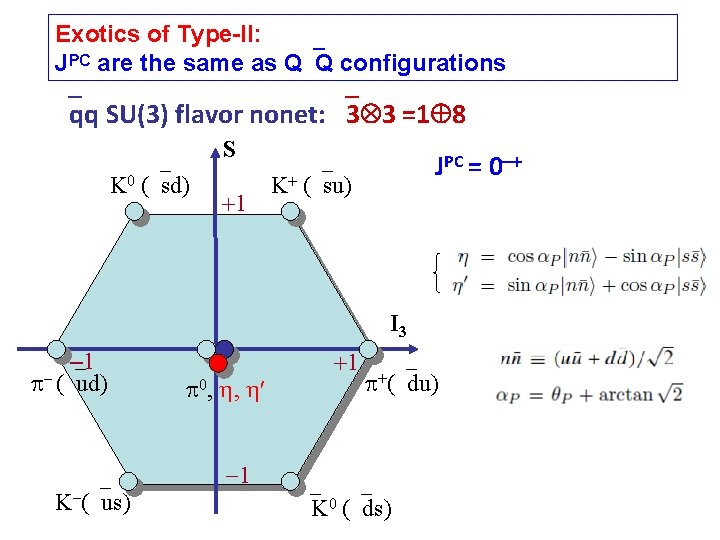
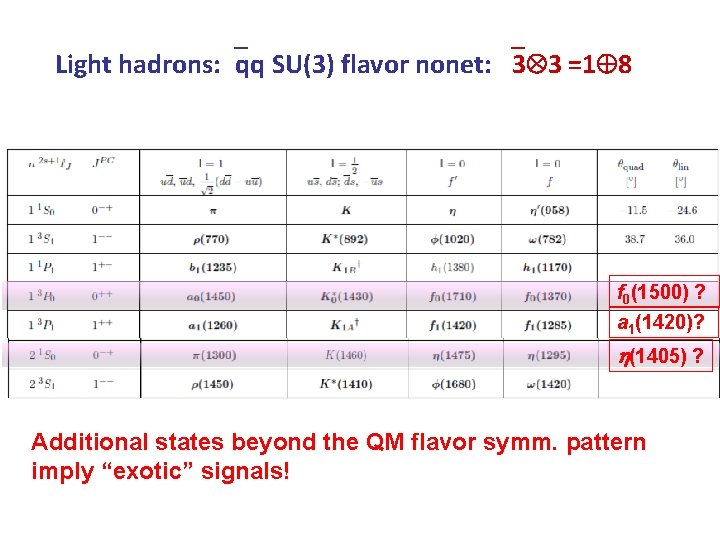
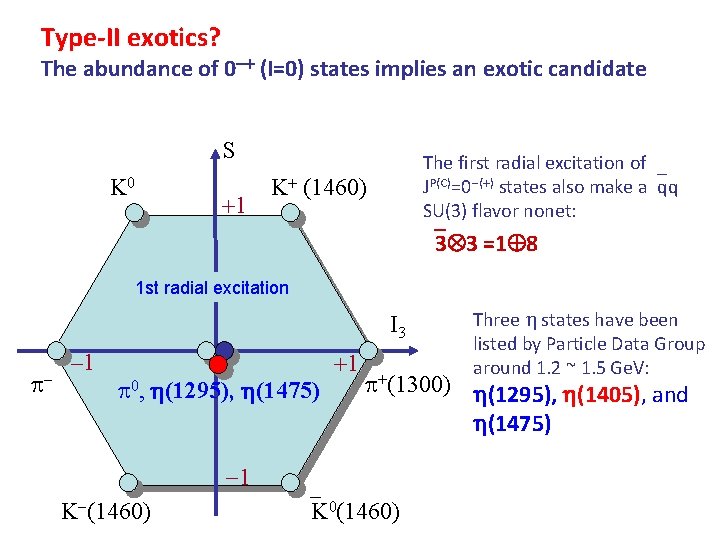
Exotics of Type-II: JPC are the same as Q Q configurations qq SU(3) flavor nonet: 3 3 =1 8 S K 0 ( sd) 1 JPC = 0 K ( su) I 3 – 1 – ( ud) K ( us) 0, , 1 +( du) 1 K 0 ( ds)
Light hadrons: qq SU(3) flavor nonet: 3 3 =1 8 f 0(1500) ? a 1(1420)? (1405) ? Additional states beyond the QM flavor symm. pattern imply “exotic” signals!
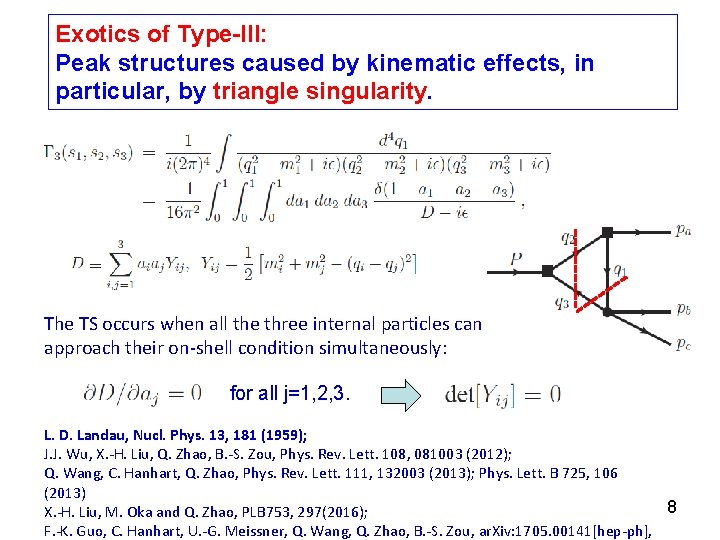
Exotics of Type-III: Peak structures caused by kinematic effects, in particular, by triangle singularity. The TS occurs when all the three internal particles can approach their on-shell condition simultaneously: for all j=1, 2, 3. L. D. Landau, Nucl. Phys. 13, 181 (1959); J. J. Wu, X. -H. Liu, Q. Zhao, B. -S. Zou, Phys. Rev. Lett. 108, 081003 (2012); Q. Wang, C. Hanhart, Q. Zhao, Phys. Rev. Lett. 111, 132003 (2013); Phys. Lett. B 725, 106 (2013) 8 X. -H. Liu, M. Oka and Q. Zhao, PLB 753, 297(2016); F. -K. Guo, C. Hanhart, U. -G. Meissner, Q. Wang, Q. Zhao, B. -S. Zou, ar. Xiv: 1705. 00141[hep-ph],
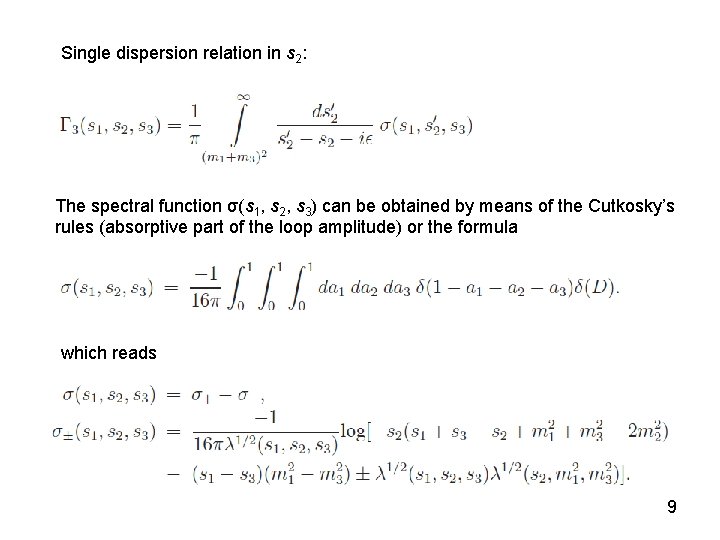
Single dispersion relation in s 2: The spectral function σ(s 1, s 2, s 3) can be obtained by means of the Cutkosky’s rules (absorptive part of the loop amplitude) or the formula which reads 9
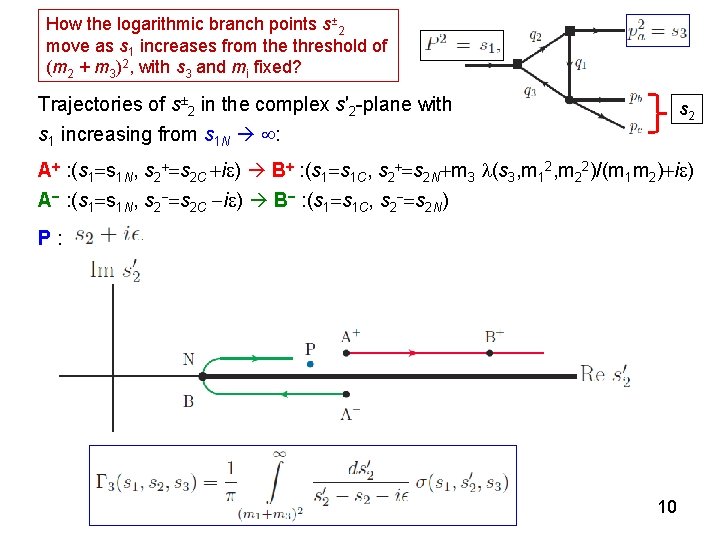
How the logarithmic branch points s± 2 move as s 1 increases from the threshold of (m 2 + m 3)2, with s 3 and mi fixed? Trajectories of s± 2 in the complex s′ 2 -plane with s 1 increasing from s 1 N : s 2 A : (s 1 s 1 N, s 2 C i ) B : (s 1 s 1 C, s 2 N m 3 (s 3, m 12, m 22)/(m 1 m 2) i ) A : (s 1 s 1 N, s 2 C i ) B : (s 1 s 1 C, s 2 N) P: 10
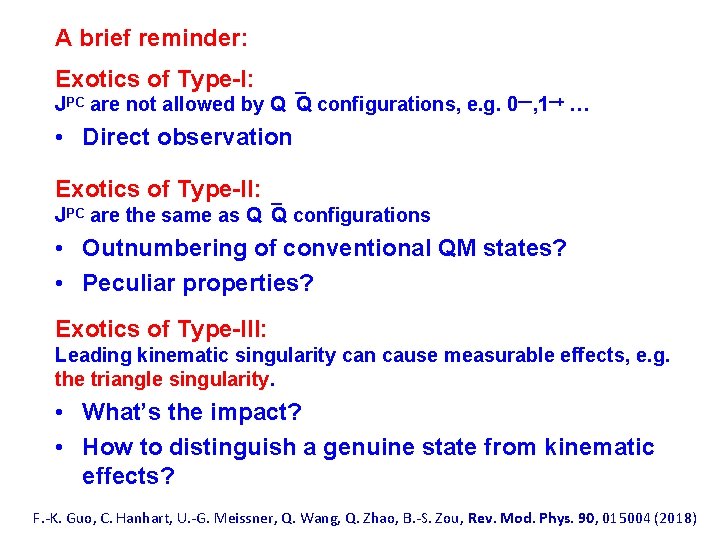
A brief reminder: Exotics of Type-I: JPC are not allowed by Q Q configurations, e. g. 0 , 1 … • Direct observation Exotics of Type-II: JPC are the same as Q Q configurations • Outnumbering of conventional QM states? • Peculiar properties? Exotics of Type-III: Leading kinematic singularity can cause measurable effects, e. g. the triangle singularity. • What’s the impact? • How to distinguish a genuine state from kinematic effects? F. -K. Guo, C. Hanhart, U. -G. Meissner, Q. Wang, Q. Zhao, B. -S. Zou, Rev. Mod. Phys. 90, 015004 (2018)
2. Controversial issues in the study of pseudoscalar glueball
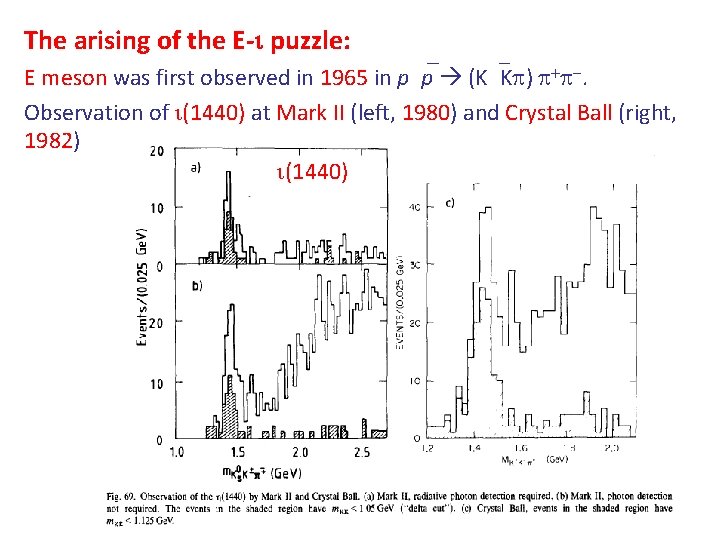
The arising of the E- puzzle: E meson was first observed in 1965 in p p (K K ) . Observation of (1440) at Mark II (left, 1980) and Crystal Ball (right, 1982) (1440)
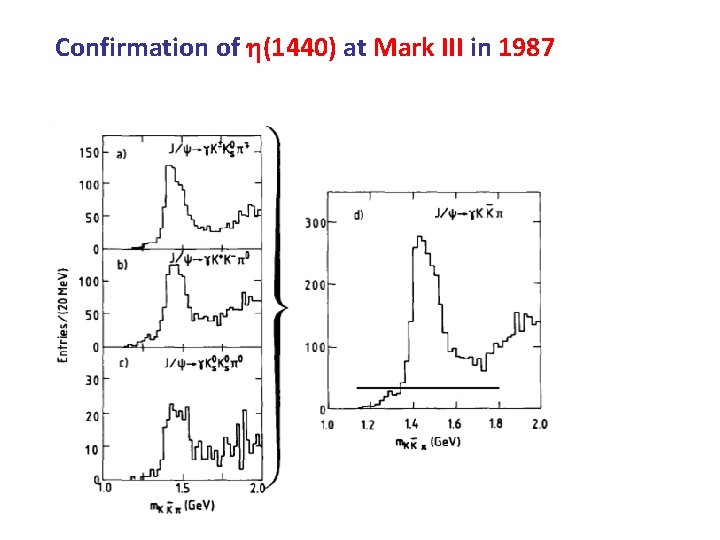
Confirmation of (1440) at Mark III in 1987
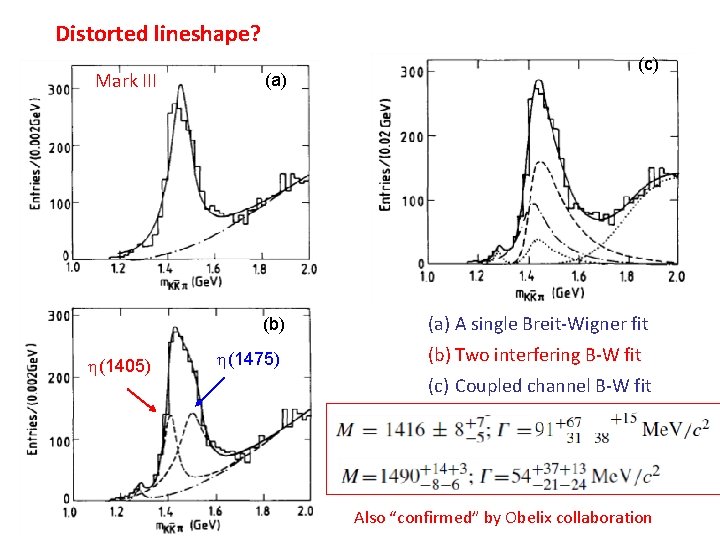
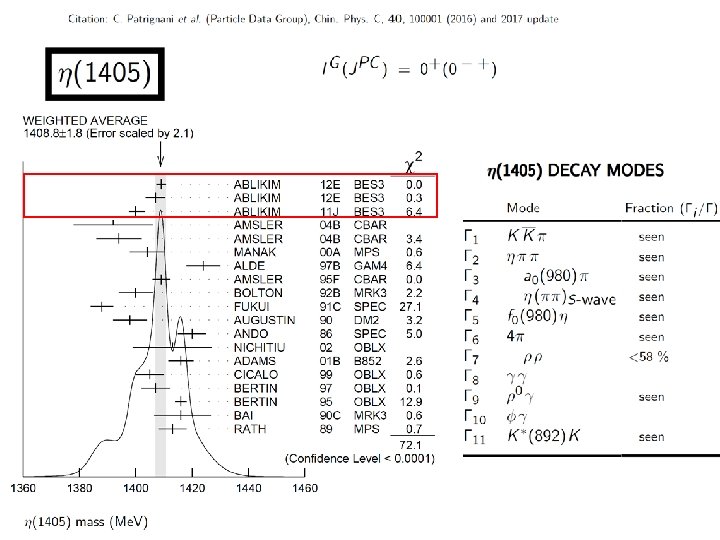
Distorted lineshape? Mark III (a) (b) (1405) (1475) (c) (a) A single Breit-Wigner fit (b) Two interfering B-W fit (c) Coupled channel B-W fit Also “confirmed” by Obelix collaboration
Type-II exotics? The abundance of 0 (I=0) states implies an exotic candidate S K 0 1 The first radial excitation of JP(C)=0 ( ) states also make a qq SU(3) flavor nonet: K (1460) 3 3 =1 8 1 st radial excitation I 3 – – 1 0, (1295), (1475) 1 +(1300) (1295), (1405), and (1475) 1 K (1460) Three states have been listed by Particle Data Group around 1. 2 ~ 1. 5 Ge. V: K 0(1460)
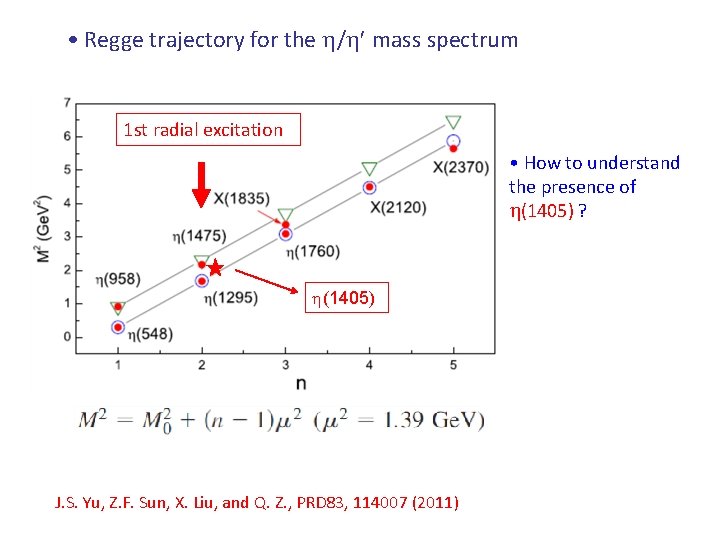
• Regge trajectory for the / mass spectrum 1 st radial excitation • How to understand the presence of (1405) ? (1405) J. S. Yu, Z. F. Sun, X. Liu, and Q. Z. , PRD 83, 114007 (2011)
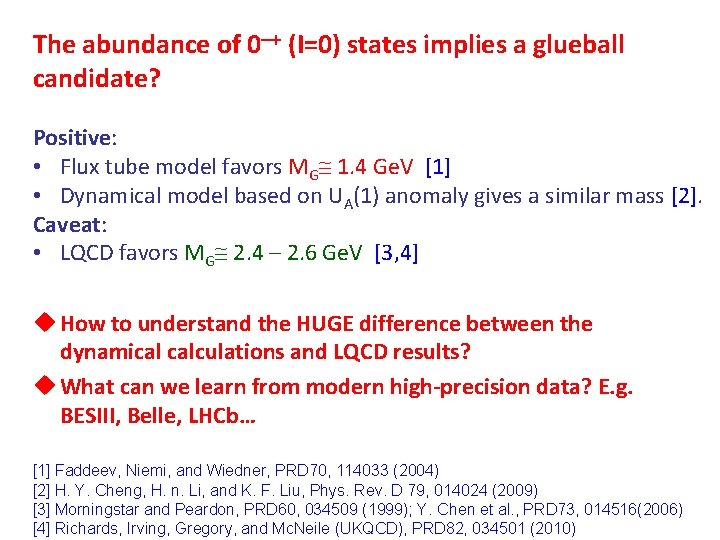
The abundance of 0 (I=0) states implies a glueball candidate? Positive: • Flux tube model favors MG 1. 4 Ge. V [1] • Dynamical model based on UA(1) anomaly gives a similar mass [2]. Caveat: • LQCD favors MG 2. 4 – 2. 6 Ge. V [3, 4] u How to understand the HUGE difference between the dynamical calculations and LQCD results? u What can we learn from modern high-precision data? E. g. BESIII, Belle, LHCb… [1] Faddeev, Niemi, and Wiedner, PRD 70, 114033 (2004) [2] H. Y. Cheng, H. n. Li, and K. F. Liu, Phys. Rev. D 79, 014024 (2009) [3] Morningstar and Peardon, PRD 60, 034509 (1999); Y. Chen et al. , PRD 73, 014516(2006) [4] Richards, Irving, Gregory, and Mc. Neile (UKQCD), PRD 82, 034501 (2010)
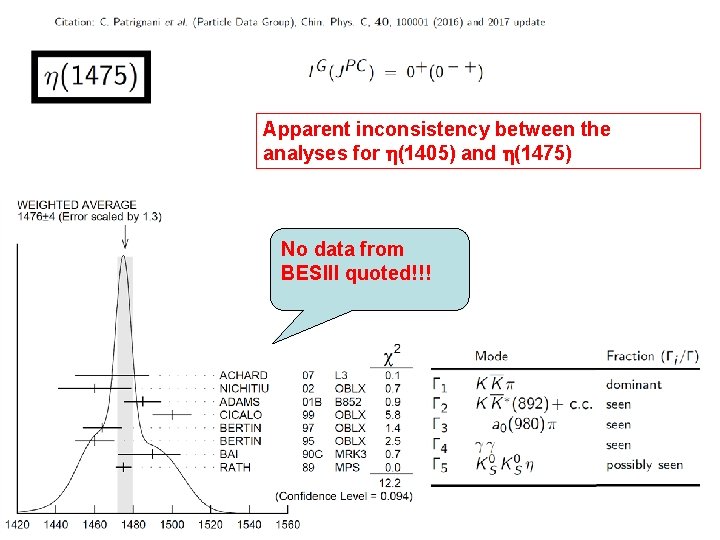
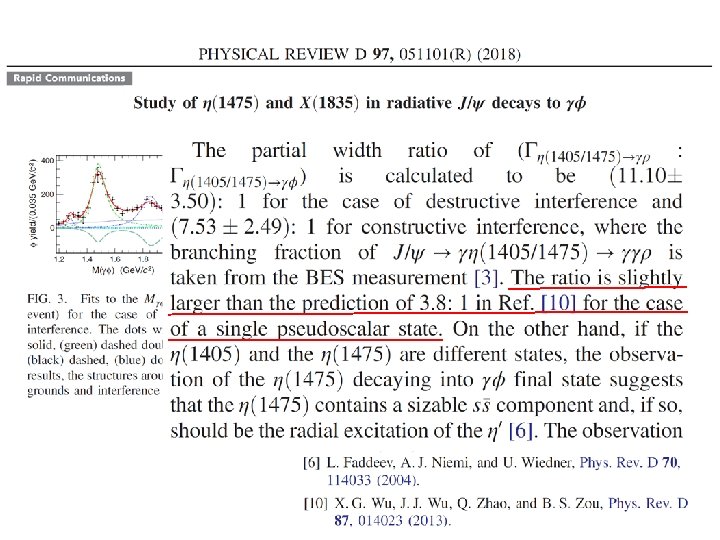
Apparent inconsistency between the analyses for (1405) and (1475) No data from BESIII quoted!!!
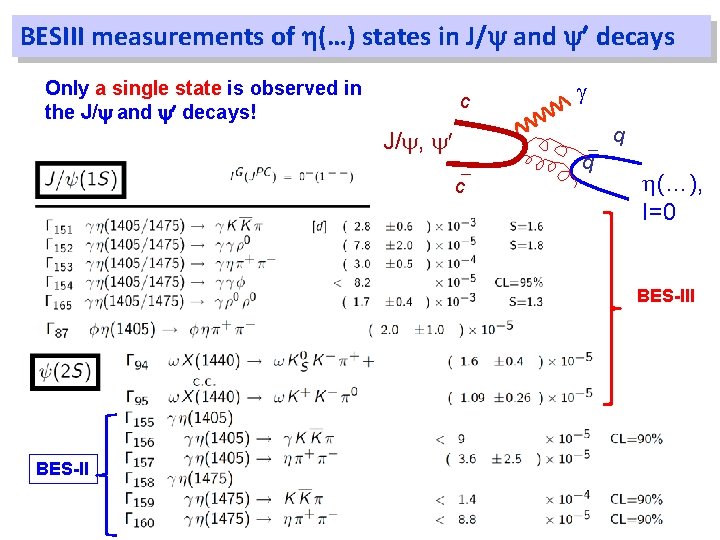
BESIII measurements of (…) states in J/ and decays Only a single state is observed in the J/ and decays! c J/ , c q q (…), I=0 BES-III BES-II
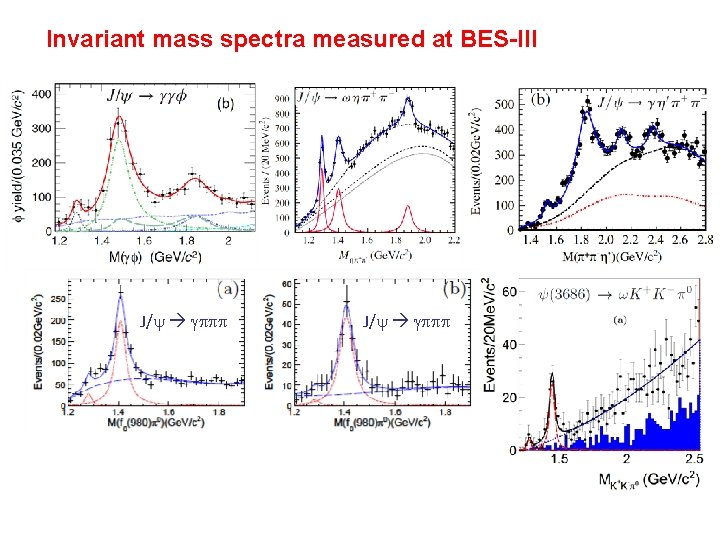
Invariant mass spectra measured at BES-III J/
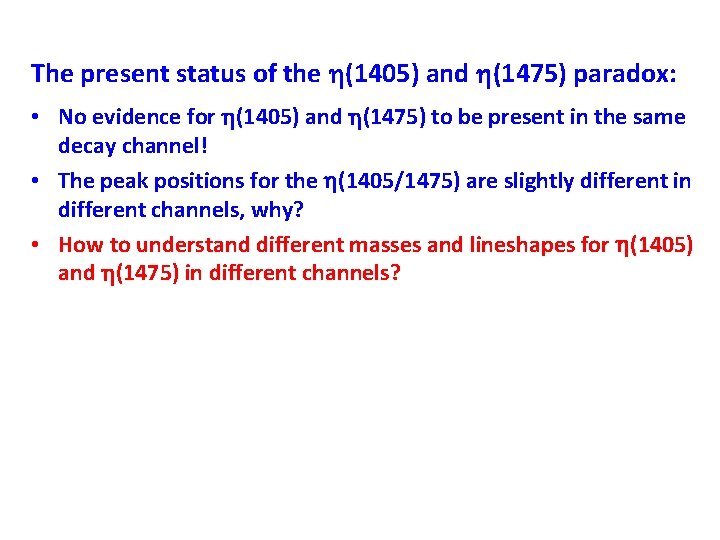
The present status of the (1405) and (1475) paradox: • No evidence for (1405) and (1475) to be present in the same decay channel! • The peak positions for the (1405/1475) are slightly different in different channels, why? • How to understand different masses and lineshapes for (1405) and (1475) in different channels?
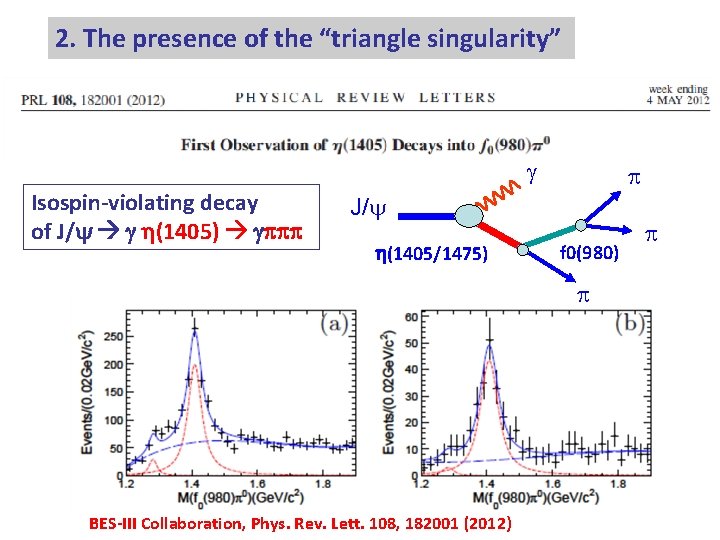
2. The presence of the “triangle singularity” Isospin-violating decay of J/ (1405) J/ (1405/1475) f 0(980) BES-III Collaboration, Phys. Rev. Lett. 108, 182001 (2012)
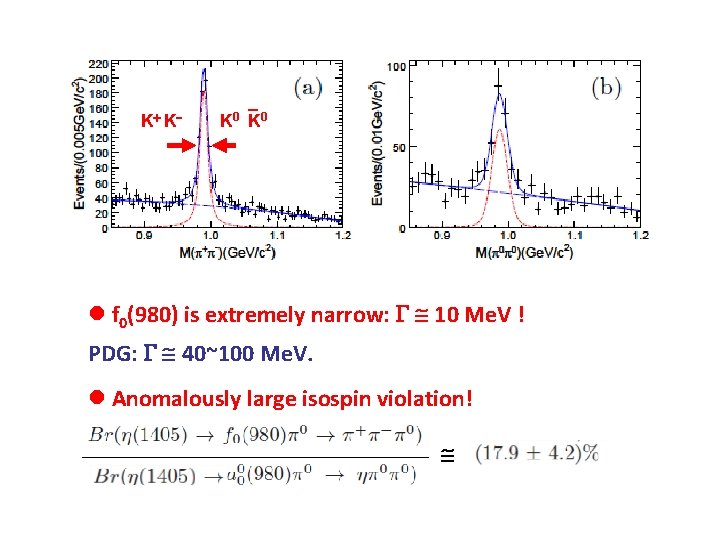
K K K 0 l f 0(980) is extremely narrow: 10 Me. V ! PDG: 40~100 Me. V. l Anomalously large isospin violation!
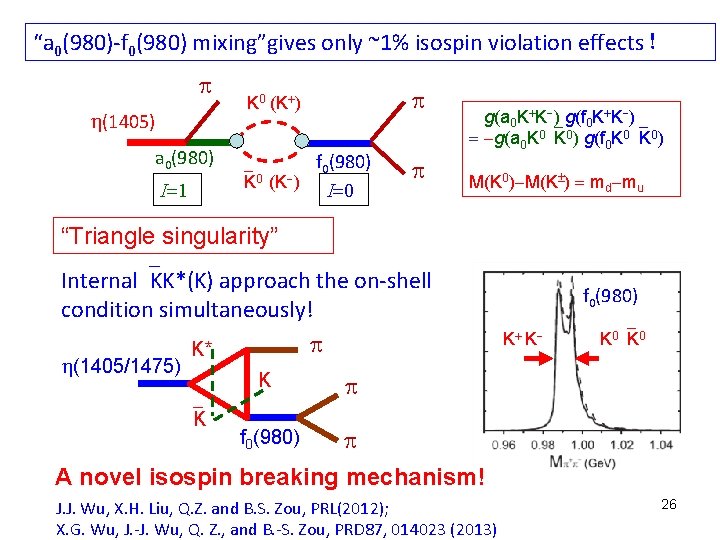
“a 0(980)-f 0(980) mixing”gives only ~1% isospin violation effects! (1405) a 0(980) I 1 K 0 (K ) f 0(980) K 0 (K ) I 0 g(a 0 K K ) g(f 0 K K ) g(a 0 K 0 K 0) g(f 0 K 0 K 0) M(K ) md mu “Triangle singularity” Internal KK*(K) approach the on-shell condition simultaneously! K* (1405/1475) K K f 0(980) K K K 0 A novel isospin breaking mechanism! J. J. Wu, X. H. Liu, Q. Z. and B. S. Zou, PRL(2012); X. G. Wu, J. -J. Wu, Q. Z. , and B. -S. Zou, PRD 87, 014023 (2013) 26
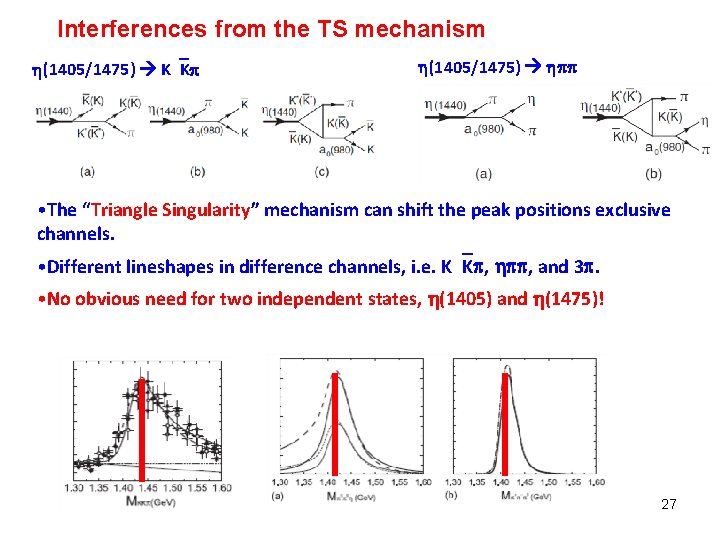
Interferences from the TS mechanism (1405/1475) K K (1405/1475) • The “Triangle Singularity” mechanism can shift the peak positions exclusive channels. • Different lineshapes in difference channels, i. e. K K , , and 3. • No obvious need for two independent states, (1405) and (1475)! 27
3. Reconsile the dynamical model calculations with LQCD simulations
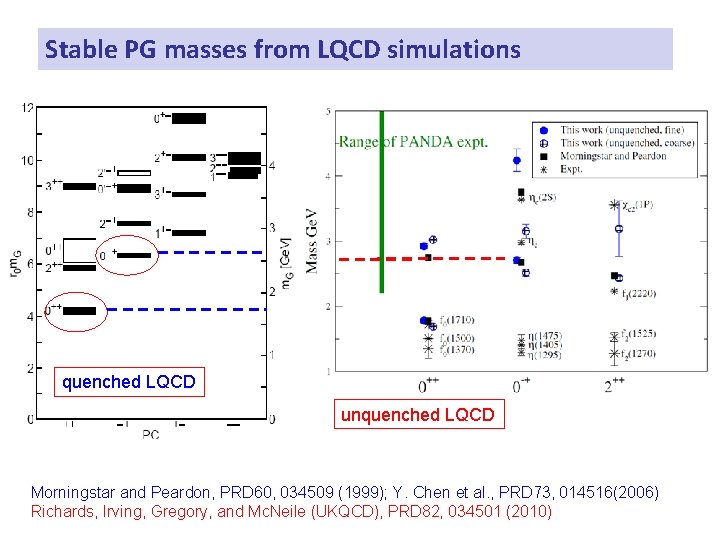
Stable PG masses from LQCD simulations quenched LQCD unquenched LQCD Morningstar and Peardon, PRD 60, 034509 (1999); Y. Chen et al. , PRD 73, 014516(2006) Richards, Irving, Gregory, and Mc. Neile (UKQCD), PRD 82, 034501 (2010)
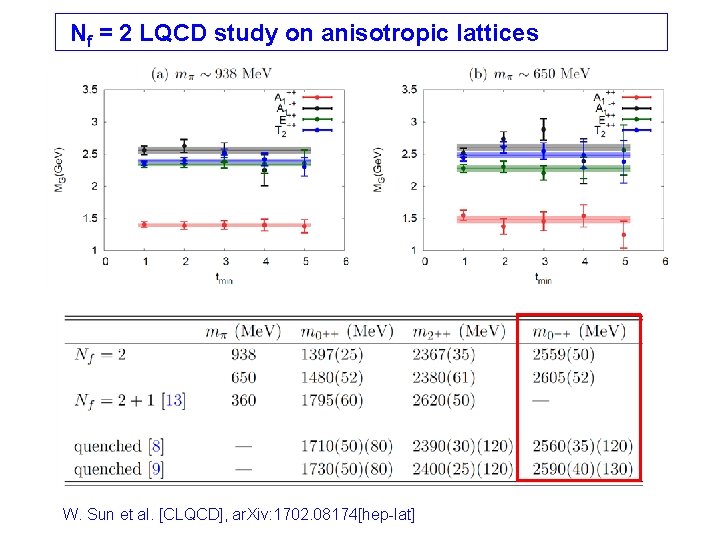
Nf = 2 LQCD study on anisotropic lattices W. Sun et al. [CLQCD], ar. Xiv: 1702. 08174[hep-lat]
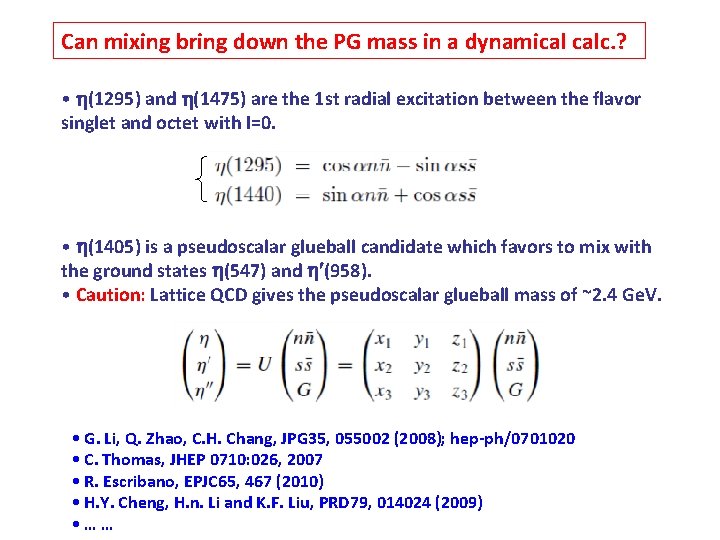
Can mixing bring down the PG mass in a dynamical calc. ? • (1295) and (1475) are the 1 st radial excitation between the flavor singlet and octet with I=0. • (1405) is a pseudoscalar glueball candidate which favors to mix with the ground states (547) and (958). • Caution: Lattice QCD gives the pseudoscalar glueball mass of ~2. 4 Ge. V. • G. Li, Q. Zhao, C. H. Chang, JPG 35, 055002 (2008); hep-ph/0701020 • C. Thomas, JHEP 0710: 026, 2007 • R. Escribano, EPJC 65, 467 (2010) • H. Y. Cheng, H. n. Li and K. F. Liu, PRD 79, 014024 (2009) • ……
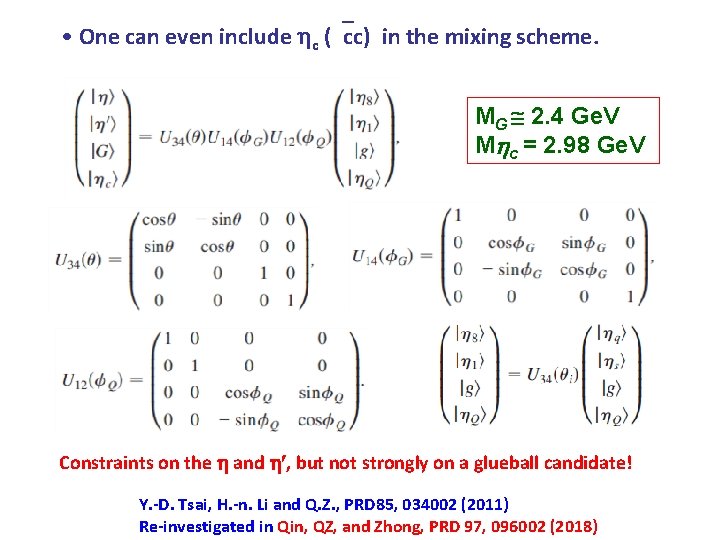
• One can even include c ( cc) in the mixing scheme. MG 2. 4 Ge. V M c = 2. 98 Ge. V Constraints on the and , but not strongly on a glueball candidate! Y. -D. Tsai, H. -n. Li and Q. Z. , PRD 85, 034002 (2011) Re-investigated in Qin, QZ, and Zhong, PRD 97, 096002 (2018)
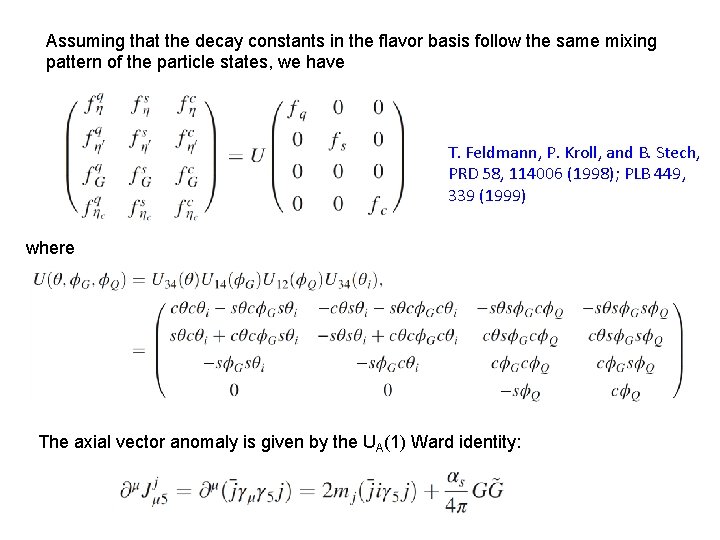
Assuming that the decay constants in the flavor basis follow the same mixing pattern of the particle states, we have T. Feldmann, P. Kroll, and B. Stech, PRD 58, 114006 (1998); PLB 449, 339 (1999) where The axial vector anomaly is given by the UA(1) Ward identity:
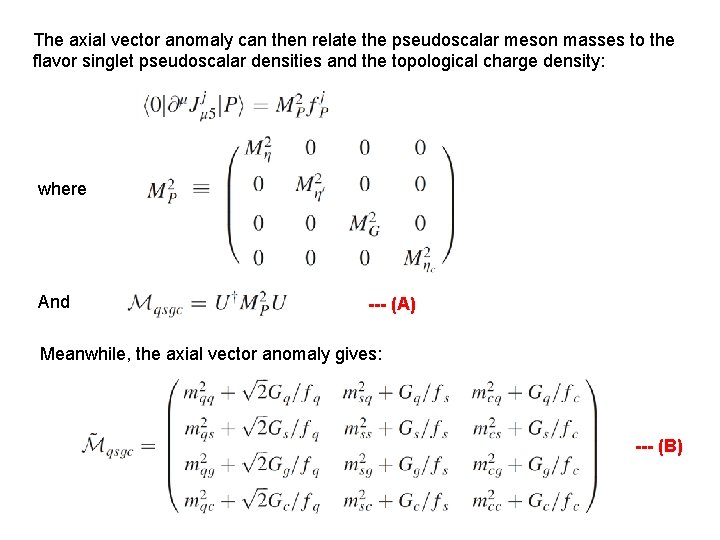
The axial vector anomaly can then relate the pseudoscalar meson masses to the flavor singlet pseudoscalar densities and the topological charge density: where And --- (A) Meanwhile, the axial vector anomaly gives: --- (B)
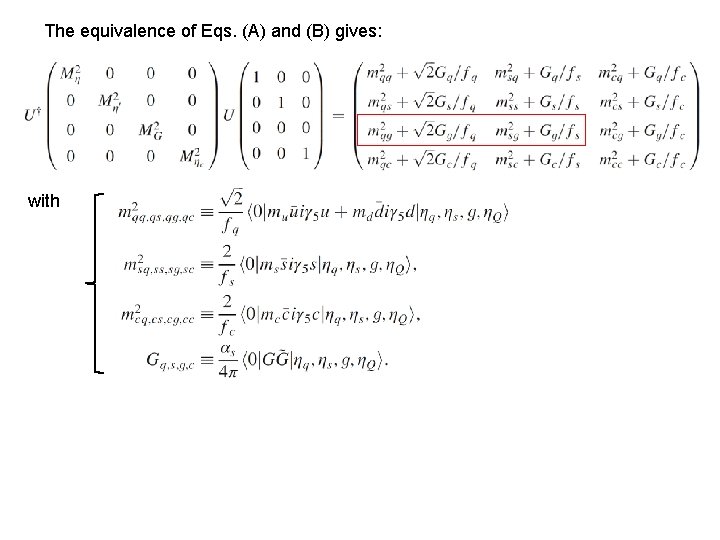
The equivalence of Eqs. (A) and (B) gives: with
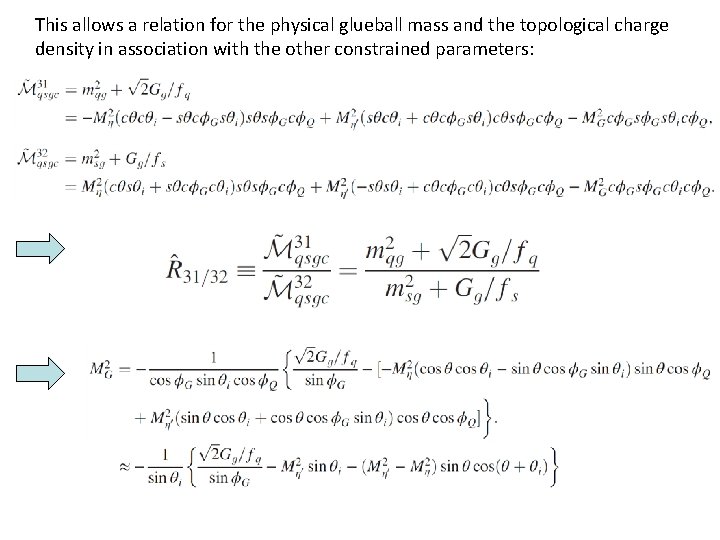
This allows a relation for the physical glueball mass and the topological charge density in association with the other constrained parameters:
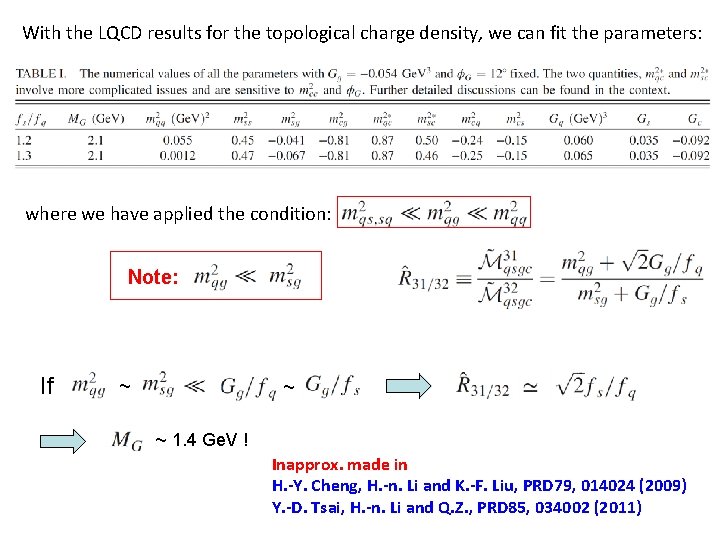
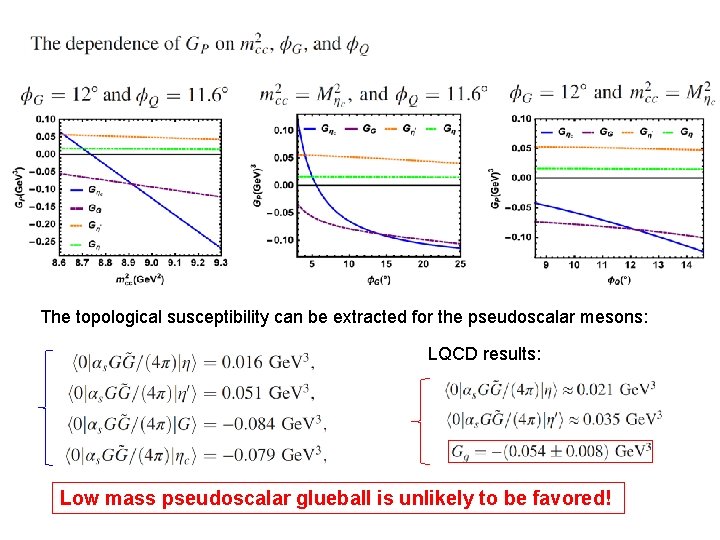
With the LQCD results for the topological charge density, we can fit the parameters: where we have applied the condition: Note: If ~ ~ ~ 1. 4 Ge. V ! Inapprox. made in H. -Y. Cheng, H. -n. Li and K. -F. Liu, PRD 79, 014024 (2009) Y. -D. Tsai, H. -n. Li and Q. Z. , PRD 85, 034002 (2011)
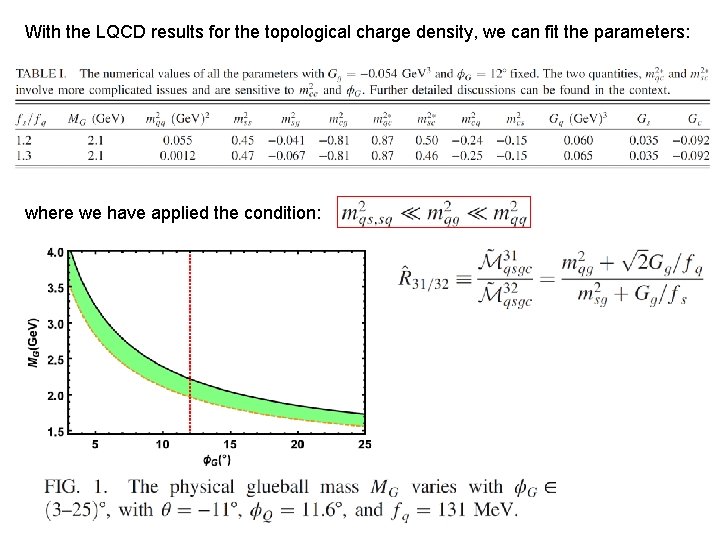
With the LQCD results for the topological charge density, we can fit the parameters: where we have applied the condition:
The topological susceptibility can be extracted for the pseudoscalar mesons: LQCD results: Low mass pseudoscalar glueball is unlikely to be favored!
4. Observables sensitive to the underlying dynamics
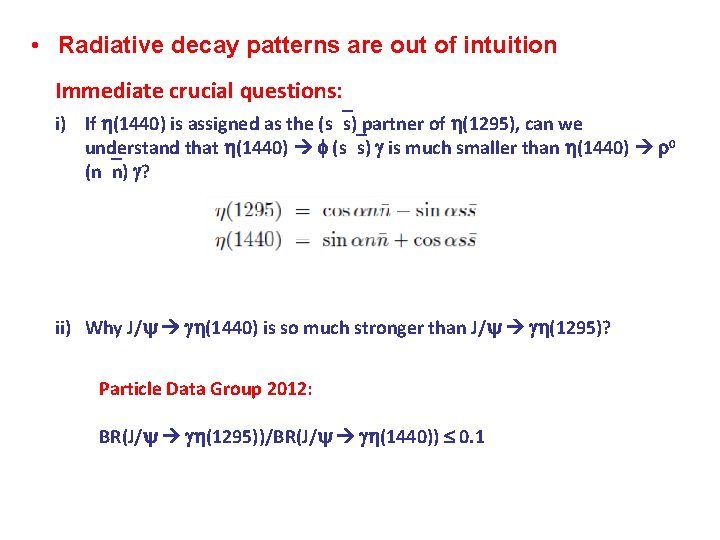
• Radiative decay patterns are out of intuition Immediate crucial questions: i) If (1440) is assigned as the (s s) partner of (1295), can we understand that (1440) (s s) is much smaller than (1440) 0 (n n) ? ii) Why J/ (1440) is so much stronger than J/ (1295)? Particle Data Group 2012: BR(J/ (1295))/BR(J/ (1440)) 0. 1
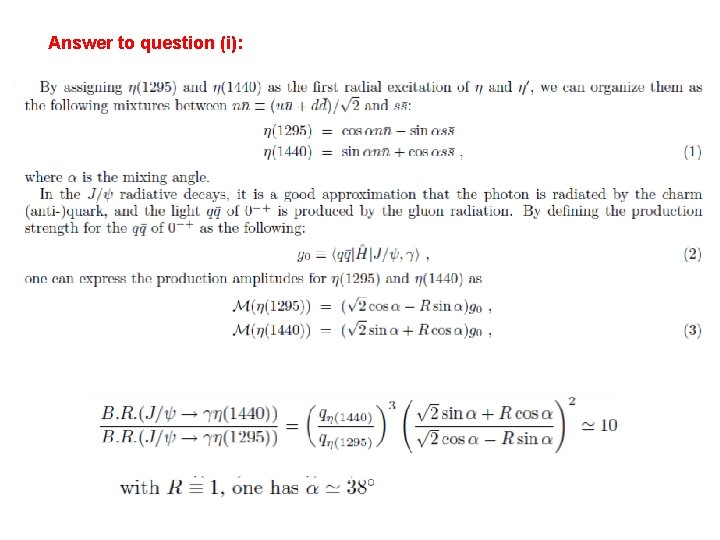
Answer to question (i):
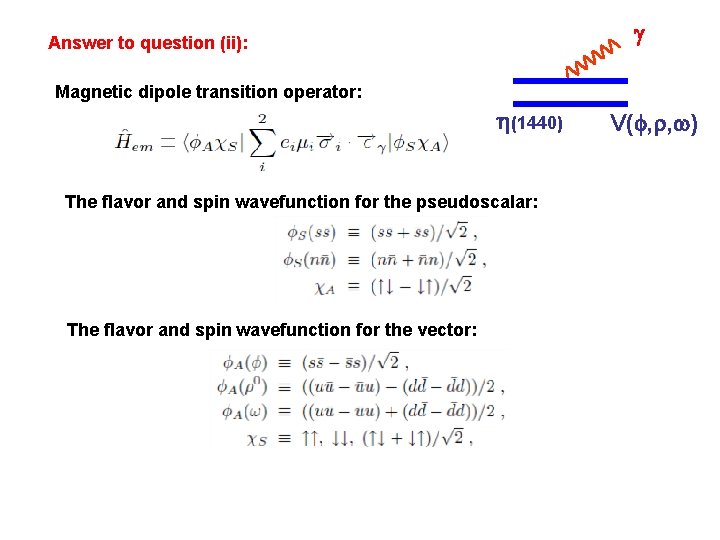
Answer to question (ii): Magnetic dipole transition operator: (1440) The flavor and spin wavefunction for the pseudoscalar: The flavor and spin wavefunction for the vector: V( , , )
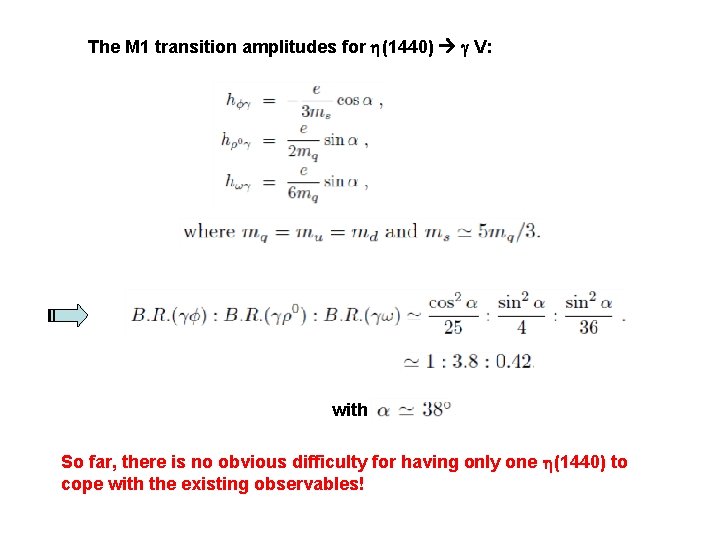
The M 1 transition amplitudes for (1440) V: with So far, there is no obvious difficulty for having only one (1440) to cope with the existing observables!
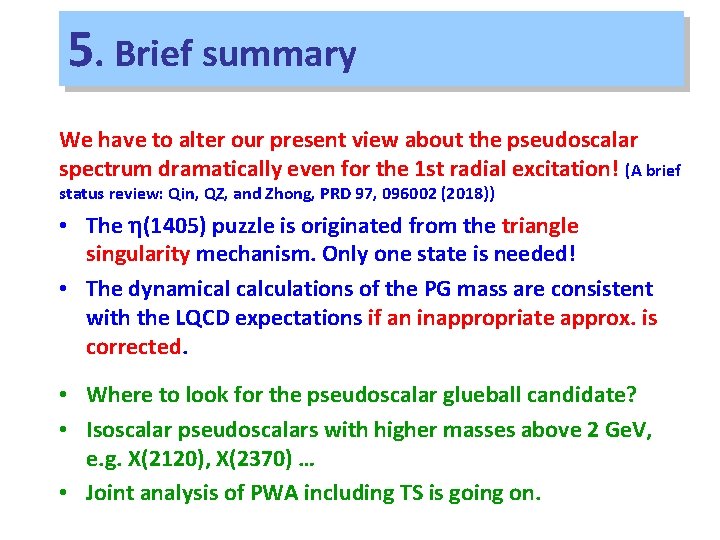
5. Brief summary We have to alter our present view about the pseudoscalar spectrum dramatically even for the 1 st radial excitation! (A brief status review: Qin, QZ, and Zhong, PRD 97, 096002 (2018)) • The (1405) puzzle is originated from the triangle singularity mechanism. Only one state is needed! • The dynamical calculations of the PG mass are consistent with the LQCD expectations if an inappropriate approx. is corrected. • Where to look for the pseudoscalar glueball candidate? • Isoscalar pseudoscalars with higher masses above 2 Ge. V, e. g. X(2120), X(2370) … • Joint analysis of PWA including TS is going on.
Institute of High Energy Physics Thanks for your attention! 47
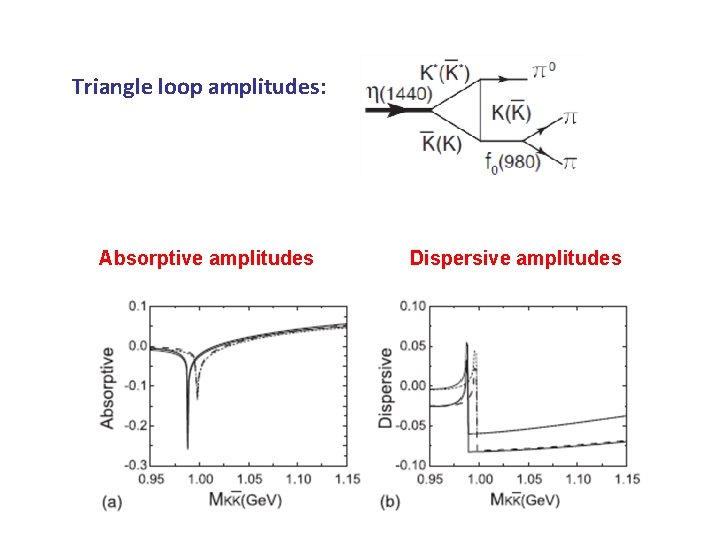
Triangle loop amplitudes: Absorptive amplitudes Dispersive amplitudes