
Warm Up 1 Draw a triangle and construct

- Slides: 30
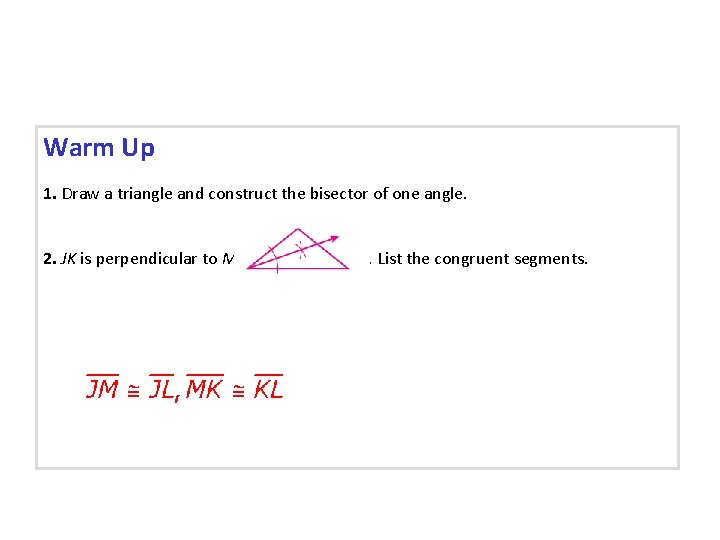
Warm Up 1. Draw a triangle and construct the bisector of one angle. 2. JK is perpendicular to ML at its midpoint K. List the congruent segments.
Objectives Prove and apply properties of perpendicular bisectors of a triangle. Prove and apply properties of angle bisectors of a triangle.
Vocabulary concurrent point of concurrency circumcenter of a triangle circumscribed incenter of a triangle inscribed
Since a triangle has three sides, it has three perpendicular bisectors. When you construct the perpendicular bisectors, you find that they have an interesting property.
Helpful Hint The perpendicular bisector of a side of a triangle does not always pass through the opposite vertex.
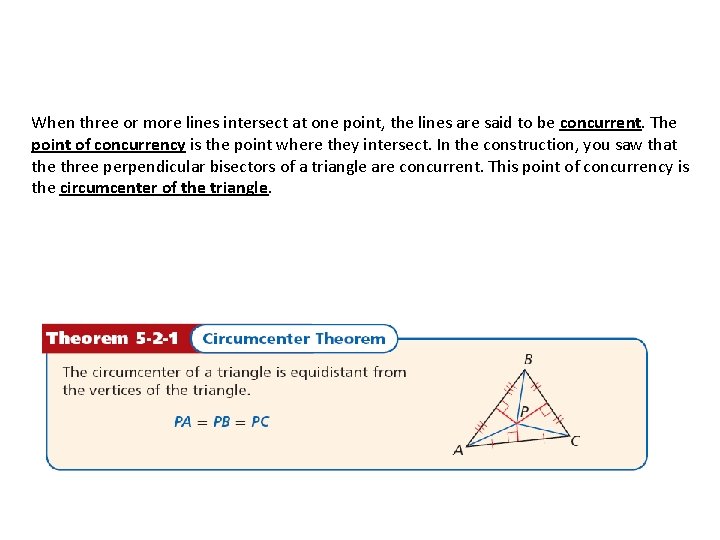
When three or more lines intersect at one point, the lines are said to be concurrent. The point of concurrency is the point where they intersect. In the construction, you saw that the three perpendicular bisectors of a triangle are concurrent. This point of concurrency is the circumcenter of the triangle.
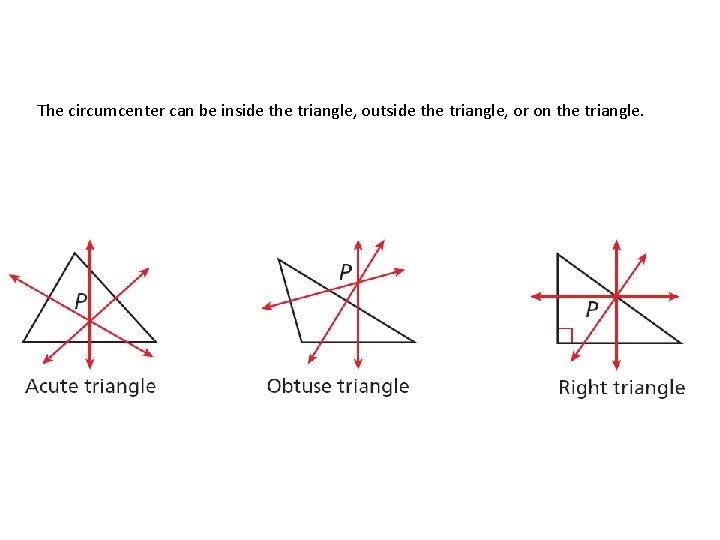
The circumcenter can be inside the triangle, outside the triangle, or on the triangle.
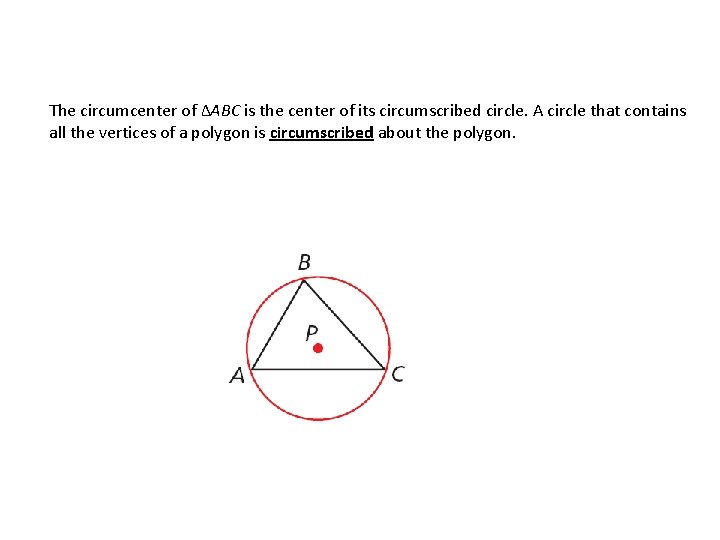
The circumcenter of ΔABC is the center of its circumscribed circle. A circle that contains all the vertices of a polygon is circumscribed about the polygon.
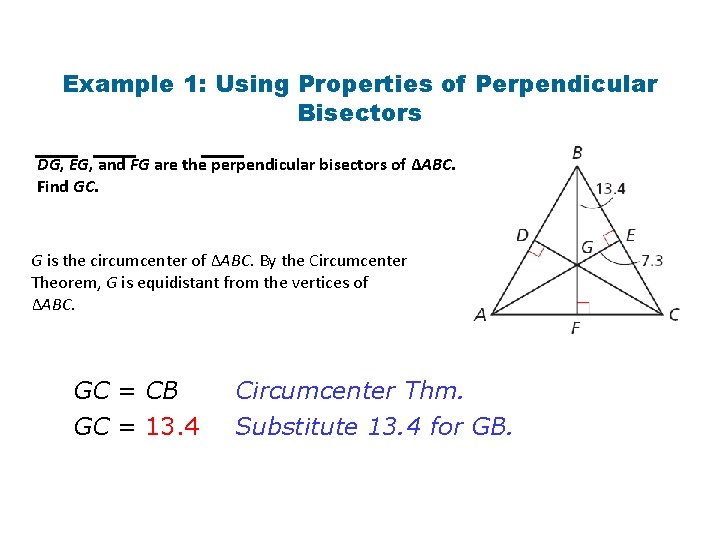
Example 1: Using Properties of Perpendicular Bisectors DG, EG, and FG are the perpendicular bisectors of ∆ABC. Find GC. G is the circumcenter of ∆ABC. By the Circumcenter Theorem, G is equidistant from the vertices of ∆ABC. GC = CB GC = 13. 4 Circumcenter Thm. Substitute 13. 4 for GB.
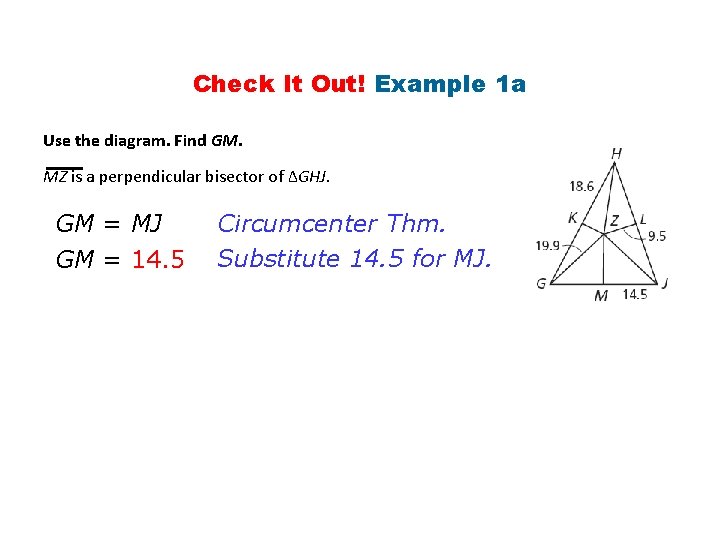
Check It Out! Example 1 a Use the diagram. Find GM. MZ is a perpendicular bisector of ∆GHJ. GM = MJ GM = 14. 5 Circumcenter Thm. Substitute 14. 5 for MJ.
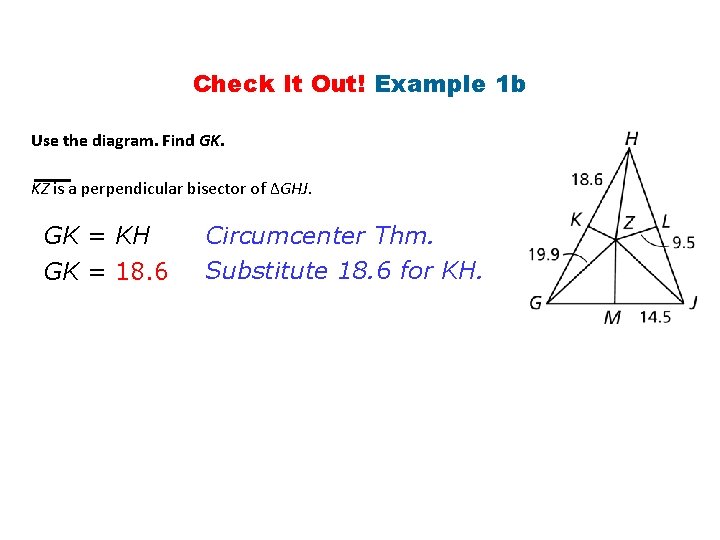
Check It Out! Example 1 b Use the diagram. Find GK. KZ is a perpendicular bisector of ∆GHJ. GK = KH GK = 18. 6 Circumcenter Thm. Substitute 18. 6 for KH.
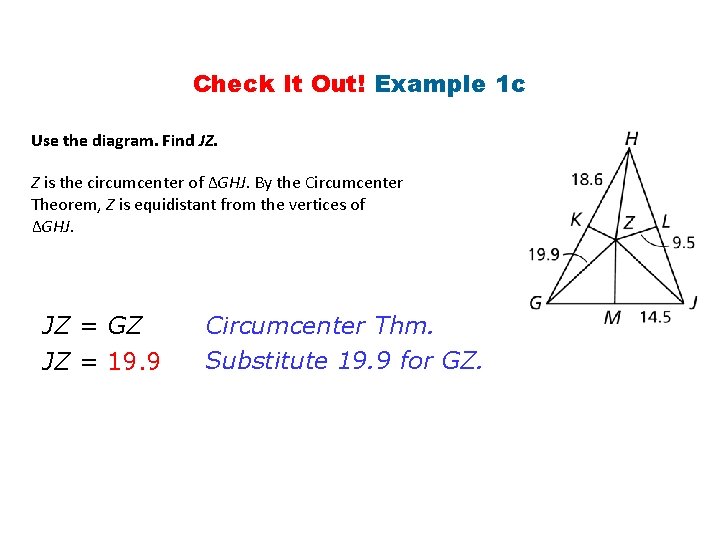
Check It Out! Example 1 c Use the diagram. Find JZ. Z is the circumcenter of ∆GHJ. By the Circumcenter Theorem, Z is equidistant from the vertices of ∆GHJ. JZ = GZ JZ = 19. 9 Circumcenter Thm. Substitute 19. 9 for GZ.
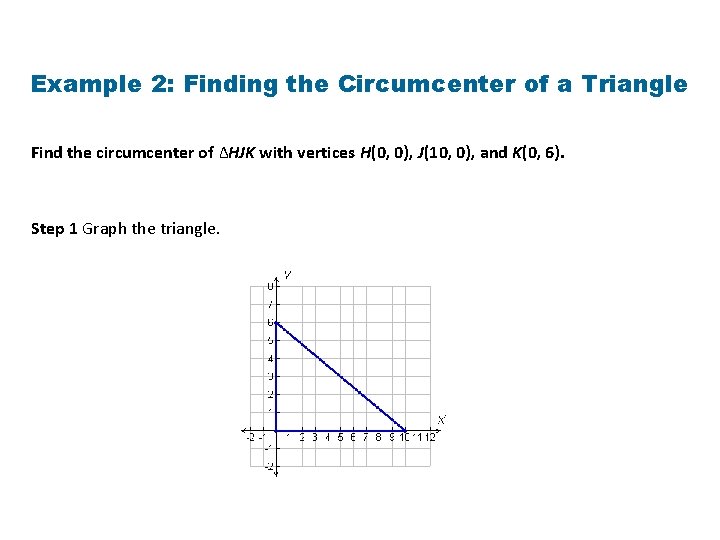
Example 2: Finding the Circumcenter of a Triangle Find the circumcenter of ∆HJK with vertices H(0, 0), J(10, 0), and K(0, 6). Step 1 Graph the triangle.
Example 2 Continued Step 2 Find equations for two perpendicular bisectors. Since two sides of the triangle lie along the axes, use the graph to find the perpendicular bisectors of these two sides. The perpendicular bisector of HJ is x = 5, and the perpendicular bisector of HK is y = 3.
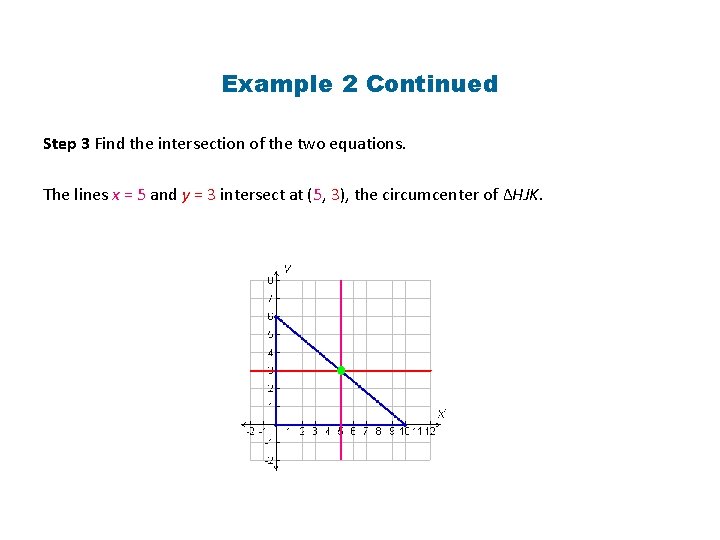
Example 2 Continued Step 3 Find the intersection of the two equations. The lines x = 5 and y = 3 intersect at (5, 3), the circumcenter of ∆HJK.
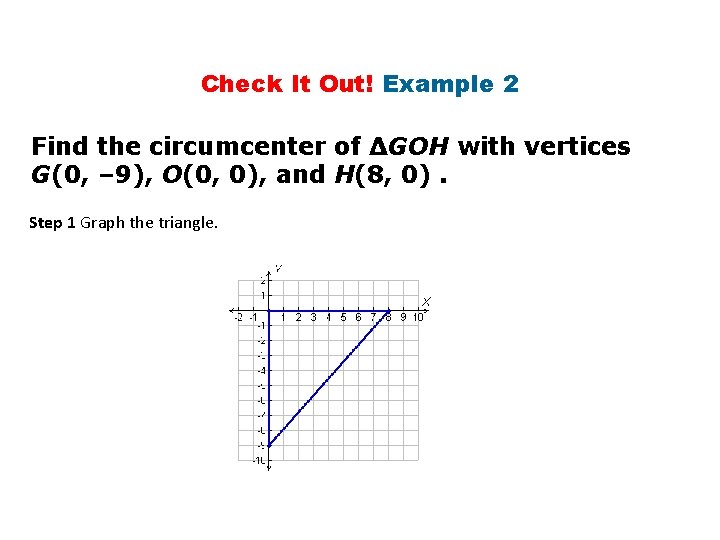
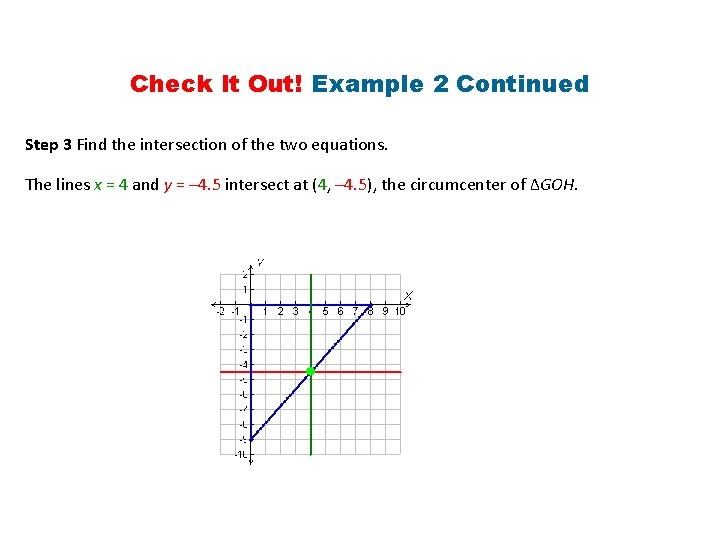
Check It Out! Example 2 Find the circumcenter of ∆GOH with vertices G(0, – 9), O(0, 0), and H(8, 0). Step 1 Graph the triangle.
Check It Out! Example 2 Continued Step 2 Find equations for two perpendicular bisectors. Since two sides of the triangle lie along the axes, use the graph to find the perpendicular bisectors of these two sides. The perpendicular bisector of GO is y = – 4. 5, and the perpendicular bisector of OH is x = 4.
Check It Out! Example 2 Continued Step 3 Find the intersection of the two equations. The lines x = 4 and y = – 4. 5 intersect at (4, – 4. 5), the circumcenter of ∆GOH.
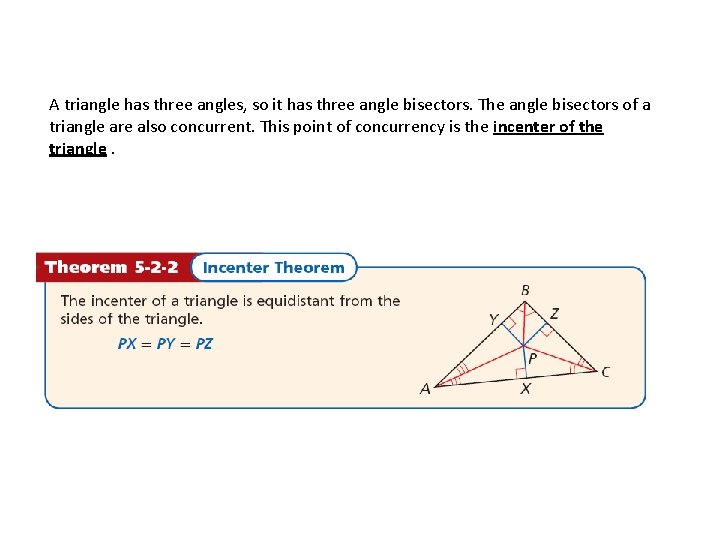
A triangle has three angles, so it has three angle bisectors. The angle bisectors of a triangle are also concurrent. This point of concurrency is the incenter of the triangle.
Remember! The distance between a point and a line is the length of the perpendicular segment from the point to the line.
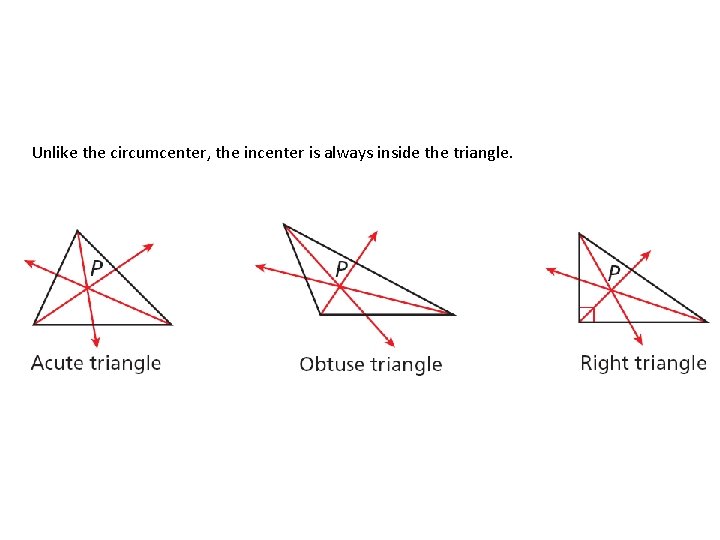
Unlike the circumcenter, the incenter is always inside the triangle.
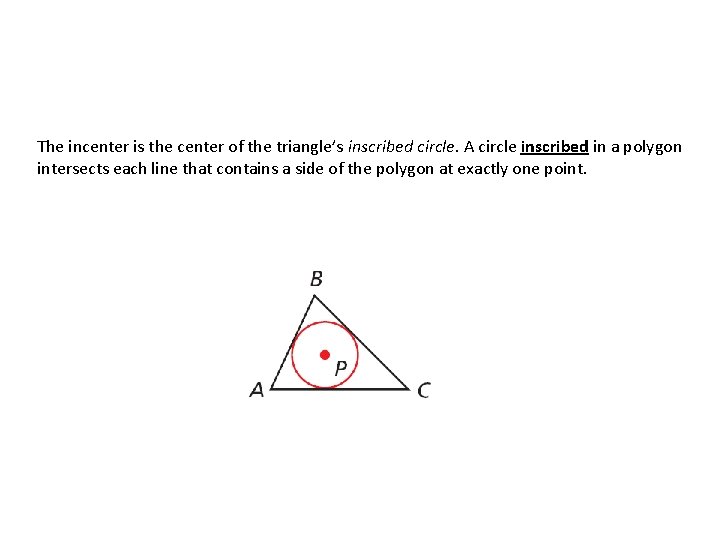
The incenter is the center of the triangle’s inscribed circle. A circle inscribed in a polygon intersects each line that contains a side of the polygon at exactly one point.
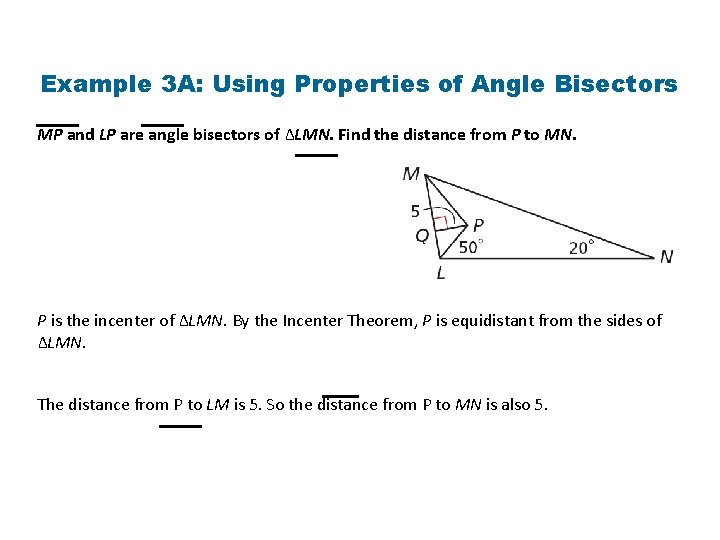
Example 3 A: Using Properties of Angle Bisectors MP and LP are angle bisectors of ∆LMN. Find the distance from P to MN. P is the incenter of ∆LMN. By the Incenter Theorem, P is equidistant from the sides of ∆LMN. The distance from P to LM is 5. So the distance from P to MN is also 5.
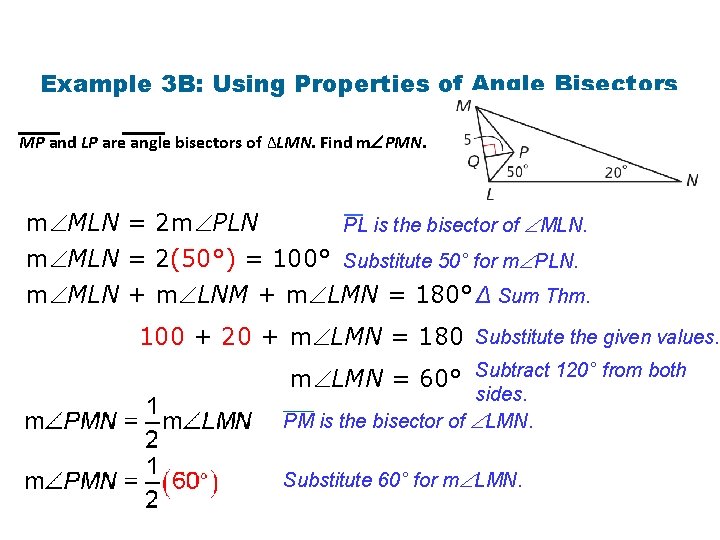
Example 3 B: Using Properties of Angle Bisectors MP and LP are angle bisectors of ∆LMN. Find m PMN. m MLN = 2 m PLN PL is the bisector of MLN. m MLN = 2(50°) = 100° Substitute 50° for m PLN. m MLN + m LNM + m LMN = 180° Δ Sum Thm. 100 + 20 + m LMN = 180 Substitute the given values. m LMN = 60° Subtract 120° from both sides. PM is the bisector of LMN. Substitute 60° for m LMN.
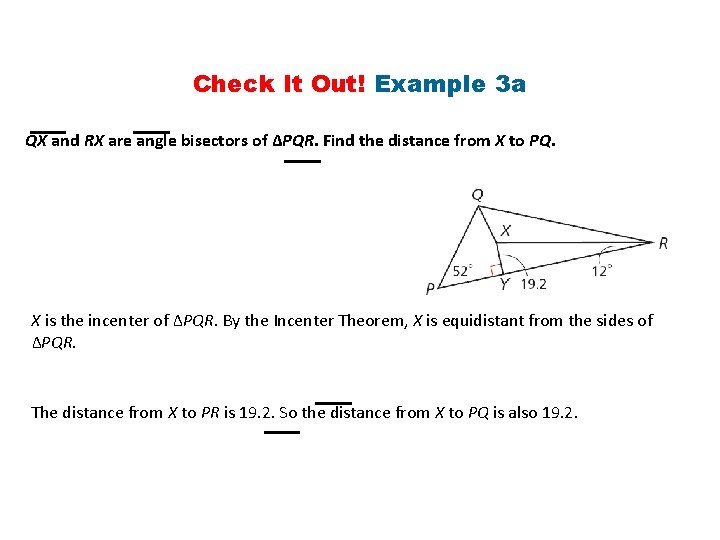
Check It Out! Example 3 a QX and RX are angle bisectors of ΔPQR. Find the distance from X to PQ. X is the incenter of ∆PQR. By the Incenter Theorem, X is equidistant from the sides of ∆PQR. The distance from X to PR is 19. 2. So the distance from X to PQ is also 19. 2.
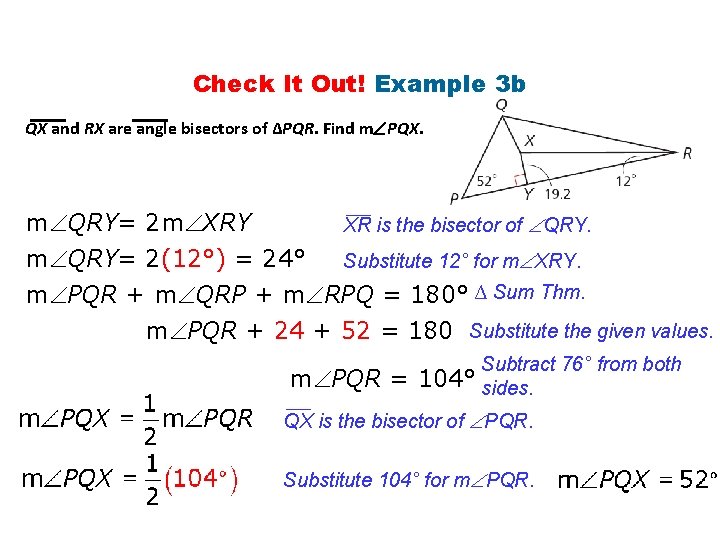
Check It Out! Example 3 b QX and RX are angle bisectors of ∆PQR. Find m PQX. m QRY= 2 m XRY XR is the bisector of QRY. m QRY= 2(12°) = 24° Substitute 12° for m XRY. m PQR + m QRP + m RPQ = 180° ∆ Sum Thm. m PQR + 24 + 52 = 180 Substitute the given values. m PQR = Subtract 76° from both 104° sides. QX is the bisector of PQR. Substitute 104° for m PQR.
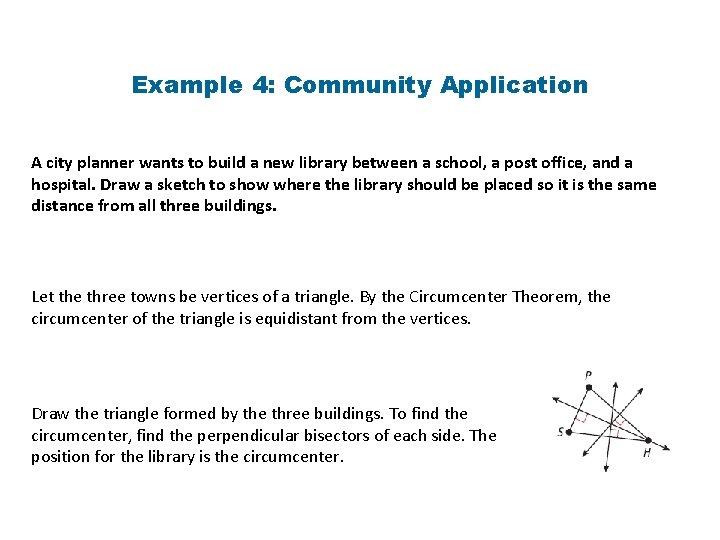
Example 4: Community Application A city planner wants to build a new library between a school, a post office, and a hospital. Draw a sketch to show where the library should be placed so it is the same distance from all three buildings. Let the three towns be vertices of a triangle. By the Circumcenter Theorem, the circumcenter of the triangle is equidistant from the vertices. Draw the triangle formed by the three buildings. To find the circumcenter, find the perpendicular bisectors of each side. The position for the library is the circumcenter.
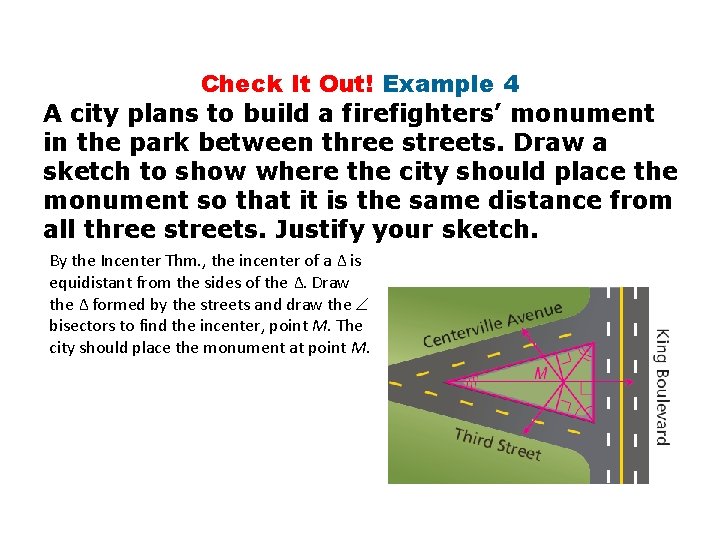
Check It Out! Example 4 A city plans to build a firefighters’ monument in the park between three streets. Draw a sketch to show where the city should place the monument so that it is the same distance from all three streets. Justify your sketch. By the Incenter Thm. , the incenter of a ∆ is equidistant from the sides of the ∆. Draw the ∆ formed by the streets and draw the bisectors to find the incenter, point M. The city should place the monument at point M.
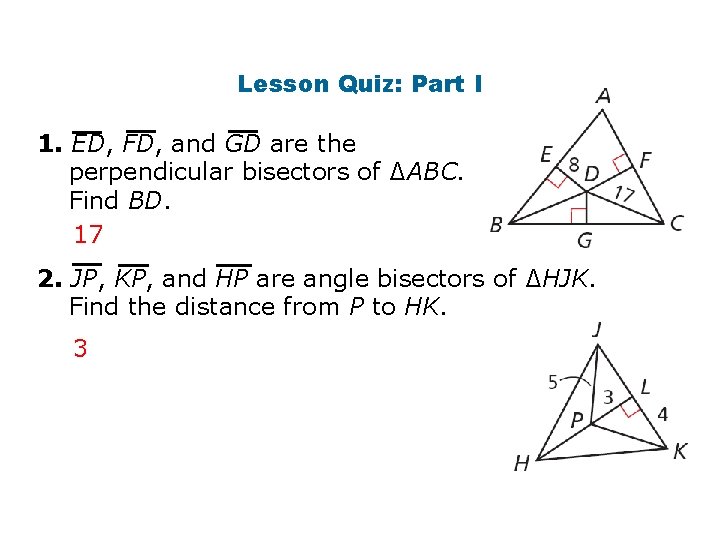
Lesson Quiz: Part I 1. ED, FD, and GD are the perpendicular bisectors of ∆ABC. Find BD. 17 2. JP, KP, and HP are angle bisectors of ∆HJK. Find the distance from P to HK. 3
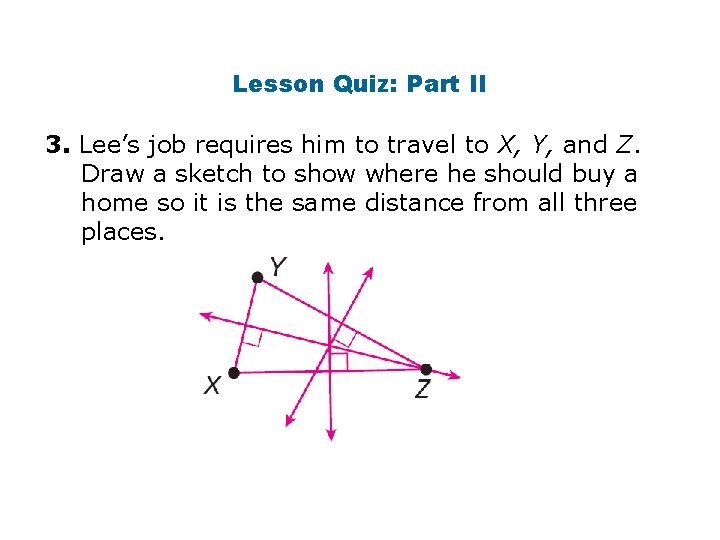
Lesson Quiz: Part II 3. Lee’s job requires him to travel to X, Y, and Z. Draw a sketch to show where he should buy a home so it is the same distance from all three places.