Implementing the Victorian Curriculum Languages Primary teachers Agenda

- Slides: 41
Implementing the Victorian Curriculum: Languages Primary teachers
Agenda • • Overview of the Victorian Curriculum Some key features of the Victorian Curriculum • Achievement standards, capabilities and cross curriculum priorities Victorian Curriculum: Languages • Aims, entry points, strands and sub-strands • Content descriptions, elaborations Curriculum planning for Languages • Online resources, curriculum mapping, revised curriculum and reporting guidelines • Using rubrics for assessment • Extracts from primary Languages curricula, intercultural capability • LAP online tests, VCAA websites
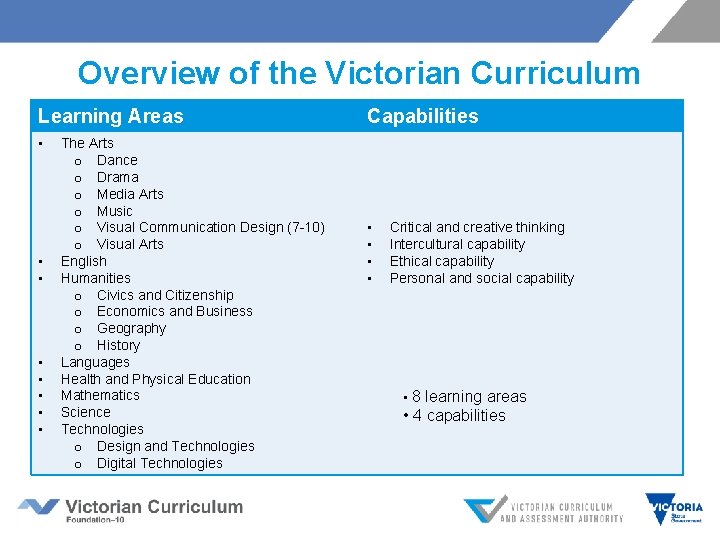
Overview of the Victorian Curriculum Learning Areas • • The Arts o Dance o Drama o Media Arts o Music o Visual Communication Design (7 -10) o Visual Arts English Humanities o Civics and Citizenship o Economics and Business o Geography o History Languages Health and Physical Education Mathematics Science Technologies o Design and Technologies o Digital Technologies Capabilities • • Critical and creative thinking Intercultural capability Ethical capability Personal and social capability • 8 learning areas • 4 capabilities
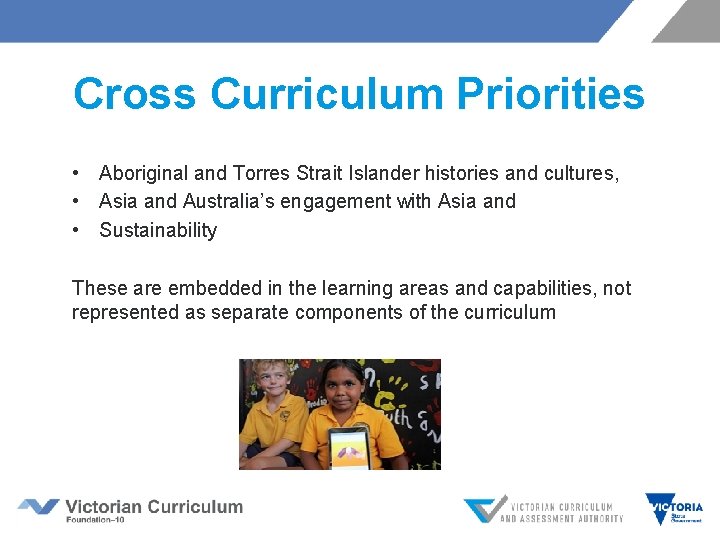
Cross Curriculum Priorities • Aboriginal and Torres Strait Islander histories and cultures, • Asia and Australia’s engagement with Asia and • Sustainability These are embedded in the learning areas and capabilities, not represented as separate components of the curriculum
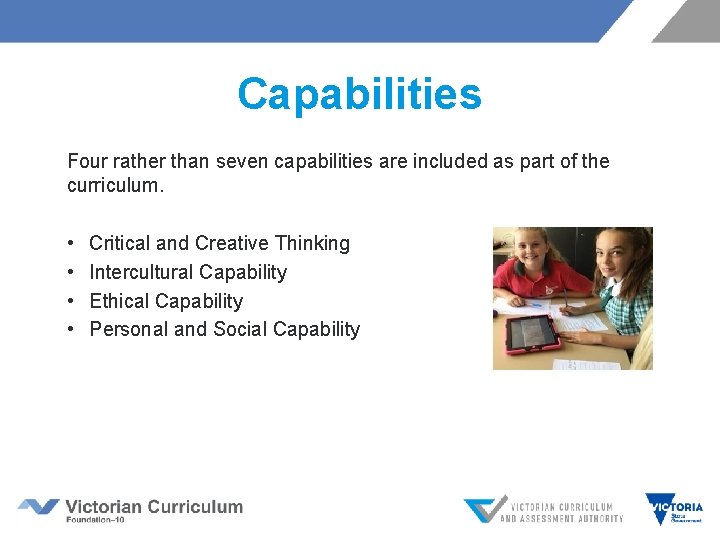
Capabilities Four rather than seven capabilities are included as part of the curriculum. • • Critical and Creative Thinking Intercultural Capability Ethical Capability Personal and Social Capability
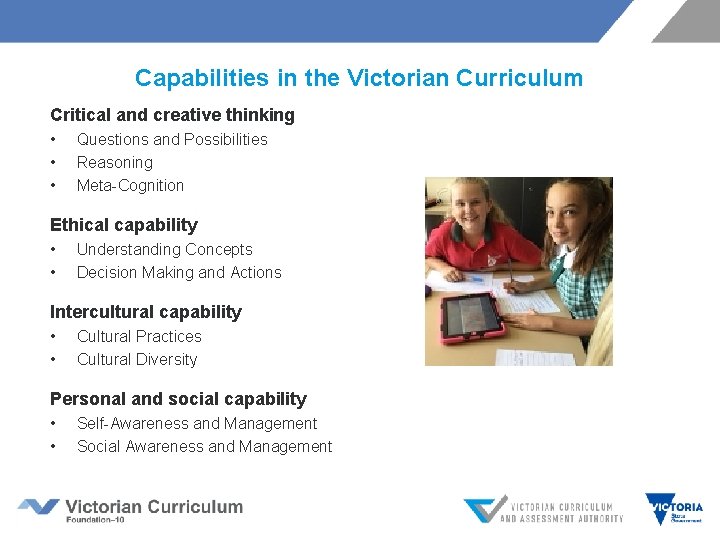
Capabilities in the Victorian Curriculum Critical and creative thinking • • • Questions and Possibilities Reasoning Meta-Cognition Ethical capability • • Understanding Concepts Decision Making and Actions Intercultural capability • • Cultural Practices Cultural Diversity Personal and social capability • • Self-Awareness and Management Social Awareness and Management
The Victorian Curriculum: Languages Aims The Languages curriculum aims to develop the knowledge, understanding and skills to ensure that students: • communicate in the language they are learning • understand the relationship between language, culture and learning • develop intercultural capabilities • understand themselves as communicators.
The Victorian Curriculum: Languages The Languages curriculum focuses on both language and culture, and students • reflect on language use and language learning • learn to communicate across linguistic and cultural systems • extend their literacy repertoires • strengthen their understanding of the nature of language • develop intercultural skills and understandings • develop openness to different experiences and perspectives
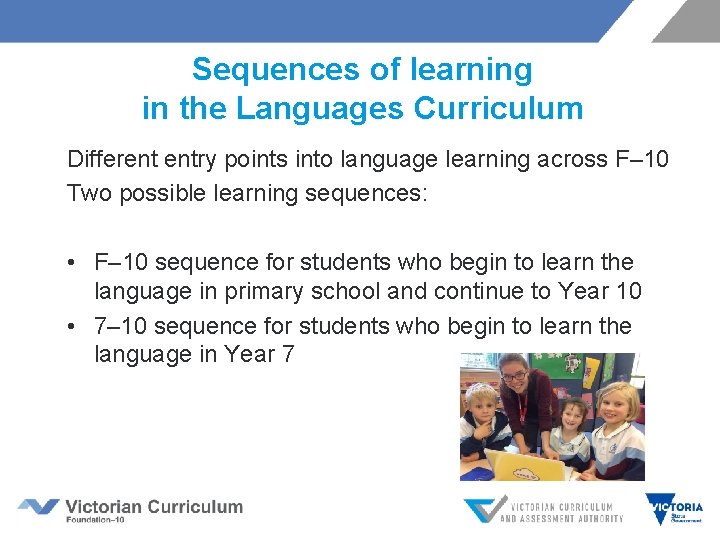
Sequences of learning in the Languages Curriculum Different entry points into language learning across F– 10 Two possible learning sequences: • F– 10 sequence for students who begin to learn the language in primary school and continue to Year 10 • 7– 10 sequence for students who begin to learn the language in Year 7
Strands and sub-strands • The content descriptions in the Languages curriculum F – 10 are organised into two interrelated strands: Communicating and Understanding. • Each strand contains several sub-strands. The strands and sub-strands are common across most languages except for the following which have variations: - Victorian Aboriginal Languages - Auslan - Classical Languages
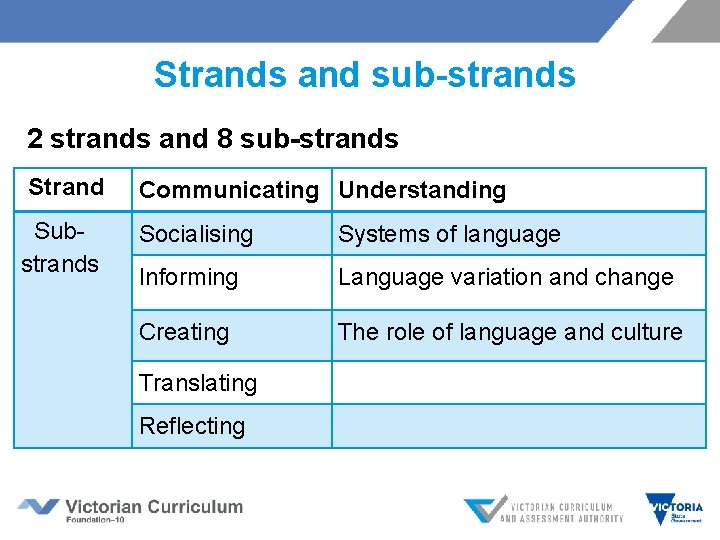
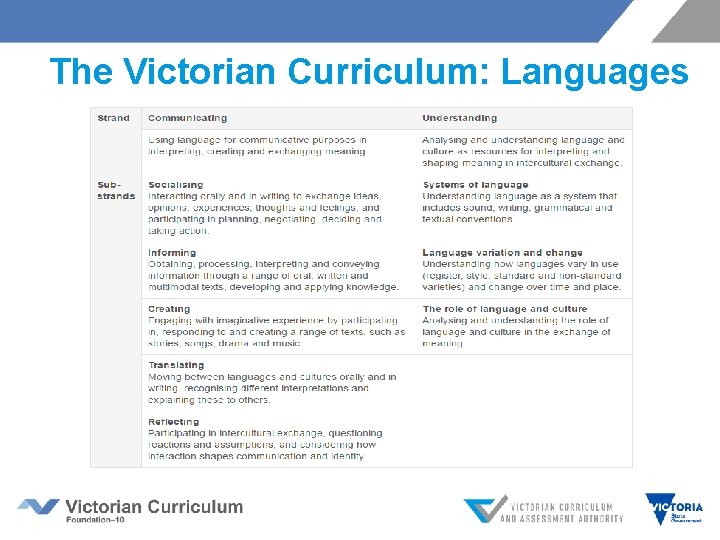
Strands and sub-strands 2 strands and 8 sub-strands Strand Sub strands Communicating Understanding Socialising Systems of language Informing Language variation and change Creating The role of language and culture Translating Reflecting
The Victorian Curriculum: Languages
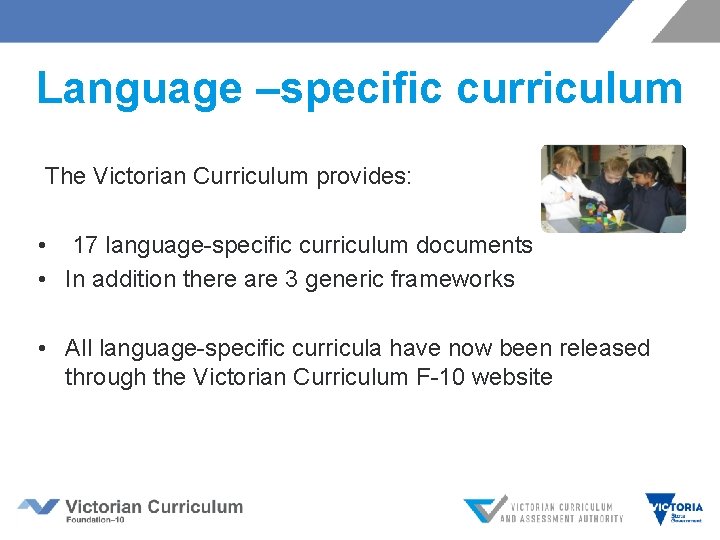
Language –specific curriculum The Victorian Curriculum provides: • 17 language-specific curriculum documents • In addition there are 3 generic frameworks • All language-specific curricula have now been released through the Victorian Curriculum F-10 website
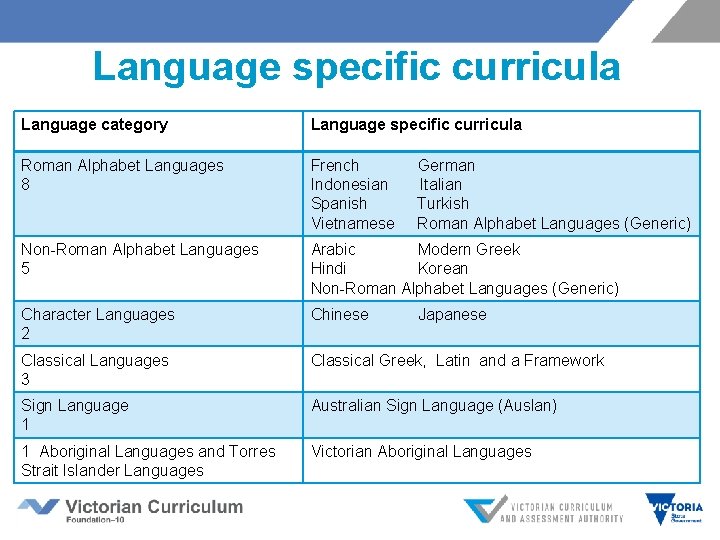
Language specific curricula Language category Language specific curricula Roman Alphabet Languages 8 French German Indonesian Italian Spanish Turkish Vietnamese Roman Alphabet Languages (Generic) Non-Roman Alphabet Languages 5 Arabic Modern Greek Hindi Korean Non-Roman Alphabet Languages (Generic) Character Languages 2 Chinese Japanese Classical Languages 3 Classical Greek, Latin and a Framework Sign Language 1 Australian Sign Language (Auslan) 1 Aboriginal Languages and Torres Strait Islander Languages Victorian Aboriginal Languages
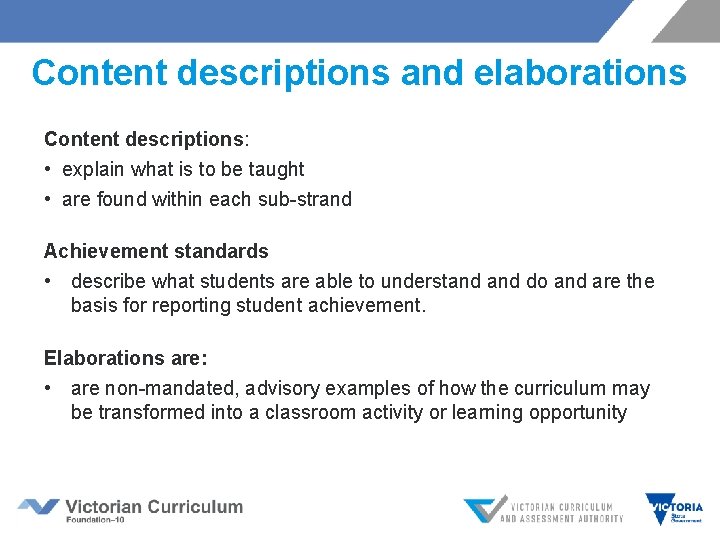
Content descriptions and elaborations Content descriptions: • explain what is to be taught • are found within each sub-strand Achievement standards • describe what students are able to understand do and are the basis for reporting student achievement. Elaborations are: • are non-mandated, advisory examples of how the curriculum may be transformed into a classroom activity or learning opportunity
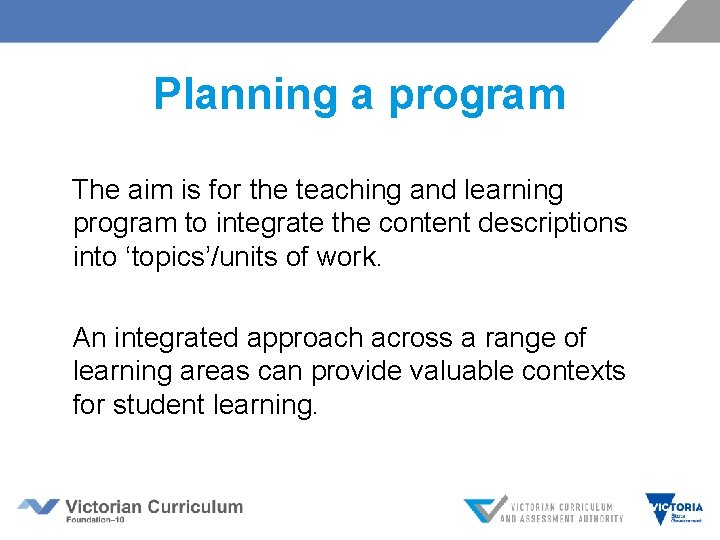
Planning a program The aim is for the teaching and learning program to integrate the content descriptions into ‘topics’/units of work. An integrated approach across a range of learning areas can provide valuable contexts for student learning.
Curriculum • provides a continuum defining increasingly complex knowledge, skills and concepts • each school develops the teaching and learning program - how the curriculum is delivered
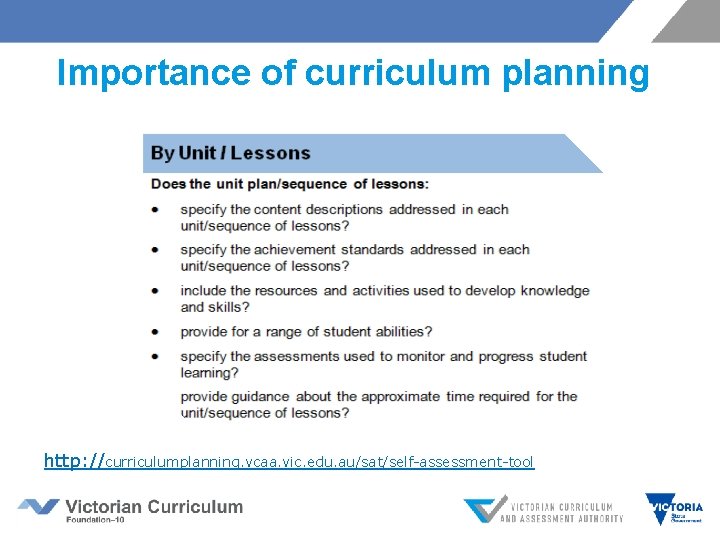
Importance of curriculum planning http: //curriculumplanning. vcaa. vic. edu. au/sat/self-assessment-tool
Use of English • Students encouraged to use the target language as much as possible for classroom routines, social interactions, structured learning tasks, and language experimentation and practice. • Students will have opportunities to engage with members of the community who speak the language being studied, which in some cases will be facilitated via digital technologies. • English is used, where appropriate, for explanation and reflection, enabling students to share complex ideas about language and culture.
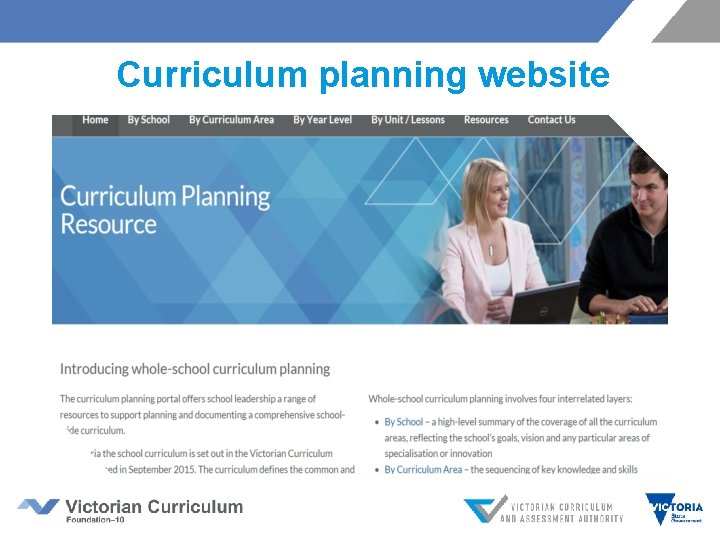
VCAA Curriculum Planning website • The Curriculum Planning website offers a range of resources to support planning and documenting the curriculum. • It includes a self-assessment tool and a suite of curriculum planning examples for both primary and secondary schools.
Curriculum planning website
Achievement standards • Achievement standards as a continuum of language learning, not an age-determined set of expectations • F– 10 Sequence: the first achievement standard for Languages is provided at Foundation–Level 2 and then at Levels 4, 6, 8 and 10. • 7– 10 Sequence: the first achievement standard is provided at Level 8 and then at Level 10.
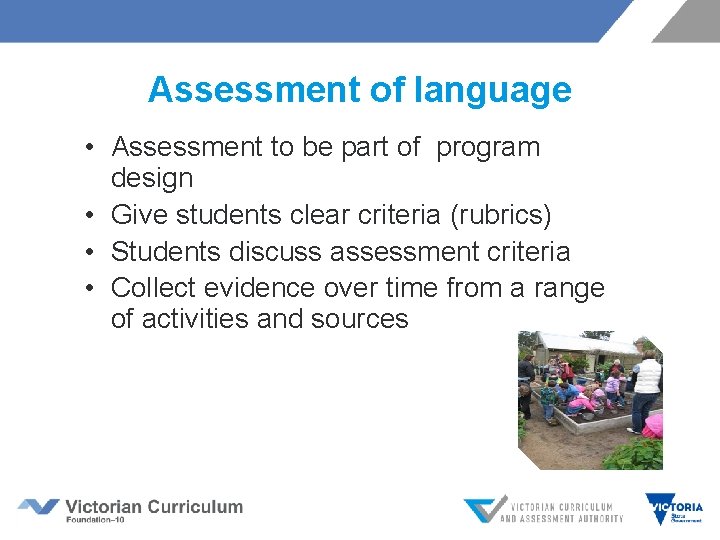
Assessment of language • Assessment to be part of program design • Give students clear criteria (rubrics) • Students discuss assessment criteria • Collect evidence over time from a range of activities and sources
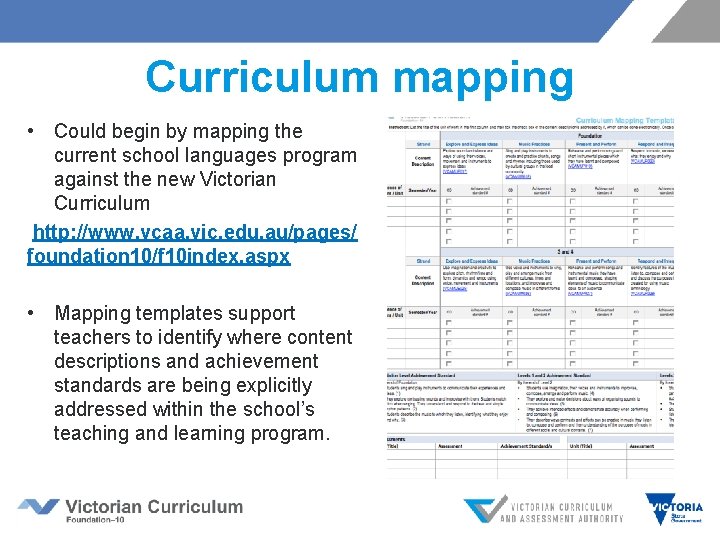
Curriculum mapping • Could begin by mapping the current school languages program against the new Victorian Curriculum http: //www. vcaa. vic. edu. au/pages/ foundation 10/f 10 index. aspx • Mapping templates support teachers to identify where content descriptions and achievement standards are being explicitly addressed within the school’s teaching and learning program.
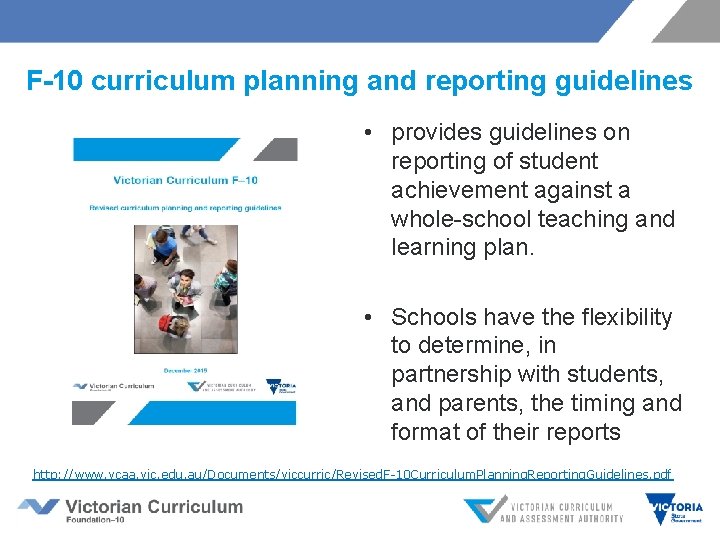
F-10 curriculum planning and reporting guidelines • provides guidelines on reporting of student achievement against a whole-school teaching and learning plan. • Schools have the flexibility to determine, in partnership with students, and parents, the timing and format of their reports http: //www. vcaa. vic. edu. au/Documents/viccurric/Revised. F-10 Curriculum. Planning. Reporting. Guidelines. pdf
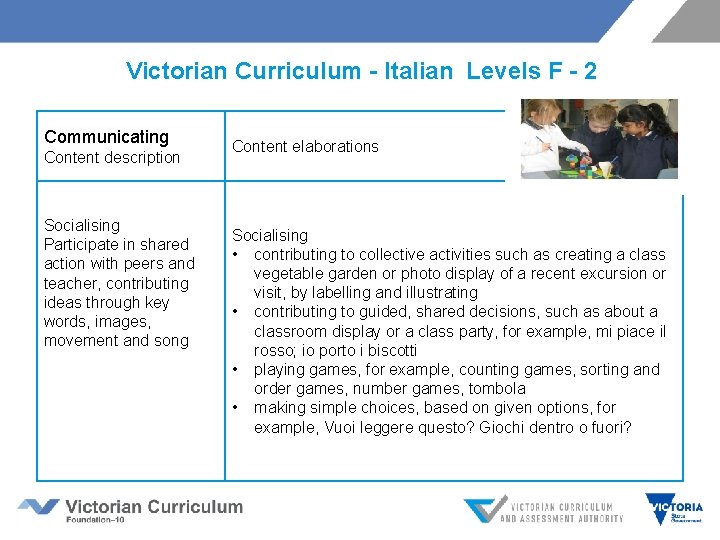
Victorian Curriculum - Italian Levels F - 2 Communicating Content description Socialising Participate in shared action with peers and teacher, contributing ideas through key words, images, movement and song Content elaborations Socialising • contributing to collective activities such as creating a class vegetable garden or photo display of a recent excursion or visit, by labelling and illustrating • contributing to guided, shared decisions, such as about a classroom display or a class party, for example, mi piace il rosso; io porto i biscotti • playing games, for example, counting games, sorting and order games, number games, tombola • making simple choices, based on given options, for example, Vuoi leggere questo? Giochi dentro o fuori?
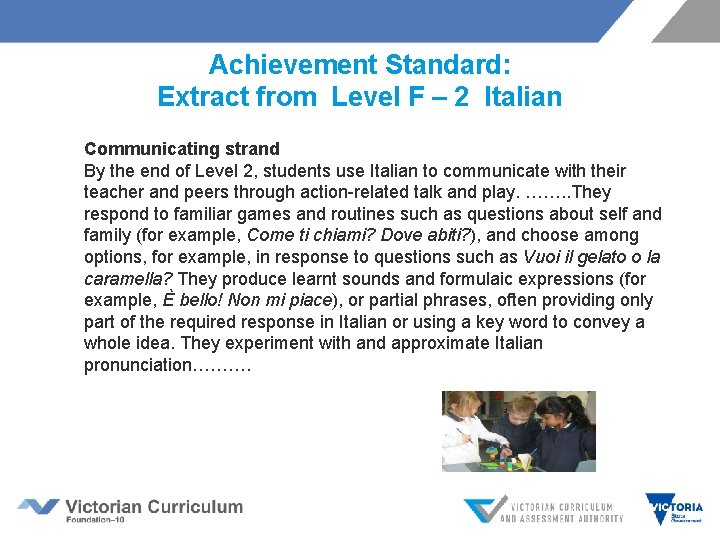
Achievement Standard: Extract from Level F – 2 Italian Communicating strand By the end of Level 2, students use Italian to communicate with their teacher and peers through action-related talk and play. ……. . They respond to familiar games and routines such as questions about self and family (for example, Come ti chiami? Dove abiti? ), and choose among options, for example, in response to questions such as Vuoi il gelato o la caramella? They produce learnt sounds and formulaic expressions (for example, È bello! Non mi piace), or partial phrases, often providing only part of the required response in Italian or using a key word to convey a whole idea. They experiment with and approximate Italian pronunciation……….
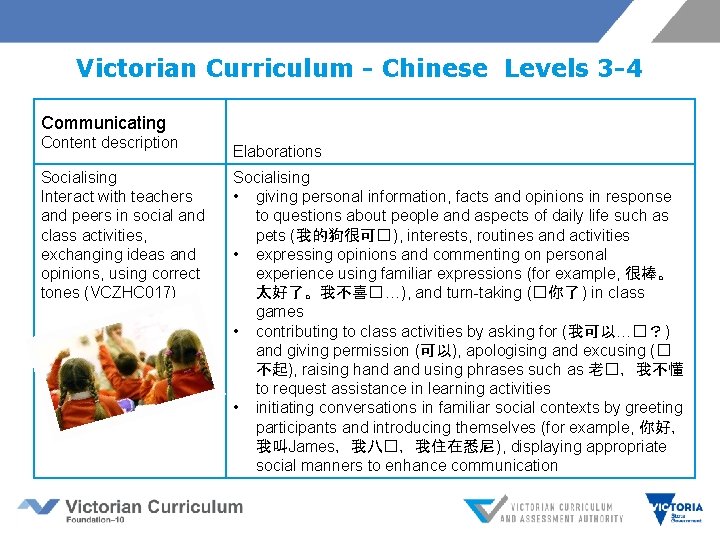
Victorian Curriculum - Chinese Levels 3 -4 Communicating Content description Socialising Interact with teachers and peers in social and class activities, exchanging ideas and opinions, using correct tones (VCZHC 017) Elaborations Socialising • giving personal information, facts and opinions in response to questions about people and aspects of daily life such as pets (我的狗很可� ), interests, routines and activities • expressing opinions and commenting on personal experience using familiar expressions (for example, 很棒。 太好了。我不喜� …), and turn-taking (�你了 ) in class games • contributing to class activities by asking for (我可以…�? ) and giving permission (可以), apologising and excusing (� 不起), raising hand using phrases such as 老�,我不懂 to request assistance in learning activities • initiating conversations in familiar social contexts by greeting participants and introducing themselves (for example, 你好, 我叫James,我八�,我住在悉尼 ), displaying appropriate social manners to enhance communication
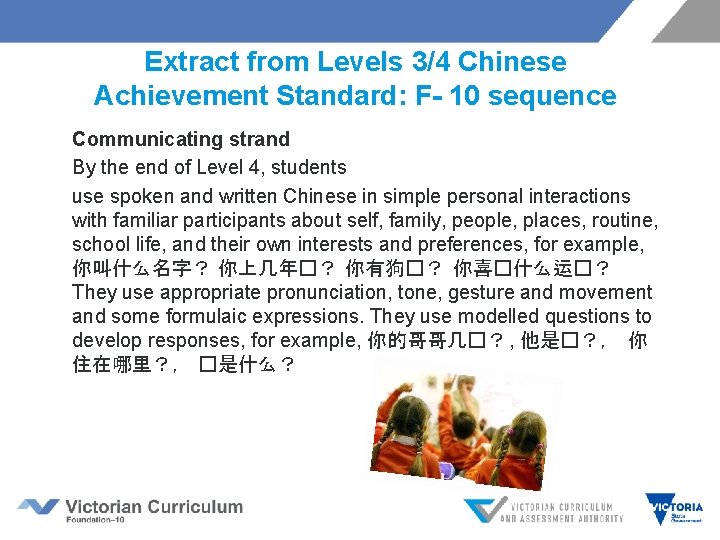
Extract from Levels 3/4 Chinese Achievement Standard: F- 10 sequence Communicating strand By the end of Level 4, students use spoken and written Chinese in simple personal interactions with familiar participants about self, family, people, places, routine, school life, and their own interests and preferences, for example, 你叫什么名字? 你上几年�? 你有狗�? 你喜�什么运�? They use appropriate pronunciation, tone, gesture and movement and some formulaic expressions. They use modelled questions to develop responses, for example, 你的哥哥几�? , 他是�?, 你 住在哪里?, �是什么?
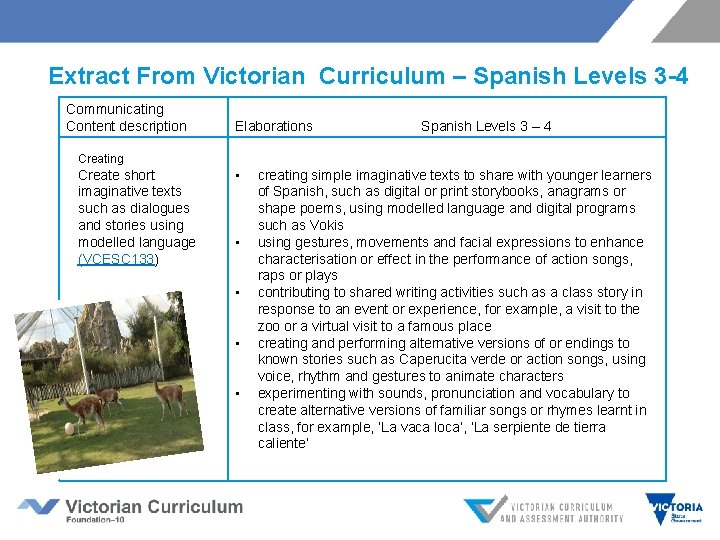
Extract From Victorian Curriculum – Spanish Levels 3 -4 Communicating Content description Creating Create short imaginative texts such as dialogues and stories using modelled language (VCESC 133) Elaborations Spanish Levels 3 – 4 • • • creating simple imaginative texts to share with younger learners of Spanish, such as digital or print storybooks, anagrams or shape poems, using modelled language and digital programs such as Vokis using gestures, movements and facial expressions to enhance characterisation or effect in the performance of action songs, raps or plays contributing to shared writing activities such as a class story in response to an event or experience, for example, a visit to the zoo or a virtual visit to a famous place creating and performing alternative versions of or endings to known stories such as Caperucita verde or action songs, using voice, rhythm and gestures to animate characters experimenting with sounds, pronunciation and vocabulary to create alternative versions of familiar songs or rhymes learnt in class, for example, ‘La vaca loca’, ‘La serpiente de tierra caliente’
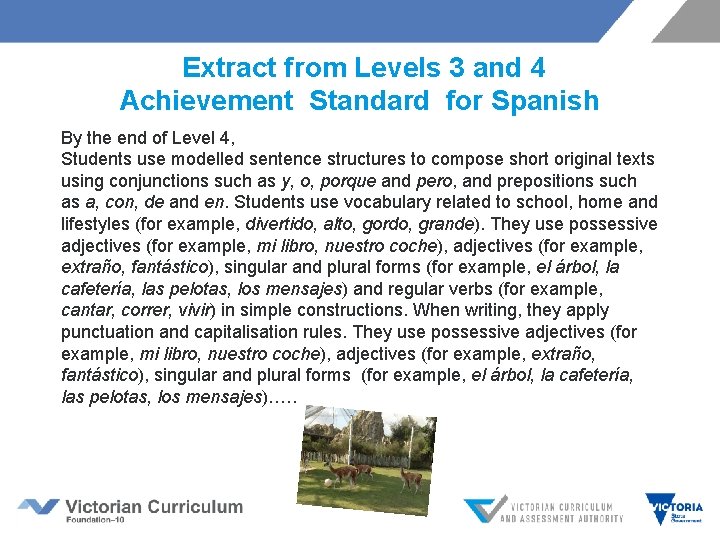
Extract from Levels 3 and 4 Achievement Standard for Spanish By the end of Level 4, Students use modelled sentence structures to compose short original texts using conjunctions such as y, o, porque and pero, and prepositions such as a, con, de and en. Students use vocabulary related to school, home and lifestyles (for example, divertido, alto, gordo, grande). They use possessive adjectives (for example, mi libro, nuestro coche), adjectives (for example, extraño, fantástico), singular and plural forms (for example, el árbol, la cafetería, las pelotas, los mensajes) and regular verbs (for example, cantar, correr, vivir) in simple constructions. When writing, they apply punctuation and capitalisation rules. They use possessive adjectives (for example, mi libro, nuestro coche), adjectives (for example, extraño, fantástico), singular and plural forms (for example, el árbol, la cafetería, las pelotas, los mensajes)……. .
Extract From Victorian Curriculum – Japanese Level 5 -6 Understanding Content description Content elaborations Language variation and change • exploring how the Japanese language is influenced by other languages and cultures, for example, in relation to food パン、 Language variation スパゲッティー、クレープ、ハンバーガー, music and sport ミ and change ュージカル、ロック、ダンス、サッカー、バスケットボール, Recognise that the and technology パソコン、メール、インターネット Japanese language • investigating the influence of Japanese language and culture on their own language and experience, for example, by is both influenced by creating a glossary of Japanese words and expressions used in turn influences in fields such as martial other languages and arts (‘judo’, ‘karate’, ‘sensei’, ‘sumo’), food (‘sushi’, ‘tofu’, cultures ‘wasabi’) or communication/culture (‘haiku’, ‘anime’, ‘manga’, ‘sudoku’) • understanding that there are Japanese-speaking communities outside Japan, for example, in Hawaii and South America, ……………. .
Achievement Standard for Japanese: Levels 5 -6 By the end of Level 6…. students give examples of ways in which languages both change over time and are influenced by other languages and cultures. They identify words from other languages used in Japanese, such as パソコン、メール、パスタ, and how the pronunciation, form and meaning of borrowed words can change when used in Japanese. Students identify behaviours and values associated with Japanese society and incorporate these into their own language use, such as ways of deflecting praise, for example, じょうず です ね。いいえ。.
Victorian Curriculum - Italian Levels 7 and 8 Understanding Content description Content elaborations Language variation and change Language variation and • exploring the influence of technological change on the Italian change language, such as: Analyse and understand • the borrowing and adapting of technical terms, for example, the dynamic nature of the cliccare, il mouse, la password, chattare Italian language, and of • observing the changes to language when used in languages in general abbreviated forms in multimedia communications, for example, 6 = sei, x = per, + = più, - = meno, TVTB = ti voglio tanto bene, ke = che • understanding the influence of other cultures on Italian, for example, the use of borrowed words such as il make-up, il bebé, un tailleur, il wurstel, il krapfen • recognising that Italian is used in diverse communities and that it changes in response to local cultural contexts
Achievement Standard: Extract from Levels 7/ 8 Italian 7 -10 sequence Understanding strand By the end of Level 8, students analyse the impact of technology and media on communication and language forms, the influence of Italian and English on one another, and the interrelationship of language and culture. They reflect on how they interpret and respond to aspects of Italian language and culture, and to intercultural experience, and identify how their response may be shaped by their own language(s) and culture(s).
Capabilities in the Victorian Curriculum Intercultural capability Levels 5 -6 Cultural practices • Analyse how aspects of their own and others lifestyle, behaviour, attitudes and beliefs can be culturally influenced • Explain how intercultural experiences can influence beliefs and behaviours, including developing a critical perspective on and respect for their own and others cultures Cultural diversity • Identify barriers to and means of reaching understandings within and between culturally diverse groups • Examine and discuss the variety of ways in which people understand appreciate differing cultural values and perspectives, and the things which promote or inhibit effective engagement with diverse cultural groups
Capabilities in the Victorian Curriculum Intercultural capability Levels 5 and 6 Achievement standard By the end of Level 6, students demonstrate an understanding how beliefs and practices can be influenced by culture and explain how intercultural experiences can influence beliefs and behaviours. Students identify the barriers to and means of reaching understandings within and between culturally diverse groups and the ways in which effective engagement with those groups is promoted or inhibited.
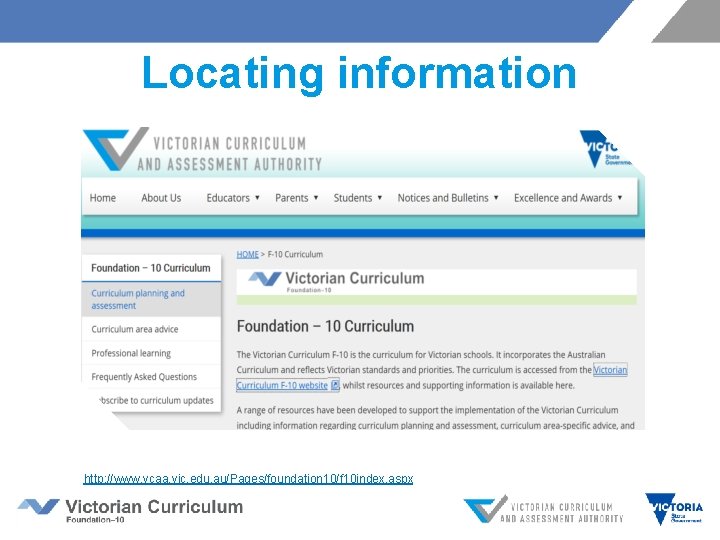
Locating information http: //www. vcaa. vic. edu. au/Pages/foundation 10/f 10 index. aspx
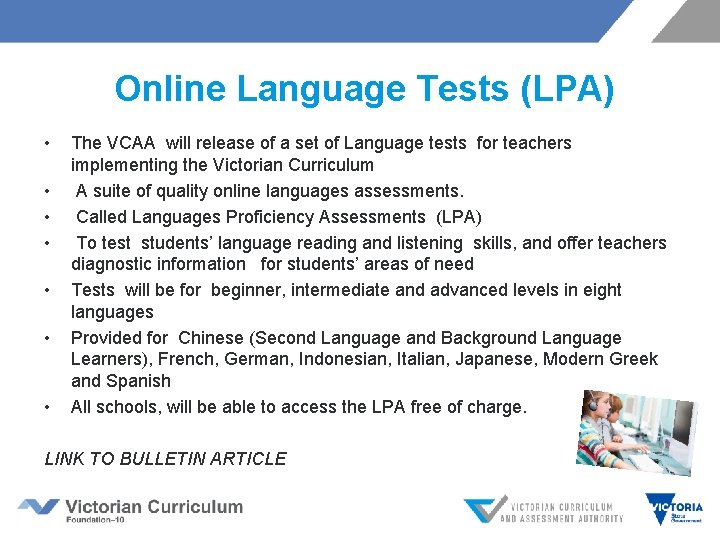
Online Language Tests (LPA) • • The VCAA will release of a set of Language tests for teachers implementing the Victorian Curriculum A suite of quality online languages assessments. Called Languages Proficiency Assessments (LPA) To test students’ language reading and listening skills, and offer teachers diagnostic information for students’ areas of need Tests will be for beginner, intermediate and advanced levels in eight languages Provided for Chinese (Second Language and Background Language Learners), French, German, Indonesian, Italian, Japanese, Modern Greek and Spanish All schools, will be able to access the LPA free of charge. LINK TO BULLETIN ARTICLE
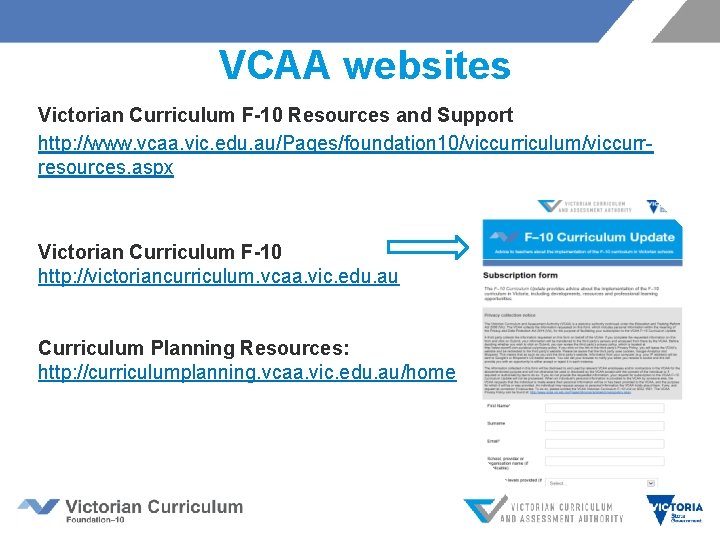
VCAA websites Victorian Curriculum F-10 Resources and Support http: //www. vcaa. vic. edu. au/Pages/foundation 10/viccurriculum/viccurrresources. aspx Victorian Curriculum F-10 http: //victoriancurriculum. vcaa. vic. edu. au Curriculum Planning Resources: http: //curriculumplanning. vcaa. vic. edu. au/home
Contact Details Maree Dellora, Languages Manager dellora. maree. r@edumail. vic. gov. au 9032 1692