
Victorian Curriculum F10 EAL A closer look at


- Slides: 28
Victorian Curriculum F-10 EAL A closer look at the Language and Learning Interview 1
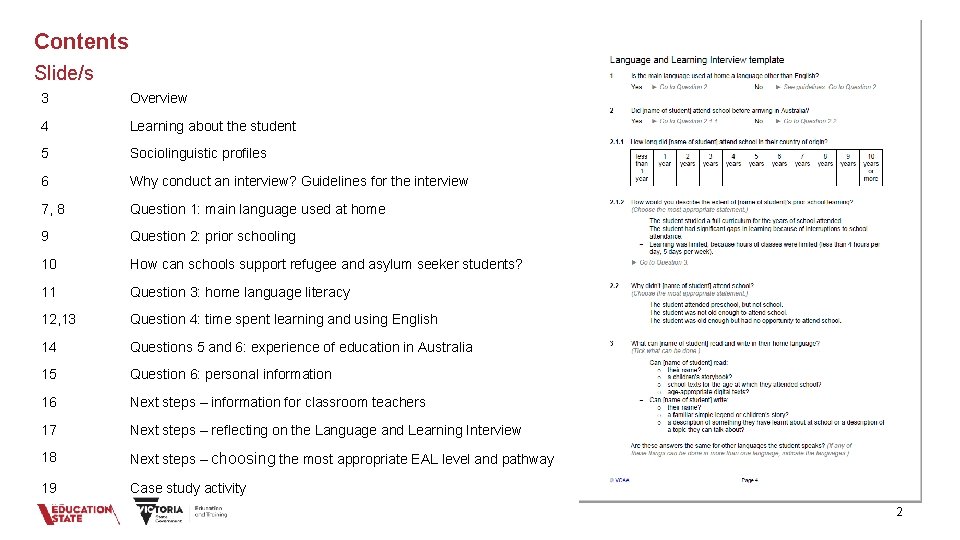
Contents Slide/s 3 Overview 4 Learning about the student 5 Sociolinguistic profiles 6 Why conduct an interview? Guidelines for the interview 7, 8 Question 1: main language used at home 9 Question 2: prior schooling 10 How can schools support refugee and asylum seeker students? 11 Question 3: home language literacy 12, 13 Question 4: time spent learning and using English 14 Questions 5 and 6: experience of education in Australia 15 Question 6: personal information 16 Next steps – information for classroom teachers 17 Next steps – reflecting on the Language and Learning Interview 18 Next steps – choosing the most appropriate EAL level and pathway 19 Case study activity 2
Overview • The Victorian Curriculum and Assessment Authority provides resources to support the Victorian Curriculum F-10 EAL, including the Language and Learning Interview. • The purpose of the interview is to find out about the student’s prior learning experiences, including their development of literacy in their home language or other languages, and any previous learning of English. • This will assist in determining the most suitable EAL pathway for the student to start on. • Some of the interview questions will already be part of the school’s enrolment process, for entry into the student’s CASES 21 record. Answers to these questions may need further exploration, to ensure CASES 21 accurately identifies the student as an EAL learner. • The interview provides guidelines for administration and interpretation of the interview and questions, and a template for questions. These are explored in this presentation. • The Language and Learning Interview is a starting point only. • Schools are encouraged to modify or extend the interview to suit their context and needs. Access the VCAA resources: Language and Learning Interview 3
Learning about the student • It is important that class teachers and school communities are aware of the English and language learning background of their students, so their language learning needs can be recognised and catered for. The Language and Learning Interview begins this process. • EAL learners follow a different pathway of English language learning from students for whom English is a first language, and the length of time they need to acquire English varies. They may have had significant experience with other languages, literacies and/or learning. • The school can collect and use this information to inform and support planning for students’ future learning. • Getting to know new students in this way also enables schools and teachers to cater for students holistically and to foster a positive and productive learning environment in which students feel known and valued. • Schools working with EAL students demonstrate best practice by developing individual student profiles. These profiles might be called sociolinguistic profiles, EAL learner profiles or other titles chosen by the school. • A sociolinguistic profile forms part of a student’s private information and must be handled in accordance with DET privacy policy. Access the Schools’ Privacy Policy: Schools’ privacy policy 4
Sociolinguistic profiles • Schools can use the information gathered during the Language and Learning Interview to develop sociolinguistic or learner profiles. • A sociolinguistic profile recognises that an EAL student’s ability to learn English is impacted by their prior learning, cultural background and life experiences. It provides information that teachers can use to cater for their individual needs, and to understand the plurilingual nature of each student. It is a living document that should continue to develop as the student’s sociolinguistic profile develops. • Best practice sociolinguistic profiles contain information about: • student and family language and literacy experience, practices and proficiencies • experiences impacting on learning such as where the student was born, their journey to Australia, if there was any trauma involved, previous education • any family the student has for support in Australia • dietary requirements, medical issues • reports from previous schools including transition reports from intensive English language programs and past school reports and/or academic records from other countries. Access resources: Sample: Learner profile document PL module: Knowing your students 5
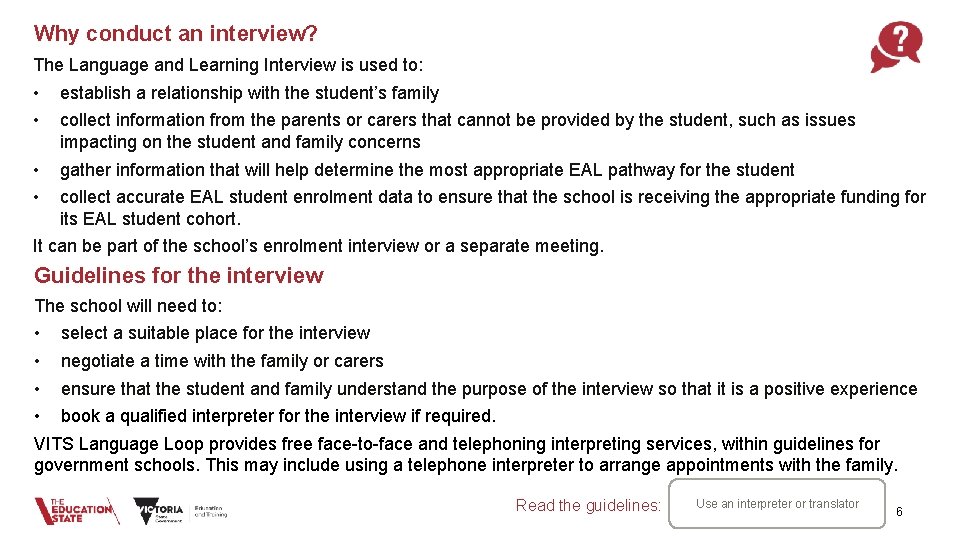
Why conduct an interview? The Language and Learning Interview is used to: • • establish a relationship with the student’s family • • gather information that will help determine the most appropriate EAL pathway for the student collect information from the parents or carers that cannot be provided by the student, such as issues impacting on the student and family concerns collect accurate EAL student enrolment data to ensure that the school is receiving the appropriate funding for its EAL student cohort. It can be part of the school’s enrolment interview or a separate meeting. Guidelines for the interview The school will need to: • select a suitable place for the interview • negotiate a time with the family or carers • ensure that the student and family understand the purpose of the interview so that it is a positive experience • book a qualified interpreter for the interview if required. VITS Language Loop provides free face-to-face and telephoning interpreting services, within guidelines for government schools. This may include using a telephone interpreter to arrange appointments with the family. Read the guidelines: Use an interpreter or translator 6
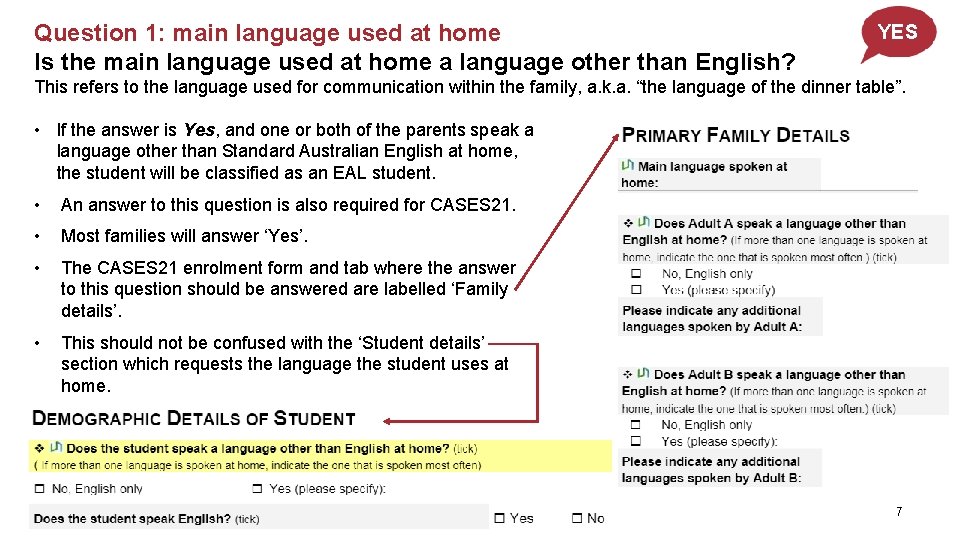
Question 1: main language used at home Is the main language used at home a language other than English? YES This refers to the language used for communication within the family, a. k. a. “the language of the dinner table”. • If the answer is Yes, and one or both of the parents speak a language other than Standard Australian English at home, the student will be classified as an EAL student. • An answer to this question is also required for CASES 21. • Most families will answer ‘Yes’. • The CASES 21 enrolment form and tab where the answer to this question should be answered are labelled ‘Family details’. • This should not be confused with the ‘Student details’ section which requests the language the student uses at home. 7
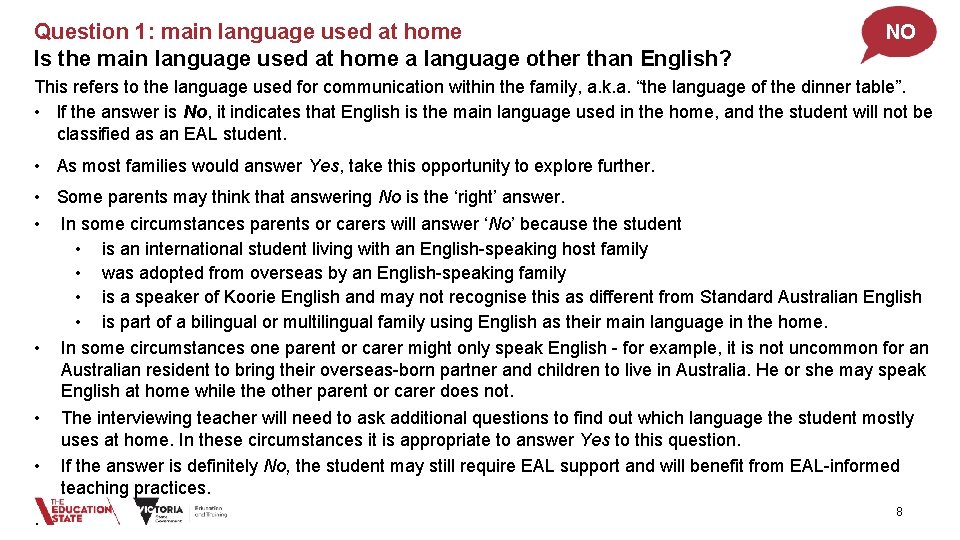
Question 1: main language used at home Is the main language used at home a language other than English? NO This refers to the language used for communication within the family, a. k. a. “the language of the dinner table”. • If the answer is No, it indicates that English is the main language used in the home, and the student will not be classified as an EAL student. • As most families would answer Yes, take this opportunity to explore further. • Some parents may think that answering No is the ‘right’ answer. • In some circumstances parents or carers will answer ‘No’ because the student • is an international student living with an English-speaking host family • was adopted from overseas by an English-speaking family • is a speaker of Koorie English and may not recognise this as different from Standard Australian English • is part of a bilingual or multilingual family using English as their main language in the home. • In some circumstances one parent or carer might only speak English - for example, it is not uncommon for an Australian resident to bring their overseas-born partner and children to live in Australia. He or she may speak English at home while the other parent or carer does not. • The interviewing teacher will need to ask additional questions to find out which language the student mostly uses at home. In these circumstances it is appropriate to answer Yes to this question. • If the answer is definitely No, the student may still require EAL support and will benefit from EAL-informed teaching practices. . 8
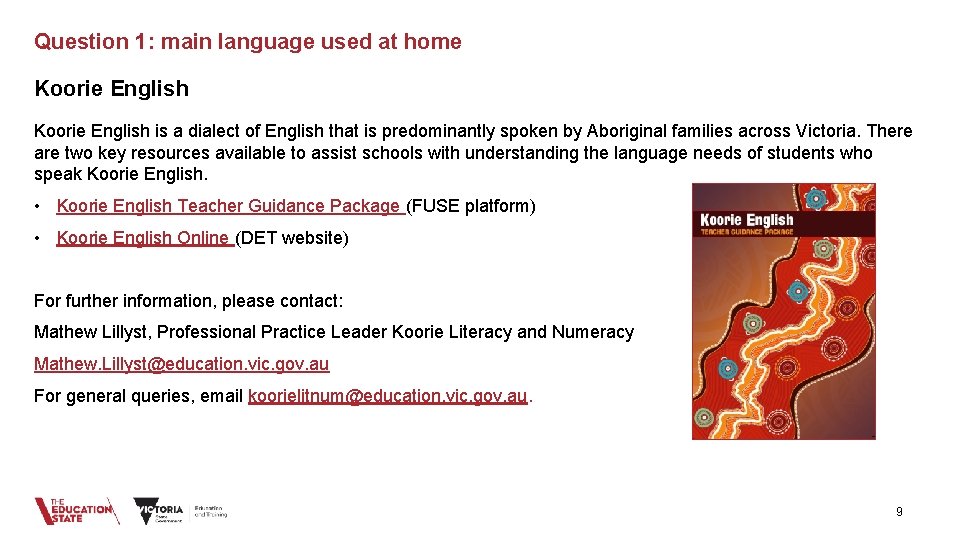
Question 1: main language used at home Koorie English is a dialect of English that is predominantly spoken by Aboriginal families across Victoria. There are two key resources available to assist schools with understanding the language needs of students who speak Koorie English. • Koorie English Teacher Guidance Package (FUSE platform) • Koorie English Online (DET website) For further information, please contact: Mathew Lillyst, Professional Practice Leader Koorie Literacy and Numeracy Mathew. Lillyst@education. vic. gov. au For general queries, email koorielitnum@education. vic. gov. au. 9
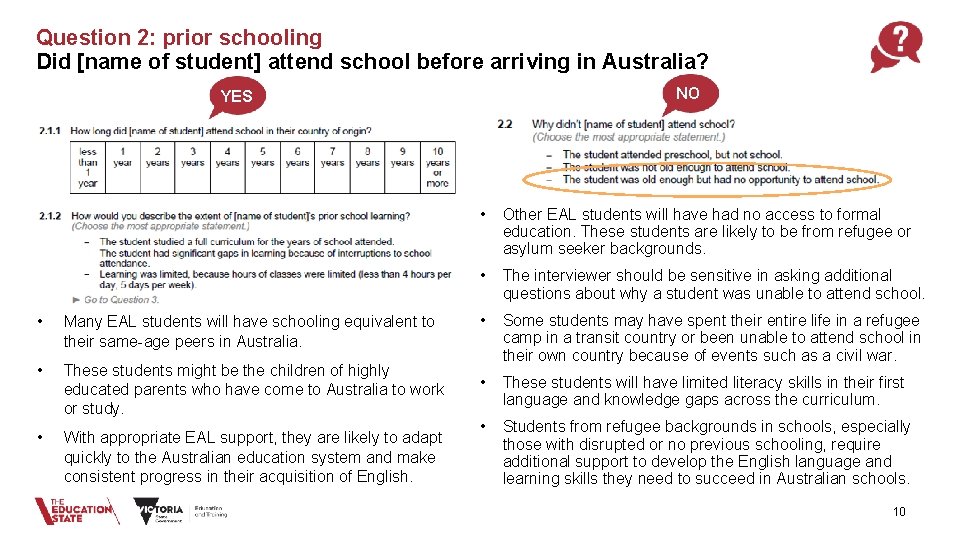
Question 2: prior schooling Did [name of student] attend school before arriving in Australia? NO YES • Many EAL students will have schooling equivalent to their same-age peers in Australia. • These students might be the children of highly educated parents who have come to Australia to work or study. • With appropriate EAL support, they are likely to adapt quickly to the Australian education system and make consistent progress in their acquisition of English. • Other EAL students will have had no access to formal education. These students are likely to be from refugee or asylum seeker backgrounds. • The interviewer should be sensitive in asking additional questions about why a student was unable to attend school. • Some students may have spent their entire life in a refugee camp in a transit country or been unable to attend school in their own country because of events such as a civil war. • These students will have limited literacy skills in their first language and knowledge gaps across the curriculum. • Students from refugee backgrounds in schools, especially those with disrupted or no previous schooling, require additional support to develop the English language and learning skills they need to succeed in Australian schools. 10
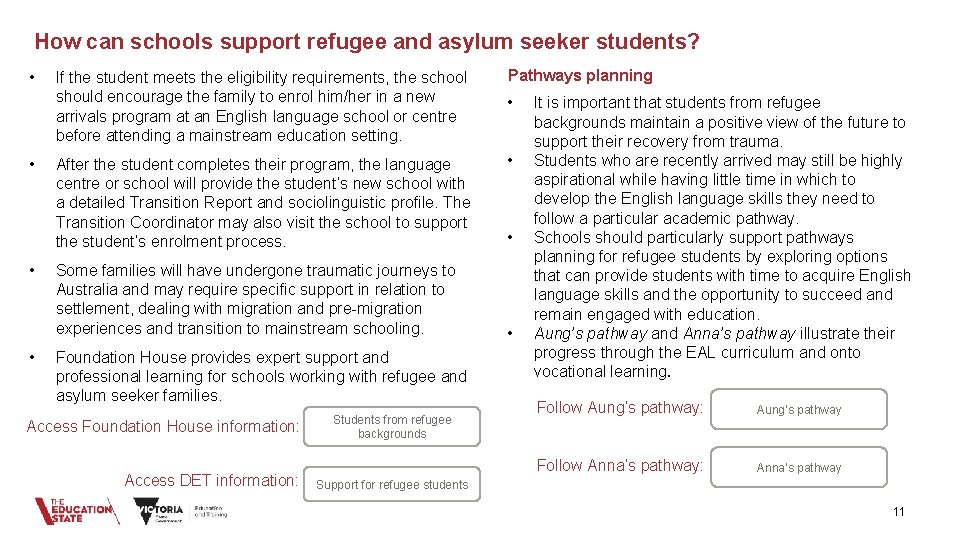
How can schools support refugee and asylum seeker students? • • If the student meets the eligibility requirements, the school should encourage the family to enrol him/her in a new arrivals program at an English language school or centre before attending a mainstream education setting. After the student completes their program, the language centre or school will provide the student’s new school with a detailed Transition Report and sociolinguistic profile. The Transition Coordinator may also visit the school to support the student’s enrolment process. Some families will have undergone traumatic journeys to Australia and may require specific support in relation to settlement, dealing with migration and pre-migration experiences and transition to mainstream schooling. Foundation House provides expert support and professional learning for schools working with refugee and asylum seeker families. Access Foundation House information: Access DET information: Students from refugee backgrounds Pathways planning • • It is important that students from refugee backgrounds maintain a positive view of the future to support their recovery from trauma. Students who are recently arrived may still be highly aspirational while having little time in which to develop the English language skills they need to follow a particular academic pathway. Schools should particularly support pathways planning for refugee students by exploring options that can provide students with time to acquire English language skills and the opportunity to succeed and remain engaged with education. Aung’s pathway and Anna’s pathway illustrate their progress through the EAL curriculum and onto vocational learning. Follow Aung’s pathway: Aung’s pathway Follow Anna’s pathway: Anna’s pathway Support for refugee students 11
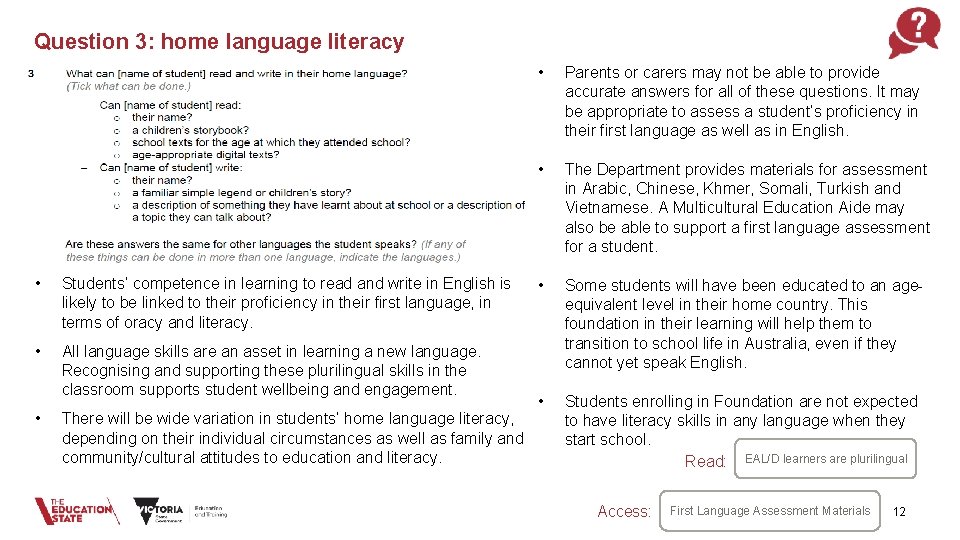
Question 3: home language literacy • Students’ competence in learning to read and write in English is likely to be linked to their proficiency in their first language, in terms of oracy and literacy. • All language skills are an asset in learning a new language. Recognising and supporting these plurilingual skills in the classroom supports student wellbeing and engagement. • There will be wide variation in students’ home language literacy, depending on their individual circumstances as well as family and community/cultural attitudes to education and literacy. • Parents or carers may not be able to provide accurate answers for all of these questions. It may be appropriate to assess a student’s proficiency in their first language as well as in English. • The Department provides materials for assessment in Arabic, Chinese, Khmer, Somali, Turkish and Vietnamese. A Multicultural Education Aide may also be able to support a first language assessment for a student. • Some students will have been educated to an ageequivalent level in their home country. This foundation in their learning will help them to transition to school life in Australia, even if they cannot yet speak English. • Students enrolling in Foundation are not expected to have literacy skills in any language when they start school. Read: EAL/D learners are plurilingual Access: First Language Assessment Materials 12
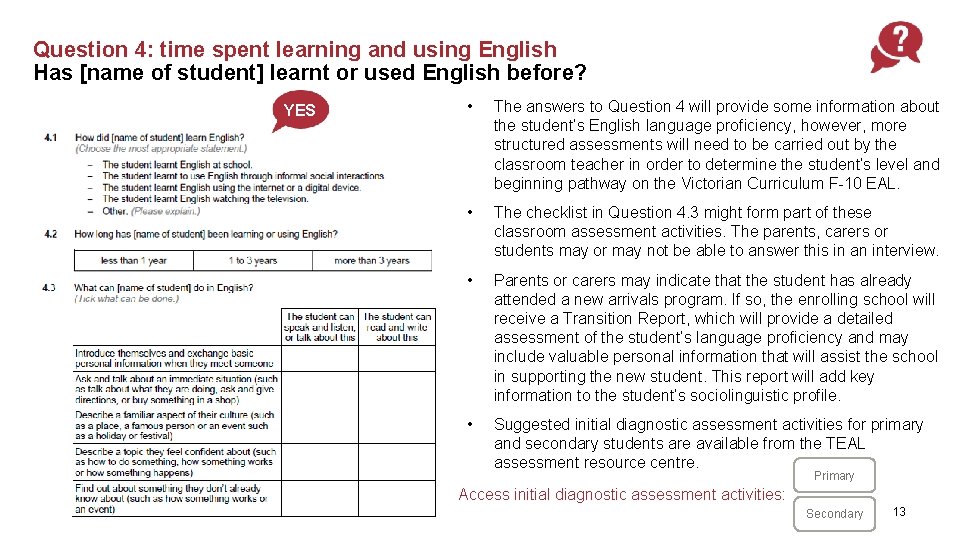
Question 4: time spent learning and using English Has [name of student] learnt or used English before? YES • The answers to Question 4 will provide some information about the student’s English language proficiency, however, more structured assessments will need to be carried out by the classroom teacher in order to determine the student’s level and beginning pathway on the Victorian Curriculum F-10 EAL. • The checklist in Question 4. 3 might form part of these classroom assessment activities. The parents, carers or students may or may not be able to answer this in an interview. • Parents or carers may indicate that the student has already attended a new arrivals program. If so, the enrolling school will receive a Transition Report, which will provide a detailed assessment of the student’s language proficiency and may include valuable personal information that will assist the school in supporting the new student. This report will add key information to the student’s sociolinguistic profile. • Suggested initial diagnostic assessment activities for primary and secondary students are available from the TEAL assessment resource centre. Access initial diagnostic assessment activities: Primary Secondary 13
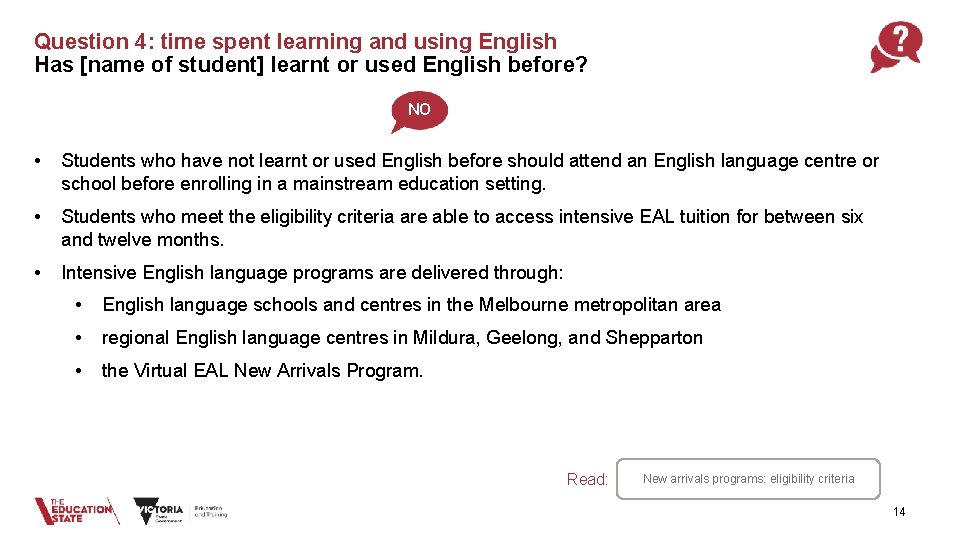
Question 4: time spent learning and using English Has [name of student] learnt or used English before? NO • Students who have not learnt or used English before should attend an English language centre or school before enrolling in a mainstream education setting. • Students who meet the eligibility criteria are able to access intensive EAL tuition for between six and twelve months. • Intensive English language programs are delivered through: • English language schools and centres in the Melbourne metropolitan area • regional English language centres in Mildura, Geelong, and Shepparton • the Virtual EAL New Arrivals Program. Read: New arrivals programs: eligibility criteria 14
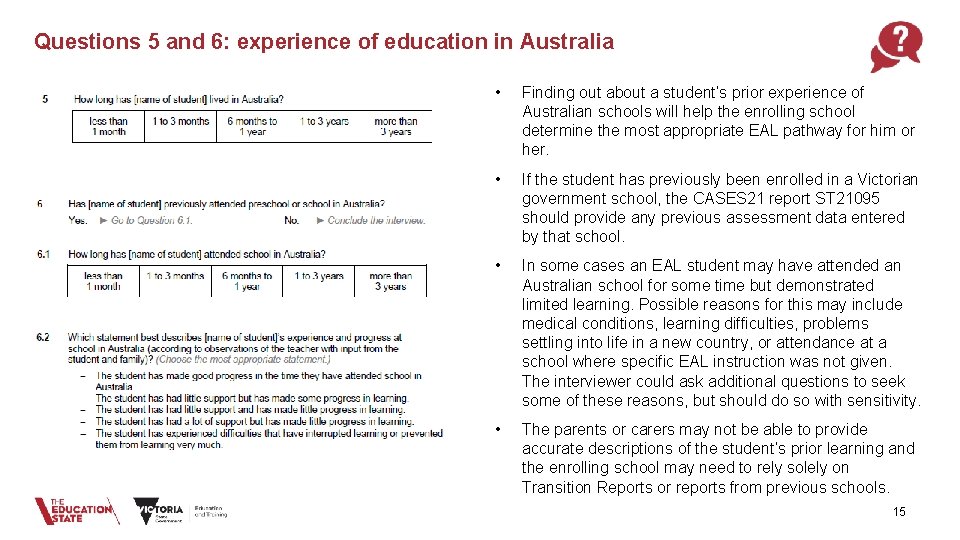
Questions 5 and 6: experience of education in Australia • Finding out about a student’s prior experience of Australian schools will help the enrolling school determine the most appropriate EAL pathway for him or her. • If the student has previously been enrolled in a Victorian government school, the CASES 21 report ST 21095 should provide any previous assessment data entered by that school. • In some cases an EAL student may have attended an Australian school for some time but demonstrated limited learning. Possible reasons for this may include medical conditions, learning difficulties, problems settling into life in a new country, or attendance at a school where specific EAL instruction was not given. The interviewer could ask additional questions to seek some of these reasons, but should do so with sensitivity. • The parents or carers may not be able to provide accurate descriptions of the student’s prior learning and the enrolling school may need to rely solely on Transition Reports or reports from previous schools. 15
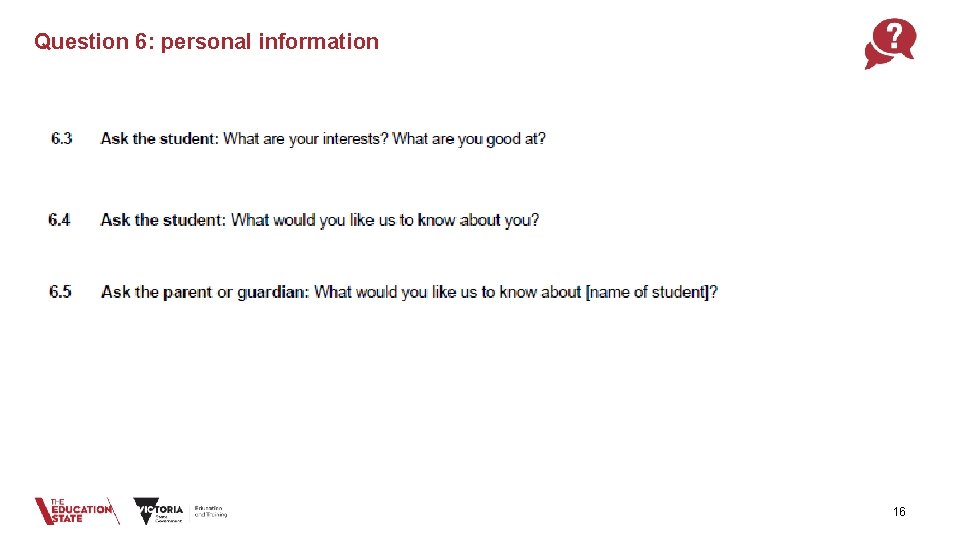
Question 6: personal information 16
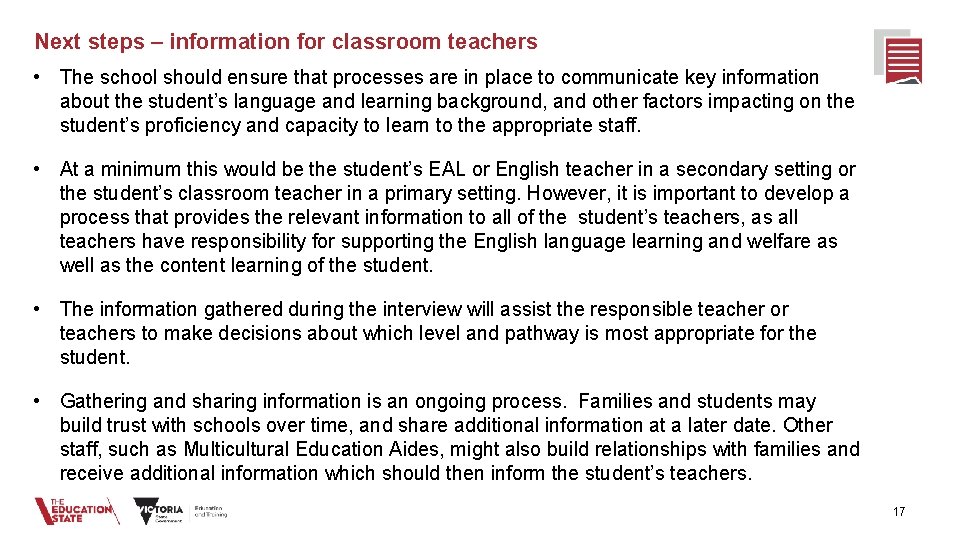
Next steps – information for classroom teachers • The school should ensure that processes are in place to communicate key information about the student’s language and learning background, and other factors impacting on the student’s proficiency and capacity to learn to the appropriate staff. • At a minimum this would be the student’s EAL or English teacher in a secondary setting or the student’s classroom teacher in a primary setting. However, it is important to develop a process that provides the relevant information to all of the student’s teachers, as all teachers have responsibility for supporting the English language learning and welfare as well as the content learning of the student. • The information gathered during the interview will assist the responsible teacher or teachers to make decisions about which level and pathway is most appropriate for the student. • Gathering and sharing information is an ongoing process. Families and students may build trust with schools over time, and share additional information at a later date. Other staff, such as Multicultural Education Aides, might also build relationships with families and receive additional information which should then inform the student’s teachers. 17
Next steps – reflecting on the Language and Learning Interview Re-visit two key points from the Overview : • The Language and Learning Interview is a starting point only. • Schools are encouraged to modify or extend the interview to suit their context and needs. Questions for reflection and discussion 1. Are there additional questions that could be asked of the student or the parents or carers? 2. Does the interview have to be conducted before a student can enrol in our school? 3. Are there other considerations unique to your school community that might impact on how you conduct the interview? 4. What are the school’s strengths and weaknesses in terms of enrolling and meeting the needs of new EAL students? 18
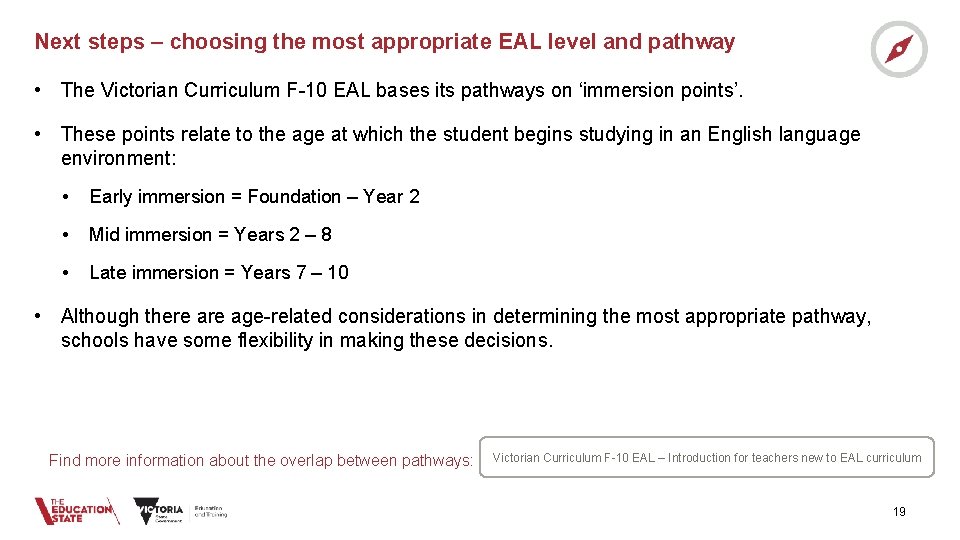
Next steps – choosing the most appropriate EAL level and pathway • The Victorian Curriculum F-10 EAL bases its pathways on ‘immersion points’. • These points relate to the age at which the student begins studying in an English language environment: • Early immersion = Foundation – Year 2 • Mid immersion = Years 2 – 8 • Late immersion = Years 7 – 10 • Although there age-related considerations in determining the most appropriate pathway, schools have some flexibility in making these decisions. Find more information about the overlap between pathways: Victorian Curriculum F-10 EAL – Introduction for teachers new to EAL curriculum 19
CASE STUDY ACTIVITY Case study 1 Case study 2 Case study 3 20
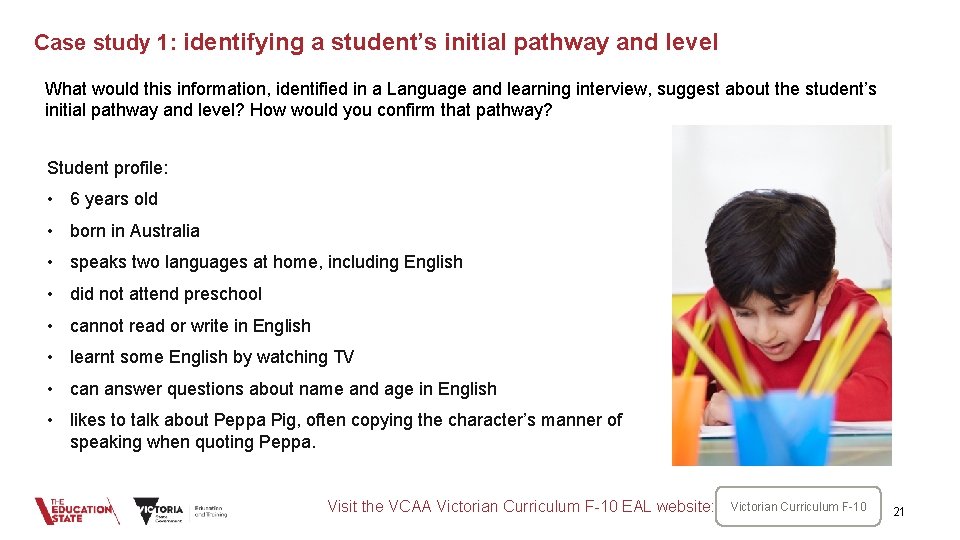
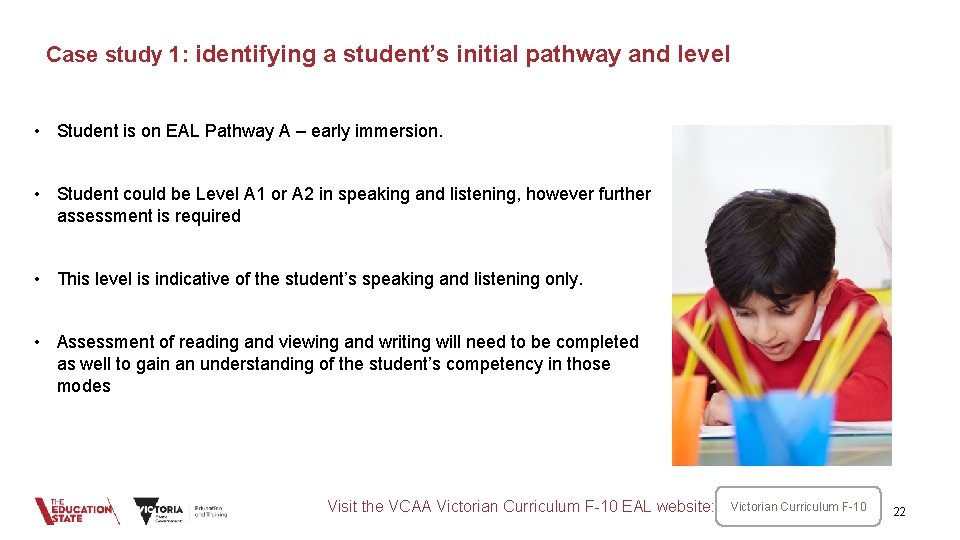
Case study 1: identifying a student’s initial pathway and level What would this information, identified in a Language and learning interview, suggest about the student’s initial pathway and level? How would you confirm that pathway? Student profile: • 6 years old • born in Australia • speaks two languages at home, including English • did not attend preschool • cannot read or write in English • learnt some English by watching TV • can answer questions about name and age in English • likes to talk about Peppa Pig, often copying the character’s manner of speaking when quoting Peppa. Visit the VCAA Victorian Curriculum F-10 EAL website: Victorian Curriculum F-10 21
Case study 1: identifying a student’s initial pathway and level • Student is on EAL Pathway A – early immersion. • Student could be Level A 1 or A 2 in speaking and listening, however further assessment is required • This level is indicative of the student’s speaking and listening only. • Assessment of reading and viewing and writing will need to be completed as well to gain an understanding of the student’s competency in those modes Visit the VCAA Victorian Curriculum F-10 EAL website: Victorian Curriculum F-10 22
Case study 2: identifying a student’s initial pathway and level What would this information, identified in a Language and learning interview, suggest about the student’s initial pathway and level? How would you confirm that pathway? Student profile: • 11 years old • attended school in country of origin for 6 years • irregular attendance at school due to need to supplement family income by selling souvenirs to tourists • can read own name and simple stories in home language • can write a familiar, simple story in home language • learnt English by speaking to tourists, can do basic exchanges and talk about immediate situations • can talk about country of origin in English due to experience with tourists • been in Australia for thirteen months, and attended an English language school for a year. Visit the VCAA Victorian Curriculum F-10 EAL website: Victorian Curriculum F-10 23
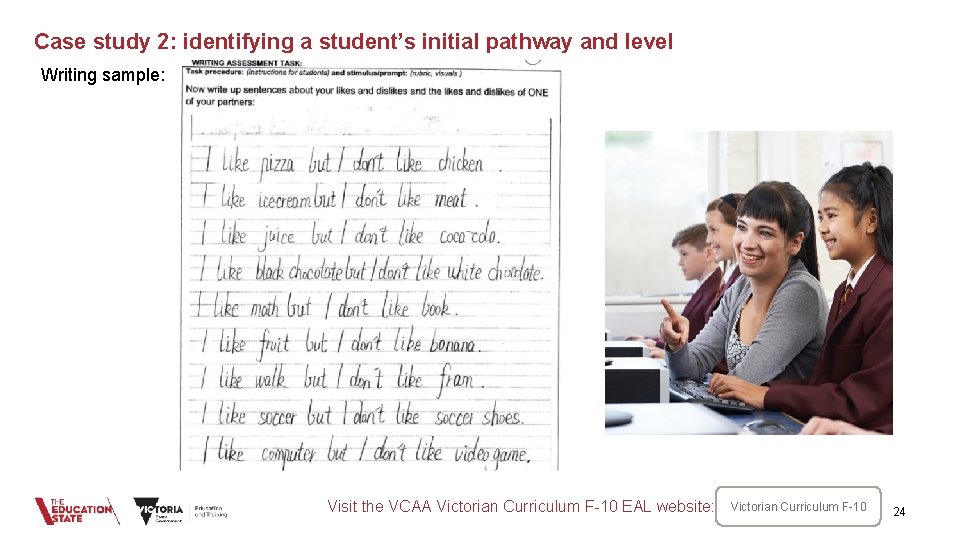
Case study 2: identifying a student’s initial pathway and level Writing sample: Visit the VCAA Victorian Curriculum F-10 EAL website: Victorian Curriculum F-10 24
Case study 2: identifying a student’s initial pathway and level • Student is on EAL Pathway B – mid immersion. • The student could be tentatively placed on Level B 1 in Writing, but need more writing samples (preferably in different text types) to form a more holistic picture. • This level is indicative of the student’s writing only. • Assessment of speaking and listening, reading and viewing will need to be done separately. Visit the VCAA Victorian Curriculum F-10 EAL website: Victorian Curriculum F-10 25
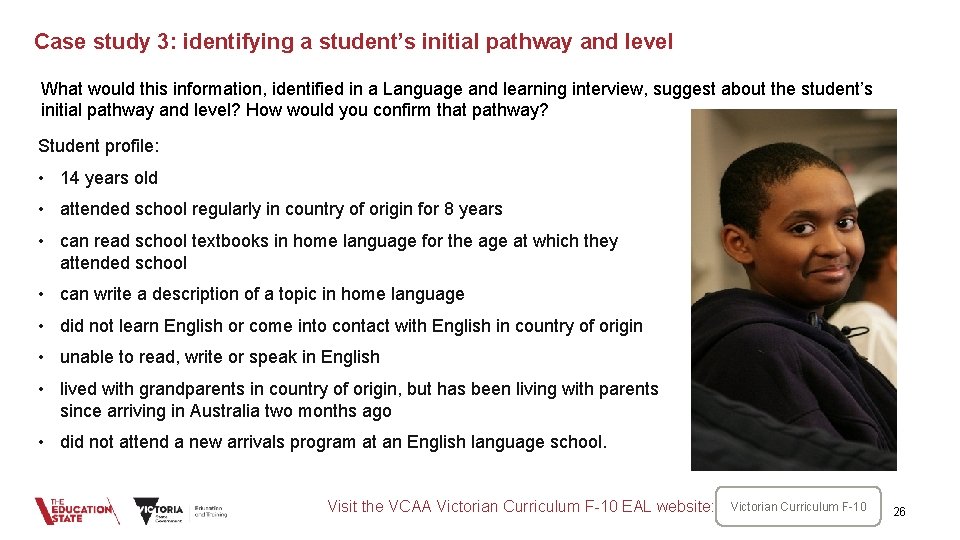
Case study 3: identifying a student’s initial pathway and level What would this information, identified in a Language and learning interview, suggest about the student’s initial pathway and level? How would you confirm that pathway? Student profile: • 14 years old • attended school regularly in country of origin for 8 years • can read school textbooks in home language for the age at which they attended school • can write a description of a topic in home language • did not learn English or come into contact with English in country of origin • unable to read, write or speak in English • lived with grandparents in country of origin, but has been living with parents since arriving in Australia two months ago • did not attend a new arrivals program at an English language school. Visit the VCAA Victorian Curriculum F-10 EAL website: Victorian Curriculum F-10 26
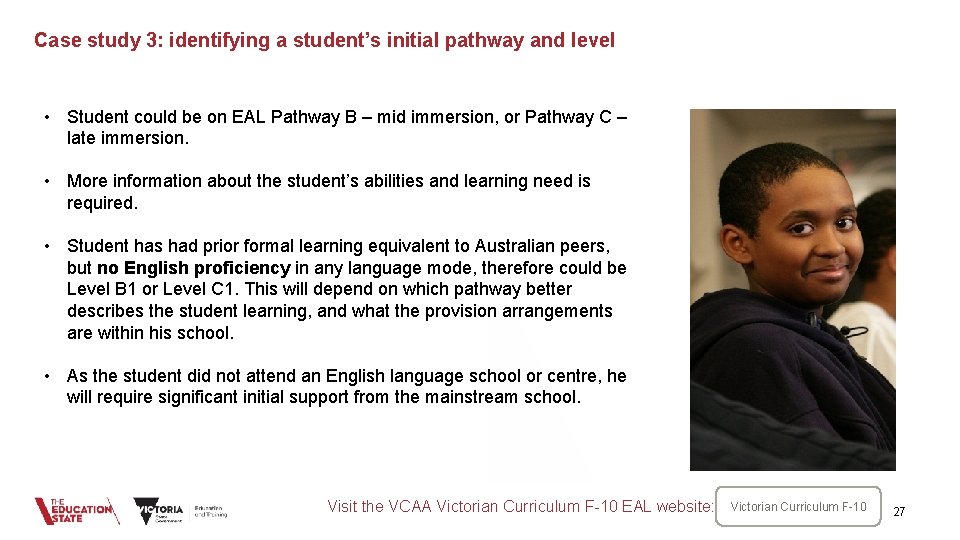
Case study 3: identifying a student’s initial pathway and level • Student could be on EAL Pathway B – mid immersion, or Pathway C – late immersion. • More information about the student’s abilities and learning need is required. • Student has had prior formal learning equivalent to Australian peers, but no English proficiency in any language mode, therefore could be Level B 1 or Level C 1. This will depend on which pathway better describes the student learning, and what the provision arrangements are within his school. • As the student did not attend an English language school or centre, he will require significant initial support from the mainstream school. Visit the VCAA Victorian Curriculum F-10 EAL website: Victorian Curriculum F-10 27
© State of Victoria (Department of Education and Training) 2020 A closer look at the Language and Learning Interview is provided under a Creative Commons Attribution 4. 0 International licence. You are free to reuse the work under that licence, on the condition that you credit the State of Victoria (Department of Education and Training), indicate if changes were made and comply with the other licence terms, see: https: //creativecommons. org/licenses/by/4. 0/ The licence does not apply to: • any images, photographs, trademarks or branding, including the Victorian Government logo and the DET logo; and • content supplied by third parties. Copyright queries may be directed to copyright@edumail. vic. gov. au 28